AQA · GCSE · Mathematics
Course version: 8300 · Version from Sept 2015
Structure and calculation: calculate with roots, and with integer indices
This row asks you to calculate, not merely recognise, with two linked ideas: roots and integer indices.
- 4 key terms
Study notes
From the checked teaching notes for this specification point.
The idea
This row asks you to calculate, not merely recognise, with two linked ideas: roots and integer indices. A root reverses a power, so √49 = 7 because 7² = 49, and ∛64 = 4 because 4³ = 64. An integer index tells you how many times the base multiplies itself: 2⁵ = 2 × 2 × 2 × 2 × 2 = 32. Negative integer indices give reciprocals: 3⁻² = 1/3² = 1/9. The index laws let you combine powers with the same base: aᵐ × aⁿ = aᵐ⁺ⁿ, aᵐ ÷ aⁿ = aᵐ⁻ⁿ, and (aᵐ)ⁿ = aᵐⁿ. Any non-zero base to the power zero equals 1, so 7⁰ = 1. In a multiple-choice question, work out the value or simplified form yourself before comparing options, and check signs and reciprocals carefully.
What earns the marks
- Evaluates square roots of perfect squares, for example √81 = 9, and recognises that a negative number has no real square root.
- Evaluates cube roots including negative radicands, for example ∛125 = 5 and ∛(−27) = −3.
- Evaluates positive integer powers, for example 3⁴ = 81, and applies the zero index rule a⁰ = 1 for non-zero a.
- Interprets negative integer indices as reciprocals, for example 5⁻² = 1/25, and evaluates them correctly.
- Applies index laws for multiplication, division and brackets with the same base, for example 4⁵ × 4⁻² = 4³ = 64.
- Selects the single correct option after independent calculation rather than by matching surface features of the options.
Common mistakes and how to put them right
Treating a negative index as making the answer negative.
Put it right: A negative index means a reciprocal, so 2⁻³ = 1/2³ = 1/8.
Confusing the root with division by the index.
Put it right: √36 asks which number squares to 36, so √36 = 6.
Adding the bases instead of the indices when multiplying powers.
Put it right: The base stays the same and the indices add, so 2³ × 2² = 2⁵ = 32.
Assuming every number has a real square root.
Put it right: Squaring any real number gives a non-negative result, so √(−16) has no real value, though ∛(−64) = −4 is valid.
Exam tips
- Work out the exact value or simplified power before looking at the options, then match your result to the list.
- Rewrite negative indices as reciprocals first, for example 10⁻³ = 1/1000, so sign errors are easier to spot.
- Check index-law answers by expanding small cases, such as confirming 2³ × 2² = 8 × 4 = 32 = 2⁵.
- For roots, ask which number multiplied by itself the required number of times gives the radicand, and note whether the radicand is negative.
Try the lesson
The start of the Structure and calculation: calculate with roots, and with integer indices lesson, made from checked teaching notes for this specification point.
Have a go first
Work out the value of 7².
Listen
This row asks you to calculate, not merely recognise, with two linked ideas: roots and integer indices. A root reverses a power, so √49 = 7 because 7² = 49, and ∛64 = 4 because 4³ = 64. An integer index tells you how many times the base multiplies itself: 2⁵ = 2 × 2 × 2 × 2 × 2 = 32. Negative integer indices give reciprocals: 3⁻² = 1/3² = 1/9. The index laws let you combine powers with the same base: aᵐ × aⁿ = aᵐ⁺ⁿ, aᵐ ÷ aⁿ = aᵐ⁻ⁿ, and (aᵐ)ⁿ = aᵐⁿ. Any non-zero base to the power zero equals 1, so 7⁰ = 1. In a multiple-choice question, work out the value or simplified form yourself before comparing options, and check signs and reciprocals carefully. A strong answer earns marks for these points. Evaluates square roots of perfect squares, for example √81 = 9, and recognises that a negative number has no real square root. Evaluates cube roots including negative radicands, for example ∛125 = 5 and ∛(−27) = −3. Evaluates positive integer powers, for example 3⁴ = 81, and applies the zero index rule a⁰ = 1 for non-zero a. Interprets negative integer indices as reciprocals, for example 5⁻² = 1/25, and evaluates them correctly. A common slip: Treating a negative index as making the answer negative: the learner writes 2⁻³ = −8. Instead, a negative index means a reciprocal, so 2⁻³ = 1/2³ = 1/8. Exam tip: Work out the exact value or simplified power before looking at the options, then match your result to the list.
See it
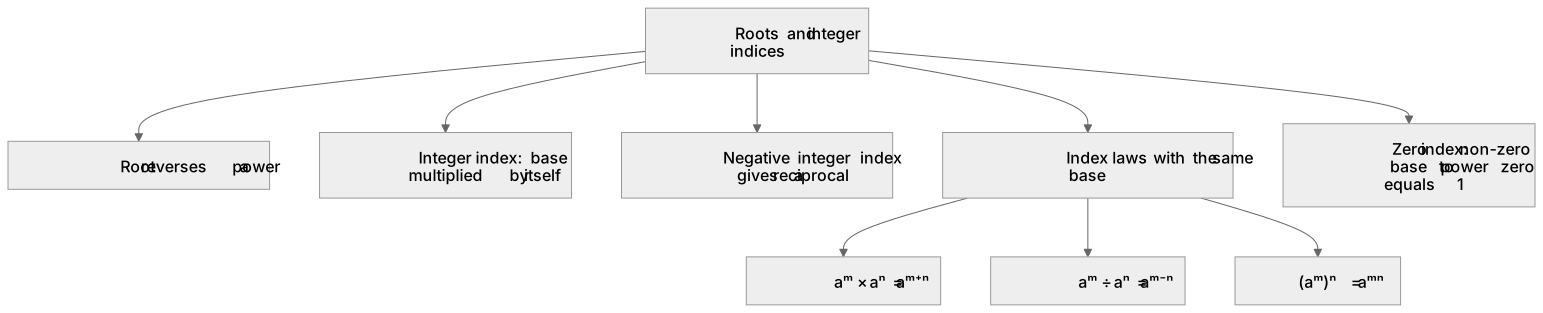
Key words
Say what each word means before you turn the card.
Roots as inverse operations of powers
Try answering aloud or in your head before turning the card.
Integer indices including zero and negative indices
Try answering aloud or in your head before turning the card.
Index laws for multiplication, division and brackets
Try answering aloud or in your head before turning the card.
Exact evaluation and checking by expansion
Try answering aloud or in your head before turning the card.
See every definition
- Roots as inverse operations of powers
- A root reverses a power, so the square root of 49 is 7 because 7 squared is 49.
- Integer indices including zero and negative indices
- An integer index tells you how many times the base multiplies itself, a negative integer index gives a reciprocal, and any non-zero base to the power zero equals 1.
- Index laws for multiplication, division and brackets
- These let you combine powers with the same base: the indices add for multiplication, subtract for division, and multiply for brackets.
- Exact evaluation and checking by expansion
- Work out the exact value or simplified power before looking at the options, and check index-law answers by expanding small cases.
Label the diagram
Some boxes have lost their names. Pick the right name for each number.
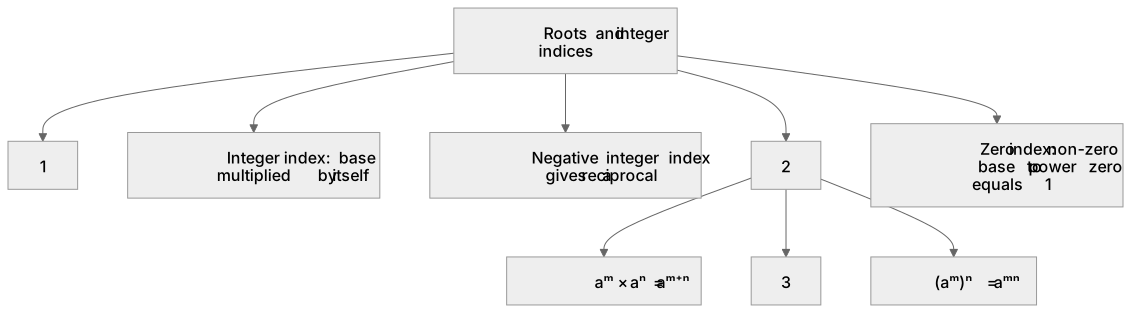
1Box 1
2Box 2
3Box 3
There is more to this lesson
The full lesson goes on to check your understanding and help you earn the marks. Create a free account to carry on, with your progress saved.
A week of Premium from your first lesson · Then the free plan continues · No card, no charge
Test your understanding of Structure and calculation: calculate with roots, and with integer indices
Active recall beats re-reading. Take an instant quiz now to test what you’ve learned and lock it into long-term memory.
A week of Premium from your first lesson · Then the free plan continues · No card, no charge