AQA · GCSE · Mathematics
Course version: 8300 · Version from Sept 2015
Structure and calculation: including use of the product rule for counting (Higher tier only)
The product rule for counting gives the total number of outcomes when a task has successive independent choices: multiply the number of options at each stage.
- 4 key terms
Study notes
From the checked teaching notes for this specification point.
The idea
The product rule for counting gives the total number of outcomes when a task has successive independent choices: multiply the number of options at each stage. For example, a 4-digit code using digits 0–9 with repetition allowed has 10 × 10 × 10 × 10 = 10⁴ possibilities; if repetition is not allowed, the choices reduce at each stage, giving 10 × 9 × 8 × 7 = 5040. The rule also applies to choosing from separate groups, such as 3 starters and 5 mains giving 3 × 5 = 15 meal combinations. This content is Higher tier only. Questions may ask for the total count or for a missing number of options, so identify the stages and whether repetition is permitted before multiplying.
What earns the marks
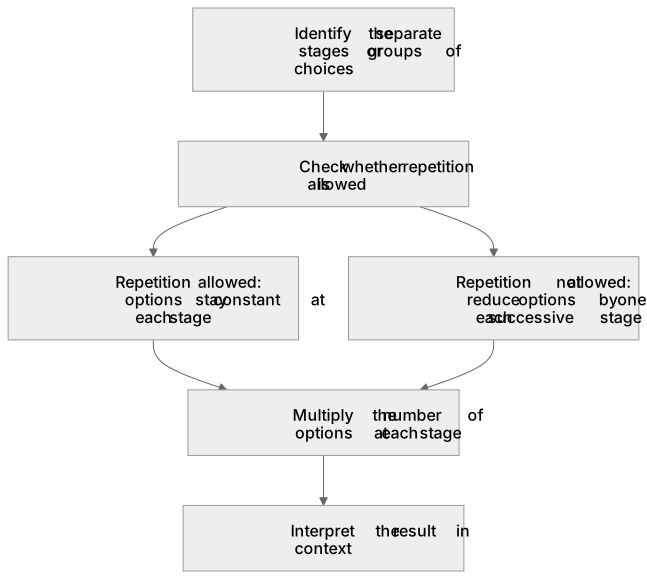
- Identifies the separate stages or groups of choices in the situation.
- Multiplies the number of options at each stage to obtain the total number of outcomes.
- Adjusts the number of options when repetition is not allowed, for example 10 × 9 × 8 × 7 = 5040 for a 4-digit code.
- Interprets the result in context, such as the number of possible codes or meal combinations.
Common mistakes and how to put them right
Adding the numbers of options instead of multiplying.
Put it right: Multiply the options at each independent stage.
Keeping the same number of options when repetition is not allowed.
Put it right: Reduce the options by one at each successive stage.
Miscounting the stages, for example treating a 4-digit code as three choices.
Put it right: Count each position or group separately.
Exam tips
- Write the number of options for each stage before multiplying, so the structure is clear.
- Check whether repetition is allowed, as this decides whether the options stay constant or decrease.
- Multiply step by step and keep the product in context rather than giving a bare number.
Try the lesson
The start of the Structure and calculation: including use of the product rule for counting (Higher tier only) lesson, made from checked teaching notes for this specification point.
Have a go first
A school jumper comes in 4 different colours and 3 different sizes. How many different colour-and-size combinations of jumper are possible?
Listen
The product rule for counting gives the total number of outcomes when a task has successive independent choices: multiply the number of options at each stage. For example, a 4-digit code using digits 0–9 with repetition allowed has 10 × 10 × 10 × 10 = 10⁴ possibilities; if repetition is not allowed, the choices reduce at each stage, giving 10 × 9 × 8 × 7 = 5040. The rule also applies to choosing from separate groups, such as 3 starters and 5 mains giving 3 × 5 = 15 meal combinations. This content is Higher tier only. Questions may ask for the total count or for a missing number of options, so identify the stages and whether repetition is permitted before multiplying. A strong answer earns marks for these points. Identifies the separate stages or groups of choices in the situation. Multiplies the number of options at each stage to obtain the total number of outcomes. Adjusts the number of options when repetition is not allowed, for example 10 × 9 × 8 × 7 = 5040 for a 4-digit code. Interprets the result in context, such as the number of possible codes or meal combinations. A common slip: Adding the numbers of options instead of multiplying. Instead, multiply the options at each independent stage. Exam tip: Write the number of options for each stage before multiplying, so the structure is clear.
See it
Key words
Say what each word means before you turn the card.
Multiplication of choices across stages
Try answering aloud or in your head before turning the card.
Independent successive choices
Try answering aloud or in your head before turning the card.
Repetition allowed versus not allowed
Try answering aloud or in your head before turning the card.
Counting outcomes in context
Try answering aloud or in your head before turning the card.
See every definition
- Multiplication of choices across stages
- The total number of outcomes is found by multiplying the number of options at each stage.
- Independent successive choices
- A task has successive independent choices, and the number of options at each stage is multiplied.
- Repetition allowed versus not allowed
- When repetition is allowed the options stay constant, but when it is not allowed the choices reduce at each stage.
- Counting outcomes in context
- The total count or a missing number of options is found by identifying the stages and whether repetition is permitted before multiplying.
Label the diagram
Some boxes have lost their names. Pick the right name for each number.
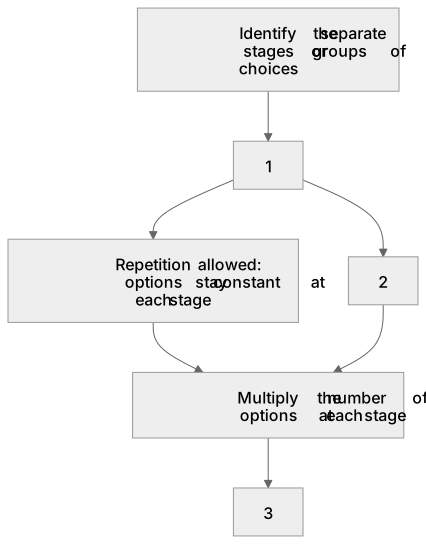
1Box 1
2Box 2
3Box 3
There is more to this lesson
The full lesson goes on to check your understanding and help you earn the marks. Create a free account to carry on, with your progress saved.
A week of Premium from your first lesson · Then the free plan continues · No card, no charge
Test your understanding of Structure and calculation: including use of the product rule for counting (Higher tier only)
Active recall beats re-reading. Take an instant quiz now to test what you’ve learned and lock it into long-term memory.
A week of Premium from your first lesson · Then the free plan continues · No card, no charge