AQA · GCSE · Mathematics
Course version: 8300 · Version from Sept 2015
Structure and calculation: recognise and use relationships between operations, including inverse operations (eg cancellation to simplify calculations and expressions) use conventional notation for priority of operations, including brackets, powers, roots and reciprocals
This topic links operations by their opposites and by order.
- 3 key terms
Study notes
From the checked teaching notes for this specification point.
The idea
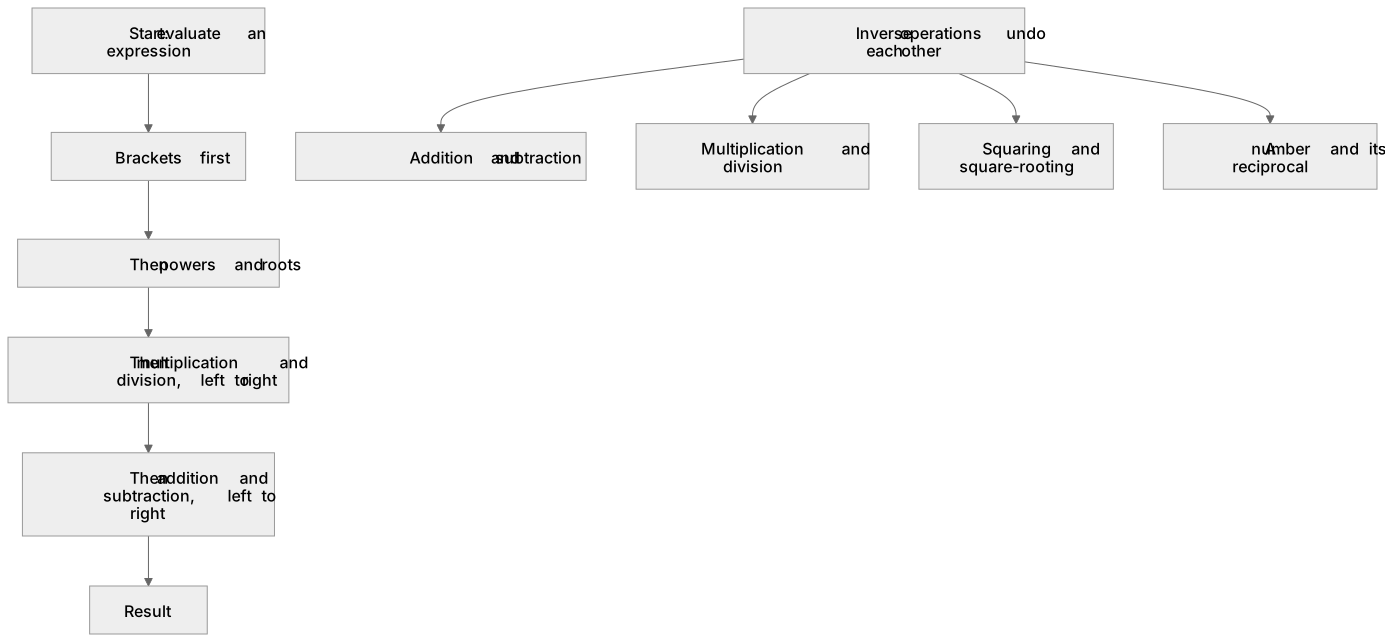
This topic links operations by their opposites and by order. Inverse operations undo each other: addition and subtraction, multiplication and division, squaring and square-rooting, and reciprocals. Recognising these lets you cancel common factors in a fraction such as 18/24 to 3/4, or rearrange an expression. Priority of operations is the agreed order: work inside brackets first, then powers and roots, then multiplication and division left to right, then addition and subtraction left to right. For example, 3 + 4 × 2² = 3 + 4 × 4 = 3 + 16 = 19, not 49. A reciprocal of a non-zero number n is 1/n, so the reciprocal of 5 is 1/5 and of 2/3 is 3/2. Brackets, powers, roots and reciprocals all change which operation happens first.
What earns the marks
- Identifies inverse pairs correctly: addition with subtraction, multiplication with division, squaring with square-rooting, and a number with its reciprocal.
- Applies cancellation to simplify a calculation or expression by dividing numerator and denominator by a common factor.
- Evaluates expressions using the conventional order: brackets, then powers and roots, then multiplication and division, then addition and subtraction.
- Recognises that a reciprocal of a non-zero number n is 1/n and uses it to rewrite division as multiplication.
- Uses brackets to change the order of operations and explains how the value changes.
- Distinguishes between expressions such as (−3)² = 9 and −3² = −9 by applying priority of operations.
Common mistakes and how to put them right
Working strictly left to right and adding before multiplying.
Put it right: Multiplication and division are completed before addition and subtraction, so 2 + 3 × 4 = 14, not 20.
Treating a reciprocal as the negative of a number.
Put it right: The reciprocal of 4 is 1/4, while the negative is −4; they are different ideas.
Squaring a negative number without brackets and keeping the negative sign.
Put it right: −3² means −(3²) = −9, whereas (−3)² = 9.
Cancelling terms that are added rather than factors that are multiplied.
Put it right: In (x + 2)/2 you cannot cancel the 2s because the numerator is a sum, not a product.
Exam tips
- Underline the operation that must be done first before starting a calculation, then rewrite the expression step by step.
- When a question asks for a reciprocal, write it as a fraction such as 1/7 or invert a fraction such as 5/8 to 8/5, and check the value is not zero.
- Use brackets in your working to show the order you intend, especially when substituting negative numbers into expressions with powers.
Try the lesson
The start of the Structure and calculation: recognise and use relationships between operations, including inverse operations (eg cancellation to simplify calculations and expressions) use conventional notation for priority of operations, including brackets, powers, roots and reciprocals lesson, made from checked teaching notes for this specification point.
Have a go first
Given that 6 × 47 = 282, use inverse operations to work out the value of 282 ÷ 6.
Listen
This topic links operations by their opposites and by order. Inverse operations undo each other: addition and subtraction, multiplication and division, squaring and square-rooting, and reciprocals. Recognising these lets you cancel common factors in a fraction such as 18/24 to 3/4, or rearrange an expression. Priority of operations is the agreed order: work inside brackets first, then powers and roots, then multiplication and division left to right, then addition and subtraction left to right. For example, 3 + 4 × 2² = 3 + 4 × 4 = 3 + 16 = 19, not 49. A reciprocal of a non-zero number n is 1/n, so the reciprocal of 5 is 1/5 and of 2/3 is 3/2. Brackets, powers, roots and reciprocals all change which operation happens first. A strong answer earns marks for these points. Identifies inverse pairs correctly: addition with subtraction, multiplication with division, squaring with square-rooting, and a number with its reciprocal. Applies cancellation to simplify a calculation or expression by dividing numerator and denominator by a common factor. Evaluates expressions using the conventional order: brackets, then powers and roots, then multiplication and division, then addition and subtraction. Recognises that a reciprocal of a non-zero number n is 1/n and uses it to rewrite division as multiplication. A common slip: Working strictly left to right and adding before multiplying. Instead, multiplication and division are completed before addition and subtraction, so 2 + 3 × 4 = 14, not 20. Exam tip: Underline the operation that must be done first before starting a calculation, then rewrite the expression step by step.
See it
Key words
Say what each word means before you turn the card.
Inverse operations
Try answering aloud or in your head before turning the card.
Cancellation
Try answering aloud or in your head before turning the card.
Priority of operations
Try answering aloud or in your head before turning the card.
See every definition
- Inverse operations
- Operations that undo each other, such as addition and subtraction, multiplication and division, squaring and square-rooting, and reciprocals.
- Cancellation
- Simplifying a calculation or expression by dividing numerator and denominator by a common factor.
- Priority of operations
- The agreed order: work inside brackets first, then powers and roots, then multiplication and division left to right, then addition and subtraction left to right.
Label the diagram
Some boxes have lost their names. Pick the right name for each number.
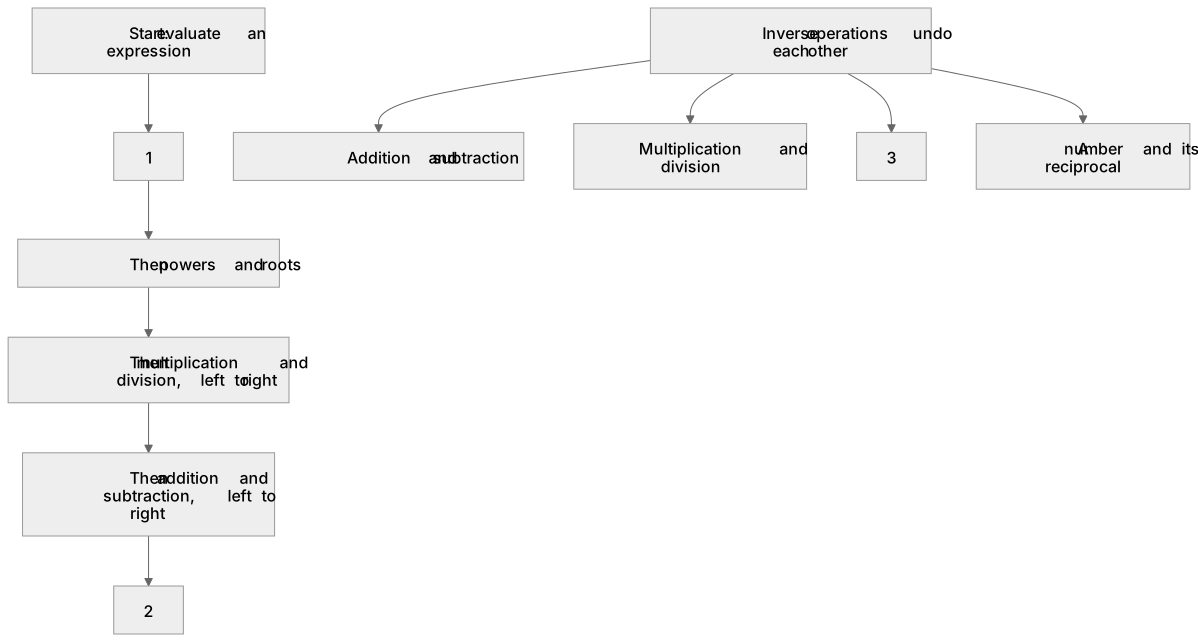
1Box 1
2Box 2
3Box 3
There is more to this lesson
The full lesson goes on to check your understanding and help you earn the marks. Create a free account to carry on, with your progress saved.
A week of Premium from your first lesson · Then the free plan continues · No card, no charge
Test your understanding of Structure and calculation: recognise and use relationships between operations, including inverse operations (eg cancellation to simplify calculations and expressions) use conventional notation for priority of operations, including brackets, powers, roots and reciprocals
Active recall beats re-reading. Take an instant quiz now to test what you’ve learned and lock it into long-term memory.
A week of Premium from your first lesson · Then the free plan continues · No card, no charge