AQA · GCSE · Mathematics
Course version: 8300 · Version from Sept 2015
Structure and calculation: use positive integer powers and associated real roots (square, cube and higher), recognise powers of 2, 3, 4, 5
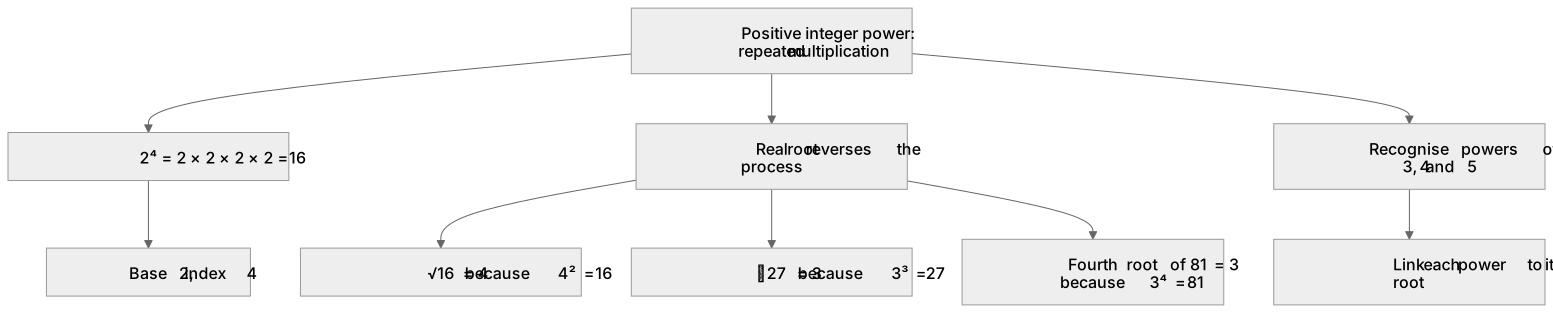
A positive integer power records repeated multiplication: 2⁴ means 2 × 2 × 2 × 2 = 16, where 2 is the base and 4 the index.
- 4 key terms
Study notes
From the checked teaching notes for this specification point.
The idea
A positive integer power records repeated multiplication: 2⁴ means 2 × 2 × 2 × 2 = 16, where 2 is the base and 4 the index. The associated real root reverses that process, so √16 = 4 because 4² = 16, and ∛27 = 3 because 3³ = 27. Higher roots follow the same logic: the fourth root of 81 is 3, since 3⁴ = 81. Recognising powers of 2, 3, 4 and 5 means recalling 2, 4, 8, 16, 32, 64; 3, 9, 27, 81; 4, 16, 64; and 5, 25, 125, and linking each to its root. For a multiple-choice question, work out the value or root directly, then compare with the options rather than guessing from the appearance of the numbers.
What earns the marks
- Correctly evaluates a positive integer power by repeated multiplication, for example 2⁵ = 32 or 5³ = 125.
- Correctly evaluates a square root, cube root or higher real root of a suitable positive number, for example √81 = 9, ∛64 = 4 or the fourth root of 16 is 2.
- Recognises and recalls powers of 2, 3, 4 and 5, such as 2⁶ = 64, 3⁴ = 81, 4³ = 64 and 5² = 25.
- Selects the option that matches a correctly computed value or root, showing the working that supports the choice.
Common mistakes and how to put them right
Multiplying the base by the index instead of using repeated multiplication.
Put it right: 2⁴ is 2 × 2 × 2 × 2 = 16, not 2 × 4 = 8.
Confusing a square root with halving.
Put it right: √64 = 8 because 8² = 64, not 32.
Treating a cube root as dividing by 3.
Put it right: ∛27 = 3 because 3³ = 27, not 9.
Assuming every root is an integer.
Put it right: Many roots are irrational, so a question may expect a decimal approximation or a surd rather than a whole number.
Exam tips
- Write the repeated multiplication out in full for small powers so the value can be checked quickly.
- Learn the power lists for 2, 3, 4 and 5, since recognition questions reward instant recall.
- Substitute each option back into the power or root to test it, which is faster and safer than estimating when the numbers are small.
Try the lesson
The start of the Structure and calculation: use positive integer powers and associated real roots (square, cube and higher), recognise powers of 2, 3, 4, 5 lesson, made from checked teaching notes for this specification point.
Have a go first
Work out the value of 2⁵.
Listen
A positive integer power records repeated multiplication: 2⁴ means 2 × 2 × 2 × 2 = 16, where 2 is the base and 4 the index. The associated real root reverses that process, so √16 = 4 because 4² = 16, and ∛27 = 3 because 3³ = 27. Higher roots follow the same logic: the fourth root of 81 is 3, since 3⁴ = 81. Recognising powers of 2, 3, 4 and 5 means recalling 2, 4, 8, 16, 32, 64; 3, 9, 27, 81; 4, 16, 64; and 5, 25, 125, and linking each to its root. For a multiple-choice question, work out the value or root directly, then compare with the options rather than guessing from the appearance of the numbers. A strong answer earns marks for these points. Correctly evaluates a positive integer power by repeated multiplication, for example 2⁵ = 32 or 5³ = 125. Correctly evaluates a square root, cube root or higher real root of a suitable positive number, for example √81 = 9, ∛64 = 4 or the fourth root of 16 is 2. Recognises and recalls powers of 2, 3, 4 and 5, such as 2⁶ = 64, 3⁴ = 81, 4³ = 64 and 5² = 25. Selects the option that matches a correctly computed value or root, showing the working that supports the choice. Exam tip: Write the repeated multiplication out in full for small powers so the value can be checked quickly.
See it
Key words
Say what each word means before you turn the card.
Index notation and repeated multiplication
Try answering aloud or in your head before turning the card.
Square, cube and higher real roots
Try answering aloud or in your head before turning the card.
Recognising powers of 2, 3, 4 and 5
Try answering aloud or in your head before turning the card.
Checking answers by substitution
Try answering aloud or in your head before turning the card.
See every definition
- Index notation and repeated multiplication
- A positive integer power records repeated multiplication, where the base is the number multiplied and the index is the number of times it is used.
- Square, cube and higher real roots
- The associated real root reverses the process of a power, so a square root, cube root or higher root gives the number whose power equals the given value.
- Recognising powers of 2, 3, 4 and 5
- Recalling the powers of 2, 3, 4 and 5 and linking each to its root.
- Checking answers by substitution
- Substituting each option back into the power or root to test it, which is faster and safer than estimating when the numbers are small.
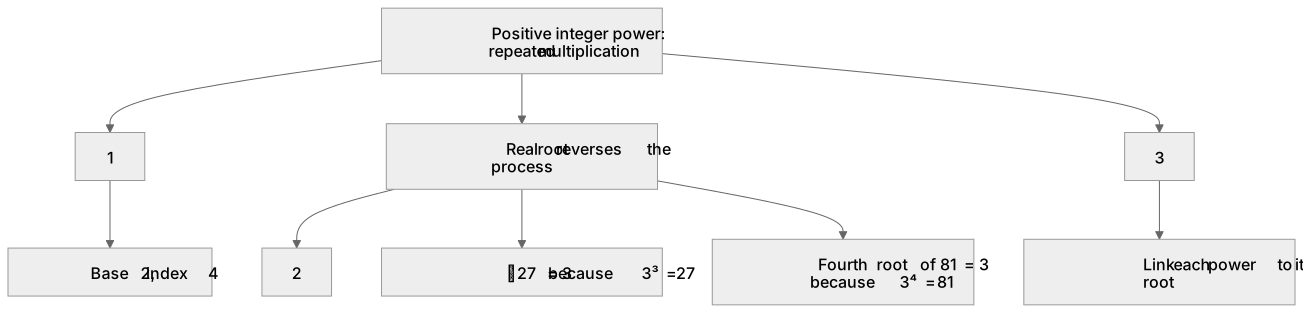
Label the diagram
Some boxes have lost their names. Pick the right name for each number.
1Box 1
2Box 2
3Box 3
There is more to this lesson
The full lesson goes on to check your understanding and help you earn the marks. Create a free account to carry on, with your progress saved.
A week of Premium from your first lesson · Then the free plan continues · No card, no charge
Test your understanding of Structure and calculation: use positive integer powers and associated real roots (square, cube and higher), recognise powers of 2, 3, 4, 5
Active recall beats re-reading. Take an instant quiz now to test what you’ve learned and lock it into long-term memory.
A week of Premium from your first lesson · Then the free plan continues · No card, no charge