Pearson Edexcel · GCSE · Mathematics
Algebra
Master the language of mathematics with this comprehensive guide to GCSE Algebra. From expanding brackets to solving quadratic equations, we'll build the fluency you need to secure top marks in your exams.
- 5 min read
- 3 worked examples
- 5 practice questions
- 6 key terms
Study Notes
Overview
Algebra is the foundation of higher-level mathematics. At its core, algebra is simply a way of writing general rules using letters instead of specific numbers. It allows us to solve complex problems, model real-world situations, and express mathematical relationships with elegance and precision.
For GCSE candidates, algebra is heavily weighted across all exam papers. It appears in standalone questions (like "Solve for x") and is integrated into geometry, probability, and ratio problems. Examiners are looking for clear, logical progression in your working out. A single sign error can lead to an incorrect final answer, but by showing every algebraic step, you can still secure the majority of the method marks.
This guide covers the essential algebraic techniques you need: expanding and factorising, solving linear and quadratic equations, working with sequences, and understanding linear graphs.
Key Concepts
Concept 1: Algebraic Notation and Substitution
Before manipulating equations, candidates must be fluent in algebraic notation. The convention is to omit multiplication signs (3 \times x becomes 3x) and division signs (x \div 2 becomes \frac{x}{2}).
Substitution involves replacing variables (letters) with given numerical values to calculate a result. The most common pitfall here is failing to use brackets when substituting negative numbers, leading to sign errors when squaring.
Example: Find the value of 2a^2 - b when a = -4 and b = 3.
Correct substitution: 2(-4)^2 - (3)
Calculation: 2(16) - 3 = 32 - 3 = 29.
Concept 2: Expanding Brackets and Factorisation
Expanding brackets means multiplying out the terms. For a single bracket, multiply the term outside by every term inside. For double brackets, the FOIL method (First, Outer, Inner, Last) ensures no terms are missed.
Factorisation is the reverse process—putting brackets back in. For a quadratic expression like x^2 + 7x + 10, you must find two numbers that multiply to give the constant term (10) and add to give the coefficient of x (7).
Example: Factorise x^2 + 7x + 10.
The numbers are 2 and 5.
Result: (x + 2)(x + 5).
Concept 3: Solving Linear Equations
A linear equation contains variables raised only to the power of 1. The goal is to isolate the variable on one side of the equals sign. Think of the equation as a perfectly balanced scale: whatever operation you perform on one side, you must perform on the other.
If the equation contains brackets, expand them first. If the variable appears on both sides, collect all variable terms on one side and all constant terms on the other.
Example: Solve 3(x - 2) = 15.
Expand: 3x - 6 = 15
Add 6: 3x = 21
Divide by 3: x = 7.
Concept 4: Solving Quadratic Equations
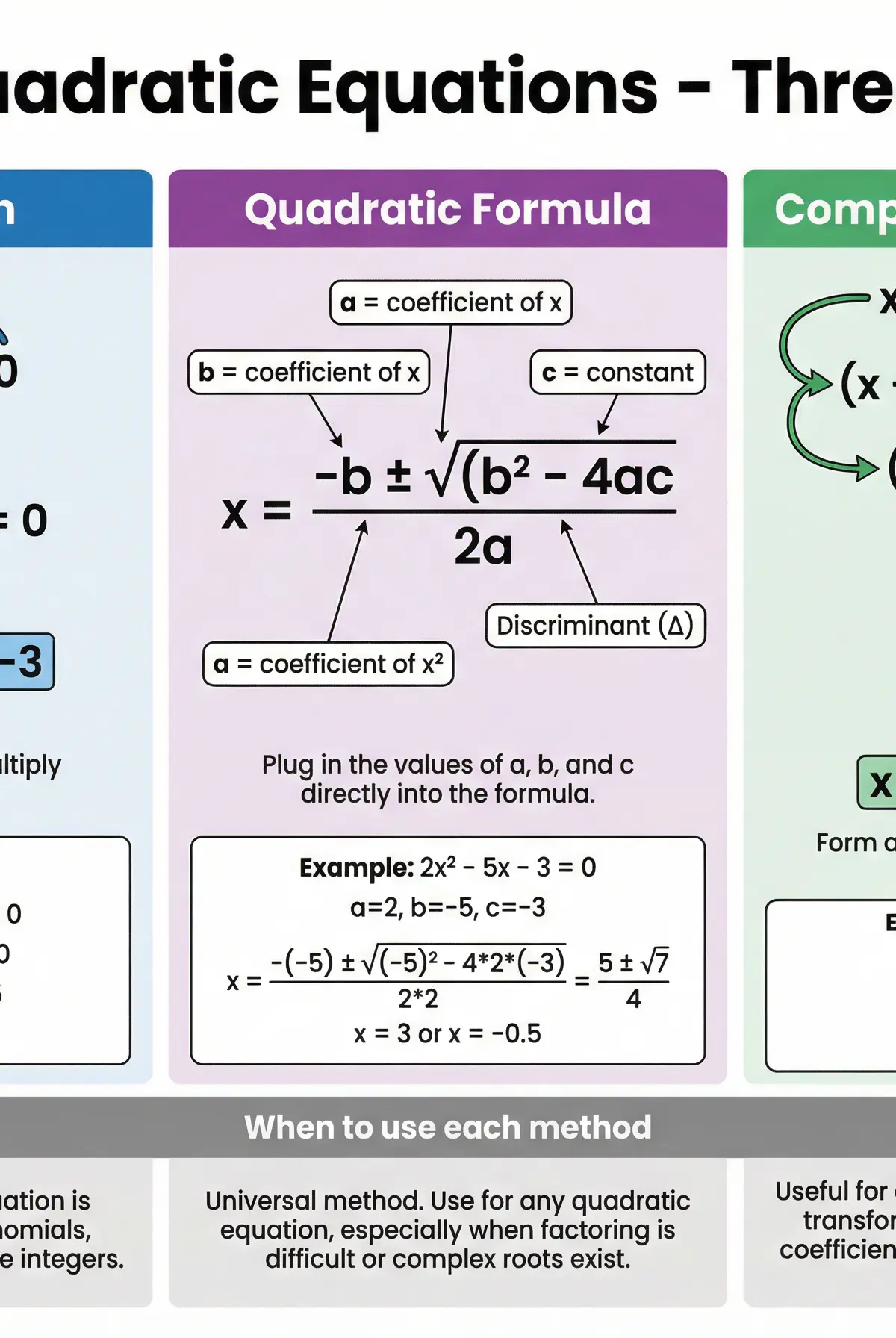
A quadratic equation takes the form ax^2 + bx + c = 0. Unlike linear equations, quadratics almost always have two solutions. Candidates frequently lose marks by only finding one.
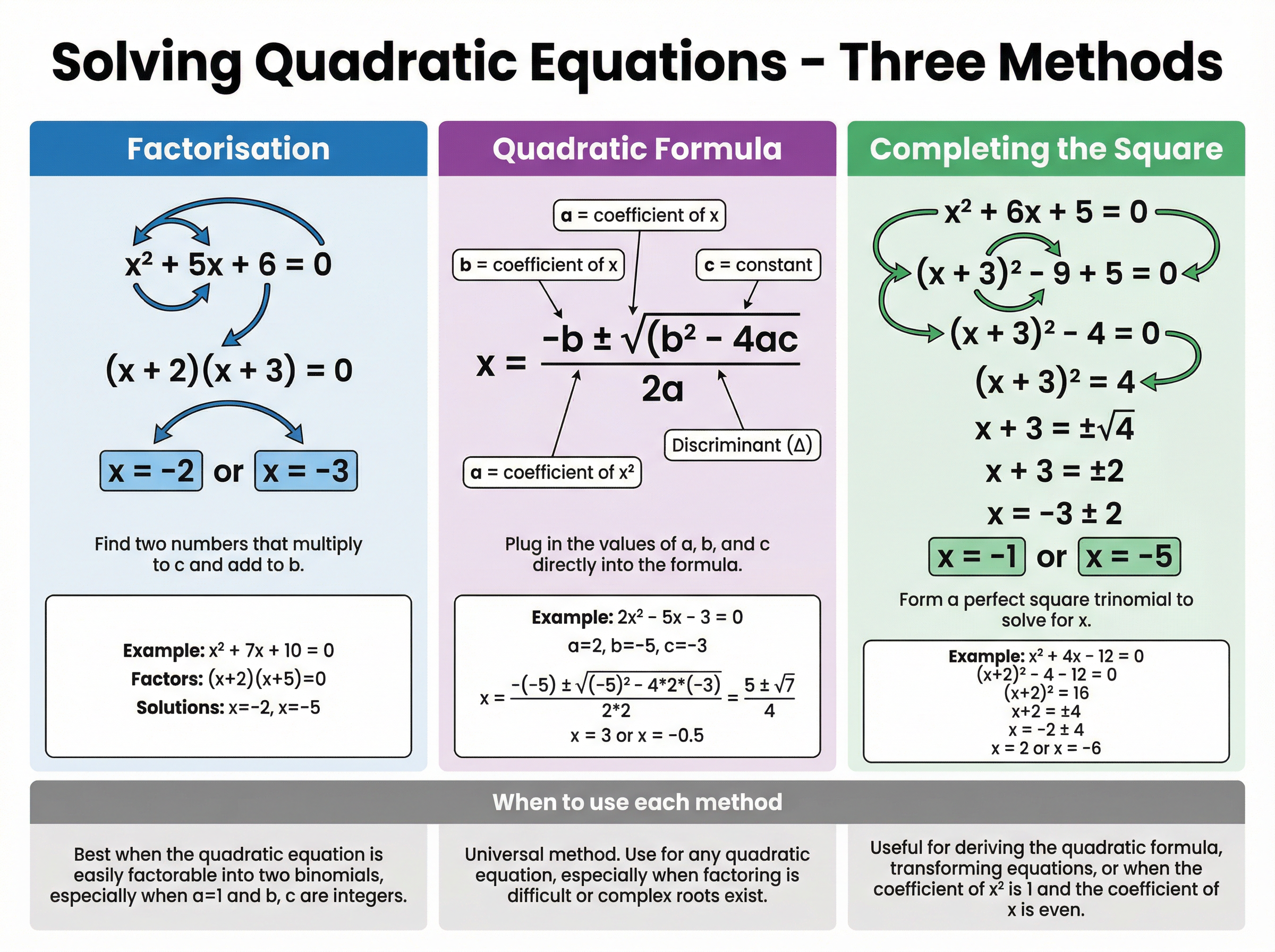
There are three main methods for solving quadratics:
- Factorisation: Best when the equation easily factorises into two brackets. Set each bracket to zero to find the solutions.
- The Quadratic Formula: A universal method that works for all quadratics. You must memorise this formula as it is rarely provided in the exam.
- Completing the Square: A Higher tier skill, particularly useful for finding the turning point (minimum or maximum) of a quadratic graph.
Concept 5: Sequences and the nth Term
A sequence is a list of numbers following a mathematical rule. In an arithmetic (linear) sequence, the difference between consecutive terms is constant.
The formula for the nth term of an arithmetic sequence is dn + (a - d), where d is the common difference and a is the first term.
Example: Find the nth term of the sequence 5, 8, 11, 14...
Common difference (d) = 3. First term (a) = 5.
Formula: 3n + (5 - 3) = 3n + 2.
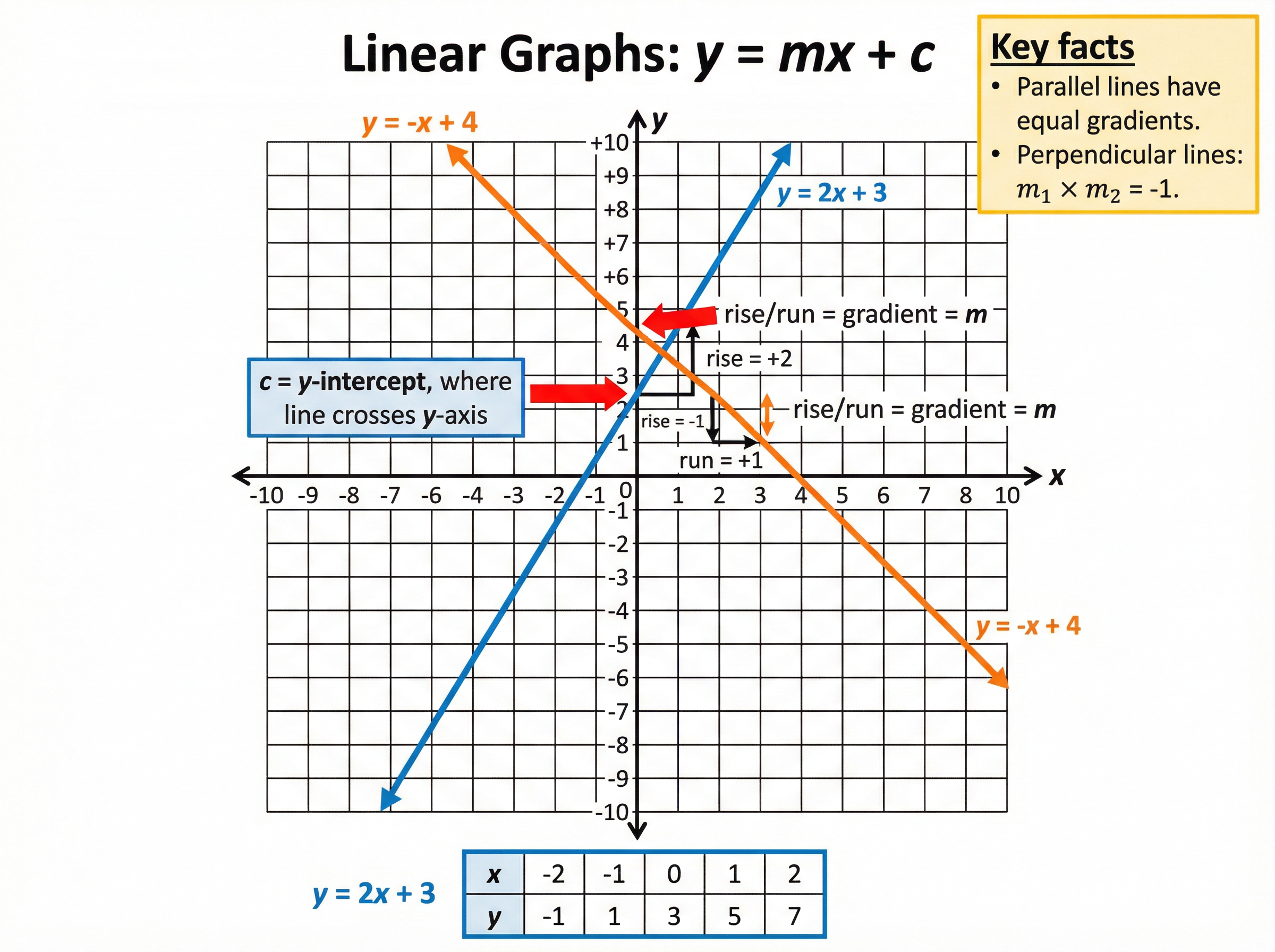
Concept 6: Linear Graphs ($y = mx + c$)
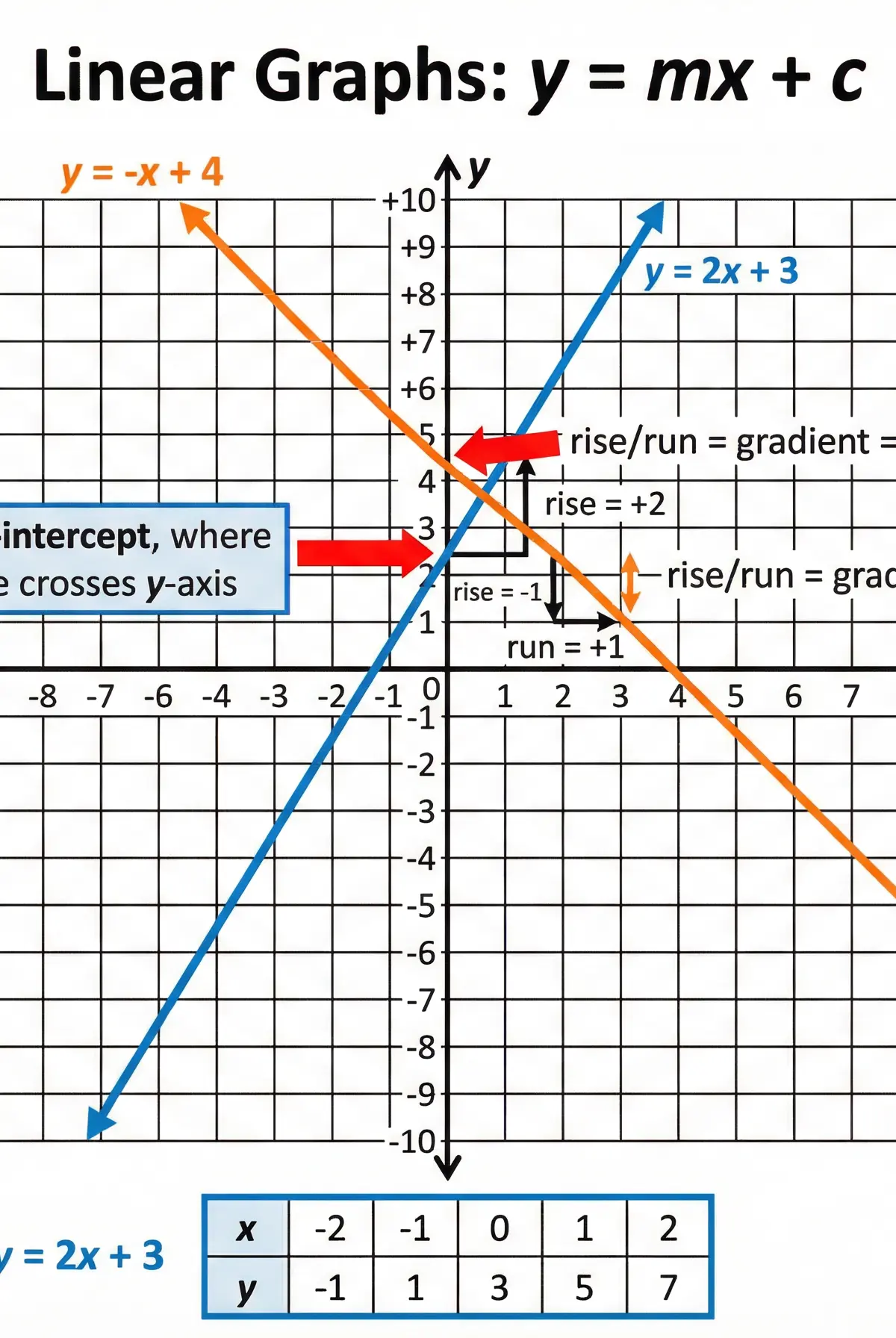
Any straight-line graph can be expressed in the form y = mx + c.
- m represents the gradient (steepness). It is calculated as \frac{\text{change in } y}{\text{change in } x} (rise over run).
- c represents the y-intercept (where the line crosses the y-axis).
Examiners frequently test the knowledge that parallel lines have identical gradients, while perpendicular lines have gradients that multiply to give -1 (m_1 \times m_2 = -1).
Mathematical Relationships
- Quadratic Formula (Must memorise): x = \frac{-b \pm \sqrt{b^2 - 4ac}}{2a}
- Gradient Formula (Must memorise): m = \frac{y_2 - y_1}{x_2 - x_1}
- nth Term (Arithmetic) (Must memorise): n\text{th term} = dn + (a - d)
- Indices Laws (Must memorise):
- a^m \times a^n = a^{m+n}
- a^m \div a^n = a^{m-n}
- (a^m)^n = a^{mn}
- a^0 = 1
Practical Applications
Algebra isn't just abstract symbols; it's the mathematical engine behind real-world problem-solving.
- Physics & Engineering: Rearranging formulas (like v = u + at) is essential for calculating speed, distance, and time.
- Computer Science: Algorithms rely heavily on variables, logical operators, and Boolean algebra.
- Finance: Calculating compound interest and modelling profit/loss margins requires a solid grasp of exponential growth and algebraic functions.
Visual Resources
2 diagrams and illustrations
Interactive Diagrams
2 interactive diagrams to visualise key concepts
Conceptual Flow Outline
GCSE Algebra Topic Map (★ indicates Higher Tier content)
Conceptual Flow Outline
Decision Flowchart: Choosing a method to solve quadratic equations
Worked Examples
3 worked examples — open one to explore the question and available guidance.
Practice Questions
Test your understanding — click to reveal model answers
Simplify fully: 4a + 3b - 2a + 5b
Hint: Group the 'a' terms together and the 'b' terms together.
Solve the inequality: 5x - 4 < 11
Hint: Treat the inequality sign just like an equals sign when rearranging.
Expand and simplify: (x - 3)(x + 8)
Hint: Use the FOIL method: First, Outer, Inner, Last.
Find the nth term of the sequence: 7, 11, 15, 19...
Hint: Find the common difference first, then work out what you need to add or subtract to get the first term.
Solve the quadratic equation using the quadratic formula. Give your answers to 2 decimal places: 2x^2 + 5x - 4 = 0
Hint: Identify a, b, and c carefully. Don't forget the negative sign on the -4.
Test your understanding of Algebra
Active recall beats re-reading. Take an instant quiz now to test what you’ve learned and lock it into long-term memory.
7 days Premium · Then free forever · No card, no charge