Trigonometry Revision Notes

    Subject: Mathematics | Level: A-Level | Exam Board: OCR

    Master OCR A-Level Trigonometry (4.9) with this comprehensive guide. We cover everything from reciprocal functions and compound angles to exam technique and common pitfalls, helping you secure top marks.

    Revision Notes & Key Concepts

    ![Header image for Trigonometry (4.9)](https://xnnrgnazirrqvdgfhvou.supabase.co/storage/v1/object/public/study-guide-assets/guide_b3a512c9-4ec1-44e0-8327-4ad1e8e776c7/header_image.png) ## Overview Trigonometry at the A-Level stage, particularly for the OCR specification, is a significant step up from GCSE. This topic, reference 4.9, moves beyond basic right-angled triangles into a more abstract and powerful set of tools essential for higher mathematics. It focuses on the behaviour of reciprocal trigonometric functions (secant, cosecant, cotangent), the manipulation of complex identities, and the use of compound and double angle formulae to solve equations and prove results. A deep understanding of the unit circle, and the difference between degrees and radians, is fundamental. Examiners frequently test these concepts in both pure problem-solving contexts (AO1), and in more challenging, unstructured problems that require you to apply your knowledge creatively (AO2 and AO3). This guide will equip you with the core knowledge, exam strategies, and multi-modal resources to excel. ![OCR A-Level Trigonometry Podcast](https://xnnrgnazirrqvdgfhvou.supabase.co/storage/v1/object/public/study-guide-assets/guide_b3a512c9-4ec1-44e0-8327-4ad1e8e776c7/trigonometry_podcast.mp3) ## Key Concepts ### Concept 1: The Unit Circle and Radians The unit circle is a circle with a radius of 1 centered at the origin. It is the foundation of A-Level trigonometry because it provides a visual and conceptual link between an angle and the values of sine, cosine, and tangent. For any angle θ measured from the positive x-axis, the coordinates of the point where the angle intersects the circle are (cos θ, sin θ). This is why sin²θ + cos²θ = 1, as it's simply the Pythagorean theorem on this circle (x² + y² = r²). Radians are the natural way to measure angles in higher maths. One radian is the angle created when the arc length equals the radius. Since the circumference of a circle is 2πr, there are 2π radians in a full circle, which is equivalent to 360°. For any calculus involving trigonometry, such as differentiation or integration, you **must** use radians. The small angle approximations (sin θ ≈ θ, cos θ ≈ 1 - θ²/2, tan θ ≈ θ) are only valid for small angles measured in radians. ![The Unit Circle: Angles and Coordinates](https://xnnrgnazirrqvdgfhvou.supabase.co/storage/v1/object/public/study-guide-assets/guide_b3a512c9-4ec1-44e0-8327-4ad1e8e776c7/unit_circle_diagram.png) ### Concept 2: Reciprocal Trigonometric Functions These are the multiplicative inverses of the three main trigonometric functions: - **Secant (sec x)** = 1 / cos x - **Cosecant (cosec x)** = 1 / sin x - **Cotangent (cot x)** = 1 / tan x = cos x / sin x Candidates must be able to sketch the graphs of these functions. A key feature is the presence of vertical asymptotes. For example, y = sec x has asymptotes wherever cos x = 0 (at x = π/2, 3π/2, etc.). Understanding the relationship between the original function and its reciprocal is crucial for sketching. For instance, where cos x has a maximum value of 1, sec x has a minimum value of 1. Where cos x is 0, sec x is undefined. ![Graphs of Reciprocal Trigonometric Functions](https://xnnrgnazirrqvdgfhvou.supabase.co/storage/v1/object/public/study-guide-assets/guide_b3a512c9-4ec1-44e0-8327-4ad1e8e776c7/reciprocal_graphs.png) ### Concept 3: Pythagorean Identities Beyond sin²x + cos²x = 1, there are two other essential Pythagorean identities derived from it. These are fundamental for simplifying expressions and solving equations. 1. **1 + tan²x ≡ sec²x**: Derived by dividing sin²x + cos²x = 1 by cos²x. 2. **1 + cot²x ≡ cosec²x**: Derived by dividing sin²x + cos²x = 1 by sin²x. Examiners will often present an equation that looks complex, but which simplifies neatly after the correct substitution of one of these identities. Being able to spot the opportunity to use them is a key skill. ### Concept 4: Compound and Double Angle Formulae These formulae are used to express the trigonometric function of a sum or difference of angles (e.g., A+B) in terms of the trigonometric functions of the individual angles A and B. They are vital for solving equations and proving more complex identities. ![Visualising Compound and Double Angle Formulae](https://xnnrgnazirrqvdgfhvou.supabase.co/storage/v1/object/public/study-guide-assets/guide_b3a512c9-4ec1-44e0-8327-4ad1e8e776c7/compound_angle_visual.png) **Compound Angle Formulae (Must Memorise):** - sin(A ± B) = sinAcosB ± cosAsinB - cos(A ± B) = cosAcosB ∓ sinAsinB - tan(A ± B) = (tanA ± tanB) / (1 ∓ tanAtanB) **Double Angle Formulae (Derived from Compound):** - sin(2A) = 2sinAcosA - cos(2A) = cos²A - sin²A = 2cos²A - 1 = 1 - 2sin²A - tan(2A) = 2tanA / (1 - tan²A) Knowing all three forms of cos(2A) is particularly important, as choosing the right one can significantly simplify a problem. ## Mathematical/Scientific Relationships | Formula | Status | When to Use | |---|---|---| | sin²x + cos²x = 1 | Must memorise | Simplifying expressions, solving equations. | | 1 + tan²x = sec²x | Must memorise | When equations involve a mix of tan and sec. | | 1 + cot²x = cosec²x | Must memorise | When equations involve a mix of cot and cosec. | | sin(A ± B) | Must memorise | Expanding expressions with sums/differences of angles. | | cos(A ± B) | Must memorise | Expanding expressions with sums/differences of angles. | | tan(A ± B) | Must memorise | Expanding expressions with sums/differences of angles. | | sin(2A) | Given on formula sheet | Problems involving multiples of angles. | | cos(2A) | Given on formula sheet | Problems involving multiples of angles. | | tan(2A) | Given on formula sheet | Problems involving multiples of angles. | | Rcos(x - α) form | Method must be memorised | Combining a.cosx + b.sinx into a single function. | ## Practical Applications Trigonometry is not just an abstract topic; it is the mathematical language used to describe oscillations and waves. Its applications are vast: - **Physics**: Analysing simple harmonic motion (e.g., a pendulum), understanding wave phenomena like light and sound, and resolving forces in mechanics. - **Engineering**: Designing structures like bridges and buildings, modelling alternating current (AC) circuits, and in signal processing for telecommunications. - **Computer Graphics**: Used extensively in rotating and translating objects in 3D space for video games and simulations. - **Navigation**: Historically used in celestial navigation and still fundamental to modern GPS technology.

    Revision Podcast Transcript

    [INTRO - 1 minute] Hello and welcome to A-Level Maths Mastery! I'm your host, and today we're diving deep into one of the most powerful topics in OCR A-Level Mathematics: Trigonometry, specifically section 4.9. Whether you're preparing for your exams or just looking to strengthen your understanding, this episode will give you the tools you need to tackle those challenging trig questions with confidence. Trigonometry at A-Level goes way beyond SOHCAHTOA. We're talking about reciprocal functions like secant, cosecant, and cotangent, compound angle formulae, and the ability to prove complex identities. These skills are absolutely essential because they appear across pure maths, mechanics, and even in real-world applications like engineering and physics. So let's get started! [CORE CONCEPTS - 5 minutes] First, let's talk about the unit circle. This is your foundation for everything in trigonometry. The unit circle has a radius of one, and it maps every angle to a coordinate point. The x-coordinate gives you cosine, and the y-coordinate gives you sine. Understanding this relationship is crucial because it explains why sine and cosine have their specific ranges and why certain angles give exact values. Now, here's something that catches many candidates out: radians versus degrees. At A-Level, you must be fluent in both, but here's the key rule: if a question involves calculus or small angle approximations, you MUST work in radians. The OCR mark scheme is very strict on this. If you differentiate sine x and you're in degrees, you won't get the correct result. Radians are the natural unit for mathematical analysis. Let's move to reciprocal functions. Secant is one over cosine, cosecant is one over sine, and cotangent is one over tangent. These aren't just theoretical concepts; they appear frequently in exam questions. The key thing to remember is where these functions have asymptotes. Secant has vertical asymptotes wherever cosine equals zero, so that's at π over 2, 3π over 2, and so on. Cosecant has asymptotes where sine equals zero, which is at 0, π, 2π. Understanding the graphs of these functions and their behaviour is worth marks in the exam. Now, the Pythagorean identities. You already know sin²x plus cos²x equals 1, but at A-Level, you need the reciprocal versions too. Dividing through by cos²x gives you 1 plus tan²x equals sec²x. Dividing by sin²x gives you 1 plus cot²x equals cosec²x. These identities are your toolkit for solving equations and proving results. Examiners love to test whether you can spot which identity to use. Compound angle formulae are absolutely critical. Sin of A plus B is NOT sin A plus sin B. This is one of the most common mistakes. The correct formula is sin A cos B plus cos A sin B. For cosine, it's cos A cos B minus sin A sin B. And for tangent, it's tan A plus tan B over 1 minus tan A tan B. You must memorise these because they're not always given on the formula sheet, depending on the exam board. These formulae allow you to expand expressions, solve equations, and prove identities. Double angle formulae are just special cases where A equals B. So sin 2A is 2 sin A cos A. Cos 2A has three forms: cos²A minus sin²A, which can also be written as 2cos²A minus 1, or 1 minus 2sin²A. Knowing all three forms is powerful because different forms are useful in different contexts. [EXAM TIPS & COMMON MISTAKES - 2 minutes] Let's talk exam technique. In "show that" questions, you must manipulate only one side of the equation to match the other. Never move terms across the equals sign because that assumes what you're trying to prove. Start with the more complicated side and work towards the simpler side, showing every step clearly. When solving trigonometric equations, always check the domain first. If the question gives the range in terms of π, your answers must be in radians and in exact form. Don't give decimal approximations unless explicitly asked. And here's a critical point: never divide both sides of an equation by a trigonometric function. If you have sin x cos x equals sin x, don't divide by sin x. Instead, rearrange to sin x times cos x minus 1 equals zero, then factorise. Dividing loses solutions because you're assuming sin x isn't zero, but it might be! Another common error: calculator mode. If you're doing calculus or using small angle approximations like sin θ approximately equals θ for small θ, your calculator must be in radians. Degree mode will give completely wrong answers. For harmonic form questions, where you express a cos x plus b sin x as R cos of x minus α, make sure you state both R and α clearly, and check that α is in the correct quadrant. Marks are awarded for the correct value and the correct quadrant. [QUICK-FIRE RECALL QUIZ - 1 minute] Right, let's test your recall. I'll give you a few seconds after each question. Question 1: What is the exact value of sin 30 degrees? ... The answer is one half. Question 2: What is 1 plus tan²x equal to? ... It's sec²x. Question 3: What is the derivative of sin x? ... It's cos x, but only if x is in radians. Question 4: Where does sec x have vertical asymptotes? ... Wherever cos x equals zero, so at odd multiples of π over 2. Question 5: What is the compound angle formula for sin of A plus B? ... It's sin A cos B plus cos A sin B. How did you do? If you got them all, brilliant! If not, go back and review those concepts. [SUMMARY & SIGN-OFF - 1 minute] To wrap up, trigonometry at A-Level is all about fluency with identities, understanding the unit circle, and being meticulous with radians versus degrees. The examiners are looking for clear, logical working, correct use of identities, and all solutions within the given range. Remember: factorise, don't divide. Use exact values. Show every step in proofs. And always, always check your domain. Practice is key. Work through past papers, focus on the mark schemes, and understand why marks are awarded. Trigonometry is a skill that improves dramatically with practice, and once it clicks, you'll find it's one of the most satisfying topics in A-Level maths. Thanks so much for listening to A-Level Maths Mastery. Keep practising, stay confident, and I'll see you in the next episode. Good luck with your exams!

    Key Terms & Definitions

    Radian
    The angle subtended at the center of a circle by an arc that is equal in length to the radius.
    Identity
    An equation that is true for all values of the variables for which both sides are defined.
    Asymptote
    A line that a curve approaches but never touches.
    Principal Value
    The unique solution to an inverse trigonometric function within a restricted range (e.g., -π/2 ≤ arcsin(x) ≤ π/2).
    Harmonic Form
    The process of expressing a sum of sine and cosine functions, a.cosx + b.sinx, as a single cosine or sine function, Rcos(x-α) or Rsin(x+α).
    Period
    The interval over which a periodic function completes one full cycle.

    Worked Examples

    Practice Questions

    Trigonometry

    OCR
    A-Level
    Mathematics

    Master OCR A-Level Trigonometry (4.9) with this comprehensive guide. We cover everything from reciprocal functions and compound angles to exam technique and common pitfalls, helping you secure top marks.

    6
    Min Read
    3
    Examples
    5
    Questions
    6
    Key Terms
    🎙 Podcast Episode
    Trigonometry
    0:00-0:00

    Study Notes

    Header image for Trigonometry (4.9)

    Overview

    Trigonometry at the A-Level stage, particularly for the OCR specification, is a significant step up from GCSE. This topic, reference 4.9, moves beyond basic right-angled triangles into a more abstract and powerful set of tools essential for higher mathematics. It focuses on the behaviour of reciprocal trigonometric functions (secant, cosecant, cotangent), the manipulation of complex identities, and the use of compound and double angle formulae to solve equations and prove results. A deep understanding of the unit circle, and the difference between degrees and radians, is fundamental. Examiners frequently test these concepts in both pure problem-solving contexts (AO1), and in more challenging, unstructured problems that require you to apply your knowledge creatively (AO2 and AO3). This guide will equip you with the core knowledge, exam strategies, and multi-modal resources to excel.

    OCR A-Level Trigonometry Podcast

    Key Concepts

    Concept 1: The Unit Circle and Radians

    The unit circle is a circle with a radius of 1 centered at the origin. It is the foundation of A-Level trigonometry because it provides a visual and conceptual link between an angle and the values of sine, cosine, and tangent. For any angle θ measured from the positive x-axis, the coordinates of the point where the angle intersects the circle are (cos θ, sin θ). This is why sin²θ + cos²θ = 1, as it's simply the Pythagorean theorem on this circle (x² + y² = r²). Radians are the natural way to measure angles in higher maths. One radian is the angle created when the arc length equals the radius. Since the circumference of a circle is 2πr, there are 2π radians in a full circle, which is equivalent to 360°. For any calculus involving trigonometry, such as differentiation or integration, you must use radians. The small angle approximations (sin θ ≈ θ, cos θ ≈ 1 - θ²/2, tan θ ≈ θ) are only valid for small angles measured in radians.

    The Unit Circle: Angles and Coordinates

    Concept 2: Reciprocal Trigonometric Functions

    These are the multiplicative inverses of the three main trigonometric functions:

    • Secant (sec x) = 1 / cos x
    • Cosecant (cosec x) = 1 / sin x
    • Cotangent (cot x) = 1 / tan x = cos x / sin x

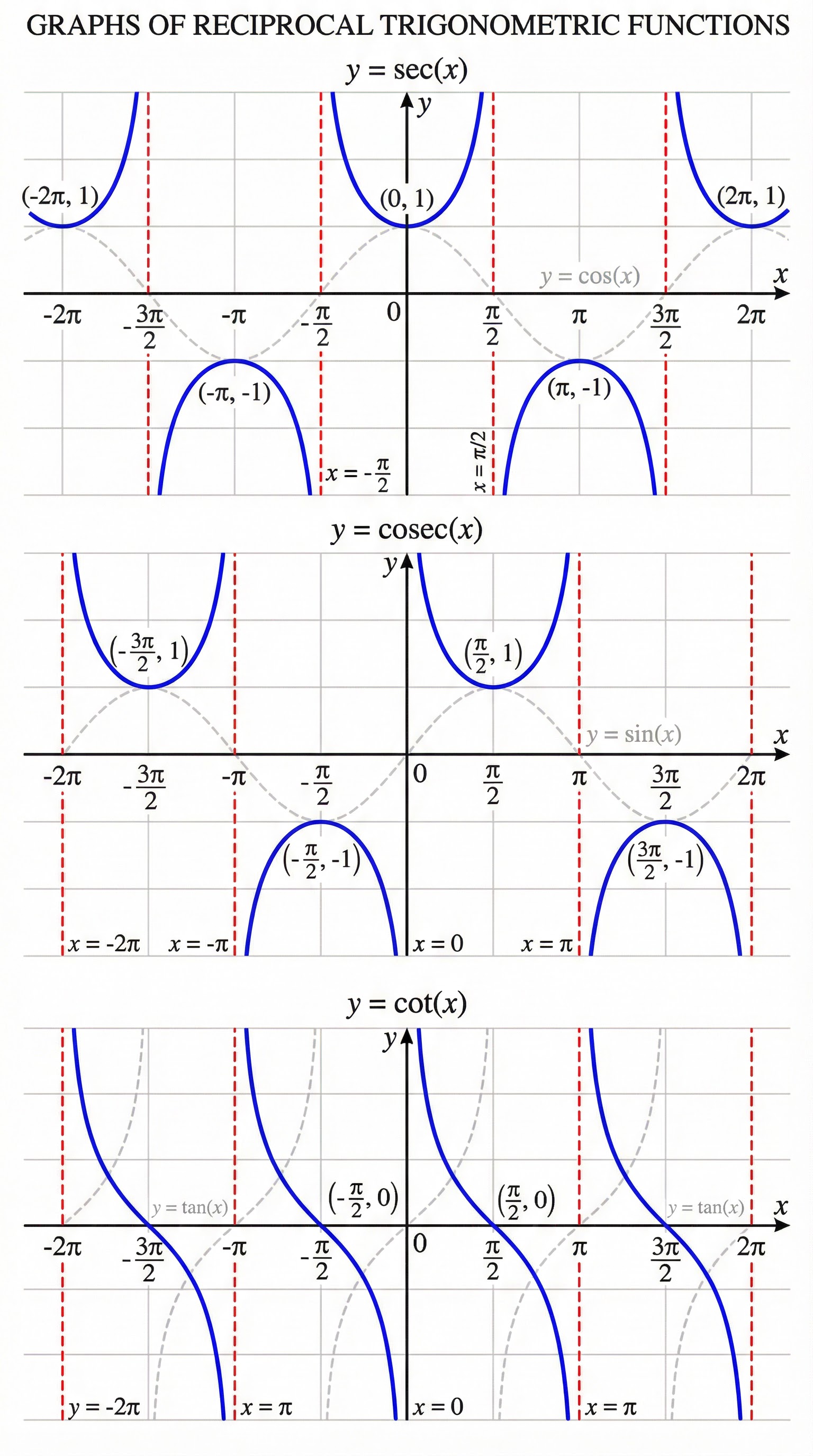
    Candidates must be able to sketch the graphs of these functions. A key feature is the presence of vertical asymptotes. For example, y = sec x has asymptotes wherever cos x = 0 (at x = π/2, 3π/2, etc.). Understanding the relationship between the original function and its reciprocal is crucial for sketching. For instance, where cos x has a maximum value of 1, sec x has a minimum value of 1. Where cos x is 0, sec x is undefined.
    Graphs of Reciprocal Trigonometric Functions

    Concept 3: Pythagorean Identities

    Beyond sin²x + cos²x = 1, there are two other essential Pythagorean identities derived from it. These are fundamental for simplifying expressions and solving equations.

    1. 1 + tan²x ≡ sec²x: Derived by dividing sin²x + cos²x = 1 by cos²x.
    2. 1 + cot²x ≡ cosec²x: Derived by dividing sin²x + cos²x = 1 by sin²x.

    Examiners will often present an equation that looks complex, but which simplifies neatly after the correct substitution of one of these identities. Being able to spot the opportunity to use them is a key skill.

    Concept 4: Compound and Double Angle Formulae

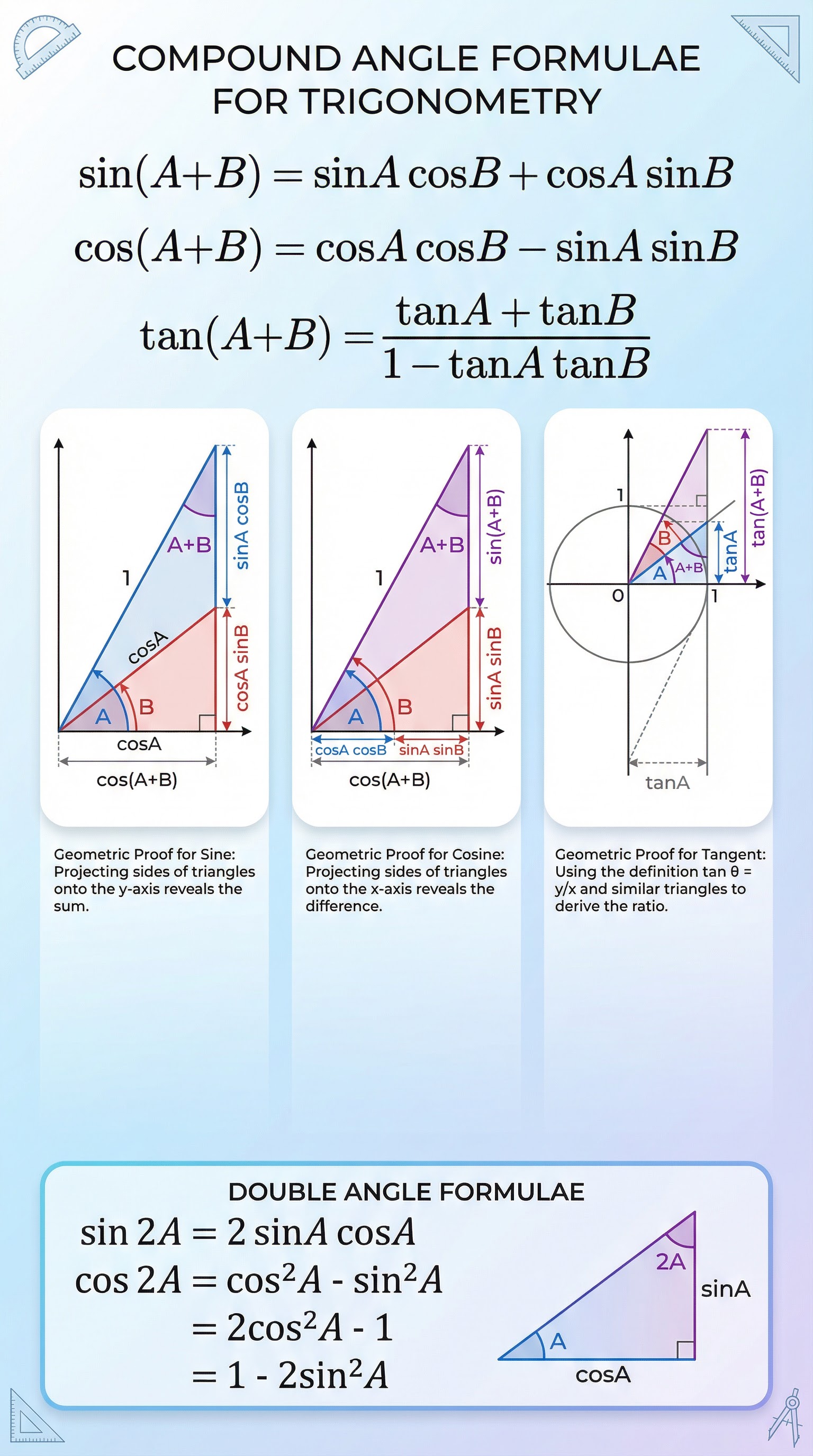
    These formulae are used to express the trigonometric function of a sum or difference of angles (e.g., A+B) in terms of the trigonometric functions of the individual angles A and B. They are vital for solving equations and proving more complex identities.
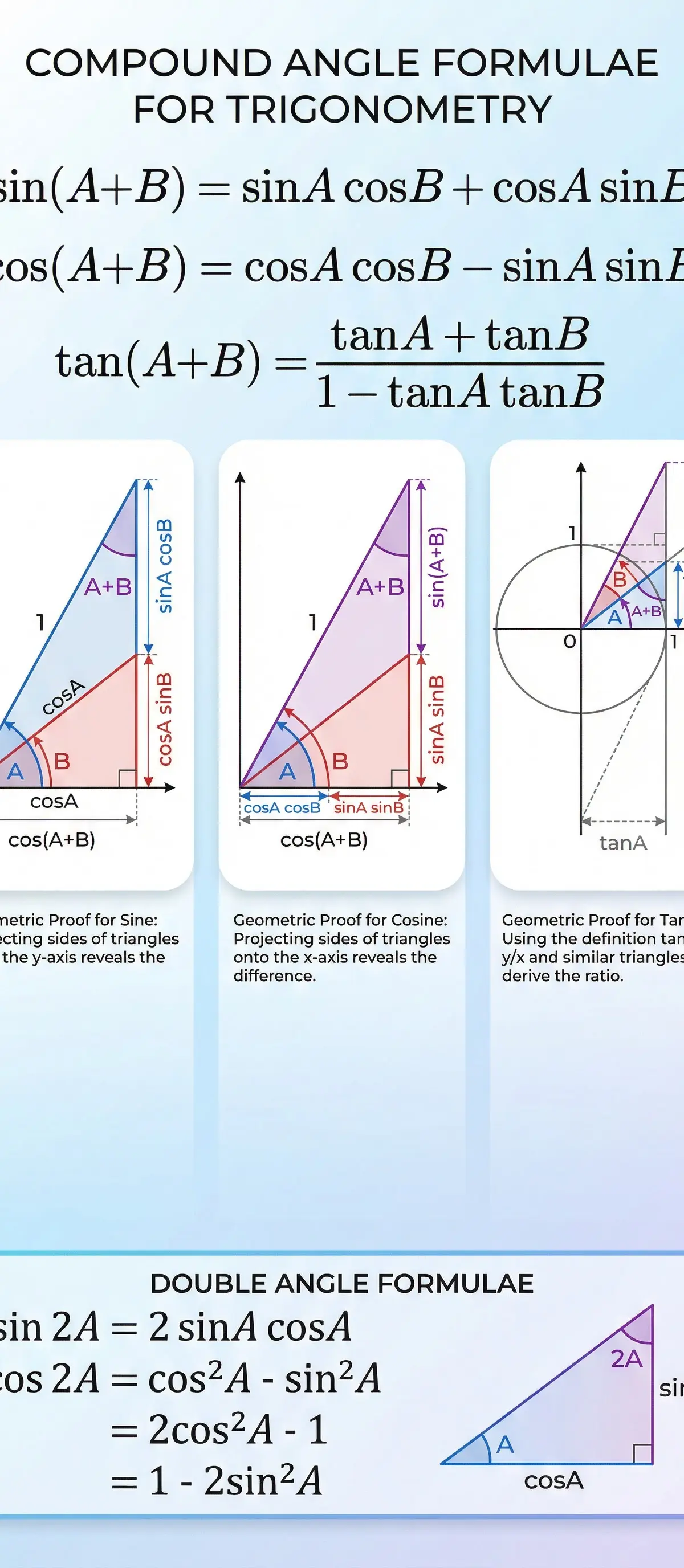
    Visualising Compound and Double Angle Formulae

    Compound Angle Formulae (Must Memorise):

    • sin(A ± B) = sinAcosB ± cosAsinB
    • cos(A ± B) = cosAcosB ∓ sinAsinB
    • tan(A ± B) = (tanA ± tanB) / (1 ∓ tanAtanB)

    Double Angle Formulae (Derived from Compound):

    • sin(2A) = 2sinAcosA
    • cos(2A) = cos²A - sin²A = 2cos²A - 1 = 1 - 2sin²A
    • tan(2A) = 2tanA / (1 - tan²A)

    Knowing all three forms of cos(2A) is particularly important, as choosing the right one can significantly simplify a problem.

    Mathematical/Scientific Relationships

    FormulaStatusWhen to Use
    sin²x + cos²x = 1Must memoriseSimplifying expressions, solving equations.
    1 + tan²x = sec²xMust memoriseWhen equations involve a mix of tan and sec.
    1 + cot²x = cosec²xMust memoriseWhen equations involve a mix of cot and cosec.
    sin(A ± B)Must memoriseExpanding expressions with sums/differences of angles.
    cos(A ± B)Must memoriseExpanding expressions with sums/differences of angles.
    tan(A ± B)Must memoriseExpanding expressions with sums/differences of angles.
    sin(2A)Given on formula sheetProblems involving multiples of angles.
    cos(2A)Given on formula sheetProblems involving multiples of angles.
    tan(2A)Given on formula sheetProblems involving multiples of angles.
    Rcos(x - α) formMethod must be memorisedCombining a.cosx + b.sinx into a single function.

    Practical Applications

    Trigonometry is not just an abstract topic; it is the mathematical language used to describe oscillations and waves. Its applications are vast:

    • Physics: Analysing simple harmonic motion (e.g., a pendulum), understanding wave phenomena like light and sound, and resolving forces in mechanics.
    • Engineering: Designing structures like bridges and buildings, modelling alternating current (AC) circuits, and in signal processing for telecommunications.
    • Computer Graphics: Used extensively in rotating and translating objects in 3D space for video games and simulations.
    • Navigation: Historically used in celestial navigation and still fundamental to modern GPS technology.

    Visual Resources

    3 diagrams and illustrations
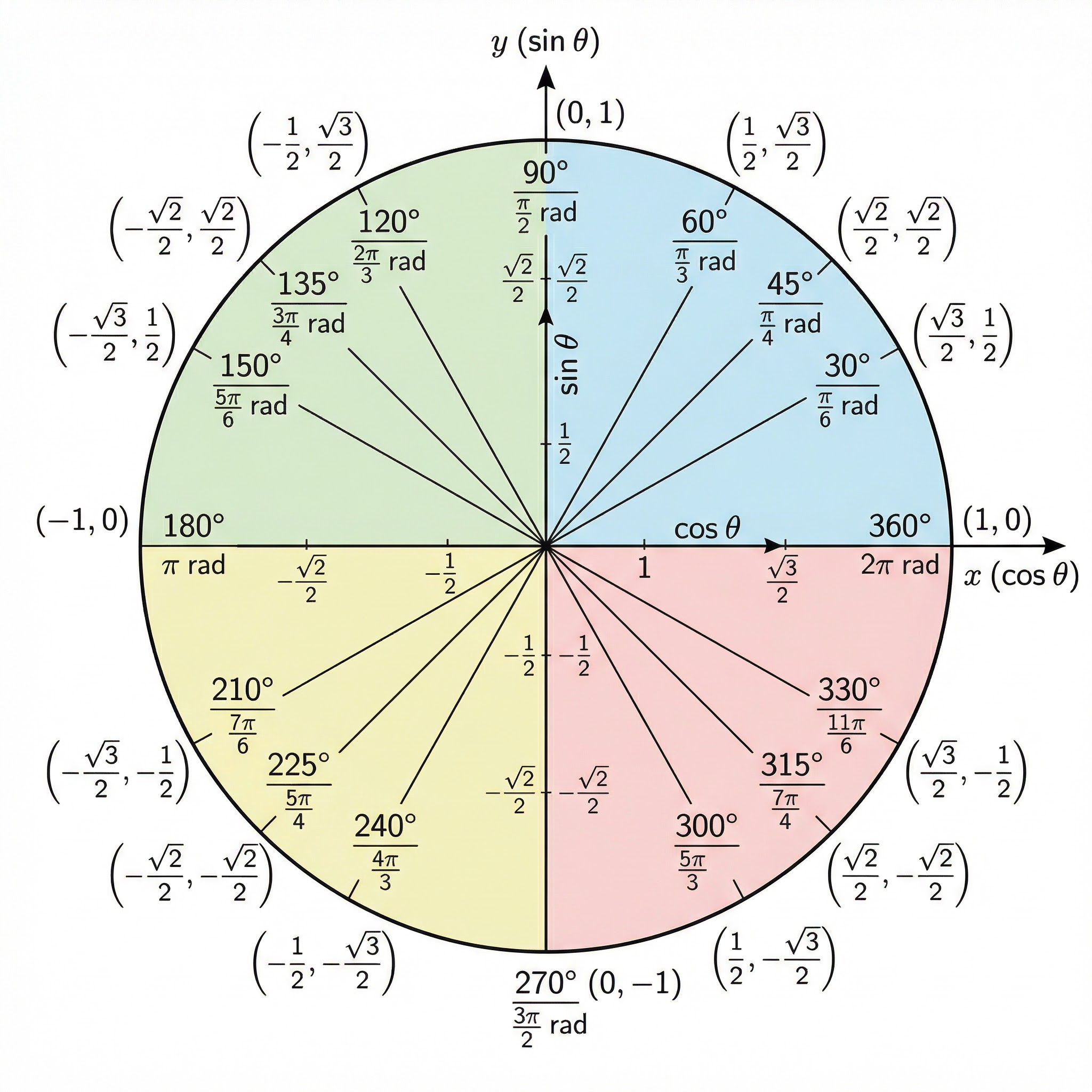
    The Unit Circle: Angles and Coordinates
    The Unit Circle: Angles and Coordinates
    Graphs of Reciprocal Trigonometric Functions
    Graphs of Reciprocal Trigonometric Functions
    Visualising Compound and Double Angle Formulae
    Visualising Compound and Double Angle Formulae

    Interactive Diagrams

    2 interactive diagrams to visualise key concepts

    A flowchart showing the decision-making process for solving trigonometric equations.

    A concept map showing how the double angle formula for cos(2A) is derived from the compound angle formula and can be expressed in multiple forms.

    Worked Examples

    3 detailed examples with solutions and examiner commentary

    Practice Questions

    Test your understanding — click to reveal model answers

    Q1

    Solve the equation 3sec²x - 4tanx - 2 = 0 for 0 ≤ x ≤ 180°.

    5 marks
    standard

    Hint: The equation has both sec and tan. Which identity connects them?

    Q2

    Find the exact value of sin(15°).

    3 marks
    standard

    Hint: Can you express 15° as a sum or difference of two angles for which you know the exact trig values (e.g., 30°, 45°, 60°)?

    Q3

    Prove the identity: (sinx + sin2x) / (1 + cosx + cos2x) ≡ tanx.

    6 marks
    challenging

    Hint: This looks complicated. Try replacing the double angle terms (sin2x and cos2x) with their identities. Choose the form of cos2x that might help you simplify the denominator.

    Q4

    A voltage V is modelled by the equation V = 120cos(100t) + 160sin(100t). Express V in the form Rcos(100t - α), where R > 0 and 0 < α < 90°. State the maximum voltage.

    5 marks
    standard

    Hint: This is a harmonic form question. The '100t' acts just like 'x'. Follow the standard procedure for finding R and α.

    Q5

    Given that sin(x) = -5/13 and x is an obtuse angle in the third quadrant, find the exact value of cos(x) and tan(x).

    4 marks
    foundation

    Hint: You can use a Pythagorean identity or sketch a right-angled triangle in the correct quadrant.

    Explore this topic further

    View Topic PageAll Mathematics Topics

    Key Terms

    Essential vocabulary to know