OCR · GCSE · Mathematics
Course version: J560 · Version from Sept 2017
Algebra
Master the essential connections between fractions, decimals, and percentages to unlock high marks across the GCSE Maths paper. This guide covers everything from basic conversions to complex percentage multipliers and recurring decimals.
- 5 min read
- 3 worked examples
- 5 practice questions
- 6 key terms
Check what you remember
Read the wording for your board, then hide it and explain Numerator in your own words. Rough notes are fine. This is a self-check, with no mark or grade.
Reference: OCR
The top number in a fraction, representing how many parts of the whole are being considered.
Study Notes
Overview
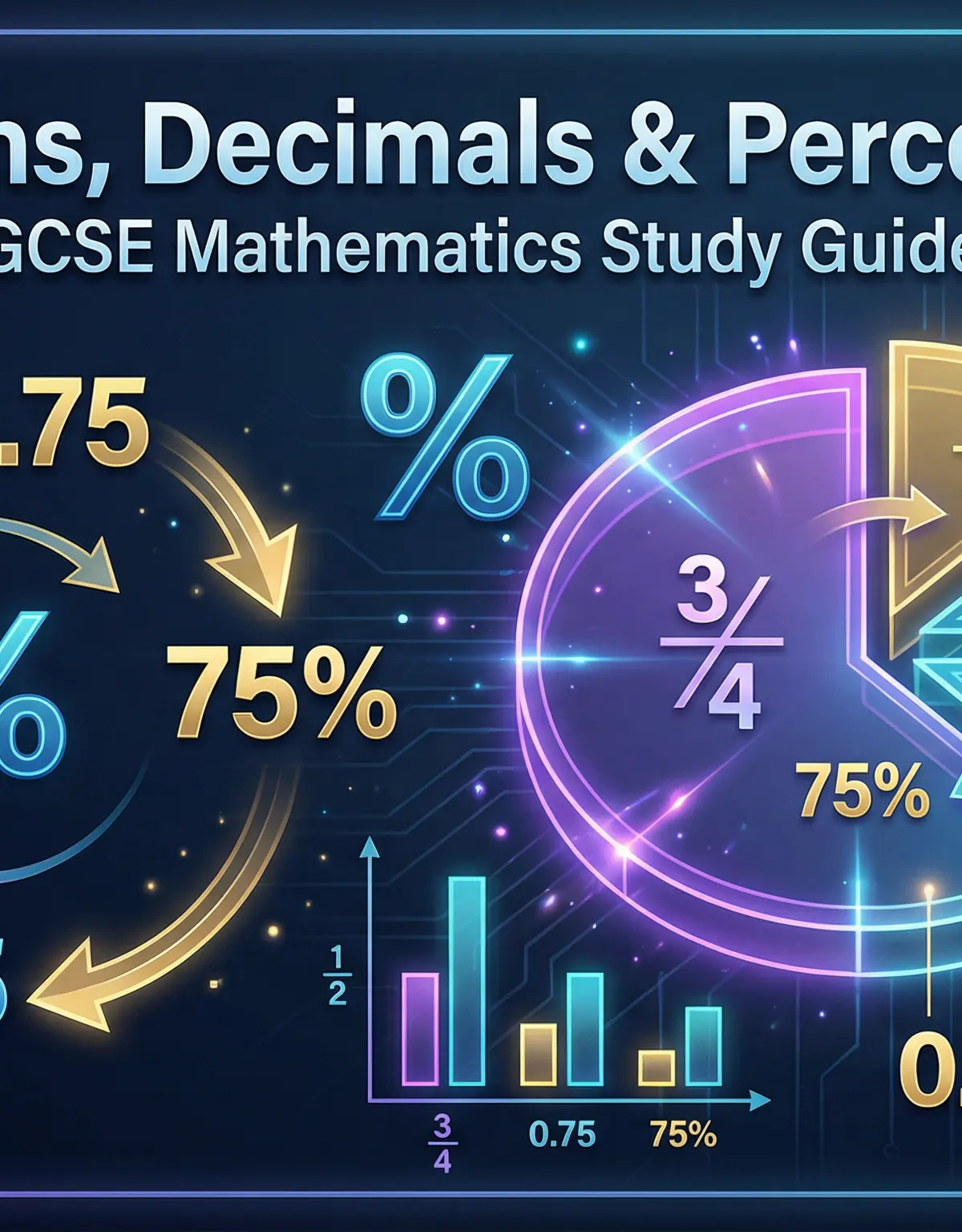
Fractions, decimals, and percentages form the bedrock of numerical and algebraic reasoning in GCSE Mathematics. This topic is not just an isolated chapter; it is a fundamental toolkit that connects to probability, statistics, ratio, and algebra. Examiners frequently test your fluency in moving between these three forms, often within the same multi-step question. Whether you are calculating compound interest, comparing probabilities, or simplifying algebraic fractions, mastering these conversions is non-negotiable for achieving top grades.
Typical exam questions range from simple 1-mark conversions in the Foundation tier to complex 4-mark compound interest or recurring decimal problems in the Higher tier. Candidates who confidently use percentage multipliers tend to save valuable time and make fewer calculation errors than those relying on traditional, multi-step methods.
Listen to the audio guide below for a comprehensive walk-through of the core concepts, complete with exam tips and a quick-fire recall quiz.
Key Concepts
Concept 1: The Holy Trinity of Equivalence
Fractions, decimals, and percentages are simply three different languages used to describe the exact same proportion of a whole. Understanding how to translate between them fluidly is where many marks are gained or lost.
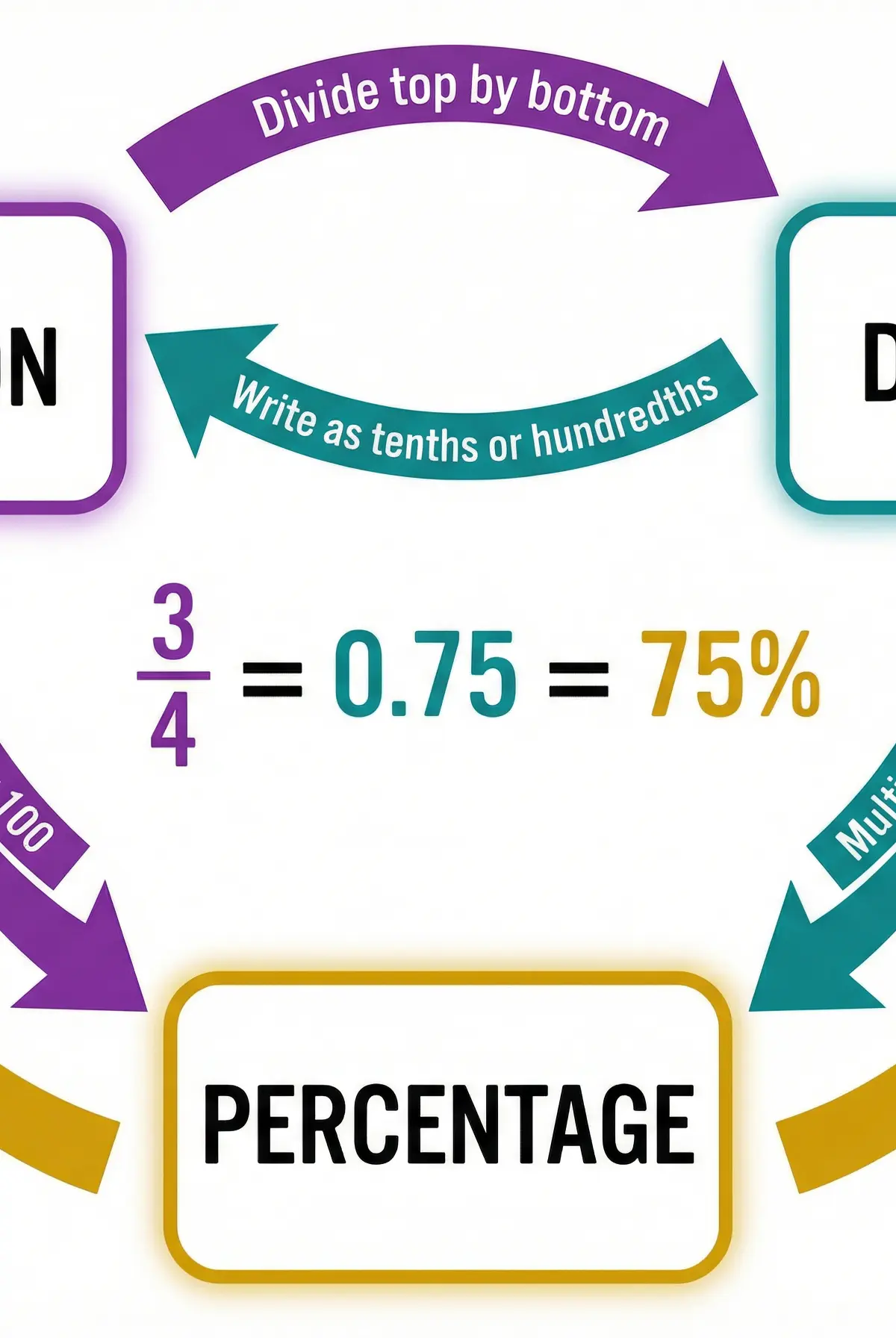
Fraction to Decimal: Divide the numerator (top) by the denominator (bottom).
Example: \frac{3}{8} = 3 \div 8 = 0.375
Decimal to Percentage: Multiply by 100 (move the decimal point two places to the right).
Example: 0.375 \times 100 = 37.5%
Percentage to Decimal: Divide by 100 (move the decimal point two places to the left).
Example: 42% \div 100 = 0.42
Percentage to Fraction: Write the percentage over 100, then simplify to its lowest terms.
Example: 65% = \frac{65}{100} = \frac{13}{20}
Concept 2: Percentage Multipliers
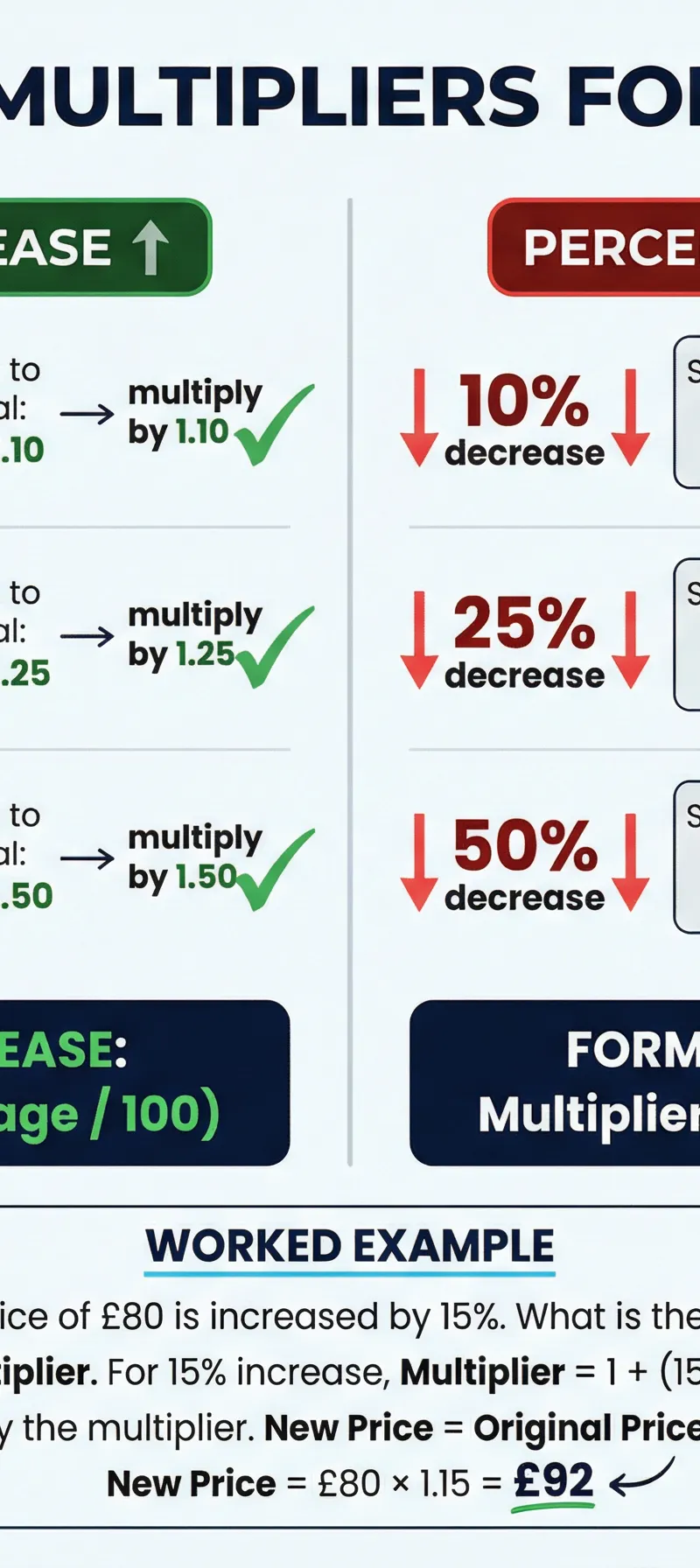
A percentage multiplier is a single decimal number that applies a percentage increase or decrease in one efficient calculation. Examiners heavily reward the use of multipliers because it demonstrates higher-order mathematical fluency and reduces the risk of arithmetic errors.
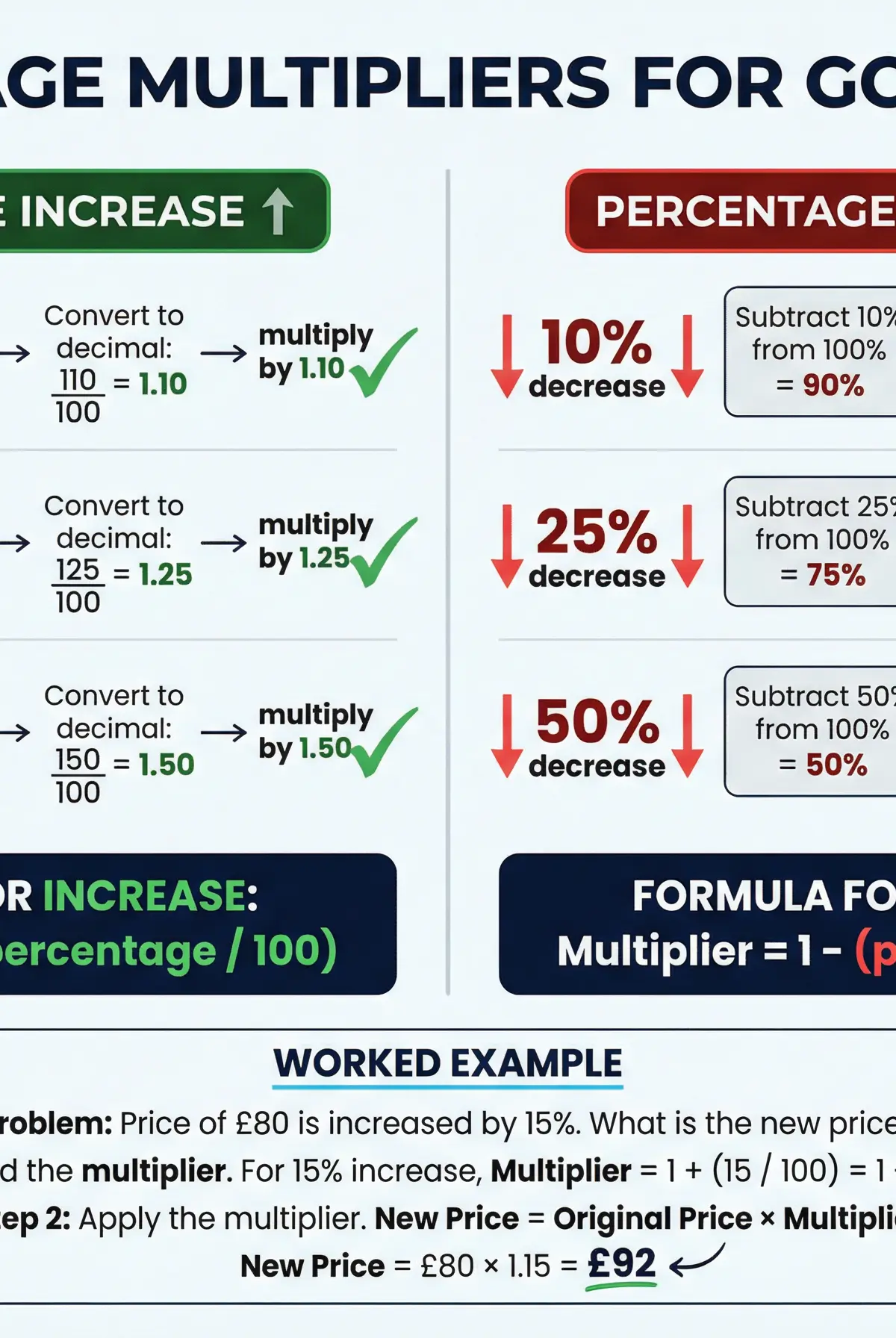
For an Increase: The multiplier is 1 + \text{the decimal equivalent}.
Example: A 15% increase means you retain the original 100% and add 15%, giving 115%. As a decimal, this is 1.15. To increase £80 by 15%, calculate 80 \times 1.15 = £92.
For a Decrease: The multiplier is 1 - \text{the decimal equivalent}.
Example: A 20% decrease means you subtract 20% from 100%, leaving 80%. As a decimal, this is 0.80. To decrease £80 by 20%, calculate 80 \times 0.80 = £64.
Concept 3: Compound Interest and Depreciation
Compound interest involves applying a percentage change repeatedly over multiple time periods. The percentage multiplier is raised to the power of the number of periods.
Formula: A = P \times (1 \pm \frac{r}{100})^n
Where:
- A = Final Amount
- P = Principal (starting amount)
- r = Percentage rate
- n = Number of time periods (e.g., years)
Example: £500 invested at 3% compound interest for 4 years.
Calculation: 500 \times 1.03^4 = £562.75
Concept 4: Recurring Decimals to Fractions (Higher Tier Only)
Some decimals repeat infinitely, such as 0.333... (0.\dot{3}). Converting these to exact fractions requires an algebraic approach that examiners test specifically.
Method:
- Set x equal to the recurring decimal.
- Multiply both sides by a power of 10 (10^1, 10^2, etc.) to shift the decimal point past the first repeating block.
- Subtract the original equation to eliminate the recurring part.
- Solve for x and simplify the resulting fraction.
Mathematical Relationships
| Conversion | Operation | Example |
|---|---|---|
| Fraction → Decimal | Numerator ÷ Denominator | $$\frac{4}{5} = 4 \div 5 = 0.8$$ |
| Decimal → Percentage | Multiply by 100 | $$0.8 \times 100 = 80%$$ |
| Percentage → Decimal | Divide by 100 | $$80% \div 100 = 0.8$$ |
| Percentage → Fraction | Write over 100, simplify | $$80% = \frac{80}{100} = \frac{4}{5}$$ |
Practical Applications
Understanding these concepts is crucial for personal finance, such as calculating the final cost of a sale item (percentage decrease), determining the return on a savings account (compound interest), or comparing mortgage rates. In science, you will frequently convert between these forms when expressing experimental yields, calculating percentage error, or dealing with probabilities in genetics.
Interactive Diagrams
2 interactive diagrams to visualise key concepts
Conceptual Flow Outline
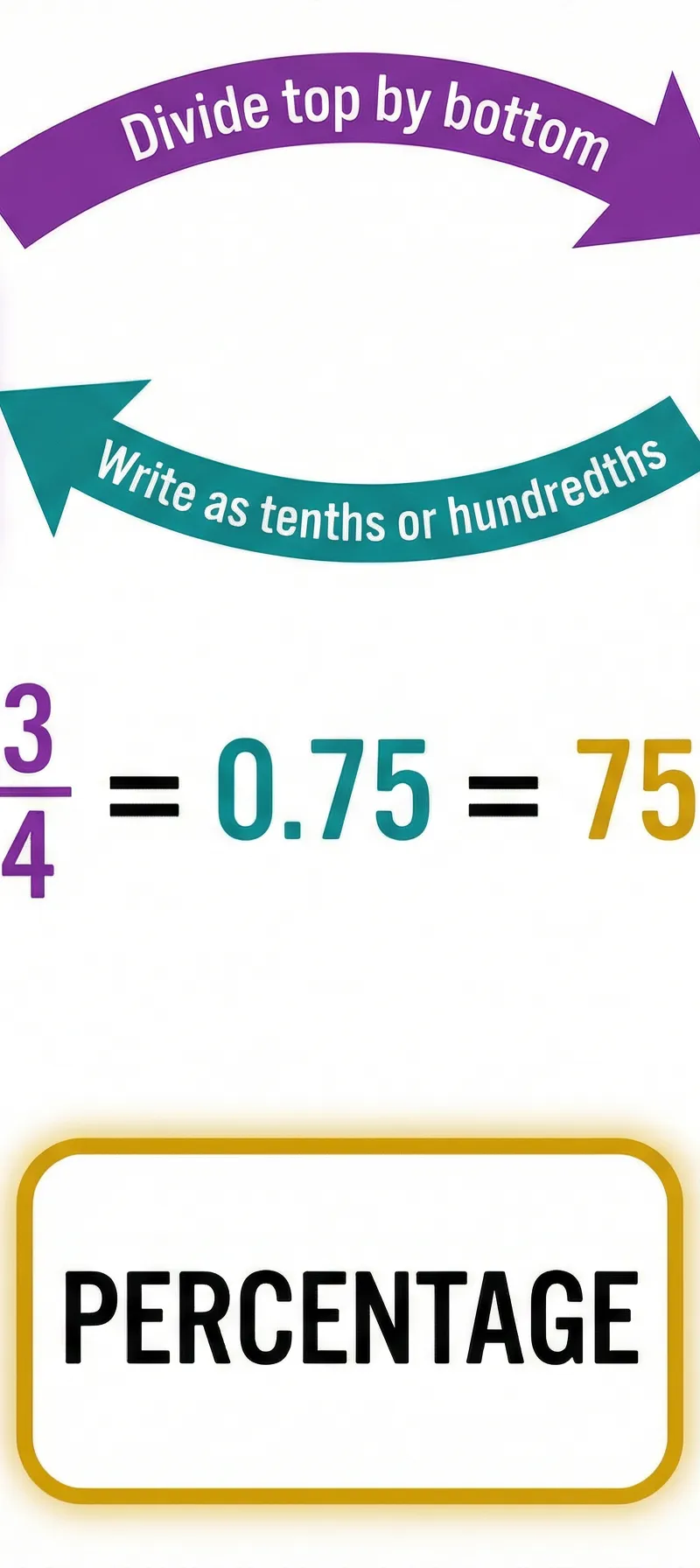
Conversion pathways between Fractions, Decimals, and Percentages.
Conceptual Flow Outline
Decision flowchart for selecting and applying percentage multipliers.
Worked Examples
3 worked examples — open one to explore the question and available guidance.
Practice Questions
Try the question, then reveal an answer plan or example response
Write 0.65 as a fraction in its simplest form. (2 marks)
Hint: What place value does the '5' represent? Write the decimal over 100 first.
A shop has a sale with 15% off all prices. The normal price of a television is £420. Calculate the sale price. (3 marks)
Hint: What is the percentage multiplier for a 15% decrease?
Arrange the following in order of size, starting with the smallest: \frac{3}{5}, 62%, 0.58, \frac{7}{10}. (2 marks)
Hint: Convert all the values to decimals first to make them easy to compare.
Sarah invests £4000 in a savings account paying 2.5% compound interest per annum. Calculate the total amount in the account after 5 years. (3 marks)
Hint: Use the compound interest formula: Principal × Multiplier^Years
Prove algebraically that 0.2\dot{7} can be written as \frac{5}{18}. (3 marks) [Higher Tier]
Hint: Only the 7 is recurring. Multiply by 10 to move the non-recurring part, then multiply by 100 to move the recurring part.
Exam technique
How to turn what you know into marks
How to approach the question
Always read the command word carefully. If a question asks to 'Prove algebraically', you cannot use trial and error. For percentage questions, immediately write down the multiplier before starting the calculation.
How to structure your answer
For multi-step calculations, structure your answer linearly down the page. State the formula or method, show the substitution, write the unrounded answer, and finally write the rounded answer with units.
Timing
Approximately 1 minute per mark, so a 3-mark question should take about 3 minutes.
Common pitfalls
- Writing 5% as 0.5 instead of 0.05. Remember 5% is 5/100, which is 0.05.
- Using simple interest methods (calculating the percentage once and multiplying by the years) when compound interest is required.
- Failing to simplify fractions to their lowest terms in the final answer.
- Calculating percentage change by dividing the difference by the new value instead of the original value.
What the command words want
- Compare
- Calculate values for both options and explicitly state which is larger/smaller using comparative language or inequality symbols.
- Evaluate
- Not common in pure algebra, but if asked, calculate the result and make a judgement based on the context of the question.
- Calculate
- Show working, use the correct method, and include units. Method marks are available even if the final calculation is wrong.
- Show that
- Provide clear, step-by-step mathematical reasoning that leads to the given answer. You cannot use the answer to prove the answer.
- State/Give
- Brief factual answer - usually no working required.
- Prove algebraically
- Use algebra (let x = ...) to demonstrate a mathematical truth. Numerical examples will score zero marks.
Watch or listen (optional)
Test your understanding of Algebra
Active recall beats re-reading. Take an instant quiz now to test what you’ve learned and lock it into long-term memory.
A week of Premium from your first lesson · Then the free plan continues · No card, no charge