Study Notes
Overview
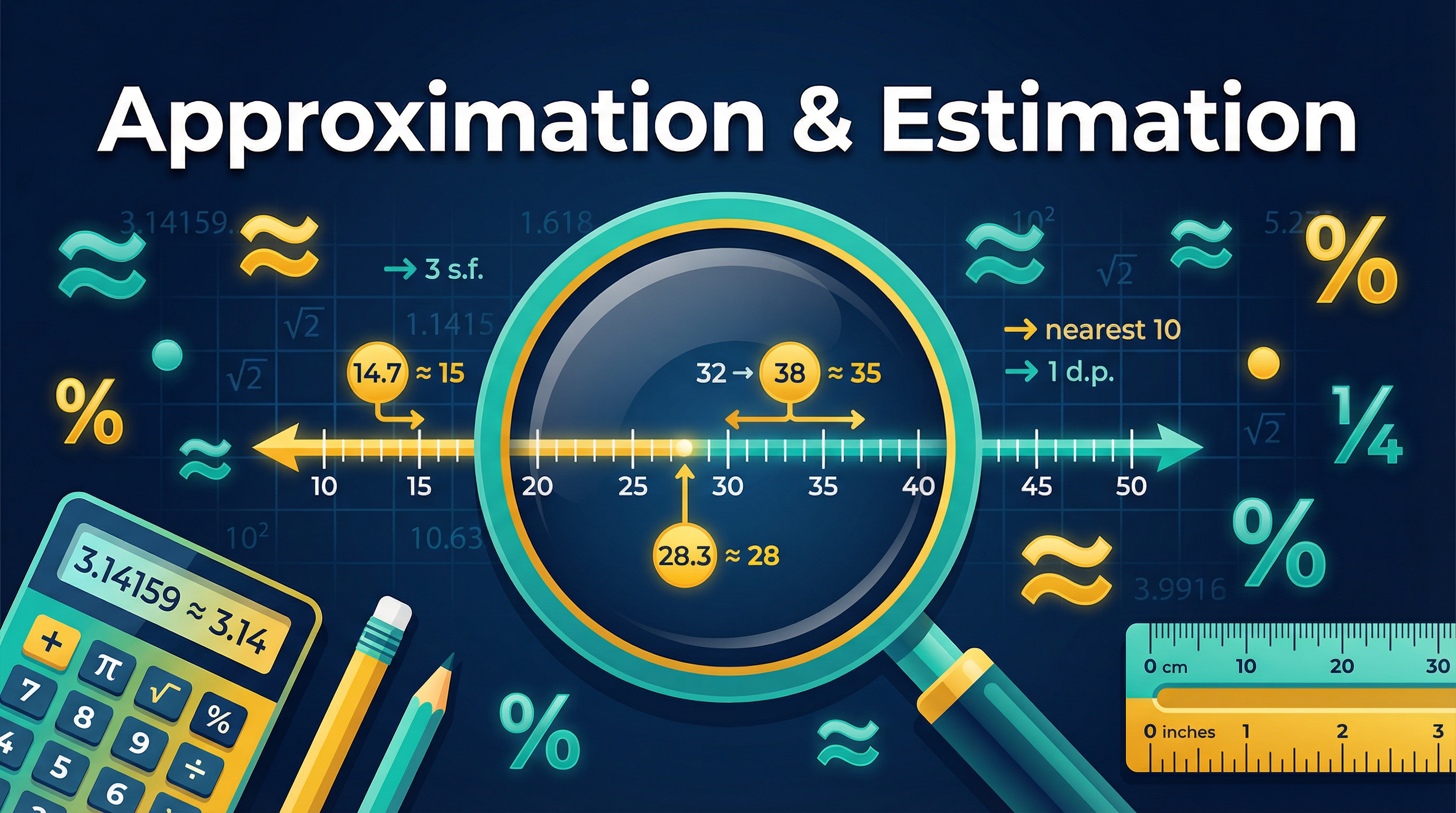
Approximation and Estimation are fundamental mathematical skills that extend far beyond simply rounding numbers. At the GCSE level, these concepts form the backbone of checking the reasonableness of calculations, understanding the limits of measurement accuracy, and efficiently tackling complex multi-step problems under exam conditions.
Examiners frequently embed estimation questions within broader topics such as geometry, percentage change, and algebra. This means that a strong grasp of how to round to decimal places and significant figures is essential for securing method marks across the entire paper. For Higher tier candidates, the topic expands into error intervals and bounds—a rigorous test of algebraic inequality notation and logical deduction.
By mastering these skills, candidates not only avoid careless arithmetic errors but also demonstrate a deep understanding of mathematical precision. The strategies detailed in this guide will ensure you know exactly when to round, how to identify the correct significant figure, and why method marks are your greatest asset in estimation questions.
Key Concepts
Concept 1: Rounding and Decimal Places
The foundation of approximation is rounding to a specified number of decimal places (d.p.). The golden rule is universally applied: locate the digit in the required position, then examine the digit immediately to its right. If this adjacent digit is 5 or greater, the target digit is rounded up. If it is 4 or less, the target digit remains unchanged (rounded down). All subsequent digits to the right are discarded.
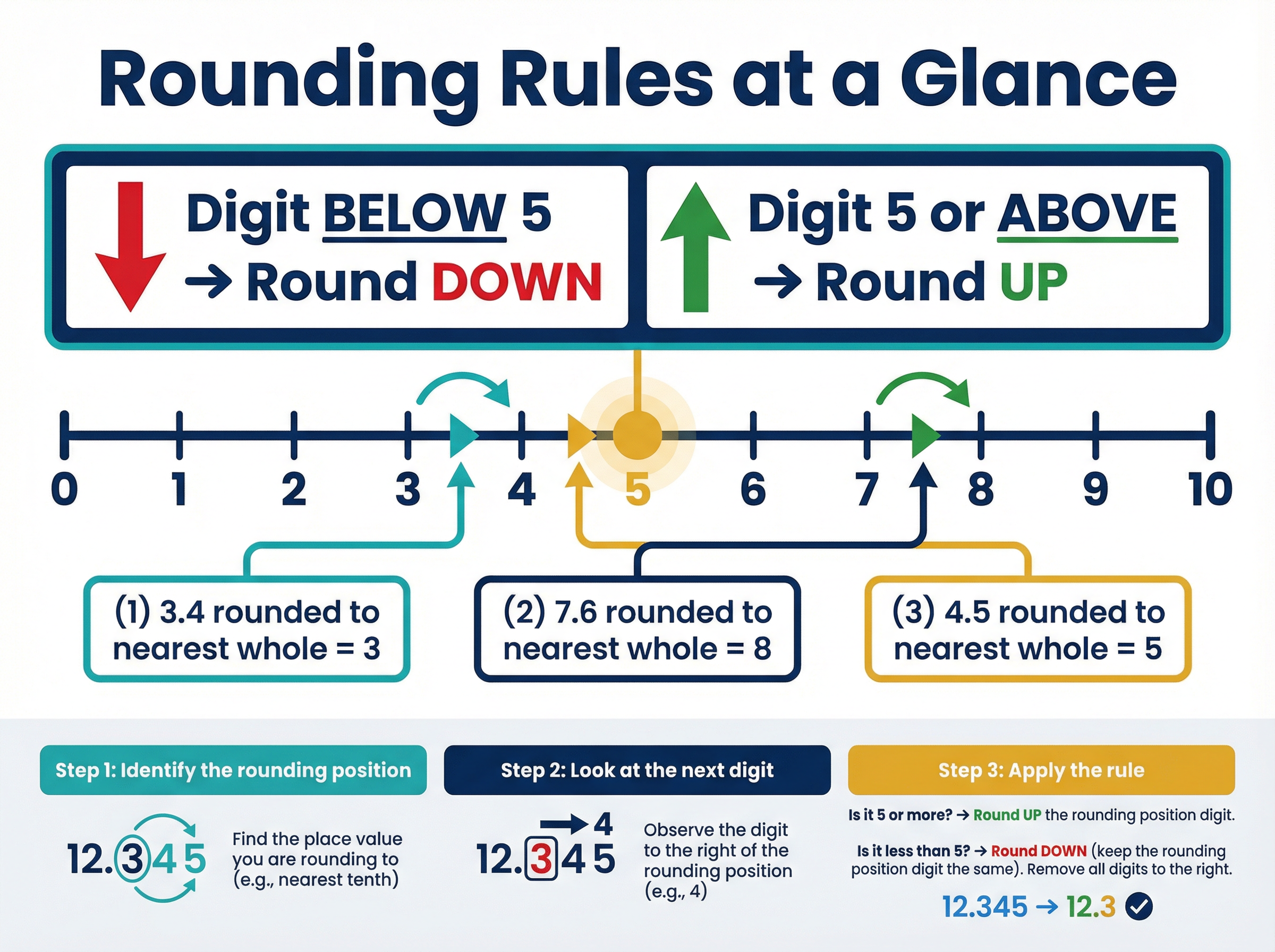
Example: Round 7.348 to one decimal place.
- Identify the first decimal place: 3.
- Look at the next digit to the right: 4.
- Since 4 is less than 5, round down by keeping the 3 and discarding the rest.
- Answer: 7.3.
Concept 2: Significant Figures
Unlike decimal places, significant figures (s.f.) measure accuracy relative to the magnitude of the number. The count begins at the first non-zero digit from the left. This concept often trips up candidates who confuse leading zeros (which are not significant) with trapped or trailing zeros (which are significant).
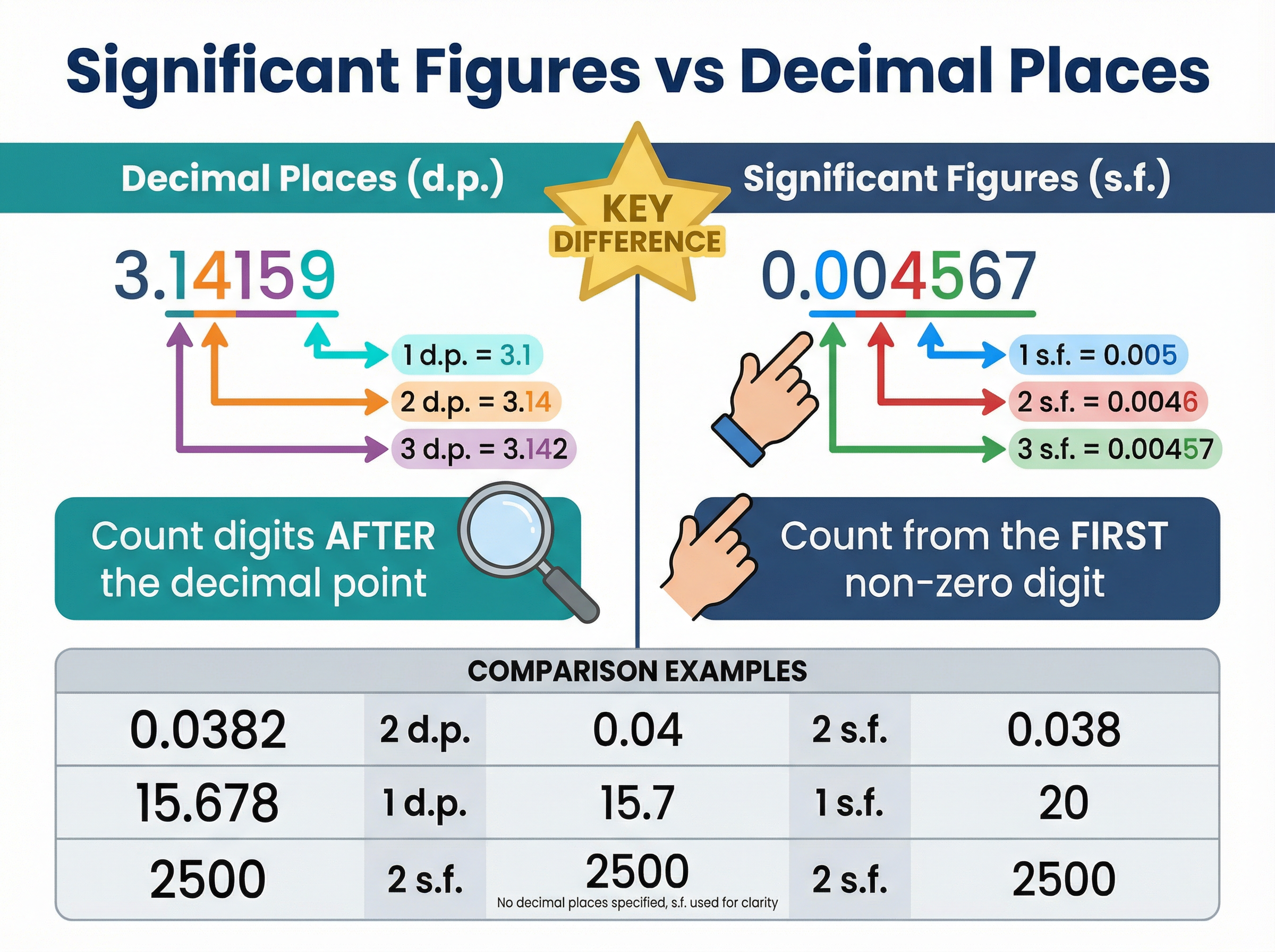
Example: Round 0.004572 to two significant figures.
- Identify the first non-zero digit: 4 (this is the 1st s.f.).
- The second significant figure is 5.
- Look at the next digit: 7.
- Since 7 \geq 5, round up the 5 to 6.
- Answer: 0.0046.
Concept 3: Estimation Strategies
Estimation is the process of finding an approximate answer to a complex calculation. The examiner-approved strategy is to round every number in the calculation to one significant figure before performing any arithmetic. This simplifies the calculation while maintaining a proportional scale.
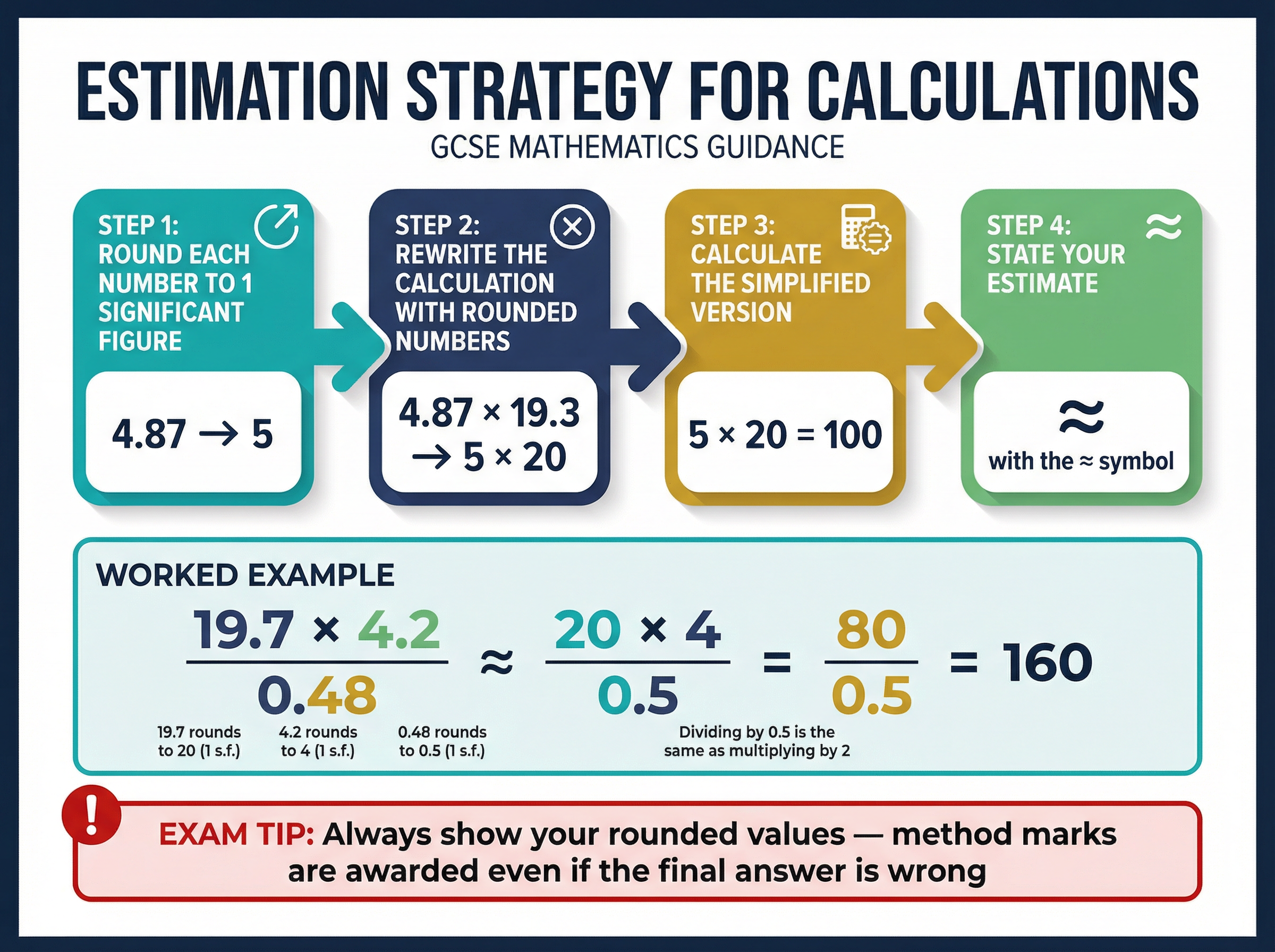
Example: Estimate the value of \frac{19.7 \times 4.2}{0.48}.
- Round each number to 1 s.f.: 19.7 \approx 20, 4.2 \approx 4, 0.48 \approx 0.5.
- Rewrite the calculation: \frac{20 \times 4}{0.5}.
- Calculate the numerator: 20 \times 4 = 80.
- Calculate the final estimate: 80 \div 0.5 = 160.
Concept 4: Error Intervals and Bounds (Higher Tier)
Whenever a measurement is rounded, the true value lies within a specific range known as the error interval. The lower bound is the smallest possible value that would round up to the given number, while the upper bound is the largest possible value (using a strict inequality) that would round down.
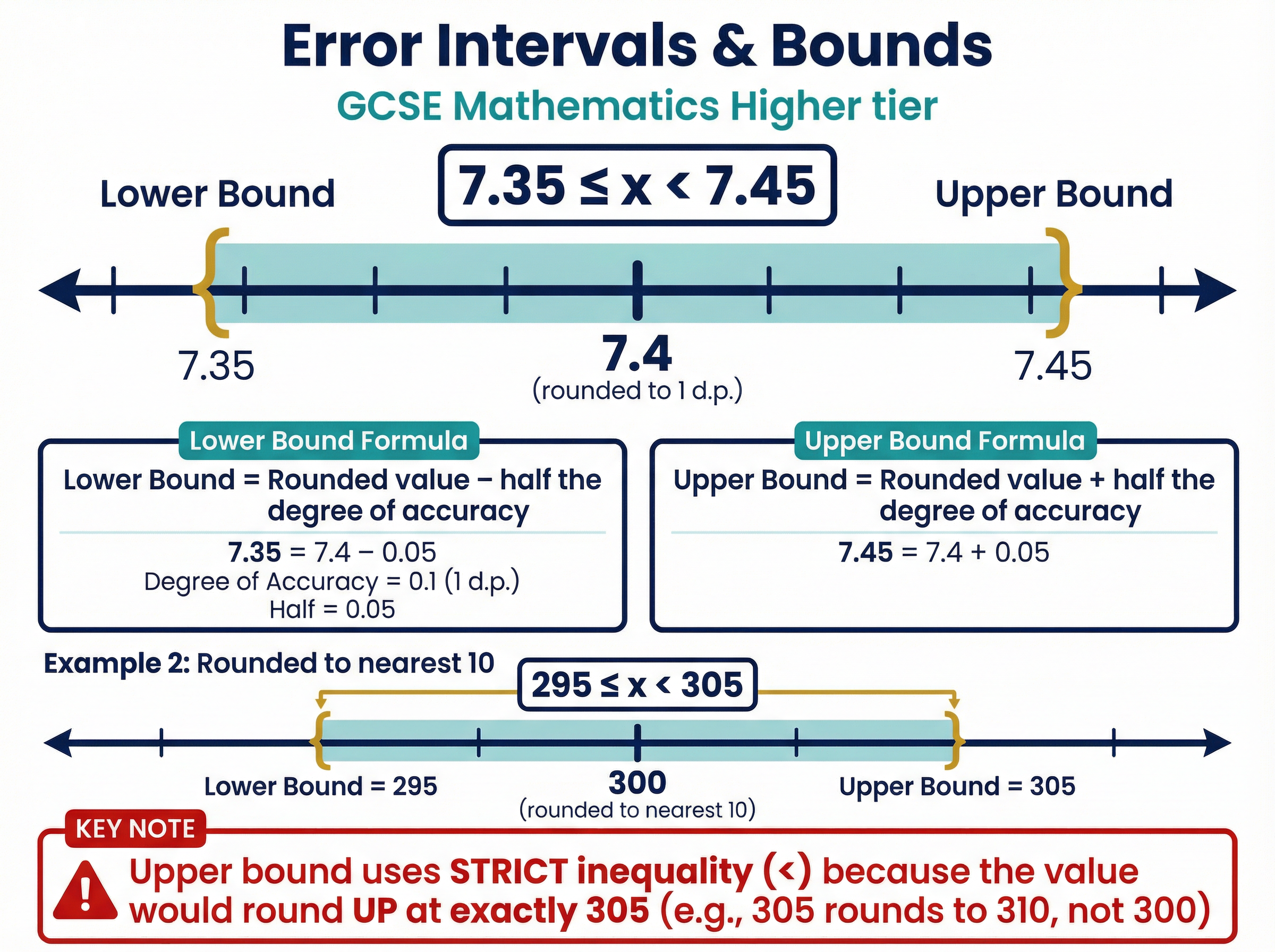
Example: A length L is measured as 7.4 cm, rounded to 1 decimal place. State the error interval for L.
- The degree of accuracy is 0.1 cm.
- Half the degree of accuracy is 0.05 cm.
- Lower bound: 7.4 - 0.05 = 7.35.
- Upper bound: 7.4 + 0.05 = 7.45.
- Error interval: 7.35 \leq L < 7.45.
Podcast Episode
Listen to our comprehensive 10-minute audio guide covering all key concepts, exam strategies, and a quick-fire recall quiz.
Mathematical Relationships
- Lower Bound Formula: \text{Lower Bound} = \text{Rounded Value} - \frac{1}{2}(\text{Degree of Accuracy})
- Upper Bound Formula: \text{Upper Bound} = \text{Rounded Value} + \frac{1}{2}(\text{Degree of Accuracy})
- Calculations with Bounds:
- Maximum Value of Addition = \text{Upper Bound}_1 + \text{Upper Bound}_2
- Maximum Value of Division = \frac{\text{Upper Bound of Numerator}}{\text{Lower Bound of Denominator}}
Practical Applications
Estimation is critical in real-world scenarios such as construction (estimating material costs), finance (quick percentage yields), and engineering (calculating worst-case scenario tolerances using error bounds).
Visual Resources
4 diagrams and illustrations
Interactive Diagrams
2 interactive diagrams to visualise key concepts
Conceptual Flow Outline
Flowchart detailing the standard examiner-approved method for estimation questions.
Conceptual Flow Outline
Process map for calculating error intervals and bounds.
Worked Examples
3 detailed examples with solutions and examiner commentary
Practice Questions
Test your understanding — click to reveal model answers
Round 0.05681 to 2 significant figures. (1 mark)
Hint: Remember to ignore the leading zeros and start counting from the first non-zero digit.
Estimate the value of \frac{6.8 \times 191}{0.051}. (3 marks)
Hint: Round each number to 1 significant figure before you multiply or divide.
A car travels a distance of 240 km, correct to the nearest 10 km. It takes 3.5 hours, correct to the nearest 0.1 hours. Calculate the upper bound for the average speed of the car. (4 marks)
Hint: Speed = Distance ÷ Time. To maximize a fraction, you need the largest possible numerator and the smallest possible denominator.
Write down the error interval for y if y = 15.3 truncated to 1 decimal place. (2 marks)
Hint: Truncation simply chops off the digits without rounding up.
Use estimation to show that the exact answer to 3.1^2 \times 8.9 is less than 100. (2 marks)
Hint: Estimate the calculation and then explain why the exact answer must be smaller.