OCR · GCSE · Mathematics
Course version: J560 · Version from Sept 2017
Basic Geometry
Master the fundamental connections between fractions, decimals, and percentages. These core skills are essential for both Foundation and Higher tier exams, unlocking marks across multiple topics from probability to compound interest.
- 5 min read
- 3 worked examples
- 5 practice questions
- 6 key terms
Check what you remember
Read the wording for your board, then hide it and explain Numerator in your own words. Rough notes are fine. This is a self-check, with no mark or grade.
Reference: OCR
The top number in a fraction, representing how many parts we have.
Study Notes
Overview
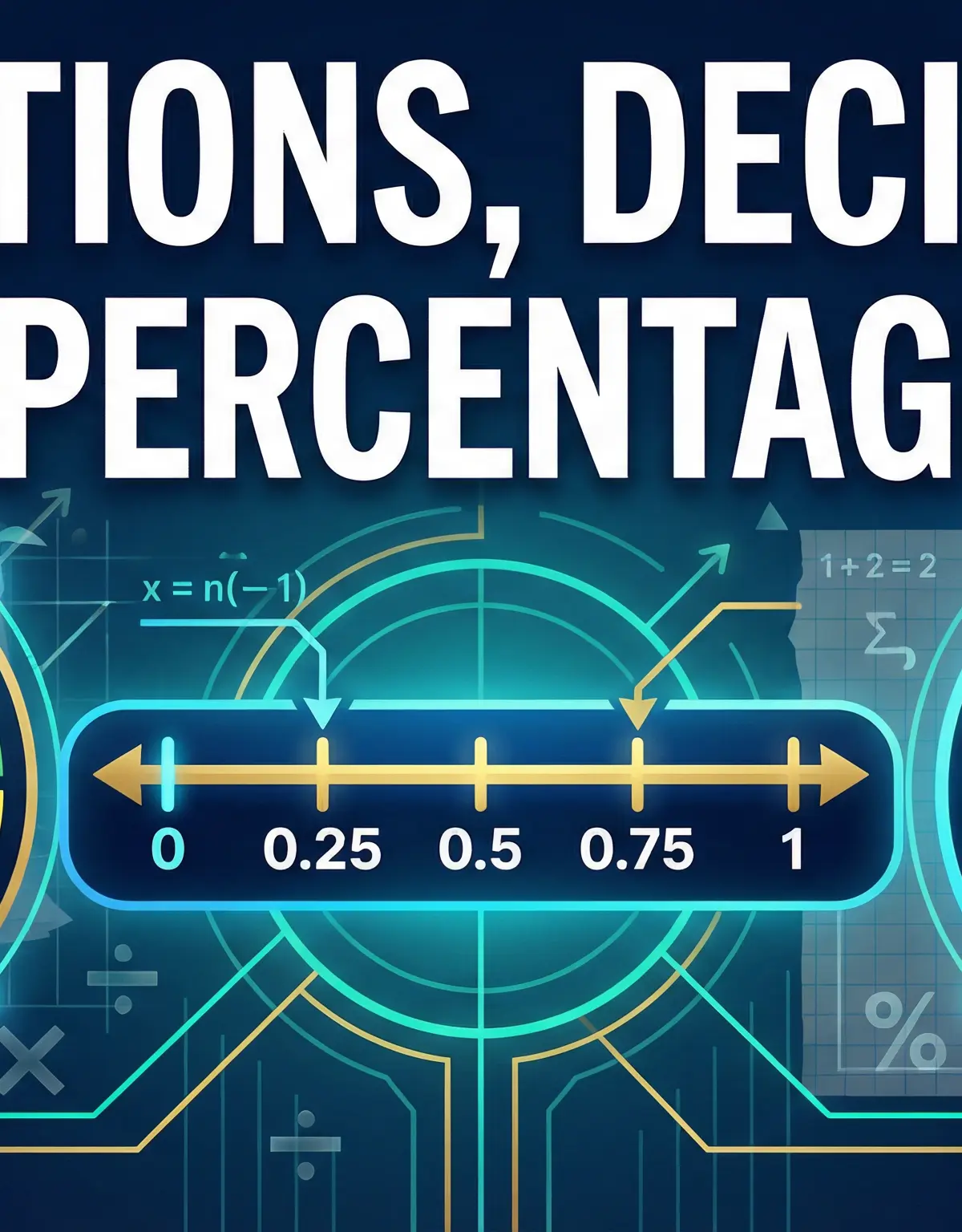
Fractions, Decimals, and Percentages (FDP) form the bedrock of numerical reasoning in GCSE Mathematics. This topic is fundamentally about understanding that a single value or proportion can be represented in three distinct ways. Whether you are calculating a discount in a sale, determining the probability of an event, or comparing data sets, fluency in converting between these forms is absolutely critical.
Examiners frequently test this topic in both isolated calculation questions and embedded within broader problem-solving contexts. You will encounter questions asking you to order mixed lists of values, calculate percentage changes using multipliers, and apply these skills to real-world financial scenarios. Mastery here is not just about learning rules; it is about developing an intuitive sense of proportion that will serve you throughout the entire syllabus.
Key Concepts
Concept 1: FDP Conversion
The most essential skill is moving seamlessly between fractions, decimals, and percentages. Think of them as three different languages describing the exact same amount.
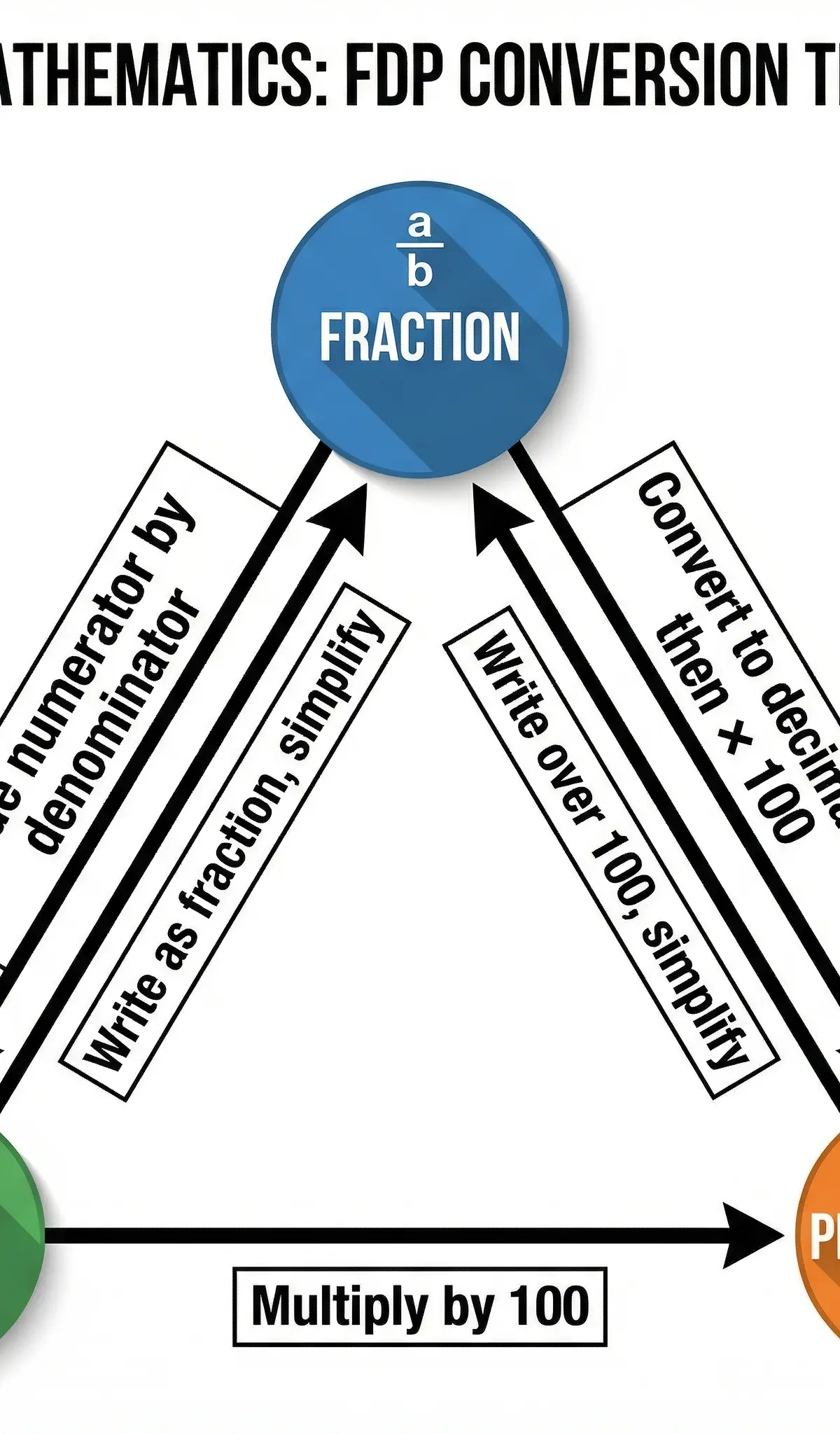
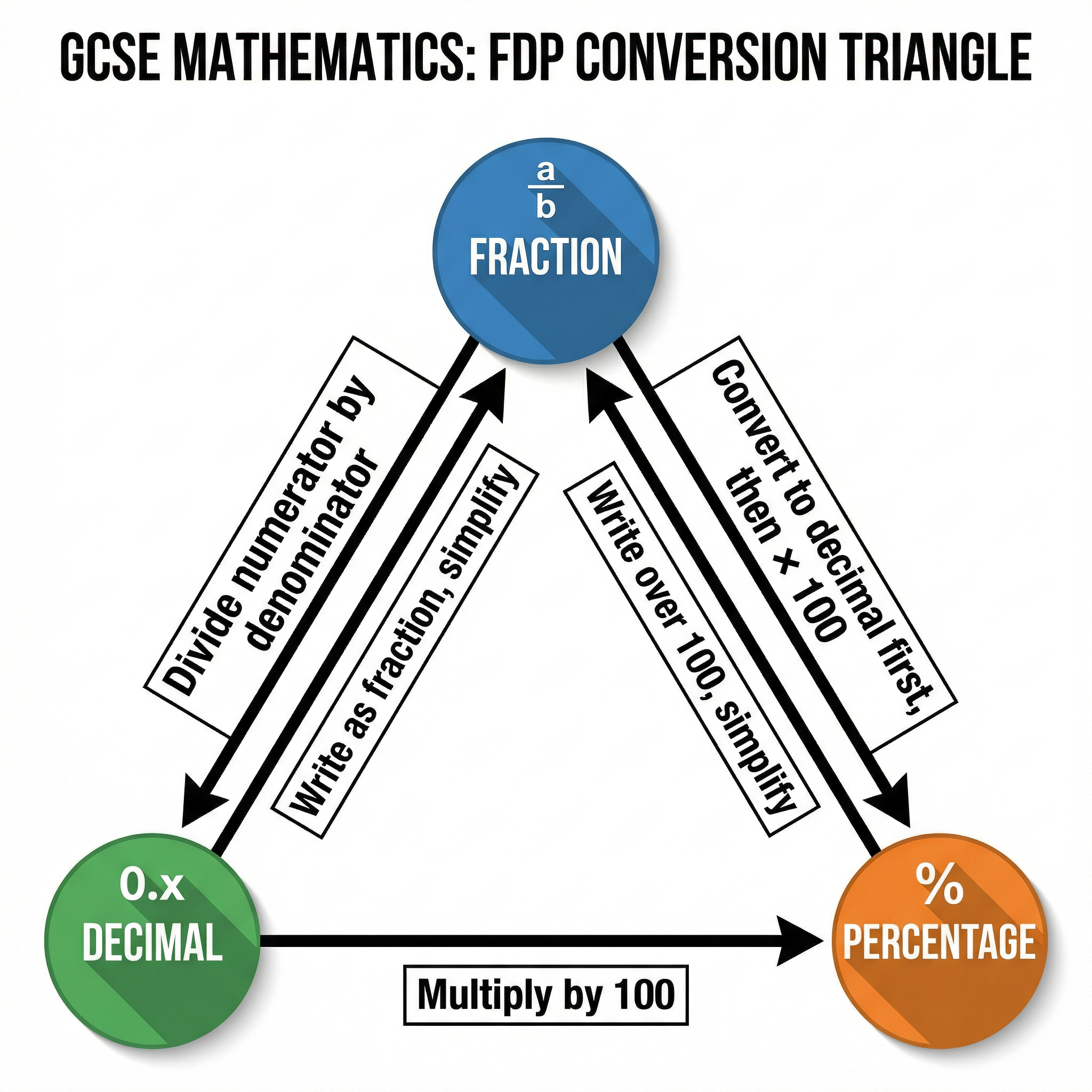
- Fraction to Decimal: Divide the numerator (top) by the denominator (bottom). For example, to convert \frac{3}{8}, you calculate 3 \div 8 = 0.375.
- Decimal to Percentage: Multiply by 100. This shifts the decimal point two places to the right. For example, 0.375 \times 100 = 37.5%.
- Percentage to Fraction: Write the percentage over 100 and simplify fully. For example, 45% becomes \frac{45}{100}. Dividing both by their highest common factor (5) gives \frac{9}{20}.
Examiner Tip: A very common error is converting single-digit percentages incorrectly. Remember that 5% is 0.05, not 0.5. Always divide by 100 carefully.
Concept 2: Fractions of Quantities
When asked to find a fraction of an amount, you are essentially scaling that amount. To find \frac{a}{b} of a quantity Q, you divide the quantity by the denominator b (to find one part) and then multiply by the numerator a (to find a parts).
Example: Find \frac{4}{7} of £350.
- Find \frac{1}{7}: 350 \div 7 = 50
- Find \frac{4}{7}: 50 \times 4 = 200
Final answer: £200
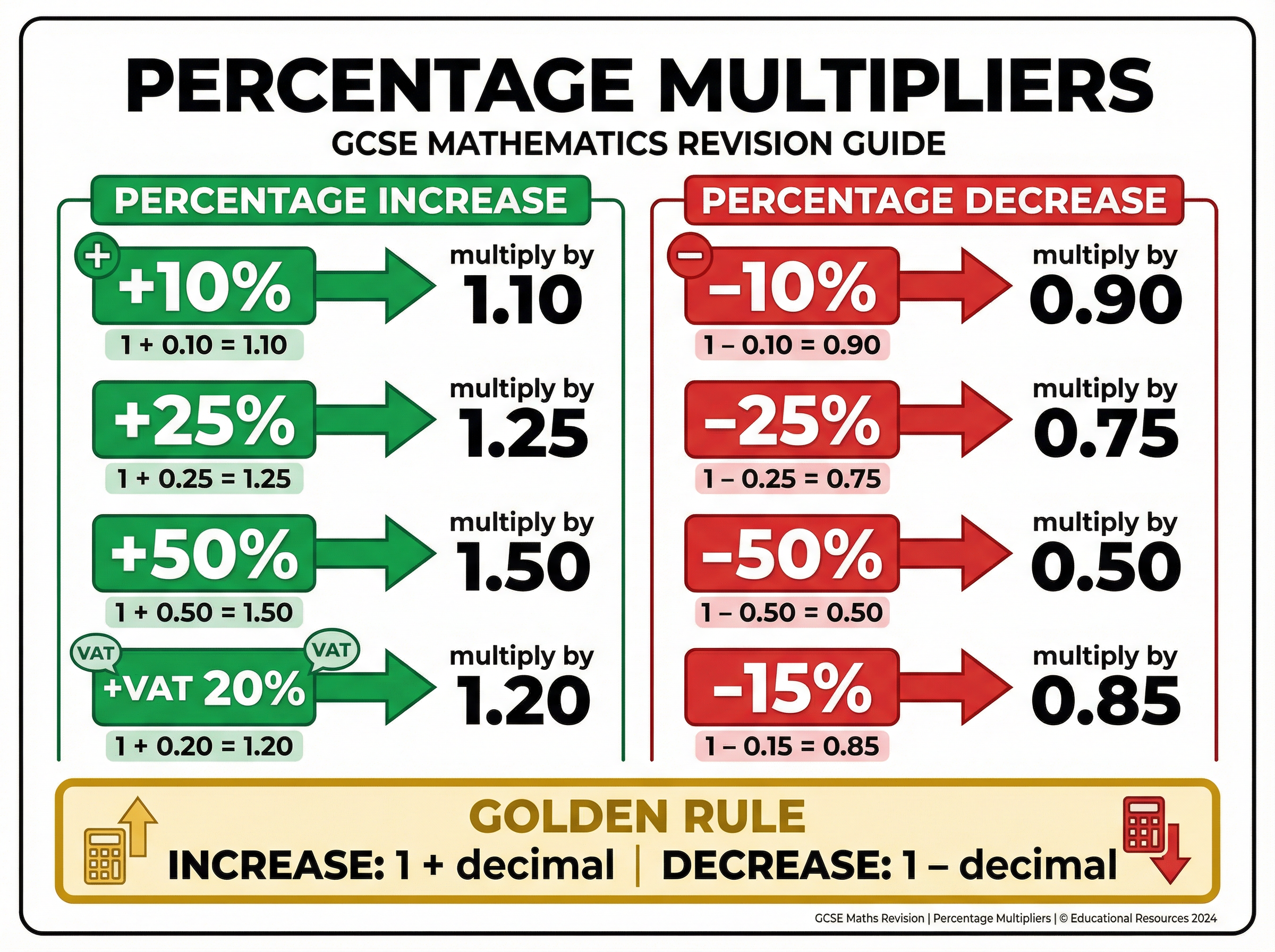
Concept 3: Percentage Multipliers
This is the most efficient way to handle percentage increase and decrease, especially on calculator papers. Instead of calculating the percentage and then adding or subtracting it, you use a single multiplier.
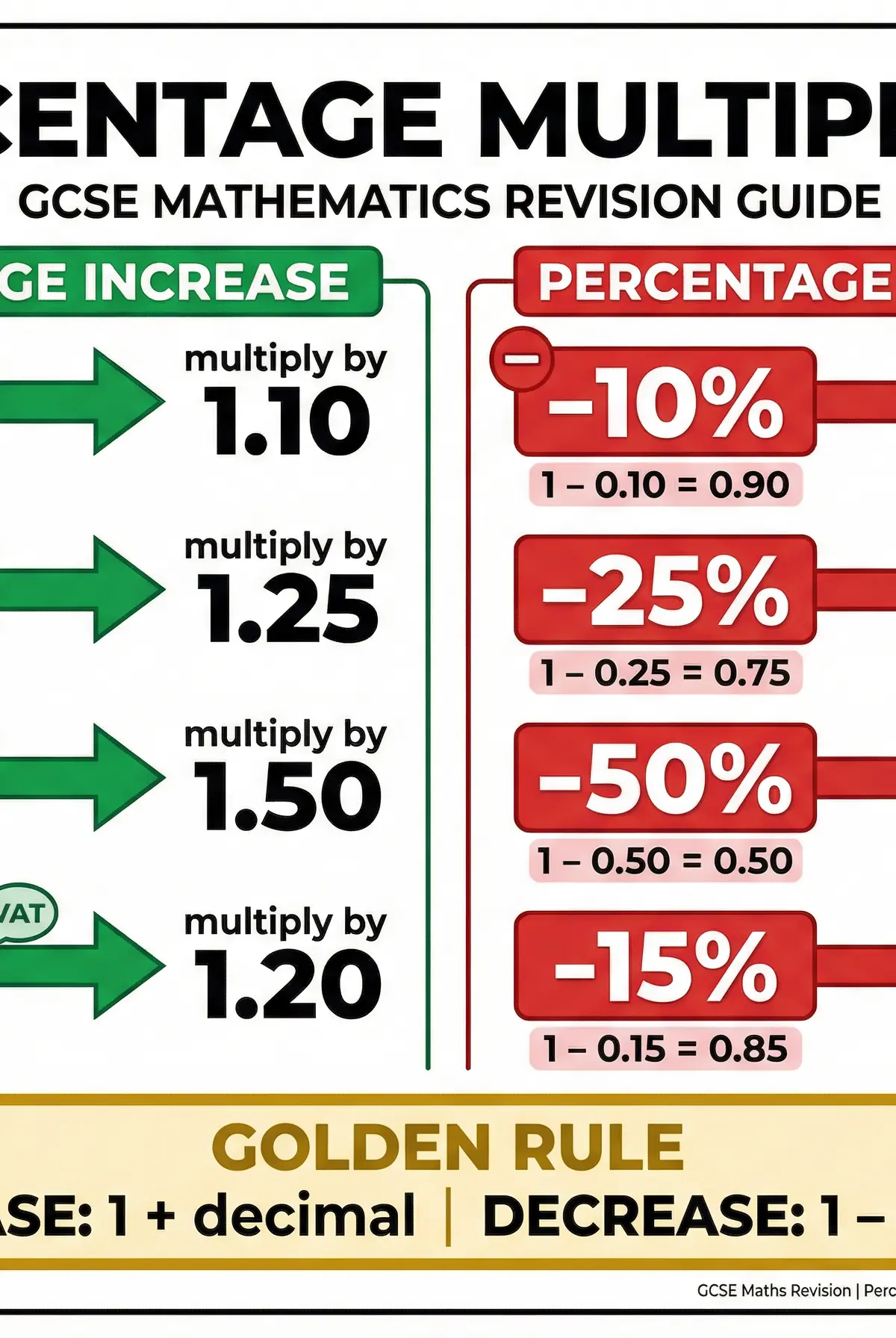
- Percentage Increase: Multiplier = 1 + \text{decimal percentage}. For a 15% increase, the multiplier is 1 + 0.15 = 1.15.
- Percentage Decrease: Multiplier = 1 - \text{decimal percentage}. For a 20% decrease, the multiplier is 1 - 0.20 = 0.80.
Example: A car costs £12,000. It depreciates by 18% in its first year. What is its new value?
Multiplier = 1 - 0.18 = 0.82
New Value = 12000 \times 0.82 = £9,840
Concept 4: Ordering Mixed Types
When asked to order a list containing fractions, decimals, and percentages, the most reliable method is to convert all of them into decimals first. Once they are all in the same format, compare their place values, order them, and then write your final answer using the original forms given in the question.
Example: Order from smallest to largest: 0.62, 60%, \frac{5}{8}, \frac{2}{3}.
- Convert to decimals: 0.62 = 0.62, 60% = 0.60, \frac{5}{8} = 0.625, \frac{2}{3} = 0.666...
- Order decimals: 0.60, 0.62, 0.625, 0.666...
- Original forms: 60%, 0.62, \frac{5}{8}, \frac{2}{3}
Concept 5: Recurring Decimals to Fractions (Higher Tier Only)
A recurring decimal has a repeating pattern of digits. To convert it to a fraction, we use an algebraic method to eliminate the recurring part.
Example: Convert 0.\dot{4}\dot{5} to a fraction in its simplest form.
- Let x = 0.454545...
- Multiply by 100 (because 2 digits recur): 100x = 45.454545...
- Subtract the original equation: 100x - x = 45.454545... - 0.454545...
- 99x = 45
- x = \frac{45}{99}
- Simplify (divide by 9): x = \frac{5}{11}
Mathematical Relationships
- Fraction to Decimal: Decimal = \frac{\text{Numerator}}{\text{Denominator}}
- Decimal to Percentage: Percentage = Decimal \times 100
- Percentage Increase Multiplier: M = 1 + \frac{P}{100}
- Percentage Decrease Multiplier: M = 1 - \frac{P}{100}
- New Value: \text{New Value} = \text{Original Value} \times \text{Multiplier}
Practical Applications
Understanding FDP is crucial for everyday financial literacy.
- Retail and Sales: Calculating discounts during sales requires percentage decrease multipliers.
- Banking and Finance: Understanding interest rates on savings accounts or loans relies on percentage increase multipliers (and compound interest, which builds on this).
- Data Analysis: Interpreting statistics in news articles often involves converting raw data (fractions) into percentages for easier comparison.
Visual Resources
2 diagrams and illustrations
Interactive Diagrams
2 interactive diagrams to visualise key concepts
Conceptual Flow Outline
Flowchart showing how to convert between Fractions, Decimals, and Percentages.
Conceptual Flow Outline
Decision process for using percentage multipliers.
Worked Examples
3 worked examples — open one to explore the question and available guidance.
Practice Questions
Try the question, then reveal an answer plan or example response
Convert 0.45 to a fraction in its simplest form. (2 marks)
Hint: Write it over 100 first, then look for a common factor.
Calculate 15% of £340. (2 marks)
Hint: You can find 10%, then 5%, and add them together. Or use a multiplier.
A train ticket costs £65. The price increases by 12%. Work out the new price of the ticket. (3 marks)
Hint: What is the multiplier for a 12% increase?
Order the following from smallest to largest: \frac{3}{5}, 62%, 0.58, \frac{13}{20}. (3 marks)
Hint: Convert all of them to decimals first.
Prove algebraically that the recurring decimal 0.8\dot{3} can be written as \frac{5}{6}. (3 marks) [Higher Tier]
Hint: Let x equal the decimal. You need to multiply by 10 and 100 to get the recurring parts to line up.
Watch or listen (optional)
Test your understanding of Basic Geometry
Active recall beats re-reading. Take an instant quiz now to test what you’ve learned and lock it into long-term memory.
7 days Premium · Then the free plan continues · No card, no charge