Fractions, Decimals and Percentages Revision Notes

    Subject: Mathematics | Level: GCSE | Exam Board: OCR

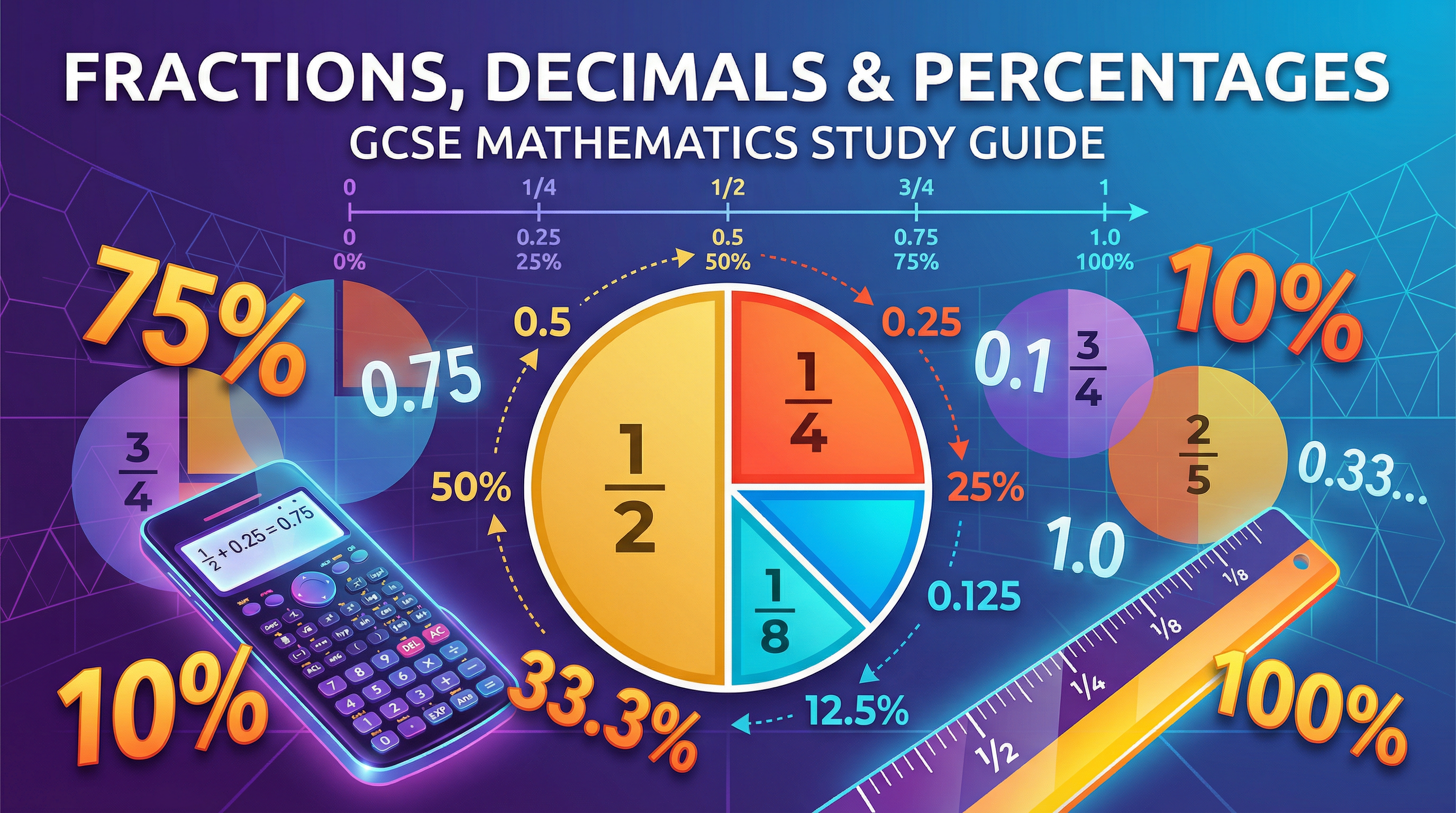
    Master the essential GCSE Maths topic of Fractions, Decimals, and Percentages (FDP). This guide will equip you to confidently switch between forms, tackle complex percentage problems, and secure maximum marks in your OCR exam. It's a cornerstone of the curriculum, vital for both calculator and non-calculator papers.

    Revision Notes & Key Concepts

    ![Header image for Fractions, Decimals and Percentages](https://xnnrgnazirrqvdgfhvou.supabase.co/storage/v1/object/public/study-guide-assets/guide_b34fd5b7-a61f-49b6-83c1-7b93b315ddf6/header_image.png) ## Overview Fractions, Decimals, and Percentages (FDP) are the three different ways of representing parts of a whole. Mastery of this topic is not just about performing calculations; it's about developing fluency and understanding the relationships between these forms. In your OCR GCSE Mathematics exam, you will be expected to move seamlessly between them, applying your knowledge to a wide range of problems, from simple arithmetic to complex financial calculations. This topic forms the bedrock of many other areas in mathematics, such as ratio, proportion, and probability. Examiners will test your ability to perform calculations without a calculator, as well as your problem-solving skills in contextual scenarios on calculator papers. Expect to see questions on finding fractions or percentages of amounts, percentage increases and decreases, and the more challenging reverse percentages. ## Key Concepts ### Concept 1: The FDP Connection Fractions, decimals, and percentages are fundamentally linked. A fraction represents a part of a whole (e.g., 1/2), a decimal represents the same part in base-10 (e.g., 0.5), and a percentage represents that part per hundred (e.g., 50%). Understanding how to convert between them is a critical skill. To convert a fraction to a decimal, you divide the numerator by the denominator. To convert a decimal to a percentage, you multiply by 100. To convert a percentage back to a fraction, you write it over 100 and simplify. **Example**: Convert 3/4 to a decimal and a percentage. - **Decimal**: 3 ÷ 4 = 0.75 - **Percentage**: 0.75 × 100 = 75% ![A conversion wheel for common FDP values.](https://xnnrgnazirrqvdgfhvou.supabase.co/storage/v1/object/public/study-guide-assets/guide_b34fd5b7-a61f-49b6-83c1-7b93b315ddf6/fdp_conversion_wheel.png) ### Concept 2: Fraction Arithmetic Candidates must be proficient in the four basic operations with fractions: addition, subtraction, multiplication, and division. For addition and subtraction, the key is to find a common denominator. For multiplication, you simply multiply the numerators and the denominators. For division, you use the 'Keep, Change, Flip' method, where you keep the first fraction, change the division to multiplication, and flip the second fraction (find its reciprocal). **Example**: Calculate 2/5 + 1/3. - Find a common denominator: 15 - Convert the fractions: (2×3)/(5×3) + (1×5)/(3×5) = 6/15 + 5/15 - Add the numerators: 11/15 ![A visual guide to fraction arithmetic.](https://xnnrgnazirrqvdgfhvou.supabase.co/storage/v1/object/public/study-guide-assets/guide_b34fd5b7-a61f-49b6-83c1-7b93b315ddf6/fraction_operations.png) ### Concept 3: Percentage Multipliers For percentage calculations, especially on calculator papers, using decimal multipliers is the most efficient and least error-prone method. An increase of P% corresponds to a multiplier of (1 + P/100), while a decrease of P% corresponds to a multiplier of (1 - P/100). This method is particularly powerful for compound interest and reverse percentage problems. **Example**: Increase £60 by 15%. - The multiplier is 1 + 15/100 = 1.15 - New amount = £60 × 1.15 = £69 ![A quick reference for percentage multipliers.](https://xnnrgnazirrqvdgfhvou.supabase.co/storage/v1/object/public/study-guide-assets/guide_b34fd5b7-a61f-49b6-83c1-7b93b315ddf6/percentage_multipliers.png) ### Concept 4: Reverse Percentages A common source of error is the reverse percentage problem, where you are given the final amount after a percentage change and asked to find the original amount. The key is to set up an algebraic equation using the multiplier. If a price was increased by 20% to £240, the original price (x) is found by solving 1.20x = £240, which means x = £240 ÷ 1.20 = £200. The mistake to avoid is calculating 20% of £240 and subtracting it. **Example**: A coat is in a sale with 30% off. The sale price is £84. What was the original price? - A 30% decrease means you have 70% of the original price. - The multiplier is 0.70. - 0.70 × Original Price = £84 - Original Price = £84 ÷ 0.70 = £120 ## Mathematical/Scientific Relationships - **Fraction to Decimal**: Numerator ÷ Denominator - **Decimal to Percentage**: Decimal × 100 - **Percentage to Fraction**: Percentage / 100 (and simplify) - **Percentage Increase**: New Amount = Original Amount × (1 + Percentage/100) - **Percentage Decrease**: New Amount = Original Amount × (1 - Percentage/100) - **Percentage Change**: (Difference / Original) × 100 - **Compound Interest**: A = P(1 + r/n)^(nt), where A is the future value, P is the principal, r is the annual interest rate, n is the number of times interest is compounded per year, and t is the number of years. For GCSE, you are more likely to perform year-on-year calculations. ## Practical Applications FDP is everywhere in the real world, which is why it's tested so heavily in context. You'll see it in: - **Shopping**: Discounts, sales tax (VAT), and special offers. - **Finance**: Interest rates on savings accounts and loans, inflation, and profit margins. - **Statistics**: Representing data in charts and graphs. - **Science**: Calculating concentrations of solutions or percentage yields in experiments. - **Everyday Life**: Splitting a bill, understanding nutritional information on food packaging, or following a recipe.
    Key Terms & Definitions

    Improper Fraction
    A fraction where the numerator is greater than or equal to the denominator (e.g., 5/4).
    Mixed Number
    A number consisting of an integer and a proper fraction (e.g., 1 1/4).
    Reciprocal
    The reciprocal of a number is 1 divided by that number. For a fraction, you 'flip' it (e.g., the reciprocal of 2/3 is 3/2).
    Multiplier
    The decimal used to calculate a percentage change in a single step (e.g., a 25% increase uses a multiplier of 1.25).
    Compound Interest
    Interest calculated on the initial principal, which also includes all of the accumulated interest from previous periods.
    Highest Common Factor (HCF)
    The largest number that divides into two or more numbers without a remainder.

    Worked Examples

    Practice Questions

    Fractions, Decimals and Percentages

    Master the essential GCSE Maths topic of Fractions, Decimals, and Percentages (FDP). This guide will equip you to confidently switch between forms, tackle complex percentage problems, and secure maximum marks in your OCR exam. It's a cornerstone of the curriculum, vital for both calculator and non-calculator papers.

    5
    Min Read
    3
    Examples
    5
    Questions
    6
    Key Terms

    Study Notes

    Header image for Fractions, Decimals and Percentages

    Overview

    Fractions, Decimals, and Percentages (FDP) are the three different ways of representing parts of a whole. Mastery of this topic is not just about performing calculations; it's about developing fluency and understanding the relationships between these forms. In your OCR GCSE Mathematics exam, you will be expected to move seamlessly between them, applying your knowledge to a wide range of problems, from simple arithmetic to complex financial calculations. This topic forms the bedrock of many other areas in mathematics, such as ratio, proportion, and probability. Examiners will test your ability to perform calculations without a calculator, as well as your problem-solving skills in contextual scenarios on calculator papers. Expect to see questions on finding fractions or percentages of amounts, percentage increases and decreases, and the more challenging reverse percentages.

    Key Concepts

    Concept 1: The FDP Connection

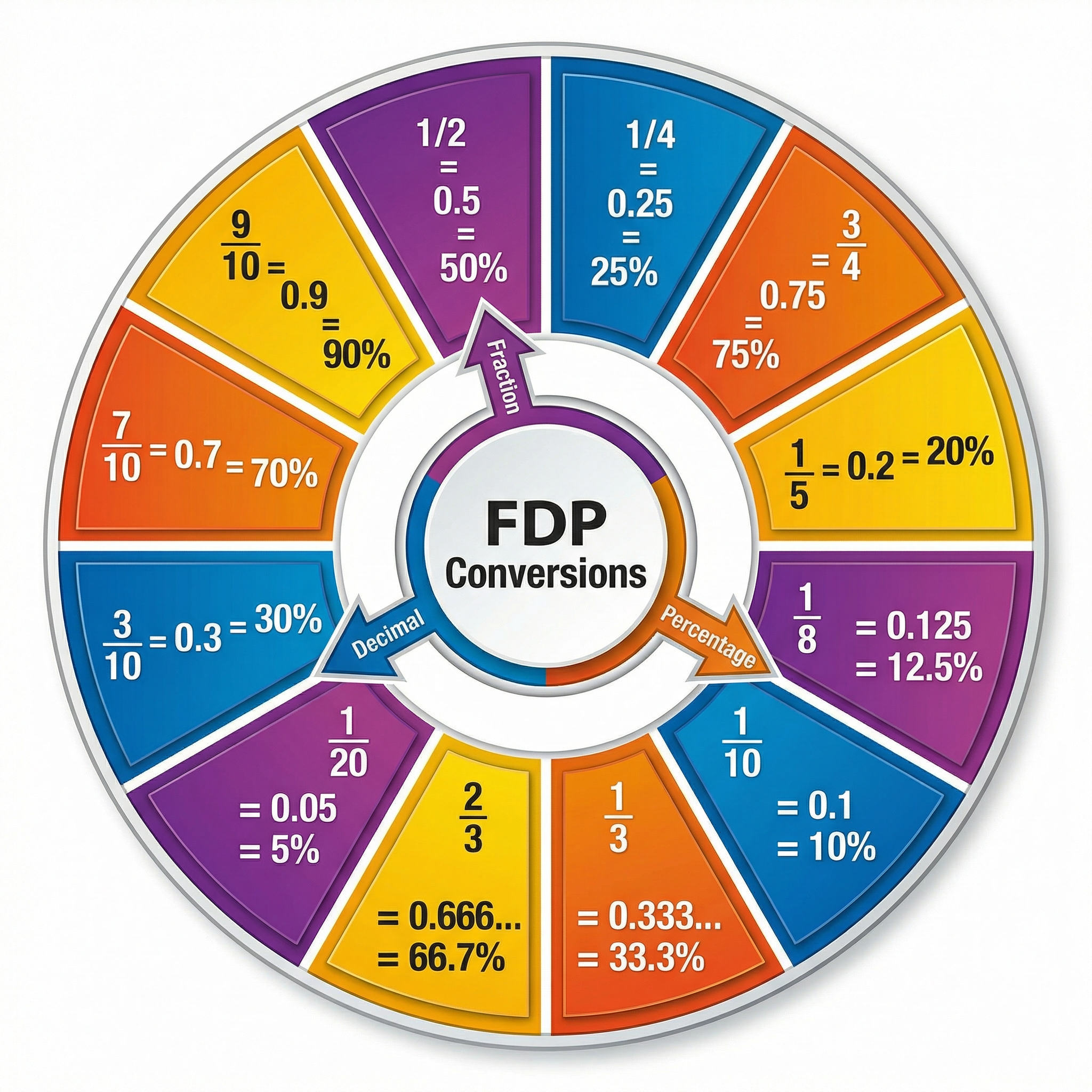
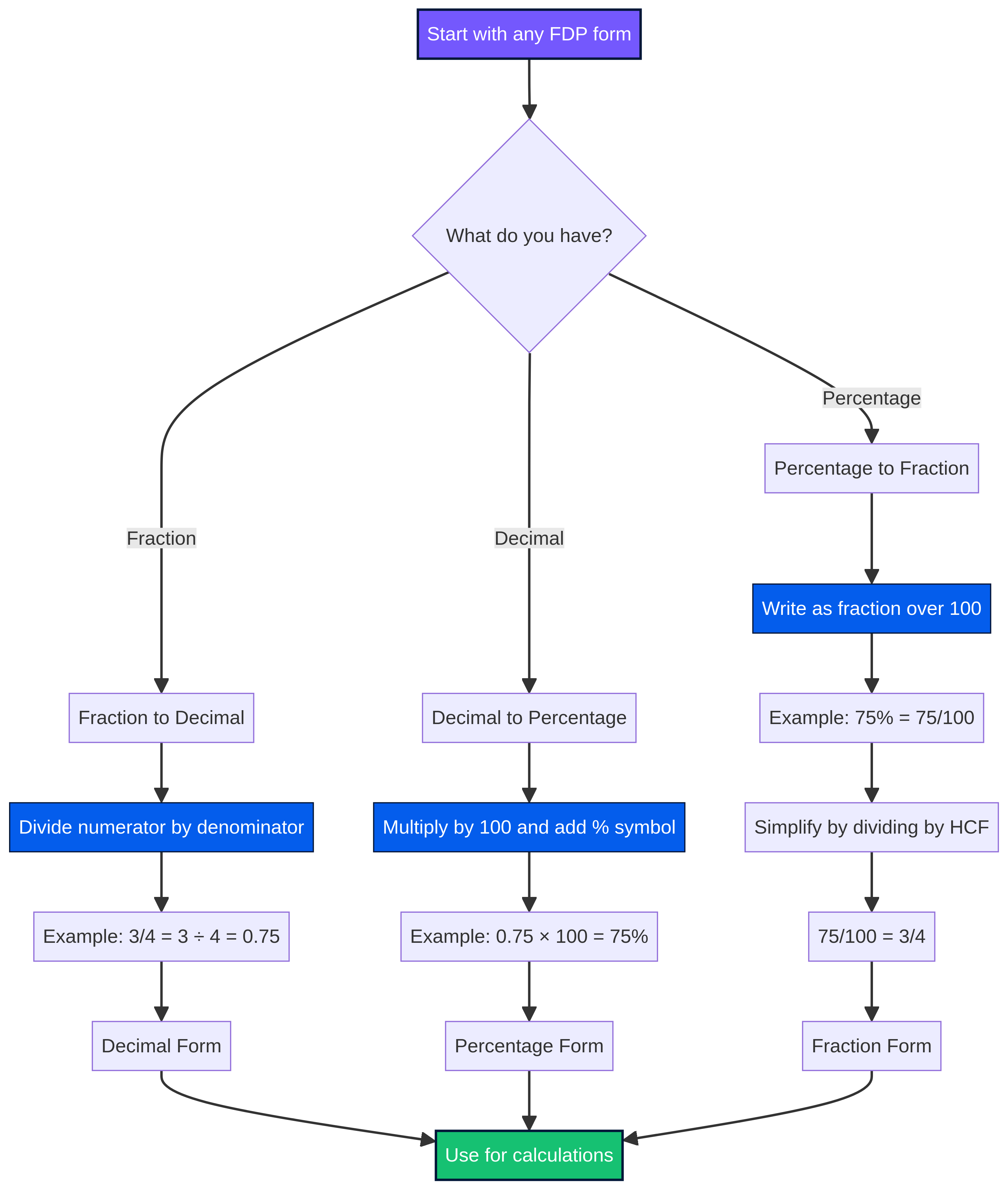
    Fractions, decimals, and percentages are fundamentally linked. A fraction represents a part of a whole (e.g., 1/2), a decimal represents the same part in base-10 (e.g., 0.5), and a percentage represents that part per hundred (e.g., 50%). Understanding how to convert between them is a critical skill. To convert a fraction to a decimal, you divide the numerator by the denominator. To convert a decimal to a percentage, you multiply by 100. To convert a percentage back to a fraction, you write it over 100 and simplify.

    Example: Convert 3/4 to a decimal and a percentage.

    • Decimal: 3 ÷ 4 = 0.75
    • Percentage: 0.75 × 100 = 75%

    A conversion wheel for common FDP values.

    Concept 2: Fraction Arithmetic

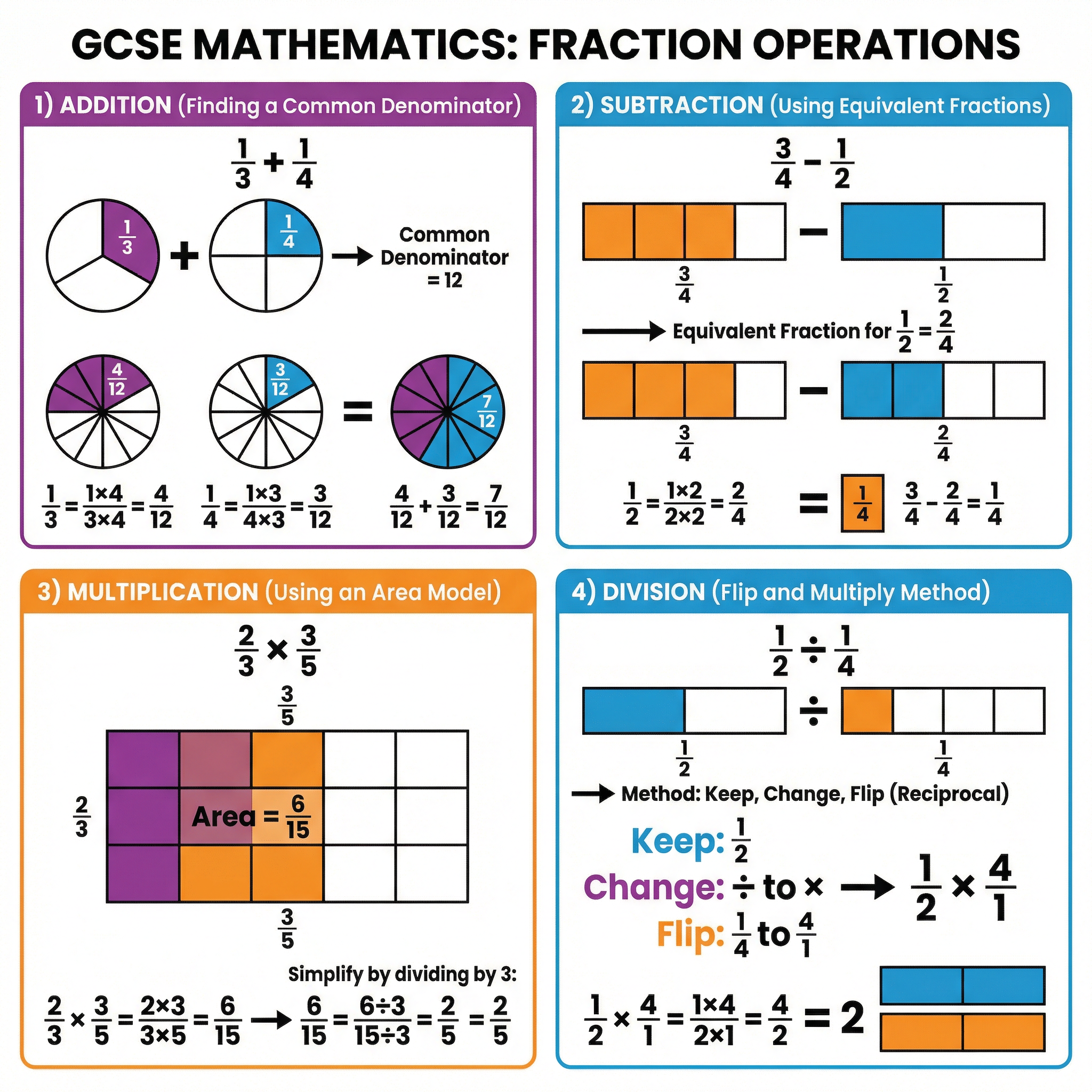
    Candidates must be proficient in the four basic operations with fractions: addition, subtraction, multiplication, and division. For addition and subtraction, the key is to find a common denominator. For multiplication, you simply multiply the numerators and the denominators. For division, you use the 'Keep, Change, Flip' method, where you keep the first fraction, change the division to multiplication, and flip the second fraction (find its reciprocal).

    Example: Calculate 2/5 + 1/3.

    • Find a common denominator: 15
    • Convert the fractions: (2×3)/(5×3) + (1×5)/(3×5) = 6/15 + 5/15
    • Add the numerators: 11/15

    A visual guide to fraction arithmetic.

    Concept 3: Percentage Multipliers

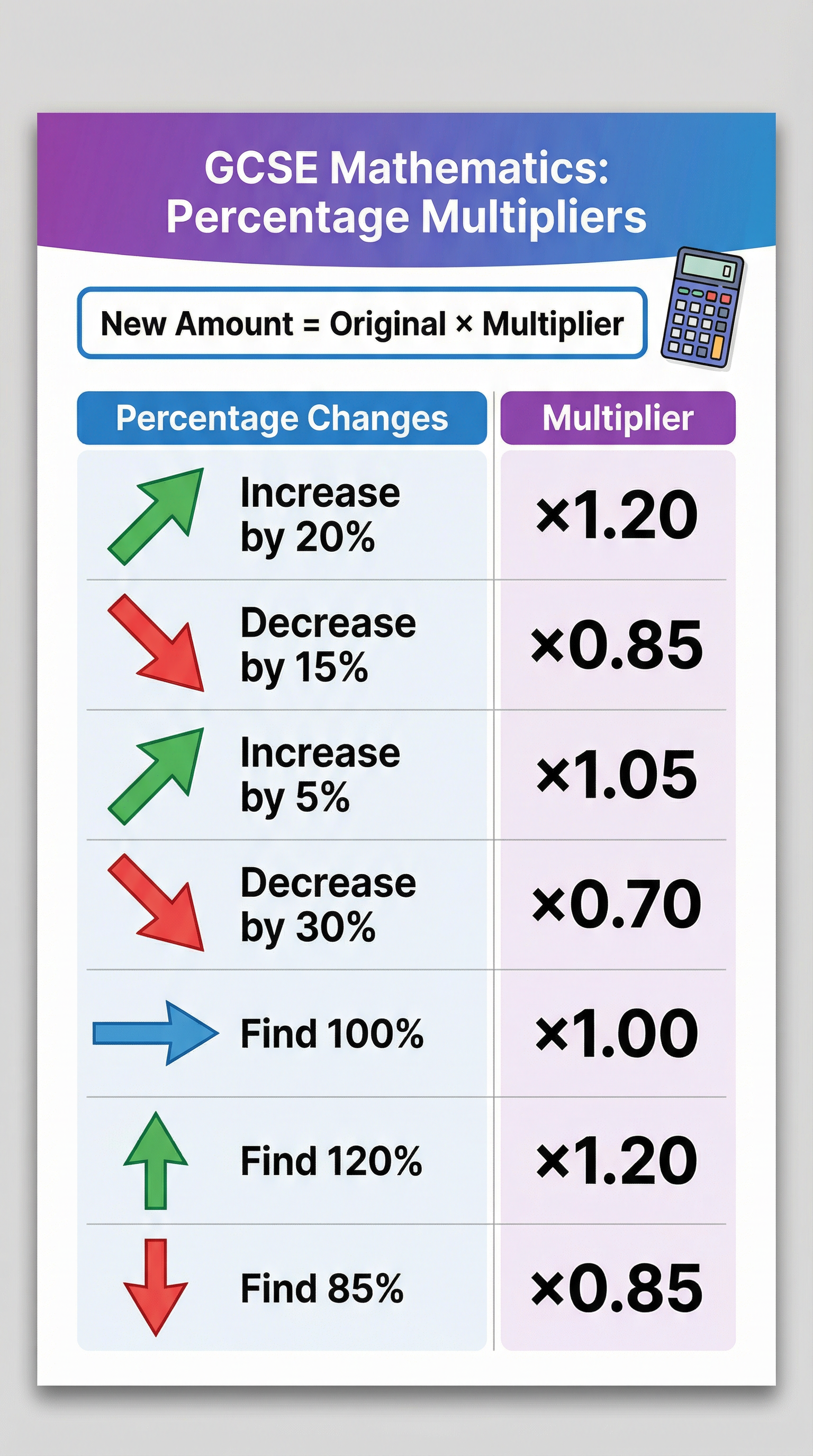
    For percentage calculations, especially on calculator papers, using decimal multipliers is the most efficient and least error-prone method. An increase of P% corresponds to a multiplier of (1 + P/100), while a decrease of P% corresponds to a multiplier of (1 - P/100). This method is particularly powerful for compound interest and reverse percentage problems.

    Example: Increase £60 by 15%.

    • The multiplier is 1 + 15/100 = 1.15
    • New amount = £60 × 1.15 = £69

    A quick reference for percentage multipliers.

    Concept 4: Reverse Percentages

    A common source of error is the reverse percentage problem, where you are given the final amount after a percentage change and asked to find the original amount. The key is to set up an algebraic equation using the multiplier. If a price was increased by 20% to £240, the original price (x) is found by solving 1.20x = £240, which means x = £240 ÷ 1.20 = £200. The mistake to avoid is calculating 20% of £240 and subtracting it.

    Example: A coat is in a sale with 30% off. The sale price is £84. What was the original price?

    • A 30% decrease means you have 70% of the original price.
    • The multiplier is 0.70.
    • 0.70 × Original Price = £84
    • Original Price = £84 ÷ 0.70 = £120

    Mathematical/Scientific Relationships

    • Fraction to Decimal: Numerator ÷ Denominator
    • Decimal to Percentage: Decimal × 100
    • Percentage to Fraction: Percentage / 100 (and simplify)
    • Percentage Increase: New Amount = Original Amount × (1 + Percentage/100)
    • Percentage Decrease: New Amount = Original Amount × (1 - Percentage/100)
    • Percentage Change: (Difference / Original) × 100
    • Compound Interest: A = P(1 + r/n)^(nt), where A is the future value, P is the principal, r is the annual interest rate, n is the number of times interest is compounded per year, and t is the number of years. For GCSE, you are more likely to perform year-on-year calculations.

    Practical Applications

    FDP is everywhere in the real world, which is why it's tested so heavily in context. You'll see it in:

    • Shopping: Discounts, sales tax (VAT), and special offers.
    • Finance: Interest rates on savings accounts and loans, inflation, and profit margins.
    • Statistics: Representing data in charts and graphs.
    • Science: Calculating concentrations of solutions or percentage yields in experiments.
    • Everyday Life: Splitting a bill, understanding nutritional information on food packaging, or following a recipe.

    Visual Resources

    5 diagrams and illustrations
    A visual guide to fraction arithmetic.
    A visual guide to fraction arithmetic.
    A quick reference for percentage multipliers.
    A quick reference for percentage multipliers.
    A conversion wheel for common FDP values.
    A conversion wheel for common FDP values.
    Flowchart for FDP conversions.
    Flowchart for FDP conversions.
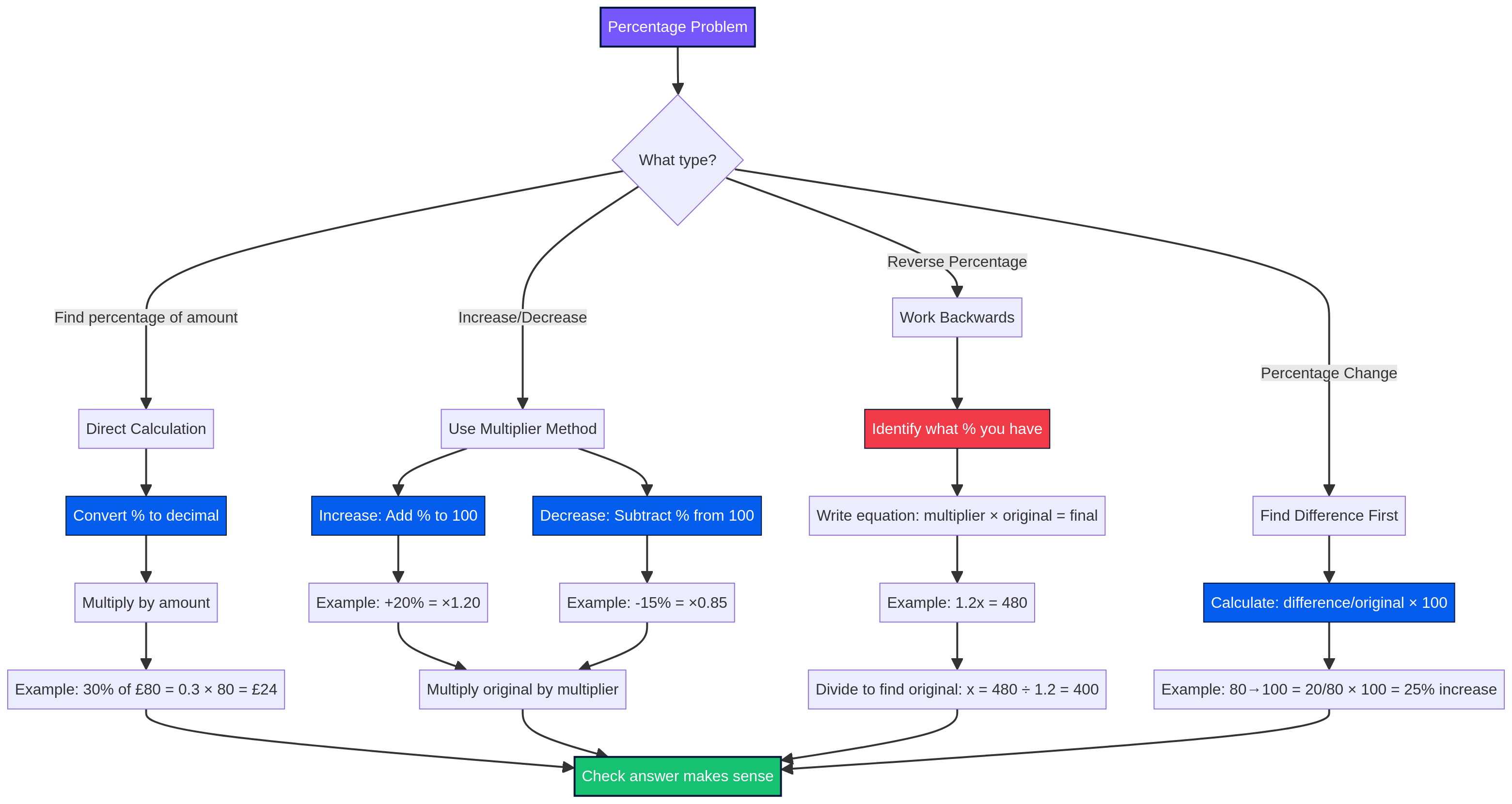
    Strategy guide for percentage problems.
    Strategy guide for percentage problems.

    Interactive Diagrams

    2 interactive diagrams to visualise key concepts

    A flowchart showing the process of converting between fractions, decimals, and percentages.

    A decision-making flowchart to help students choose the correct strategy for different types of percentage problems.

    Worked Examples

    3 detailed examples with solutions and examiner commentary

    Practice Questions

    Test your understanding — click to reveal model answers

    Q1

    Express 7/8 as a decimal and a percentage.

    2 marks
    foundation

    Hint: To convert a fraction to a decimal, divide the top number by the bottom number.

    Q2

    A bag contains 60 sweets. 1/4 are red, 1/3 are green, and the rest are blue. How many blue sweets are there?

    4 marks
    standard

    Hint: First, calculate the number of red and green sweets. Then, subtract this from the total.

    Q3

    The price of a train ticket is increased by 5% to £94.50. What was the price before the increase?

    3 marks
    challenging

    Hint: This is a reverse percentage problem. The new price represents 105% of the original price.

    Q4

    Calculate (4/5) × (3/8). Give your answer as a fraction in its simplest form.

    2 marks
    foundation

    Hint: Multiply the numerators together and the denominators together. Then simplify.

    Q5

    A house is bought for £200,000. Its value increases by 10% in the first year, and then by 20% in the second year. What is its value after 2 years?

    3 marks
    standard

    Hint: This is a compound percentage increase. Calculate the increase for the first year, and then calculate the second year's increase on the new value.

    Explore this topic further

    View Topic PageAll Mathematics Topics

    Key Terms

    Essential vocabulary to know