Pearson Edexcel · A-Level · Mathematics
Course version: 9MA0 · Version from Mar 2026
Calculate the magnitude and direction of a vector and convert between component form and magnitude/direction form
Vectors become predictable scoring opportunities when you separate their length from their direction. This Pearson Edexcel 10.2 guide shows how to calculate magnitude, normalise a vector and convert forms with the exact checks that protect method marks in Pure Mathematics and beyond.
- 10 min read
- 4 worked examples
- 6 practice questions
- 8 key terms
Check what you remember
Read the wording for your board, then hide it and explain Vector in your own words. Rough notes are fine. This is a self-check, with no mark or grade.
Reference: Pearson Edexcel
A quantity with both magnitude and direction, represented algebraically or by a directed line segment.
Study Notes
Overview
Pearson Edexcel A-Level Mathematics specification point 10.2 turns vectors from arrows on a page into precise mathematical objects. Candidates must calculate a vector’s magnitude, state or represent its direction, convert between component form and magnitude/direction form, and find a unit vector in the direction of a non-zero vector. This is high-value foundation work: it reappears in position vectors, vector geometry, mechanics, forces and displacement.
A vector is not merely a list of numbers. Its components say how far it moves along perpendicular coordinate axes, its magnitude says how long the movement is, and its direction says where the movement points. Examiners often set short, reliable method-mark questions here, then embed the same ideas inside a longer geometry or mechanics problem. A clean vector method can therefore unlock several marks at once.
Typical question styles ask candidates to find (|\mathbf a|), show that a given vector is a unit vector, write (\mathbf a) as (|\mathbf a|\hat{\mathbf a}), recover components from a magnitude and a unit direction vector, or give an angle/bearing in a 2D setting. The formulae booklet should not be your safety net for this skill: learn the route and show it clearly.
Listen: 10-minute revision podcast
Key Concepts
1. Component form is an axis-by-axis journey
In two dimensions, write a vector as (\mathbf a=x\mathbf i+y\mathbf j), or as the column vector (\begin{pmatrix}x\y\end{pmatrix}). The unit vector (\mathbf i) means one unit in the positive (x)-direction; (\mathbf j) means one unit in the positive (y)-direction. In three dimensions, add (\mathbf k), one unit in the positive (z)-direction: (\mathbf a=x\mathbf i+y\mathbf j+z\mathbf k).
Treat the components as perpendicular movements. For example, (4\mathbf i-3\mathbf j+12\mathbf k) means move 4 in the (x)-direction, 3 in the negative (y)-direction, and 12 in the (z)-direction. The signs control direction along an axis. They are not optional decoration.
Examiner language:credit is given for using consistent notation. A column vector and (\mathbf i,\mathbf j,\mathbf k) notation express the same components, but do not accidentally change a row vector into a column vector or drop the negative sign while converting.
2. Magnitude is the non-negative length
The notation (|\mathbf a|) means the magnitude, or length, of (\mathbf a). It is a scalar, not a vector. Because the components lie along perpendicular axes, Pythagoras gives the length:
[
|\mathbf a|=\sqrt{x^2+y^2}\quad\text{for }\mathbf a=x\mathbf i+y\mathbf j,
]
[
|\mathbf a|=\sqrt{x^2+y^2+z^2}\quad\text{for }\mathbf a=x\mathbf i+y\mathbf j+z\mathbf k.
]
The square root is defined to be non-negative. If (\mathbf a=6\mathbf i-8\mathbf j), then (|\mathbf a|=\sqrt{6^2+(-8)^2}=\sqrt{100}=10), not (-10). A negative component becomes positive only because it is squared. Write brackets around negative components before squaring to protect the sign.
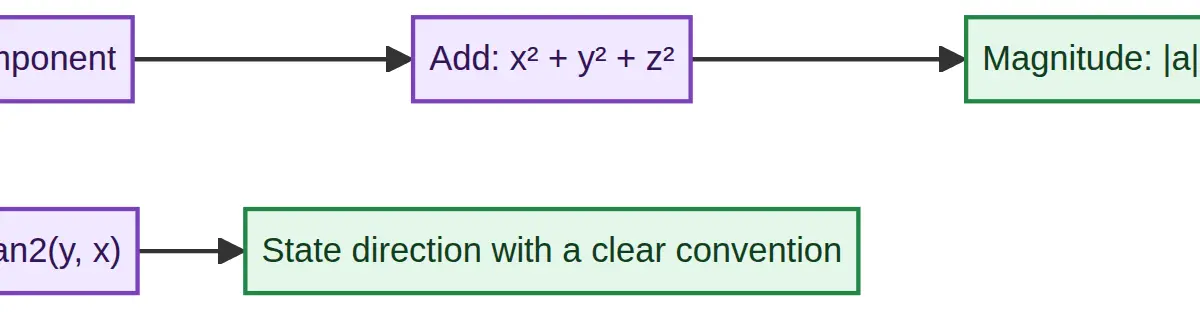
Why this works: in 3D, first combine two perpendicular components to make a right-angled triangle, then combine that result with the third, perpendicular component. Algebraically, this gives the same sum of squares whatever order you choose.
3. Direction can be an angle or a unit vector
In a 2D coordinate question, direction may be an angle measured anticlockwise from the positive (x)-axis. For a vector (x\mathbf i+y\mathbf j), use (\tan\theta$=y/x) to get a reference angle, then check the quadrant. The inverse tangent alone does notknow which quadrant the vector occupies. A calculator’s (\operatorname{atan2}(y,x)) function is useful if available, but candidates must still state the convention requested. A bearing is measured clockwise from North and normally written with three figures, so it is a different convention.$
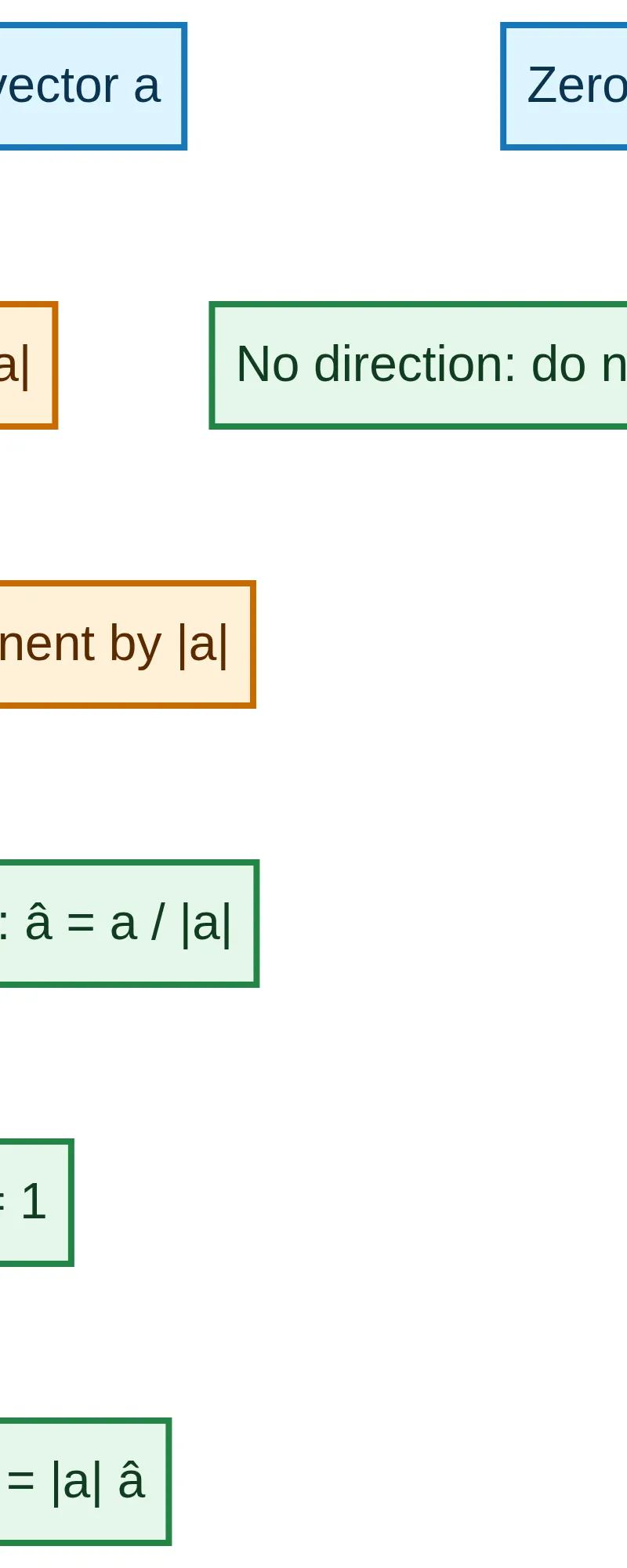
More generally, and especially in 3D, direction is represented by a unit vector. A unit vector has magnitude 1. It carries direction but no original scale. For every non-zero vector (\mathbf a), the unit vector in its direction is
[
\hat{\mathbf a}=\frac{\mathbf a}{|\mathbf a|}.
]
For (\mathbf a=3\mathbf i+4\mathbf j), (|\mathbf a|=5), so (\hat{\mathbf a}=\tfrac35\mathbf i+\tfrac45\mathbf j). The check is immediate: (\sqrt{(3/5)^2+(4/5)^2}=1). Divide every component by the magnitude. Dividing one component only changes the direction and cannot earn full credit.
4. Magnitude/direction form separates scale from route
A non-zero vector can be written as
[
\mathbf a=|\mathbf a|\hat{\mathbf a}.
]
The positive scalar outside gives the magnitude. The unit vector inside gives the direction. This is magnitude/direction form. For example,
[
12\mathbf i-5\mathbf j=13\left(\frac{12}{13}\mathbf i-\frac5{13}\mathbf j\right).
]
The vector in brackets must have magnitude 1. This is your fastest self-check. To convert from magnitude/direction form back to components, multiply the magnitude through all components. To convert components to magnitude/direction form, calculate the magnitude first, then divide every component by it.
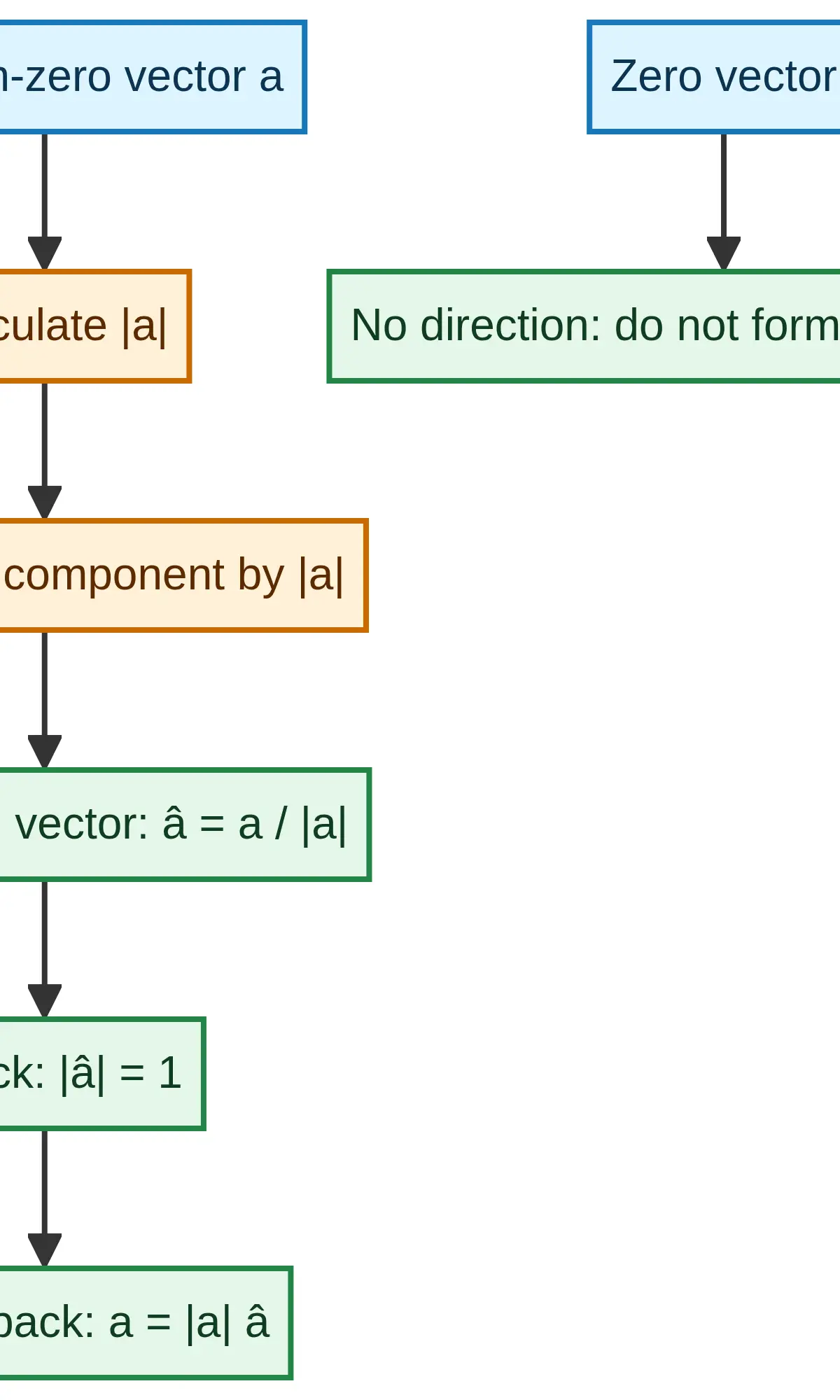
The zero vector is the one exception. It has magnitude zero but no direction, so (\mathbf0/|\mathbf0|) is undefined. State this explicitly if asked. Never invent a unit vector for (\mathbf0).
Mathematical Relationships
Must memorise for this topic
- (|x\mathbf i+y\mathbf j|=\sqrt{x^2+y^2})
- (|x\mathbf i+y\mathbf j+z\mathbf k|=\sqrt{x^2+y^2+z^2})
- (\hat{\mathbf a}=\mathbf a/|\mathbf a|), for (\mathbf a
e\mathbf0) - (\mathbf a=|\mathbf a|\hat{\mathbf a})
- In 2D, (\tan\theta=y/x), followed by a quadrant check when an angle direction is required.
The official 9MA0 formulae booklet contains advanced vector formulae such as vector products, but it does not provide the component-to-magnitude and normalisation relationships needed for 10.2. Memorise and practise them. The relevant specification statement is 10.2: calculate magnitude and direction, convert forms, find a unit vector in the direction of (\mathbf a), and understand (|\mathbf a|).
Formula choice routine: identify whether the question asks for a length, direction, or a full vector. Length means sum of squared components and square root. A unit direction means divide by the length. A full vector from a magnitude and direction means multiply the length by a verified unit vector.
Graph and diagram skills
If a question supplies a coordinate grid, sketch the component moves head-to-tail or draw a right triangle from the origin to the vector endpoint. This makes the signs and quadrant visible before using inverse tangent. Label axes and arrow direction. Do not measure a diagram to replace calculation: it is a checking tool, not evidence for an exact answer.
Practical applications and synoptic use
A drone displacement, a force, or a velocity can all be represented by a vector. The magnitude gives a physical size such as distance, force or speed, while the direction says where it acts or moves. In mechanics, resolving a force creates components; here, magnitude and a unit vector rebuild the whole force. In coordinate geometry, subtracting position vectors gives a displacement vector, after which this topic gives its length and direction.
There is no required practical, tier split or unit conversion specific to this A-Level pure topic. The transferable practical habit is checking whether an answer makes sense: a unit vector must have magnitude 1, a magnitude cannot be negative, and a 3D calculation must include all three components.
A mark-winning routine for every conversion
When a question gives component form and asks for magnitude/direction form, use the same four-line layout every time. First copy the vector accurately, with brackets around any negative components. Second calculate the magnitude exactly. Third divide the original vector by that magnitude to form a unit vector. Fourth write the original vector as the magnitude multiplied by that unit vector. This layout lets an examiner see the method even if arithmetic slips in the final line. It also makes an effective self-check possible: multiply your final expression back out and compare every component with the vector you started with.
When the question gives a magnitude and a direction vector instead, pause before multiplying. The direction vector must be unit length. If the question says it is a unit vector, that fact can be used, but it is still wise to recognise the check. If it merely says “in the direction of”, normalise it first. For instance, a vector in the direction of (2\mathbf i-\mathbf j) is not itself a unit vector because its magnitude is (\sqrt5). The unit direction is (\tfrac2{\sqrt5}\mathbf i-\tfrac1{\sqrt5}\mathbf j). A vector of magnitude 10 in this direction is therefore (10(\tfrac2{\sqrt5}\mathbf i-\tfrac1{\sqrt5}\mathbf j)), not (10(2\mathbf i-\mathbf j)).
Accuracy, exact form and checking
Keep exact values as long as possible. Fractions and surds protect accuracy and show mathematical structure. If (|\mathbf a|=\sqrt{14}), then the unit vector is obtained by dividing each component by (\sqrt{14}); do not convert to 3.742 unless the question asks for a decimal. If rationalising a denominator does not make the requested answer clearer, a correct exact fractional form is normally acceptable. Follow the wording and the mark allocation.
Use two rapid checks before moving on. Size check: a unit vector’s magnitude must be 1, and a magnitude is never negative. Direction check:the signs of a normalised vector must match the signs of the original vector. For example, normalising (-2\mathbf i+5\mathbf j) cannot produce a vector with a positive (\mathbf i)-component. These ten-second checks catch more lost marks than re-entering the whole calculation into a calculator.
Common question twists
Examiners can disguise this topic in a coordinate or context question. If points (A) and (B) are given, form (\overrightarrow{AB}=\mathbf b-\mathbf a) before taking a magnitude. If a force or velocity has components, the same formula produces the resultant size. If two vectors are said to be parallel, their unit vectors may be equal or negatives of each other, depending on whether they point in the same or opposite direction. A negative scalar reverses a direction but does not make a magnitude negative.
In “show that” questions, show the evidence. To show (\mathbf u) is unit, calculate (|\mathbf u|) and obtain 1. To show that a magnitude/direction representation is valid, demonstrate both that the bracketed vector is unit and that scaling it recovers the original components. A statement such as “it is clearly a unit vector” gains no credit because the required property has not been verified.
Interactive Diagrams
2 interactive diagrams to visualise key concepts
Conceptual Flow Outline
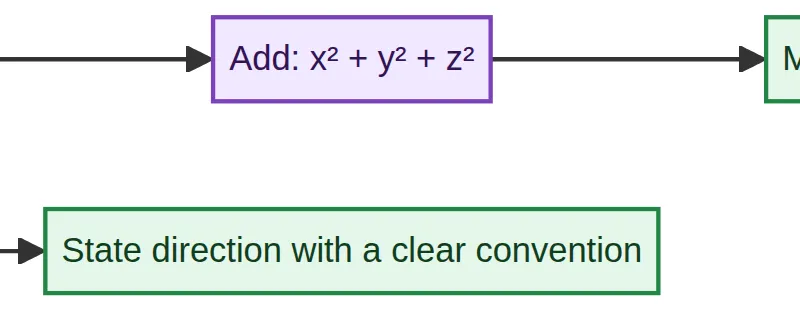
Magnitude route and the separate direction check required for a 2D angle.
Conceptual Flow Outline
Normalising a vector and the zero-vector exception.
Worked Examples
4 worked examples — open one to explore the question and available guidance.
Practice Questions
Try the question, then reveal an answer plan or example response
Calculate (|\mathbf a|) for (\mathbf a=5\mathbf i+12\mathbf j).
Hint: The two components are perpendicular legs of a right-angled triangle.
Findthe unit vector in the direction of (\mathbf b=-2\mathbf i+3\mathbf j+6\mathbf k).
Hint: Find the magnitude before dividing all three components by it.
A vector is (15(\tfrac35\mathbf i-\tfrac45\mathbf j)).Write it in component form and verify its magnitude.
Hint: Multiply 15 through the bracket, then use the magnitude formula on your result.
The vector (\mathbf c=-7\mathbf i-7\mathbf j).Calculate its direction anticlockwise from the positive (x)-axis, giving your answer to 1 decimal place.
Hint: The reference angle is \(45^\circ\). Which quadrant contains negative \(x\), negative \(y\)?
A candidate claims that (\mathbf u=\tfrac23\mathbf i-\tfrac13\mathbf j+\tfrac23\mathbf k) is a unit vector.Determine whether the claim is correct, giving a reason.
Hint: A unit vector must have magnitude 1. Calculate it exactly.
A displacement is (\mathbf d=9\mathbf i-12\mathbf j+20\mathbf k) metres.Find its magnitude and the unit vector in its direction.
Hint: The magnitude is an integer. Then divide every component, including the negative \(j\)-component, by that integer.
Exam technique
How to turn what you know into marks
How to approach the question
Underline the command word, then decide whether the target is a scalar magnitude, a unit direction vector, a magnitude/direction expression, or an angle. Write the general formula before numbers. In 3D, count components before calculating. In 2D angle questions, identify the quadrant before finalising the direction.
How to structure your answer
For 2-3 marks: formula, substitution, simplified answer. For 4-5 marks: calculate magnitude, state the normalisation or angle process, then give the requested vector or convention-labelled angle. For 6 marks in context: define the relevant displacement or force vector first, perform the vector calculation, and interpret the final magnitude/direction in context.
Timing
Each 100-mark Pearson Edexcel 9MA0 paper is 2 hours, so budget about 1.2 minutes per mark. A standard 3-mark magnitude calculation should take roughly 3-4 minutes including a check.
Common pitfalls
- Leaving a negative sign unsquared, for example treating \((-3)^2\) as \(-9\). Write brackets before squaring.
- Dividing only one component when forming a unit vector. Divide the entire vector by the same magnitude.
- Giving an inverse-tangent reference angle without adjusting to the vector’s quadrant or the stated bearing convention.
- Calling any parallel vector a unit vector. Verify that its magnitude is exactly 1.
- Using a decimal when an exact integer or surd is available. Simplify \(\sqrt{169}\) to 13.
What the command words want
- Compare
- Compare both magnitude and direction. Vectors can have equal magnitude but different directions, or be parallel but different lengths.
- Explain
- Link mathematical steps with ‘because’: components are perpendicular, so Pythagoras gives the magnitude; dividing by the magnitude preserves direction and makes the length 1.
- Describe
- Use correct vector language, for example ‘magnitude is the non-negative length’ or ‘a unit vector has magnitude 1’.
- Evaluate
- Check a proposed unit vector by finding its magnitude, then make a justified decision rather than accepting its label.
- Calculate
- Show the formula, substitution and simplification. Do not rely on a calculator answer alone.
- State/Give
- Provide the requested vector, value or direction convention directly. Include a degree sign for an angle and three figures if a bearing is required.
Watch or listen (optional)
Test your understanding of Calculate the magnitude and direction of a vector and convert between component form and magnitude/direction form
Active recall beats re-reading. Take an instant quiz now to test what you’ve learned and lock it into long-term memory.
7 days Premium · Then the free plan continues · No card, no charge