Pearson Edexcel · A-Level · Mathematics
Course version: 9MA0 · Version from Mar 2026
Decompose rational functions into partial fractions (denominators not more complicated than squared linear terms and with no more than 3 terms, numerators constant or linear)
Partial fractions turn a complicated rational function into simpler pieces that reveal the marks in integration, differentiation and series questions. For Pearson Edexcel 2.10, success comes from reading the denominator accurately, choosing the compulsory form, and using a disciplined identity to find each constant.
- 10 min read
- 4 worked examples
- 5 practice questions
- 8 key terms
Check what you remember
Read the wording for your board, then hide it and explain Rational function in your own words. Rough notes are fine. This is a self-check, with no mark or grade.
Reference: Pearson Edexcel
A function that can be written as a quotient of two polynomials, with a non-zero denominator.
Study Notes

Overview
Partial fractions are the A-Level method for breaking one rational function into simpler fractions. In Pearson Edexcel Mathematics specification point 2.10, the denominator is built from linear factors, may contain no more than three terms, and may include a repeated factor up to a square. The reward is considerable: once a rational function has been decomposed, an awkward expression becomes a set of standard terms that can be integrated, differentiated or converted into a series.
Candidates should see this as a pattern-recognition topic first and an algebra topic second. The denominator tells you the structure of the answer before you calculate a single constant. In a Pure Mathematics paper, a partial-fractions question may ask you to express, hence integrate, differentiate, or find the first terms of an expansion. It can also be a concealed first step inside a longer question. Pearson Edexcel Papers 1 and 2 are each 2 hours for 100 marks, so work at about 1.2 minutes per mark. A correct opening form protects method marks and makes every later step efficient.
Key Concepts
1. Start by deciding whether the fraction is proper
A rational function is proper when the degree of its numerator is lower than the degree of its denominator. Only then should you start the partial-fraction setup. If the numerator degree is equal to or higher than the denominator degree, carry out algebraic division first. For example,
\frac{x^2+3x+4}{(x-1)(x+2)}=\frac{x^2+3x+4}{x^2+x-2}=1+\frac{2x+6}{(x-1)(x+2)}.
The remainder is now proper and can be decomposed. Credit is given for recognising that the quotient remains part of the final answer. A common error is to ignore division and force a partial-fraction form on an improper fraction.
2. Let the factor pattern choose the form
Factor the denominator completely before writing any fractions. The form is not optional: it is determined by the factors.
Two distinct linear factors use one constant above each factor:
\frac{P(x)}{(ax+b)(cx+d)}=\frac{A}{ax+b}+\frac{B}{cx+d}.
Three distinct linear factors extend the same pattern:
\frac{P(x)}{(ax+b)(cx+d)(ex+f)}=\frac{A}{ax+b}+\frac{B}{cx+d}+\frac{C}{ex+f}.
A repeated linear factor needs a term for every power up to the highest power:
\frac{P(x)}{(ax+b)(cx+d)^2}=\frac{A}{ax+b}+\frac{B}{cx+d}+\frac{C}{(cx+d)^2}.
The numerator is constant because each denominator factor is linear. Do not write a linear numerator, such as Ax+B, above a linear factor. More importantly, never omit the lower power of a repeated factor. For (x-2)^2, the full contribution is B/(x-2)+C/(x-2)^2, not two copies of the same fraction.
Memory hook: One floor, one numerator; repeated factor, every power gets a door. Imagine (x-2) and (x-2)^2 as separate floors in the same building. Both need their own key.

3. Clear denominators to create an identity
Once the form is correct, multiply every term by the complete original denominator. For example,
\frac{5x+1}{(x-1)(x+2)}=\frac{A}{x-1}+\frac{B}{x+2}
becomes
5x+1=A(x+2)+B(x-1).
This is an identity: it is true for every permissible value of x. Candidates who retain fractions at this stage often create unnecessary arithmetic and sign errors. Clear the denominators before substituting or expanding.
4. Use strategic substitution, then compare coefficients if needed
After denominators have been cleared, substitute roots of the factors. In the identity above, setting x=1 removes the B term, while setting x=-2 removes the A term. This is often called the cover-up idea, but in an exam it must be shown as valid substitution in the cleared identity.
For a repeated-factor question, substitution may give two constants immediately but leave one unknown. Choose any convenient third value, usually x=0, or expand and equate coefficients. If
3x+7=A(x-2)^2+B(x+1)(x-2)+C(x+1),
then the coefficients of x^2, x and the constant term must match on both sides. Take care over negative signs, especially after inserting a negative root.
Memory hook: Plug the roots first; compare coefficients second. It is faster than expanding everything at the start, but it leaves you a reliable fallback.
5. Check by recombining
Before moving to a later part of the question, put your fractions over the original denominator and simplify the numerator. It should reproduce the expression given in the question exactly. This short rebuild check catches missing factors, incorrect signs and swapped constants. In a long question, it prevents a small early error from contaminating integration or a series expansion.
Memory hook: Rebuild before you leave. Treat it as the final ten-second quality check.
6. Understand where the marks come from
In a typical short decomposition, the examiner is looking for a mathematical chain, not simply the final constants. The opening template demonstrates that you have read the factor structure. The cleared equation demonstrates that you understand the fractions form an identity. Substitution or coefficient comparison demonstrates how the constants were obtained. The final separated expression answers the command word. If a later part says hence, the mark scheme will normally credit the use of that earlier structure even if a small arithmetic error has been carried forward consistently.
For example, in a repeated-factor question, writing
\frac{A}{x+1}+\frac{B}{x-2}+\frac{C}{(x-2)^2}
is not cosmetic. It is evidence that candidates understand why the numerator needs enough independent constants to reproduce any permitted numerator after recombination. A term over (x-2)^2 alone cannot generally reproduce all possible numerators. This is the mathematical reason behind the rule "every power gets a door".
When choosing a substitution value, select a root that makes as many terms as possible disappear. For A(x+2)+B(x-1), x=1 isolates A and x=-2 isolates B. In a three-term identity, two roots often find two constants immediately. A safe third substitution is usually x=0, unless it creates awkward arithmetic. Candidates should write the substituted equation before solving it. This keeps signs visible and makes method credit secure.
7. Precision checks that separate a complete answer from a nearly-right one
Use brackets whenever a negative substitution is inserted. For instance, if x=-2, write A(-2+2)+B(-2-1), rather than calculating mentally. In a squared factor, square the complete bracket: (-2-1)^2, not -2-1^2. These are small habits, but they protect accuracy marks.
Keep the algebraic conventions consistent. A denominator written as 1-x has a different sign convention from x-1. Either is acceptable, but the numerator constants must match your chosen form. If you choose A/(1-x), do not silently replace it with A/(x-1) later. In series questions, 1-x is often helpful because it fits the standard 1/(1-u) form directly.
Finally, observe excluded values. The original rational function is undefined where its denominator is zero. Partial fractions do not remove these restrictions. Although a routine algebra question may not ask you to state them, awareness of x=1, x=-2, or other roots helps you avoid invalid cancellation and explains why logarithmic antiderivatives use absolute values.
Mathematical Relationships and Formulae
The formula booklet does not supply a partial-fraction template. You must memorise the forms above. The following relationships are the essential working toolkit.
- Distinct factors: P(x)/[(x-a)(x-b)] = A/(x-a)+B/(x-b).
- Repeated factor: P(x)/[(x-a)(x-b)^2] = A/(x-a)+B/(x-b)+C/(x-b)^2.
- Integration after decomposition:
$$\int\frac{A}{ax+b},dx=\frac{A}{a}\ln|ax+b|+C.$$
The divisor a is the derivative of the denominator. The absolute-value signs and the constant of integration are required for an indefinite integral. - Differentiation after decomposition:
\frac{d}{dx}\left(\frac{A}{ax+b}\right)=-\frac{aA}{(ax+b)^2}. - Geometric-series forms:
$$\frac{1}{1-u}=1+u+u^2+\cdots,\quad |u|<1,$$
$$\frac{1}{1+u}=1-u+u^2-\cdots,\quad |u|<1.$$
The Edexcel formula booklet gives the infinite geometric-series sum, but you must be able to recognise and manipulate these expansion forms.
Applications that Earn Further Marks
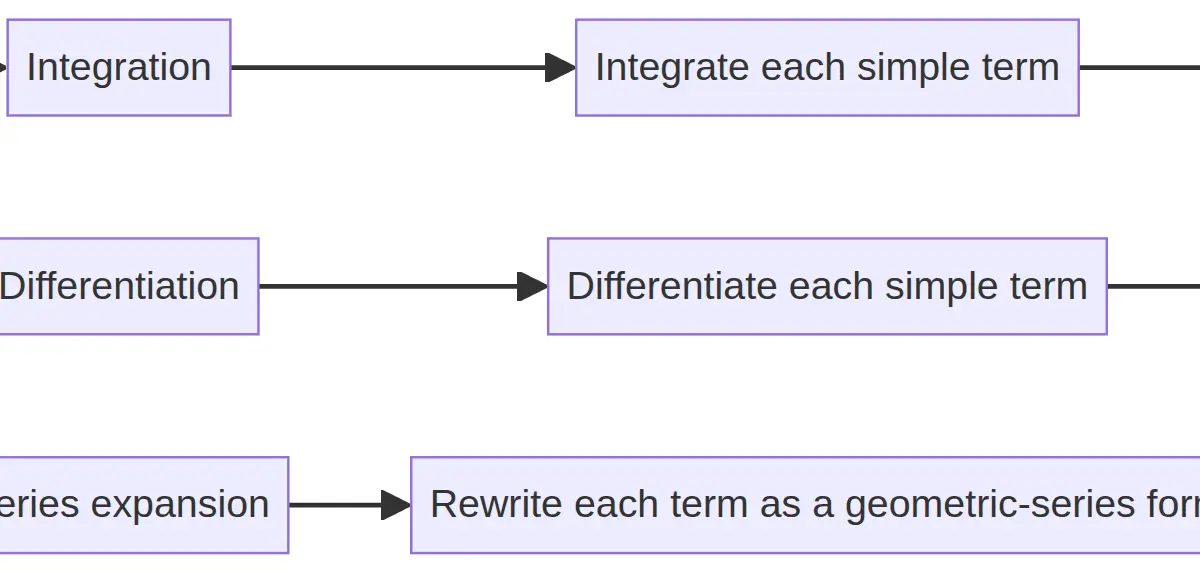
Integration
Partial fractions turn a product denominator into separate logarithmic terms. For instance,
\frac{2x+7}{(x-1)(x+2)}=\frac{3}{x-1}-\frac{1}{x+2}.
Therefore,
$$\int\frac{2x+7}{(x-1)(x+2)},dx=3\ln|x-1|-\ln|x+2|+C.$$
The word hence means that the earlier decomposition is intended to be used. Do not restart with an unrelated method. Marks are awarded for a correct decomposition, integrating each term accurately, and including +C.
Differentiation
Decomposition can be cleaner than the quotient rule. If f(x)=3/(x-1)-1/(x+2), then
f'(x)=-\frac{3}{(x-1)^2}+\frac{1}{(x+2)^2}.
When the factor is 2x+1, apply the chain rule. The derivative of A/(2x+1) is -2A/(2x+1)^2. Missing this factor of 2 is a common accuracy error.
Series expansion
First decompose, then rewrite each term in geometric-series form. For example,
\frac{5}{(1-x)(1+2x)}=\frac{5}{3(1-x)}+\frac{10}{3(1+2x)}.
Use $u=x$ in the first term and $u=2x$ in the second. The second expansion requires $|2x|<1$, so the combined expansion has the stricter condition $|x|<1/2$. Candidates should state this range whenever requested: a beautiful series without its valid range is incomplete.
Exam Technique
Use D-FORM-R at the top of the page: Degree check, Factor fully, repeated-power Order, Right numerator, Multiply through, Roots then coefficients, Rebuild. It guards the structure marks before the numerical work begins.
For a 3-mark question, write the form, clear denominators, then find and state the constants. For a 4- or 5-mark repeated-factor question, explicitly include every required denominator power and show enough working to justify all constants. For an integration question, write the decomposition line again or clearly carry it forward, then integrate one term at a time. For a series question, write the substituted geometric forms and finish with the common range of validity.
Avoid these predictable losses: using the wrong repeated-factor template; failing to divide before decomposing; substituting into the original fraction instead of the cleared identity; losing a sign at a negative root; omitting the factor 1/a in a logarithmic integral; omitting +C; and giving a series without its range. The calculator may check arithmetic, but it cannot choose the correct form for you.
Podcast Revision Session
Listen once with the guide closed. On the second listen, pause after each method and reproduce the setup from memory. That turns the audio into retrieval practice rather than passive revision.
Visual Resources
2 diagrams and illustrations

Interactive Diagrams
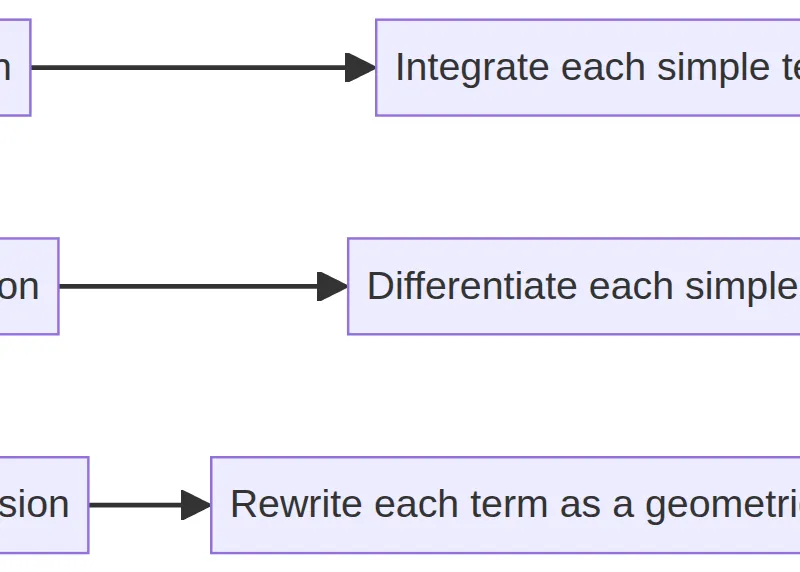
2 interactive diagrams to visualise key concepts
Conceptual Flow Outline
Decision path for setting up and checking an Edexcel 2.10 partial-fractions decomposition.
Conceptual Flow Outline
How one correct decomposition supports the three specified applications: integration, differentiation and series expansions.
Worked Examples
4 worked examples — open one to explore the question and available guidance.
Practice Questions
Try the question, then reveal an answer plan or example response
Express \frac{x+11}{(x+2)(x-3)} in partial fractions.
Hint: Use $A/(x+2)+B/(x-3)$, then substitute $x=-2$ and $x=3$ in the cleared identity.
Express \frac{5x-1}{(x-1)(x+2)^2} in partial fractions.
Hint: The $(x+2)^2$ factor requires both $B/(x+2)$ and $C/(x+2)^2$.
Express \frac{x^2+4x+7}{(x-1)(x+2)} in partial fractions.
Hint: The numerator and denominator have the same degree, so division comes before decomposition.
Find \int\frac{5x+1}{(2x+1)(x-3)},dx.
Hint: After decomposition, the first denominator is $2x+1$, so its logarithm needs a factor of one half.
Find the first three non-zero terms, in ascending powers of x, of \frac{3}{(1-x)(1+3x)}, stating the range of validity.
Hint: Decompose into terms with denominators $1-x$ and $1+3x$ before using the geometric-series forms.
Exam technique
How to turn what you know into marks
How to approach the question
Read the denominator before calculating. Check whether division is needed, factor fully, write the compulsory form, clear denominators, use roots strategically, compare coefficients if required, then state the fully separated result. For a 'hence' part, use that exact decomposition rather than restarting.
How to structure your answer
For 3 marks: form, identity, constants and final expression. For 4-5 marks with a repeated factor: show every denominator power, the cleared identity, and enough substitutions or coefficient equations to find all constants. For 5-6 marks involving calculus or series: show the decomposition, apply the relevant standard method to each term, and finish with $+C$ or the common range of validity as appropriate.
Timing
Pearson Edexcel Papers 1 and 2 are 120 minutes for 100 marks, so budget about 1.2 minutes per mark. A 6-mark question should normally take about 7 minutes, including a quick recombination check.
Common pitfalls
- Omitting $B/(x-a)$ when $(x-a)^2$ appears. Avoid it by writing every power from 1 up to the repeat.
- Attempting decomposition before algebraic division. Compare degrees before factoring anything.
- Substituting a root into the original fraction rather than the cleared identity. Always multiply through first.
- Dropping a negative sign when substituting $x=-a$. Write brackets around the substituted number.
- Integrating $A/(ax+b)$ as $A\ln|ax+b|$. Divide by $a$ and include $+C$.
- Giving a geometric-series expansion without its shared range of validity. Use the tightest condition.
What the command words want
- Find
- Show the form and the algebra that determines every unknown; unsupported answers risk method marks.
- Hence
- Use the result established in the earlier part and make the link visible in your first line.
- Expand
- Rewrite as geometric forms, collect the requested powers only, and state the range of validity.
- Integrate
- Integrate one partial fraction at a time, use logarithms correctly, and include $+C$.
- Differentiate
- Differentiate each simple fraction and apply the chain rule to the linear denominator.
- Express in partial fractions
- End with a sum of separate fractions, not merely values for A, B and C.
Watch or listen (optional)
Test your understanding of Decompose rational functions into partial fractions (denominators not more complicated than squared linear terms and with no more than 3 terms, numerators constant or linear)
Active recall beats re-reading. Take an instant quiz now to test what you’ve learned and lock it into long-term memory.
7 days Premium · Then the free plan continues · No card, no charge