Pearson Edexcel · A-Level · Mathematics
Course version: 9MA0 · Version from Mar 2026
Differentiate using the product rule, the quotient rule and the chain rule, including problems involving connected rates of change and inverse functions; differentiation of cosec x, cot x and sec x
Differentiation 7.4 is the point where familiar derivatives become layered exam problems. Learn to recognise the structure first, then show every factor, bracket and sign so that Pearson Edexcel can award method marks with confidence.
- 9 min read
- 4 worked examples
- 5 practice questions
- 7 key terms
Check what you remember
Read the wording for your board, then hide it and explain Product rule in your own words. Rough notes are fine. This is a self-check, with no mark or grade.
Reference: Pearson Edexcel
For y = uv, where u and v are differentiable functions of x, dy/dx = u(dv/dx) + v(du/dx).
Study Notes

Overview
Specification reference: Pearson Edexcel A-Level Mathematics 7.4. This part of differentiation is where standard derivatives become exam tools. Candidates must recognise whether a function is built by multiplication, division or composition, then show a valid method for the product, quotient or chain rule. Pearson explicitly includes reciprocal trigonometric functions, connected rates of change and inverse functions in this section.
The marks are often accessible, but only when the structure is identified before any differentiation begins. A derivative can contain the correct-looking functions and still lose method marks if a factor from an inner function, a minus sign, or a pair of quotient-rule brackets has disappeared. This guide trains you to make each factor accountable.
Typical questions ask you to differentiate a composite expression, find a gradient or tangent, model a changing radius and volume, or differentiate a relation written as x = f(y). These techniques link directly to curve sketching, optimisation, kinematics and integration. Work throughout in radians when trigonometric calculus is involved.
Key Concepts
1. Product rule: two changing factors
Use the product rule when the outer operation is multiplication: y = u(x)v(x). Both factors may change as x changes, so differentiating one factor alone is incomplete. The rule is:
dy/dx = u(dv/dx) + v(du/dx)
A reliable layout is to write u, v, du/dx and dv/dx first, then substitute them into the rule. For y = x^3 cos(2x), take u = x^3 and v = cos(2x). The derivative is:
dy/dx = x^3[-2sin(2x)] + cos(2x)[3x^2]
so dy/dx = 3x^2 cos(2x) - 2x^3 sin(2x).
The -2 comes from the chain rule inside cos(2x). This is a frequent Edexcel style of question because it checks two ideas at once. Credit is given for a correct product-rule structure before simplification. Do not write the incorrect shortcut u'v': that gives only the rate of each factor separately and misses the two ways in which the product can change.
2. Quotient rule: a changing numerator and denominator
Use the quotient rule for y = u/v when the function is naturally a fraction and no simpler rewrite is more transparent. The rule is:
dy/dx = [v(du/dx) - u(dv/dx)] / v^2.
The denominator is the bottom of the original fraction. It appears first in the numerator and is squared underneath. For y = (2x + 1)/(x^2 + 4)^(1/2), set u = 2x + 1 and v = (x^2 + 4)^(1/2). Then du/dx = 2, while dv/dx = x/(x^2 + 4)^(1/2) by the chain rule. Substitute with brackets before any cancellation:
dy/dx = [2(x^2 + 4)^(1/2) - (2x + 1){x/(x^2 + 4)^(1/2)}] / (x^2 + 4).
After putting the numerator over a common denominator and simplifying, this becomes (8 - x)/(x^2 + 4)^(3/2). Marks are awarded for the quotient-rule order and for differentiating the denominator correctly. The most expensive error is losing the subtraction because the second term was not bracketed.
3. Chain rule: derivatives through layers
A composite function has one function inside another. For y = f(g(x)), the chain rule is:
dy/dx = f'(g(x)) × g'(x).
In words: differentiate the outside function, leave the inside expression in place, then multiply by the derivative of the inside. For y = [sin(3x - 1)]^4, start with the outer fourth power. This gives 4[sin(3x - 1)]^3. Next differentiate sin(3x - 1), giving 3cos(3x - 1). Therefore:
dy/dx = 12[sin(3x - 1)]^3 cos(3x - 1).
The original inside 3x - 1 remains inside the sine and cosine. A candidate who writes only 4sin^3(3x - 1)cos(3x - 1) has stopped one layer early and loses the factor of 3. For nested functions such as tan^2(2x), identify every layer: square, tangent, then 2x. Keep multiplying until every layer has been differentiated.
4. Reciprocal trigonometric functions
The Pearson formula booklet gives the three reciprocal trig derivatives. Select them accurately and then apply the chain rule whenever the angle is not simply x:
d/dx[sec(x)] = sec(x)tan(x)d/dx[cosec(x)] = -cosec(x)cot(x)d/dx[cot(x)] = -cosec^2(x)
Only sec has a positive derivative. For example, d/dx[cosec(5x)] = -5cosec(5x)cot(5x). The formula supplies the outer derivative, while 5 is supplied by the inner derivative. Keep the full angle inside every trig function. This is especially important in a multi-line answer, where writing sec^2 without its argument can conceal a chain-rule omission.
5. Inverse functions: reverse the derivative direction
In this topic, an inverse-function differentiation question often gives a relation in the form x = f(y). Differentiate with respect to y first, obtaining dx/dy, then use:
dy/dx = 1 / (dx/dy).
For x = 3tan(2y), differentiating with respect to y gives dx/dy = 6sec^2(2y). Therefore dy/dx = 1/[6sec^2(2y)]. If a particular y value is stated, substitute it after differentiating. The notation matters: dx/dy and dy/dx are reciprocal rates, not identical expressions. State the one requested in the final line.
6. Connected rates of change: differentiate before substituting
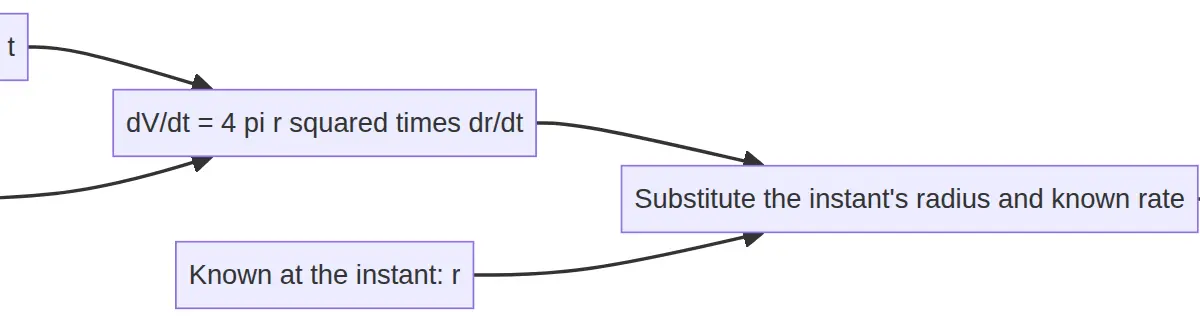
Connected rates questions describe quantities that are related and both vary with time. Start with the geometric or physical relationship, then differentiate every changing quantity with respect to t. For a sphere, V = 4πr^3/3. Since V and r depend on time:
dV/dt = 4πr^2 dr/dt.
This is the chain rule in a model. If a balloon has radius 3 cm and dr/dt = 0.2 cm s^-1 at that instant, then dV/dt = 4π(3)^2(0.2) = 7.2π cm^3 s^-1.
Do not substitute the radius before differentiating, because that converts a changing quantity into a constant and destroys the relation you need. The final unit must also change appropriately: a rate of radius uses length per time, while a rate of volume uses length cubed per time.
Mathematical Relationships and Formulae
All of the following are relevant to 7.4. The Pearson Mathematical Formulae and Statistical Tables booklet provides the standard derivative rules, including the reciprocal trig derivatives. The marks, however, come from applying the rule to the given function correctly.
| Relationship | Status in Edexcel assessment | When to use it |
|---|---|---|
d(uv)/dx = u dv/dx + v du/dx | Given in Pearson formulae booklet | Product of two functions |
d(u/v)/dx = [v du/dx - u dv/dx]/v^2 | Given in Pearson formulae booklet | A quotient of two functions |
d[f(g(x))]/dx = f'(g(x))g'(x) | Given in Pearson formulae booklet | A composite function |
d/dx[sin(kx)] = kcos(kx) | Given in Pearson formulae booklet | Sine with a linear inner function |
d/dx[cos(kx)] = -ksin(kx) | Given in Pearson formulae booklet | Cosine with a linear inner function |
d/dx[tan(kx)] = ksec^2(kx) | Given in Pearson formulae booklet | Tangent with a linear inner function |
d/dx[sec(kx)] = ksec(kx)tan(kx) | Given in Pearson formulae booklet | Secant, including chain rule factor |
d/dx[cosec(kx)] = -kcosec(kx)cot(kx) | Given in Pearson formulae booklet | Cosecant, including chain rule factor |
d/dx[cot(kx)] = -kcosec^2(kx) | Given in Pearson formulae booklet | Cotangent, including chain rule factor |
dy/dx = 1/(dx/dy) | Must be understood and used | A relation first differentiated with respect to y |
dV/dt = (dV/dr)(dr/dt) | Must be understood and used | A connected-rate model where V depends on r(t) |
Practical Applications
This specification point models real change. In engineering, the product rule appears when a quantity is a changing area multiplied by a changing pressure. In economics, a quotient may represent an average that changes because both a total and the number of items change. The chain rule is the mathematical language of a sensor whose output responds to a quantity that itself depends on time.
Connected rates make the model explicit. A filling sphere, a melting object, a widening circular ripple and a moving object whose position depends on another changing parameter all require a relationship first and a derivative with respect to time second. In an exam, define variables with units, write the governing equation, differentiate generally, substitute the stated instant, then finish with a rate and correct units. There is no required practical for this Pure Mathematics topic.
Graph and data skills
A derivative gives a gradient. When a question combines this topic with curve sketching, use the sign of the derivative to decide where a function is increasing or decreasing. A product or quotient derivative may need factorising before its sign is easy to analyse. With trig functions, check the stated domain and work in radians before interpreting roots or turning points.
Unit and tier note
A-Level Mathematics has no Foundation and Higher tiers. There are no standard unit conversions unique to 7.4, but candidates commonly lose accuracy by failing to convert a length rate into a volume rate: cm s^-1 becomes cm^3 s^-1 after applying a volume formula.
Audio Revision Recap
Use this ten-minute tutor-led recap after attempting the practice questions. Pause after each worked method, say the relevant rule aloud, then complete the quick-fire recall quiz without looking at the formula booklet. The best final check is to explain why every multiplier in a chain-rule answer is present.
Visual Resources
2 diagrams and illustrations
Interactive Diagrams
2 interactive diagrams to visualise key concepts
Conceptual Flow Outline
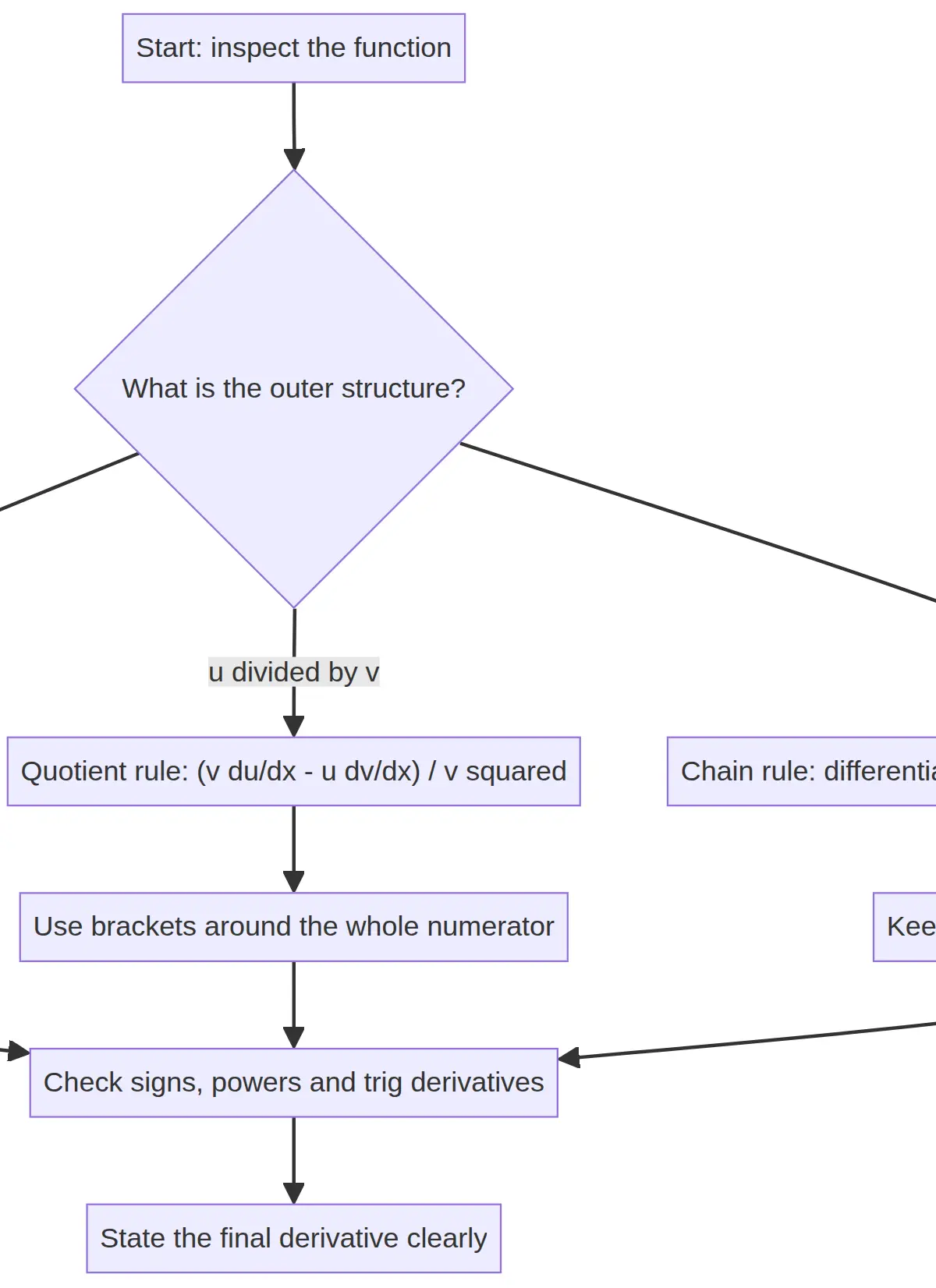
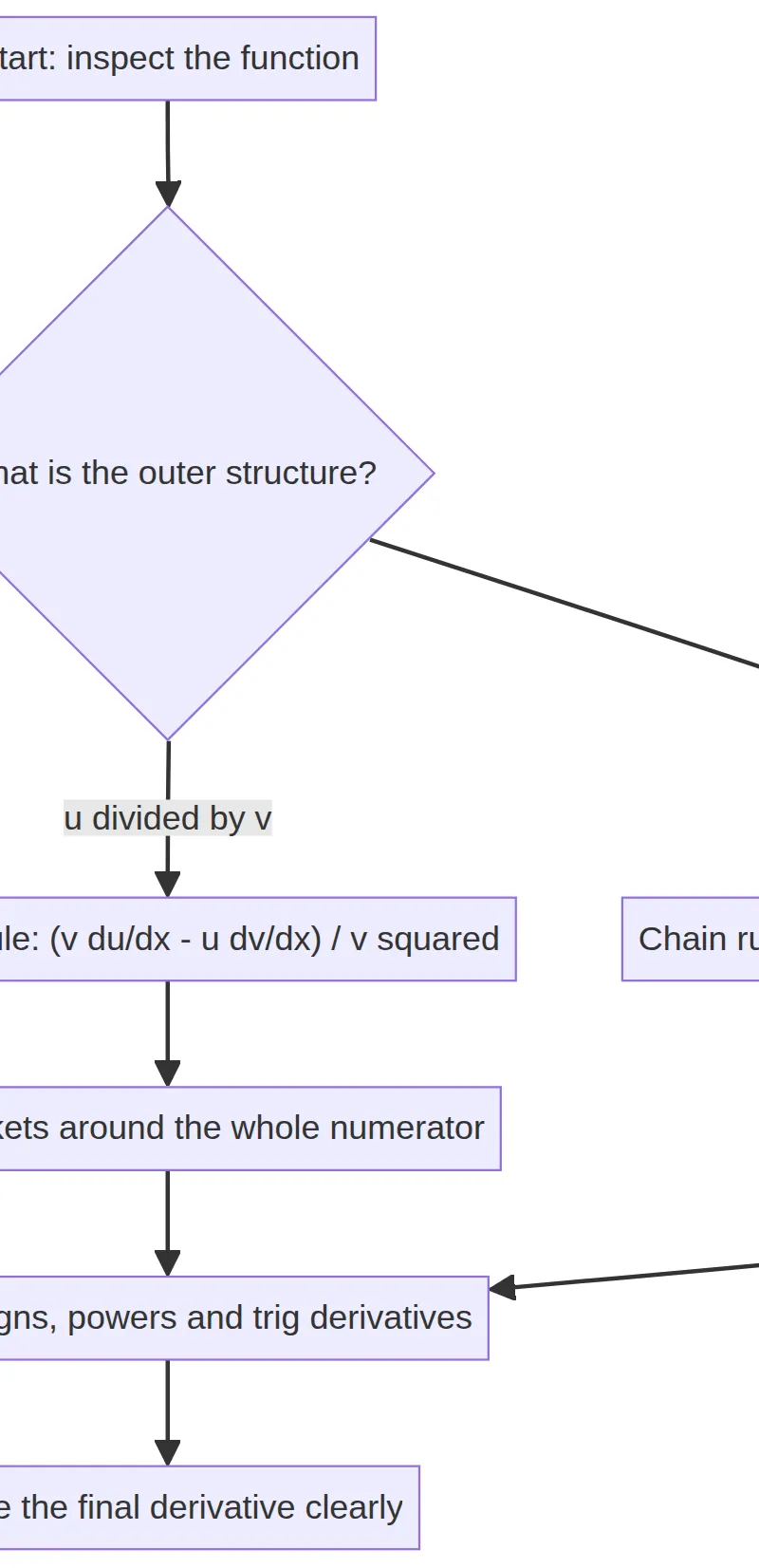
A fast decision process for selecting the correct differentiation rule from the outer structure.
Conceptual Flow Outline
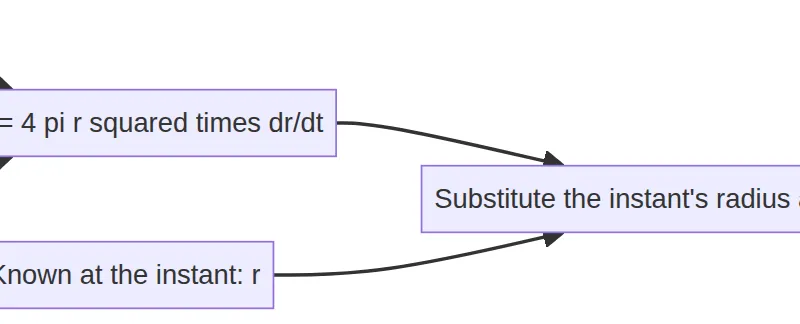
The connected-rates sequence: relationship first, general derivative second, values third, units last.
Worked Examples
4 worked examples — open one to explore the question and available guidance.
Practice Questions
Try the question, then reveal an answer plan or example response
Differentiate y = x^2 e^x. [3 marks]
Hint: It is a product. Let u = x^2 and v = e^x.
Differentiate y = [sin(4x)]^3. [3 marks]
Hint: There are three layers: cube, sine, then 4x.
Differentiate y = cosec(3x). [3 marks]
Hint: Use the derivative of cosec and then differentiate 3x.
Using the quotient rule, differentiate y = (x^2 + 1)/(x - 1). [4 marks]
Hint: Use u = x^2 + 1 and v = x - 1, so du/dx = 2x and dv/dx = 1.
For a cone, h = 4r and V = πr^2h. At an instant r = 2 cm and dr/dt = 0.5 cm s^-1. Find dV/dt. [5 marks]
Hint: Eliminate h first so that V is written only in terms of r.
Exam technique
How to turn what you know into marks
How to approach the question
First identify the outer structure. Define u and v for a product or quotient if it keeps the method readable. For a composite function, list the layers from outside to inside. For rates, write the model first and differentiate with respect to time before substituting. For inverse relations, state clearly whether you have found dx/dy or dy/dx.
How to structure your answer
For 3-4 marks, show the rule, substitute derivatives and write one clear final answer. For 5-6 marks, add variable definitions, an intermediate general derivative, a separate substitution line and units or an evaluation at the stated point. Do not compress several logical steps into one line when a sign or chain factor could be hidden.
Timing
Use approximately 1 minute per mark as a planning guide. For a 6-mark connected-rates question, reserve the final 30 seconds to check the differentiated relationship, the substituted instant and the units.
Common pitfalls
- Writing u'v' instead of u v' + v u'. Prevent this by writing two product-rule terms before simplifying.
- Dropping the minus in the quotient rule. Put brackets around the entire numerator from the first line.
- Stopping the chain rule one layer early, especially for tan^2(2x), cosec(5x) and powers of trig functions.
- Substituting a radius or angle before differentiating a connected-rate or inverse-function relation.
- Using degrees in trigonometric calculus. Use radians unless the question explicitly establishes a different numerical context.
What the command words want
- Find
- Locate the requested quantity precisely. If a point or instant is stated, differentiate first and then substitute it.
- Hence
- Use the previous result explicitly. A fresh unrelated method may not earn the intended follow-through credit.
- Explain
- Name the rule and justify the factor or sign, for example, 'the factor 3 is from differentiating the inner expression 3x - 1'.
- Show that
- Present a reversible chain of correct algebra from the given information. Do not assume the result in the working.
- State/Give
- Give the requested derivative, value or unit concisely, but include sufficient working if the mark allocation exceeds one mark.
- Differentiate
- State or apply the appropriate rule, show the derivative of every layer and simplify only after the method is visible.
Watch or listen (optional)
Test your understanding of Differentiate using the product rule, the quotient rule and the chain rule, including problems involving connected rates of change and inverse functions; differentiation of cosec x, cot x and sec x
Active recall beats re-reading. Take an instant quiz now to test what you’ve learned and lock it into long-term memory.
7 days Premium · Then the free plan continues · No card, no charge