Pearson Edexcel · A-Level · Mathematics
Course version: 9MA0 · Version from Mar 2026
Evaluate definite integrals; use a definite integral to find the area under a curve and the area between two curves
Definite integration is the A-level tool for turning a changing graph into a finite area. In Edexcel 8.3, the winning method is visual first and algebra second: locate the boundary, find the limits, choose a positive height and then integrate. Master that sequence and you can handle areas under curves, between curves and parametric regions with confidence.
- 10 min read
- 3 worked examples
- 6 practice questions
- 7 key terms
Check what you remember
Read the wording for your board, then hide it and explain Definite integral in your own words. Rough notes are fine. This is a self-check, with no mark or grade.
Reference: Pearson Edexcel
The signed accumulation of a function between two stated limits; if F'(x)=f(x), then ∫ₐᵇf(x)dx=F(b)−F(a).
Study Notes
Overview
Definite integration turns a changing height into a precise finite area. In Pearson Edexcel A-level Mathematics 8.3, candidates must evaluate definite integrals and use them to find the area under a curve and the area between curves. This is not simply an antidifferentiation topic: the marks usually reward interpretation first. You must identify the boundary, find the intersection points, decide which function is on top, then integrate over the correct interval.
A strong answer makes the diagram do some of the thinking. A sketch can reveal a wrong limit, a reversed subtraction or a section below the x-axis before it costs marks. Questions may be presented as pure algebra, a shaded region, a curve and a line, or parametric equations. The same core idea links them all: a definite integral gives signed accumulation, while an area must be positive. This topic is also a bridge to kinematics, numerical integration and later applications of calculus.
Specification anchor: Pearson Edexcel A Level Mathematics, Pure Mathematics 8.3 requires areas bounded by curves and straight lines, areas between two curves, and parametric curves. Official specification.
Key Concepts
1. Definite integrals: accumulation between two limits
If (F'(x)=f(x)), then
[
\int_a^b f(x),dx=F(b)-F(a).
]
This is the Fundamental Theorem of Calculus in the form needed for calculations. Read the vertical bar notation as “evaluate the antiderivative at the upper limit, then subtract its value at the lower limit”. The lower limit is not substituted first. Candidates who write the bracket correctly but reverse the subtraction usually lose the final accuracy mark.
For example,
[
\int_1^3(2x+1),dx=[x^2+x]_1^3=(9+3)-(1+1)=10.
]
There is no (+C) in a definite integral. A constant would cancel because ((F(b)+C)-(F(a)+C)=F(b)-F(a)). Credit is given for a correct antiderivative and correct substitution; the final mark normally depends on accurate arithmetic.
2. Area under a curve is only automatic when the curve is above the x-axis
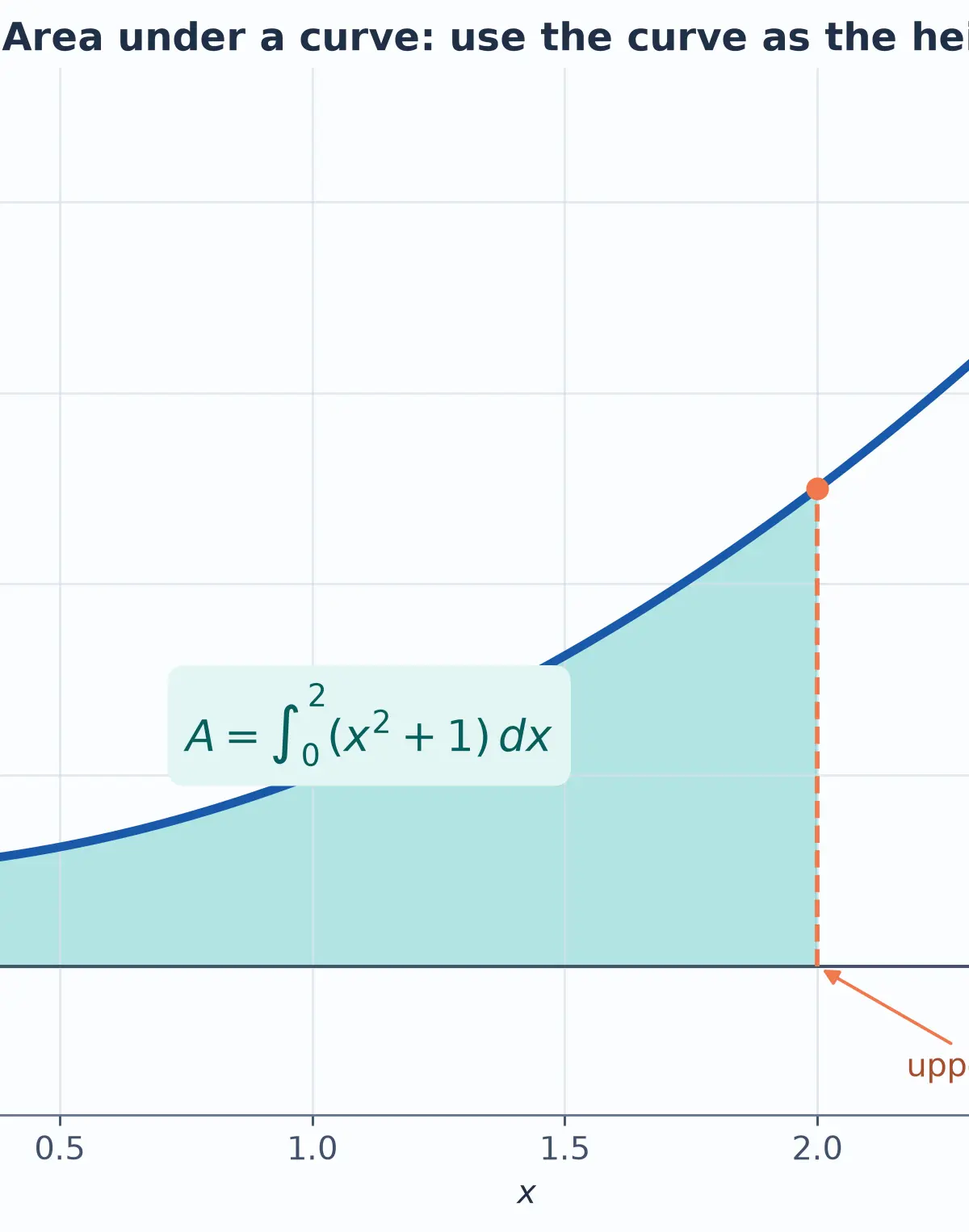
When (y=f(x)\ge0) between (x=a) and (x=b), the area between the curve, the x-axis and the vertical lines is
[
A=\int_a^b f(x),dx.
]
Think of each very thin vertical strip as having width (dx) and height (y). Integration adds the strip areas. The integral is signed: a section above the x-axis contributes positively, while a section below contributes negatively. The word “area” changes the task. If the graph crosses the x-axis, find the roots and split the integral so that each contribution is made positive.
Exam trigger: if the question says “total area” or shows a region crossing the x-axis, do not submit one signed integral as the area. State the roots, divide the interval and either negate the below-axis contribution or use absolute values only after you have justified the split.
3. Area between two curves: top minus bottom
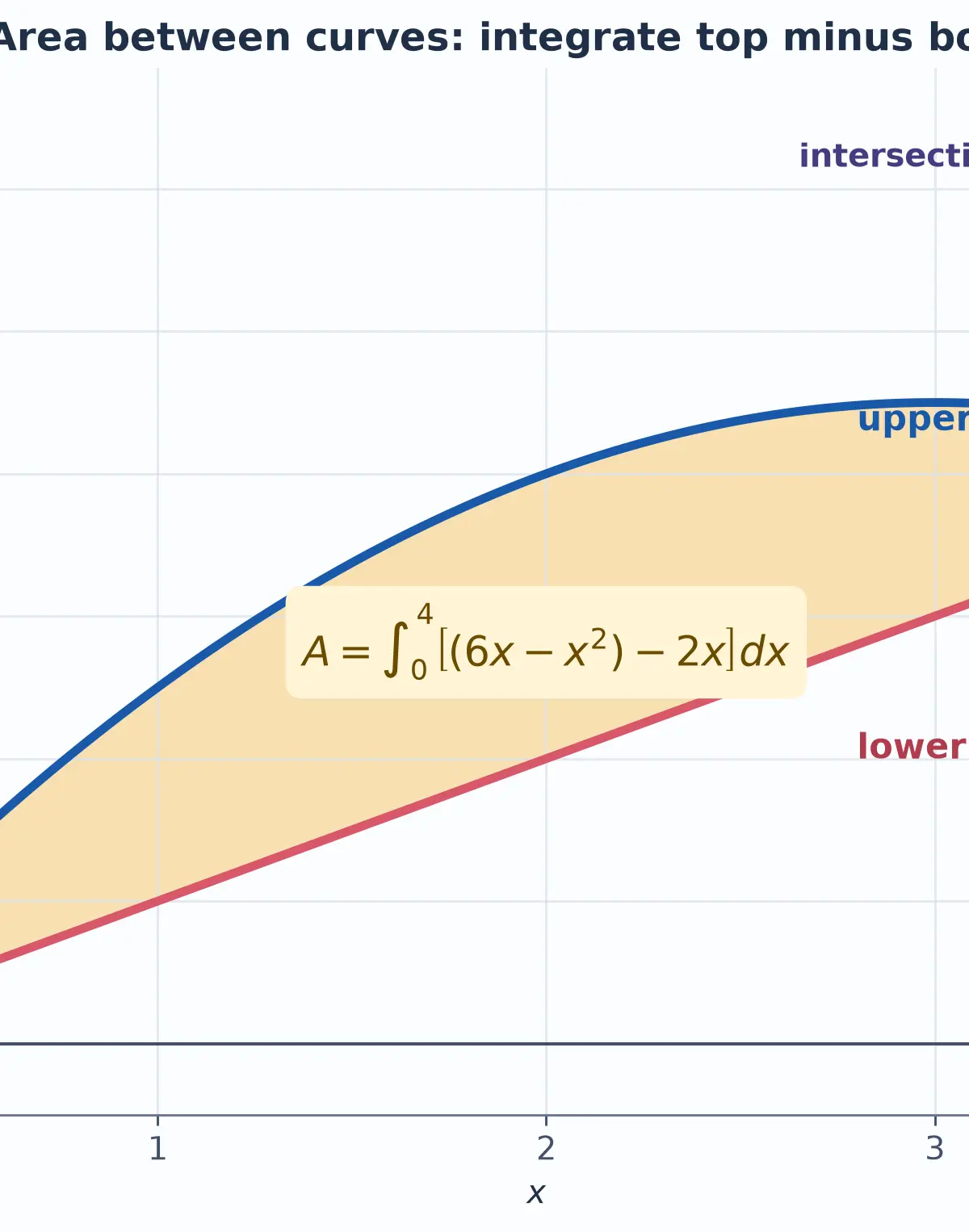
For vertical strips, the height of the strip is the y-value of the upper curve minus the y-value of the lower curve. Therefore
[
A=\int_a^b\bigl[f(x)-g(x)\bigr],dx,
]
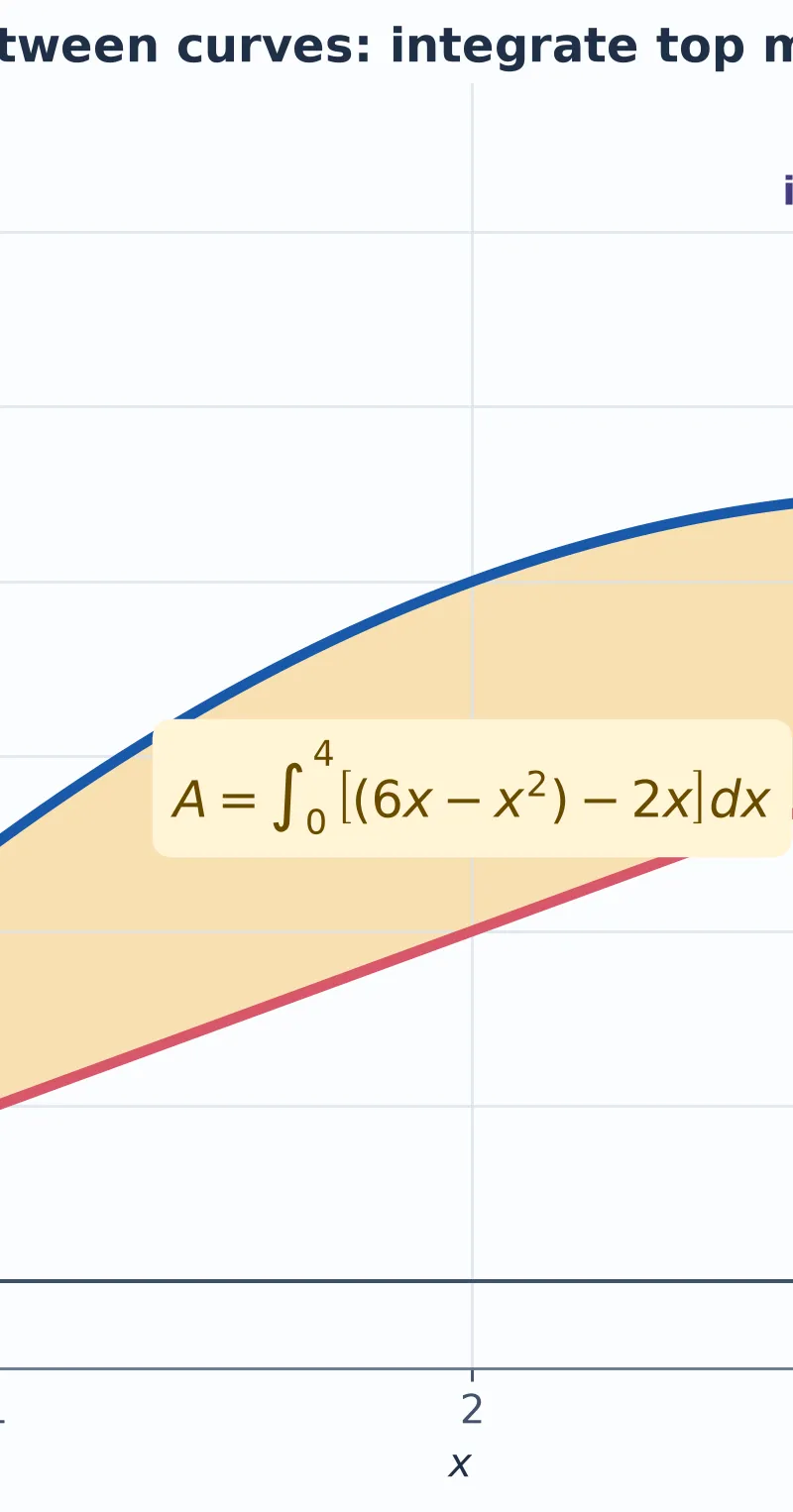
where (f(x)) is above (g(x)) throughout the chosen interval. The limits (a) and (b) are often the x-coordinates of intersections, found by solving (f(x)=g(x)). A sketch is not decoration: it confirms which curve is upper and whether the same order holds throughout.
For (y=6x-x^2) and (y=2x), first solve (6x-x^2=2x). This gives (x(4-x)=0), so the relevant limits are 0 and 4. A test value, such as (x=2), shows that (6x-x^2=8) and (2x=4), so the parabola is upper. The integrand must be ((6x-x^2)-2x), not the other way round.
If the curves swap order, one “top minus bottom” expression will fail. Find every intersection, split at each point and choose the upper curve separately on each interval. This is a common 1-mark sketch or interpretation issue that controls several later method marks.
4. Bounded regions and the language of limits
A finite area needs a closed boundary. The boundary may include a curve, the x-axis, vertical lines such as (x=1), or another curve or straight line. Read the wording literally. “Bounded by the curve and the line (y=2x)” normally means the intersections of those two graphs provide the horizontal limits. “Between (x=1) and (x=4)” gives the limits directly.
Before integrating, annotate a small sketch with every boundary. Then say in words what your integral represents, for example: “area = integral of parabola minus line from (x=0) to (x=4)”. This short line protects the structure of a 4- or 5-mark response and makes any later arithmetic error easier for an examiner to follow.
5. Parametric curves: change the variable carefully
For a curve given by (x=x(t)) and (y=y(t)), a vertical-strip area is
[
A=\int_{t_1}^{t_2}y\frac{dx}{dt},dt.
]
The parameter limits must match the requested endpoints, not the x-values unless the question has already converted them. First calculate (dx/dt). Then replace (dx) by ((dx/dt)dt), use limits in (t), simplify and integrate with respect to (t). For instance, if (x=t^2), (y=2t+1), (0\le t\le2), then (dx/dt=2t), so (A=\int_0^2(2t+1)(2t),dt).
Watch direction. If (dx/dt<0) over an interval, the parametrisation moves right to left and the signed integral may be negative. Sketch or inspect the parameter range, then reverse limits or split the interval when the question asks for area. Pearson’s enhanced content guidance permits conversion to Cartesian form, but it may create a more complicated integral; the parametric method is normally cleaner.
Mathematical Relationships and Formula Status
- Fundamental Theorem of Calculus, must memorise and understand: (\int_a^b f(x),dx=[F(x)]_a^b=F(b)-F(a)), where (F'(x)=f(x)).
- Area under a positive curve, given on the Pearson Edexcel formula booklet: (A=\int_a^b y,dx) for (y\ge0).
- Area between curves, must memorise as a setup rule: (A=\int_a^b(\text{upper}-\text{lower}),dx). It is the area-under-a-curve rule applied to the vertical distance between graphs.
- Total area where the graph crosses the x-axis, must memorise as a technique: split at roots and add positive pieces. Equivalently, (A=\int_a^b|f(x)|,dx), but show the intervals rather than treating absolute value as a calculator instruction.
- Parametric area, must memorise as a chain-rule application: (A=\int_{t_1}^{t_2}y,\dfrac{dx}{dt},dt), provided the direction and sign have been considered.
- Power rule for antiderivatives, given through standard integration formulae in the formula booklet: (\int x^n,dx=\dfrac{x^{n+1}}{n+1}+C), (n
e-1). In a definite integral the constants cancel, so do not add (+C).
Graph and calculator skills
A sketch need not be to scale, but it should show axes, intersections, limits and which graph is higher. Use algebra for exact intersections unless the question explicitly asks for a numerical approximation. A calculator can check a definite integral, but it cannot replace the setup in a “show that”, “find” or “hence” question. Enter brackets carefully: for area between curves, type the whole difference as one integrand. If a numerical answer is required, keep exact fractions until the final line and only round when the question asks.
A reliable four-line setup
- Sketch and label the region, including intersections and any x-axis crossings.
- Find the limits by solving the boundary equations, or convert endpoints to parameter values.
- State the height: curve above x-axis, or upper minus lower, or (y,dx/dt) for a parametric curve.
- Evaluate and interpret: substitute upper minus lower, make total area positive, then give exact units squared where physical units are supplied.
Why the procedure earns method marks
Each line of the routine answers a different mathematical question. The sketch answers “what is the region?”. The intersection calculation answers “where does it begin and end?”. The positive-height expression answers “what is the height of one thin strip?”. The antiderivative and limit substitution answer “what is the total of all strips?”. If you skip directly to a calculator result, an examiner cannot see those decisions and may only be able to award a final-answer mark. In contrast, a clear setup can retain most method credit when arithmetic goes wrong.
Use equality signs honestly. Write (A=\int) only when the integral represents the requested area. If you are still finding intersections, use a separate line. For a region between curves, brackets around the upper-minus-lower expression matter: they show that the whole vertical separation is being integrated. This is especially important when the lower curve has several terms or a negative coefficient.
Practical Applications
Integration models accumulated quantities whenever a changing rate or height is split into many thin pieces. In mechanics, the area under a velocity-time graph gives displacement, while total distance requires positive contributions. In economics, the area between supply and demand curves can represent a surplus. In design and engineering, a cross-sectional area can be integrated before being used in a volume model. These contexts change the labels, not the calculus: identify what the vertical distance means, identify the bounds, then add it continuously.
For this specification point there is no required practical. The assessment emphasis is mathematical modelling, algebraic accuracy and clear communication of a region. There are no special unit conversions for pure area questions; if a context gives metres, centimetres or seconds, convert before integrating and square the final length unit for an area. A candidate who writes (12\text{ m}) instead of (12\text{ m}^2) has not communicated the quantity fully.
Ten-minute revision podcast
Listen after working through the examples, then pause at the quick-fire quiz and answer aloud before the model response.
Examiner-Focused Checklist
For a typical 3-mark definite-integral question, one mark is often available for a correct antiderivative, one for valid evaluation at both limits and one for the simplified answer. For a 5-mark region question, marks are commonly distributed across intersections, correct order of subtraction, valid integral, integration and final area. The exact allocation varies by question, but the sequence is dependable. Do not hide the key setup inside calculator notation. Candidates are rewarded for a visible mathematical argument, even if a final arithmetic slip occurs.
Visual Resources
2 diagrams and illustrations
Interactive Diagrams
2 interactive diagrams to visualise key concepts
Conceptual Flow Outline
Decision process for selecting correct limits and a positive area integrand.
Conceptual Flow Outline
Parametric-area workflow, showing why dx/dt and parameter limits are required.
Worked Examples
3 worked examples — open one to explore the question and available guidance.
Practice Questions
Try the question, then reveal an answer plan or example response
Calculate ∫₀²(3x²−4x+1)dx. [3 marks]
Hint: Integrate each term, then apply 2 minus 0.
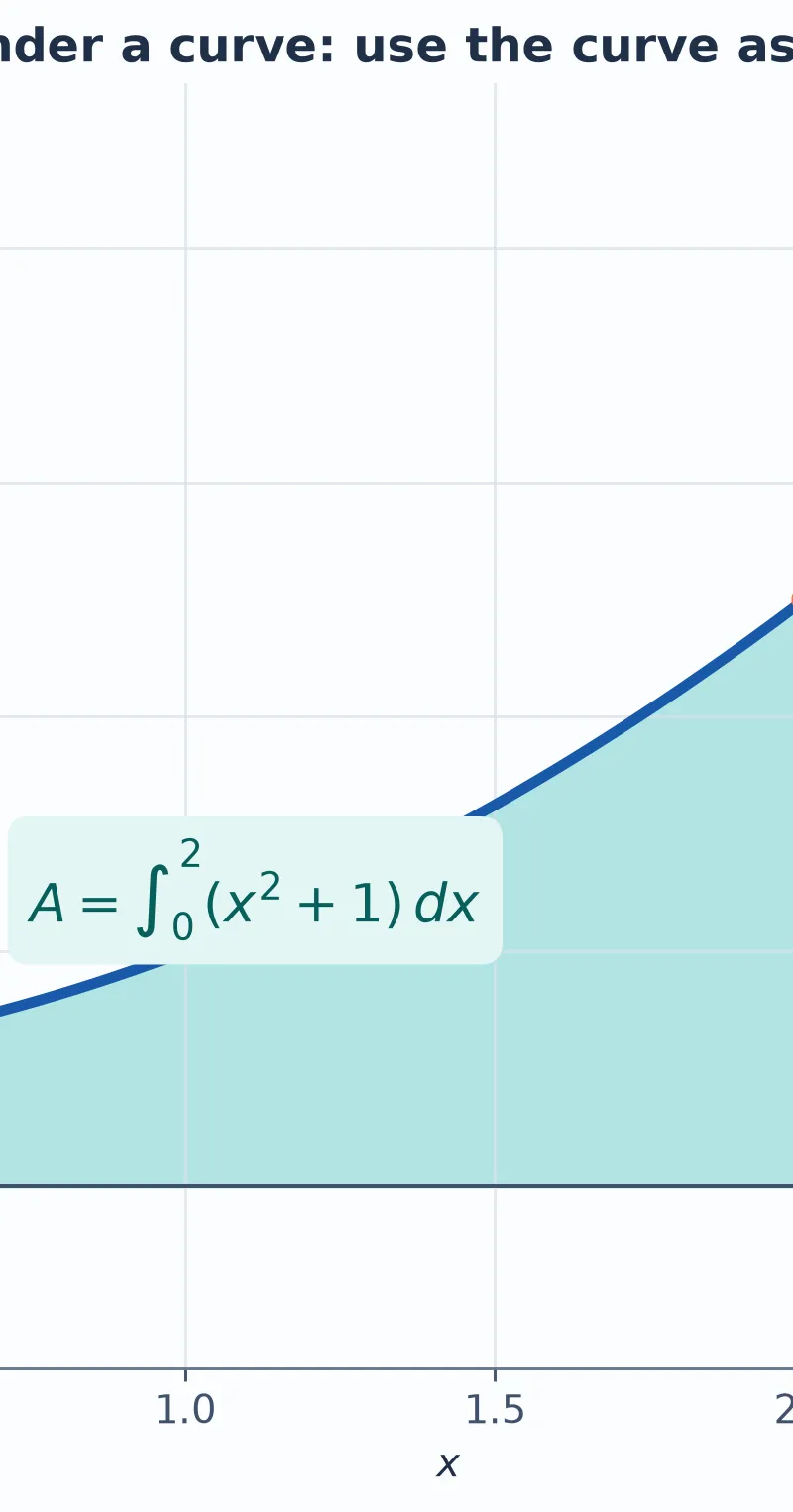
Find the area between y=x²+1, the x-axis, x=0 and x=2. [3 marks]
Hint: The curve is above the x-axis, so its y-value is the strip height.
The curve y=8x−x² and the line y=2x enclose a region. Find its area. [4 marks]
Hint: Find intersections before deciding the upper curve.
Find the total area between y=x²−4x+3 and the x-axis for 0≤x≤4. [5 marks]
Hint: Factor the quadratic and split at each root.
A curve is given by x=t²+1, y=3t, 1≤t≤3. Find the area under the curve. [5 marks]
Hint: Start with dx/dt, then use ∫y(dx/dt)dt.
Find the total area between y=x³−4x and the x-axis for −2≤x≤2. [5 marks]
Hint: Find the roots and use the symmetry only after you have checked the sign.
Exam technique
How to turn what you know into marks
How to approach the question
Draw a small labelled sketch before any integration. Identify the closed boundary, solve intersections for limits, test which curve is upper on each interval, then write one visible integral before calculating. For a parametric curve, differentiate x first and use limits in t.
How to structure your answer
For 3 marks: antiderivative, bracket notation, exact value. For 4-5 marks: intersections or stated limits, upper-minus-lower integral, evaluated antiderivative, positive area. For 6 marks with parameters: dx/dt, transformed integral with t-limits, simplification, evaluation and interpretation.
Timing
Allow approximately 1 minute per mark. A 3-mark evaluation should take about 3 minutes; allow 5-6 minutes for a 5- or 6-mark area question because the sketch and setup carry method marks.
Common pitfalls
- Using the y-coordinates of intersections as limits of an integral with respect to x. Avoid this by writing the differential first: dx needs x-limits; dt needs t-limits.
- Writing lower minus upper because the functions are listed in that order. Test one point inside the interval; the integrand for an area between curves must be positive.
- Treating a negative definite integral as a negative area. If the graph crosses the x-axis, find roots, split the interval and add magnitudes.
- Adding +C to a definite integral. It is not required and does not earn a mark.
What the command words want
- Find
- Translate every boundary in the wording into a sketch or an equation before committing to limits.
- Compare
- Check the same limits and distinguish signed integral from positive total area.
- Explain
- Link the choice to the geometry: for example, “the parabola is subtracted first because it is above the line on 0≤x≤4”.
- Describe
- Use graph language precisely: above or below the x-axis, upper or lower curve, intersection, bounded region and direction of increasing x.
- Evaluate
- Use bracket notation and calculate upper limit minus lower limit exactly before rounding.
- Calculate
- Show the integral setup, a correct antiderivative and substitution of both limits. Include square units where a physical area is asked for.
- Show that
- Work forwards from the given functions and retain exact algebra. Do not start from the printed answer.
- State/Give
- Write the exact requested value or equation with no unnecessary working, but preserve fractions unless a decimal is requested.
Watch or listen (optional)
Test your understanding of Evaluate definite integrals; use a definite integral to find the area under a curve and the area between two curves
Active recall beats re-reading. Take an instant quiz now to test what you’ve learned and lock it into long-term memory.
7 days Premium · Then the free plan continues · No card, no charge