Pearson Edexcel · A-Level · Mathematics
Course version: 9MA0 · Version from Mar 2026
Solve equations approximately using simple iterative methods; be able to draw associated cobweb and staircase diagrams
Simple iterative methods turn difficult root equations into a repeatable numerical routine: feed each answer back into \(x_{n+1}=g(x_n)\). For Pearson Edexcel 9.2, marks come from accurate iteration, a correctly constructed cobweb or staircase diagram, and a precise conclusion about convergence at the fixed point.
- 9 min read
- 4 worked examples
- 5 practice questions
- 8 key terms
Check what you remember
Read the wording for your board, then hide it and explain Fixed-point iteration in your own words. Rough notes are fine. This is a self-check, with no mark or grade.
Reference: Pearson Edexcel
A numerical method that generates successive approximations using a recurrence relation of the form \(x_{n+1}=g(x_n)\).
Study Notes

Pearson Edexcel A-Level Mathematics: Simple Iterative Methods, Cobweb and Staircase Diagrams
Overview
Iteration is the numerical escape route when an equation will not give up a tidy algebraic answer. In Pearson Edexcel A-Level Mathematics 9MA0, section 9.2, candidates must turn an equation into the form (x=g(x)), repeatedly calculate (x_{n+1}=g(x_n)), and explain the resulting behaviour using a cobweb or staircase diagram. The calculation, graph and written conclusion all assess the same idea: the current approximation becomes the next input.
This is an excellent marks-per-minute topic when the method is organised. A question may ask you to calculate a few terms, choose or use an initial value, draw steps between (y=g(x)) and (y=x), or decide whether the iteration converges. It connects directly to roots, graphs, recurrence relations and the numerical methods that follow. The hard part is not pressing a calculator button. It is showing the examiner that you understand what the numbers and the graph mean. Vertical to the curve, horizontal to the diagonal is the construction to remember.
Specification anchor: Pearson Edexcel A-Level Mathematics (9MA0), topic 9.2, requires simple iterative methods of the form (x_{n+1}=f(x_n)), roots of (x=f(x)), and cobweb and staircase diagrams to show convergence geometrically.
Key Concepts
1. From a root equation to a fixed-point equation
A root problem normally begins as (F(x)=0). If exact algebra is awkward or impossible, rearrange it into (x=g(x)). A value (\alpha) satisfying (\alpha=g(\alpha$)) is a fixed point. Provided the rearrangement is valid for the root being sought, that fixed point gives a root of the original equation.$
For example, (x^2-x-1=0) can be written as (x^2=x+1). For the positive root, (x=\sqrt{x+1}), giving (x_{n+1}=\sqrt{x_n+1}). Notice the restriction: the positive square root targets the positive root. A rearrangement is not a decorative algebra step. It chooses the function that will generate the approximations.
Why it works: at a fixed point, putting (\alpha) into (g) returns (\alpha). The process has stopped changing. Iteration attempts to make the changing values (x_0,x_1,x_2,\ldots) settle at that value.
2. The iteration routine
Use the starting value stated in the question, or a sensible value suggested by a graph or bracket. Then calculate in order:
[
x_1=g(x_0),\quad x_2=g(x_1),\quad x_3=g(x_2),\ldots
]
Keep full calculator accuracy in the stored answer. Write only the requested accuracy in your table or final answer. A candidate who rounds every intermediate term to three decimal places can shift later terms enough to lose the accuracy mark.
For (x_{n+1}=\sqrt{x_n+1}) with (x_0=1):
[
x_1=\sqrt{2}=1.414213\ldots,\qquad
x_2=\sqrt{2.414213\ldots}=1.553774\ldots
]
The values rise towards (1.618\ldots). This looks promising, but do not write only “the answer is 1.618”. State that the iterates appear to converge to the fixed point. If the question asks you tojustify a rounded root, use the original function and an appropriate sign-change interval from topic 9.1 as well.
3. The indispensable line (y=x)
A graph of (y=g(x)) alone is not an iteration diagram. You also need the diagonal line (y=x). It converts an output height into the next input position.
Start at (x_0) on the x-axis. Move vertically to the curve (y=g(x)). The height reached is (x_1=g(x_0)). Move horizontally to (y=x). At that point, the horizontal coordinate is also (x_1), ready to be used as the next input. Repeat vertical, then horizontal.
Memory hook: VCHD = Vertical to the Curve, Horizontal to the Diagonal.
This is why beginning horizontally is an error. You cannot transfer an output until you have first generated one.
4. Staircase behaviour
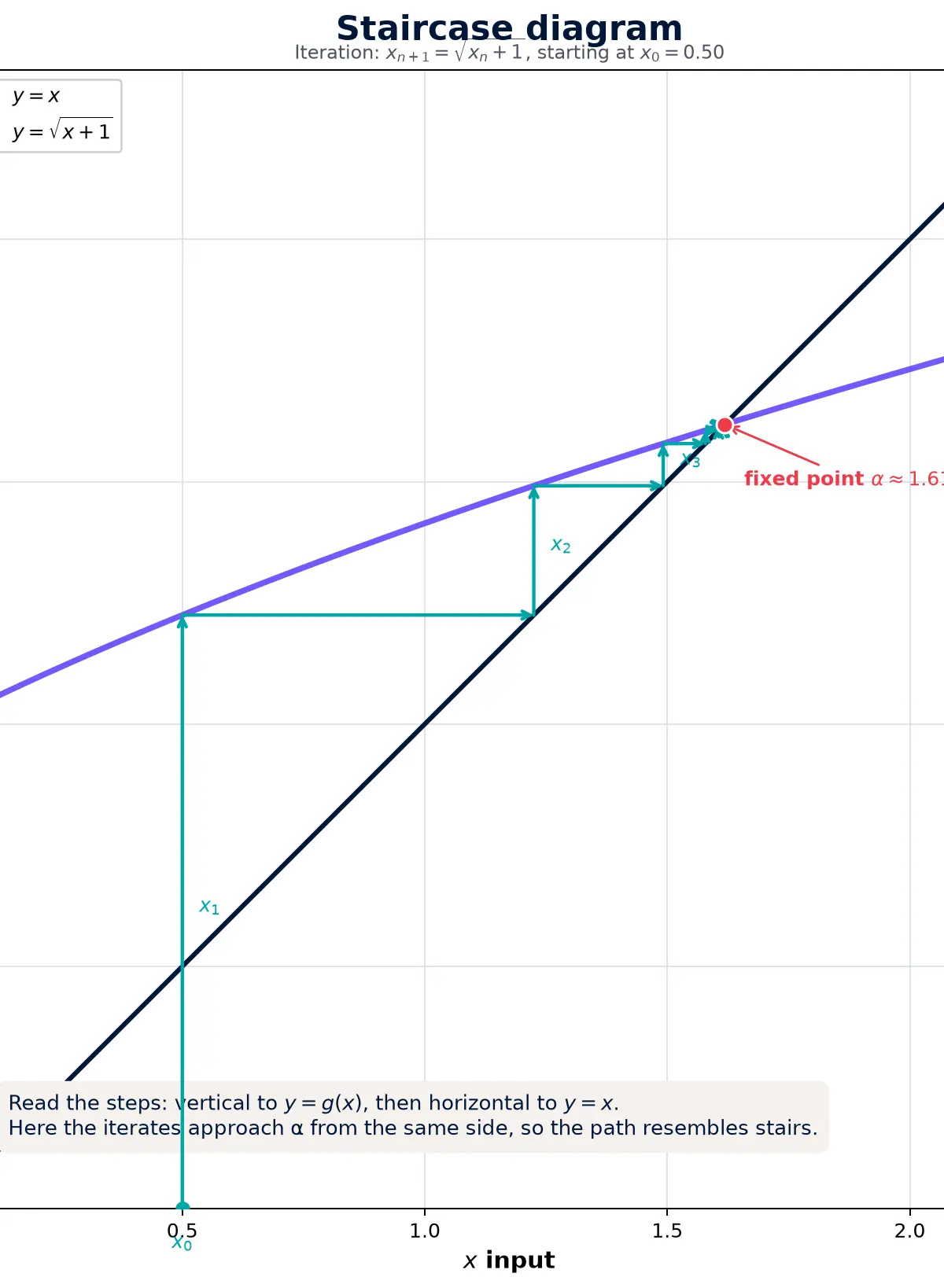
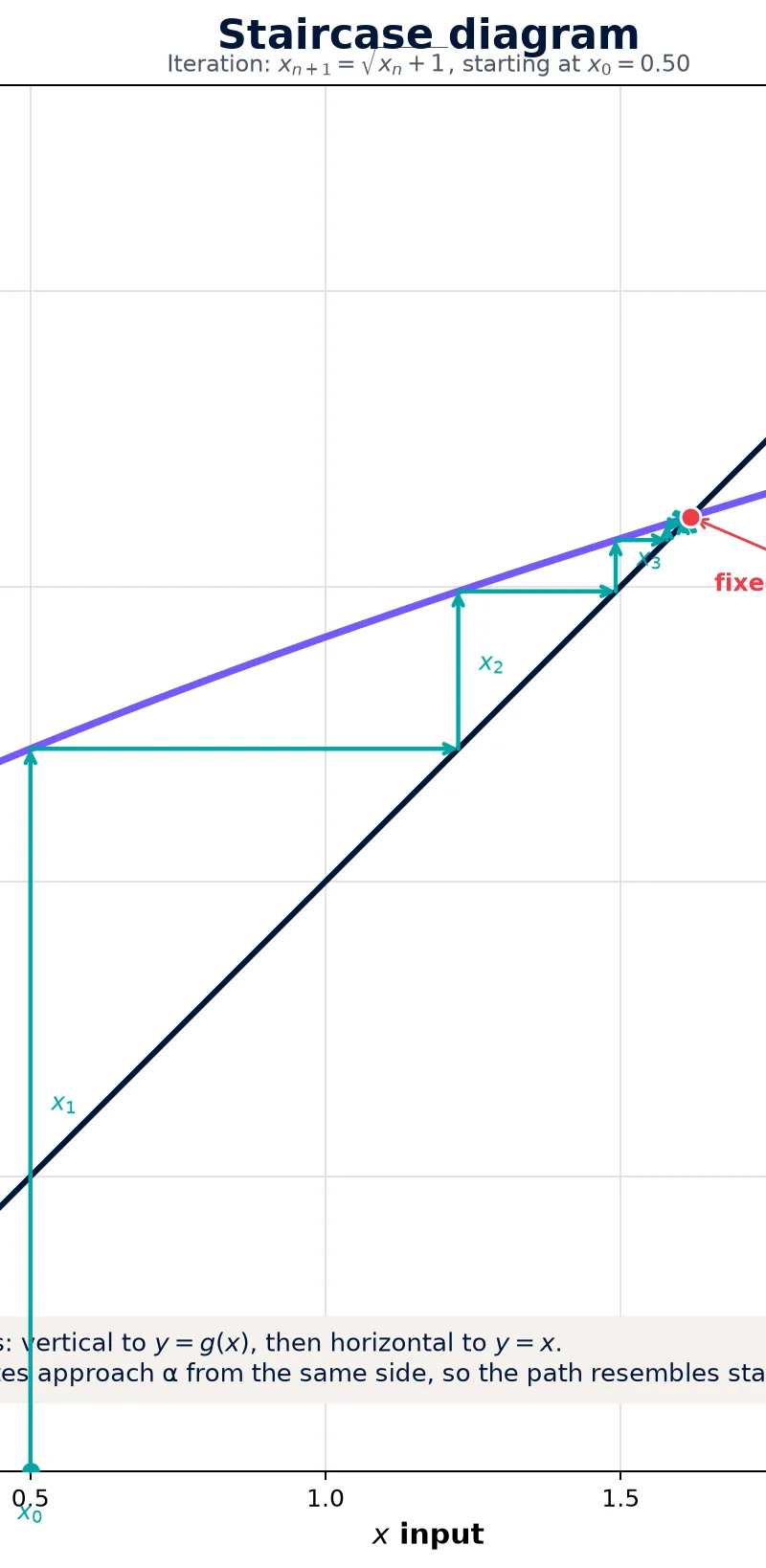
$A staircase diagram normally occurs when successive values approach the fixed point from the same side. Using (x_{n+1}=\sqrt{x_n+1}) with (x_0=0.5), the approximations lie below the positive fixed point and rise towards it. The repeated vertical and horizontal movements make narrowing steps.$
A full-mark interpretation is specific: “The successive iterates move closer to the intersection of (y=\sqrt{x+1}) and (y=x), so the iteration converges to the fixed point (\alpha\approx1.618).” Credit is given for identifying the intersection and describing the shrinking steps, not for a vague statement that the graph “goes up”.
5. Cobweb behaviour
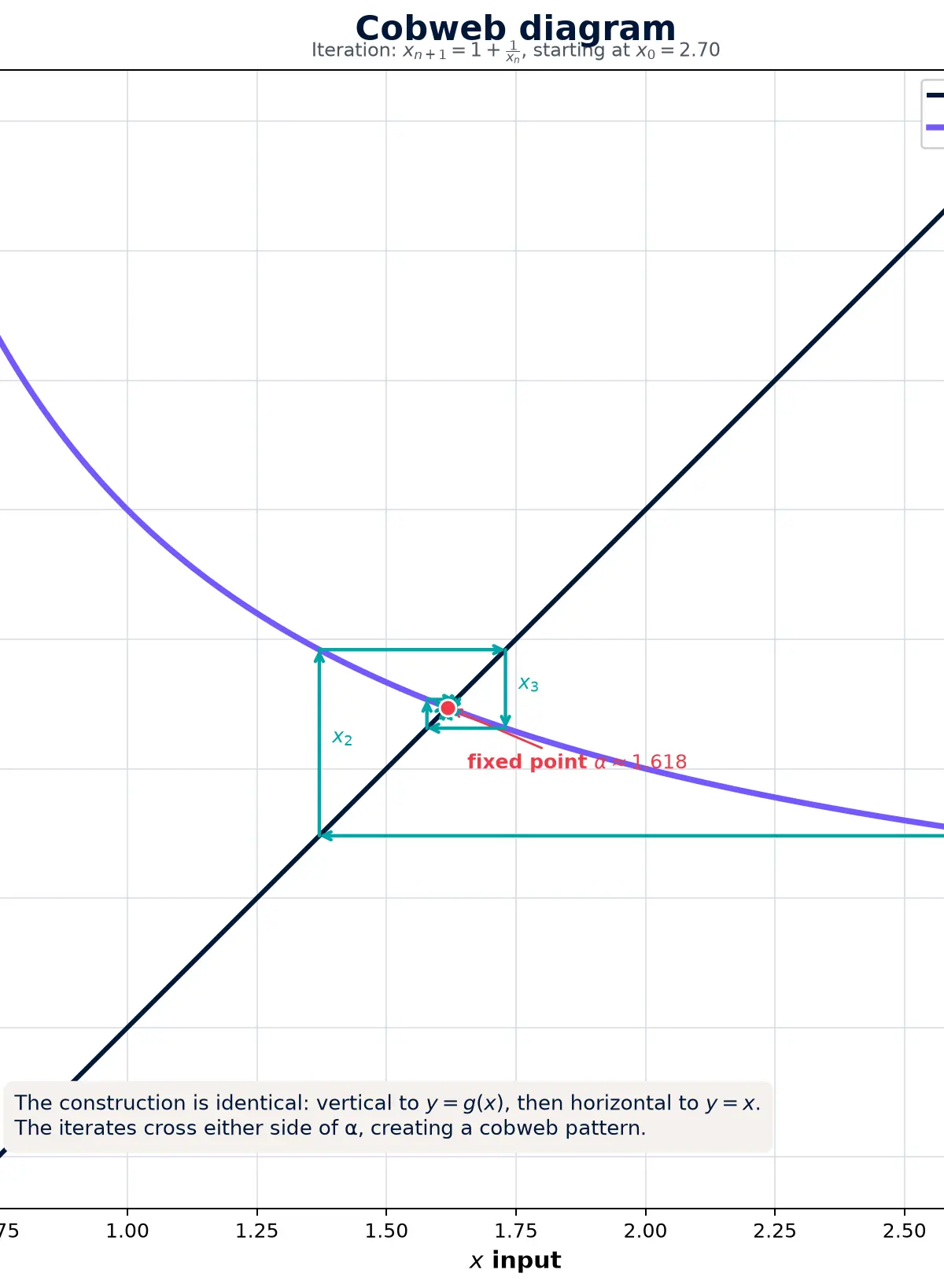
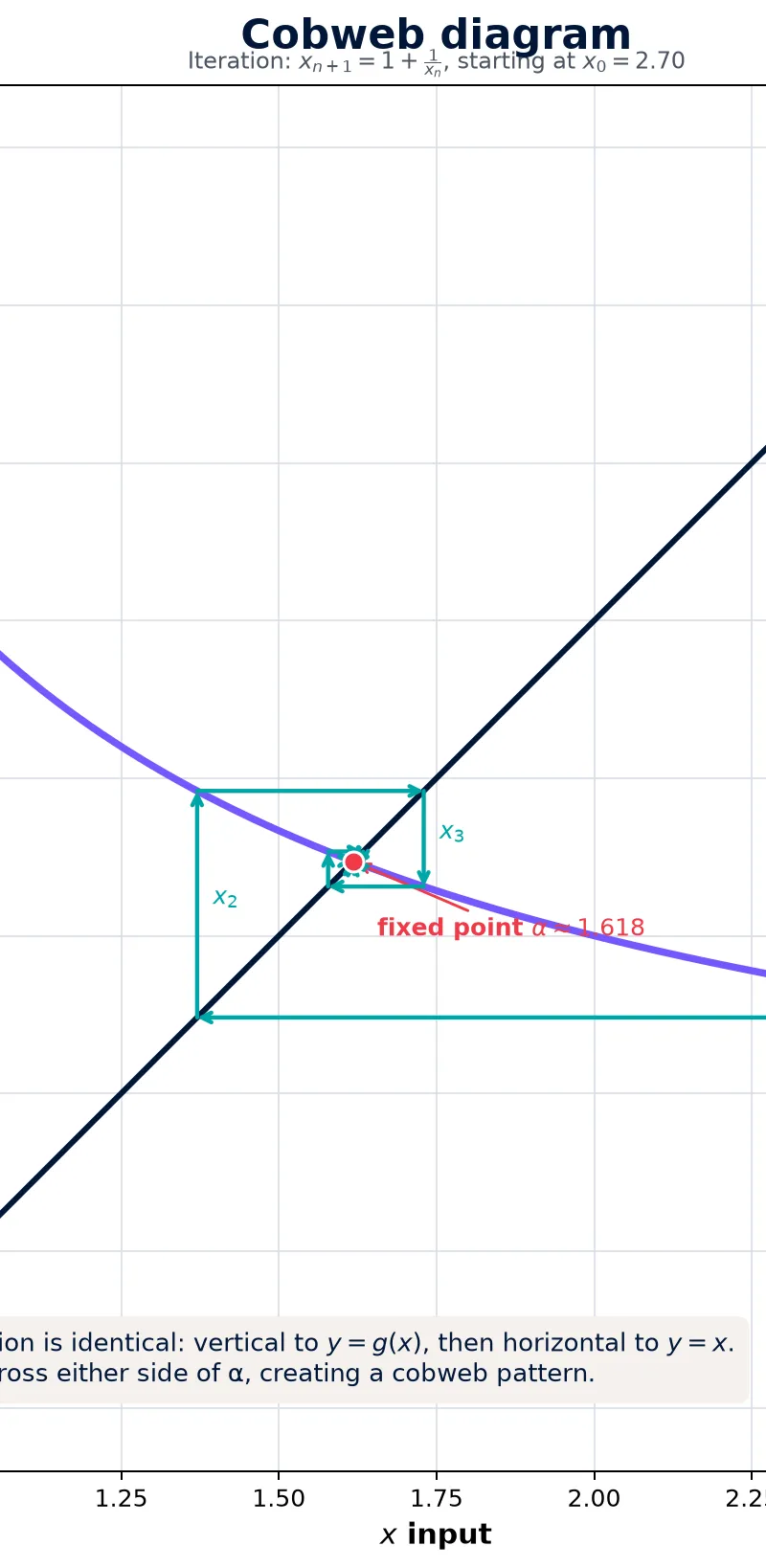
A cobweb diagram uses the identical construction but usually shows values alternating either side of the fixed point. The same original equation (x^2-x-1=0) can be rearranged as (x=1+\frac1x), giving (x_{n+1}=1+\frac1{x_n}). Starting at (x_0=2.7) gives (1.370\ldots, 1.730\ldots, 1.578\ldots, 1.634\ldots). The approximations jump across (1.618\ldots) while closing in.
Do not say that cobwebs and staircases are two different numerical methods. Both are graphical records of fixed-point iteration. The shape tells you how the sequence approaches the intersection: same side for a staircase; alternating sides for a cobweb.
6. Convergence, divergence and choosing a rearrangement
Different valid rearrangements of the same equation can behave very differently. A useful iteration has steps that close in towards the intersection. A divergent iteration has steps that move away or fail to settle. It is therefore possible for the algebra to be correct but the iteration to be unsuitable.
For this specification point, the diagram and the numerical values are the key evidence. You may know the useful diagnostic (|g'(\alpha)|<1) from wider work with functions, but it is not a replacement for drawing or interpreting the required geometry. In an Edexcel answer, follow the command word. If asked to draw, show the route. If asked to explain, refer to the iterates and the intersection.
Mathematical Relationships
| Relationship | Meaning | Formula-sheet status |
|---|---|---|
| Root form | The original problem is often (F(x)=0). | Must understand. No special iteration entry is supplied. |
| Fixed-point form | Rearrange to (x=g(x)). A solution (\alpha) satisfies (\alpha=g(\alpha)). | Must construct or use when given. |
| Iterative formula | Generate the next approximation from the current one. | Must memorise/use: (x_{n+1}=g(x_n)). |
| Rounding check | A sign change of a continuous original function over a suitable narrow interval can justify a stated rounding. | Must understand when the question asks for justification; this links to 9.1. |
There is no dedicated iterative-method formula to copy from the Edexcel formula booklet. Candidates are expected to understand the notation and use the rearrangement supplied or derived in the question.
Graph and Data Skills
- Plot (y=x) accurately with a ruler. It must be a straight diagonal through the origin with gradient 1.
- Plot or use the given curve (y=g(x)) on the same scale and label both graphs clearly.
- Begin at the stated (x_0) on the x-axis. First move vertical to (y=g(x)), then horizontal to (y=x).
- Use arrows or clear step directions. A chain of unlabelled right angles may not communicate the iteration process.
- Describe convergence by saying the steps get closer to the intersection. Describe divergence by saying the steps move away or do not settle.
Practical Applications
Iteration is how computers turn equations with no convenient exact solution into usable approximations. Engineers can use repeated calculations inside a model, programmers use recurrence relations in numerical algorithms, and economists may repeatedly update a predicted equilibrium. In the exam, however, the application is mathematical: the answer is an approximation and its reliability depends on the behaviour of the chosen iteration.
Examiner's Marking Lens
Treat a fixed-point question as three linked pieces of evidence. First comes the algebra: the stated or derived (g(x)) must genuinely represent the equation being solved. Second comes the numerical evidence: each line must feed the current approximation into the formula, with sensible accuracy. Third comes the geometrical evidence: the labelled path between the curve and the line must support the written conclusion. Strong candidates keep these pieces joined together rather than treating the graph as an unrelated sketch.
For a short calculation question, the first substitution is often the most valuable line to show. It proves that you understand both the index notation and the rule. On a diagram question, labels are marks-protectors: write (y=x), write (y=g(x)), and identify (x_0). Use a ruler for the diagonal and for the vertical-horizontal movements. The exact artistic shape of a hand-drawn cobweb is less important than an unambiguous sequence of steps which begins in the correct place and heads towards or away from the intersection.
When you interpret a graph, use a complete mathematical sentence. For example: “The iterates alternate about the fixed point but the distance to the intersection decreases, so the sequence converges.” This earns more credit than “it gets closer”. It identifies the behaviour, gives evidence and reaches a conclusion. Conversely, if the steps become larger, say that the iteration diverges and is unsuitable from that starting value or with that rearrangement. There is no required practical or unit conversion for this pure-mathematics topic; accuracy, notation and graphical communication are the assessed skills.
Podcast Revision Companion
Use the ten-minute audio companion after reading this guide. Pause during the recall quiz and answer before the tutor reveals the response. Then draw one staircase and one cobweb diagram from memory.
Visual Resources
2 diagrams and illustrations
Interactive Diagrams
2 interactive diagrams to visualise key concepts
Conceptual Flow Outline
The numerical workflow: rearrange, iterate, then judge whether the approximations settle.
Conceptual Flow Outline
The VCHD diagram cycle: vertical to the curve, horizontal to the diagonal, then repeat.
Worked Examples
4 worked examples — open one to explore the question and available guidance.
Practice Questions
Try the question, then reveal an answer plan or example response
Using (x_{n+1}=\sqrt{x_n+1}) with (x_0=1), calculate (x_2) correct to 3 decimal places.
Hint: You must calculate \(x_1\) before you can calculate \(x_2\).
A candidate starts a diagram for (x_{n+1}=g(x_n)) by moving horizontally from (x_0) to the curve (y=g(x)). Explain the error and state the correct first two moves.
Hint: Ask whether \(x_0\) is an input or an output.
An iteration has values (2.000, 1.500, 1.667, 1.600, 1.625, 1.615). Describe its behaviour and name the likely diagram type.
Hint: Notice which side of about 1.618 each value lies on, and whether the gaps shrink.
A graph shows iterative steps that move farther away from the intersection of (y=g(x)) and (y=x). State the behaviour, explain why this matters, and give one sensible next step.
Hint: Use the technical word for moving away from a fixed point.
The equation (x^3+x-4=0) is solved using (x_{n+1}=\sqrt[3]{4-x_n}), with (x_0=1.5). Calculate successive terms until a stable 3-decimal-place value is obtained. State the root and describe the convergence. [6 marks]
Hint: Do not round a term before feeding it into the next cube-root calculation.
Exam technique
How to turn what you know into marks
How to approach the question
Underline the starting value, the iterative formula and the command word. For a numerical question, write the first substitution, then feed every answer into the next calculation. For a graph question, draw and label \(y=x\) and \(y=g(x)\) before adding the vertical-horizontal route. Finish with convergence, divergence or alternation stated in words.
How to structure your answer
For 2-3 marks: state the formula, show one or more substitutions and give the requested accuracy. For 4-6 marks: add the rearrangement, labelled graph construction, arrowed steps and a conclusion tied to the intersection. A diagram without a conclusion, or a conclusion without evidence from the diagram, is incomplete.
Timing
Approximately 1 minute per mark. For a 5-mark diagram question, allow about 30 seconds to set up and label both graphs, then spend the remaining time showing steps and writing a precise conclusion.
Common pitfalls
- Starting on the y-axis or moving horizontally first. Avoid this by saying VCHD before drawing: start with the input \(x_0\), so go vertical first.
- Omitting \(y=x\), or using the x-axis instead of \(y=x\) for the horizontal move. The diagonal transfers the output to the next input.
- Rounding each iterate before reusing it. Store full calculator accuracy and round only displayed values unless instructed otherwise.
- Calling the intersection a root of \(g(x)=0\). It is a fixed point of \(g\), and hence a root of the original equation only after a valid rearrangement.
What the command words want
- Compare
- Give both the shared construction and the distinction: both use fixed-point iteration; staircase behaviour is typically one-sided while cobweb behaviour alternates.
- Explain
- Use because: the steps become smaller and close in on the intersection of \(y=g(x)\) and \(y=x\), therefore the iteration converges.
- Describe
- Name the observed behaviour: the iterates approach from one side, alternate around, or move away from the intersection.
- Evaluate
- Judge whether the sequence is reliable by using numerical values or the route on the diagram. State convergence or divergence and support it with evidence.
- Calculate
- Show the recurrence substitution at least once, reuse the latest value and round only at the requested stage.
- State/Give
- Write the fixed point, convergence outcome or requested approximation directly, with the required accuracy.
- Draw/Sketch
- Label \(y=x\) and \(y=g(x)\), start at \(x_0\), then draw vertical-to-curve and horizontal-to-diagonal steps with a ruler.
Watch or listen (optional)
Test your understanding of Solve equations approximately using simple iterative methods; be able to draw associated cobweb and staircase diagrams
Active recall beats re-reading. Take an instant quiz now to test what you’ve learned and lock it into long-term memory.
7 days Premium · Then the free plan continues · No card, no charge