Pearson Edexcel · A-Level · Mathematics
Course version: 9MA0 · Version from Mar 2026
Solve equations using the Newton-Raphson method and other recurrence relations of the form xₙ₊₁ = g(xₙ); understand how such methods can fail
Newton-Raphson and recurrence relations let you approximate roots that algebra cannot conveniently solve. For Pearson Edexcel, the highest marks come from pairing accurate calculator work with a clear function, derivative or recurrence, and a geometric explanation of convergence or failure.
- 10 min read
- 4 worked examples
- 5 practice questions
- 8 key terms
Check what you remember
Read the wording for your board, then hide it and explain root in your own words. Rough notes are fine. This is a self-check, with no mark or grade.
Reference: Pearson Edexcel
A value α for which f(α)=0; graphically, an x-coordinate where y=f(x) meets the x-axis.
Study Notes
Overview
Numerical methods are what mathematicians use when an equation refuses to give a neat algebraic answer. In Pearson Edexcel A-Level Mathematics, you must turn an equation into a root problem, use Newton-Raphson or a recurrence relation to generate increasingly accurate approximations, and explain when the process is unreliable. This is a high-value topic because it joins algebra, differentiation, graphs and calculator fluency in one place.
The question wording often tells you the method to use. Expect instructions such as “use the Newton-Raphson method”, “show that the iteration converges”, “use the recurrence relation” or “explain why this method may fail”. Marks are awarded for the mathematical set-up as well as the decimal answer. A calculator can produce the numbers, but candidates earn credit by defining the right function, showing enough substitution, and interpreting the graph correctly.
Key Concepts
1. Roots, fixed points and a safe starting point
$A root is a value, often written (\alpha), for which (f(\alpha)=0). If the original equation is (x^3+x=4), do not start Newton-Raphson with that form. Move everything to one side first:$
[
f(x)=x^3+x-4.
]
Now the root is exactly the value where the graph of (y=f(x)) crosses the x-axis. This first line is frequently worth a method mark. A sign change in a short interval can help you choose a sensible initial estimate. For example, (f(1)=-2) and (f(2)=6), so a root lies between 1 and 2 because the polynomial is continuous.
A recurrence relation has a different-looking target. If (x_{n+1}=g(x_n)), the limiting value must satisfy (\alpha=g(\alpha$)). Such a value is called a fixed point. Rearranging an equation into (x=g(x)) creates an iteration, but not every rearrangement is useful. The algebra may be correct while the sequence fails to settle.$
Exam habit: write down the supplied starting value as (x_0), retain full calculator precision, and round only the final answer. Repeated rounding can create a misleading final digit or even make a slowly converging iteration appear stationary too early.
2. Newton-Raphson: tangent, intercept, repeat
Newton-Raphson turns local gradient information into a better estimate of a root. For a differentiable function (f), the iteration is
[
x_{n+1}=x_n-\frac{f(x_n)}{f'(x_n)}.
]
Here (x_n) is the current estimate, (f(x_n)) is its vertical distance from the x-axis, and (f'(x_n)) is the gradient of the curve at that point. Geometrically, draw the tangent to (y=f(x)) at ((x_n,f(x_n))). Where that tangent meets the x-axis is the next estimate, (x_{n+1}). The method can be extremely fast once the estimate is close to a well-behaved root.
Reliable method for a calculation question:
- Rearrange to (f(x)=0).
- Differentiate to find (f'(x)).
- State the Newton-Raphson formula before using it.
- Substitute the supplied (x_0), then continue until the required accuracy is secure.
- State the root clearly, for example (x=1.379) correct to 3 decimal places.
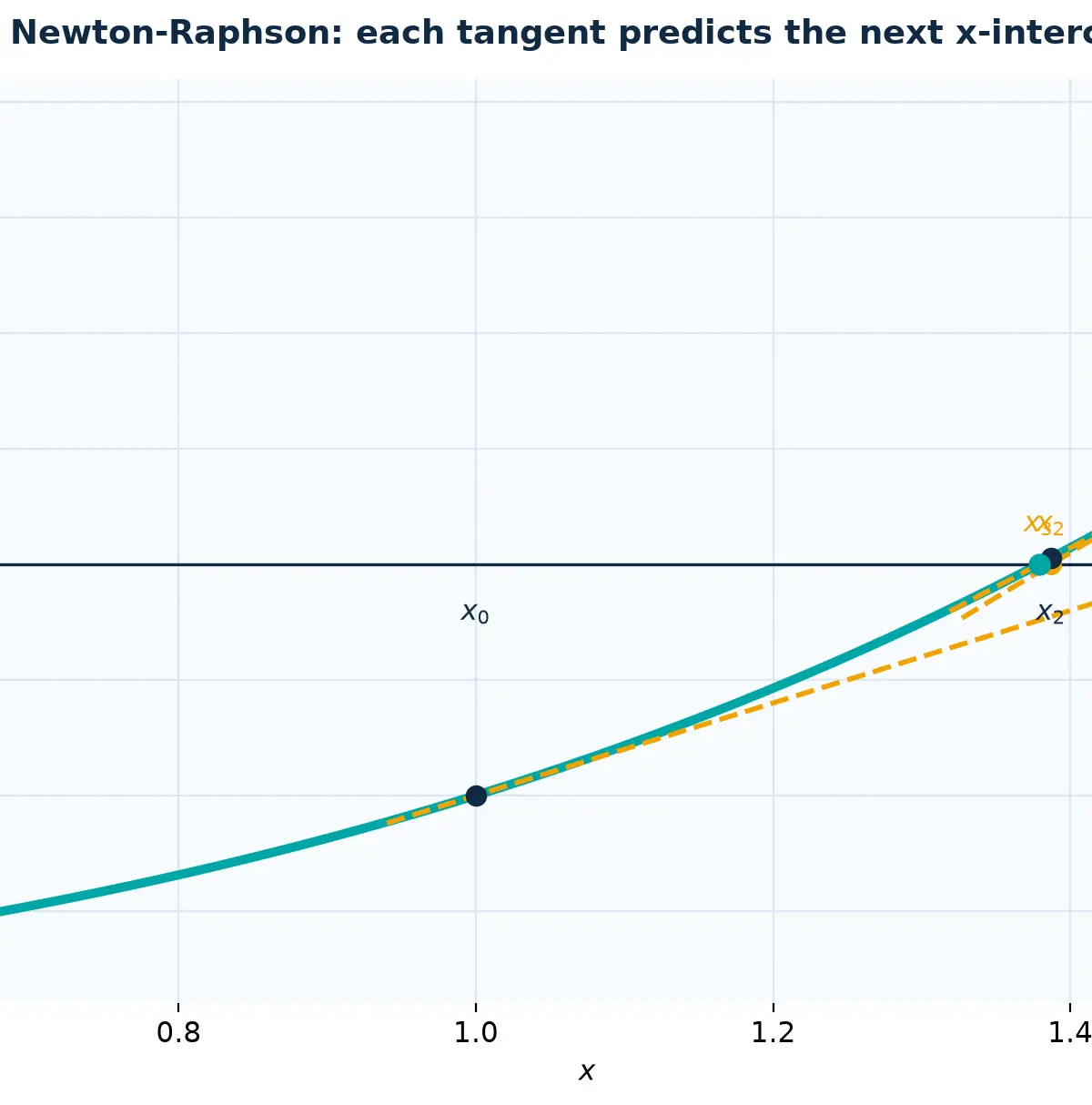
The diagram shows why a tangent is useful. It is a straight-line local approximation to the curve. Its x-intercept is usually closer to the true intercept than the starting point. It is not magic: if the tangent is nearly horizontal, its x-intercept can be very far away.
3. General recurrence relations and the cobweb picture
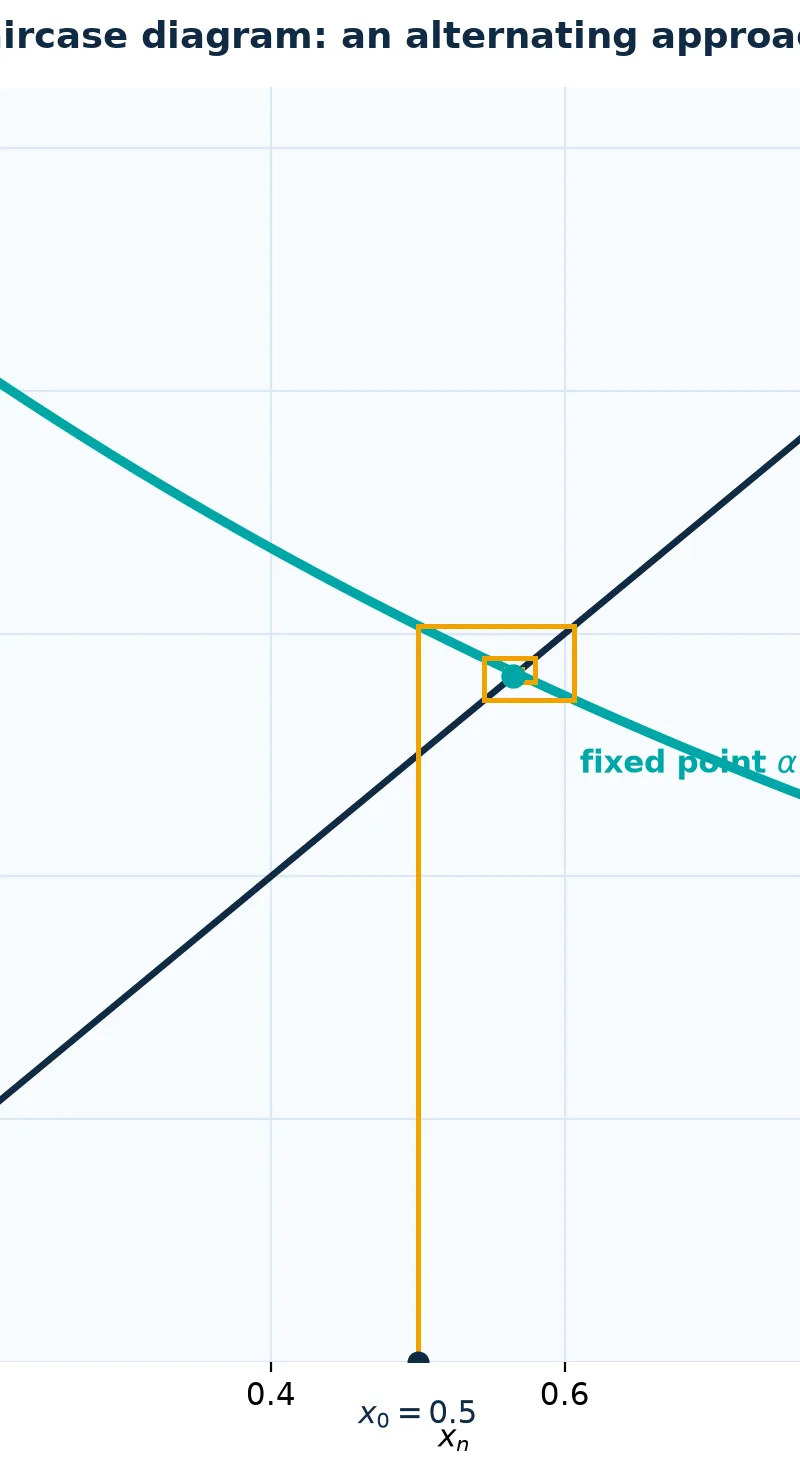
For a recurrence of the form (x_{n+1}=g(x_n)), repeatedly put the previous answer into the same expression. For instance, (x_{n+1}=e^{-x_n}) with (x_0=0.5) gives (0.60653, 0.54524, 0.57970,\ldots). The values alternate around a fixed point near (0.567), with the gap becoming smaller.
A cobweb or staircase diagram uses the two curves (y=g(x)) and (y=x). Start at (x_n) on the x-axis, move vertically to (y=g(x)), then horizontally to (y=x). Repeating these vertical-horizontal moves traces the sequence. If the steps head into the intersection, the iteration converges. If they move away, cycle, or wander, it fails from that start or with that rearrangement.
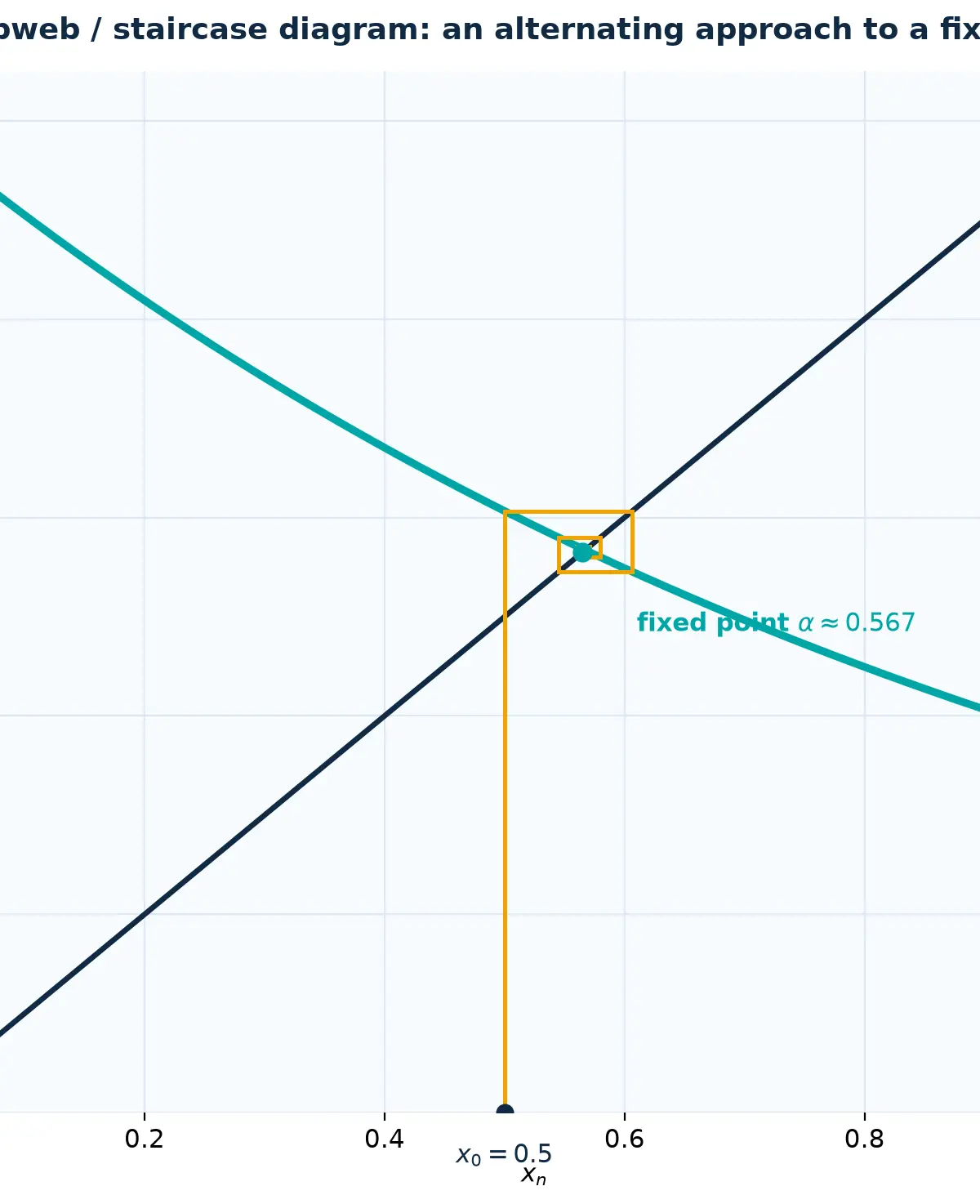
A helpful local test is the size of the gradient of (g) near the fixed point. If (|g'(\alpha)|<1), nearby iterations normally converge; a negative gradient produces an alternating approach. If (|g'(\alpha)|>1), nearby errors tend to grow. Treat this as an explanation tool rather than a replacement for the recurrence the question has specified.
4. How and why methods fail
Pearson explicitly expects geometric understanding of failure near small gradients. In Newton-Raphson, the denominator is (f'(x_n)). If (f'(x_n)=0), the tangent is horizontal and never meets the x-axis, so the formula is undefined. If (f'(x_n)) is very small, dividing by it creates a large correction. The next estimate can jump away from the intended root, possibly towards another root or a region where the function is unsuitable.
For example, with (f(x)=x^3-3x+1) and (x_0=1), (f'(x)=3x^2-3), so (f'(1)=0). The correct explanation is not merely “the calculator does not work”. Write: “At (x=1), the gradient is zero, so the tangent is parallel to the x-axis and has no x-intercept. Therefore the Newton-Raphson iteration is undefined.” That links algebra to geometry and earns the explanatory mark.
General iterations can fail because an unsuitable rearrangement has a steep gradient near its fixed point, because the starting value is too far away, or because the values enter a cycle. Do not claim that every rearrangement of the same equation behaves identically. Choosing (g(x)) is part of the mathematics.
5. Exam-ready presentation and calculator control
Approximately one minute per mark is a sensible planning rule. A 4-mark numerical-methods task should normally have a visible function, derivative or recurrence, a substitution, numerical evidence, and a correctly rounded conclusion. If the instruction says “show that”, your lines must make the stated result unavoidable. If it says “explain”, a bare decimal receives no credit.
Use the calculator’s Ans key or stored variables to repeat an iteration, but copy at least the first one or two substitutions into the answer. State enough digits to justify the requested accuracy. For 3 decimal places, show estimates that agree to 3 decimal places, preferably one further iteration after the agreement is first seen. Check the calculator is in radians for any trigonometric function, and never use a rounded previous answer unless the question explicitly tells you to.
6. Choosing between Newton-Raphson and simple iteration
The method named in the question is the method you use. When a question asks for Newton-Raphson, do not replace it with a simple iteration just because a calculator sequence is easier to type. The examiner is testing the tangent formula and your derivative. Similarly, when a recurrence is supplied, use that recurrence even if you can see a different rearrangement that would converge more quickly. You may comment on its behaviour only if the question asks you to explain, compare or evaluate.
When the method is not prescribed, begin with the structure of the equation. Newton-Raphson is usually effective when you can differentiate accurately and have a sensible starting value away from a stationary point. A general recurrence is convenient if a natural rearrangement is supplied or if a fixed-point graph is the focus. Change of sign is useful before either method because it brackets a root and gives a defensible region for a starting estimate. It is not, by itself, a final decimal solution unless the question asks only for an interval.
Candidates sometimes write a recurrence that looks almost right but uses the new value on both sides, for example (x_{n+1}=g(x_{n+1})). Check the subscripts: the old value goes into (g), and the new value comes out. For Newton-Raphson, put brackets around the full numerator and denominator before pressing =. This prevents a calculator precedence error such as subtracting only part of the fraction.
7. Graph and data skills that secure explanation marks
A sketch need not be perfectly scaled, but it must communicate the mathematical idea. For Newton-Raphson, show the curve, the x-axis, a point on the curve and a tangent that meets the axis at the next estimate. For a cobweb diagram, plot both (y=g(x)) and (y=x), then use vertical and horizontal segments. A diagonal line alone is not a cobweb. Label the intersection as the fixed point and make the direction of iteration unambiguous.
Read an iteration table as evidence, not decoration. Values such as (1.442, 1.368, 1.381, 1.378) suggest convergence because the estimates tighten around one value. Values growing in magnitude, jumping between distant values, or repeating two distinct values suggest failure. If the values alternate but the interval between them shrinks, that is still convergence. State exactly what your figures show rather than using “converges” as a guess.
Mathematical Relationships
| Relationship | What it means | Formula-sheet status |
|---|---|---|
| Root condition | Convert the original equation to a function equal to zero. | Must construct and use |
| Newton-Raphson | Uses the tangent at the current estimate to obtain the next x-intercept. | Given on formula sheet: (x_{n+1}=x_n-f(x_n)/f'(x_n)) |
| Fixed-point condition | At convergence, the input and output of the recurrence are equal. | Must construct and use: (\alpha=g(\alpha)) |
| Recurrence iteration | Feed each estimate into the same function. | Given by question or must construct |
| Gradient check | Explains local convergence or divergence of a recurrence. | Useful diagnostic: ( |
The differentiation rules required to form (f'(x)) must be known and applied accurately. A formula sheet cannot repair an incorrectly differentiated function.
Practical Applications
Numerical methods are used whenever an exact rearrangement is impractical: engineers locate where a design curve meets a safety limit, programmers solve equations inside simulations, and scientists calibrate models against observations. In the examination, the context may be a volume, a time, or an optimisation boundary, but the mathematics is unchanged: define the equation, approximate the required root, then interpret the answer in context. There is no required practical or tier split for this A-Level topic. Unit conversion is only needed when the surrounding context supplies units.
Listen: 10-minute tutor podcast
Visual Resources
2 diagrams and illustrations
Interactive Diagrams
2 interactive diagrams to visualise key concepts
Conceptual Flow Outline
Newton-Raphson exam workflow, including the gradient danger check.
Conceptual Flow Outline
How a cobweb or staircase diagram represents a recurrence relation.
Worked Examples
4 worked examples — open one to explore the question and available guidance.
Practice Questions
Try the question, then reveal an answer plan or example response
For ln x + x = 2, state f(x), find f′(x), and use x₀ = 1 to obtain x₁ by Newton-Raphson. [3 marks]
Hint: Move 2 to the left before differentiating.
Use xₙ₊₁ = cos(xₙ), with x₀ = 0.5, to calculate x₁ to x₄. Describe the behaviour of the sequence. [4 marks]
Hint: Keep the calculator in radians and retain its full stored value.
Use Newton-Raphson with x₀ = 2 to solve x³ − 2x − 5 = 0, giving the root correct to 4 decimal places. [5 marks]
Hint: Use f(x) = x³ − 2x − 5 and differentiate before iterating.
Explain why Newton-Raphson cannot proceed from x₀ = 1 for f(x) = x³ − 3x + 1. [4 marks]
Hint: Calculate the derivative at the starting value, then turn that fact into a tangent explanation.
The equation x³ + x − 4 = 0 is rearranged as g₁(x) = (4 − x)^(1/3) and g₂(x) = 4 − x³. Starting with x₀ = 1, decide which recurrence is likely to converge to the root. Justify your answer and give three iterates for the suitable recurrence. [6 marks]
Hint: Near the root 1.379, compare the magnitude of each derivative.
Exam technique
How to turn what you know into marks
How to approach the question
Identify the requested method before calculating. For Newton-Raphson, write f(x)=0 and f′(x), state the formula, then show initial substitutions and a short iteration table. For a recurrence, copy the relation accurately, iterate from x₀ with full precision, then describe convergence from values or a cobweb diagram. For failure questions, connect algebra to geometry.
How to structure your answer
For 2-3 marks: state the function or derivative and one valid iteration. For 4-5 marks: add a stated recurrence, several accurate values and a rounded conclusion. For 6 marks: include the set-up, sufficient iterations, a fully justified accuracy statement, and any requested explanation of convergence or failure.
Timing
Approximately 1 minute per mark. A 6-mark numerical-methods question should normally take 6-7 minutes, including a final accuracy check.
Common pitfalls
- Using Newton-Raphson before rearranging to f(x)=0. Avoid it by boxing the zero-function before differentiating.
- Rounding intermediate values. Avoid it by using Ans or stored values and rounding once at the final statement.
- Saying “gradient is zero” without explaining the tangent. Add: “the tangent is horizontal, so it has no x-intercept”.
- Assuming any valid rearrangement x=g(x) must converge. Check the sequence or the local gradient.
What the command words want
- Compare
- Mention both recurrence relations and link their different gradients to their different convergence behaviour.
- Explain
- Use a cause-and-consequence chain. For example, f′(x₀)=0, therefore the tangent is horizontal, therefore no next intercept exists.
- Describe
- Report what the sequence does: alternates, approaches, diverges or cycles. Refer to values or a diagram.
- Evaluate
- Discuss reliability of the start value, gradient and numerical evidence before reaching a conclusion.
- Calculate
- Show f(x), f′(x) or g(x), the recurrence, enough substitution to evidence the method, then a final value at the stated accuracy.
- State/Give
- Provide the requested function, recurrence or rounded value only, using correct notation.
Watch or listen (optional)
Test your understanding of Solve equations using the Newton-Raphson method and other recurrence relations of the form xₙ₊₁ = g(xₙ); understand how such methods can fail
Active recall beats re-reading. Take an instant quiz now to test what you’ve learned and lock it into long-term memory.
7 days Premium · Then the free plan continues · No card, no charge