Pearson Edexcel · A-Level · Mathematics
Course version: 9MA0 · Version from Mar 2026
Understand and use composite functions; inverse functions and their graphs
Composite and inverse functions turn algebra into a chain of controlled processes: apply rules in the right order, then reverse them only when the mapping is one-to-one. In Pearson Edexcel A-level Mathematics, this compact topic can test notation, domains, graph reflection and algebraic rearrangement in a single multi-mark question.
- 9 min read
- 3 worked examples
- 5 practice questions
- 8 key terms
Check what you remember
Read the wording for your board, then hide it and explain Function in your own words. Rough notes are fine. This is a self-check, with no mark or grade.
Reference: Pearson Edexcel
A mapping which assigns exactly one output to each input in its domain.
Study Notes

Composite and inverse functions: Edexcel A-level Mathematics
Overview
Specification point 2.8 asks you to treat functions as mappings, combine functions in the correct order, and reverse a function when that reversal is valid. This is not merely notation. In an Edexcel question, a composite function can expose whether you understand an algebraic process as a chain of actions, while an inverse-function question tests algebra, restrictions, and graph interpretation together. Expect short items such as finding fg(3) or f^{-1}(x), but also connected questions in which a domain restriction, a composite calculation and a sketch each earn marks. The topic links directly to transformations, solving equations, logarithms, exponentials, differentiation and modelling. In the full A-level, each paper is 2 hours and 100 marks, so use approximately 1.2 minutes per mark as your pacing guide.
Key concepts
1. A function is a rule with a controlled output
A function takes each allowed input and gives it exactly one output. The allowed inputs form the domain; the set of outputs actually produced is the range. Write f: x ↦ 2x + 5 to show that the rule sends x to 2x + 5, and write f(3) = 11 for a particular input-output calculation.
The distinction between one-to-one and many-one matters. A one-to-one function gives different outputs for different inputs. Its graph passes the horizontal-line test: no horizontal line meets it more than once. A many-one function can send different inputs to the same output. For example, x² is many-one on all real numbers because 2 and −2 both give 4.
Why does this matter? An inverse must take an output back to one unique original input. If two starting inputs share an output, an inverse would have to give two answers for one input, so it would not be a function. Restricting the domain can repair this. For f(x) = x², state x ≥ 0; then every output comes from one input and the inverse is f^{-1}(x) = √x.
Examiner focus: candidates must state a restriction clearly, for example x ≥ 0. Writing only √x after starting with x² loses credit if the question has not already supplied a suitable domain.
2. Composite functions: the right-hand rule comes first
For a composite function fg(x), do g first, then f. Read it from the inside out: calculate g(x), then feed that entire result into f. This mirrors function notation such as f(g(x)).
Suppose f(x) = 3x − 1 and g(x) = x² + 2.
fg(x) = f(g(x)) = f(x² + 2)
= 3(x² + 2) − 1 = 3x² + 5.
The reverse order is a different function:
gf(x) = g(f(x)) = g(3x − 1)
= (3x − 1)² + 2 = 9x² − 6x + 3.
The functions are not usually commutative, so never assume fg = gf. A reliable check is to write a small arrow above your working: x → g(x) → f(g(x)). It prevents the common error of applying the left-hand function first.
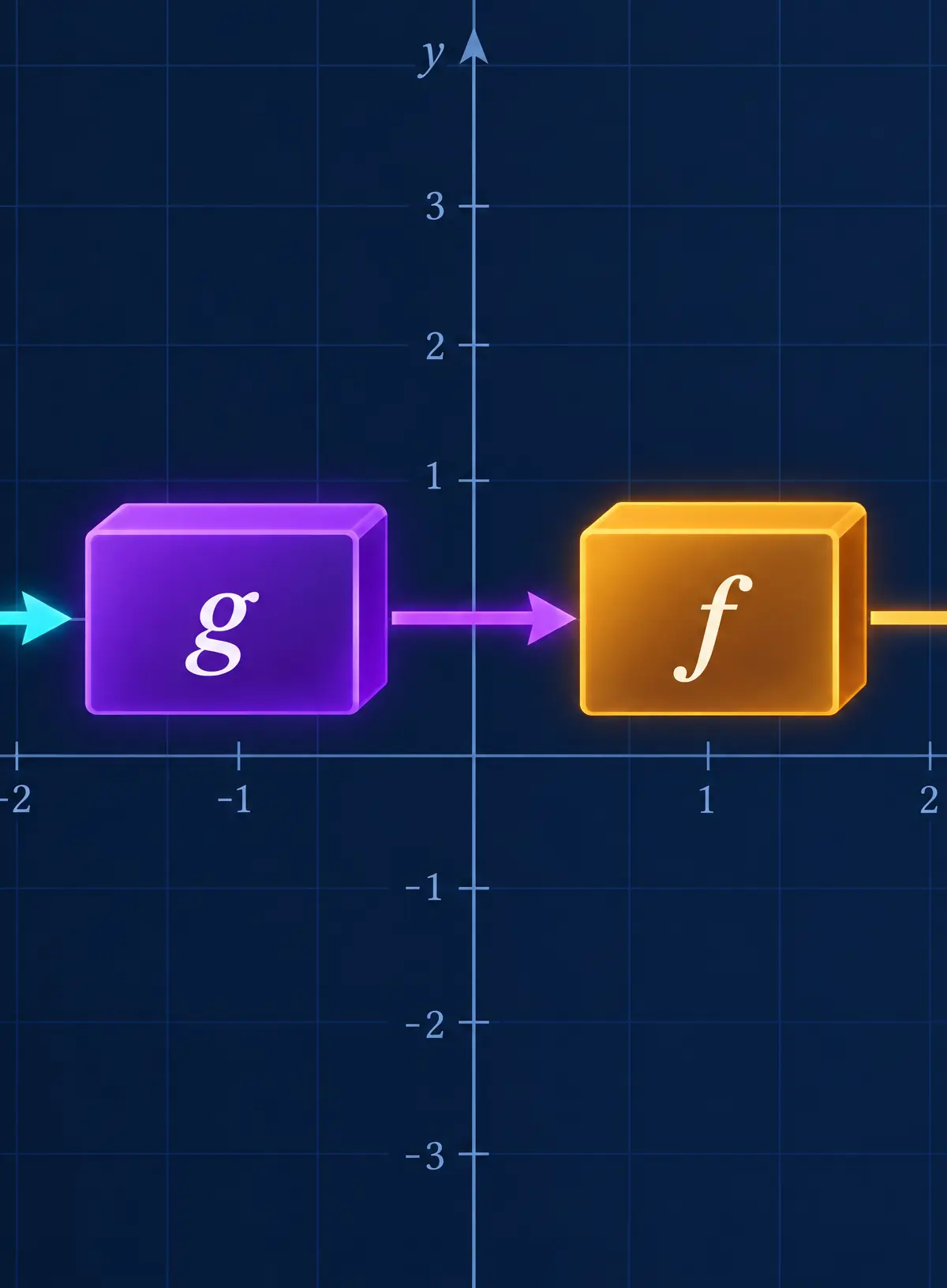
Why this works: the output of g becomes the input of f. Parentheses preserve the whole output, especially when the second rule involves squaring, a reciprocal, a logarithm or a modulus. If f(x) = x² and g(x) = 2x − 3, then f(g(x)) is (2x − 3)², not 4x² − 9. The bracket is a mathematical instruction, not decoration.
3. Domains and ranges travel through a composite function
When finding fg, the domain contains values that are allowed into g and whose resulting values are allowed into f. This becomes important with square roots, fractions and logarithms. If f(x) = √x and g(x) = 5 − x, then
fg(x) = √(5 − x).
For a real-valued answer, 5 − x ≥ 0, so the domain is x ≤ 5. A candidate who gives the formula but ignores the restriction may miss a final accuracy or independent mark in a domain question.
For rational functions, exclude inputs that make a denominator zero. For a logarithm, the input must be strictly positive. For a square root in the real-number setting, the expression inside must be non-negative. Sketching before you state the range is often faster and safer than relying on a remembered pattern.
4. Finding an inverse algebraically
Use a controlled swap-and-solve method:
- Write
y = f(x). - Interchange
xandy. - Rearrange to make
ythe subject. - Rename the result
f^{-1}(x). - State any necessary domain or range restriction.
For f(x) = (2x − 3)/5, begin with y = (2x − 3)/5. Swap: x = (2y − 3)/5. Then 5x = 2y − 3, so 2y = 5x + 3 and y = (5x + 3)/2. Therefore f^{-1}(x) = (5x + 3)/2.
Do not confuse f^{-1}(x) with 1/f(x). The inverse reverses the mapping; the reciprocal replaces a value by its multiplicative reciprocal. For instance, if f(x) = 2x + 1, then f^{-1}(x) = (x − 1)/2, whereas 1/f(x) = 1/(2x + 1). They are entirely different functions.
5. Verification: compose back to the identity
The defining test is:
f^{-1}(f(x)) = x and f(f^{-1}(x)) = x.
For the previous pair, substitute f(x) = (2x − 3)/5 into the inverse:
f^{-1}(f(x)) = [5((2x − 3)/5) + 3]/2 = (2x − 3 + 3)/2 = x.
This check is valuable when a rearrangement contains a negative sign, a fraction or a square root. In a longer response it can secure assurance before you commit to a final answer, but only show it when the command word is ‘show that’, ‘verify’ or the available marks justify it.
6. Inverse graphs: reflect, do not translate
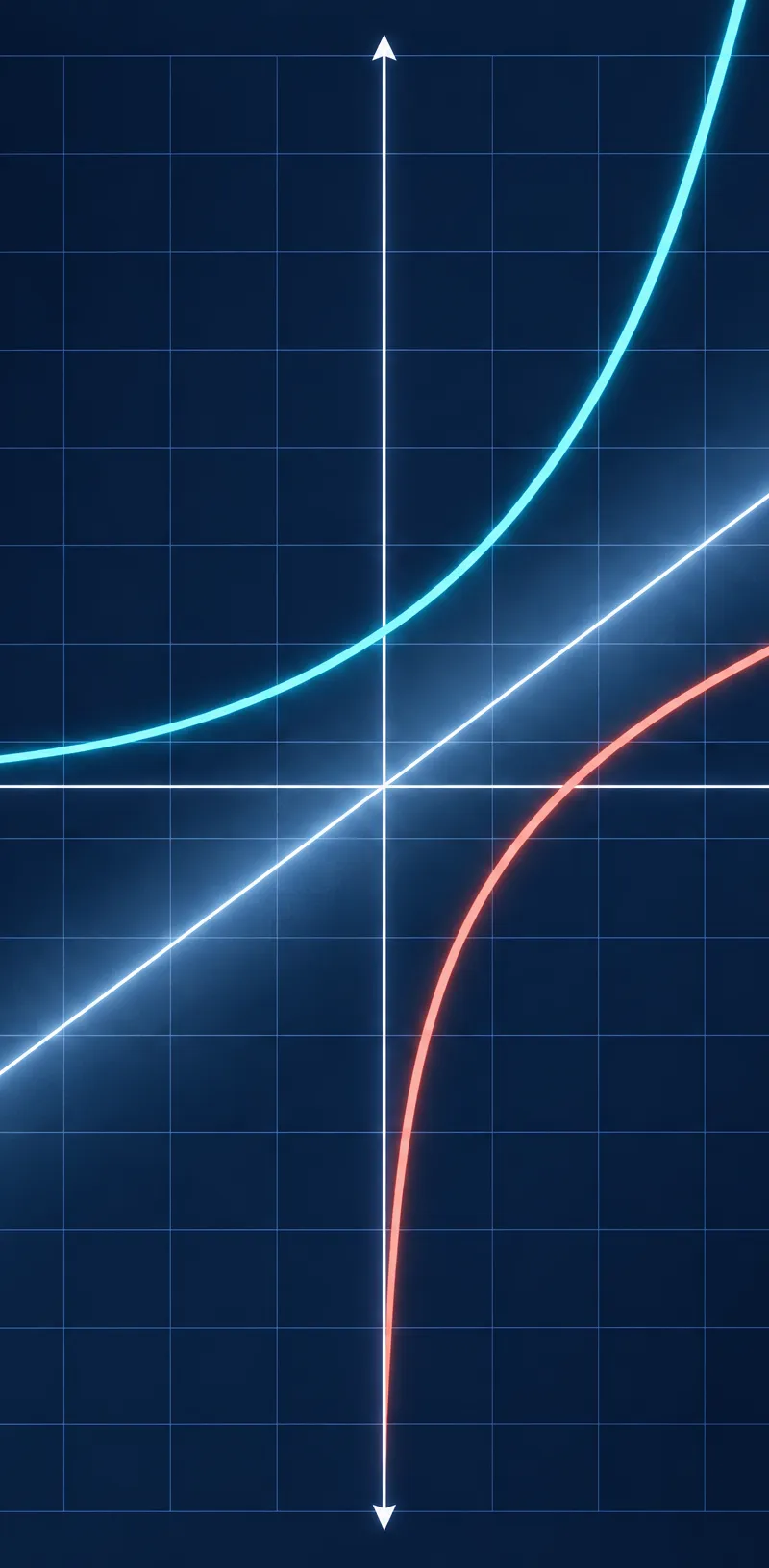
The graph of y = f^{-1}(x) is the reflection of y = f(x) in the line y = x. Every point (a, b) on f becomes (b, a) on the inverse. Intercepts swap when they exist: an x-intercept (p, 0) becomes the y-intercept (0, p). The domain and range also swap.
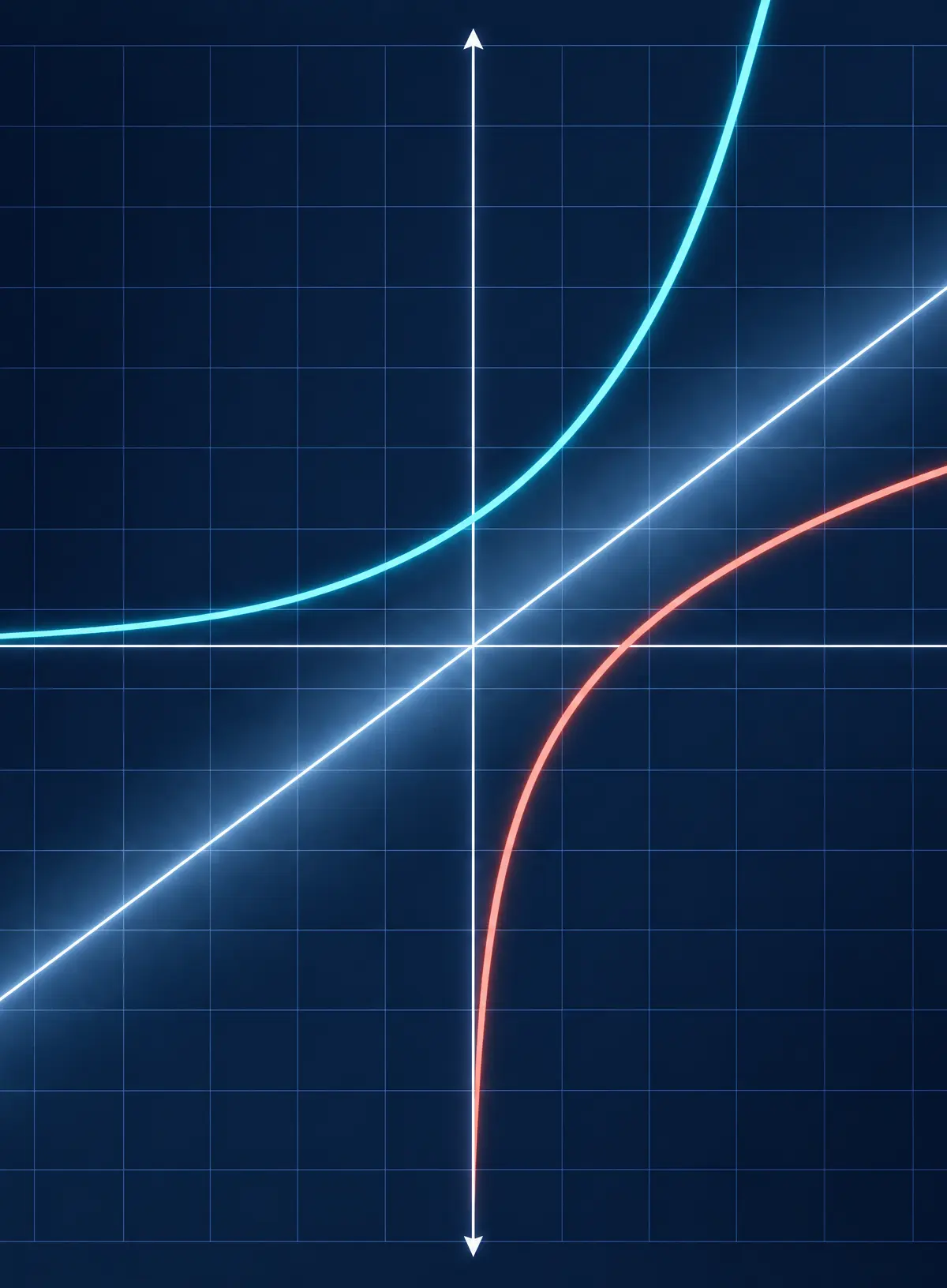
Draw the line y = x as a dashed construction line. Then reflect recognisable points and shape, rather than trying to calculate many new coordinates. If the original graph is a restricted parabola, its inverse is a square-root-shaped curve. If the original graph is a non-horizontal straight line, its inverse is another straight line, with coordinates swapped. A vertical line cannot be a function; after reflection it would become a horizontal line. This explains why the original must be one-to-one before its inverse can be a function.
7. Relationships and formulae to memorise
All function relationships in this topic are must memorise. They are not supplied on the Mathematical Formulae and Statistical Tables booklet.
fg(x) = f(g(x)): applyg, then applyf.gf(x) = g(f(x)): applyf, then applyg.f^{-1}(f(x)) = x: inverse after function returns the starting input, where defined.f(f^{-1}(x)) = x: function after inverse returns the starting input, where defined.(a, b) → (b, a): coordinate rule for reflection iny = x.domain(f) = range(f^{-1})andrange(f) = domain(f^{-1}).
Graph and data skills
On a sketch, label axes, any given domain endpoints, key intercepts and the line y = x when an inverse is requested. Use open circles for excluded endpoints and solid circles for included endpoints. For an inverse, swap at least two labelled coordinates to demonstrate a genuine reflection. Never draw the full sideways parabola for y = x² as an inverse function over all real numbers, because it fails the vertical-line test. A-Level Mathematics has no Foundation/Higher tier split, and there are no relevant unit conversions or required practicals for this specification point.
Mark-awareness: turning working into credit
Edexcel mark schemes commonly distinguish M marks for a valid method, A marks for accurate completion after the method, and B marks for an independently correct fact. In functions questions, an M mark may come from writing a correct composition such as f(g(x)), swapping x and y, or using a stated domain restriction. An A mark then depends on accurate expansion, rearrangement or final notation. Do not jump from a question to an unexplained answer in a multi-mark part. A clear line for the substitution or swap makes a creditable method visible, and it can protect follow-through credit if one later arithmetic slip occurs.
Practical applications and synoptic thinking
Composite functions model processes that occur in stages. A temperature sensor may convert temperature to voltage, then voltage to a displayed reading. Tax calculations, currency conversion with commission, and coordinate changes all behave like chained rules. An inverse function reverses a reversible process: a calibration equation can be undone to infer the original quantity from a display value.
In later work, composite functions sit behind the chain rule. When differentiating f(g(x)), first identify the inner function and the outer function, exactly as you do here. In exponentials and logarithms, ln(x) and e^x are inverse functions on their valid domains. In transformations, the distinction between changing the input and changing the output reinforces why function order matters. These links turn a short algebra topic into a recurring way of thinking across the whole course.
Examiner-ready checklist
Before moving on, ask: Have I applied the right-hand function first? Have I kept brackets around a substituted expression? Is the proposed inverse one-to-one on the stated domain? Have I swapped domain and range? If I have sketched an inverse, have I reflected in y = x, rather than shifted or rotated the graph? Those checks routinely protect marks in questions that look routine but combine several ideas.
Visual Resources
2 diagrams and illustrations
Interactive Diagrams
2 interactive diagrams to visualise key concepts
Conceptual Flow Outline
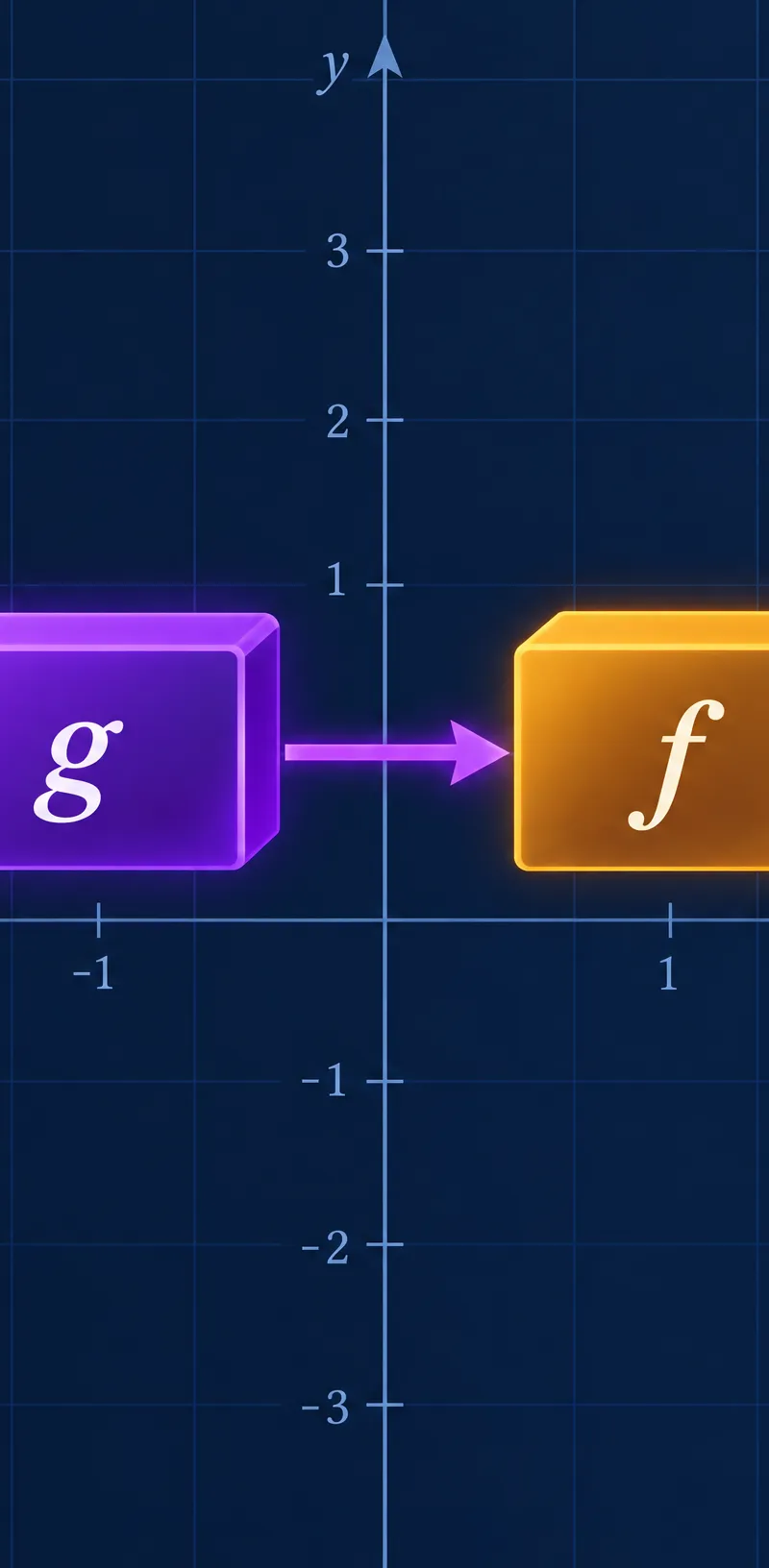
For fg(x), the right-hand function g acts first; its complete output becomes the input to f.
Conceptual Flow Outline
A reliable algebraic route for finding an inverse function.
Worked Examples
3 worked examples — open one to explore the question and available guidance.
Practice Questions
Try the question, then reveal an answer plan or example response
[3 marks] Let f(x) = 4x + 1 and g(x) = 2 − x. Find fg(3).
Hint: Do not substitute 3 into f first. Find g(3), then use that answer as the input to f.
[4 marks] Given f(x) = 5x − 7, find f⁻¹(x). State the domain and range of f⁻¹.
Hint: Write y = 5x − 7, swap x and y, and make y the subject.
[4 marks] The function g is defined by g(x) = √(7 − 2x). State the domain of g and the range of g.
Hint: For a real square root, the expression inside the root cannot be negative.
[5 marks] The function h is defined by h(x) = (x + 1)² for x ≥ −1. Find h⁻¹(x) and state its domain.
Hint: The domain x ≥ −1 tells you which square-root branch to choose after rearranging.
[6 marks] A graph of y = p(x) passes through (−2, 5), (0, 1) and (3, −4), and p is one-to-one. State three points on y = p⁻¹(x). Explain the transformation that produces the graph of y = p⁻¹(x), and state the domain of p⁻¹ if the range of p is −4 ≤ y ≤ 5.
Hint: For an inverse graph, swap every coordinate pair and swap domain with range.
Exam technique
How to turn what you know into marks
How to approach the question
Underline the requested composition or inverse. For a composite, draw x → inner function → outer function and substitute with brackets. For an inverse, check one-to-one status, swap x and y, rearrange, then state the domain where relevant. For a sketch, draw y = x and swap coordinates.
How to structure your answer
For 1-2 marks, give the required expression or fact with minimal working. For 3-4 marks, show the input substitution and simplification. For 5-6 marks, show the restriction or range, the method, the correct final function, and a verification or graphical interpretation if requested.
Timing
About 1.2 minutes per mark across the 2-hour, 100-mark Pearson Edexcel A-level papers. In a 6-mark functions question, aim for roughly 7 minutes, then move on.
Common pitfalls
- Applying f before g in fg(x). Avoid this by writing fg(x) = f(g(x)) before substituting numbers or expressions.
- Treating f⁻¹(x) as 1/f(x). Avoid this by using the swap-and-solve method, never a reciprocal rule.
- Using ± after inverting a square but ignoring the original restriction. Avoid this by choosing the branch consistent with the domain of the original function.
- Sketching an inverse as a translation or a rotation. Avoid this by plotting y = x and swapping two or three coordinates.
What the command words want
- Compare
- Compare both order and output: fg and gf often differ because they feed different intermediate values into the second function.
- Explain
- Link the claim to the mapping: an inverse requires one-to-one behaviour because each output must identify one input.
- Describe
- Use the precise phrase ‘reflection in the line y = x’ for an inverse graph, and mention coordinate or domain-range swapping when appropriate.
- Evaluate
- Check validity as well as algebra. Assess whether the stated domain makes the function one-to-one and whether the inverse has the correct reflected domain and range.
- Calculate
- Show the composition order, keep brackets around substituted expressions, simplify accurately and state any required restriction.
- State/Give
- Give the exact requested range, domain, value or equation. Do not add an unrequested method unless it removes ambiguity.
Watch or listen (optional)
Test your understanding of Understand and use composite functions; inverse functions and their graphs
Active recall beats re-reading. Take an instant quiz now to test what you’ve learned and lock it into long-term memory.
7 days Premium · Then the free plan continues · No card, no charge