Pearson Edexcel · A-Level · Mathematics
Course version: 9MA0 · Version from Mar 2026
Understand and use moments in simple static contexts
Moments turn a static diagram into a solvable mechanics problem: calculate a turning effect, then combine it with force equilibrium. This guide gives candidates an examiner-friendly routine for beams, rods and ladder problems, where accurate diagrams and perpendicular distances secure the method marks.
- 9 min read
- 3 worked examples
- 5 practice questions
- 8 key terms
Check what you remember
Read the wording for your board, then hide it and explain moment of a force in your own words. Rough notes are fine. This is a self-check, with no mark or grade.
Reference: Pearson Edexcel
The turning effect of a force about a point, equal in magnitude to the force multiplied by the perpendicular distance from the point to the force’s line of action.
Study Notes
Overview
Moments explain why a force turns an object. In Pearson Edexcel A-level Mathematics, Topic 9.1 asks candidates to use this turning effect in simple static situations, especially rods, beams and ladders. The mathematical idea is concise, but marks are often lost through a poor free-body diagram, a distance measured along the object rather than perpendicular to the force, or an incomplete use of equilibrium.
This is a rigid-body topic. A particle can be in equilibrium when the resultant force is zero. A rigid body can still rotate even when its resultant force is zero, so for a body that is genuinely at rest you must also make its resultant moment zero. This makes moments a natural extension of forces, resolving and friction. On Paper 3, the Statistics and Mechanics paper is 2 hours and 100 marks, so use the overall pace of roughly 72 seconds per mark while allowing time to draw a clear diagram.
Typical questions give a diagram of a ladder, rod, beam or sign. You may be asked to find an unknown force, a reaction, a coefficient of friction or an angle. The reliable route is always: isolate the body, mark every external force, resolve forces where needed, then take moments about a clever point.
Specification checkpoint
Pearson Edexcel A-level Mathematics (9MA0), Topic 9.1: understand and use moments in simple static contexts; equilibrium of rigid bodies; parallel and non-parallel coplanar forces, including ladder problems. Pearson’s enhanced guidance specifically allows unknown forces or coefficients of friction, rough-ground/rough-wall ladders and rods against pegs or cylinders.
Key concept 1: moment of a force
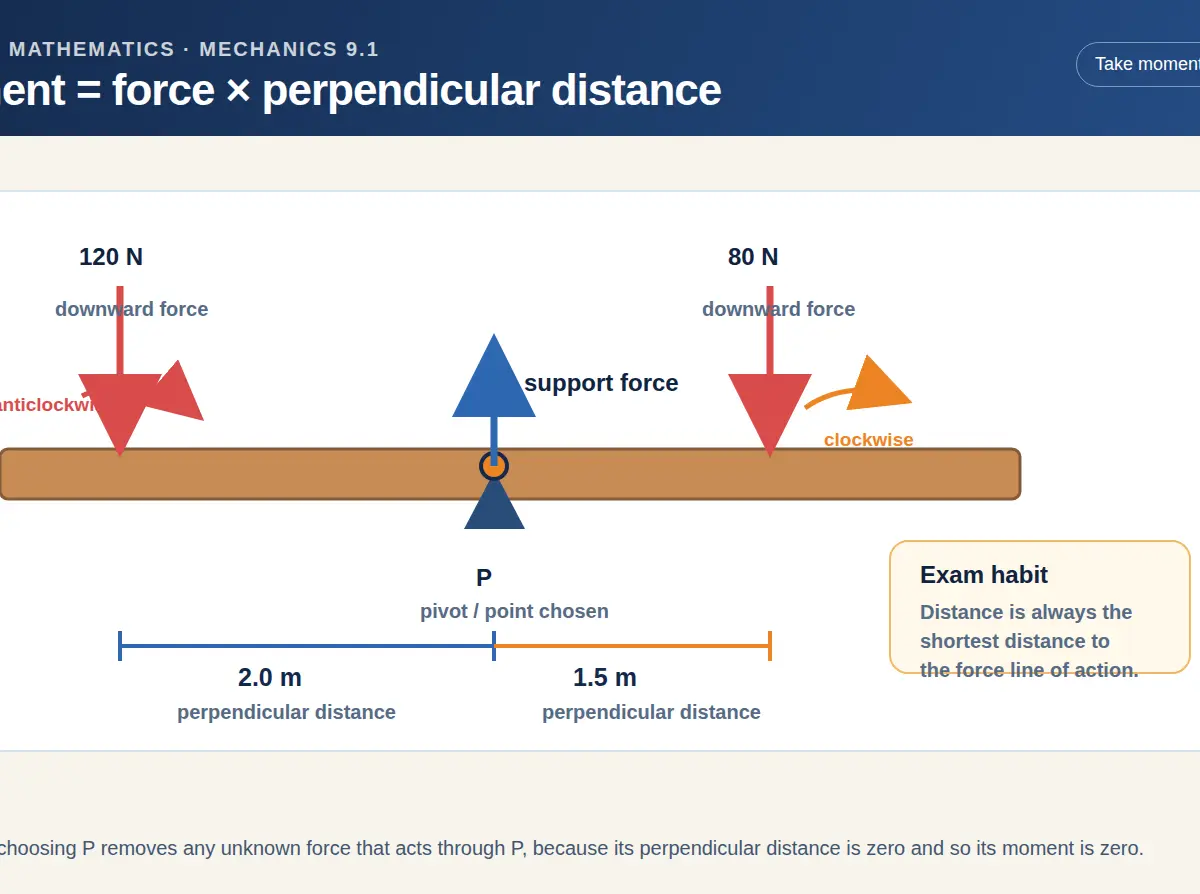
A moment is the turning effect of a force about a chosen point or pivot. Its magnitude is
[
M = Fd_\perp
]
where (F) is the force in newtons and (d_\perp) is theperpendicular distance in metres from the pivot to the force’s line of action. The unit is N m. Although this has the same unit as energy, a moment is not energy: it describes tendency to turn, not work done.
A force whose line of action passes through the pivot has zero moment. This is more than a definition. It is the reason candidates choose a support, hinge or contact point when taking moments: any unknown reaction acting there disappears from the moment equation. You can solve for other unknowns before returning to vertical or horizontal equilibrium.
$The word perpendicular is non-negotiable. If a force is vertical, the moment arm is a horizontal distance. If a force is horizontal, the moment arm is a vertical distance. Do not use a sloping length just because it is printed on the diagram. For a force at an angle (\theta) to a rod of length (r), an equivalent form is (M =Fr\sin\theta). Here, (r\sin\theta) is the perpendicular distance, or (F\sin\theta) is the perpendicular component of the force.$
Direction and sign
A force can turn an object clockwise or anticlockwise. State the direction in a short question. In an equation, choose one convention and stay with it, for example anticlockwise positive:
[
\sum M_P = 0 \quad\text{so}\quad \text{anticlockwise moments} = \text{clockwise moments}.
]
The point (P) is the point about which you are taking moments. Choosing the same point consistently matters. A candidate may take moments about any point, but a poorly chosen point leaves more unknown terms and creates unnecessary algebra.
Key concept 2: equilibrium of a rigid body
A rigid body in planar equilibrium needs three conditions:
[
\sum F_x = 0, \qquad \sum F_y = 0, \qquad \sum M = 0.
]
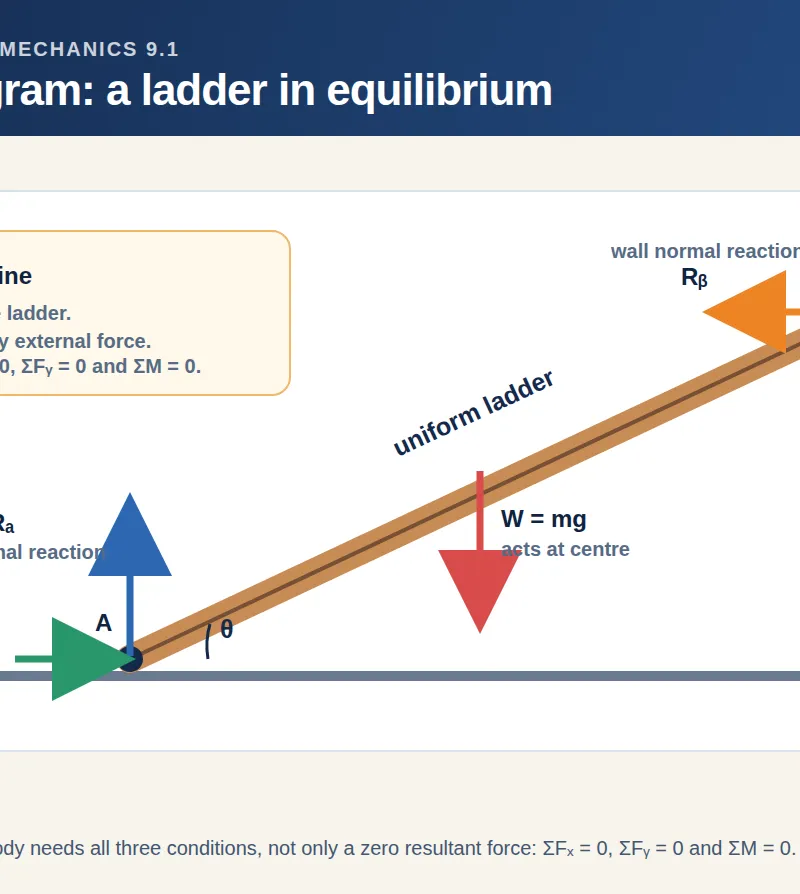
The first two conditions prevent translation left/right and up/down. The third prevents rotation. Do not write only (\sum F = 0) on a ladder question and stop: that may prove the ladder has no resultant force, but it does not prove it will not turn.
Start with a free-body diagram. Draw only the object you are analysing, not the room around it. Replace supports and contacts by the forces they exert on the object. Include the weight at the centre of mass. For a uniform rod or ladder, this is its midpoint. Label known forces, unknown reactions, friction and relevant angles. A light rod has negligible weight; a uniform rod is not automatically light. Those modelling words change the diagram and can change the final answer.
$At a smooth contact there is only a normal reaction, perpendicular to the contact surface. At a rough contact there may also be friction, parallel to the surface. Friction acts against the direction in which the surfaces would tend to slide relative to each other. It is not always at its limiting value: use (F=\mu R) only when the wording sayslimiting equilibrium or about to slip. Otherwise use (F\leq\mu R) if the coefficient is relevant.$
Key concept 3: rods, beams and non-parallel forces
For a horizontal beam with vertical loads, the perpendicular distances are visually straightforward. Nevertheless, draw a short measurement line from the chosen pivot to each line of action. This prevents the common error of using a distance from the wrong end.
For a tilted rod or a force at an angle, choose one of two equally valid methods. Method A: calculate the shortest distance from pivot to the line of action, then use (M=Fd_\perp). Method B: resolve the force into a component perpendicular to the rod, then multiply that component by the rod length. Do not resolve the force into arbitrary horizontal and vertical components unless that makes the perpendicular distance clearer. Candidates receive credit for a correct equivalent setup, but only when every component and distance is matched consistently.
A useful self-check is dimensional. A moment must be N m. If your answer is just N, you have calculated a force. If it is m, you have found a distance. If a very large force produces a smaller moment than a small force acting much closer to the pivot, that can be physically reasonable: turning depends on both force and leverage.
Key concept 4: ladder problems
A ladder question combines all three equilibrium conditions. Before using an equation, imagine the likely motion. A ladder leaning against a wall tends to have its top slide down and its base slide away from the wall. Friction arrows oppose those tendencies. Then check the wording: a smooth wall supplies no friction, while a rough wall may supply both a normal reaction and friction.
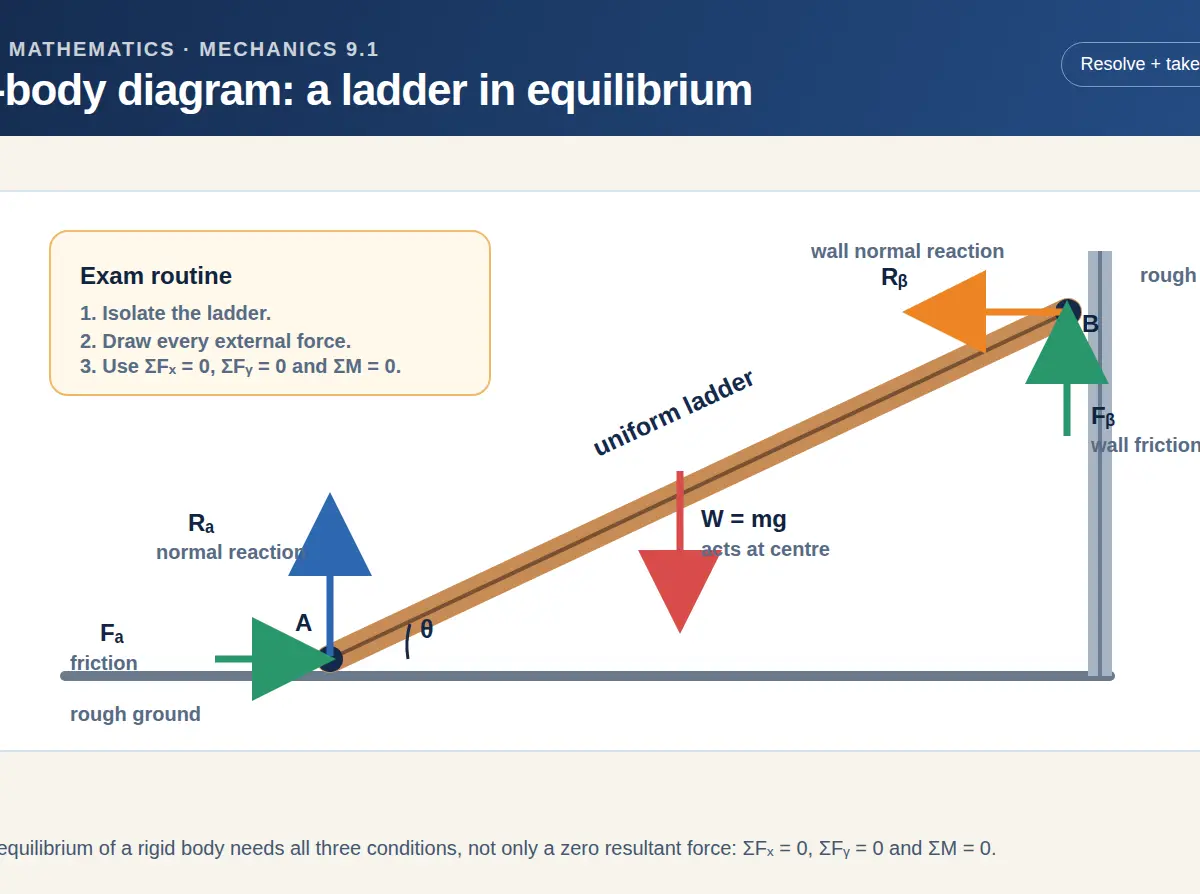
For a ladder of length (L) at angle (\theta) to the horizontal, the top is (L\sin\theta) vertically above the foot and the midpoint is (\tfrac12L\cos\theta) horizontally from the foot. Taking moments about the foot often removes both the ground normal reaction and ground friction from the moment equation. You can then use (\sum F_x=0) and (\sum F_y=0) to find the remaining contact forces. This order is efficient and clear to a marker.
In a question involving a person on a ladder, place the person’s weight vertically through their stated point along the ladder. Their horizontal distance from the foot is the given distance along the ladder multiplied by (\cos\theta). Their weight creates a clockwise moment about the foot if the ladder rises towards the wall on the right. Write the distances symbolically first if the diagram looks busy.
Formulae, units and modelling language
| Relationship | Use | Formula booklet status |
|---|---|---|
| Moment of a force | Turning effect about a point | (M=Fd_\perp) |
| Angled-force form | Force at angle (\theta) to position vector | (M=Fr\sin\theta) |
| Translational equilibrium | No horizontal or vertical acceleration | (\sum F_x=0,\ \sum F_y=0) |
| Rotational equilibrium | No angular acceleration | (\sum M=0) |
| Weight | Convert mass into force | (W=mg) |
| Limiting friction | Only when contact is about to slip | (F=\mu R) |
Pearson provides a mathematical formulae and statistical tables booklet in Paper 3, but it does not give the moments relationship or equilibrium conditions. Remember N m, not (\text{N}/\text{m}), and use (g=9.8\text{ m s}^{-2}) unless the question gives a different value.
Practical applications and diagram skills
Moments govern door handles, seesaws, crane arms, shelves, bridges, spanners and ladders. A long spanner needs less force for the same turning effect because its perpendicular distance from the bolt is greater. This is not a separate real-life story to memorise: it is exactly (M=Fd_\perp).
There is no required practical and no standard graph-plotting skill for this topic. The assessed diagram skill is a free-body diagram. Use a ruler for the main object, show each external force with a clear arrow, make labels readable and do not draw internal forces. On an exam diagram, a 10-second sketch can protect several later marks.
Examiner’s final checklist
Before moving on, ask: Have I shown every external force? Have I used the shortest distance to each line of action? Have I declared clockwise/anticlockwise consistently? Have I used all three equilibrium conditions where the question asks for reactions or friction? Is every final force in N, every moment in N m, and every coefficient unitless?
Listen and recall
Use the audio recap after attempting the questions, not before. Pause at each prompt, cover the answer and retrieve the method aloud.
Visual Resources
2 diagrams and illustrations
Interactive Diagrams
2 interactive diagrams to visualise key concepts
Conceptual Flow Outline
A mark-efficient workflow for any static moments problem.
Conceptual Flow Outline
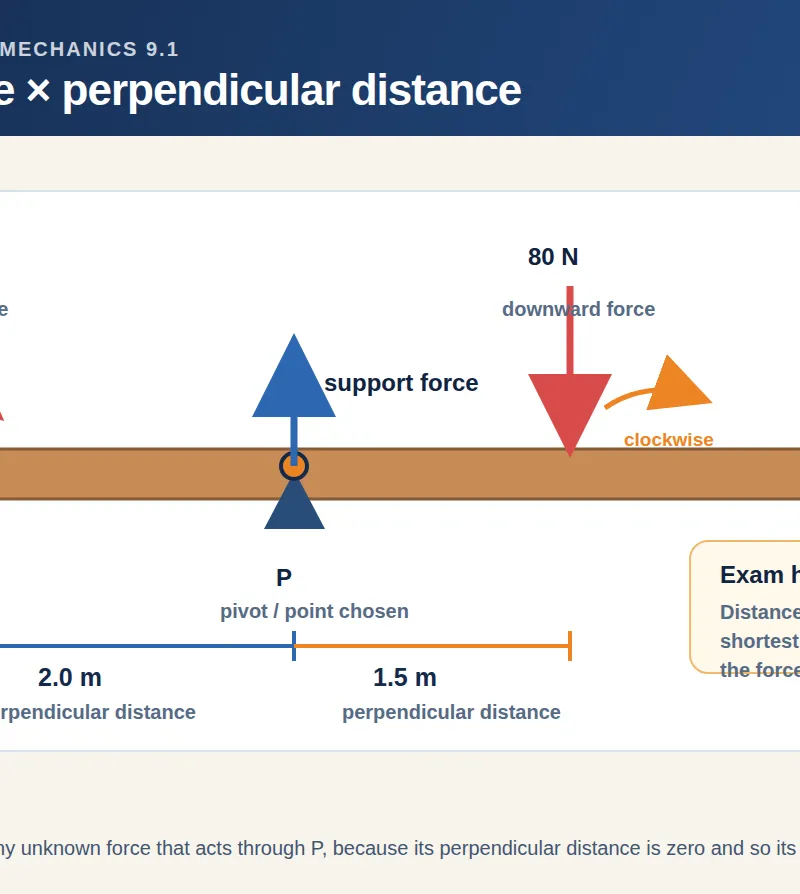
The moment depends on the force and the shortest distance from the pivot to its line of action.
Worked Examples
3 worked examples — open one to explore the question and available guidance.
Practice Questions
Try the question, then reveal an answer plan or example response
Calculate the moment about a hinge produced by a 40 N force acting perpendicular to a door 0.75 m from the hinge. State the unit. [3 marks]
Hint: The force is perpendicular, so the stated 0.75 m is already the moment arm.
A light horizontal rod is pivoted at P. A 50 N load acts 1.0 m to the left of P. A vertical load W acts 1.25 m to the right of P. The rod is in equilibrium. Calculate W. [4 marks]
Hint: The pivot reaction has zero moment about P, so take moments about P.
A 150 N force acts at the end of a 1.8 m rod. The force makes an angle of 35° with the rod. Calculate the moment about the other end of the rod. [4 marks]
Hint: Use the angle between the rod and force in M = Fr sin θ.
A uniform 4.0 m horizontal beam weighs 80 N and is supported at each end A and B. A 120 N load is 1.0 m from A. Calculate the vertical reaction at B. [5 marks]
Hint: The beam’s own weight acts at its midpoint, 2.0 m from A. Take moments about A.
A uniform 6.0 m ladder weighs 240 N and rests at 60° to the horizontal against a smooth vertical wall. Calculate the wall reaction and the friction force at the ground. [6 marks]
Hint: Take moments about the foot first. The smooth-wall reaction is horizontal and its perpendicular distance is the vertical height of the top.
Exam technique
How to turn what you know into marks
How to approach the question
1. Read the modelling words: light, uniform, smooth, rough, limiting equilibrium. 2. Isolate the named rigid body and draw every external force. 3. Predict the possible motion to set friction directions. 4. Choose a moments point that removes unknown reactions. 5. Use ΣM = 0, then ΣFx = 0 and ΣFy = 0 as required. 6. State magnitudes, directions and units.
How to structure your answer
For 2–3 marks, write the moment formula, substitute the perpendicular distance, calculate and give direction/unit. For 4–5 marks, include a labelled diagram and one equilibrium equation. For 6 or more marks, show a complete free-body diagram, a moments equation about a named point, then separate horizontal and vertical equilibrium equations.
Timing
Paper 3 is 120 minutes for 100 marks, so the overall allowance is about 72 seconds per mark. Spend the first 30–60 seconds of a multi-mark statics question on the free-body diagram, then recover time through a cleaner calculation.
Common pitfalls
- Using a distance along a sloping rod instead of the perpendicular distance. Draw the line of action first, then the shortest distance from the pivot.
- Treating a rigid body as a particle. Add ΣM = 0 as well as force equilibrium.
- Placing the weight of a uniform object at an end. Put it at the midpoint or stated centre of mass.
- Adding friction automatically at μR. Use F = μR only at limiting equilibrium; otherwise its magnitude may be less.
- Omitting force direction or units. Give force in N, moment in N m and coefficient of friction without units.
What the command words want
- Compare
- Compare both force size and perpendicular distance. A smaller force can have a larger moment if its moment arm is larger.
- Explain
- Link model to result using ‘because’, for example ‘the reaction at A has zero moment about A because its line of action passes through A’.
- Describe
- Describe a tendency using mechanics language, for example ‘the foot tends to slide away from the wall’.
- Evaluate
- State modelling assumptions, test whether conditions such as F ≤ μR are satisfied, and make a conclusion in the context.
- Calculate
- Show M = Fd⊥ or the relevant equilibrium equation before numerical substitution. Include units and appropriate significant figures.
- State/Give
- Give the requested quantity precisely, including a direction if it is a force or moment. Do not add an unsupported explanation.
Watch or listen (optional)
Test your understanding of Understand and use moments in simple static contexts
Active recall beats re-reading. Take an instant quiz now to test what you’ve learned and lock it into long-term memory.
7 days Premium · Then the free plan continues · No card, no charge