Pearson Edexcel · A-Level · Mathematics
Course version: 9MA0 · Version from Mar 2026
Understand and use Newton's third law; equilibrium of forces on a particle and motion in a straight line (restricted to forces in two perpendicular directions or simple cases of forces given as 2-D vectors); application to problems involving smooth pulleys and connected particles; resolving forces in 2 dimensions; equilibrium of a particle under coplanar forces
Mechanics becomes much more reliable when you treat every question as a force-modelling task: select one particle, draw the forces, choose axes and then write the appropriate Newton’s-law equation. This Pearson Edexcel A-Level guide covers the full 8.4 extension, including resolved forces, coplanar equilibrium and smooth-pulley systems, so candidates can turn a difficult diagram into creditable method marks.
- 9 min read
- 3 worked examples
- 5 practice questions
- 7 key terms
Check what you remember
Read the wording for your board, then hide it and explain Newton’s third law in your own words. Rough notes are fine. This is a self-check, with no mark or grade.
Reference: Pearson Edexcel
If body A exerts a force on body B, body B simultaneously exerts a force of equal magnitude and opposite direction on body A.
Study Notes
Overview
This Pearson Edexcel A-Level Mathematics Mechanics topic turns a physical situation into a set of mathematical equations. You must decide which forces act on each particle, draw them accurately, choose useful axes and then use either equilibrium, (\Sigma F = 0), or Newton’s second law, (\Sigma F = ma). It is an excellent source of linked, multi-stage marks because a correct force model leads naturally to correct algebra.
For the full A-Level course, this is Paper 3 material: Statistics and Mechanics is 2 hours and 100 marks, so a sensible average working rate is about 1.2 minutes per mark. The specification reference is 8.4. Questions can involve a particle on an inclined plane, forces given as simple two-dimensional vectors, a connected-particle system over a smooth pulley, and the force exerted on the pulley itself. Pure Mathematics, particularly trigonometry and vectors, is assumed knowledge. Your job is not to memorise a single template. It is to make the force diagram tell you which equations are valid.
Key Concepts
1. Model first: identify the particle and draw a free-body diagram
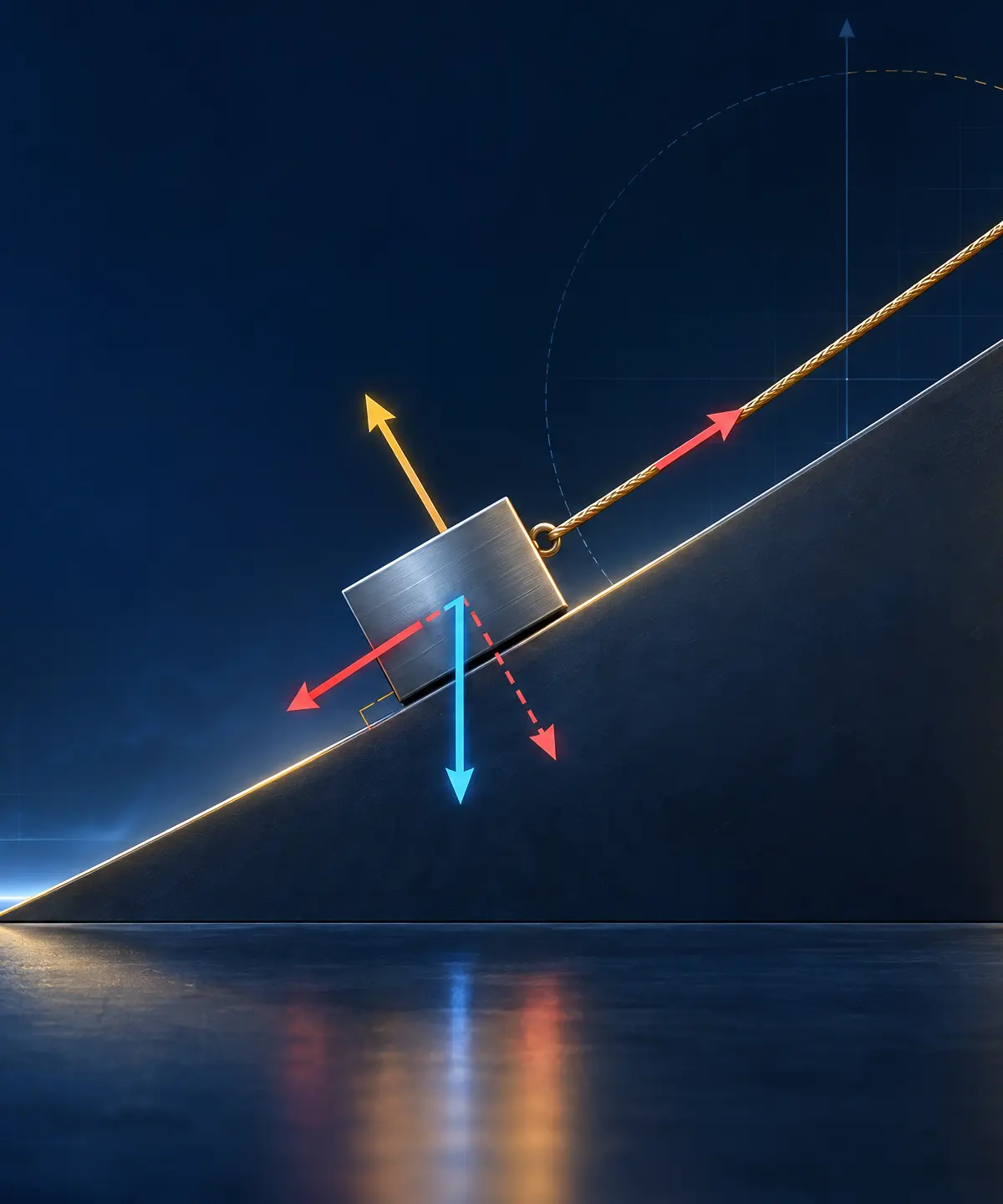
A particle has mass but negligible size. This lets candidates represent it by a dot, even if the real object is a box, lift or vehicle. A free-body diagram shows only the forces acting on that one selected body. It is not a picture of the whole situation.
Typical forces are: weight (mg), vertically downwards; tension (T), along a string and away from the particle; normal reaction (R), perpendicular to a smooth surface; and an applied force or thrust in the stated direction. A smooth plane supplies a reaction but no friction. Do not add a force because the body is moving. Motion does not create a forward force: the resultant of the real forces causes the acceleration.
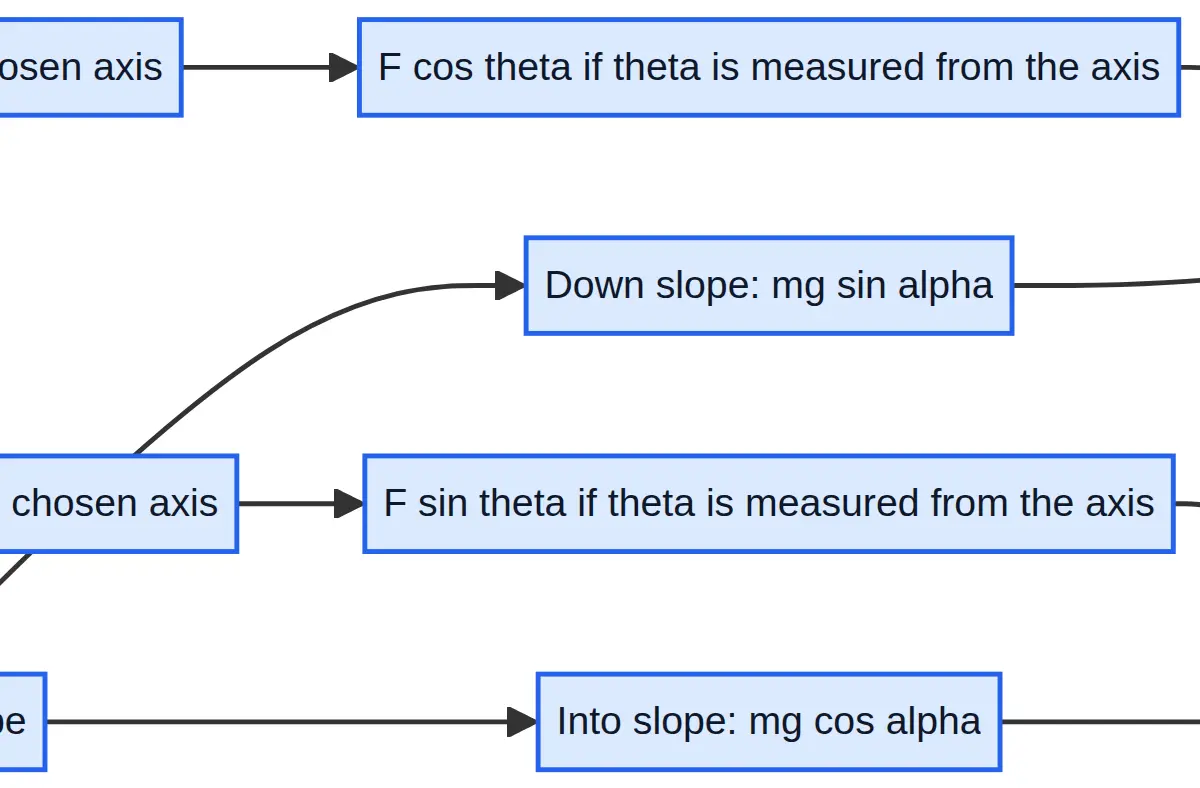
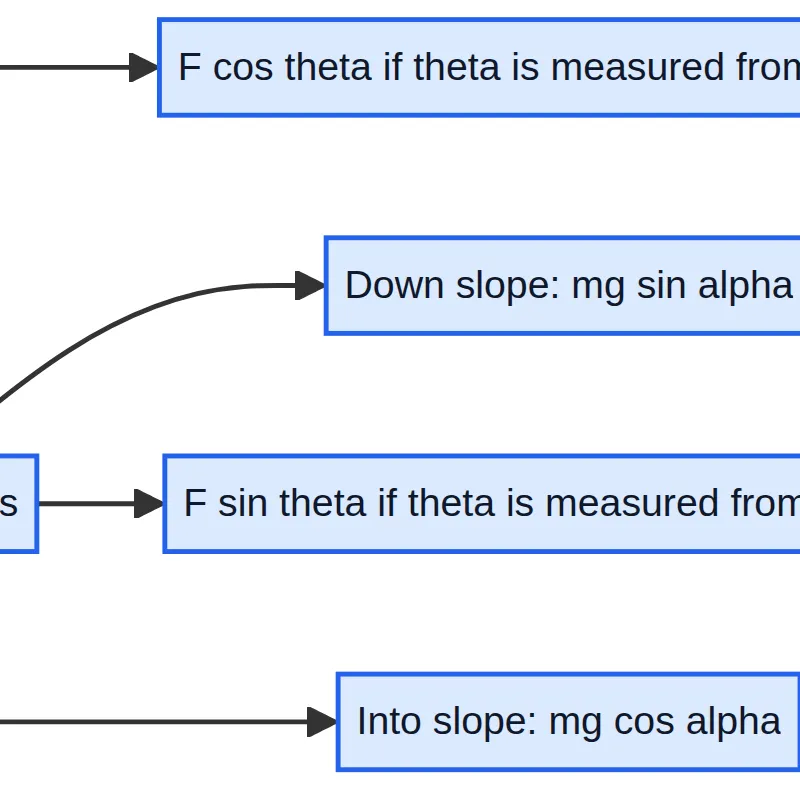
$Before writing an equation, choose axes. On an inclined plane, choose one axis parallel to the plane and one perpendicular to it. This makes tension and any acceleration lie on an axis. If the plane makes angle (\alpha) with the horizontal, resolve the weight as (mg\sin\alpha) down the plane and (mg\cos\alpha) into the plane. This is often the point at which marks are won or lost.$
Why this works: Newton’s laws apply in every direction. Resolving a single vector into perpendicular components does not change the physical force. It only gives two simpler equations.
2. Newton’s third law is a pair across two bodies
Newton’s third law states that when body A exerts a force on body B, body B simultaneously exerts a force of equal magnitude and opposite direction on body A. The forces are the same type and act along the same line, but crucially they act on different bodies. They therefore do not cancel on one free-body diagram.
For example, a string pulls a mass upwards with tension (T). The mass pulls the string downwards with tension (T). The upward and downward forces belong to different objects. A common error is to call weight and normal reaction a third-law pair. They are not: both act on the same object. The partner to a particle’s weight is the gravitational pull exerted by the particle on the Earth.
3. Equilibrium and straight-line motion
For a particle in equilibrium, the resultant force is zero:
[\Sigma F_x=0 \quad \text{and} \quad \Sigma F_y=0.]
Equilibrium means acceleration is zero. The particle may be stationary, or it may move with constant velocity. State the direction before forming each equation so your signs are controlled. For a body moving in a straight line with acceleration (a), use Newton’s second law in the chosen direction:
[\Sigma F = ma.]
The mass is always positive. Acceleration may be negative if it is opposite to your chosen positive direction. A negative answer is useful information, not an automatic error: interpret it as a reversal of the assumed direction.
4. Resolving forces in two dimensions and using simple vectors
Resolve a force by making a right-angled triangle. The component adjacent to the labelled angle uses cosine and the component opposite uses sine. The safe rule is not “sine is vertical”. The safe rule is “mark the angle on the force triangle, then identify opposite and adjacent”.
If a force is supplied as (\mathbf F=ai+bj), its horizontal and vertical components are already (a) and (b). In equilibrium, add corresponding components separately. For example, forces (8i+6j) N and (pi+qj) N balance when (8+p=0) and (6+q=0), giving (p=-8) and (q=-6). The negative signs show leftward and downward components.
For several coplanar forces, do not combine angles in one leap. Either resolve all forces into the same horizontal and vertical axes, or resolve along and perpendicular to a plane. Then apply the appropriate pair of equations. This approach is more reliable than using a force polygon unless the question specifically makes a vector diagram natural.
5. Smooth pulleys and connected particles
A connected-particle model normally uses a light, inextensible string passing over a smooth, light pulley. Each word has a mark-worthy consequence:
- light string: its mass is negligible;
- inextensible string: connected particles have the same magnitude of acceleration while the string is taut;
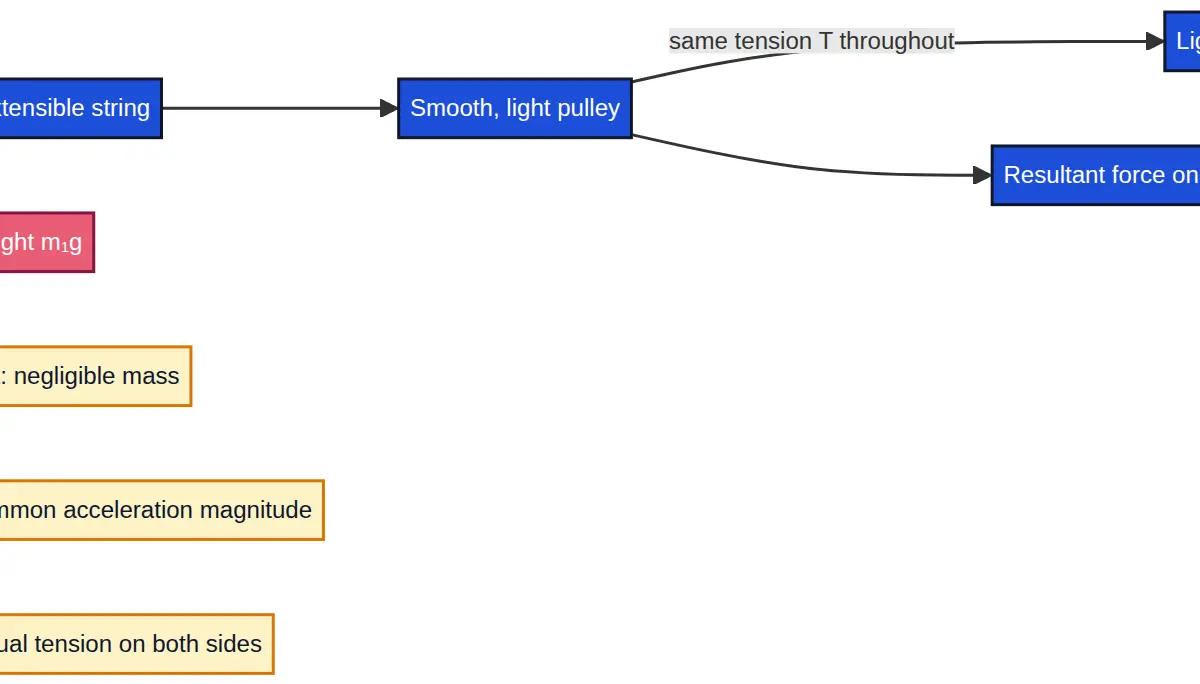
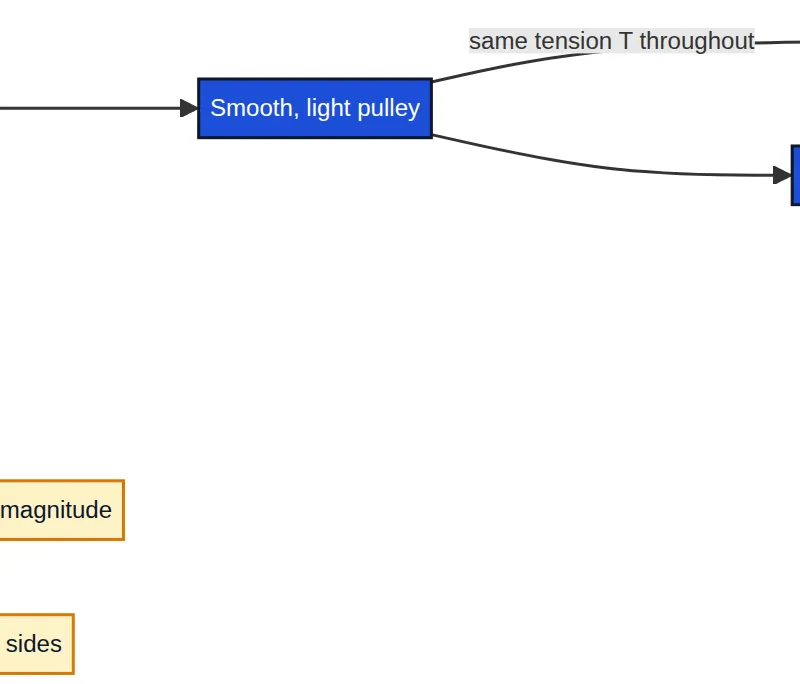
- smooth, light pulley: tension has the same magnitude on both sides of the string.
Draw a separate free-body diagram for each particle. Their accelerations have the same magnitude but can point in different directions. Choose a positive direction for each particle that agrees with the expected motion. Then write one (\Sigma F=ma) equation per particle, using thesame symbol (a) and the same symbol (T). Solve the simultaneous equations only after the force equations are correct.
$If a question asks for the force on the pulley, do not answer (T). The string exerts one tension force on each side of the pulley. Add those forces as vectors. If the two string sections are perpendicular and both tensions are (T), the magnitude is (\sqrt{T^2+T^2}=T\sqrt2), directed along the angle bisector. Draw the two forces first; this prevents the frequent error of adding magnitudes when the forces are not collinear.$
6. Worked modelling example: a smooth slope
A 5 kg particle is on a smooth plane inclined at (30^\circ) to the horizontal. It is pulled up the plane by a 31 N force. Weight is (5g) vertically downward and reaction is perpendicular to the plane. Along the plane, weight contributes (5g\sin30^\circ=24.5) N down the plane. Taking up the plane as positive gives (31-24.5=5a), so (a=1.30\ \mathrm{m,s^{-2}}) up the plane. Perpendicular to the plane, there is no acceleration, so (R=5g\cos30^\circ=42.4) N to three significant figures. The two equations use different directions and therefore answer different physical questions.
Mathematical Relationships
| Relationship | Use and meaning | Formula-sheet status |
|---|---|---|
| Newton’s second law | Resultant force in one chosen direction equals mass times acceleration. | Must memorise |
| Equilibrium | Resultant force is zero in every independent direction. | Must memorise |
| Weight | For a mass (m) near Earth, weight is (mg); use the stated (g), otherwise 9.8 (\mathrm{m,s^{-2}}). | Must memorise |
| Slope components of weight | On a plane at (\alpha) to the horizontal: (mg\sin\alpha) down the slope and (mg\cos\alpha) into it. | Must memorise |
| Vector resultant | Add components, then use Pythagoras and inverse tangent when required. | Must memorise |
| Constant-acceleration equations | Equations such as (v=u+at) and (v^2=u^2+2as), if the force calculation is followed by motion. | Given on formula sheet |
The official formula booklet gives the constant-acceleration equations, but it does not give Newton’s laws, (W=mg), equilibrium conditions or force-resolution rules. Learn those precisely.
Practical Applications and modelling limits
Pulley systems model lifts, counterweights, cranes and cable-driven machinery. A smooth-plane model can represent a load on a low-friction ramp. In each case, the model deliberately ignores details such as rope mass, pulley bearing friction and air resistance. Credit is given for using the stated model consistently. Do not introduce a friction force on a surface described as smooth, and do not make tension different on the two sides of a smooth light pulley.
There is no required practical for this A-Level Mathematics content. Instead, examiners test modelling by asking candidates to translate words such as “light”, “smooth”, “inextensible”, “at rest” and “moves upwards” into the correct forces and equations. Keep units throughout: forces in newtons, masses in kilograms and accelerations in (\mathrm{m,s^{-2}}).
7. Checks that protect the final mark
After solving, perform a short plausibility check. A tension in a vertical accelerating system should be less than the hanging weight when the particle accelerates downwards, and greater than the weight when it accelerates upwards. A normal reaction on a slope should be less than (mg) for a non-horizontal plane with no other perpendicular force. If your answer contradicts the expected direction, return to the signs in your force equations rather than changing the numerical answer by hand. Use the stated value of (g); only use 9.8 (\mathrm{m,s^{-2}}) when the question does not specify another value. These checks do not replace working, but they can expose a sine-cosine or direction error before you lose the final accuracy mark.
Exam-Ready Checklist
- Is there one free-body diagram for each particle?
- Have you labelled every force and omitted forces that do not act?
- Have you chosen axes before resolving?
- Does every equation state a direction or use a clear sign convention?
- For a string system, have you used one common (T) and one common magnitude (a)?
- Is the final answer accompanied by a direction and correct units where appropriate?
Visual Resources
2 diagrams and illustrations
Interactive Diagrams
2 interactive diagrams to visualise key concepts
Conceptual Flow Outline
The force-modelling sequence that secures method marks before algebra begins.
Conceptual Flow Outline
How the wording of a smooth-pulley model determines the equations candidates may use.
Worked Examples
3 worked examples — open one to explore the question and available guidance.
Practice Questions
Try the question, then reveal an answer plan or example response
[3 marks] A particle is acted on by ((4i-7j)) N and ((pi+qj)) N. It is in equilibrium. Find (p) and (q).
Hint: Set the total \(i\)-component and total \(j\)-component equal to zero separately.
[4 marks] A 4 kg particle is at rest on a smooth plane inclined at (30^\circ) to the horizontal. It is held by a string parallel to the plane. Find the tension and normal reaction. Take (g=9.8\ \mathrm{m,s^{-2}}).
Hint: Resolve weight parallel and perpendicular to the plane. The particle is at rest.
[5 marks] A 1.5 kg particle and a 2.5 kg particle hang on opposite sides of a smooth light pulley and are connected by a light inextensible string. Find their acceleration magnitude and the tension. Take (g=9.8\ \mathrm{m,s^{-2}}).
Hint: Take the 2.5 kg particle downwards as positive and use a separate equation for each particle.
[5 marks] A 6 kg particle lies on a smooth plane at (30^\circ) to the horizontal and is connected over a smooth pulley to a 4 kg hanging particle. Find the acceleration magnitude and tension. Take (g=9.8\ \mathrm{m,s^{-2}}).
Hint: The 4 kg particle moves down because \(4g\) is larger than \(6g\sin30^\circ\).
[4 marks] A light string passes over a smooth light pulley. The two straight sections of string are perpendicular, and the tension is 12 N throughout. Find the magnitude and direction of the force exerted by the string on the pulley.
Hint: The pulley receives two perpendicular tension forces, each of 12 N.
Exam technique
How to turn what you know into marks
How to approach the question
Translate every modelling word first. Is the surface smooth? Is the string light and inextensible? Is the pulley smooth and light? Then isolate each particle, draw force arrows, select axes, state the positive direction and only then use \(\Sigma F=0\) or \(\Sigma F=ma\).
How to structure your answer
For 1-2 marks, write the precise definition or one correctly directed equation. For 3-4 marks, show the free-body diagram or resolution and then solve. For 5-6 marks, show a separate force equation for each particle, solve systematically, state direction and units, and interpret a negative result if obtained.
Timing
Paper 3 is 120 minutes for 100 marks, so target about 1.2 minutes per mark. A 6-mark mechanics part should normally take about 7 minutes, including a diagram and a final units check.
Common pitfalls
- Putting action-reaction forces on one free-body diagram. Avoid this by naming the body on every diagram.
- Using \(T=mg\) for a moving hanging mass. Use \(mg-T=ma\) or \(T-mg=ma\) in a stated direction.
- Resolving weight with the sine and cosine components swapped. Draw the right-angled component triangle against the labelled slope angle.
- Adding tension magnitudes rather than vectors when finding the force on a pulley. Sketch both tension directions before calculating the resultant.
What the command words want
- Find
- Model first, then calculate. The command word may hide several method marks for the diagram and equations.
- Explain
- Use a physics reason, not a repeated calculation. For example, ‘the string is inextensible, so both particles have the same acceleration magnitude’.
- Calculate
- Show the force equation, solve it and give a sensible unit and direction where relevant.
- Show that
- Work from the given data and preserve enough algebra for the stated result to follow. Do not reverse-engineer by assuming the printed answer.
- State/Give
- Give a concise definition or value. For Newton’s third law, include equal magnitude, opposite direction and different bodies.
Watch or listen (optional)
Test your understanding of Understand and use Newton's third law; equilibrium of forces on a particle and motion in a straight line (restricted to forces in two perpendicular directions or simple cases of forces given as 2-D vectors); application to problems involving smooth pulleys and connected particles; resolving forces in 2 dimensions; equilibrium of a particle under coplanar forces
Active recall beats re-reading. Take an instant quiz now to test what you’ve learned and lock it into long-term memory.
7 days Premium · Then the free plan continues · No card, no charge