Pearson Edexcel · A-Level · Mathematics
Course version: 9MA0 · Version from Mar 2026
Understand and use position vectors; calculate the distance between two points represented by position vectors
Position vectors give a precise language for locating points from an origin, while displacement and magnitude convert that location data into journeys and distances. In Pearson Edexcel 10.4, candidates must work securely in both 2D and 3D, where a correct direction, clear working and an exact final distance can unlock dependable marks in Pure and synoptic mechanics questions.
- 10 min read
- 3 worked examples
- 5 practice questions
- 8 key terms
Check what you remember
Read the wording for your board, then hide it and explain position vector in your own words. Rough notes are fine. This is a self-check, with no mark or grade.
Reference: Pearson Edexcel
A vector that gives the position of a point relative to a fixed origin.
Study Notes
Pearson Edexcel A-Level Mathematics: Position Vectors and Distance (10.4)
Overview
Position vectors turn a point on a grid into an instruction from a fixed origin. Instead of saying merely that A is at ((3,-2)), you state the vector (\overrightarrow{OA}): the journey from the origin (O) to A. This matters because the same vector language works in two dimensions and three dimensions, and it becomes the foundation for vector geometry, mechanics and kinematics. Pearson Edexcel identifies this as specification point10.4: understand and use position vectors, then calculate the distance between points represented by them. Questions may be set in 2D or 3D.
The exam habit that unlocks this topic is to name the direction before subtracting. For the vector from A to B, write (\overrightarrow{AB}=\mathbf b-\mathbf a), not the other way around. For distance, find the displacement components, square them, add them, then square-root the result. A short question may award one mark for a correct displacement and a later mark for a correctly simplified exact distance. Make every line visible.
Key concepts
1. Position vector: a location measured from the origin
A position vectorgives the location of a point relative to the origin. If (\overrightarrow{OA}=\begin{pmatrix}4\-3\end{pmatrix}), move four units in the positive (x)-direction and three units in the negative (y)-direction to reach A. In 3D, (\overrightarrow{OP}=\begin{pmatrix}x\y\z\end{pmatrix}) records a third movement parallel to the (z)-axis. It can also be written (x\mathbf i+y\mathbf j+z\mathbf k). These are equivalent descriptions, provided the components stay in the same order.
The crucial distinction is that a position vector has a fixed start: the origin. A free vector can be translated without changing it. In an exam, a diagram may show (\mathbf a) and (\mathbf b) from O. Treat them as the two position vectors (\overrightarrow{OA}) and (\overrightarrow{OB}), not as two unrelated arrows.
Examiner lens:credit is given for correct component order and notation. A vector written as a row when the question expects a column may still communicate the mathematics, but use the form requested. Do not call (\begin{pmatrix}4\-3\end{pmatrix}) “point A” when the question asks for a vector.
2. Displacement between two points: end minus start
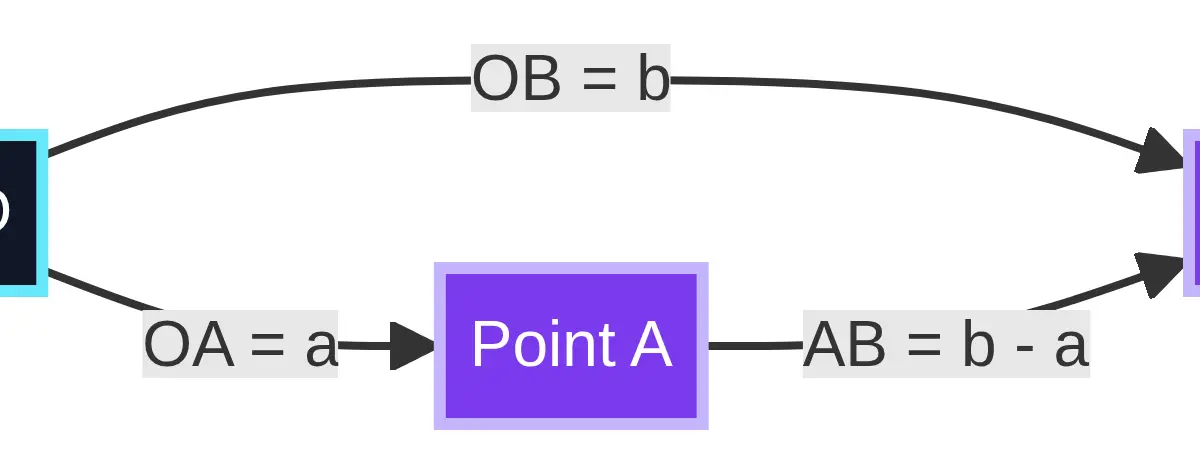
Suppose (\overrightarrow{OA}=\mathbf a) and (\overrightarrow{OB}=\mathbf b). To travel from A to B, first travel backwards from A to O, then forwards from O to B:
[
\overrightarrow{AB}=\overrightarrow{AO}+\overrightarrow{OB}=-\mathbf a+\mathbf b=\mathbf b-\mathbf a.
]
This is not a rule to copy blindly. It follows from the triangle law. The phrase “end minus start”protects you from the common sign error. The end of (\overrightarrow{AB}) is B, so its position vector (\mathbf b) is written first. Reversing the journey reverses every component: (\overrightarrow{BA}=\mathbf a-\mathbf b=-\overrightarrow{AB}).
For example, if (\mathbf a=\begin{pmatrix}-2\5\end{pmatrix}) and (\mathbf b=\begin{pmatrix}4\1\end{pmatrix}), then
[
\overrightarrow{AB}=\begin{pmatrix}4\1\end{pmatrix}-\begin{pmatrix}-2\5\end{pmatrix}=\begin{pmatrix}6\-4\end{pmatrix}.
]
Subtracting a negative is adding. Use brackets around the whole second vector if there is any risk of losing a sign.
3. Distance is the magnitude of the displacement
Distance has no direction, so it is a scalar. Once you have (\overrightarrow{AB}), the distance (AB) is its magnitude: (|\overrightarrow{AB}|). In 2D, a displacement (\begin{pmatrix}p\q\end{pmatrix}) forms the horizontal and vertical sides of a right-angled triangle. Pythagoras gives
[
AB^2=p^2+q^2, \qquad AB=\sqrt{p^2+q^2}.
]
Equivalently, for A((x_1,y_1)) and B((x_2,y_2)),
[
AB^2=(x_2-x_1)^2+(y_2-y_1)^2.
]
The order of each difference does not affect the final distance because it is squared. However, working through the displacement first is safer and gives method marks in a vector question.
Why the square root? Pythagoras first finds the square of the hypotenuse. A distance is a length, so the final answer needs the positive square root. Leave a non-square surd exact, for example (\sqrt{52}=2\sqrt{13}), unless the question asks for decimals.
4. Moving into three dimensions
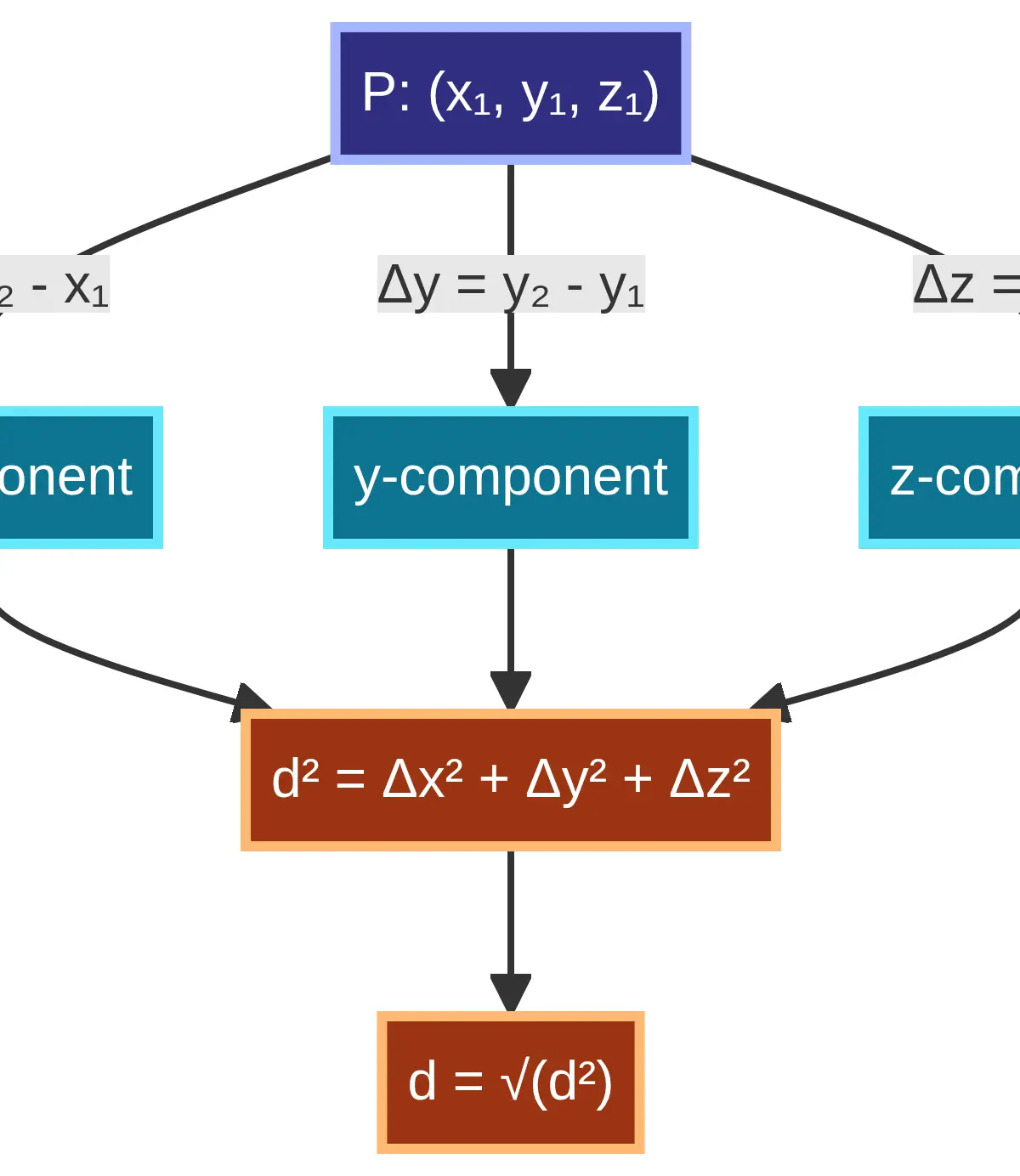
In 3D, there is one more perpendicular component. For A((x_1,y_1,z_1)) and B((x_2,y_2,z_2)),
[
AB^2=(x_2-x_1)^2+(y_2-y_1)^2+(z_2-z_1)^2.
]
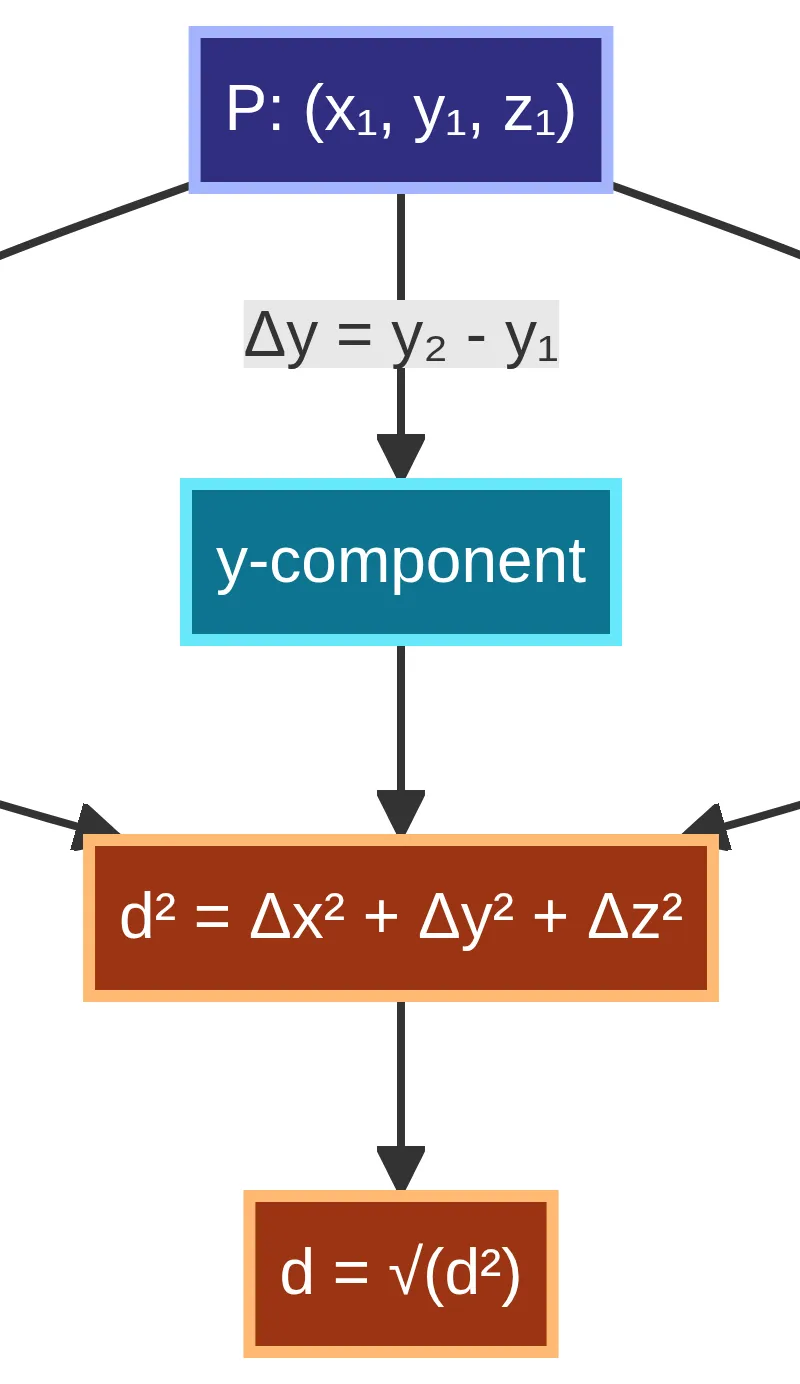
Think of this as Pythagoras twice: first combine the horizontal components, then combine that planar distance with the vertical (z)-component. The formula is not a new trick. It is the magnitude formula extended to three perpendicular directions.
A reliable 3D layout is to write three separate component differences before squaring. For example, from ((1,-2,4)) to ((5,1,-2)), write (4), (3), and (-6), then calculate (4^2+3^2+(-6)^2=61). The negative component is allowed. Its square is positive, but only because the bracket was retained.
5. Notation and precision that earn marks
Use arrows or bold letters for vectors where appropriate. Write (\overrightarrow{AB}) for a directed displacement, but write (AB) or (|\overrightarrow{AB}|) for distance. These are not interchangeable: (\overrightarrow{AB}) can have negative components, while distance cannot be negative. If a context supplies metres, kilometres or centimetres, include the correct length unit for distance. If the question is pure geometry with no unit, a number or exact surd is sufficient.
Be especially alert when coordinates are negative. A component such as (-3-5) is (-8), while (2-(-7)) is (9). Do not square before completing each subtraction. A calculator can check an arithmetic result, but it cannot show a marker that you understood the direction of the vector. The clearest solution is: position vectors, displacement, magnitude calculation, exact final answer.
6. A mark-by-mark routine for any distance question
Use this routine even when the numbers look easy. First, translate the words into an arrow.If the question asks for the distance from P to Q, label the intended displacement (\overrightarrow{PQ}). This makes P the start and Q the end.Second, calculate the displacement components. Write them as a column vector or show each coordinate subtraction. For negative coordinates, use brackets: (y_Q-y_P=3-(-4)), not a rushed string of signs.
Third, decide whether the answer requested is a vector or a distance. If it is a vector, stop after the component calculation and check the requested notation. If it is a distance, continue to the magnitude. Fourth, square every component inside brackets, add, then take the positive square root. In a 2D question, there should be two squared contributions. In 3D, there must be three. This visible structure helps an examiner award method marks even if an early arithmetic slip changes the final answer.
Fifth, simplify only as far as the question requires. For instance, (\sqrt{72}) should become (6\sqrt{2}), because (72=36\times2). A decimal is not automatically better. In an exact-value question, a rounded calculator output is not the requested answer. When a question specifies a degree of accuracy, retain full calculator precision until the final line, then round once.
Finally, use a sense check.The distance must be non-negative. If both points differ greatly in x, the distance cannot be smaller than that horizontal change. If (\overrightarrow{AB}) has been reversed, its magnitude will look unchanged, so use the arrow direction to check the vector before relying on the distance to reveal an error. This is why a question that asks for both displacement and distance should always show both answers separately.
For an unfamiliar context, strip it back to coordinates. A satellite, a force diagram, a cuboid or a route through a warehouse may sound different, but the mathematical core remains: identify the two locations, form end minus start, then take a magnitude only if the straight-line length is needed. Candidates who recognise this invariant method are less likely to be distracted by the story around the data.
Mathematical relationships and formula status
The following are expected working knowledge for this topic. The Pearson specification supplies the vector relationship and 2D/3D squared-distance forms in its content guidance; learn and use them confidently rather than waiting for a formula prompt.
- Displacement:(\overrightarrow{AB}=\overrightarrow{OB}-\overrightarrow{OA}=\mathbf b-\mathbf a).Must memorise.Here (\mathbf a) and (\mathbf b) are the position vectors of A and B.
- 2D magnitude/distance: (|\begin{pmatrix}p\q\end{pmatrix}|=\sqrt{p^2+q^2}), so (AB^2=(x_2-x_1)^2+(y_2-y_1)^2). Must memorise.
- 3D magnitude/distance: (|\begin{pmatrix}p\q\r\end{pmatrix}|=\sqrt{p^2+q^2+r^2}), so (AB^2=(x_2-x_1)^2+(y_2-y_1)^2+(z_2-z_1)^2). Must memorise.
- Reverse direction:(\overrightarrow{BA}=-\overrightarrow{AB}). **Must memorise.**There is no required practical and no Foundation/Higher tier split at A-Level. Graph plotting is not assessed as a separate skill here, but a quick coordinate sketch can expose an impossible sign or direction. There are no universal unit conversions: use the units in the stated context and remember that the components and final distance use the same length unit.
Practical applications and synoptic use
Position vectors describe a drone’s location in a warehouse, an object’s displacement in a physics model, or the straight-line separation between two points in a 3D design. In mechanics, (\mathbf r) is a position vector and changes in (\mathbf r) represent displacement. In kinematics, the same language appears in vector equations such as (\mathbf r=\mathbf u t+\tfrac12\mathbf a t^2). In forces, components are added and subtracted in the same ordered way.
For exam purposes, do not wait for a question to say “use vectors”. A coordinate pair can be treated as a position vector from O. Conversely, if a context mentions a route from A to B, identify the start and end before selecting the subtraction. Later vector questions on lines, ratios, parallelograms, velocity and forces reward this exact discipline.
Specification source
Pearson Edexcel A-Level Mathematics (9MA0), section 10.4, explicitly includes position vectors and distance between points, in both 2D and 3D. [1] [2]
Listen: 10-minute revision podcast
Visual Resources
2 diagrams and illustrations
Interactive Diagrams
2 interactive diagrams to visualise key concepts
Conceptual Flow Outline
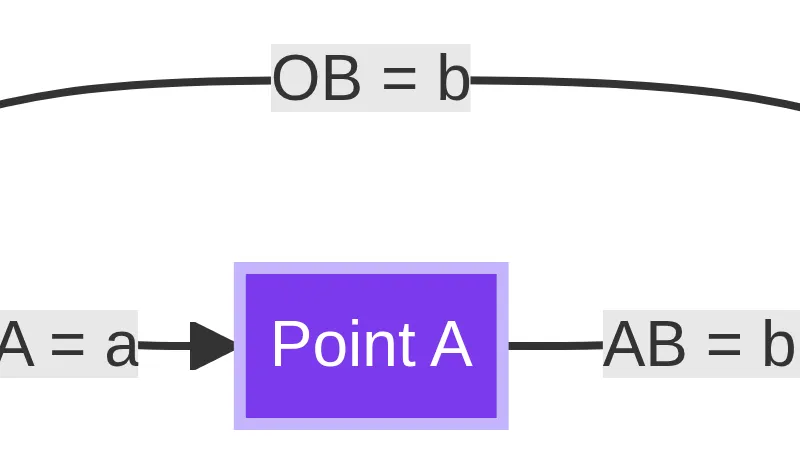
The triangle-law relationship between two position vectors and the displacement from A to B.
Conceptual Flow Outline
A reliable 3D distance workflow: subtract each component, square all three, add, then take the positive square root.
Worked Examples
3 worked examples — open one to explore the question and available guidance.
Practice Questions
Try the question, then reveal an answer plan or example response
Calculate →RS given →OR = (4, -3) and →OS = (-2, 5). [3 marks]
Hint: Name the end point and start point in the arrow before choosing the subtraction.
A is (−1, 2) and B is (5, −6). Calculate the exact distance AB. [4 marks]
Hint: Find the two changes first, then use Square, Add, Root.
P is (2, −1, 3) and Q is (−4, 2, 9). Calculate the exact distance PQ. [5 marks]
Hint: Make an x, y, z checklist before squaring.
→OA = (3, −2) and →AB = (−7, 5). Find the position vector of B. [4 marks]
Hint: Use the route O to A, then A to B, to form the route O to B.
A drone moves from A with position vector (−2, 1, 4) metres to B with position vector (4, −3, 7) metres. Calculate its straight-line displacement vector and the exact distance travelled directly from A to B. [5 marks]
Hint: There are two requested objects: first a vector, then its magnitude with metres.
Exam technique
How to turn what you know into marks
How to approach the question
Underline the direction letters first. Write the general relationship before numbers: →AB = b - a. Then use brackets for every negative coordinate, calculate components one line at a time, and only then use the magnitude formula if distance is required.
How to structure your answer
For 2–3 marks: state end minus start, substitute, then give a column vector. For 4–5 marks: show the displacement or coordinate differences, write the full magnitude calculation, evaluate inside the root, then give a positive exact distance. For a contextual question, add the supplied unit.
Timing
Approximately 1 minute per mark. A 3-mark vector subtraction should take about 3 minutes; reserve an extra 30 seconds to check direction and signs.
Common pitfalls
- Reversing the subtraction: attach the phrase ‘end minus start’ to the arrow before calculating.
- Losing signs: keep negative components in brackets until after squaring.
- Giving d² rather than d: ask ‘have I taken the positive square root?’ before moving on.
- Omitting z in a 3D question: explicitly write three component differences before applying Pythagoras.
What the command words want
- Compare
- State both the common magnitude and the reversed direction where relevant, for example →BA = -→AB.
- Explain
- Link the calculation to the reason: →AB = b - a because the journey is from A back to O and then from O to B.
- Describe
- Use directional language such as positive x, negative y and displacement from A to B, with correct vector notation.
- Evaluate
- Check direction, signs, units and whether a final square root or simplification is required before judging the answer.
- Calculate
- Show the formula, substitutions with brackets, accurate working and the required exact or rounded final form.
- State/Give
- Give exactly the requested object, for example a column vector or an exact distance. Do not replace a vector with its magnitude.
Watch or listen (optional)
Test your understanding of Understand and use position vectors; calculate the distance between two points represented by position vectors
Active recall beats re-reading. Take an instant quiz now to test what you’ve learned and lock it into long-term memory.
7 days Premium · Then the free plan continues · No card, no charge