Pearson Edexcel · A-Level · Mathematics
Course version: 9MA0 · Version from Mar 2026
Understand and use the definitions of secant, cosecant and cotangent and of arcsin, arccos and arctan; their relationships to sine, cosine and tangent; understanding of their graphs; their ranges and domains
Reciprocal and inverse trigonometric functions reward accuracy because a single denominator, asymptote or principal range controls the whole answer. Master the difference between a ratio and an angle-returning function, and Edexcel graph, domain/range and equation questions become a predictable source of marks.
- 10 min read
- 3 worked examples
- 5 practice questions
- 10 key terms
Check what you remember
Read the wording for your board, then hide it and explain reciprocal trigonometric function in your own words. Rough notes are fine. This is a self-check, with no mark or grade.
Reference: Pearson Edexcel
A function formed by taking the reciprocal of a trigonometric function: $\sec x=1/\cos x$, $\mathrm{cosec}\,x=1/\sin x$ and $\cot x=1/\tan x$.
Study Notes

Reciprocal and Inverse Trigonometric Functions
Overview
This Pearson Edexcel A-Level Mathematics topic, specification reference 5.4, asks you to move confidently between ordinary trigonometric functions, their reciprocals and their inverses. It is a compact topic with a high return: a correct domain, range or asymptote can secure a mark quickly, while a carefully restricted inverse value prevents a whole solution from going wrong. Candidates must distinguish two ideas that look similar in notation but do different jobs. A reciprocal such as \sec x is a new ratio, rac{1}{\cos x}; an inverse such as \arcsin x returns an angle.
Questions commonly ask you to state a definition, sketch a graph with asymptotes, identify domain and range, or solve a trigonometric equation on a stated interval. The topic links directly to radians, the unit circle, transformations, functions and trigonometric equations. Treat every graph as evidence: the denominator tells you where a reciprocal function is undefined, and the principal range tells you which angle an inverse function is allowed to return.
Examiner lens: Credit is given for mathematically precise language. “Undefined at x=\frac{\pi}{2}” is better than “the graph goes up there”; “-\frac{\pi}{2}<y<\frac{\pi}{2}” is better than “between minus and plus pi over two” when you are stating the range of \arctan x.
Key Concepts
1. Reciprocal functions: turn the original ratio upside down
The three reciprocal trigonometric functions are:
| Function | Definition | Denominator to watch | What this immediately tells you |
|---|---|---|---|
| $\sec x$ | $\sec x=\frac{1}{\cos x}$ | $\cos x$ | Undefined when $\cos x=0$ |
| $\mathrm{cosec},x$ | $\mathrm{cosec},x=\frac{1}{\sin x}$ | $\sin x$ | Undefined when $\sin x=0$ |
| $\cot x$ | $\cot x=\frac{1}{\tan x}=\frac{\cos x}{\sin x}$ | $\sin x$ | Undefined when $\sin x=0$ |
The key word is reciprocal: if a value is a, its reciprocal is \frac1a. This is why \sec x is paired with cosine, not sine. Use the unit circle or exact values to anchor the definitions: \sec 0=1 because \cos0=1; \mathrm{cosec}\frac{\pi}{2}=1 because \sin\frac{\pi}{2}=1; and \cot\frac{\pi}{4}=1 because \tan\frac{\pi}{4}=1.
Why do the ranges of sec and cosec have a gap? Sine and cosine always lie in [-1,1]. Taking a reciprocal of a non-zero number between -1 and 1 produces a value with magnitude greater than 1. Therefore \sec x and \mathrm{cosec},x can never have outputs strictly between -1 and 1. Their range is (-\infty,-1]\cup[1,\infty). Cotangent has range \mathbb R because rac{\cos x}{\sin x} can take every real value.
2. Graphs: the denominator creates the vertical asymptotes
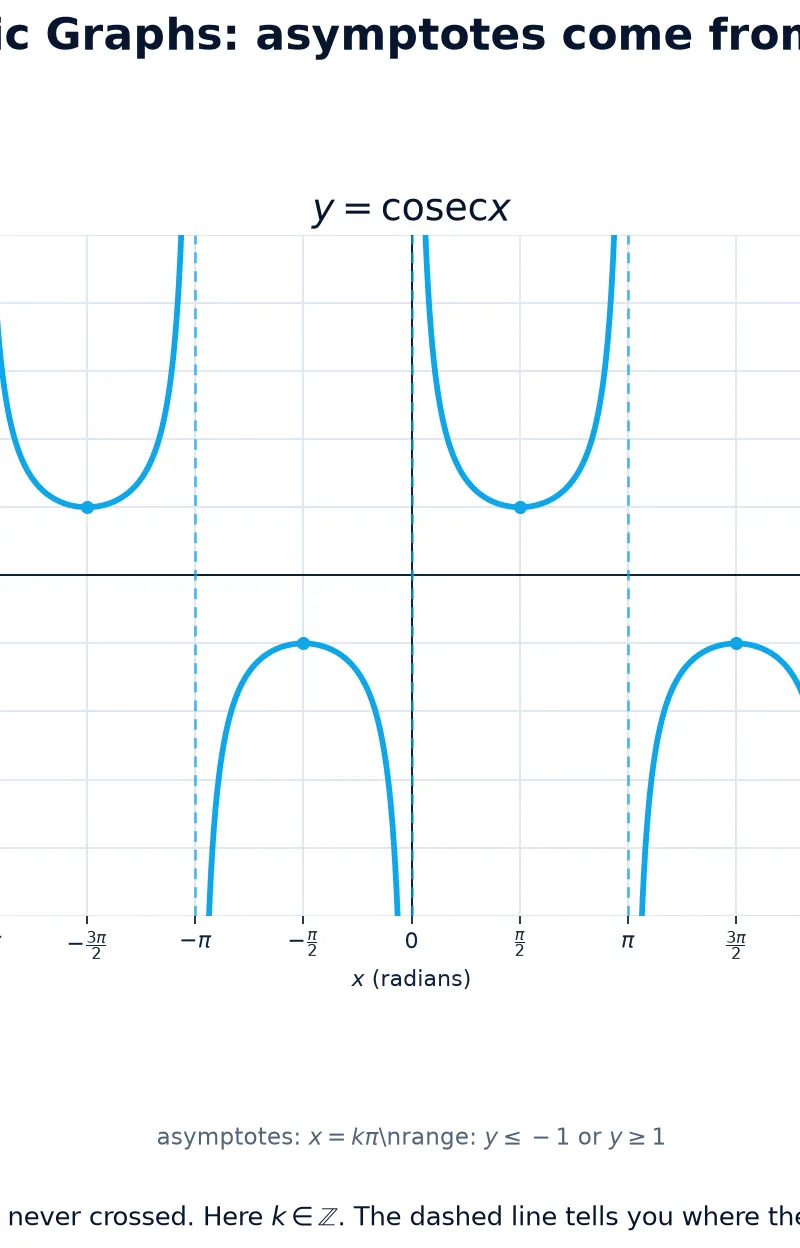
A reciprocal graph has a vertical asymptote wherever its denominator is zero. Write this down before you sketch a curve.
- y=\sec x: \cos x=0 at x=\frac{\pi}{2}+k\pi. Domain: x\in\mathbb R, $x
e\frac{\pi}{2}+k\pi. Period:2\pi$. - y=\mathrm{cosec},x: \sin x=0 at x=k\pi. Domain: x\in\mathbb R, $x
e k\pi. Period:2\pi$. - y=\cot x: ,\sin x=0 at x=k\pi. Domain: x\in\mathbb R, $x
e k\pi. Period:\pi$.
Here k\in\mathbb Z. The graph of \sec x has upward branches around x=2k\pi and downward branches around x=(2k+1)\pi, touching y=1 and y=-1 respectively. The graph of \mathrm{cosec},x has its nearest points to the x-axis at the maxima and minima of sine. Neither curve crosses the x-axis because a reciprocal cannot equal zero.
For y=\cot x, each branch falls from +\infty to -\infty as x increases between neighbouring asymptotes. It has zeros at x=\frac{\pi}{2}+k\pi. This falling direction is a frequent discriminator in sketch questions: candidates who draw a rising tangent-shaped curve do not earn the shape mark.
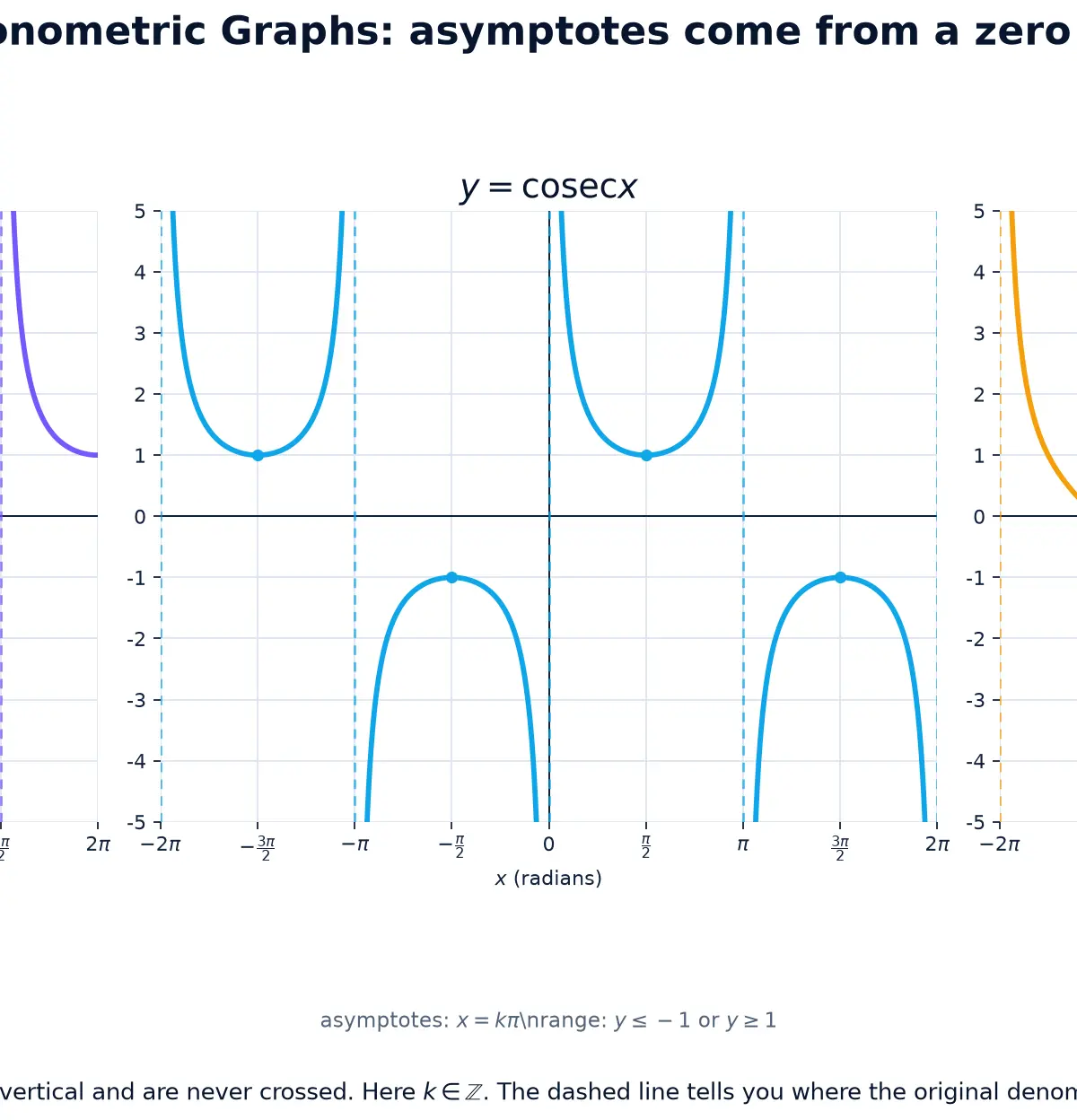
Graph-sketch routine for 3 or 4 marks:
- Rewrite as a fraction if necessary.
- Set the denominator equal to zero and draw labelled dashed asymptotes.
- Find intercepts or nearest points, such as \sec0=1.
- Draw the correct branch shape, respecting the period and never crossing an asymptote.
3. Inverse functions: return a principal angle, not a reciprocal
The inverse trigonometric functions reverse a restricted version of the original function:
- \arcsin x means “the principal angle whose sine is x”.
- \arccos x means “the principal angle whose cosine is x”.
- \arctan x means “the principal angle whose tangent is x”.
This is not the same operation as taking a reciprocal. In particular, \sin^{-1}x is conventional notation for \arcsin x, while \frac1{\sin x} is \mathrm{cosec},x. State the distinction explicitly if a proof or explanation question invites it.
The original trig functions repeat outputs, so none is one-to-one on all real numbers. To form an inverse, we restrict each original function to a principal branch where every output occurs once. You must know both the input domain and output range below.
| Inverse function | Domain, possible input values | Principal range, returned angles | Endpoint detail |
|---|---|---|---|
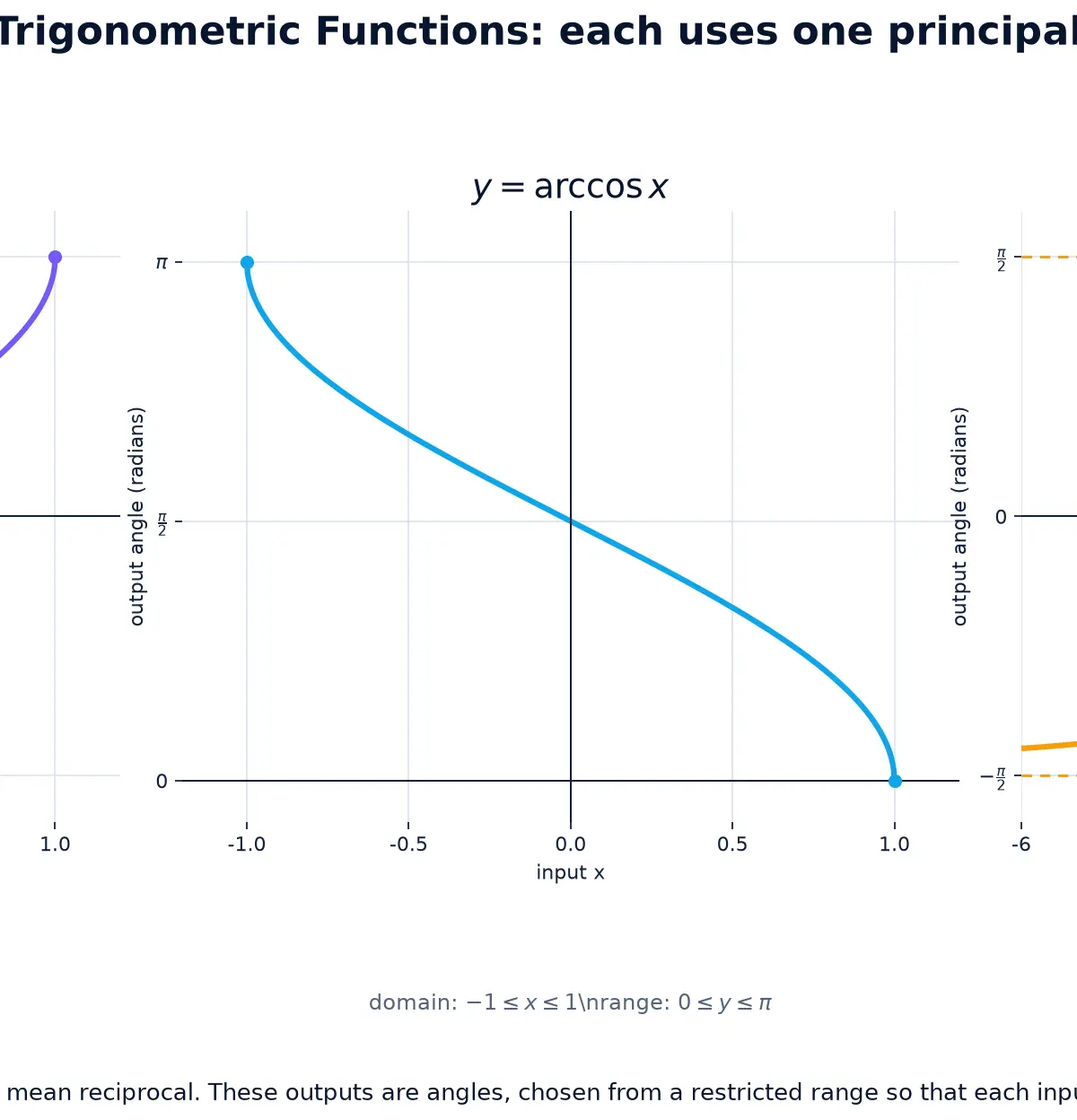
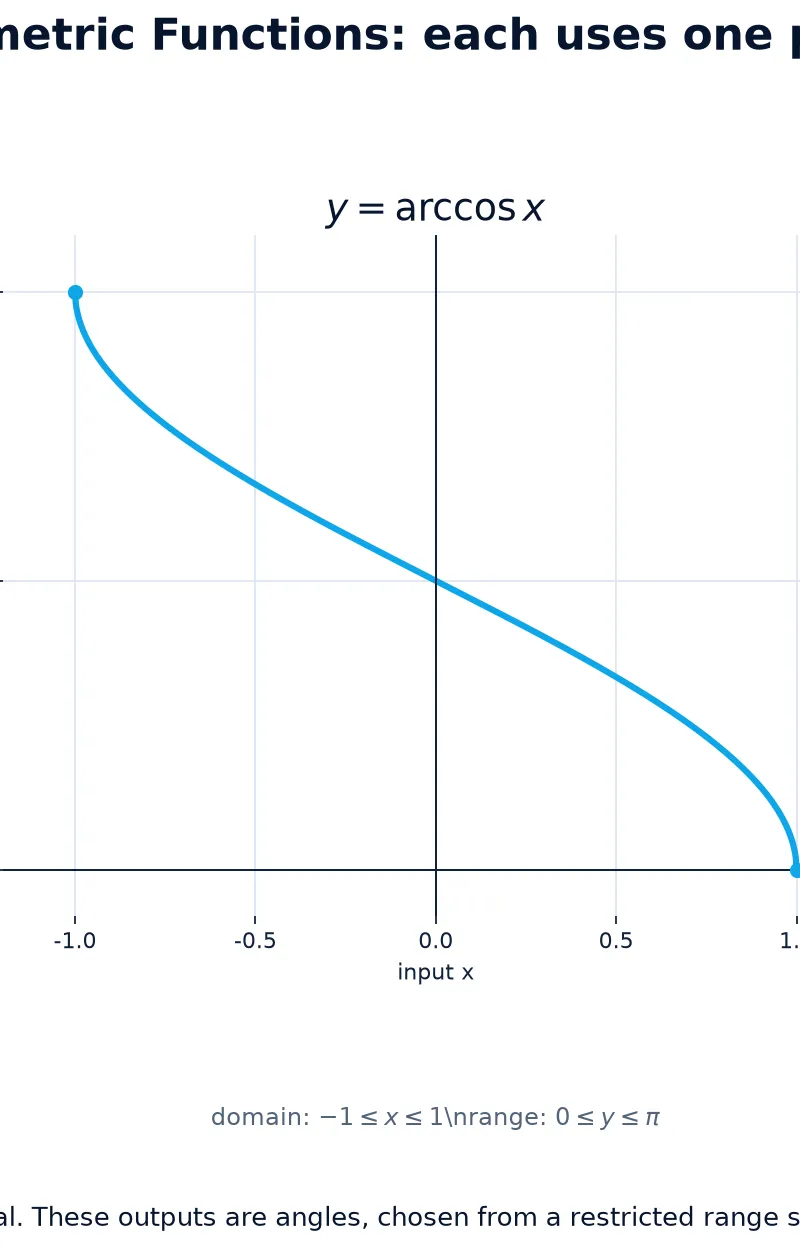
| $y=\arcsin x$ | $-1\le x\le1$ | $-\frac{\pi}{2}\le y\le\frac{\pi}{2}$ | Both endpoints included |
| $y=\arccos x$ | $-1\le x\le1$ | $0\le y\le\pi$ | Both endpoints included |
| $y=\arctan x$ | $x\in\mathbb R$ | $-\frac{\pi}{2}<y<\frac{\pi}{2}$ | Endpoints excluded |
The ranges are not arbitrary. Cosine is decreasing and one-to-one on [0,\pi], so it is the natural branch for arccos. Sine is increasing and one-to-one on [-\frac\pi2,\frac\pi2]. Tangent is increasing and one-to-one between -\frac\pi2 and \frac\pi2, but it is undefined at the endpoints, explaining the strict inequalities.
Principal-value checks: \arcsin\left(\frac12\right)=\frac\pi6, not \frac{5\pi}{6}, because only \frac\pi6 is in the arcsin range. \arccos\left(-\frac12\right)=\frac{2\pi}{3} because it lies in [0,\pi]. \arctan(-1)=-\frac\pi4 because it lies strictly between -\frac\pi2 and \frac\pi2.
4. Compositions and equations: principal value versus every solution
A composition such as \sin(\arcsin x)=x works for -1\le x\le1, because arcsin returns an angle whose sine is exactly x. The reverse order needs care: \arcsin(\sin x) is only equal to x when x is already in the arcsin principal range. For instance, \arcsin(\sin\frac{5\pi}{6})=\arcsin(\frac12)=\frac\pi6, not \frac{5\pi}{6}.
When solving a reciprocal equation, first convert it to sine, cosine or tangent, then solve normally and apply the interval. For example, \sec(2x)=2 becomes \cos(2x)=\frac12. A strong answer shows the general solution for 2x, divides every term by two, then checks each value against the requested interval. Applying \arccos gives a starting principal angle, not automatically every valid solution.
Mathematical Relationships
All formulae in this topic should be memorised. They are not normally supplied as reciprocal or inverse-function definitions on the Pearson Edexcel formula booklet.
| Relationship | Status | Use it when |
|---|---|---|
| $\sec x=\frac1{\cos x}$ | Must memorise | Converting sec into a solvable cosine equation; locating sec asymptotes |
| $\mathrm{cosec},x=\frac1{\sin x}$ | Must memorise | Converting cosec; locating cosec asymptotes |
| $\cot x=\frac1{\tan x}=\frac{\cos x}{\sin x}$ | Must memorise | Locating cot asymptotes and zeros |
| $\sin(\arcsin x)=x$ for $-1\le x\le1$ | Must memorise | Simplifying a valid inverse composition |
| $\cos(\arccos x)=x$ for $-1\le x\le1$ | Must memorise | Simplifying a valid inverse composition |
| $\tan(\arctan x)=x$ for $x\in\mathbb R$ | Must memorise | Simplifying a valid inverse composition |
There are no Foundation/Higher tiers at A-Level. There are also no physical unit conversions, but a unit conversion of 180^\circ=\pi radians is essential if a question changes between degrees and radians. Follow the question: degree-mode calculator answers and radian-mode exact answers are not interchangeable.
Practical Applications
There is no required practical for this pure-mathematics topic. Its practical value is nevertheless useful for memory. In navigation, graphics and engineering, an inverse trig function converts a ratio back into an angle: for example, \arctan(\text{rise}/\text{run}) returns a direction or gradient angle. Reciprocal trig functions appear when a relationship is naturally written as a ratio to sine or cosine, including projection, wave and geometry calculations. For the examination, the valuable transfer is not learning an application story; it is recognising whether a symbol represents a ratio (\sec, \mathrm{cosec}, \cot) or an angle-returning function (\arcsin, \arccos, \arctan).
Exam Accuracy Checklist
Before moving on from a reciprocal or inverse-trig question, use this five-point check. First, decide whether the notation asks for a ratio or an angle: sec, cosec and cot are reciprocals; arcsin, arccos and arctan return principal angles. Second, if it is reciprocal, locate the zero denominator and exclude it from the domain before you draw or solve. Third, if it is inverse, compare your proposed angle with the required principal range. Fourth, read the interval and the unit carefully: an exact radian solution is usually expected unless degrees are requested, and every solution must lie in the stated interval. Finally, make the evidence visible. In a sketch, label asymptotes and show branch direction; in an equation, write the reciprocal conversion and general solution; in a domain/range answer, use correct strict or inclusive inequality signs.
A useful examiner-style self-mark is to ask: “Could somebody see why my answer is true without pressing a calculator button?” If not, add the missing line. For example, \arcsin(1/2)=\pi/6 earns greater confidence when the range is named, while \sec(2x)=2 is safer when the line \cos(2x)=1/2 is shown. This topic is not about long algebra. It is about short, precise mathematical decisions.
Listen and retrieve
After listening, close this guide and sketch \sec x, \mathrm{cosec},x and \cot x over one or two periods. Then write the three inverse ranges from memory. Retrieval, rather than re-reading, is the revision action that will expose a missing range before the examination does.
Visual Resources
2 diagrams and illustrations
Interactive Diagrams
2 interactive diagrams to visualise key concepts
Conceptual Flow Outline
A mark-secure sequence for sketching a reciprocal trigonometric graph.
Conceptual Flow Outline
A decision path for selecting a valid principal inverse-trig value.
Worked Examples
3 worked examples — open one to explore the question and available guidance.
Practice Questions
Try the question, then reveal an answer plan or example response
Calculate \sec\left(\frac{\pi}{3}\right) exactly. [2 marks]
Hint: Write secant as the reciprocal of cosine before using an exact value.
State the vertical asymptotes, zeros and period of y=\cot x. [3 marks]
Hint: Use $\cot x=\cos x/\sin x$: the denominator gives asymptotes and the numerator gives zeros.
Give the domain and range of y=\arctan x. [2 marks]
Hint: Think of the horizontal asymptotes on the arctan graph.
Solve \mathrm{cosec},x=-2 for 0\le x<2\pi. [4 marks]
Hint: Convert to sine, identify the reference angle, then use the quadrants where sine is negative.
Explain why \arcsin(\sin(5\pi/6)) is not 5\pi/6, and give its exact value. [4 marks]
Hint: Evaluate the inner sine first, then apply the arcsin principal range.
Exam technique
How to turn what you know into marks
How to approach the question
Classify the symbol before calculating. For sec, cosec or cot, convert to a fraction and inspect the denominator. For arcsin, arccos or arctan, identify the principal range before selecting an angle. In an equation, show the conversion, write the general solution and only then filter by the stated interval.
How to structure your answer
For 1–2 marks, state the exact definition, domain or range with correct inequality signs. For 3–4 marks, label asymptotes first, then use key coordinates and shape. For 5–6 marks, show an algebraic conversion, a complete general solution, interval filtering and a final list in ascending order.
Timing
Approximately 1 minute per mark. Spend about 3–4 minutes on a 3-mark domain/range or sketch item and about 5–6 minutes on a 5-mark equation, leaving time to check the interval and mode.
Common pitfalls
- Writing $\sec x=1/\sin x$. Avoid it by pairing SEC with COS and COSEC with SINE before working.
- Giving a trigonometric angle that is correct but outside the inverse principal range. Check the allowed range as a final line.
- Drawing cotangent increasing, or allowing a reciprocal curve to cross an asymptote. Cotangent falls; an asymptote is an excluded x-value.
- Using degree mode in a radian question or failing to check interval endpoints. Write the unit and test each candidate value.
What the command words want
- Compare
- State both the shared reciprocal/inverse feature and the different asymptotes, periods or principal ranges.
- Explain
- Link the denominator to undefined values, or the principal branch to the selected inverse angle, using ‘because’.
- Describe
- Name the asymptotes, period, intercepts and direction of branches using correct graph vocabulary.
- Evaluate
- Check whether every stated solution meets the interval and whether an inverse value belongs to its principal range.
- Calculate
- Show the reciprocal conversion or inverse evaluation, retain exact values where possible, and include radians or degrees.
- State/Give
- Give the exact fact only. For a domain or range, use inequalities or set notation and include excluded values.
Watch or listen (optional)
Test your understanding of Understand and use the definitions of secant, cosecant and cotangent and of arcsin, arccos and arctan; their relationships to sine, cosine and tangent; understanding of their graphs; their ranges and domains
Active recall beats re-reading. Take an instant quiz now to test what you’ve learned and lock it into long-term memory.
7 days Premium · Then the free plan continues · No card, no charge