Pearson Edexcel · A-Level · Mathematics
Course version: 9MA0 · Version from Mar 2026
Understand and use the equation of a straight line, including the forms y – y₁ = m(x – x₁) and ax + by + c = 0; gradient conditions for two straight lines to be parallel or perpendicular; be able to use straight line models in a variety of contexts
Straight lines are the algebraic language of constant rate of change: one gradient and one point fix a unique line. Pearson Edexcel candidates must move confidently between equation forms, use negative reciprocals for perpendicular lines and interpret models, because these short questions can test algebra, graph skills and contextual reasoning at once.
- 8 min read
- 4 worked examples
- 5 practice questions
- 8 key terms
Check what you remember
Read the wording for your board, then hide it and explain gradient in your own words. Rough notes are fine. This is a self-check, with no mark or grade.
Reference: Pearson Edexcel
The constant rate of change of y with respect to x on a non-vertical straight line; it is vertical change divided by horizontal change.
Study Notes
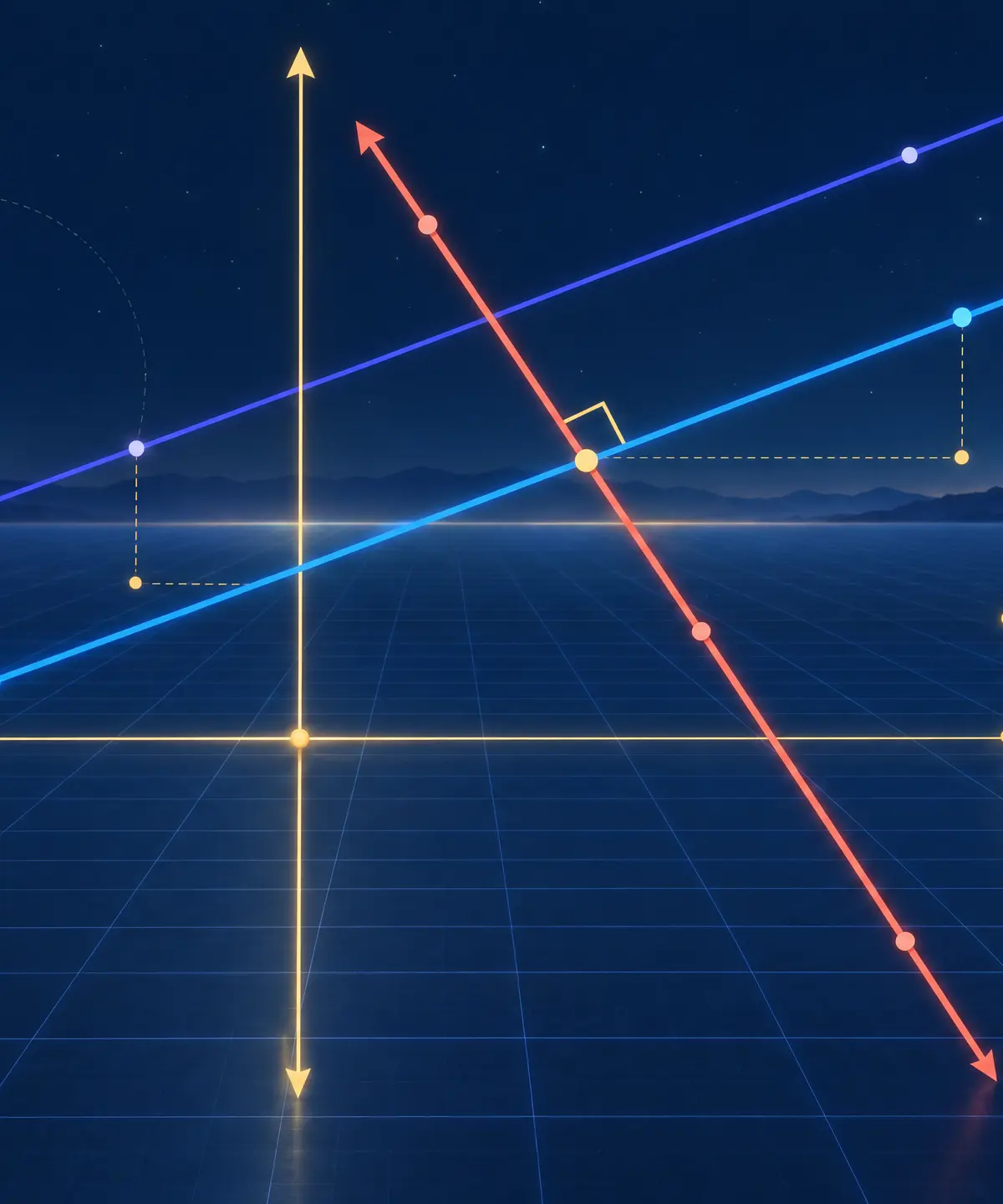
Overview
Straight-line coordinate geometry is a compact topic with a very high return in Pearson Edexcel A-Level Mathematics. Specification point 3.1 requires candidates to build, rearrange and interpret equations of lines, rather than merely recall y = mx + c. In exam questions, a line may be disguised as two coordinates, a general-form equation, a parallel or perpendicular condition, or a context such as a temperature conversion or constant-speed journey.
The underlying idea is simple: a straight line has a constant rate of change. Its gradient tells you how much y changes for each one-unit change in x; a point tells you where that line sits. Together, those facts determine a unique line. The skill links directly to algebraic manipulation, graphs, modelling, circles and later differentiation. Typical questions ask candidates to find an equation through two points, prove two lines are perpendicular, write a line in ax + by + c = 0 form, or interpret the gradient and intercept of a model.
Specification focus: Pearson Edexcel Topic 3.1: use
y − y₁ = m(x − x₁)andax + by + c = 0; find equations through points or parallel/perpendicular to a given line; and use straight-line models in context.
Key concepts
1. Gradient: the line’s rate of change
For a non-vertical line, the gradient is
m = (y₂ − y₁) / (x₂ − x₁).
It is vertical change divided by horizontal change, often remembered as rise over run. When using two points, preserve the order of the subtraction. From A(−2, 3) to B(4, −6),
m = (−6 − 3) / (4 − (−2)) = −9/6 = −3/2.
The line falls from left to right because its gradient is negative. The arithmetic is not a separate preliminary task. It determines every later step, so a sign error here changes the whole line.
Why it works: on a straight line the ratio of vertical movement to horizontal movement is constant between any two points. That constant is exactly the gradient. A gradient of −3/2 means that moving two units right always moves three units down.
Examiner habit: write the gradient clearly before substituting it into an equation. In a multi-step question, this makes your method visible and can earn method credit even if a later expansion slips.
2. The point-gradient form: start here when a point and gradient are known
y − y₁ = m(x − x₁) is the most reliable construction tool. Here (x₁, y₁) is a known point on the line and m is the gradient. The bracket is essential: it represents the horizontal movement from the known point, x − x₁.
For a line of gradient 4 through (-1, 5), substitute first:
y − 5 = 4(x − (−1))
y − 5 = 4(x + 1)
y = 4x + 9.
Notice that the coordinates are not substituted as x = −1 and y = 5 into the final line. They are used as the anchor point in the form. Candidates commonly lose accuracy by expanding before the point-gradient substitution is correct.
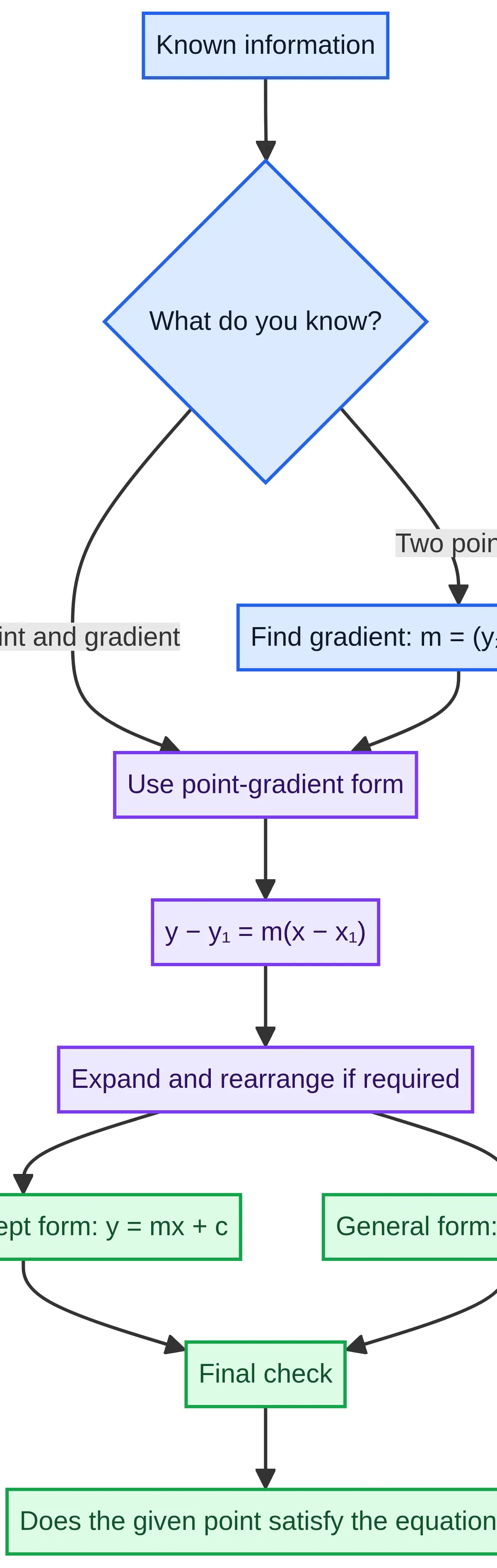
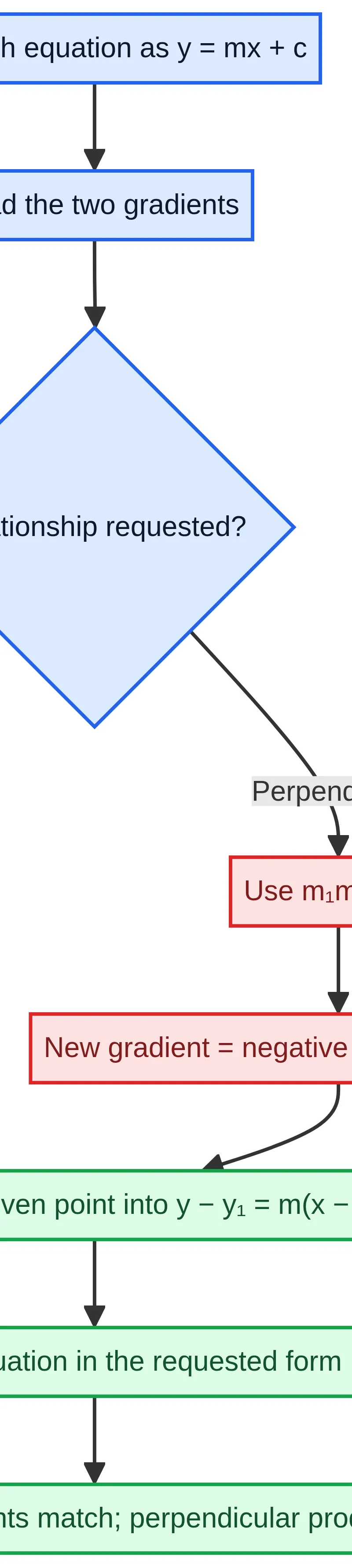
The diagram shows a safe exam route. Find the gradient if needed, write point-gradient form, then only rearrange if the command word demands a different final form. As a check, substitute the original point into your final equation. It must satisfy it exactly.
3. Moving between equation forms
The form y = mx + c is useful for reading a graph: m is the gradient and c is the y-intercept, the value of y when x = 0. It is often the natural form for a model such as
distance = speed × time + initial distance.
The general form is ax + by + c = 0. It is not a different kind of line. It is the same relationship with every term collected on one side. To find the gradient, rearrange carefully.
From 3x − 2y + 8 = 0:
−2y = −3x − 8
y = 3/2 x + 4.
So the gradient is 3/2. A useful shortcut is that the gradient of ax + by + c = 0 is −a/b, provided b ≠ 0, but rearranging is safer under pressure because it exposes signs.
To convert y = 3/2 x − 4 to general form, multiply by two first: 2y = 3x − 8. Then collect terms: 3x − 2y − 8 = 0. The final line may be written with every coefficient multiplied by the same non-zero constant, so −3x + 2y + 8 = 0 describes the same line. Follow the question’s preferred convention if one is stated.
4. Parallel and perpendicular lines
Two distinct parallel lines have the same gradient:
m₁ = m₂.
They point in the same direction but usually have different intercepts. If 3x − 2y + 8 = 0, its gradient is 3/2. A parallel line through (2, −1) must therefore begin as
y + 1 = 3/2(x − 2).
Do not copy the whole original equation: that would give the same line, not merely a parallel one.
Perpendicular gradients are negative reciprocals:
m₁m₂ = −1, so m₂ = −1/m₁.
For a line with gradient 3/2, a perpendicular line has gradient −2/3. Changing the sign alone is not enough; the fraction must be inverted. If it passes through (2, −1),
y + 1 = −2/3(x − 2).
A quick check is (3/2) × (−2/3) = −1. This is often the final verification mark in a proof or geometry question.
Special cases: a horizontal line has gradient 0 and equation y = k; a vertical line has undefined gradient and equation x = k. A horizontal and vertical line are perpendicular, but you must not try to apply m₁m₂ = −1 where a gradient is undefined.
5. Lines through two points
Given A(x₁, y₁) and B(x₂, y₂), calculate the gradient first, then use either point in point-gradient form. For A(1, 7) and B(5, −1),
m = (−1 − 7)/(5 − 1) = −8/4 = −2.
Using A,
y − 7 = −2(x − 1), so y = −2x + 9.
Using B should produce the same answer. This is a useful self-check, not a requirement to show two methods. If the points share the same x-coordinate, the line is vertical, so the answer is x = constant; do not divide by zero attempting the gradient formula.
6. Straight-line models in context
A linear model expresses a constant rate of change. For Celsius C and Fahrenheit F,
F = 9/5 C + 32.
The gradient 9/5 means each increase of one degree Celsius corresponds to an increase of 9/5 degrees Fahrenheit. The intercept 32 is the Fahrenheit temperature when C = 0. State variables and units before forming a model. This is not presentation fluff: it allows the examiner to see that you understand what the algebra represents.
For constant-speed travel, d = vt + d₀, where d is distance, v is speed, t is time and d₀ is starting distance. The gradient has units of distance per time. If v is in kilometres per hour and t is in hours, d must be in kilometres. A linear model is only sensible over its stated domain. A calculated negative time or an implausibly extreme prediction should prompt you to comment on the limitation rather than report it uncritically.
Formulae, graphs and checks
| Relationship | Use | Formula-booklet status |
|---|---|---|
| Gradient from two points | Find a line’s rate of change | Must memorise |
| Point-gradient form | Form an equation through a known point | Must memorise |
| Parallel condition | Identify or construct a parallel line | Must memorise |
| Perpendicular condition | Identify or construct a perpendicular line | Must memorise |
General form ax + by + c = 0 | Rearrangement and formal final answer | Must memorise |
For graph questions, use two accurate points to draw or check a line, label axes with variables and units, and read the gradient using points well separated on the drawn line. Never estimate a gradient from a single plotted point. In an algebraic answer, substitute the known point into the final equation and check the stated condition: equal gradients for parallel lines, or product −1 for perpendicular non-vertical lines.
Audio revision companion
Use the podcast once with a pen and once without notes. On the second listen, pause before each answer and retrieve the rule yourself. That turns listening into exam-ready practice.
When a question says prove or show
A proof-style coordinate-geometry question expects a chain, not a conclusion alone. If asked to show two lines are perpendicular, first obtain both gradients from their equations or coordinates, then write their product explicitly. For example, m₁ = 3/2 and m₂ = −2/3, so m₁m₂ = −1; therefore the lines are perpendicular. This final statement links the calculation to the criterion. If asked to show points are collinear, calculate the gradient between each adjacent pair, or show that all points satisfy the same line equation. Avoid assuming that a diagram is to scale.
For an intersection question, solve the two equations simultaneously and then substitute the coordinate back into both equations. The coordinate is the point where both relationships are true at the same time. This is a useful synoptic link to algebra: coordinate geometry supplies the interpretation, while simultaneous equations supply the calculation.
Visual Resources
2 diagrams and illustrations
Interactive Diagrams
2 interactive diagrams to visualise key concepts
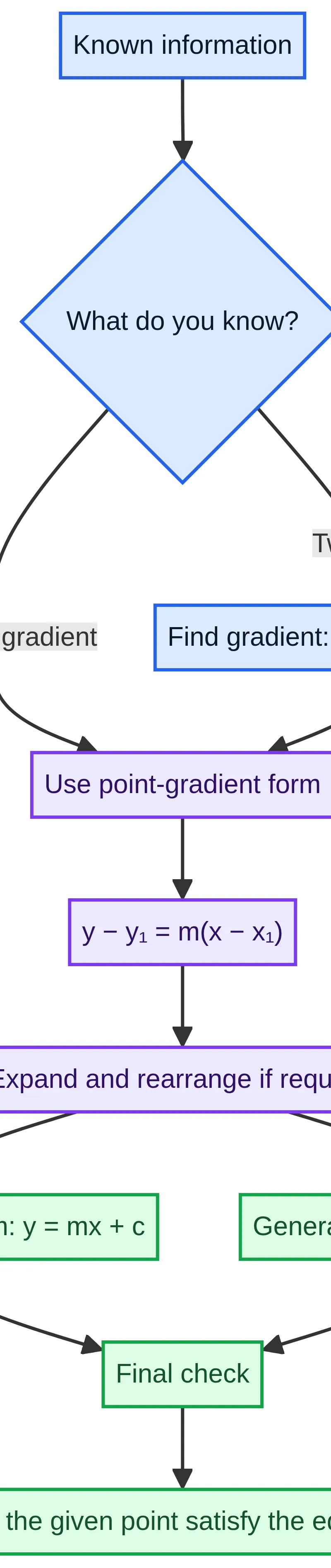
Conceptual Flow Outline
A safe sequence for constructing a straight-line equation.
Conceptual Flow Outline
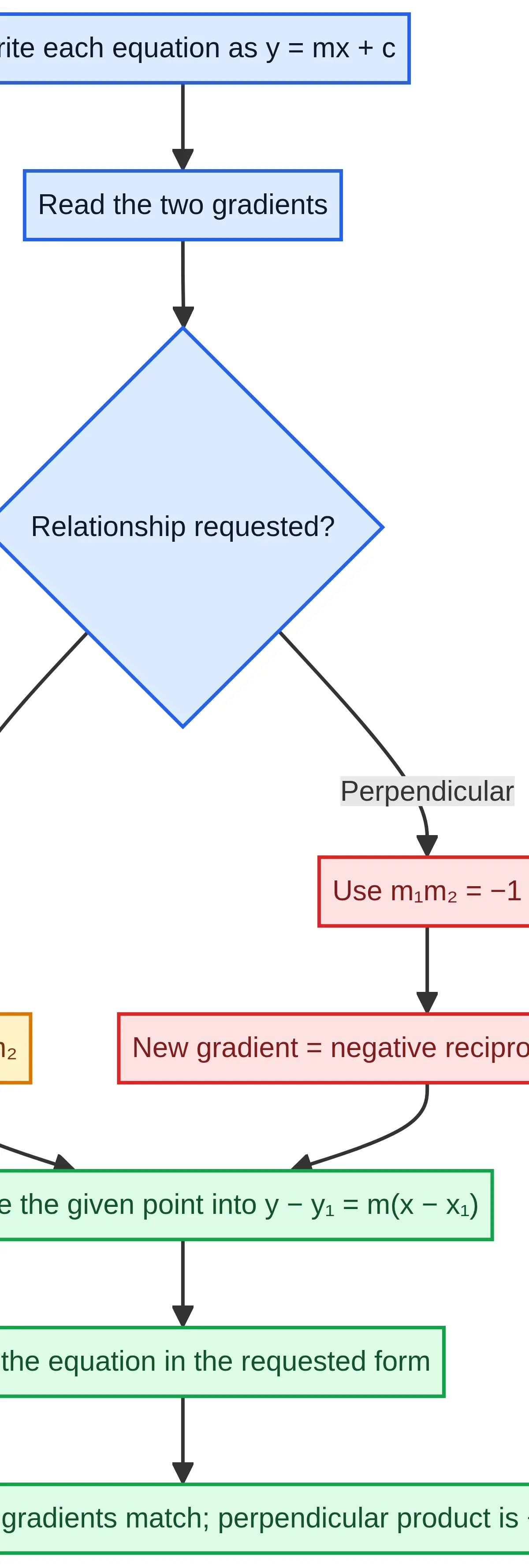
Decision map for parallel and perpendicular line questions.
Worked Examples
4 worked examples — open one to explore the question and available guidance.
Practice Questions
Try the question, then reveal an answer plan or example response
Find the gradient of the line joining (−4, 7) and (2, 1). [2 marks]
Hint: Use the same subtraction order in the numerator and denominator.
Find the equation of the line of gradient 3 through the point (−2, 5). Give your answer in the form y = mx + c. [3 marks]
Hint: Start with y − y₁ = m(x − x₁).
The line 5x + 2y − 14 = 0 is given. Find the equation of the line parallel to it through (2, 3), in the form ax + by + c = 0. [4 marks]
Hint: First find the gradient by isolating y. A parallel line has the same gradient.
The line r passes through (1, −2) and (7, 4). Find the equation of the line perpendicular to r and passing through (3, 5). [5 marks]
Hint: Find the gradient of r before taking its negative reciprocal.
A water tank contains V litres after t minutes, modelled by V = 180 − 7.5t. (a) State the initial volume. (b) Explain the meaning of the gradient. (c) State a sensible restriction on t. [5 marks]
Hint: Think about what must be true physically for a volume of water.
Exam technique
How to turn what you know into marks
How to approach the question
Underline the requested equation form, then identify the known point(s), gradient(s) and relationship. Calculate the gradient before forming an equation. State ‘same gradient’ for parallel or ‘negative reciprocal’ for perpendicular, substitute into point-gradient form, rearrange only at the end, and check the original point or gradient condition.
How to structure your answer
For 2–3 marks: show the gradient and the final equation. For 4 marks: show gradient, relationship or form, correct point substitution and the requested rearrangement. For 5–6 marks: add a clear contextual interpretation, domain comment or explicit verification where asked.
Timing
For Pearson Edexcel A-Level Pure Mathematics papers, 100 marks are completed in 2 hours, so allow about 1.2 minutes per mark. A 6-mark straight-line question should normally take about 7 minutes, including a final check.
Common pitfalls
- Using the negative gradient instead of the negative reciprocal for a perpendicular line. Avoid it by writing m₁m₂ = −1 and checking the product.
- Dropping a sign for a negative coordinate, for example changing x − (−3) into x − 3. Keep coordinates in brackets until expansion.
- Reading the coefficient of x in ax + by + c = 0 as the gradient. Rearrange to y = mx + c before deciding.
- Giving a correct equation in the wrong requested form. Circle the required form before you start rearranging.
- Reporting a model result without units or interpretation. Define variables and state what the gradient and intercept mean in context.
What the command words want
- Compare
- Compare both gradient and intercept where relevant. Same gradient means parallel; different gradients may intersect unless a vertical-line case applies.
- Explain
- Link the algebra to the reason: ‘The gradients are equal, therefore the lines are parallel’ or ‘the product is −1, therefore the lines are perpendicular’.
- Describe
- For a graph or model, say what changes and in which direction. Use terms such as increasing, decreasing, constant rate and intercept.
- Evaluate
- Discuss whether a straight-line model is valid over the stated domain, using units and a realistic interpretation of extrapolated values.
- Calculate
- Show the relevant formula or substitution, retain exact fractions where possible, and include units in contextual final answers.
- State/Give
- Provide the requested gradient, value or equation directly. Do not add unsupported claims, but retain a short calculation if a numerical answer has been obtained.
Watch or listen (optional)
Test your understanding of Understand and use the equation of a straight line, including the forms y – y₁ = m(x – x₁) and ax + by + c = 0; gradient conditions for two straight lines to be parallel or perpendicular; be able to use straight line models in a variety of contexts
Active recall beats re-reading. Take an instant quiz now to test what you’ve learned and lock it into long-term memory.
7 days Premium · Then the free plan continues · No card, no charge