Pearson Edexcel · A-Level · Mathematics
Course version: 9MA0 · Version from Mar 2026
Understand and use the sine, cosine and tangent functions; their graphs, symmetries and periodicity; know and use exact values of sin and cos for 0, π/6, π/4, π/3, π/2, π and multiples thereof, and exact values of tan for 0, π/6, π/4, π/3, π and multiples thereof
Trigonometry becomes far easier once you see it as coordinates moving around a unit circle. This guide turns Edexcel Topic 5.3 into exact-value patterns, graph routines and solution strategies that convert directly into marks on Pure Mathematics papers.
- 9 min read
- 3 worked examples
- 5 practice questions
- 8 key terms
Check what you remember
Read the wording for your board, then hide it and explain unit circle in your own words. Rough notes are fine. This is a self-check, with no mark or grade.
Reference: Pearson Edexcel
A circle of radius 1 centred at the origin; at angle θ its point has coordinates `(cos θ, sin θ)`.
Study Notes
Overview
Pearson Edexcel A-Level Mathematics Topic 5.3 expects candidates to use the sine, cosine and tangent functions confidently, not simply recall a few special-angle answers. You must connect the unit circle to exact values, recognise the parent graphs, and use symmetry and periodicity to predict what happens beyond one cycle. This is examined across Pure Mathematics Papers 1 and 2, which are each 2 hours and 100 marks, so a small exact-value item can become the first step in a longer graph, transformation or equation problem.
The unifying idea is coordinate geometry. On the unit circle, an angle θ reaches the point (cos θ, sin θ). This makes the values, signs and graph shapes logical: sine is vertical position, cosine is horizontal position, and tangent is sin θ / cos θ. Build answers from that model, then use a sketch as your error check. It connects directly to radians, function transformations, identities, trigonometric equations, calculus and modelling periodic motion.
Specification anchor. Pearson specifies knowledge of graphs such as y = sin x, y = cos(x + 30°) and y = tan 2x, alongside the stated exact values. The official formula booklet provides compound-angle and small-angle formulae, but not a special-angle table or parent-graph periods: the Topic 5.3 facts below must be secure from memory.
Key Concepts
1. Exact values from the unit circle
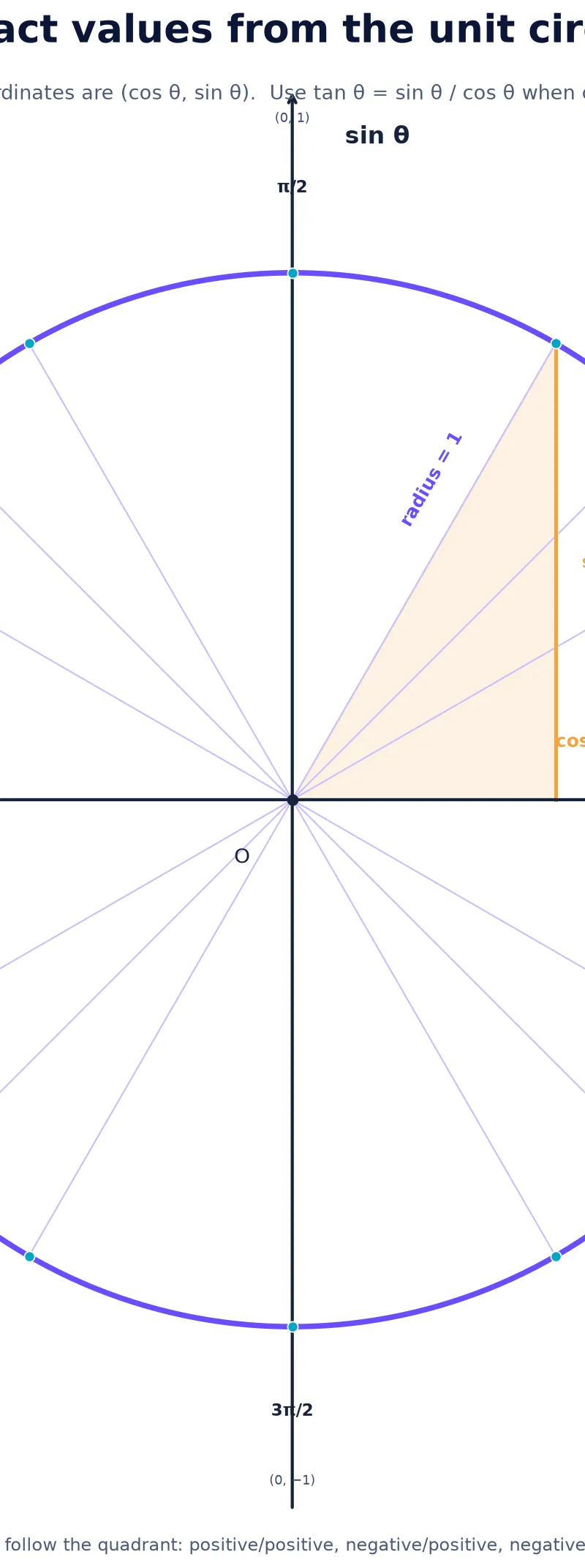
The unit circle has radius 1. For an angle θ measured anticlockwise from the positive x-axis, the point on the circle is:
(x, y) = (cos θ, sin θ)
So read cosine first, then sine. In the first quadrant, the exact values are:
| θ | 0 | π/6 | π/4 | π/3 | π/2 |
|---|---|---|---|---|---|
| sin θ | 0 | 1/2 | √2/2 | √3/2 | 1 |
| cos θ | 1 | √3/2 | √2/2 | 1/2 | 0 |
| tan θ | 0 | √3/3 | 1 | √3 | undefined |
For angles in later quadrants, keep the reference angle and apply coordinate signs. Quadrant I has (+, +), II has (−, +), III has (−, −), and IV has (+, −). Since tan θ = sin θ / cos θ, tangent is positive where sine and cosine have the same sign, in quadrants I and III. At π/2 + kπ, cosine is zero, so tangent is undefined, not zero.
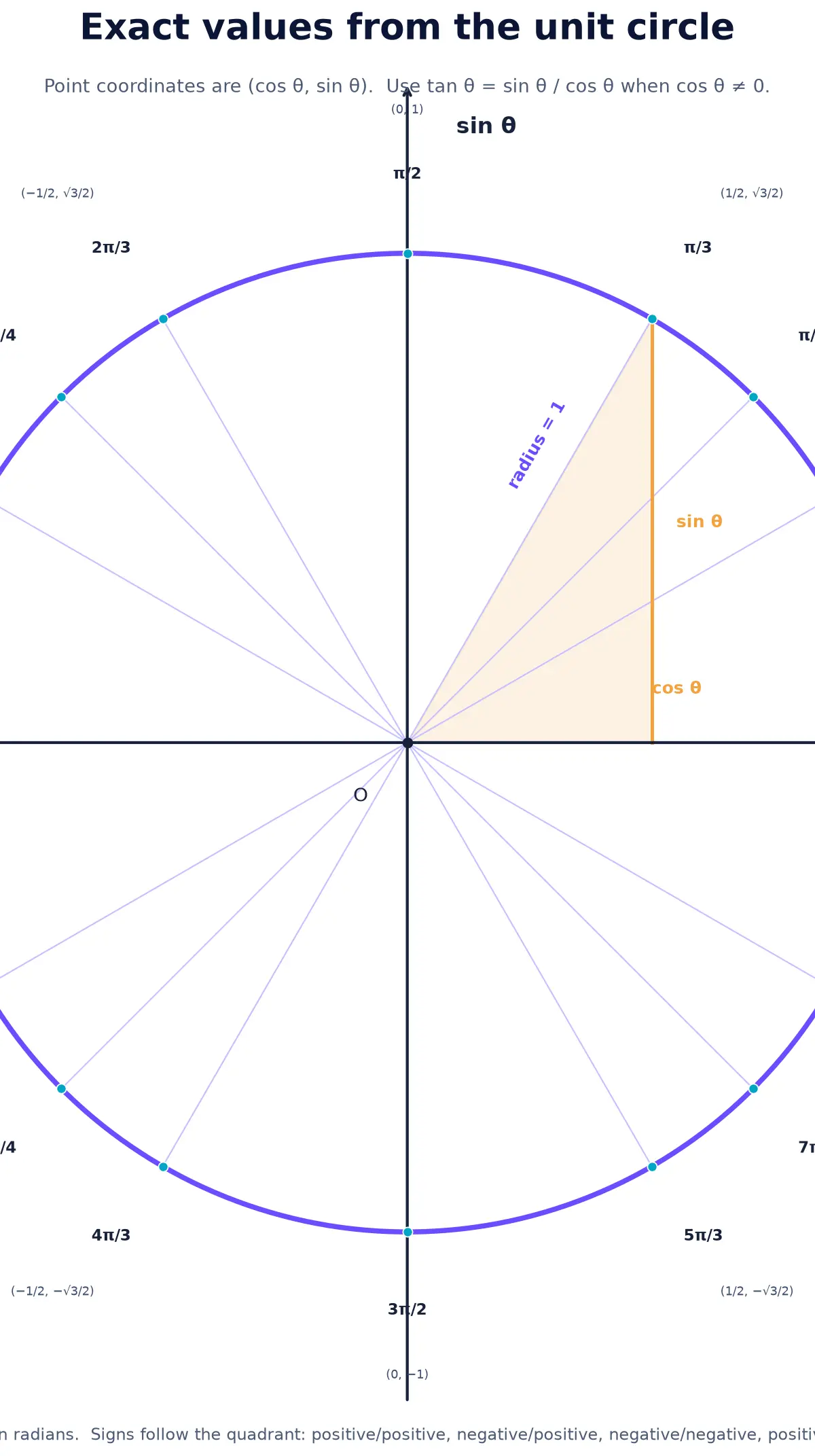
Why this works. The first-quadrant coordinates come from the 30-60-90 and 45-45-90 triangles scaled so that the hypotenuse is 1. Reflection in the axes changes signs but preserves the reference angle, so the same magnitudes reappear around the circle.
Example. Find sin(7π/6). The reference angle is π/6. The angle is in quadrant III, where sine is negative. Therefore sin(7π/6) = −1/2.
2. Parent graphs: shape, symmetry and period
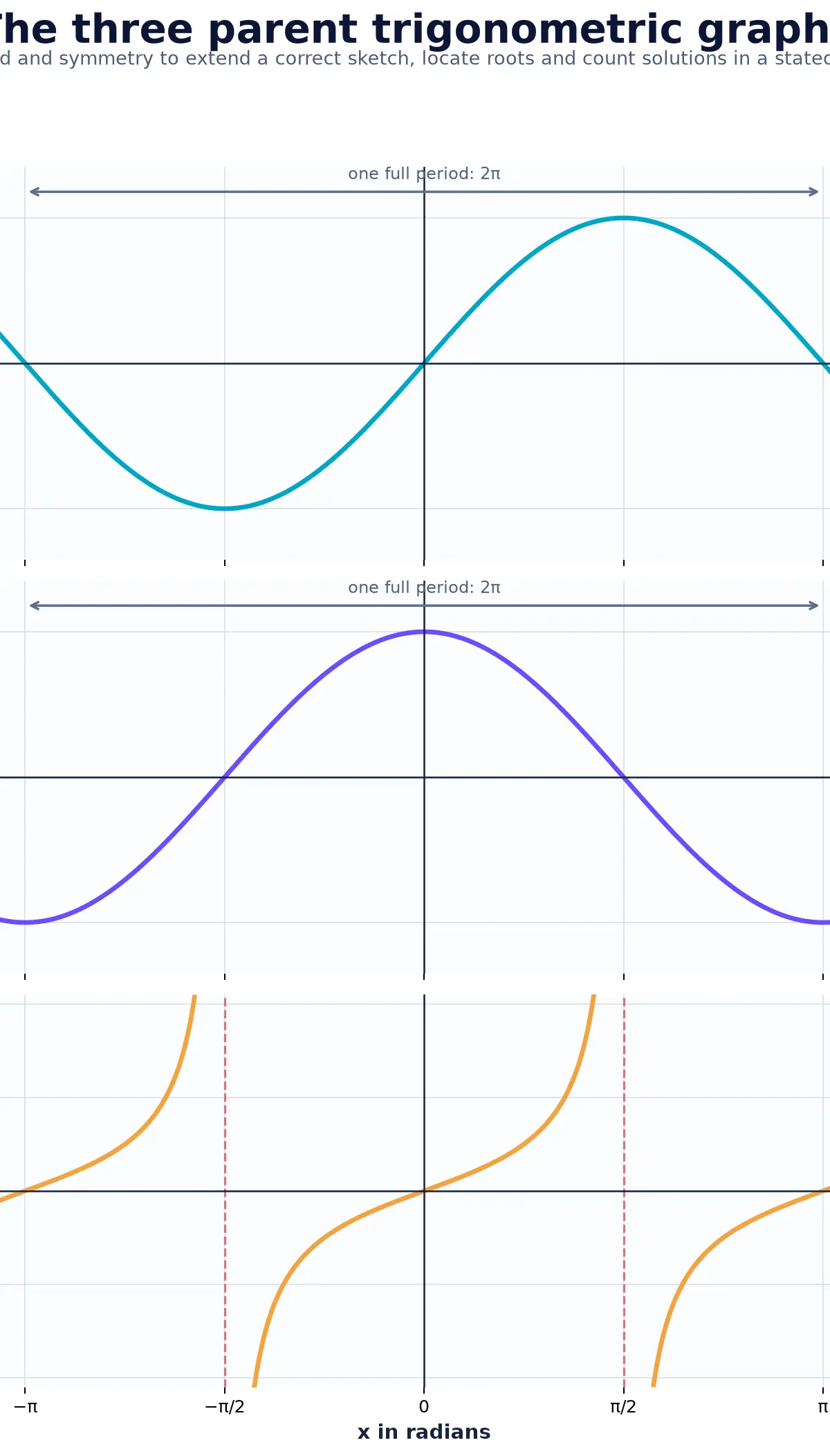
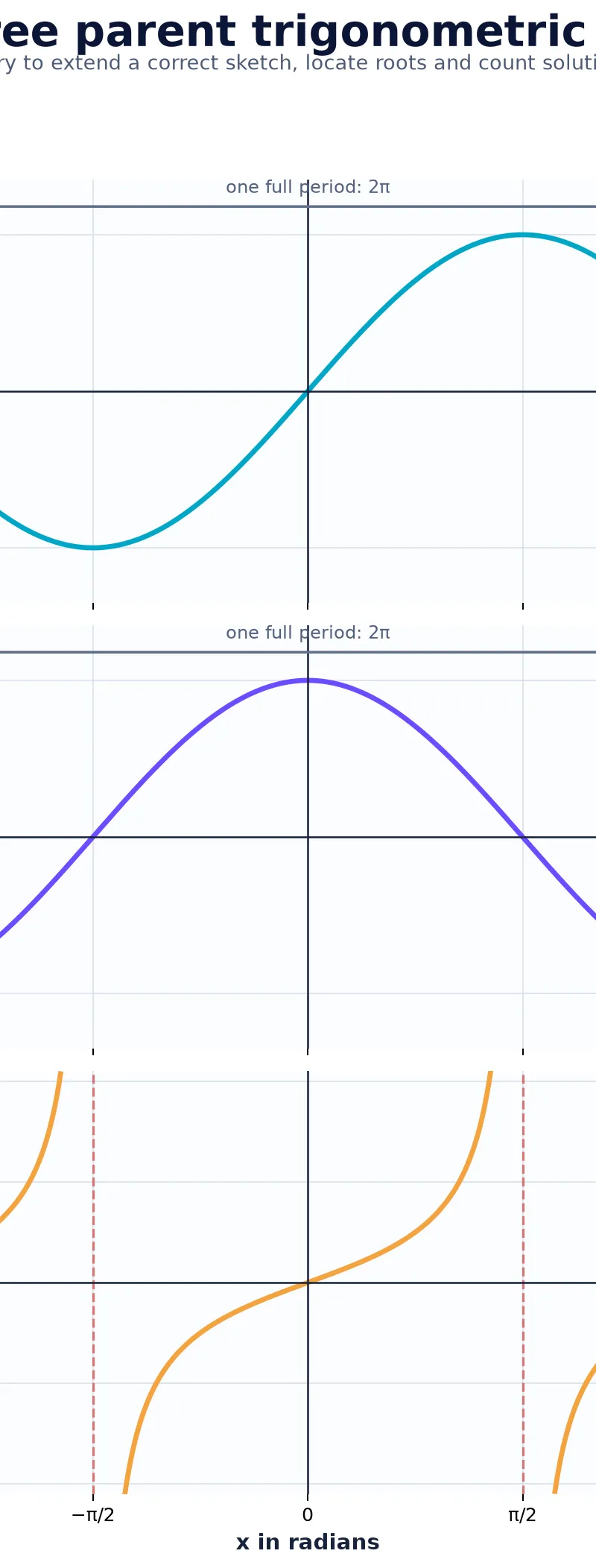
y = sin x starts at (0, 0), reaches 1 at π/2, returns to 0 at π, reaches −1 at 3π/2, then returns to 0 at 2π. Its range is −1 ≤ y ≤ 1, its period is 2π, and it is odd: sin(−x) = −sin x. Its graph has rotational symmetry about the origin.
y = cos x starts at (0, 1), crosses at π/2, reaches −1 at π, crosses at 3π/2, and returns to 1 at 2π. Its range and period match sine, but it is even: cos(−x) = cos x. Its graph is symmetrical about the y-axis.
y = tan x crosses the origin and rises on each branch. It has zeros at x = kπ, vertical asymptotes at x = π/2 + kπ, and period π. It is odd: tan(−x) = −tan x. Never join tangent branches across an asymptote. An asymptote is a boundary approached by the curve, not a point on the graph.
3. Periodicity and transformations
A function is periodic if its values repeat after a fixed horizontal distance. The parent periods are 2π for sine and cosine, and π for tangent. A multiplier inside the function changes the period:
y = sin(bx)ory = cos(bx)has period2π / |b|.y = tan(bx)has periodπ / |b|.
For example, y = tan 2x has period π/2, so it completes twice as many cycles as y = tan x over the same interval. In y = cos(x + π/6), the input is larger by π/6, so the graph shifts left by π/6. The bracket is decisive: inside changes are horizontal and work in the opposite direction to many candidates’ first instinct.
When sketching, work in this order: parent, period, points. Name the parent curve, calculate the changed period, then place exact intercepts, peaks, troughs and asymptotes. A correct period with vague plotting can still lose accuracy credit; a smooth curve should pass through labelled key points.
4. Solving by symmetry and periodicity
Inverse trig gives one principal value; it does not automatically give every answer. If sin x = 1/2 in 0 ≤ x < 2π, use the reference angle π/6, then choose the two quadrants where sine is positive: x = π/6 and x = 5π/6. If cos x = −√2/2, cosine is negative in quadrants II and III, giving 3π/4 and 5π/4.
When the angle is multiplied, widen the working interval before listing solutions. For sin 2x = √3/2 with 0 ≤ x < 2π, let u = 2x. Then 0 ≤ u < 4π, so there are two periods of the sine function to search. Solve for u, then divide every solution by 2. This is a common place where candidates lose solutions.
5. A mark-winning checking routine
At the end of any exact-value or equation response, run a ten-second check rather than reworking the whole question. First, sign: is the function positive or negative in that quadrant? Second, size: sine and cosine must lie between −1 and 1; a result such as √3 cannot be a sine or cosine value. Third, period: for sine or cosine, a corresponding answer repeats after 2π; for tangent, it repeats after π. Fourth, interval: count whether every listed answer actually lies inside the stated bounds. If the question says < 2π, do not include 2π itself.
For a sketch, use the axes as mathematical evidence. A candidate who writes the correct verbal period but draws too many waves has not communicated the answer clearly. Mark the x-values first, then plot coordinates. On a sin x graph over 0 ≤ x ≤ 2π, five anchors are enough: (0,0), (π/2,1), (π,0), (3π/2,−1), (2π,0). On a cosine graph, change only the starting height. On a tangent graph, draw the asymptotes before the curves. This sequence makes it very difficult to join branches accidentally.
Where a question uses degrees, preserve degrees throughout. For example, cos(x + 30°) is a degree-mode or exact-degree question, whereas cos(x + π/6) is in radians. Do not convert partly and then label the axis with mixed units. Pearson permits calculators, but a calculator mode error can make an otherwise good approach unrecoverable. Before pressing sin, cos or tan, read the angle notation and check the display mode.
The clearest final line is a set of exact values with the variable stated, for example x = π/6, π/3, 7π/6, 4π/3. Do not write x = 30, 60, 210, 240 if the original question used radians. Credit is given for valid alternatives, but ambiguity costs time for both candidate and examiner. Exact mathematical notation is part of communication, so use π, fractions and surds cleanly.
Mathematical Relationships and Formula Status
| Relationship | Status | Use and examiner focus |
|---|---|---|
(cos θ, sin θ) on the unit circle | Must memorise and understand | Generates exact values and signs. The order matters. |
tan θ = sin θ / cos θ | Must memorise and understand | Explains tangent values and why tangent is undefined when cos θ = 0. |
sin²θ + cos²θ = 1 | Must memorise | Synoptic identity, useful for checking or linking values. |
| Exact values at 0, π/6, π/4, π/3, π/2 and multiples | Must memorise | Give exact surd or fractional form, not a decimal. |
Periods: sin/cos 2π, tan π | Must memorise | Essential for sketches and counting solutions. |
sin(A ± B), cos(A ± B), tan(A ± B) | Given on formula sheet | Later trigonometry work; recognise but do not confuse with Topic 5.3 graph facts. |
| Small-angle approximations | Given on formula sheet | A separate 5.2 skill; angles must be in radians. |
Graph and data skills. Use radian labels such as −π, −π/2, 0, π/2, π, not decimals, unless the question requests a decimal. Mark tangent asymptotes with dashed vertical lines. Do not invent a y-intercept for an undefined tangent point. At A-Level there are no Foundation/Higher tiers, and this topic has no required practical or unit conversion requirement.
Practical Applications
Trigonometric graphs model quantities that oscillate or rotate. The height of a point on a Ferris wheel, the vertical displacement of a vibrating spring, alternating current and seasonal daylight patterns are all described by repeating functions. In modelling, amplitude controls vertical size, period controls the time for one repeat, and a phase shift controls when the cycle begins. These contexts are assessed later in trigonometric modelling, mechanics and calculus, but the graph-reading habits begin here.
Reference note
These revision points are aligned to Pearson Edexcel GCE Mathematics (9MA0) Topic 5.3 and the official assessment and formula-booklet documents listed in sources below.
Visual Resources
2 diagrams and illustrations
Interactive Diagrams
2 interactive diagrams to visualise key concepts
Conceptual Flow Outline
A reliable exact-value route: magnitude from the reference angle, sign from the quadrant.
Conceptual Flow Outline
Parent graphs determine both their symmetry and how an inside multiplier changes the period.
Worked Examples
3 worked examples — open one to explore the question and available guidance.
Practice Questions
Try the question, then reveal an answer plan or example response
Give the exact value of tan(11π/6). [3 marks]
Hint: Use reference angle `π/6` and identify the quadrant before using the tangent value.
State the period and symmetry of y = cos x. [3 marks]
Hint: Think of what happens from `0` to `2π`, then replace x by −x.
Sketch y = cos(x + π/3) for −π ≤ x ≤ π. State the transformation from y = cos x. [4 marks]
Hint: The plus is inside the bracket. Find where the new maximum occurs.
Solve tan x = −1 for −π < x ≤ π. [4 marks]
Hint: The reference angle is `π/4`. Tangent is negative in quadrants II and IV.
Solve cos 2x = −1/2 for 0 ≤ x < 2π. [5 marks]
Hint: Let `u = 2x`; the interval for u is twice as large as the interval for x.
Exam technique
How to turn what you know into marks
How to approach the question
First circle the interval and the angle unit. For exact values, write reference angle plus quadrant sign. For a graph, use parent → period → key points. For an equation, use reference angle → permitted quadrants → every solution in range.
How to structure your answer
For 1–2 marks, state an exact value and enough working to show the sign. For 3–4 marks, put one method line before the precise result. For 5–6 marks, define a substitution if useful, transform the interval, list all solutions systematically and finish with a boxed exact set.
Timing
Each Pure paper is 120 minutes for 100 marks, an overall average of 1.2 minutes per mark. Routine 2–4 mark exact-value or sketch questions should be completed briskly; bank the time for longer proof, modelling or calculus items.
Common pitfalls
- Using a decimal when the command says ‘exact’. Keep radicals and fractions, then simplify `1/√3` to `√3/3` if required.
- Forgetting that `tan x` is undefined at `π/2 + kπ`. Draw asymptotes, not points, there.
- Giving only principal-value answers after a calculator inverse function. Use a sketch and the stated interval to find all valid solutions.
- Reversing an inside horizontal shift. `f(x + a)` moves left by `a`; `f(x − a)` moves right by `a`.
What the command words want
- Solve
- Write every solution in the specified interval, not an unrestricted general solution unless asked for one.
- Sketch
- Label axes in the supplied units; include intercepts, extrema, period information and tangent asymptotes where relevant.
- Compare
- State both a similarity and a difference, such as the shared odd symmetry of sine and tangent but different periods.
- Explain
- Use a mathematical reason: for example, ‘undefined because cosine is zero, so the quotient divides by zero’.
- Calculate
- Show the reference angle or formula route, then give a simplified exact answer.
- Show that
- Work towards the printed target with valid equal steps. Do not assume the result at the start.
- State/Give
- Write the requested exact value or fact only, but check sign and units first.
Watch or listen (optional)
Test your understanding of Understand and use the sine, cosine and tangent functions; their graphs, symmetries and periodicity; know and use exact values of sin and cos for 0, π/6, π/4, π/3, π/2, π and multiples thereof, and exact values of tan for 0, π/6, π/4, π/3, π and multiples thereof
Active recall beats re-reading. Take an instant quiz now to test what you’ve learned and lock it into long-term memory.
7 days Premium · Then the free plan continues · No card, no charge