Pearson Edexcel · A-Level · Mathematics
Course version: 9MA0 · Version from Mar 2026
Understand and use the standard small angle approximations of sine, cosine and tangent: sin θ ≈ θ, cos θ ≈ 1 – θ²/2, tan θ ≈ θ where θ is in radians
Small-angle approximations let you replace trigonometric functions with simple algebra when the angle is close to zero in radians. In Edexcel Topic 5.2, the formulae are provided, so the marks come from accurate substitution of the whole argument, clear algebra and a disciplined check of the angle unit.
- 10 min read
- 3 worked examples
- 5 practice questions
- 7 key terms
Check what you remember
Read the wording for your board, then hide it and explain Radian in your own words. Rough notes are fine. This is a self-check, with no mark or grade.
Reference: Pearson Edexcel
The angle subtended at the centre of a circle by an arc whose length is equal to the radius.
Study Notes

Overview
$Small-angle approximations turn awkward trigonometric expressions into algebra when an angle is close to zero and is measured in radians. In Pearson Edexcel A-Level Mathematics, this is Topic 5.2. The specification requires candidates to use (\sin\theta\approx\theta), (\cos\theta\approx1-\theta^2/2) and (\tan\theta\approx\theta), where (\theta) is in radians. The formulae are supplied in the Mathematical Formulae and Statistical Tables booklet, but marks are awarded for selecting the right one and applying it to the entire angle.$
This is a compact topic with high return: it regularly appears as a short algebraic approximation, a limit-style expression, an estimate of a small root, or a step inside a larger trig, differentiation or modelling question. The central skill is not memorising three lines. It is noticing that the argument of the trig function may be (2x), (3x), (x/2) or another small expression, then substituting that whole argument accurately. A calculator can check whether an answer is plausible, but it cannot earn the method marks that clear approximation working earns.
Listen: 10-minute revision podcast
Key concept 1: What “small” means
A small-angle approximation describes how a trigonometric curve behaves very close to the origin. Near (\theta=0), the curves (y=\sin\theta) and (y=\tan\theta) are almost indistinguishable from the straight line (y=\theta). The curve (y=\cos\theta) begins at 1 and bends downwards, so its nearby behaviour is captured by (1-\theta^2/2). The symbol (\approx$) matters: these statements are not identities and should not be replaced by an equals sign unless the question explicitly defines an approximation.$
There is no universal numerical boundary at which an angle suddenly stops being “small”. The accuracy required depends on the question. In an Edexcel question, wording such as “(x) is small”, “for values close to the origin”, or a stated use of the small-angle approximations is the invitation to use them. If an angle such as (3x) is used, you must also judge it to be small. In the usual exam setting, if (x) is stated to be small then fixed multiples such as (2x) and (3x) are intended to be small too.
Key concept 2: Radians are non-negotiable
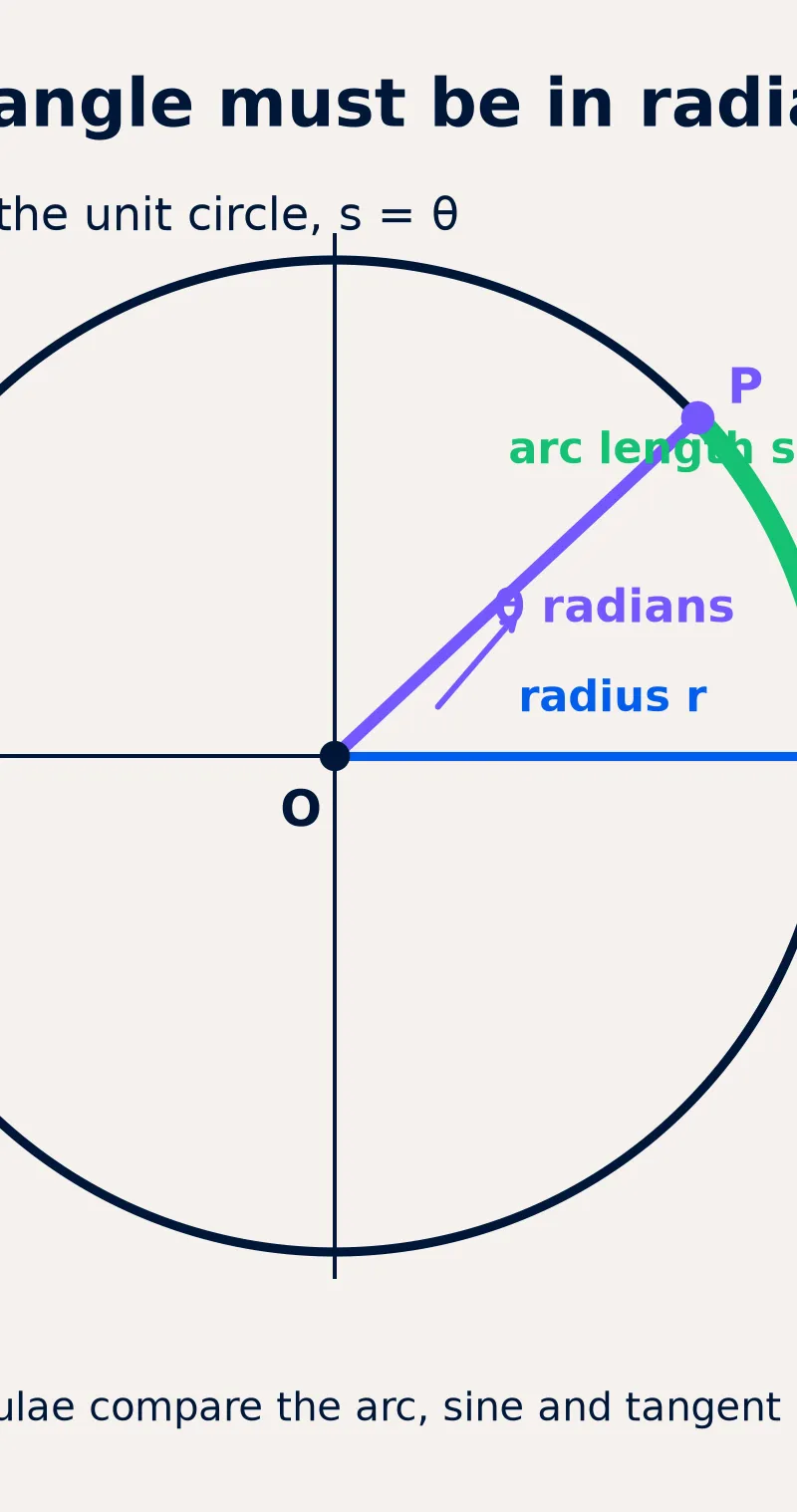
$The three standard formulae work in this simple form only when angles are in radians. A radian measures an angle by comparing arc length with radius: (\theta=s/r). On a unit circle, where (r=1), the arc length is numerically equal to (\theta). That is why the nearby sine, tangent and angle lengths line up so neatly.$
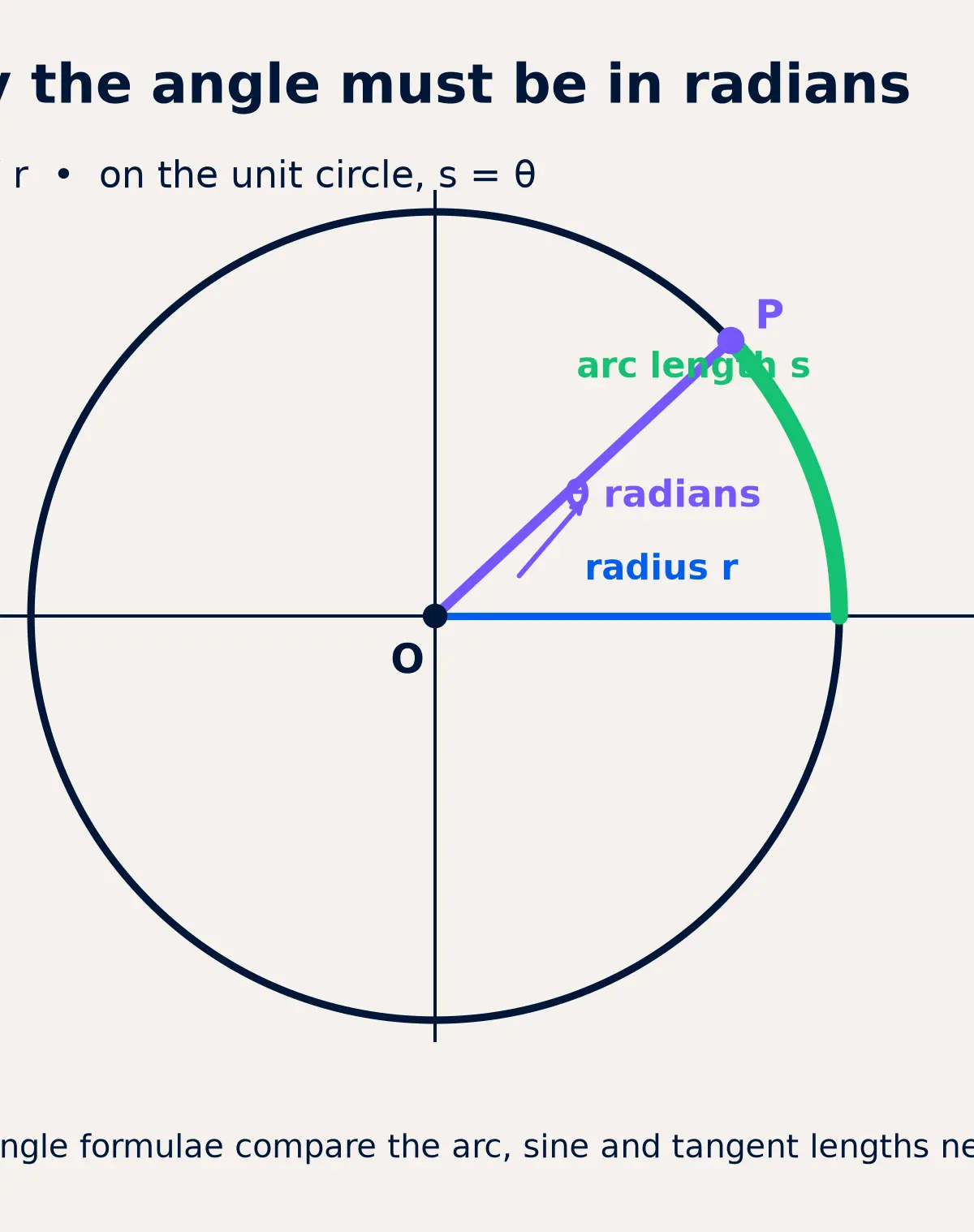
Never insert a degree value directly. For example, (\sin(2^\circ)) is not approximately 2. If a question gives (2^\circ), first convert it: (2^\circ=2\pi/180=\pi$/90) radians, then decide whether an approximation is appropriate. In this topic, the examiner’s key check is often visible in one phrase: “where the angle is measured in radians”. Candidates who omit this condition may reach a numerically reasonable answer by accident, but cannot show secure understanding.$
Key concept 3: The three formulae and the whole argument
Use the formula that matches the trig function, then replace (\theta$) by the complete argument.$
| Expression near zero | Replace it with | What must be substituted |
|---|---|---|
| (\sin u) | (u) | the whole of (u) |
| (\cos u) | (1-u^2/2) | square the whole of (u) |
| (\tan u) | (u) | the whole of (u) |
For instance, (\sin(4x)\approx4x), (\tan(x/3)\approx x/3), and (\cos(3x)\approx1-(3x)^2/2=1-9x^2/2). The last example is the common danger point. Writing (\cos(3x)\approx1-3x^2/2) loses the factor of 3 being squared. No credit is normally given for a final answer based on this incorrect substitution, even if later algebra is tidy.
A useful examiner-facing routine is name, replace, simplify. Name the approximation by writing it; replace the trig expression; simplify only after the bracket has been squared. This makes the method easy to follow and protects the first two marks in a multi-step question.
Mathematical relationships and formula-booklet status
The following three formulae are given on the Pearson Edexcel Mathematical Formulae and Statistical Tables booklet. You do not need to reproduce them from memory in the exam, but you do need to recognise when each is appropriate.
[
\sin\theta\approx\theta,\qquad
\cos\theta\approx1-\frac{\theta^2}{2},\qquad
\tan\theta\approx\theta
]
The condition for all three is (\theta) small and in radians. The conversion (180^\circ=\pi$) radians is must-know prior knowledge. For synoptic work with sectors, (s=r\theta) and (A=\tfrac12r^2\theta) also require (\theta) in radians; that shared condition is a useful memory link.$
Why is cosine different? At (\theta=0), cosine has value 1 and a horizontal tangent, so there is no linear term. Its first visible change is quadratic and negative. This is why a cosine approximation can produce a term in (x^2) while sine and tangent usually produce a term in (x). You are not expected to derive these formulae from series in this topic. In an exam, use the supplied standard results cleanly rather than adding unnecessary theory.
Key concept 4: Simplifying fractions and “show that” questions
After substitution, treat the expression as algebra. This is where cancellation often reveals a constant. For example, if (x) is small,
[
$\frac{\cos(3x)-1}{x\sin(4x)}$
$\approx$
$\frac{\left(1-\frac{9x^2}{2}\right)-1}{x(4x)}$
\frac{-9x^2/2}{4x^2}
=-\frac98.
]
This is the exact style of example referenced in the Pearson specification. The candidate must keep brackets around the cosine approximation, simplify the numerator to (-9x^2/2), and only then cancel (x^2). In a “show that” question, carry enough working for the examiner to award each method mark. A bare final constant is difficult to credit.
Be especially alert to a denominator such as (\sin(2x)) or (\tan(5x)). Replace it with (2x) or (5x), not merely (x). If the denominator contains (x\sin(4x)), it becomes (x(4x)=4x^2). Writing the multiplying (x) explicitly is a simple way to avoid losing a power of (x).
Accuracy, graphs and sensible checking
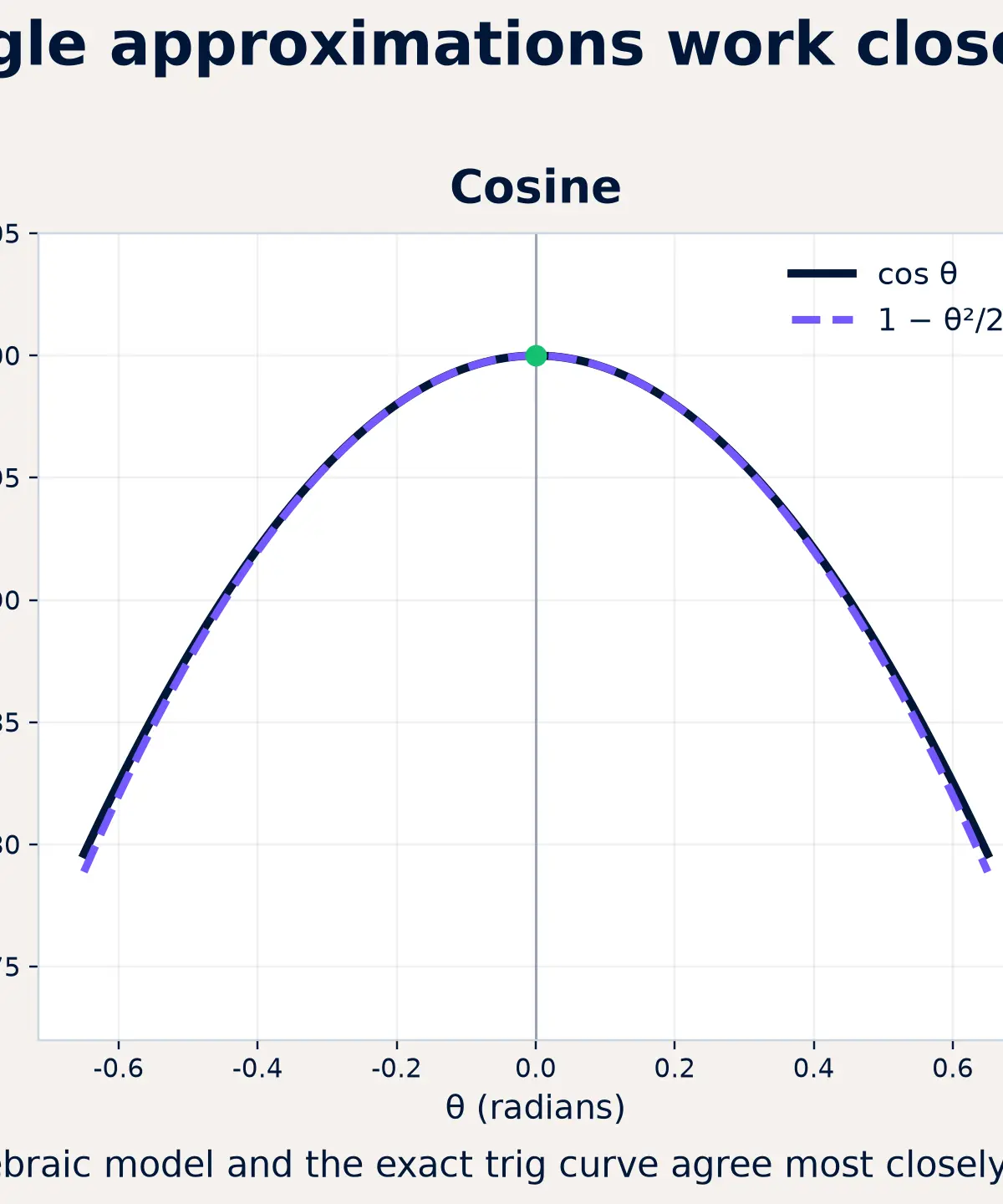
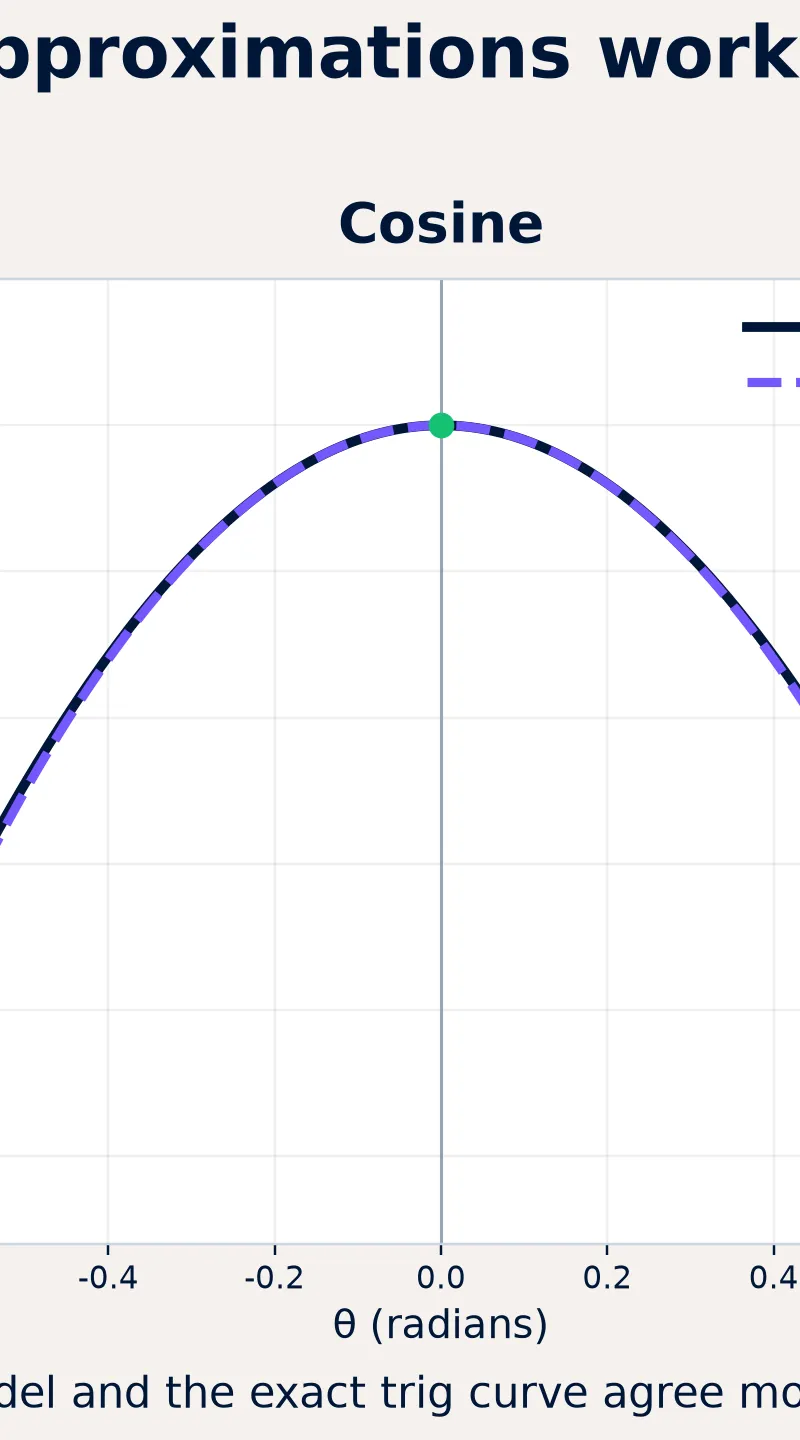
The graph matters because it explains the signs. For positive small (\theta), (\sin\theta<\theta<\tan\theta), while cosine is a little below 1. Therefore a positive small sine or tangent approximation is slightly high, whereas (1-\theta^2/2) is a close cosine estimate near zero. The same approximations work for negative small angles: sine and tangent change sign, while cosine remains even.
$Use a calculator only as a sense check, set to radian mode. For example, (\cos(0.2)) should be slightly below 1, so an answer such as (1+0.02) signals that the minus sign has been lost. Do not replace the requested approximation method with a calculator decimal. In a method-marked question, calculator-only work may receive no credit because the required mathematical model has not been shown.$
Choosing the right approximation under pressure
Before you write an equation, make three quick decisions. First, identify the function: sine, cosine or tangent. Second, identify the complete angle: it may be (x), (2x), (3x), (x/4) or an expression such as (a-b). Third, decide what happens after substitution. Sine and tangent normally create linear terms, whereas cosine creates a constant plus a quadratic term. This prediction is a powerful error check before you calculate.
For example, (1-\cos(5x)) should become a positive multiple of (x^2), because the two constant 1 terms cancel. If your working produces a linear term, return to the cosine formula and look for a missing square. Conversely, a fraction involving (\sin(2x)) in its denominator usually introduces a factor of (2x). Write the denominator in full before cancelling anything. Candidates who predict the form of their answer are much less likely to lose a mark through an unnoticed sign, factor or power error.
If a question gives a numerical angle but does not explicitly call it small, do not automatically use this topic. The approximation is a local model, not a general calculator shortcut. In contrast, when the question tells you to use small-angle approximations, accept that instruction, state the replacement and complete the algebra. The examiner is assessing method selection and precise application, not whether you can decide a universal cut-off for “small”.
Exam method: four moves that earn marks
- Read the condition. Underline “small” and “radians”. If degrees appear, convert before doing anything else.
$2. Identify every trig argument. Circle the contents of each sine, cosine or tangent bracket. This is the value replacing (\theta).$
$3. Write the approximation before simplifying. For cosine, retain brackets: (\cos(3x)\approx1-(3x)^2/2).$
$4. Do ordinary algebra and state the result as an approximation. Keep (\approx) in a derived expression and give a requested decimal to the stated accuracy.$
For a 3-mark question, expect one mark for a suitable approximation, one for correct substitution or algebra, and one for the simplified answer. For a 5- or 6-mark question, marks are often spread across more than one replacement, a rearrangement or cancellation, and a final conclusion. Credit is given for visible, correct intermediate work. Do not jump from the original expression straight to the final number.
Typical question styles and practical meaning
Small-angle approximations appear in four recurring forms. First, an examiner may ask you to simplify an expression. Second, you may estimate a root by replacing cosine or sine with a polynomial. Third, a graph or curve question may ask for behaviour near the origin. Fourth, an applied model may use (\sin\theta\approx\theta) to turn a non-linear relation into one proportional to displacement.
The classical physical picture is a pendulum at a small displacement. Its restoring effect contains (\sin\theta); replacing this by (\theta) produces the linear model for simple harmonic motion. You do not need physics to answer a pure maths question, but the application helps explain why approximation is valuable: complicated trig can become solvable algebra without pretending that the two functions are exactly the same.
Formula and source check
$Pearson Edexcel lists this as Topic 5.2 and gives the specification example ((\cos 3x-1)/(x\sin4x)\approx-9/8) for small (x). The three approximations also appear in the supplied Edexcel formula booklet. Official specification.$
Visual Resources
2 diagrams and illustrations
Interactive Diagrams
2 interactive diagrams to visualise key concepts
Conceptual Flow Outline
Decision process for selecting and applying a small-angle approximation.
Conceptual Flow Outline
Why the three approximations have different algebraic forms near the origin.
Worked Examples
3 worked examples — open one to explore the question and available guidance.
Practice Questions
Try the question, then reveal an answer plan or example response
Calculate tan(0.04) using a small-angle approximation. State the condition that allows this. (3 marks)
Hint: Tangent has the same small-angle approximation as sine.
Given that x is small and in radians, find an approximation for 1 − cos(2x). (3 marks)
Hint: Use the cosine formula with θ = 2x before subtracting from 1.
Given that x is small and measured in radians, find an approximation for sin(3x) + tan(x). (3 marks)
Hint: Both sine and tangent become their complete arguments.
Show that, for small x in radians, (1 − cos(4x)) / (x sin(2x)) ≈ 4. (5 marks)
Hint: Approximate numerator and denominator separately, then cancel x².
For small positive x in radians, use small-angle approximations to estimate the solution of (1 − cos(2x)) / sin(x) = 0.10. (5 marks)
Hint: The numerator becomes 2x² and the denominator becomes x.
Exam technique
How to turn what you know into marks
How to approach the question
Underline ‘small’ and ‘radians’; identify the entire argument of every trig function; write the relevant approximation with brackets; then simplify as algebra. Use radian-mode calculator values only as a final sense check.
How to structure your answer
For 2–3 marks, show the replacement and the simplification. For 4–6 marks, put each replacement on its own line, retain brackets for cosine, show cancellation or rearrangement, and state an approximate final answer in radians where appropriate.
Timing
Edexcel A-Level Mathematics papers are 2 hours for 100 marks: aim for about 1.2 minutes per mark. A routine 3-mark approximation should usually take no more than 4 minutes.
Common pitfalls
- Using degrees directly. Avoid it by writing θrad = θdeg × π/180 before any approximation.
- Writing cos(3x) ≈ 1 − 3x²/2. Avoid it by writing 1 − (3x)²/2 first.
- Replacing sin(4x) or tan(4x) by x. Avoid it by circling the full argument 4x.
- Using = instead of ≈. Avoid it by preserving the approximation sign through the working.
- Giving only a calculator decimal. Avoid it by showing the supplied formula and algebraic method.
What the command words want
- Compare
- Use the near-origin shapes: sine and tangent are close to y = θ; cosine is close to 1 − θ²/2. State a similarity and a difference.
- Explain
- Refer explicitly to the angle being small and in radians, then name the approximation used.
- Estimate
- Form an approximate algebraic equation, solve it, and label the result as an approximation in radians.
- Calculate
- Write the chosen approximation, substitute the full argument, simplify and give the requested accuracy.
- Show that
- Start from the given expression, replace the trig terms visibly and work logically to the stated result. Do not assume the target.
- State/Give
- Give the requested approximation or value concisely, retaining units where relevant.
Watch or listen (optional)
Test your understanding of Understand and use the standard small angle approximations of sine, cosine and tangent: sin θ ≈ θ, cos θ ≈ 1 – θ²/2, tan θ ≈ θ where θ is in radians
Active recall beats re-reading. Take an instant quiz now to test what you’ve learned and lock it into long-term memory.
7 days Premium · Then the free plan continues · No card, no charge