Pearson Edexcel · A-Level · Mathematics
Course version: 9MA0 · Version from Mar 2026
Use vectors in two dimensions and in three dimensions
Vectors turn movement through a plane or space into precise algebra: they describe both size and direction. For Pearson Edexcel A-Level Mathematics, candidates need fluent notation, secure component arithmetic and disciplined use of position vectors, because the same ideas recur in pure geometry and Paper 3 mechanics.
- 11 min read
- 4 worked examples
- 6 practice questions
- 9 key terms
Check what you remember
Read the wording for your board, then hide it and explain Vector in your own words. Rough notes are fine. This is a self-check, with no mark or grade.
Reference: Pearson Edexcel
A quantity with both magnitude and direction, represented algebraically by components or geometrically by a directed line segment.
Study Notes
Pearson Edexcel A-Level Mathematics: Vectors in Two and Three Dimensions
Overview
Vectors are the mathematics of directed movement. A scalar tells you only “how much”; a vector tells you how much and which way. Pearson Edexcel 9MA0 section 10.1 requires candidates to work confidently with vectors in both two and three dimensions, using column notation and the unit vectors i, j and k. In actual papers, this knowledge rarely sits in isolation. A short pure question may ask you to find a displacement vector, while a Paper 3 mechanics question may quietly use the same algebra for velocity, acceleration or force.
Treat every vector as an arrow. Its components describe the movement along perpendicular axes, not the coordinates of a point unless the question specifically says it is a position vector. That distinction protects marks. Typical questions ask candidates to add or subtract vectors, multiply by scalars, find a magnitude, form a unit vector, prove parallelism, calculate a displacement such as (\overrightarrow{AB}), find a distance, or determine a missing vertex of a parallelogram. Questions may be set in 2D or 3D. The arithmetic is almost identical; in 3D, simply carry the k-component through every line.
Examiner habit:Write the vector relation before substituting numbers. A correct statement such as (\overrightarrow{AB}=\mathbf b-\mathbf a) often earns method credit even if later arithmetic slips.
Key Concept 1: Components, column vectors and unit vectors
A two-dimensional vector can be written as (\begin{pmatrix}x\y\end{pmatrix}) or (xi+yj). The components give the horizontal and vertical movements. For example, (\begin{pmatrix}3\-2\end{pmatrix}=3i-2j) means “three units in the positive x-direction and two units in the negative y-direction”. In three dimensions, add the z-direction: (\begin{pmatrix}x\y\z\end{pmatrix}=xi+yj+zk).
The symbols (i), (j) and (k) are unit vectors: (i) points one unit along x, (j) one unit along y and (k) one unit along z. They are directions with magnitude 1. Do not write them as ordinary variables and do not omit a zero component. For instance, (4i-3k) in 3D is (\begin{pmatrix}4\0\-3\end{pmatrix}), not (\begin{pmatrix}4\-3\end{pmatrix}).
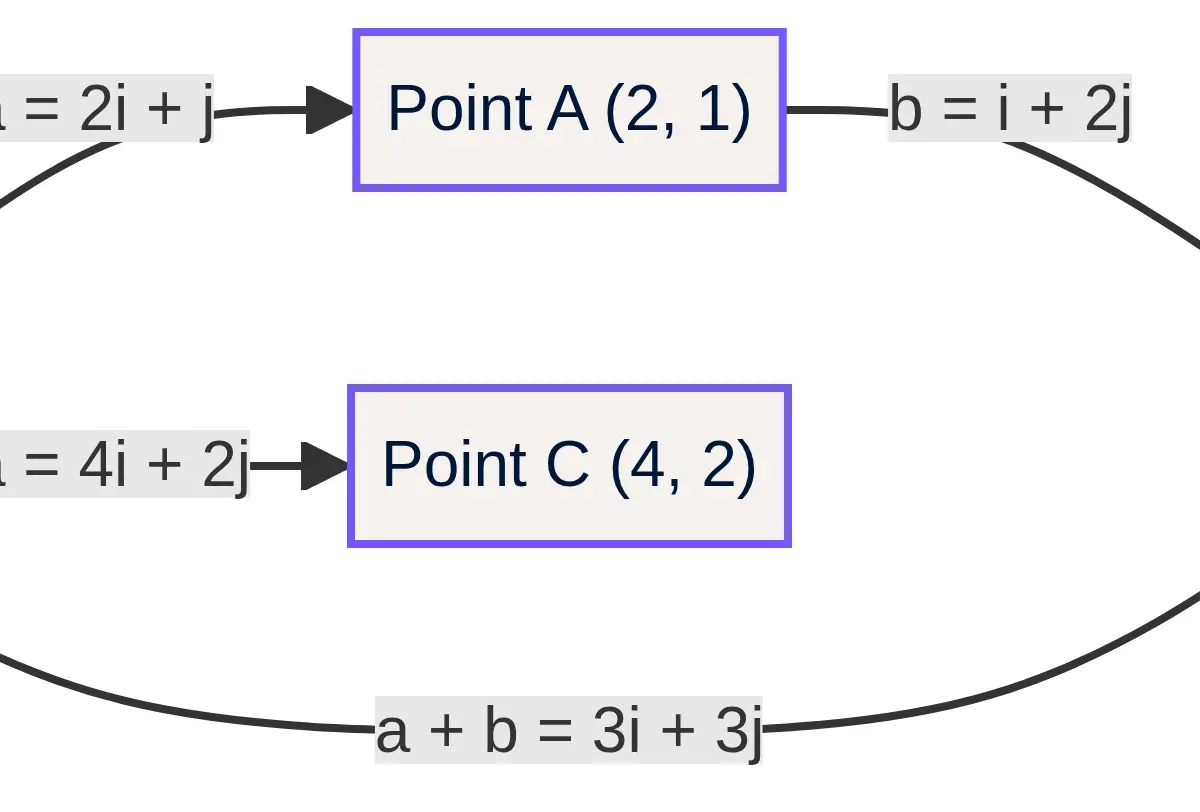
Why it works: perpendicular components are independent. Moving 3 right and then 2 down produces the same final displacement as making those movements simultaneously, so the components can be recorded and calculated separately.
Key Concept 2: Addition, subtraction and scalar multiplication
Add or subtract vectors component by component. If (\mathbf a=\begin{pmatrix}2\-1\3\end{pmatrix}) and (\mathbf b=\begin{pmatrix}4\5\-2\end{pmatrix}), then
[
\mathbf a+\mathbf b=\begin{pmatrix}6\4\1\end{pmatrix},\qquad
\mathbf a-\mathbf b=\begin{pmatrix}-2\-6\5\end{pmatrix}.
]
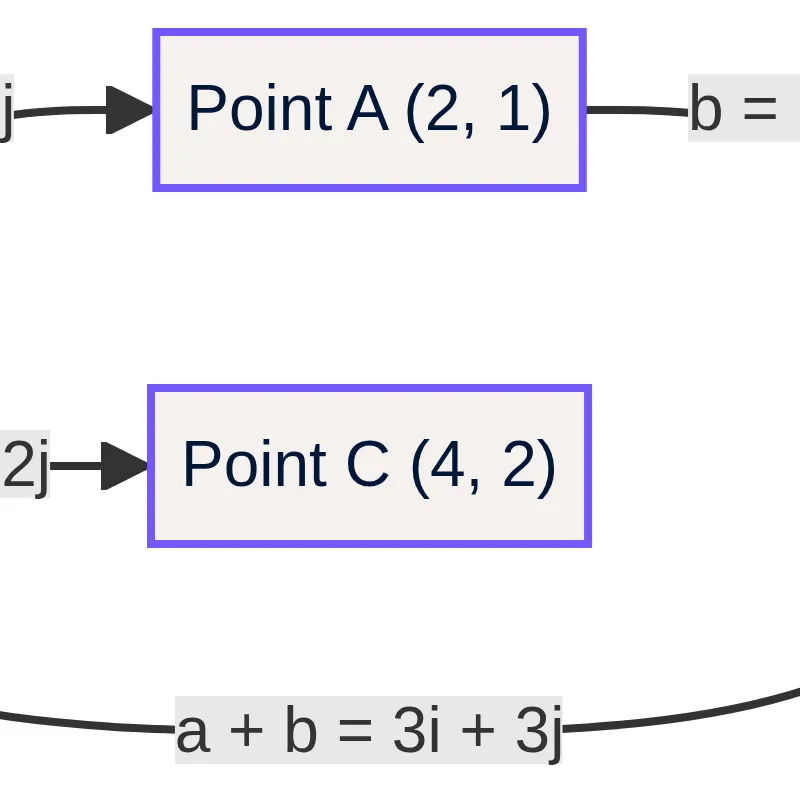
A resultant (\mathbf a+\mathbf b) is the single displacement made by following (\mathbf a) then (\mathbf b). Sketching head-to-tail gives the triangle law. Drawing both from the same starting point gives the diagonal of a parallelogram.
For a scalar (\lambda), multiplyeverycomponent: (\lambda\mathbf a=\begin{pmatrix}\lambda x\lambda y\lambda z\end{pmatrix}). A positive scalar stretches or shrinks the vector without turning it. A negative scalar also reverses its direction. This gives the parallel test: non-zero vectors are parallel when one is a scalar multiple of the other. Check the same multiplier in every component. A single matching ratio is not proof.
Memory hook: “Same lane, same scale.” Parallel vectors lie in the same or opposite direction and one is a single scale factor of the other.
Key Concept 3: Magnitude, direction and unit vectors
The magnitude (|\mathbf a|) is the length of the arrow. In 2D, Pythagoras gives (|\mathbf a|=\sqrt{x^2+y^2}). In 3D, apply Pythagoras twice: (|\mathbf a|=\sqrt{x^2+y^2+z^2}). Square every component, including negative ones. For (\mathbf v=2i-3j+6k), (|\mathbf v|=\sqrt{2^2+(-3)^2+6^2}=\sqrt{49}=7).
A unit vector has magnitude 1 and preserves direction. To find one in the direction of a non-zero vector, divide the whole vector by its magnitude: (\widehat{\mathbf a}=\frac{\mathbf a}{|\mathbf a|}). This is a division of every component, not just the leading component. It is impossible to find a unit vector “in the direction of” the zero vector because the zero vector has no direction.
For a 2D direction measured anticlockwise from the positive x-axis, use (\tan\theta=\frac{y}{x}), then use the signs of both components to choose the correct quadrant. A calculator may give a reference angle only. State the required convention, normally degrees and an angle from the positive x-axis, unless the question specifies a bearing or another direction.
Key Concept 4: Position vectors and displacement
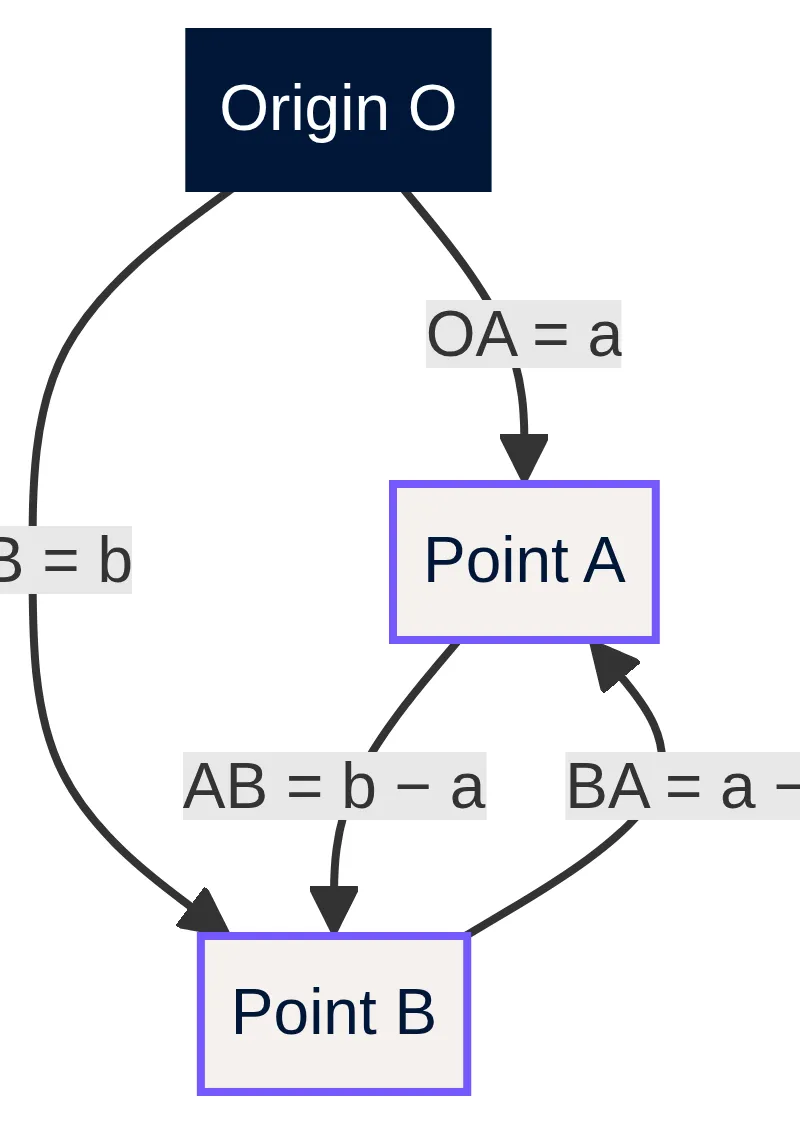
A point A with position vector (\mathbf a) is reached by the arrow (\overrightarrow{OA}) from the origin O. It is a location. The displacement (\overrightarrow{AB}) is the arrow from A to B. If (\overrightarrow{OA}=\mathbf a) and (\overrightarrow{OB}=\mathbf b), then
[
\overrightarrow{AB}=\overrightarrow{OB}-\overrightarrow{OA}=\mathbf b-\mathbf a.
]
Read this aloud as end minus start. This makes the order secure. Reversing the direction reverses the vector: (\overrightarrow{BA}=\mathbf a-\mathbf b=-\overrightarrow{AB}).
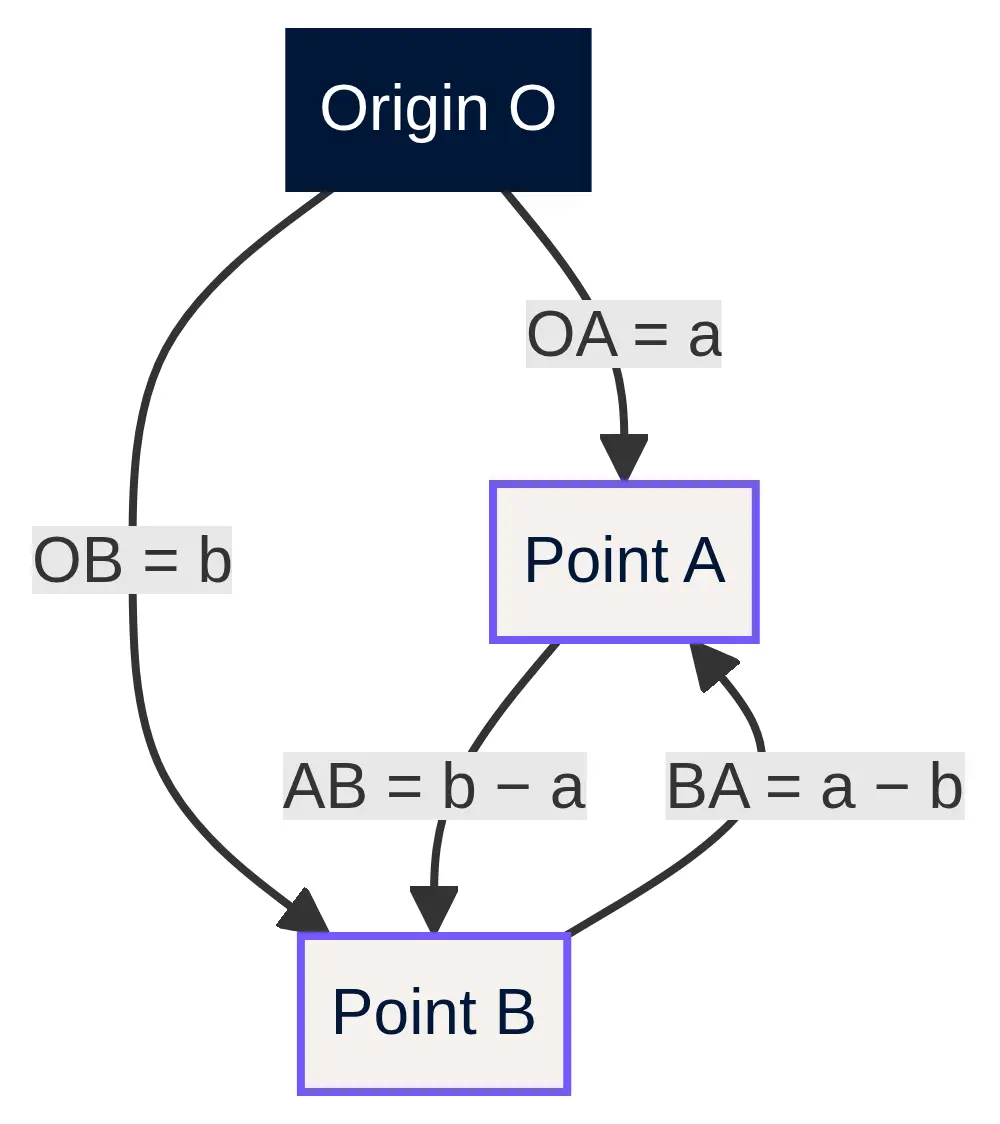
The distance between A and B is the magnitude of their displacement: (AB=|\mathbf b-\mathbf a|). In coordinates, this produces the familiar distance formula. In 3D, include the third squared difference. Distance is a non-negative scalar, so a final answer such as (-5) cannot be a distance.
For a parallelogram ABCD labelled in order, opposite sides are equal as vectors: (\overrightarrow{AD}=\overrightarrow{BC}). With position vectors (\mathbf a), (\mathbf b) and (\mathbf c) for A, B and C, the fourth point is (\mathbf d=\mathbf a+\mathbf c-\mathbf b). Derive it from a route rather than memorising a loose pattern: (\mathbf d=\mathbf a+\overrightarrow{AD}=\mathbf a+(\mathbf c-\mathbf b)).
Mathematical Relationships: know these, not just the buttons
| Relationship | Use | Formula-sheet status |
|---|---|---|
| Component/unit-vector equivalence | Change notation | (\begin{pmatrix}x\y\z\end{pmatrix}=xi+yj+zk), must memorise |
| Vector addition/subtraction | Combine or compare displacements | component by component, must memorise |
| Scalar multiplication | Stretch, reverse or test parallelism | (\lambda\begin{pmatrix}x\y\z\end{pmatrix}=\begin{pmatrix}\lambda x\\lambda y\\lambda z\end{pmatrix}), must memorise |
| Magnitude | Find a length | ( |
| Unit vector | Keep direction, set length to 1 | (\widehat{\mathbf a}=\frac{\mathbf a}{ |
| Position-vector displacement | Travel from A to B | (\overrightarrow{AB}=\mathbf b-\mathbf a), must memorise |
| Distance | Separation of two points | (AB= |
| Parallel vectors | Establish common line/direction | (\mathbf a=\lambda\mathbf b), must memorise |
Pearson Edexcel’s formula booklet does not supply the vector relationships above. Learn them as a connected system rather than as isolated formulas.
Practical applications and synoptic use
In mechanics, displacement, velocity, acceleration and force are vectors. A force of (3i-4j) N has components that can be added with other forces before applying Newton’s second law. In 2D kinematics, (\mathbf v=\mathbf u+\mathbf at) and (\mathbf r=\mathbf ut+\tfrac12\mathbf at^2) use exactly the same component-by-component algebra. In pure mathematics, vector geometry turns a diagram into equations for routes, lengths and parallel lines.
There is no required practical for this pure mathematics topic. Nevertheless, use a sketch as a practical checking routine: mark O, A and B; draw the arrow direction; then decide whether you need a position vector, a displacement vector or a scalar distance. This ten-second sketch is often the difference between full credit and a sign error.
Exam execution routine
- Name the objects. Write the given position vectors, vectors or coordinates clearly.
- Write the route. For a displacement, use “end minus start”; for a shape, link equal opposite sides.
- Calculate line by line. Align components vertically. In 3D, include all three entries every time.
- Interpret the result. Is it a vector, a magnitude, a unit vector, a distance or an angle? Give the answer in the correct form.
- Check the geometry. A reversed displacement should have the opposite signs; a distance cannot be negative; a unit vector must have magnitude 1.
Cover and recall
Cover the formulas above and answer aloud: What is (\overrightarrow{PQ}) if the position vectors of P and Q are (\mathbf p) and (\mathbf q)? What changes when you reverse the arrow? How would you recognise a vector parallel to (\begin{pmatrix}2\-1\3\end{pmatrix})? Why does a unit vector preserve direction? Finally, explain why a 3D magnitude contains three squared components.
Direction conventions, diagrams and answer quality
Direction is where a correct calculation can still lose its final communication mark. A vector such as (\begin{pmatrix}-3\4\end{pmatrix}) lies in the second quadrant: left and up. The calculator value from (\tan^{-1}(4/-3)) must therefore be adjusted to the direction requested by the question. If the convention is anticlockwise from the positive x-axis, the answer is (126.9^\circ), not the negative reference angle. If the convention is a three-figure bearing, measure clockwise from north and write leading zeroes where needed. Never assume that “direction” automatically means a bearing.
A quick sketch is not decoration. It gives three powerful checks. First, it makes the sign pattern plausible: right is positive x, left is negative x, up is positive y and down is negative y. Second, it exposes a reversed displacement. If your calculated (\overrightarrow{AB}) points from B back to A on the sketch, you used the wrong order. Third, it lets you distinguish vector equality from equal lengths. Equal vectors have the same magnitudeand direction. Vectors of the same length may point in different directions and are then not equal.
For a “show that” or proof question, presentation creates marks. Start with a named relationship, for example (\overrightarrow{AD}=\overrightarrow{BC}), (\overrightarrow{AB}=\mathbf b-\mathbf a), or (\mathbf q=\lambda\mathbf p). Substitute on the next line. Simplify on a further line. Finish with an explicit conclusion: “Therefore the vectors are parallel” or “Therefore D has position vector ...”. Candidates who only write a correct final result risk losing method marks because the examiner cannot see why it is valid.
When a question asks for a magnitude or distance, keep radicals exact unless a decimal is requested. (\sqrt{41}) is preferable to (6.403...) because it is exact, easier to check and avoids premature rounding. When an answer requests a unit vector, a rapid self-check is to square its components and add them: the result should be 1. When an answer requests a displacement, check that it is still a vector with components, not a scalar length.
Deliberate-practice routine
After each question, do not simply mark it right or wrong. Diagnose the error type: notation, route, component arithmetic, magnitude, direction convention, or interpretation. Then repeat one near-identical question immediately without notes. This is retrieval practice, not rereading. Once the method is secure, mix 2D and 3D questions, then mix pure and mechanics contexts. That variation is valuable because the examination will not announce which vector skill it is testing before the problem begins.
Visual Resources
2 diagrams and illustrations
Interactive Diagrams
2 interactive diagrams to visualise key concepts
Conceptual Flow Outline
Adding vectors head-to-tail gives the resultant; multiplying by 2 doubles every component.
Conceptual Flow Outline
Position vectors locate A and B from the origin; their difference gives the displacement between the points.
Worked Examples
4 worked examples — open one to explore the question and available guidance.
Practice Questions
Try the question, then reveal an answer plan or example response
Write 4i − 3j + 2k as a column vector. [3 marks]
Hint: Read off the i, j and k coefficients in that order.
Given a = (3, −1, 2) and b = (−2, 4, 5), calculate 2a − b. [3 marks]
Hint: Multiply a first, then subtract each corresponding component of b.
For v = (3, 4), find (a) |v| and (b) the direction of v measured anticlockwise from the positive x-axis, to 1 decimal place. [4 marks]
Hint: Use Pythagoras for the magnitude and tan θ = y/x for the direction.
Points A and B have position vectors a = (1, −2, 3) and b = (5, 1, −1). Find AB and the distance AB. [4 marks]
Hint: Find the displacement first. The distance is then the magnitude of that vector.
A, B, C and D are consecutive vertices of a parallelogram. A = (1, 0, 2), B = (4, 2, −1) and C = (6, 5, 3). Find D. [5 marks]
Hint: In a parallelogram, AD = BC. Work from A using the vector from B to C.
Determine whether p = (2, −3, 4) and q = (−6, 9, −12) are parallel. Give a reason. [3 marks]
Hint: Try to write q as a single scalar multiple of p.
Exam technique
How to turn what you know into marks
How to approach the question
Identify the required output before calculating: a vector, a scalar distance, a magnitude, an angle, a unit vector or a parallelism statement. Write the governing vector relation first, then substitute values. In a geometry question, trace a route around the shape and match its arrow direction.
How to structure your answer
For 1–2 marks, state the relevant vector relation and answer clearly. For 3–4 marks, show component arithmetic on separate lines and label a magnitude or unit-vector step. For 5–6 marks, establish the route or geometry relationship, carry through the component calculation, then state the required interpretation in the correct form.
Timing
Pearson Edexcel A-Level Mathematics has 300 marks across 6 hours, so allow about 1.2 minutes per mark. A 6-mark vector question should normally take around 7 minutes, including a diagram check.
Common pitfalls
- Writing a − b for AB. Avoid this by saying “end minus start” before any subtraction.
- Leaving out the zero component in a 3D vector. Write all three components on every working line.
- Using a negative distance. A distance is a magnitude, so it must be non-negative.
- Claiming vectors are parallel from one matching ratio. Verify one common multiplier across every component.
- Finding a magnitude when the question requests a vector, or vice versa. Underline the command and the answer type.
What the command words want
- Find
- Choose and label the correct relationship, such as AB = b − a or distance = |b − a|, before calculation.
- Explain
- Use vector vocabulary precisely: magnitude, direction, scalar multiple, position vector, displacement and resultant.
- Calculate
- Show the formula or vector relation, substitute all components and simplify. Method marks are awarded for a clear valid route.
- Show that
- Make each algebraic step visible and finish with the stated result. Do not assume the answer from the question.
- State/Give
- Give the requested vector, scalar or angle only, in the required notation. Avoid unnecessary working but check the direction carefully.
- Prove parallel
- Find one scalar λ and explicitly show one vector equals λ times the other, checking all components.
Watch or listen (optional)
Test your understanding of Use vectors in two dimensions and in three dimensions
Active recall beats re-reading. Take an instant quiz now to test what you’ve learned and lock it into long-term memory.
7 days Premium · Then the free plan continues · No card, no charge