Pearson Edexcel · A-Level · Mathematics
Course version: 9MA0 · Version from Mar 2026
Use vectors to solve problems in pure mathematics and in context (including forces)
Vectors let candidates turn geometry, motion and forces into component equations. Pearson Edexcel specification 10.5 rewards clear vector relationships, accurate component work and confident notation, so this topic is a bridge between Pure Mathematics and Paper 3 Mechanics.
- 10 min read
- 4 worked examples
- 5 practice questions
- 9 key terms
Check what you remember
Read the wording for your board, then hide it and explain Vector in your own words. Rough notes are fine. This is a self-check, with no mark or grade.
Reference: Pearson Edexcel
A quantity with both magnitude and direction.
Study Notes
Overview
Pearson Edexcel A-Level Mathematics specification reference 10.5 asks candidates to use vectors to solve problems in pure mathematics and in context, including forces. This is a high-value topic because a single question can assess algebra, geometry, notation, modelling and mechanics in one chain of reasoning. Marks are usually awarded for setting up a correct vector relationship, carrying out component calculations accurately, and communicating the result with consistent notation.
A vector has magnitude and direction. In Pure Mathematics, vectors are used to describe positions, displacements, distances, parallel lines, shapes and geometric proofs. In Paper 3 Mechanics, the same ideas reappear as velocity, acceleration, displacement and force. The examiner is looking for candidates who can move confidently between a diagram, a component form such as (3\mathbf{i}-2\mathbf{j}), and a mathematical statement such as (\overrightarrow{AB}=\mathbf{b}-\mathbf{a}).
Key Concepts
Concept 1: Vectors are directed quantities
A scalar is just a size, such as mass or time. A vector has size and direction, such as displacement, velocity, acceleration or force. In Edexcel questions, vectors may be written as column vectors, as (\mathbf{i}), (\mathbf{j}), (\mathbf{k}) components, or as bold lower-case letters such as (\mathbf{a}). Credit is normally given when the candidate uses a clear and consistent notation. A common reason candidates lose marks is mixing notations or dropping the vector symbol halfway through a proof.
The component form tells you how far the vector moves in each axis direction. For example, (4\mathbf{i}-3\mathbf{j}) means 4 units in the positive (x)-direction and 3 units in the negative (y)-direction. Its magnitude is found using Pythagoras: (|4\mathbf{i}-3\mathbf{j}|=\sqrt{4^2+(-3)^2}=5). This is not a new rule, it is the distance formula applied to the right-angled triangle made by the vector components.
Concept 2: Position vectors and displacement vectors are not the same thing
A position vector starts at the origin. If point (A) has position vector (\mathbf{a}), the vector (\mathbf{a}) takes you from (O) to (A). A displacement vector moves from one point to another. The most important exam relationship is
[\overrightarrow{AB}=\mathbf{b}-\mathbf{a}.]
Memory rule: arrival minus departure. To travel from (A) to (B), subtract where you start from where you finish. Candidates often reverse this and get (\mathbf{a}-\mathbf{b}), which usually costs an accuracy mark and may then lose method marks later if the direction matters.
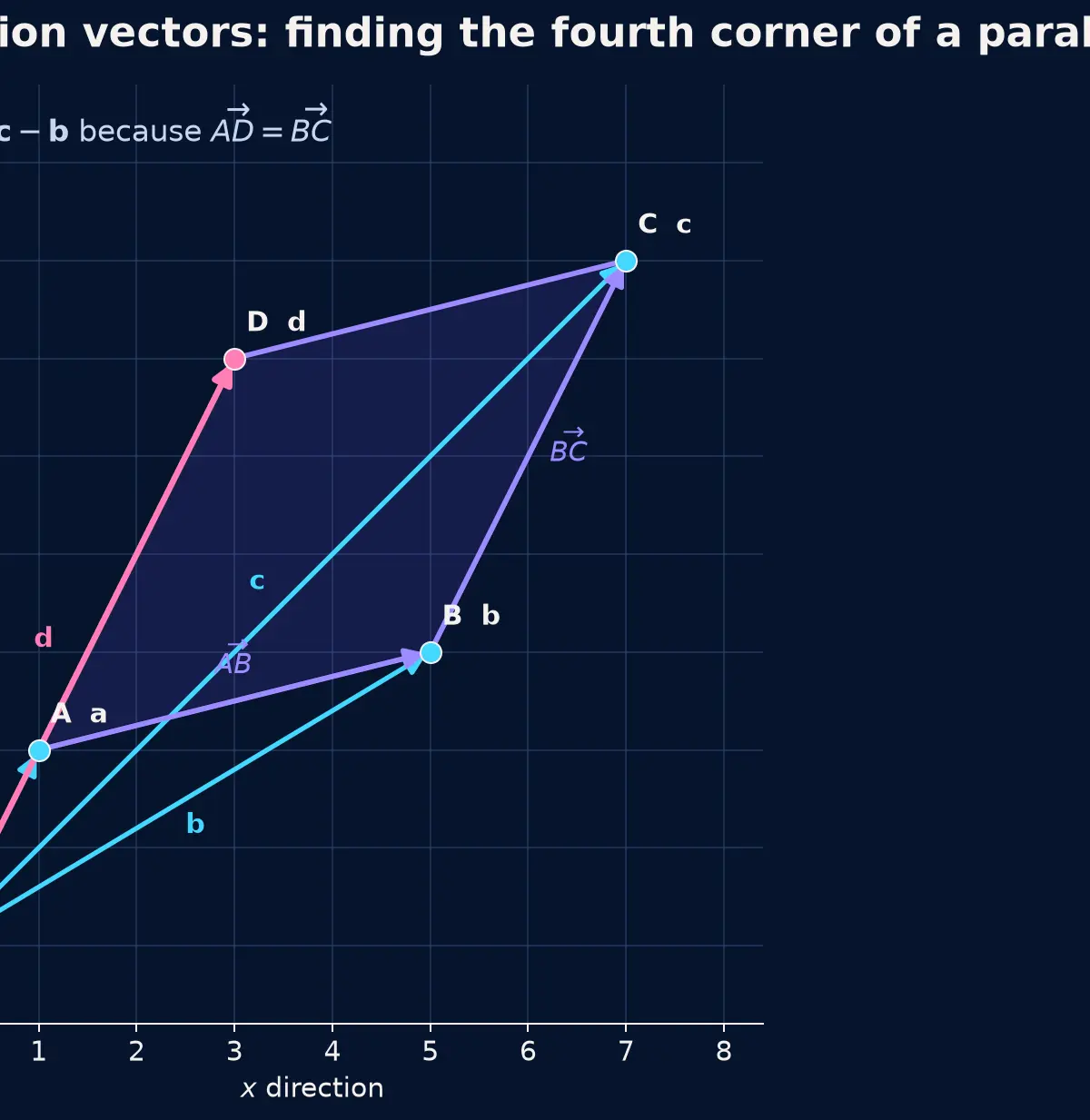
For a parallelogram (ABCD) with consecutive vertices, opposite sides are equal and parallel, so (\overrightarrow{AD}=\overrightarrow{BC}). If the known position vectors are (\mathbf{a}), (\mathbf{b}) and (\mathbf{c}), then
[\mathbf{d}-\mathbf{a}=\mathbf{c}-\mathbf{b}\quad\Rightarrow\quad \mathbf{d}=\mathbf{a}+\mathbf{c}-\mathbf{b}.]
That single line is the type of relationship Edexcel expects candidates to construct rather than guess.
Concept 3: Magnitude, direction and unit vectors
The magnitude of (\mathbf{a}=x\mathbf{i}+y\mathbf{j}+z\mathbf{k}) is
[|\mathbf{a}|=\sqrt{x^2+y^2+z^2}.]
In two dimensions, omit the (z)-component. A unit vector has length 1. The unit vector in the direction of (\mathbf{a}) is
[\frac{\mathbf{a}}{|\mathbf{a}|}.]
This is useful when a question gives a direction but asks for a vector of a different magnitude. For example, the vector of magnitude 10 in the direction (3\mathbf{i}+4\mathbf{j}) is (10\times\frac{3\mathbf{i}+4\mathbf{j}}{5}=6\mathbf{i}+8\mathbf{j}). Examiner commentary: credit is given for finding the unit vector first because it proves the candidate has separated direction from size.
Concept 4: Vector addition and scalar multiplication have geometric meaning
Vector addition follows the triangle law or parallelogram law. Algebraically, components are added. Geometrically, placing the tail of one vector at the head of another shows the combined displacement. Scalar multiplication changes length, and a negative scalar reverses direction. If (\mathbf{p}=\lambda\mathbf{q}), the two vectors are parallel. Candidates should state this explicitly when proving lines are parallel or when showing three points are collinear.
For points on a line segment, ratios are often tested. If (P) lies on (AB), write
[\mathbf{p}=\mathbf{a}+\lambda(\mathbf{b}-\mathbf{a}).]
When (0<\lambda<1), (P) is between (A) and (B). When (\lambda>1) or (\lambda<0), it lies on an extension. This form is powerful because it works in both 2D and 3D, and it makes the direction of travel clear.
Concept 5: Forces are vectors, so resolve before you sum
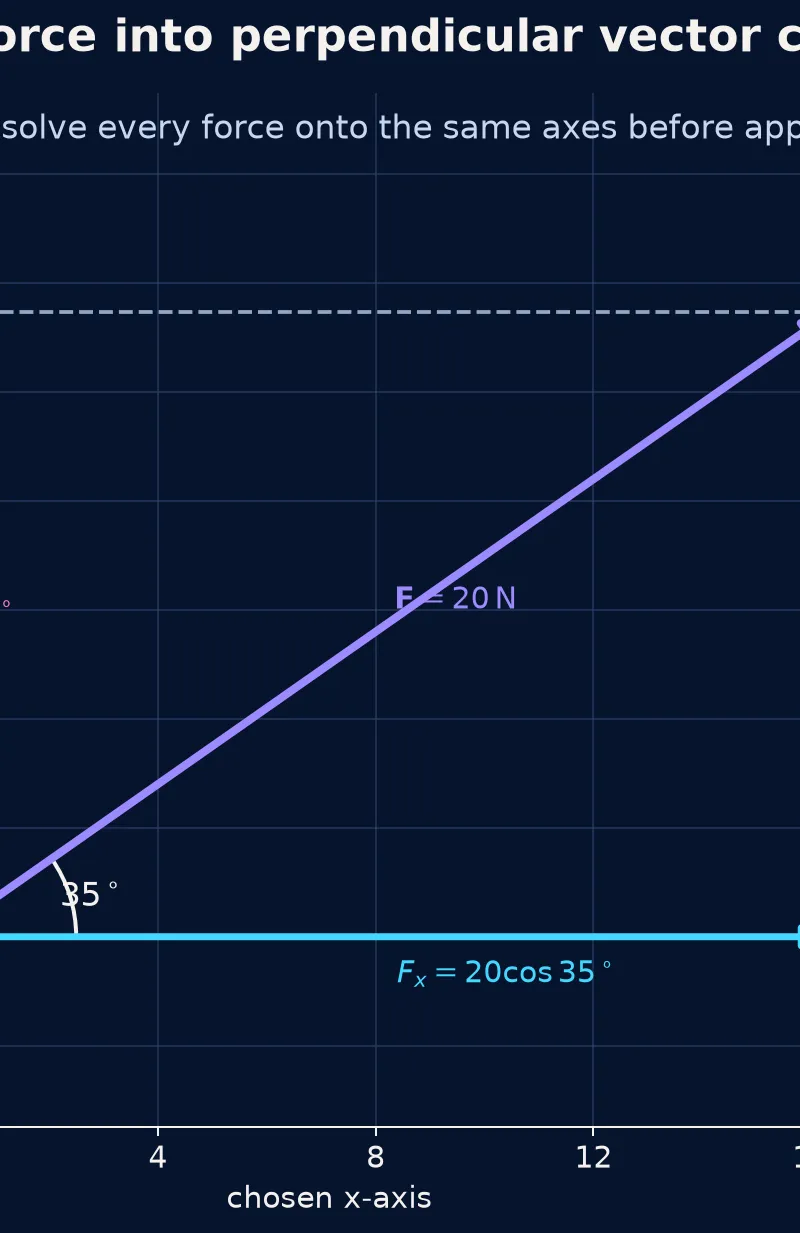
In mechanics contexts, force is a vector measured in newtons. Newton's second law is (\mathbf{F}=m\mathbf{a}), so the resultant force and acceleration must point in the same direction. Edexcel may give forces directly as (\mathbf{i})-(\mathbf{j}) vectors, or may require candidates to resolve forces into perpendicular components. The essential rule is:choose axes once, resolve every force onto those axes, then sum components.
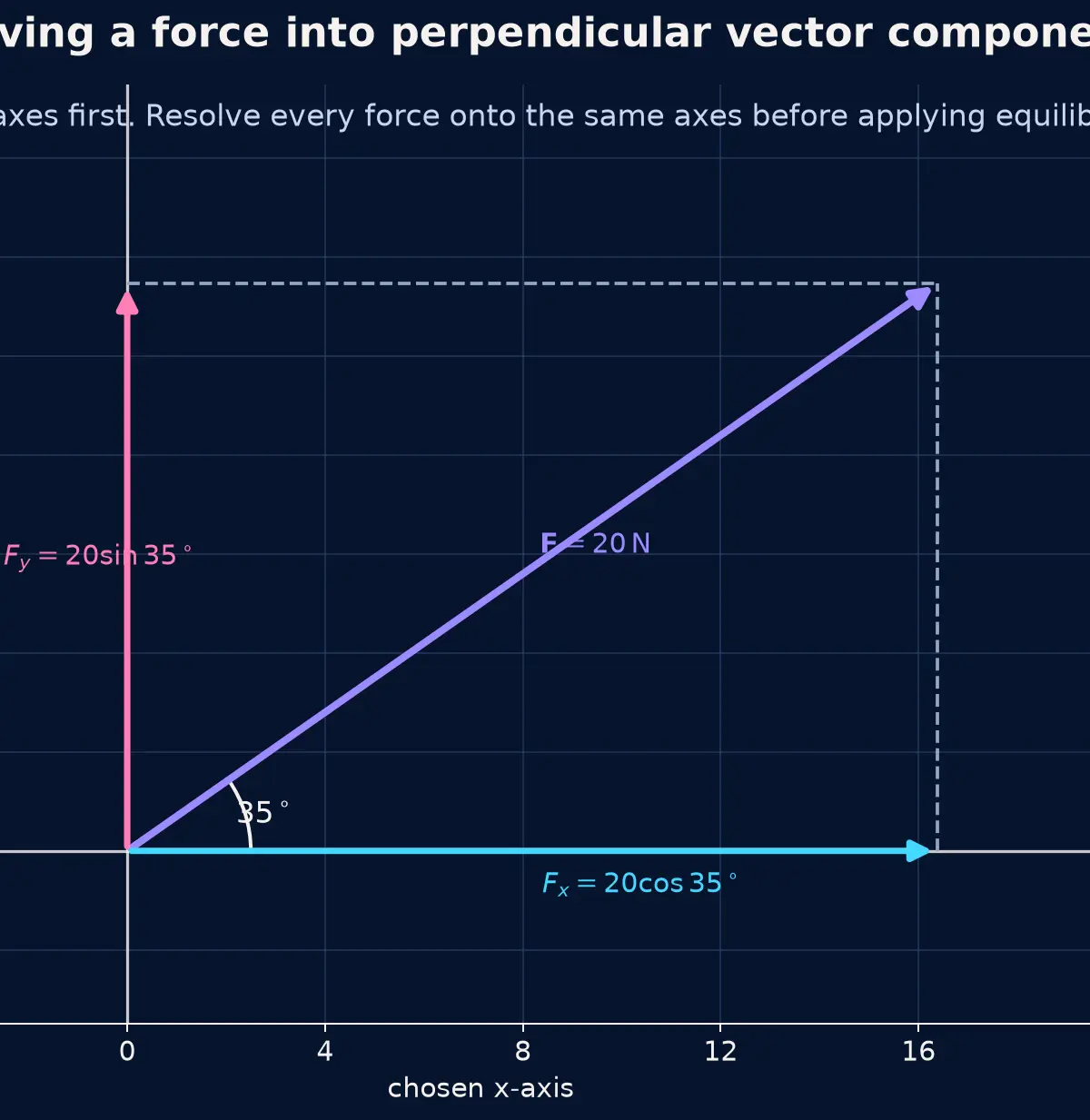
For a force (F) acting at angle (\theta) above the positive horizontal, the horizontal component is (F\cos\theta) and the vertical component is (F\sin\theta). If the angle is measured from the vertical, those swap. Marks are awarded for resolving relative to the angle actually shown, not for memorising a fixed sine or cosine pattern.
Concept 6: Vectors link pure maths and kinematics
In Paper 3, vector kinematics extends constant-acceleration formulae into two dimensions. If (\mathbf{u}), (\mathbf{v}), (\mathbf{a}) and (\mathbf{r}) are vectors, then equations such as (\mathbf{v}=\mathbf{u}+\mathbf{a}t) and (\mathbf{r}=\mathbf{u}t+\frac12\mathbf{a}t^2) are applied component by component. With calculus, differentiate position to get velocity and differentiate velocity to get acceleration. Integrate acceleration to get velocity, remembering the constant vector of integration. Forgetting that constant is a frequent loss of a method mark.
Concept 7: Equality, direction and checking are mathematical evidence
In vector questions, a line of algebra should say what it means. Suppose you obtain (\overrightarrow{AB}=2\overrightarrow{BC}). That equation establishes three useful facts: the vectors are parallel, they point in the same direction because the scalar is positive, and the length of (AB) is twice the length of (BC). Because both displacement vectors meet at (B), the points lie on one straight line. If the scalar were negative, the vectors would still be parallel but would point in opposite directions. That distinction matters when a question asks about a segment, a ray or an extension of a line.
Candidates should routinely perform a sense check. In a geometry question, does the position of the calculated point fit the sketch? Does a supposed fourth vertex make opposite sides equal? In a force question, does a negative component simply mean the force acts opposite to the chosen positive axis? A negative answer is often physically meaningful. Do not change it to positive merely because a force magnitude is positive. The sign belongs to the component and communicates direction.
Exact arithmetic is normally best until the final line. Keep expressions such as (25\cos30^\circ), (3\sqrt2) and (\sqrt{13}) rather than rounding early. Premature rounding can move a later answer outside the accepted accuracy range. Where an answer is a vector, state both the vector and any requested magnitude or direction, with units in mechanics. A position vector has no physical unit in a pure geometry setting unless the question defines one; a force component must be in N and an acceleration component must be in (\mathrm{m,s^{-2}}).
Formula booklet and assessment choices
Pearson provides the Mathematical Formulae and Statistical Tables booklet in the assessment. It supplies the constant-acceleration equations, while (F=ma) and (W=mg) are standard mechanics relationships candidates must recognise and apply. The booklet is a resource, not a substitute for modelling. It will not tell you whether to subtract (\mathbf{a}) from (\mathbf{b}), which sides of a parallelogram to equate, or which components of an angled force should be negative. These are the decisions that distinguish a complete response from a formula substitution.
Topic 10.5 may be assessed in Pure Mathematics through position vectors and shapes, while the linked vector contexts of velocity, displacement, kinematics and forces appear in Paper 3 Mechanics. The mathematical idea is identical: decompose a situation into perpendicular components, preserve direction, then recombine through vector addition. Once candidates see that link, a force diagram becomes a vector geometry diagram with units attached.
This transfer of method is exactly what synoptic examination questions reward most clearly.
Mathematical Relationships
The relationships candidates need most often are: (\overrightarrow{AB}=\mathbf{b}-\mathbf{a}), (|\mathbf{a}|=\sqrt{x^2+y^2+z^2}), the unit vector (\mathbf{a}/|\mathbf{a}|), parallel-vector condition (\mathbf{p}=\lambda\mathbf{q}), resultant force (\sum\mathbf{F}=m\mathbf{a}), weight (W=mg), and component resolution using sine and cosine. The important exam skill is choosing the right relationship from the wording. If a question says show that points are collinear, aim to show two displacement vectors are scalar multiples. If it says find the force, resolve and use (F=ma). If it says find the fourth vertex, construct an equal-side relationship such as (\overrightarrow{AD}=\overrightarrow{BC}).
Practical Applications
Vectors model real movement. A plane's velocity can be split into east and north components. A force on a slope can be resolved parallel and perpendicular to the plane. A robot's position can be updated by adding displacement vectors. These contexts matter in Edexcel because modelling questions award marks for translating words into mathematics before doing any calculation. Candidates who draw a small diagram, label axes, and write one vector equation usually make fewer sign errors and gain method marks even if an arithmetic slip follows.
Examiner's Core Routine
Use the four-step routine DARS: Diagram, Axes, Relationship, Substitute. First draw the geometry or force diagram. Second choose axes or notation. Third write the vector relationship before calculating. Fourth substitute components and simplify. This routine mirrors the mark scheme: method marks reward the relationship, accuracy marks reward the calculation, and communication marks reward notation and conclusion.
Visual Resources
2 diagrams and illustrations
Interactive Diagrams
2 interactive diagrams to visualise key concepts
Conceptual Flow Outline
DARS routine for setting up vector solutions before calculating.
Conceptual Flow Outline
Mechanics decision flow for vector force questions.
Worked Examples
4 worked examples — open one to explore the question and available guidance.
Practice Questions
Try the question, then reveal an answer plan or example response
Points A and B have position vectors 3i - 2j and -i + 4j. Calculate vector AB and the distance AB. (3 marks)
Hint: Use arrival minus departure before finding the magnitude.
A, B and C have position vectors a = i + 2j, b = 6i + 3j and c = 8i + 9j. ABCD is a parallelogram. Find d. (4 marks)
Hint: For consecutive vertices, use d = a + c - b.
A particle has position vector r = (2t^2 - 3t)i + (t^3 - 4)j. Find its velocity and acceleration at t = 2. (4 marks)
Hint: Differentiate position once for velocity and twice for acceleration.
Forces 10i + 4j, -3i + 8j and Fi + Gj act on a particle in equilibrium. Determine F and G. (4 marks)
Hint: Equilibrium means the total i component and total j component are both zero.
A point P has position vector p = a + lambda(b - a), where a = 2i - j + k and b = 8i + 5j - 2k. Given that P has x-coordinate 11, determine lambda and state whether P lies on the segment AB. (5 marks)
Hint: Use only the x-component first, then interpret lambda.
Exam technique
How to turn what you know into marks
How to approach the question
Use DARS: draw a diagram, choose axes or notation, write the vector relationship, then substitute components. In pure questions, identify whether the problem is asking for a displacement, a point on a line, a scalar multiple, or a missing vertex. In mechanics, resolve forces before summing them.
How to structure your answer
For 3-4 marks, show the key relationship and the component calculation. For 5-6 marks, include a diagram or stated axis choice, separate component equations, and a final interpretation with units where relevant. For 'show that' questions, write a complete conclusion rather than relying on a numerical coincidence.
Timing
Pearson Edexcel A-Level Paper 3 is 100 marks in 120 minutes, so use about 1.2 minutes per mark. A 5-mark vector question should take about 6 minutes, including a quick diagram.
Common pitfalls
- Confusing position vectors with displacement vectors. Avoid this by using arrival minus departure.
- Resolving with sine and cosine the wrong way round. Avoid this by checking which axis the angle is measured from.
- Adding vector magnitudes instead of components. Always sum i, j and k components separately.
- Forgetting vector constants of integration in kinematics. Use a constant vector, not just a scalar c.
- Losing notation marks by mixing column vectors and i, j, k notation without clarity.
What the command words want
- Hence
- Use the previous result. Candidates lose marks when they restart with an unrelated method.
- Prove
- Use a general vector argument or scalar-multiple relationship. A diagram alone is not proof.
- Determine
- Calculate and then make a decision, such as whether a point lies on a segment or whether equilibrium is possible.
- Show that
- The result is supplied, so the reasoning must be watertight. Work from known facts to the required result.
- Find/Calculate
- Show the formula or vector relationship, then substitute components. Do not give only a final answer.
Watch or listen (optional)
Test your understanding of Use vectors to solve problems in pure mathematics and in context (including forces)
Active recall beats re-reading. Take an instant quiz now to test what you’ve learned and lock it into long-term memory.
7 days Premium · Then the free plan continues · No card, no charge