Pearson Edexcel · GCSE · Mathematics
Course version: 1MA1 · Version from Mar 2026
Algebra - Graphs: identify and interpret roots, intercepts, turning points of quadratic functions graphically; deduce roots algebraically and turning points by completing the square (Higher tier)
Turn a quadratic from a mysterious curve into a set of marks you know how to earn. Learn to read roots and intercepts, then use completing the square to find exact turning points and explain whether real roots exist.
- 12 min read
- 4 worked examples
- 7 practice questions
- 10 key terms
Try the lesson
The start of the Algebra - Graphs: identify and interpret roots, intercepts, turning points of quadratic functions graphically; deduce roots algebraically and turning points by completing the square (Higher tier) lesson, made from checked teaching notes for this specification point.
Have a go first
The graph of y = x² + 8x + 7 crosses the x-axis at two points. Work out the coordinates of these two points.
There is more to this lesson
The full lesson goes on to check your understanding and help you earn the marks. Create a free account to carry on, with your progress saved.
7 days Premium · Then the free plan continues · No card, no charge
Check what you remember
Read the wording for your board, then hide it and explain Quadratic function in your own words. Rough notes are fine. This is a self-check, with no mark or grade.
Reference: Pearson Edexcel
A function f(x) = ax² + bx + c with a ≠ 0; its highest power of x is 2.
Study Notes

Overview
Quadratic graphs are a reliable place to earn marks because the algebra, graph and language all describe the same shape. A quadratic function has the form f(x) = ax² + bx + c, where a ≠ 0. Its graph is a parabola: it has a line of symmetry and one turning point, which is a minimum when a > 0 and a maximum when a < 0. You need to distinguish carefully between a root, which is an x-value that makes f(x) = 0, and an x-intercept, which is the coordinate where the graph crosses or touches the x-axis. Completing the square is Higher-only in the Edexcel specification, and is particularly useful for revealing the turning point and deciding how many real roots are possible. Reading a quadratic graph, including its intercepts and approximate solutions, is common to both tiers. In Higher questions, choose a method that matches the command word, show enough algebra for method marks, and use a smooth, accurately scaled sketch to check that your answer makes sense.
Key Concepts
The language behind the graph
A quadratic is f(x) = ax² + bx + c, with a ≠ 0. The coefficient a determines whether the parabola opens upwards or downwards. The value c is found by putting x = 0, so it gives the y-intercept (0, c). This is a coordinate, not merely the number c.
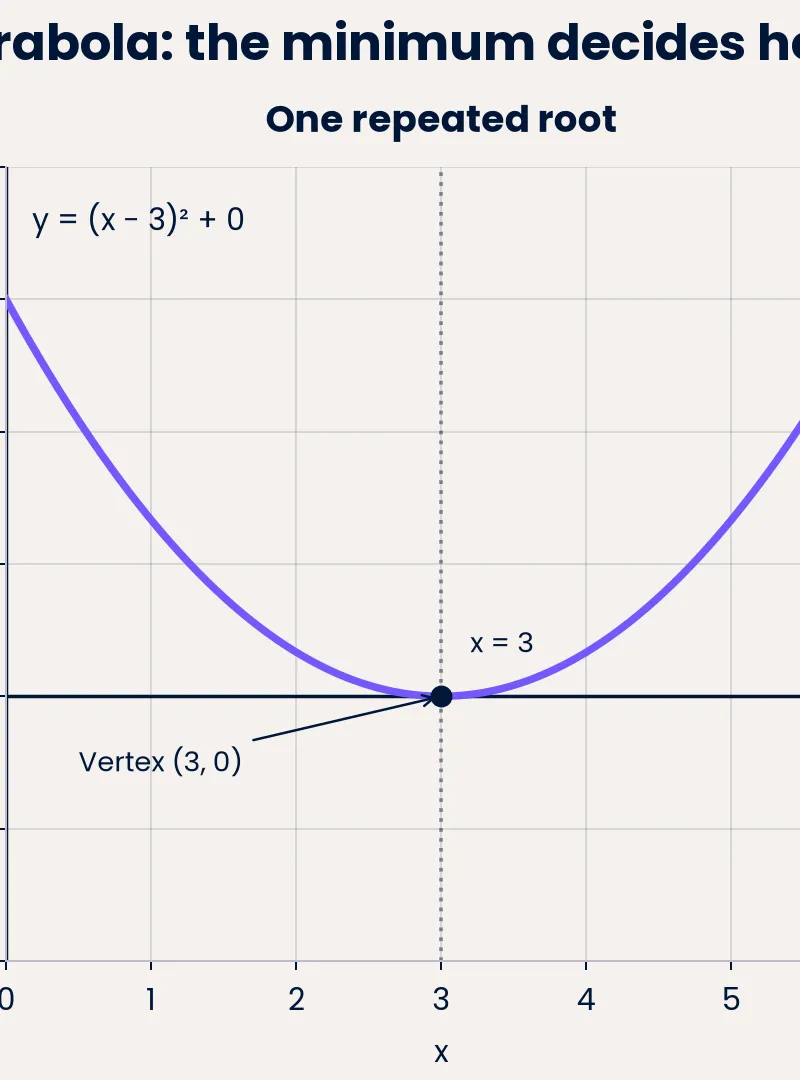
A root or solution is an x-value. If the roots are −1 and 5, write x = −1 and x = 5. The corresponding x-intercepts are (−1, 0) and (5, 0). If a graph just touches the x-axis at (3, 0), it has one distinct real root, x = 3, often called a repeated root. The turning point, also called the vertex, is a coordinate and lies on the line of symmetry. State it as, for example, (3, 2), not just 3 or 2.
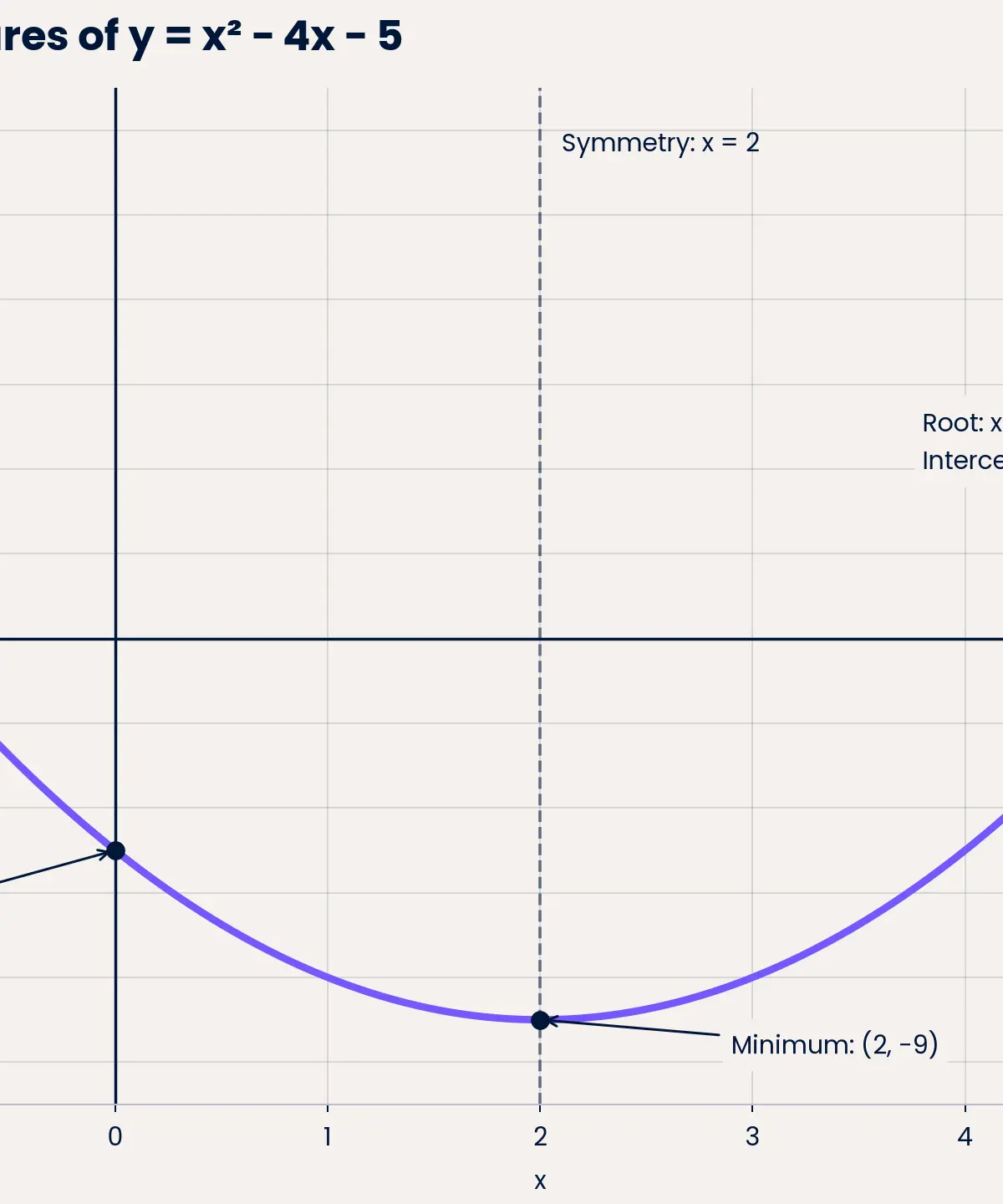
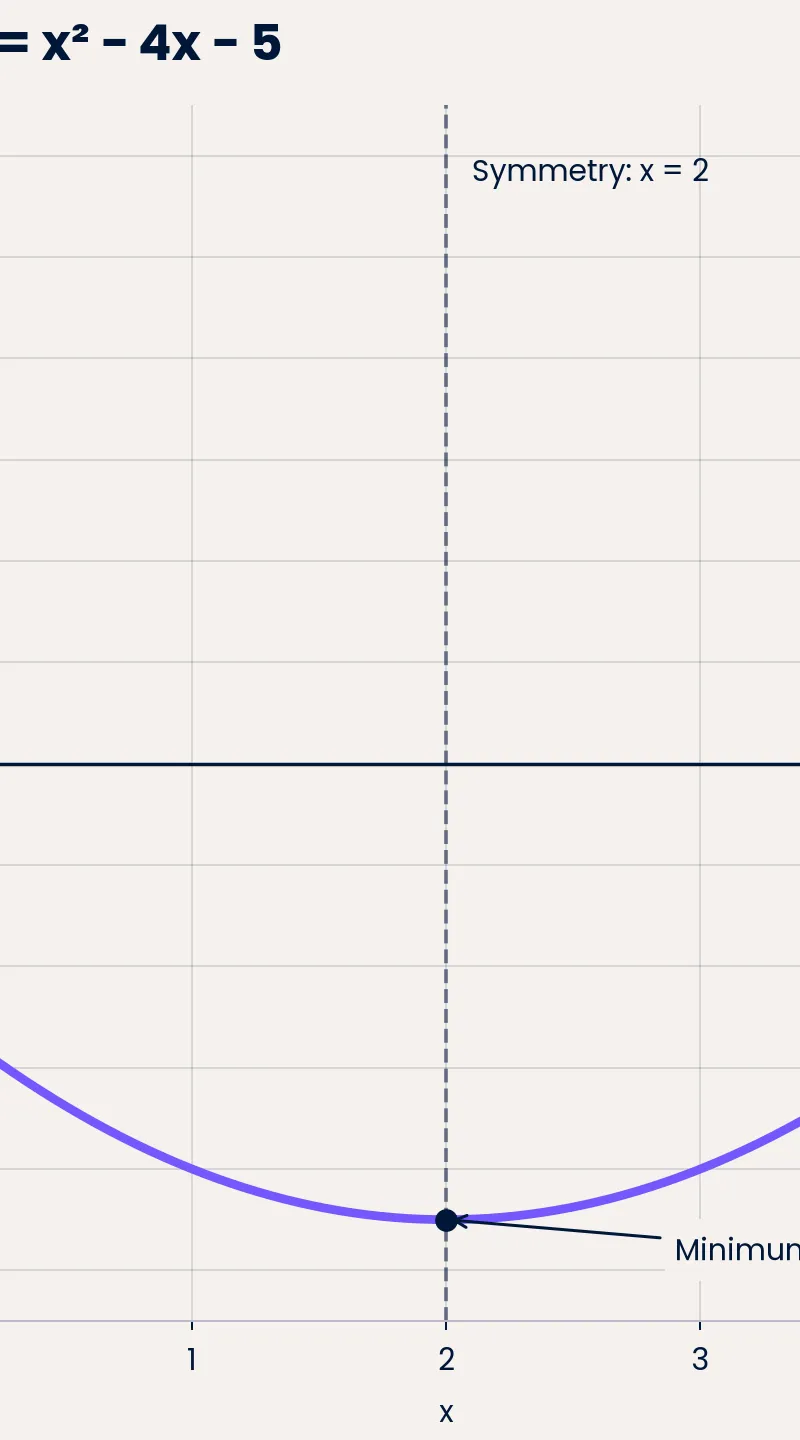
The expression x² − 4x − 5 factors as (x − 5)(x + 1). Therefore its roots are 5 and −1, its x-intercepts are (5, 0) and (−1, 0), and its y-intercept is (0, −5). Its turning point is (2, −9). Notice how each answer has the right type: x-values for roots, coordinates for intercepts and the vertex.
Formula focus
Use this small set fluently. Must memorise here means understand and reproduce the relation rather than searching for a new rule in the exam.
- Must memorise, standard form: f(x) = ax² + bx + c, a ≠ 0.
- Must memorise, vertex form: f(x) = a(x − h)² + k. The turning point is (h, k), and the symmetry line is x = h.
- Must memorise, equivalent sign form: f(x) = a(x + p)² + q. Here the turning point is (−p, q), not (p, q).
- Must memorise, completing-square identity: ax² + bx + c = a[x + b/(2a)]² + c − b²/(4a). Hence h = −b/(2a).
- Must memorise, roots from vertex form: for a(x + p)² + q = 0, x = −p ± √(−q/a), when the square root is real. This works whether a is positive or negative.
- Given on the Higher formula sheet, quadratic formula: x = [−b ± √(b² − 4ac)]/(2a). Identify a, b and c correctly and substitute negative values using brackets.
- Optional check, must memorise if used: the discriminant D = b² − 4ac. It is not printed as a separate rule, although it appears inside the quadratic formula.
- Must memorise, square expansion: (x + p)² = x² + 2px + p², so x² + bx + c = (x + b/2)² + c − (b/2)².
- Must memorise, intercept rules: roots satisfy f(x) = 0; the y-intercept is (0, f(0)) = (0, c).
- Must memorise, zero-product rule: if UV = 0, then U = 0 or V = 0. Here U and V are the factors.
- Must memorise, symmetry from real roots: if the roots are r₁ and r₂, the symmetry line is x = (r₁ + r₂)/2. Substitute this x-value into the function to obtain the turning-point y-coordinate.
The current Higher exam aid includes the quadratic formula, but not a turning-point formula or a completing-the-square identity 3. Completing the square therefore needs confident algebra, not a formula-sheet lookup.
Completing the square, step by step
For x² − 6x + 11, halve −6 to obtain −3. The bracket (x − 3)² expands to x² − 6x + 9, so you must subtract the extra 9 before retaining the original constant:
x² − 6x + 11 = (x − 3)² − 9 + 11 = (x − 3)² + 2.
Because (x − 3)² ≥ 0, the smallest possible value is 2. It occurs when x − 3 = 0, so x = 3 and the minimum point is (3, 2). The function never reaches zero, so this quadratic has no real roots. This non-negative-square argument is stronger than simply saying that the graph looks as if it misses the axis.
For a negative leading coefficient, preserve the minus sign outside the square:
−x² + 6x − 5 = −[(x − 3)² − 9] − 5 = −(x − 3)² + 4.
The square is non-negative, so its negative is at most zero. The maximum is therefore 4, at (3, 4). The graph opens downwards.
If the leading coefficient is not 1, factor it from the quadratic and linear terms before completing the square:
2x² + 8x + 3 = 2(x² + 4x) + 3 = 2[(x + 2)² − 4] + 3 = 2(x + 2)² − 5.
Do not accidentally multiply the constant 3 by 2. However, the correction −4 inside the bracket must be multiplied by 2. Fractions are perfectly valid: x² + 3x + 1 = (x + 3/2)² − 5/4. Its turning point is (−3/2, −5/4). Keep fractions exact unless the question asks for a decimal approximation.
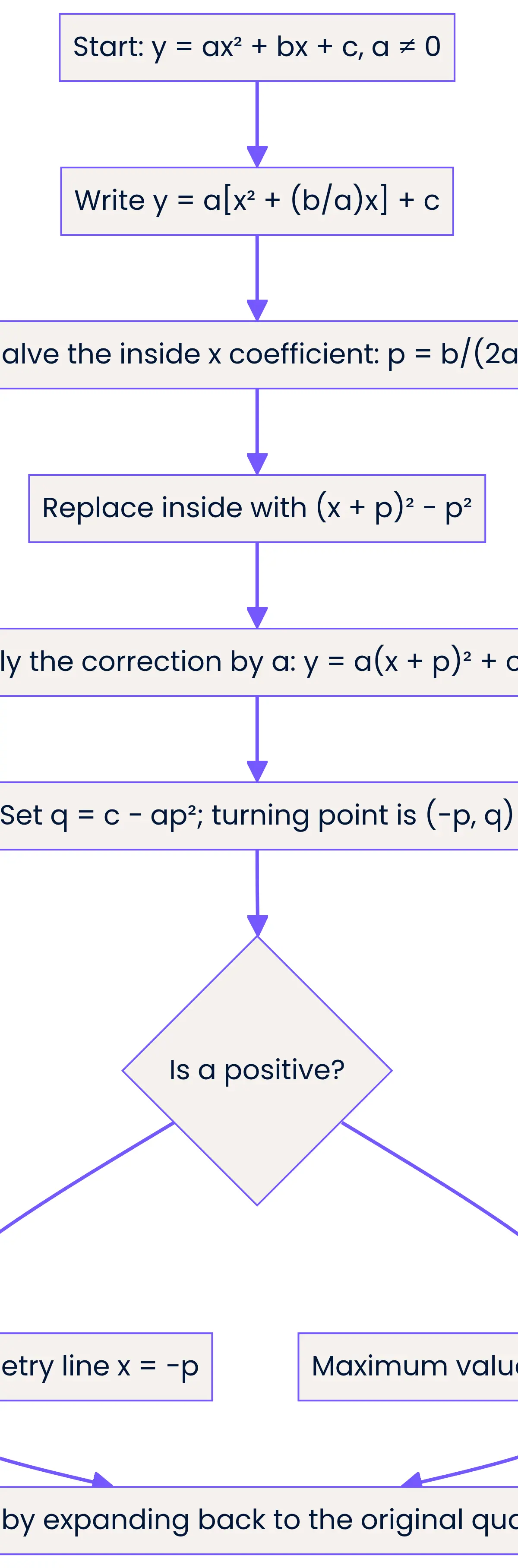
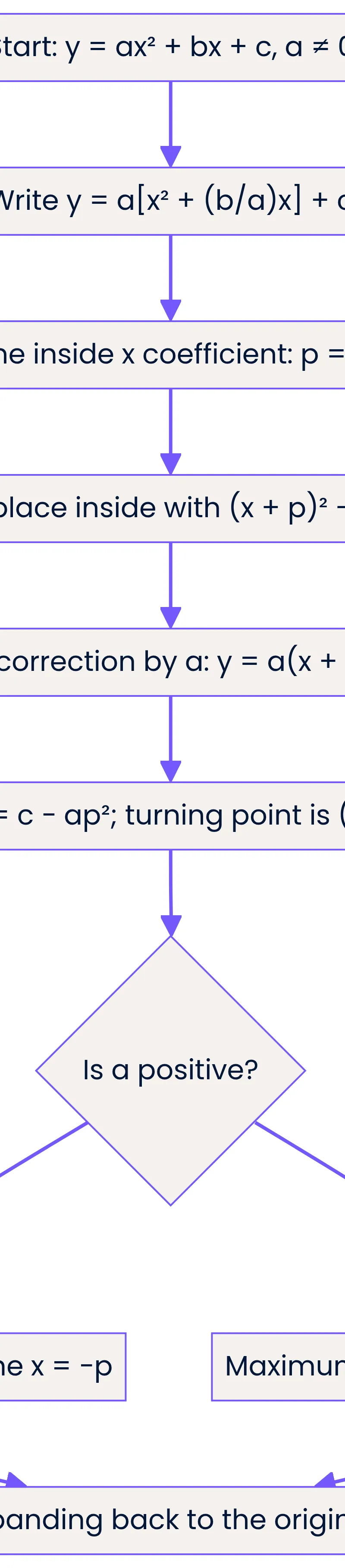
A secure routine is: factor out a from the x-squared and x terms if needed; halve the coefficient of x inside the bracket; square that half; balance the adjustment outside the bracket; then read the vertex. Expand your final form for an efficient check, particularly when signs or fractions are involved. Edexcel teaching guidance expects Higher students to complete the square for any ax² + bx + c, does not expect calculus, and stresses using the specified method 2.
Mathematical/Scientific Relationships
Roots, turning point and number of intersections
In vertex form a(x + p)² + q, setting the expression equal to zero produces (x + p)² = −q/a. The sign of −q/a tells you the number of distinct real roots: a negative value gives none, zero gives one repeated root, and a positive value gives two. This test works for upward and downward parabolas because it comes directly from the requirement that a real square cannot be negative.
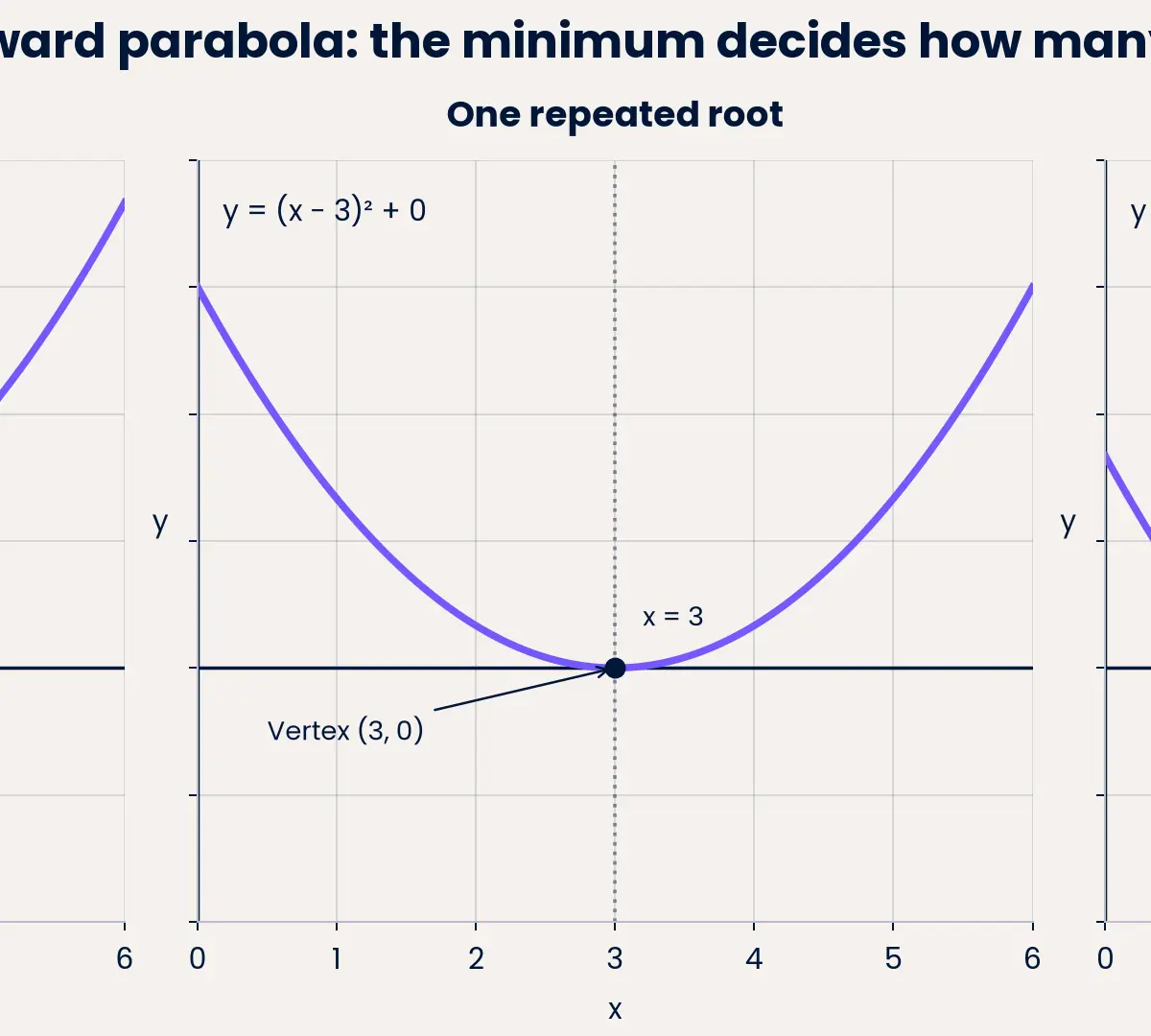
For example, (x − 3)² + 2 = 0 has no real roots; (x − 3)² = 0 has one distinct root; and (x − 3)² − 4 = 0 has roots 1 and 5. On a sketch, translate those results into zero x-axis intersections, one tangent contact, or two crossings. If using the optional discriminant, the matching test is D < 0, D = 0, or D > 0, respectively. Treat it as a check, not a replacement for a requested completing-the-square method.
When asked to solve f(x) = d, do not automatically find x-intercepts. You are finding where the parabola meets the horizontal line y = d. Algebraically, rearrange to f(x) − d = 0 and solve the new quadratic. Graphically, draw or use the line y = d and read the x-coordinates of its intersections. This connects factorising, completing the square and the quadratic formula to graph interpretation.
A sketch communicates key features, so label the vertex, requested intercepts, symmetry line and opening direction. A plot needs calculated points at the stated scale, then a smooth curve through them. Never join the points of a quadratic with straight segments. Use the actual axis scale, including negative x-values, and estimate roots sensibly between grid lines. Algebra gives exact values such as −3/2; a graph generally gives approximations, so match the precision requested.
These links support recognising and sketching a quadratic, transformations of graphs, solving quadratics, simultaneous equations involving a line and a quadratic, and quadratic inequalities. For an inequality, mark the roots, decide whether the curve is above or below the relevant axis or line, and use the intervals required by the inequality sign. The specification identifies A11 as this topic, with completing the square Higher-only. Linked content includes A12 recognising and sketching quadratics, A13 translations, A18 solving quadratics, A19 simultaneous equations and A22 quadratic inequalities 1.
Choosing and showing a method
Factorise when factors are clear and the question asks for roots. Complete the square when the turning point, maximum or minimum, or proof of no real roots matters. Use the quadratic formula for awkward roots, remembering that it is supplied. If the command says solve by completing the square, another correct method may not earn the intended method marks. Write the rearranged equation, substitution or completed-square line before the final answers.
Official marking can reward a correct method and accuracy separately. In June 2022 Higher Paper 1, Question 19 includes an M1 for a method solving a rearranged quadratic using the formula or completing the square; Question 6(c) awards method and accuracy for graph roots 4. Follow-through is only available where that particular question’s mark scheme permits it. Do not assume an earlier numerical slip will always be carried forward.
Practical Applications
A quadratic model is useful only with a stated meaning and domain. Suppose a ball’s height is modelled by h(t) = −5(t − 2)² + 20, where t is in seconds and h is in metres, for 0 ≤ t ≤ 4. The vertex tells you the maximum height is 20 m at 2 s. Solving h(t) = 0 gives t = 0 or 4, representing launch and landing in this model. Do not invent extra units or extend the model beyond its meaningful interval. Convert seconds to minutes only when needed, using 60 seconds = 1 minute.
For a rectangle with fixed perimeter 20 units, let one side be x. The other is 10 − x, giving A = x(10 − x) = −(x − 5)² + 25, valid for 0 < x < 10. The negative-square form shows a maximum area of 25 units² when x = 5, so the rectangle is a square. Here the vertex answers an optimisation question directly, while the domain rejects impossible side lengths. There is no science-style required practical for this mathematics topic.
Podcast and active recall
The ten-minute podcast contains an introduction, five minutes of core concepts, two minutes of exam tips, a one-minute recall quiz and a final recap. Use it actively rather than as background noise. Cover the notes and answer: What is the difference between a root and an x-intercept? How do I read the vertex from a(x + p)² + q? Why can (x − 3)² + 2 have no real root? Which horizontal line represents f(x) = d? Then uncover and correct your wording.
Try this graph-skills recall from memory: write a quadratic in vertex form, state the symmetry line, decide up or down from a, find the y-intercept, and predict zero, one or two roots before drawing. On another day, convert a new quadratic to completed-square form and expand it to check. A useful spaced-retrieval pattern is today, in a few days, then about a week later, using different examples each time. The purpose is to make methods easier to retrieve, not to promise marks automatically.
Before committing an answer read from a graph, make a quick visual check. Two roots should sit the same horizontal distance from the symmetry line, and the vertex should lie on that line. For an upward parabola, points close to the vertex should have lower y-values than points farther away on the same side. Count labelled increments rather than assuming every small square represents one unit. These checks help when a root is negative or your algebra and graph disagree.
Exam-ready finish
Edexcel GCSE Mathematics papers are 90 minutes and 80 marks each 1. A sensible planning guide is roughly one minute per mark, while the paper average is 90/80 = 1.125 minutes per mark. This is a pacing aid, not an official rule. Underline command words such as sketch, plot, solve, show that, hence and by completing the square. For algebra, check the final roots in the original quadratic where time allows.
The worked examples and suggested practice allocations are original teaching material, not official exam mark schemes. Use official papers and their mark schemes to see the precise evidence required in a particular question.
References
Visual Resources
3 diagrams and illustrations
Interactive Diagrams
2 interactive diagrams to visualise key concepts
Conceptual Flow Outline
Completing the square for any non-zero leading coefficient.
Conceptual Flow Outline
Count real roots using an isolated square. This sign test works for positive and negative a.
Worked Examples
4 worked examples — open one to explore the question and available guidance.
Practice Questions
Try the question, then reveal an answer plan or example response
The curve y = x² + 2x − 8 meets both coordinate axes. Find the coordinates of all its intercepts.
Hint: For x-intercepts set y = 0 and factorise. For the y-intercept set x = 0.
For y = (x − 1)² − 9, (a) state the turning point, (b) find the x-intercepts and (c) find the y-intercept.
Hint: Set the bracket to zero for the vertex. Set y = 0 for roots.
Use completing the square to solve x² − 3x + 1 = 0. Give your answers exactly.
Hint: Half of −3 is −3/2. Add and subtract its square.
For y = 2x² − 4x − 6, (a) write y in the form 2(x − a)² + b, (b) state the turning point and (c) find the x-intercepts.
Hint: Factor out 2 from the first two terms before completing the square.
For y = 4x² + 12x + 9, (a) show that y is the square of a linear expression, (b) hence state the x-coordinate where it meets the x-axis and (c) explain why it touches rather than crosses.
Hint: Expand (2x + 3)² to demonstrate the identity.
For real p, x² + (p − 4)x + p = 0 has a repeated root. Find all possible values of p and state the associated repeated root for each.
Hint: A repeated root requires b² − 4ac = 0.
For y = (1/2)x² − 3x + 4, (a) write y in the form (1/2)(x − a)² + b, (b) state the minimum point and (c) find the x-intercepts.
Hint: Factor out 1/2 from the quadratic and linear terms.
Exam technique
How to turn what you know into marks
How to approach the question
Identify the requested answer type: roots are x-values; intercepts and turning points are coordinates. Underline the command word and any required method. Check graph scales for graphical readings. Set y = 0 for roots and x = 0 for the y-intercept. Choose factorisation for easy roots and completing the square for a vertex, bound or required method. Practice difficulty labelled foundation means accessible difficulty within this Higher guide, not that every such question belongs to the Foundation specification.
How to structure your answer
For 1 mark, state the requested value, coordinate or equation. For 2–3 marks, show the key algebraic setup and the requested answer. For 4–6 marks, show a logical chain: factor the leading coefficient, create and balance the square, derive the requested features and explain when asked. Proposed allocations in this guide are not official Pearson schemes. In official schemes, M denotes method credit, A accuracy, B unconditional accuracy and C communication; the individual question determines which apply.
Timing
Each paper is 90 minutes for 80 marks, an overall average of 1.125 minutes per mark. Use roughly 1 minute per mark as a working target and preserve checking time: about 4 minutes for 4 marks or 6 minutes for 6 marks. This is advice, not an official Edexcel question timing.
Common pitfalls
- Leaving the constant unchanged: (x − 3)² adds 9, so subtract 9 before retaining the original constant.
- Reading (x − 3)² + 2 as vertex (−3, 2): solve the bracket equals zero, giving x = 3.
- Halving the original b when a ≠ 1: factor a first and halve b/a inside.
- Forgetting the outside coefficient: 2[(x + 2)² − 4] + 3 gives outside constant −8 + 3 = −5.
- Writing only one root after square-rooting: use both ± branches unless the square is zero.
- Assuming every parabola crosses the axis: check the sign of the isolated square or compare the correct bound with zero.
- Using graph estimates when exact algebra is requested, or claiming a truncated graph proves no real roots.
- Assuming a later mark is automatic after an earlier error: follow-through is question-specific.
- Confusing a minimum value, such as 2, with the minimum point (3, 2).
What the command words want
- Plot
- Calculate and accurately plot points on the stated scale, then draw a smooth curve.
- Hence
- Use the preceding result. A completed square should lead directly to the vertex, bound or roots.
- Solve
- Find all values satisfying the equation. Use exact form or the requested rounding and retain both square-root branches.
- Sketch
- Show the correct shape and label the requested features. A full coordinate grid is not normally required.
- Compare
- Compare specified features directly, such as both graphs opening upward but having different minimum values.
- Explain
- Provide a mathematical reason. For example: because (x − 3)² ≥ 0, y ≥ 2, so y cannot equal zero.
- Describe
- Use mathematical features such as opening direction, intercepts, vertex and symmetry. Include numerical details where required.
- Evaluate
- In mathematics this normally means work out the value of an expression, not discuss both sides of an argument.
- Calculate
- Show substitution or algebra and evaluate accurately. Include units only when the variables represent measured quantities.
- Show that
- Give convincing algebra establishing the stated result. Merely copying the provided answer does not demonstrate it.
- State/Give
- Give the requested x-value, coordinate pair, equation or number of roots without unnecessary explanation.
- By completing the square
- Demonstrate that method. Do not substitute a calculator result or another method for the requested algebra.
Watch or listen (optional)
Test your understanding of Algebra - Graphs: identify and interpret roots, intercepts, turning points of quadratic functions graphically; deduce roots algebraically and turning points by completing the square (Higher tier)
Active recall beats re-reading. Take an instant quiz now to test what you’ve learned and lock it into long-term memory.
7 days Premium · Then the free plan continues · No card, no charge