Pearson Edexcel · GCSE · Mathematics
Course version: 1MA1 · Version from Mar 2026
Algebra - Sequences: deduce expressions to calculate the nth term of linear and quadratic sequences (Higher tier)
Turn a list of numbers into a rule that jumps straight to any term. Master constant first and second differences, recover every part of a quadratic expression, and show the working that gives an examiner evidence to award credit.
- 12 min read
- 4 worked examples
- 6 practice questions
- 13 key terms
Try the lesson
The start of the Algebra - Sequences: deduce expressions to calculate the nth term of linear and quadratic sequences (Higher tier) lesson, made from checked teaching notes for this specification point.
Have a go first
A linear sequence begins 7, 11, 15, 19, ... Find an expression for the nth term of this sequence.
There is more to this lesson
The full lesson goes on to check your understanding and help you earn the marks. Create a free account to carry on, with your progress saved.
7 days Premium · Then the free plan continues · No card, no charge
Check what you remember
Read the wording for your board, then hide it and explain Sequence in your own words. Rough notes are fine. This is a self-check, with no mark or grade.
Reference: Pearson Edexcel
An ordered list of terms indexed by permitted positions.
Study Notes

Overview
A sequence is an ordered list of numbers. An nth-term expression is a shortcut from a term's position to its value, so you can calculate the 50th term without finding the previous 49. In this topic, you learn to deduce that expression from the terms you are given, rather than merely continue a pattern.
For Pearson Edexcel GCSE Mathematics 1MA1, specification A25, finding linear nth terms is assessed at Foundation and Higher tiers. Deducing quadratic nth terms is Higher-only. Foundation candidates can still recognise quadratic patterns and substitute into a supplied quadratic rule under A23 and A24. This distinction matters: recognising squares is not the same skill as constructing a quadratic expression. 1 2
Typical questions ask candidates to find an expression in n, calculate a distant term, decide whether a number belongs, or explain a growing diagram. These tasks connect directly to substitution, expanding brackets, equations and graphs. Pearson's teaching guidance includes two-mark linear nth-term parts and three-mark quadratic nth-term questions; longer questions may combine deduction with further reasoning. 2 The worked examples and practice schemes here are original Edexcel-style teaching material, not official past-paper mark schemes.
Key Concepts
1. Position is not value
Write the positions above the terms. Unless told otherwise, the first listed term has position n = 1, the second n = 2, and so on. For 7, 11, 15, 19, the third term has position 3 and value 15. In the notation u_n, the subscript identifies the position; u_n is the term's value.
A term-to-term rule tells you how to move onwards, such as 'add 4'. A position-to-term rule gives the value directly, such as u_n = 4n + 3. An answer of 'add 4' does not satisfy 'Find an expression for the nth term'. Credit for a requested expression requires an expression involving n, or an equivalent algebraic form.
Cover and recall: What do you substitute to find the 20th term: 20 or the value of the first term? Answer without rereading, then check: substitute n = 20.
2. Linear sequences: constant first differences
Subtract each term from the next, keeping the sign. For 7, 11, 15, 19, the differences are 4, 4, 4. The constant difference d becomes the coefficient of n. Begin with 4n, whose first four values are 4, 8, 12, 16. Every target term is 3 larger, so the rule is 4n + 3.
Why does this work? Increasing n by one increases dn by d, while an added constant stays unchanged. The constant shifts the starting value without changing the gap. In general, the rule is u_n = dn + (u_1 − d), equivalently u_1 + (n − 1)d. Remember the n − 1: reaching position n from position 1 requires n − 1 jumps.
The same method handles decreasing and fractional sequences. For 12, 9, 6, 3, the difference is −3, giving −3n + 15. For 1.5, 2, 2.5, 3, the difference is 0.5, giving 0.5n + 1. Never discard the sign or assume coefficients must be integers.
3. Quadratic sequences: constant second differences
A quadratic nth-term rule has the form u_n = an² + bn + c, with a ≠ 0. Its first differences change, but its second differences are constant. For 3, 8, 15, 24, 35, the first differences are 5, 7, 9, 11; the second differences are 2, 2, 2. The squared coefficient is half the second difference, so a = 1.
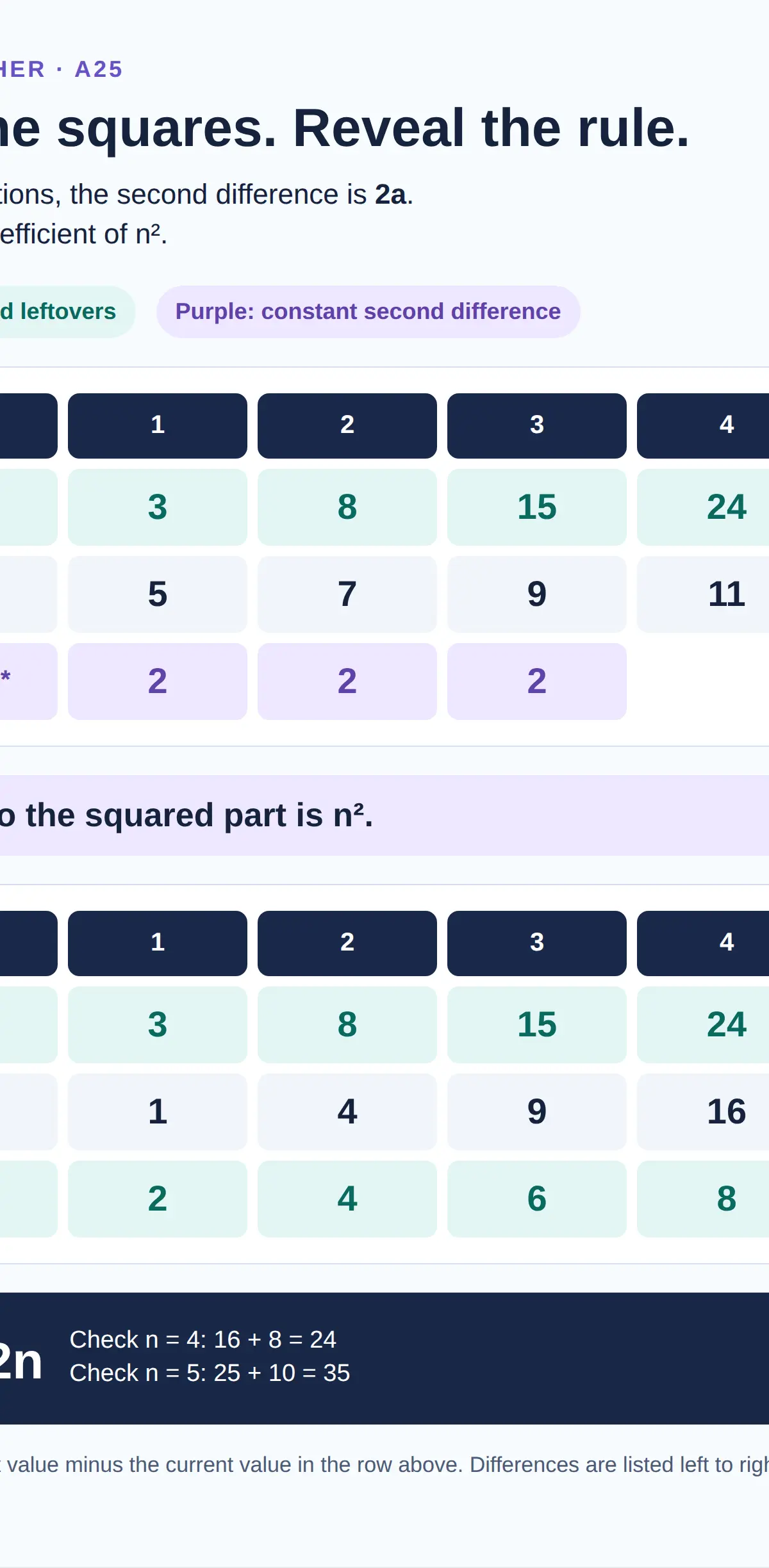
Use all available differences, not one convenient pair. Three terms give only one second difference, so by themselves they cannot demonstrate that several second differences agree. In an examination, follow any statement that the sequence is quadratic. A finite list does not logically determine every later term without an assumed rule; the differences identify the intended linear or quadratic model.
A constant zero second difference corresponds to a linear rule, possibly a constant sequence, rather than a genuine quadratic. A negative second difference produces a negative squared coefficient. A second difference of 1 produces a = 1/2. Both are valid.
4. Why the second difference is 2a
The square numbers 1, 4, 9, 16, 25 have first differences 3, 5, 7, 9 and second differences 2. Multiplying the squares by a multiplies that second difference by a, giving 2a. Adding bn + c contributes a constant first difference b, whose second difference is zero. The squared part is therefore the only part that survives two rounds of differencing.
For an algebraic explanation, expand (n + 1)² = n² + 2n + 1. Then u_(n+1) − u_n = 2an + a + b. Increasing n by one changes this by 2a. Hence a = D/2, where D is the constant second difference.
This shortcut assumes consecutive positions. If values are listed at n = 2, 4, 6, 8, the gap is h = 2, and the second difference is 2ah², not 2a. Check the position labels before using the shortcut.
5. Subtract the squared part, then rebuild
Once a is known, calculate an² for every given position. Subtract that row from the original terms. For 3, 8, 15, 24, 35, subtract 1, 4, 9, 16, 25. The leftovers are 2, 4, 6, 8, 10, whose rule is 2n. Add the parts: u_n = n² + 2n.
Subtraction removes the quadratic part and exposes bn + c. The leftovers' common difference gives b, and their first value minus b gives c. This is why the method works, not just a set of instructions to copy.
For 4, 9, 18, 31, 48, the second difference is 4, so a = 2. Subtract 2, 8, 18, 32, 50, leaving 2, 1, 0, −1, −2. The leftover rule is −n + 3, giving 2n² − n + 3. A negative leftover is useful information, not evidence that the method has failed.
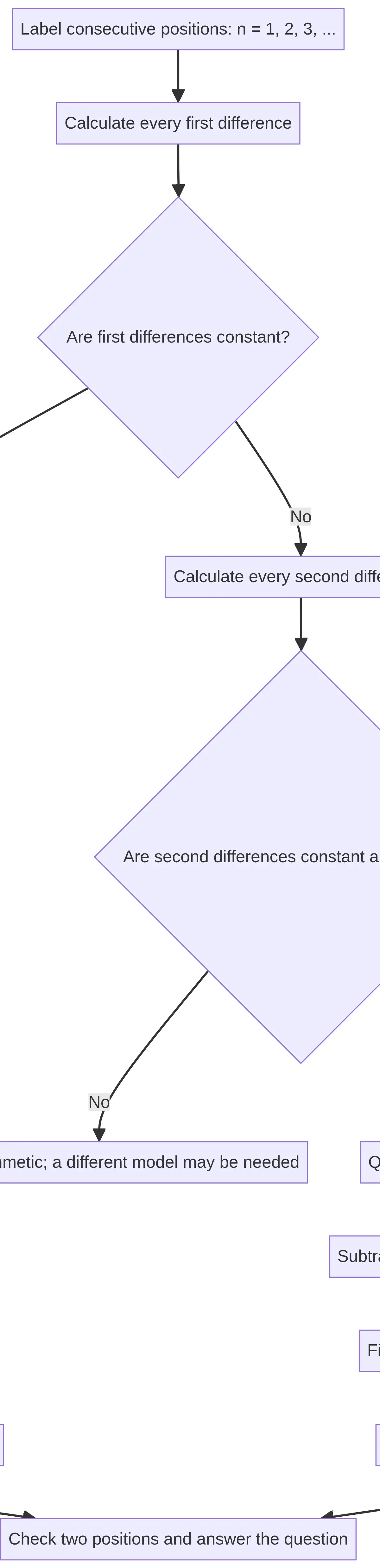
If the leftovers are all equal to 5, the remaining rule is simply +5: b = 0 and c = 5. If they are all zero, the squared part is already the complete expression. Do not invent an n term.
6. A coefficient shortcut, once the method is secure
For consecutive positions starting at 1, let F = u_2 − u_1 and D = u_3 − 2u_2 + u_1. Then a = D/2, b = F − 3a, and c = u_1 − a − b. The identity F = 3a + b follows by substituting n = 1 and n = 2 into an² + bn + c.
For 4, 9, 18, 31, 48, D = 4 and F = 5. Thus a = 2, b = 5 − 6 = −1, and c = 4 − 2 − (−1) = 3. This reaches the same answer as subtraction. Candidates should choose the approach they can explain and execute accurately; the shortcut is not an additional specification requirement.
7. Use, test and challenge the expression
To calculate a term, replace n by its position and square before multiplying. For 2n² − n + 3 at n = 10, calculate 2 × 100 − 10 + 3 = 193. The expression 2n² means 2 × n², not (2n)².
Check at two distinct positions, preferably including the last given term. At n = 1, the expression gives 4; at n = 5, it gives 48. One matching term can conceal an incorrect coefficient elsewhere. Checks strengthen confidence but are not a proof of an unrestricted continuation, and do not automatically earn an extra mark.
To test membership, set u_n equal to the proposed value and solve. For n² + 2n = 48, rearrange and factorise: n² + 2n − 48 = (n + 8)(n − 6) = 0. The solutions are −8 and 6. Reject −8 because positions here are positive integers; 48 is the sixth term. For n² + 2n = 50, (n + 1)² = 51 gives no positive integer position, so 50 is not a term.
Mathematical Relationships and Formula-Sheet Status
Must memorise: u_n = dn + (u_1 − d), or u_n = u_1 + (n − 1)d, for linear sequences. Here d is the signed common difference and u_1 is the first value.
Must memorise: u_n = an² + bn + c for a genuine quadratic, with a ≠ 0; first difference u_(n+1) − u_n = 2an + a + b; second difference D = 2a; therefore a = D/2. The leftover rule is u_n − an² = bn + c. These relationships are not supplied on the 2026 Higher formula sheet. 3
Must memorise if using the optional shortcut: b = F − 3a and c = u_1 − a − b. Must memorise if analysing equally spaced gaps: D = 2ah². These are derived identities, not separate compulsory formula-recall items.
Must memorise: square numbers have rule n²; triangular numbers have rule n(n + 1)/2 = (n² + n)/2. Recognising these links can simplify a diagram question. 1
Given on formula sheet: for solving An² + Bn + C = 0, n = [−B ± √(B² − 4AC)]/(2A), where A ≠ 0. This is an equation-solving tool for membership questions, not a way to deduce the rule directly. Factorise first when straightforward, and reject non-integer or non-positive positions. 3
Graph and Data Skills
Plot position n horizontally and term value u_n vertically, using labelled axes and a consistent scale. For 4n + 3, the points (1, 7), (2, 11), (3, 15), (4, 19) lie on a straight line with gradient 4. For n² + 2n, the points (1, 3), (2, 8), (3, 15), (4, 24), (5, 35) lie on a quadratic curve and successive rises get larger.
A sequence is discrete: only the permitted integer positions belong. A smooth curve may illustrate the related continuous function, but intermediate decimal positions are not additional sequence terms. Do not infer that b is the gradient of a quadratic: its changes depend on n. A plotted finite set is also not proof of a unique rule. If values represent lengths or counts, label the vertical axis accordingly.
Practical Applications and Units
Growing tile patterns make the three coefficients visible. An n by n square contributes n² tiles; two separate strips of n tiles contribute 2n, giving n² + 2n when there is no overlap. Four times a pattern is not automatically the pattern at position four: the nth-term expression determines growth.
A linear seating model might have 7 seats in row 1 and 4 extra seats in each successive row, giving 4n + 3 seats in row n. A square courtyard tiled at increasing sizes gives quadratic growth because both dimensions increase. In either context, count the actual diagram before generalising and account for shared tiles only once.
There is no required practical for this mathematics topic. The position n has no unit; u_n has the unit specified in the question, or no unit for a pure number sequence. No unit conversion is inherent to finding an nth term. In contextual problems, 1 m = 100 cm, whereas 1 m² = 10,000 cm². Changing metres to centimetres multiplies every length value and its rule by 100, not the position n.
Exam Execution and Active Revision
Read the command word and mark allocation before calculating. Find the differences, identify the correct degree, deduce the expression, then answer any later part using it. Pearson uses question-specific marking: method evidence can receive credit even when a final value is incorrect, but no universal allocation guarantees a mark for each differences row. 4
Each paper has 80 marks in 90 minutes. That gives 90/80 = 1.125 minutes per mark as a planning benchmark, approximately 1 minute 8 seconds. Budget about 3–4 minutes for a three-mark sequence question and 6–7 minutes for six marks, adjusting for other questions and checking time. These are revision targets, not Pearson timing rules. 1
Cover the worked solution and recreate it on blank paper. Ask yourself why subtracting an² leaves a linear rule, and what would change if a were negative. After checking, redo only the missed step, then solve a different sequence. Return tomorrow and again several days later without notes. Retrieval is useful when it reveals a gap that you correct, not when you simply recognise an answer you have just read.
Listen and Recall
The ten-minute female-tutor episode follows: introduction 0:00–1:00; core concepts 1:00–6:00; exam tips 6:00–8:00; quick-fire quiz 8:00–9:00; summary 9:00–10:00. Answer the quiz aloud before hearing each explanation. Audio complements written algebra; it does not replace showing the calculation in an exam.
References and Download
Visual Resources
2 diagrams and illustrations

Interactive Diagrams
2 interactive diagrams to visualise key concepts
Conceptual Flow Outline
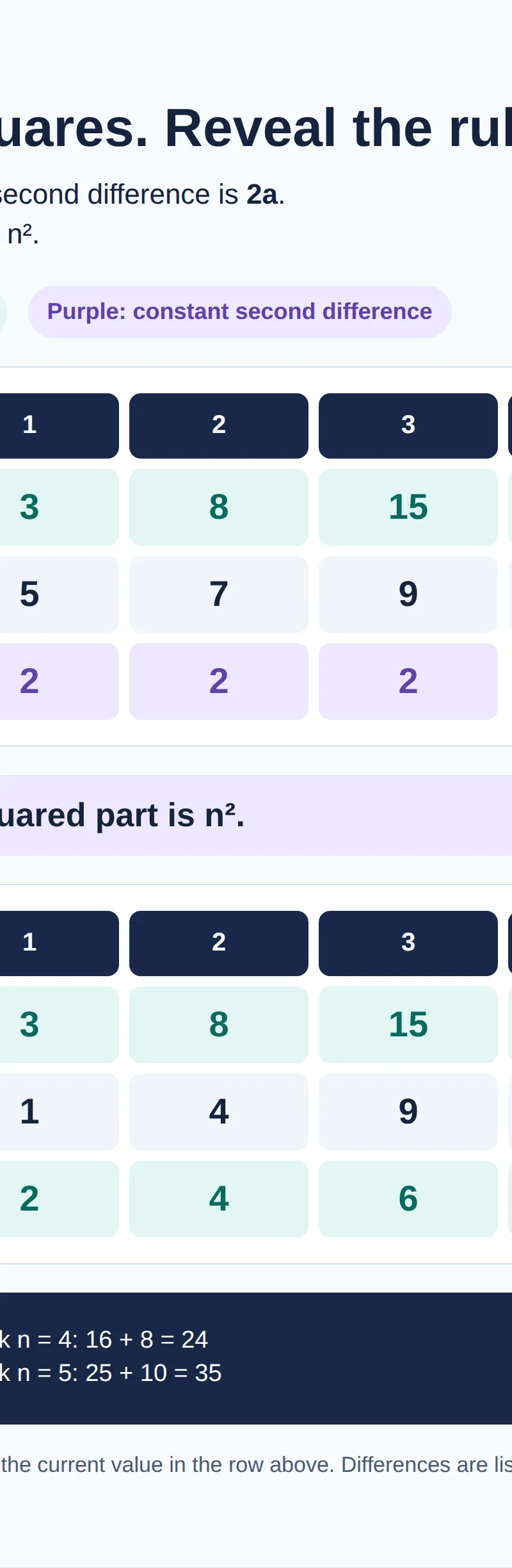
Choose a method from the difference pattern. This flowchart assumes consecutive integer positions; the PNG version is included as sequence_method.png.
Conceptual Flow Outline
What each coefficient means after subtracting the squared part: a comes from half the second difference, b from the leftover gap, and c from its first-value adjustment.
Worked Examples
4 worked examples — open one to explore the question and available guidance.
Practice Questions
Try the question, then reveal an answer plan or example response
A linear sequence begins 12, 9, 6, 3. (a) Find its nth-term expression. (2 marks) (b) Work out the 10th term. (1 mark)
Hint: Keep the sign of the common difference, then match the first term.
Here are the first five terms of a quadratic sequence: 1, 3, 7, 13, 21. Find an expression, in terms of n, for its nth term. (3 marks) This is an original teaching version of the pattern used in Pearson A25 guidance.
Hint: After identifying the squared coefficient, subtract 1, 4, 9, 16, 25.
A quadratic sequence begins 7, 14, 25, 40, 59. (a) Find an expression for the nth term. (3 marks) (b) Work out the 10th term. (1 mark)
Hint: The leftovers after removing the squared part increase by 1.
A quadratic sequence begins 4, 3, −2, −11, −24. (a) Find an expression for the nth term. (3 marks) (b) Work out the 6th term. (1 mark)
Hint: A negative second difference gives a negative coefficient of n². Subtracting a negative value means adding its magnitude.
A quadratic sequence begins 3, 6, 10, 15, 21. (a) Find an expression for the nth term. (3 marks) (b) A candidate claims the rule is n² + 2 because it matches the first two terms. Show that the candidate is wrong. (1 mark)
Hint: The constant second difference is odd. The coefficient of n² can be a fraction.
A quadratic sequence begins 2, 7, 14, 23, 34. (a) Find its nth-term expression. (3 marks) (b) Determine whether 79 is a term of this sequence. Show your working. (3 marks)
Hint: Once the rule is known, completing the square is a quick way to test the proposed value.
Exam technique
How to turn what you know into marks
How to approach the question
Read the command word, total marks and position labels. Determine whether the sequence is stated to be linear or quadratic. Calculate all available first differences, then second differences only if needed. Deduce the complete rule, check two positions and answer each subsequent part. Do not confuse a requested term value with its position.
How to structure your answer
For a two-mark linear deduction, show the common difference and starting-value adjustment, then state an expression in n. For a three-mark quadratic deduction, make a visible, justified squared coefficient and a coherent leftover method, then combine into a complete expression. For a four-to-six-mark multipart question, label the parts and show substitution or a membership equation after deduction. All detailed allocations in this guide are indicative, guide-authored teaching schemes. Pearson question-specific schemes decide real marks; neither a differences row nor a check is automatically a separate mark. M denotes method, A accuracy, B unconditional accuracy, P process and C communication.
Timing
Each Edexcel 1MA1 paper is 90 minutes for 80 marks: 1.125 minutes per mark, about 1 minute 8 seconds. As revision targets, allow roughly 3–4 minutes for 3 marks, 4–5 minutes for 4 marks and 6–7 minutes for 6 marks. Adjust to retain checking time; these are not mandated question timings.
Common pitfalls
- Using D as a rather than D/2. Write “a = second difference ÷ 2” before the squared row.
- Reversing residual subtraction. Calculate original term − an² at each position.
- Stopping at an². Always determine and combine the leftover linear rule, even when it is only a constant.
- Treating b as the original first difference. The original first difference at n = 1 is 3a + b; b is the leftovers’ common difference.
- Assuming the first term is c. For a quadratic starting at n = 1, u_1 = a + b + c.
- Changing a negative difference to a positive number. Keep signed arithmetic throughout.
- Using 2a for non-consecutive position gaps. For equally spaced gaps h, the second difference is 2ah².
- Accepting non-integer or non-positive membership roots. Check the permitted domain for n.
- Evaluating 2n² as (2n)². Square n first, then multiply by 2.
- Treating a few matching values as proof of every later term. Check the intended model and follow the question’s stated assumptions.
What the command words want
- Compare
- If requested, compare signed first or second differences, coefficients, or specified term values. A larger a does not guarantee a larger value at every position when b and c also differ.
- Describe
- When asked to describe a pattern or rule, state its mathematical structure clearly. This is not a substitute for an algebraic expression when one is explicitly requested.
- Evaluate
- In mathematics, evaluate normally means calculate the value of an expression. Substitute accurately and apply the order of operations; it does not normally mean discuss both sides of an argument.
- Show that
- Start from given information and demonstrate a logically linked calculation leading to the stated result. Merely repeating the result does not show it.
- Determine whether
- Set the rule equal to the proposed value, solve and check that a permitted positive-integer position exists. State yes or no with the supporting position or contradiction.
- Write down / Give
- Provide the requested expression or value clearly. An nth-term answer must involve n, not just “add 4”. No unnecessary explanation is needed unless a reason is also requested.
- Explain / Give a reason
- State the conclusion and support it with mathematical evidence, such as unequal second differences, a mismatching substituted term or a non-integer position.
- Find / Work out / Calculate
- Obtain the requested rule, value or position. Show a coherent method for multi-step work, and include contextual units only when relevant.
Watch or listen (optional)
Test your understanding of Algebra - Sequences: deduce expressions to calculate the nth term of linear and quadratic sequences (Higher tier)
Active recall beats re-reading. Take an instant quiz now to test what you’ve learned and lock it into long-term memory.
7 days Premium · Then the free plan continues · No card, no charge