Pearson Edexcel · GCSE · Mathematics
Course version: 1MA1 · Version from Mar 2026
Algebra - Sequences: deduce expressions to calculate the nth term of linear sequences (Foundation tier)
Turn a number pattern into a rule that finds any term without listing all the earlier ones. Learn how to secure marks on Edexcel Foundation sequence questions, handle decreasing patterns and prove whether a number belongs.
- 11 min read
- 3 worked examples
- 6 practice questions
- 11 key terms
Try the lesson
The start of the Algebra - Sequences: deduce expressions to calculate the nth term of linear sequences (Foundation tier) lesson, made from checked teaching notes for this specification point.
Have a go first
Here are the first four terms of a linear sequence. 5, 8, 11, 14, ... Work out an expression for the nth term of this sequence.
There is more to this lesson
The full lesson goes on to check your understanding and help you earn the marks. Create a free account to carry on, with your progress saved.
7 days Premium · Then the free plan continues · No card, no charge
Check what you remember
Read the wording for your board, then hide it and explain Sequence in your own words. Rough notes are fine. This is a self-check, with no mark or grade.
Reference: Pearson Edexcel
An ordered list of terms generated according to a stated or intended rule.
Study Notes
Overview
A linear sequence is a list of numbers that changes by the same amount at every step. Your job is to turn that repeated change into an expression that finds any term directly. Instead of adding 3 nineteen times to reach the twentieth term, you can substitute 20 into a short algebraic rule. This is Pearson Edexcel GCSE Mathematics 1MA1, Foundation tier, specification A25: deduce expressions to calculate the nth term of linear sequences. 1
Candidates may be asked to find an expression in terms of n, calculate a distant term, explain a mistake, or decide whether a number appears in a sequence. These questions connect number patterns with substitution, solving equations and straight-line graphs. An nth-term expression is often a short question, but linked subparts can test several skills together.
The central idea is Difference, Adjust, Check. Find the common difference, write that number multiplied by n, then adjust by a constant. Finally, test a later given term. Throughout this guide, n starts at 1 unless the question explicitly says otherwise. Every question created here is original Edexcel-style practice; its stated marks are teaching allocations, not an official Pearson mark scheme.
Key Concepts
1. Position and value are different
In the sequence 5, 8, 11, 14, the first term has value 5 and the fourth term has value 14. The position is a counting number: 1, 2, 3, 4 and so on. The term value is the number occupying that position. Write u_n for the value at position n; this notation means the nth term, not u multiplied by n.
The expression 3n + 2 is a position-to-term rule. Substituting n = 4 gives 3 × 4 + 2 = 14. By contrast, “add 3” is a term-to-term rule: it tells you how to move from one value to the next. Both describe the pattern, but only the expression answers “Find the nth term in terms of n”.
Cover and recall: In 5, 8, 11, 14, what are the position and value of the third term? Say “position 3, value 11” before checking. Candidates who confuse these two quantities often substitute the term value where the position belongs.
2. Identify the common difference, including its sign
Subtract each term from the next. For 5, 8, 11, 14, the differences are 8 − 5 = 3, 11 − 8 = 3 and 14 − 11 = 3. Equal differences identify an arithmetic, or linear, sequence in this GCSE context. Increasing sequences have positive differences; decreasing sequences have negative differences.
For 20, 17, 14, 11, the difference is 17 − 20 = −3. “The gap is 3” is incomplete if it hides the direction. Write −3 beside each gap. The coefficient of n must therefore be −3, not +3.
Check every available gap. The list 2, 4, 7, 11 has differences 2, 3, 4, so the linear method does not apply. Do not invent a constant difference from only the first pair. A few equal gaps do not prove that every possible continuation is linear, but a question stating “arithmetic sequence” supplies the intended pattern.
3. Why the difference is the coefficient of n
The multiples of 3 are 3, 6, 9, 12, generated by 3n. When n increases by 1, 3n increases by 3. Adding a fixed constant changes each value equally, so it does not change the gaps. Therefore 3n + 2 still has common difference 3.
Algebra confirms the idea. Consecutive terms of dn + c are dn + c and d(n + 1) + c. Subtracting gives d(n + 1) + c − (dn + c) = d. The constant cancels, leaving the coefficient d. You do not need to reproduce this proof in every exam answer, but understanding it prevents guesswork.
Why does this work? If you add 10 to every term, the sequence moves upwards by 10 but neighbouring terms remain the same distance apart. Only the constant changes. If you change the coefficient instead, the gaps change, so you have a different rate of growth.
4. Find the constant by matching positions
For 5, 8, 11, 14, begin with 3n. At positions 1, 2, 3, 4, that produces 3, 6, 9, 12. Each actual value is 2 larger than its matching multiple. Add 2 to obtain 3n + 2.
The quick version is c = first term − difference. Here c = 5 − 3 = 2. The first term is not automatically the constant. Writing 3n + 5 would give 8 at position 1, which is already wrong.
For 3, 7, 11, 15, the difference is 4. The multiples 4, 8, 12, 16 are each 1 too large. Subtract 1, giving 4n − 1. A negative constant is perfectly valid. In 6, 12, 18, 24, the constant is 6 − 6 = 0, so the answer simplifies to 6n.
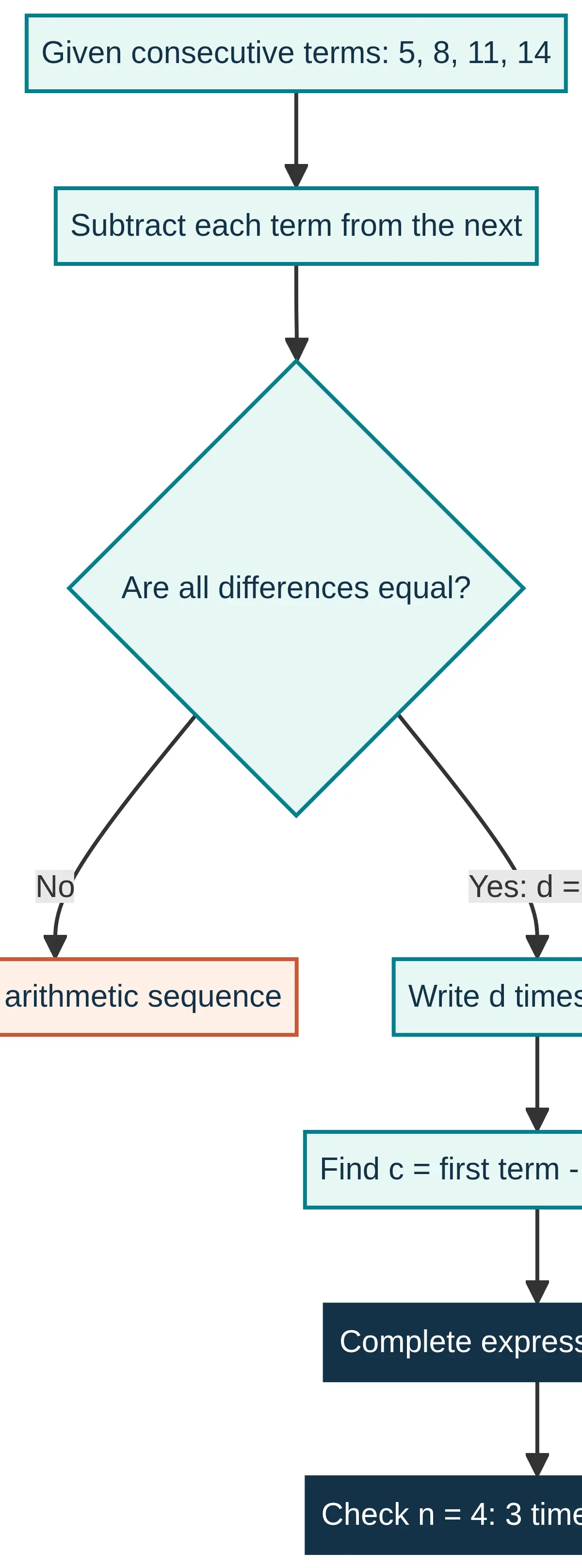
Use the diagram actively: Cover the last two boxes. For 7, 12, 17, 22, work out the coefficient and constant yourself. The completed expression is 5n + 2. Explain why the constant is 2 rather than 7.
5. Decreasing sequences and equivalent expressions
For 20, 17, 14, 11, start with −3n. At position 1, −3n gives −3, so add 23 to reach 20. The expression is −3n + 23, usually written 23 − 3n. These forms are equivalent and generate the same terms.
The shortcut still works: c = 20 − (−3) = 23. Subtracting a negative adds its positive counterpart. Keep the brackets until you have handled the signs correctly.
Check position 4: 23 − 3 × 4 = 11. The incorrect rule 23 + 3n produces 35 instead. A decreasing sequence can continue through zero into negative term values. For this sequence, the eighth term is −1. That is allowed because the position 8 is positive, even though the term value is negative.
6. Calculate a distant term accurately
Once you know the expression, substitute the requested position. For u_n = 3n + 2, the twentieth term is u_20 = 3 × 20 + 2 = 62. Multiplication comes before addition. The expression means “multiply n by 3, then add 2”, not “multiply 3 by n + 2”.
Use n = 20, not n = 19. There are nineteen jumps from the first term to the twentieth, but the rule 3n + 2 has already accounted for the starting position. If using the alternative first-term formula, those nineteen jumps appear explicitly.
Candidates should show the substitution, not merely an unexplained number, particularly when the question requests working. A sequence question can appear on any of the three papers. Practise this method without a calculator so it remains available on Paper 1. 1
7. Decide whether a number belongs
Set the nth-term expression equal to the target value and solve for n. To test 68 in 3n + 2, write 3n + 2 = 68, then 3n = 66 and n = 22. Since 22 is a positive whole number, 68 is the twenty-second term. Check: 3 × 22 + 2 = 68.
To test 69, solve 3n + 2 = 69. This gives n = 67/3, which is not a whole number. Therefore 69 is not a term. Do not round to 22: rounding would answer a different question.
A whole-number solution is not enough if it is zero or negative. Testing 2 gives n = 0, which is not an allowed position here. Testing −1 gives n = −1, also disallowed. The decisive condition is positive whole-number position, not positive term value.
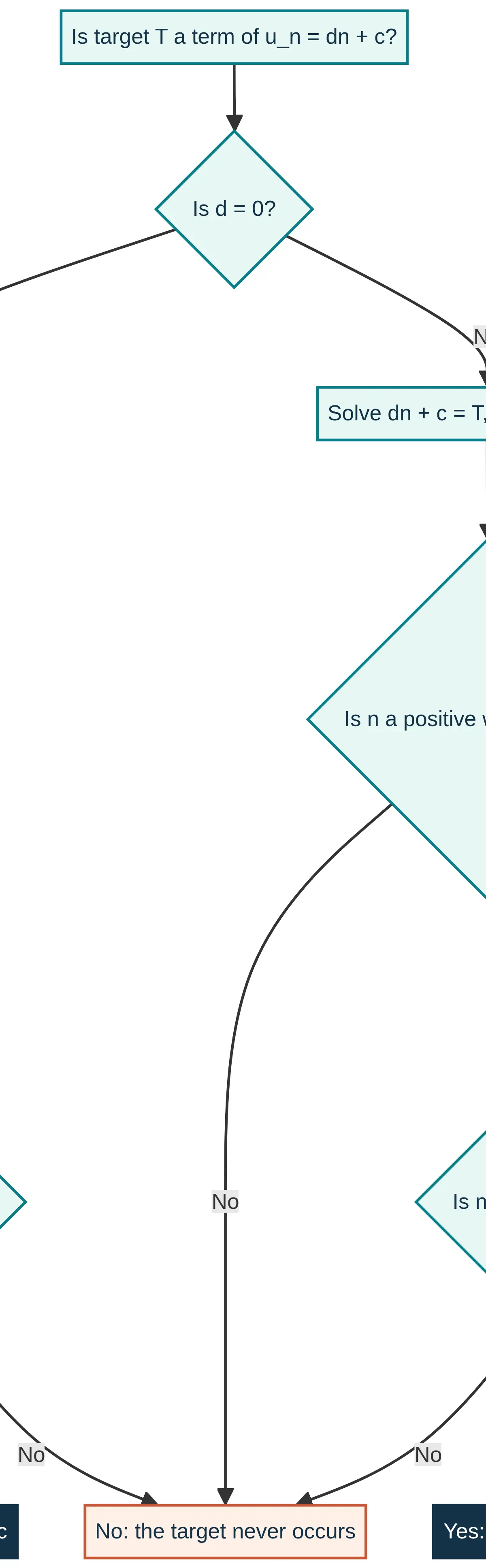
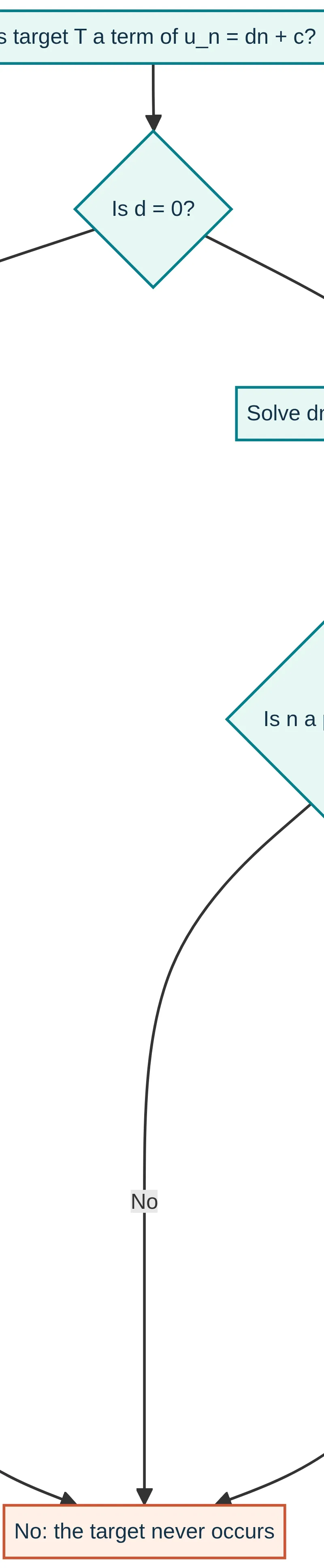
For a finite real-world pattern, check its stated limit too. If only twenty rows are built, an answer n = 22 is outside that context. If d = 0, the sequence is constant; compare the target with that constant instead of dividing by zero.
Mathematical/Scientific Relationships
The relationships to learn
All the sequence relationships below are labelled Must memorise because they are not supplied on the checked 2026 Edexcel Foundation formula sheet. Understanding how to reconstruct them is just as useful as recalling them. 3
Must memorise: d = u_(n+1) − u_n. Here d is the common difference, u_n is a term value, and u_(n+1) is the next value. Use subtraction in this order to preserve the sign.
Must memorise: u_n = dn + c, with c = a − d. Here a is the first term, n is a positive whole-number position, and c is the fixed adjustment. This is the main Foundation method.
Must memorise: u_n = a + (n − 1)d. This is an equivalent form. There are n − 1 jumps after the first term. For a = 5 and d = 3, it becomes 5 + 3(n − 1) = 3n + 2. Learn one method securely rather than switching mid-solution.
Must memorise: u_(n+1) = u_n + d. This is the term-to-term relationship. It generates the next value but is not the requested nth-term expression.
Must memorise: n = (T − c)/d when d ≠ 0. Here T is the target term value. This rearrangement tests membership; interpret the result as a position.
Must memorise: d = (u_q − u_p)/(q − p), where q ≠ p. This finds the difference when two known positions are not adjacent. If the third term is 11 and the seventh is 23, four position steps produce an increase of 12, so d = 3. Then c = 11 − 3 × 3 = 2.
Graph and data skills
Plot position n horizontally and term value u_n vertically. For 3n + 2, plot (1, 5), (2, 8), (3, 11), (4, 14). Use equal scale intervals, label both axes and keep coordinates in position-first order. The points lie on a straight line with gradient 3.
The extended line crosses the vertical axis at 2, matching c, but n = 0 is not a term position in this sequence. The sequence consists of points at positive integer positions, not every point on the continuous line. Use a line extension for interpretation only when appropriate to the question; do not claim that position 2.5 is allowed.
Practical Applications
Growing arrangements
A seating pattern might have 5 seats in row 1, 8 in row 2, 11 in row 3 and 14 in row 4. If the pattern continues, row n has 3n + 2 seats. The thirtieth row therefore has 92 seats. This is the number in that row, not the total number of seats across thirty rows. Read the quantity being requested before calculating.
Money and units
A collection starts with £5 in week 1 and increases by £3 each week. Its value in week n is £(3n + 2). If the question uses pence, convert consistently: the rule becomes 300n + 200 pence because £1 = 100p. The position n has no money units. There is no required practical for this algebra topic.
Exam-Focused Checking and Recall
A real marking example matters more than a guessed universal rule. In Pearson's June 2024 Paper 1F mark scheme, question 20 awards B2 for 4n − 3 or equivalent. It allows B1 for an unambiguous 4n + k with the constant wrong or absent. This demonstrates why writing the coefficient with n can secure partial credit in that question. Other questions have their own schemes; a standalone difference written alone is not guaranteed a mark. 2
For “Find an expression”, finish with an expression containing n. For “Work out the twentieth term”, finish with a value. For “Explain whether”, show a calculation and an interpreted conclusion. Writing u_n = 3n + 2 is legitimate notation; writing n = 3n + 2 confuses position with value.
Test the last given term, since it checks both the difference and the adjustment. A rule can accidentally fit the first term while using the wrong coefficient. Avoid presenting several competing final answers. Cross out an abandoned expression clearly.
Recall routine: Close the guide and find the rule for 9, 13, 17, 21. Next, explain why 41 is a term but 42 is not. Check afterwards: the rule is 4n + 5; 41 gives n = 9, while 42 gives n = 37/4. Retry a decreasing sequence tomorrow, then mix both types a few days later.
Ten-Minute Tutor Podcast
Listen actively: introduction 0:00–1:00, core concepts 1:00–6:00, exam technique 6:00–8:00, recall quiz 8:00–9:00, summary 9:00–10:00. Say answers aloud during the quiz and pause the player if you need more thinking time.
Tier boundary: Everything taught here is Foundation-accessible. Deduction of quadratic nth-term expressions is Higher-only in 1MA1 and is outside this guide. Recognising that unequal first differences are not linear remains useful at Foundation. 1
References
Downloadable JSON
Visual Resources
2 diagrams and illustrations
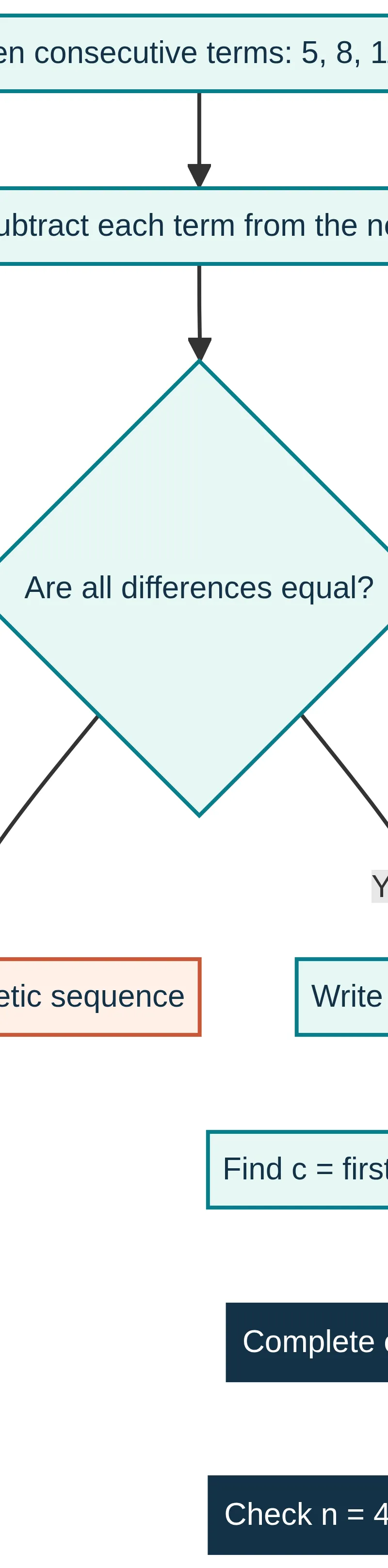
Interactive Diagrams
2 interactive diagrams to visualise key concepts
Conceptual Flow Outline
Derive the nth term using Difference, Adjust, Check.
Conceptual Flow Outline
Test whether a target value occurs at an allowed sequence position.
Worked Examples
3 worked examples — open one to explore the question and available guidance.
Practice Questions
Try the question, then reveal an answer plan or example response
Original Edexcel-style practice. The first four terms of an arithmetic sequence are 7, 11, 15, 19. Find an expression, in terms of n, for the nth term. [2 marks]
Hint: Compare the terms with 4, 8, 12, 16.
Original Edexcel-style practice. The first four terms of an arithmetic sequence are 6, 12, 18, 24. (a) Find the nth term. [2 marks] (b) Work out the twentieth term. [1 mark]
Hint: The actual values already match the multiples of 6.
Original Edexcel-style practice. The first four terms of an arithmetic sequence are 30, 26, 22, 18. (a) Find an expression for the nth term. [2 marks] (b) Work out the tenth term. [1 mark]
Hint: Calculate 26 − 30, then remember that subtracting a negative increases the constant.
Original Edexcel-style practice. The nth term of a sequence is 3n + 2, starting at n = 1. Explain whether 68 is a term of the sequence. [3 marks]
Hint: Set the expression equal to the target, then interpret the solved position.
Original Edexcel-style practice. A sequence has nth term 4n − 7 and starts at n = 1. (a) Explain whether −3 is a term. [2 marks] (b) Explain whether −7 is a term. [2 marks]
Hint: Negative term values are allowed; zero positions are not allowed in this sequence.
Original Edexcel-style practice, challenging Foundation extension. The third term of an arithmetic sequence is 11 and the seventh term is 23. (a) Find an expression for the nth term. [3 marks] (b) Explain whether 52 is a term. [2 marks]
Hint: There are four position steps from term 3 to term 7, not one step.
Exam technique
How to turn what you know into marks
How to approach the question
Identify whether the question wants a rule, a term value or a membership explanation. Label positions from 1 unless stated otherwise. Check all consecutive differences, preserve the sign, write dn, find c = first term − d, and test the last given term. For membership, set the expression equal to the target and solve for n.
How to structure your answer
For an nth-term task, show the variable part and adjustment, then finish with one complete expression in n. For substitution, show the position substituted and the final value. For an explanation, include a mathematical reason and a clear conclusion. The worked examples use original teaching allocations. Official marks are question-specific: June 2024 Paper 1F question 20 gives B2 for 4n − 3 or equivalent and B1 for an unambiguous 4n + k with the constant wrong or absent. Do not assume that identifying the difference alone always earns a mark.
Timing
Each 1MA1 paper has 80 marks in 90 minutes: 1.125 minutes per mark, or approximately 1 minute 8 seconds. As a planning guide, allow about 2–3 minutes for 2 marks, 3–4 minutes for 3 marks, and 6–7 minutes for 6 marks. This is a paper-wide average, not an official time limit per question.
Common pitfalls
- Using the first term as the constant: for 5, 8, 11, use 5 − 3 = 2, not +5.
- Giving 'add 3' when an expression is requested: write 3n + 2 instead.
- Losing the sign in a decreasing sequence: calculate next term minus previous term and keep −3 attached to n.
- Substituting the term value instead of its position: the fourth term uses n = 4.
- Rounding a fractional membership solution: a non-integer n means the target is not a term.
- Accepting n = 0 or a negative integer: positions start at 1 unless explicitly defined otherwise.
- Checking only the first term: a wrong coefficient can still fit it if the constant is adjusted. Check a later term too.
- Writing n = 3n + 2: use u_n = 3n + 2 or simply 3n + 2; n is not the term value.
What the command words want
- Compare
- Compare the sequences' differences and first terms or constants. Equal differences do not necessarily mean identical sequences.
- Explain
- Support your conclusion with a mathematical reason. For membership, state whether the solved n is a positive whole number. Do not give only yes or no.
- Describe
- Describe the actual pattern using precise language, such as 'decreases by 3 each time'. Use this only when a description is requested, not as a substitute for an nth-term expression.
- Evaluate
- In mathematics, evaluate usually means calculate the value of an expression. It does not normally mean discuss advantages and disadvantages. Substitute any given n and simplify accurately.
- Show that
- Demonstrate the stated result using calculation or a valid argument. For a claimed term, find its position and verify the substitution.
- Work out/Calculate
- Substitute the required position, apply multiplication before addition, and give the numerical result. Include units only when the context supplies them.
- State/Give/Write down
- Give the requested expression or value clearly. An expression in terms of n must contain n; a term-to-term sentence does not replace it.
- Find/Deduce an expression
- Identify the constant signed difference, construct dn + c, and give the complete rule. Showing the comparison with dn makes your reasoning visible.
Watch or listen (optional)
Test your understanding of Algebra - Sequences: deduce expressions to calculate the nth term of linear sequences (Foundation tier)
Active recall beats re-reading. Take an instant quiz now to test what you’ve learned and lock it into long-term memory.
7 days Premium · Then the free plan continues · No card, no charge