Pearson Edexcel · GCSE · Mathematics
Course version: 1MA1 · Version from Mar 2026
Algebra - Sequences: recognise and use sequences of triangular, square and cube numbers, simple arithmetic progressions, Fibonacci type sequences, quadratic sequences, and simple geometric progressions (rⁿ where n is an integer, and r is a rational number > 0) (Foundation tier)
Number patterns stop being guesses when you know what to test. Learn to recognise seven sequence families, extend them accurately and justify whether a value belongs, using clear working that can earn credit in Pearson Edexcel Foundation questions.
- 12 min read
- 5 worked examples
- 8 practice questions
- 18 key terms
Try the lesson
The start of the Algebra - Sequences: recognise and use sequences of triangular, square and cube numbers, simple arithmetic progressions, Fibonacci type sequences, quadratic sequences, and simple geometric progressions (rⁿ where n is an integer, and r is a rational number > 0) (Foundation tier) lesson, made from checked teaching notes for this specification point.
Have a go first
Which number is the next square number after 16?
There is more to this lesson
The full lesson goes on to check your understanding and help you earn the marks. Create a free account to carry on, with your progress saved.
7 days Premium · Then the free plan continues · No card, no charge
Check what you remember
Read the wording for your board, then hide it and explain Sequence in your own words. Rough notes are fine. This is a self-check, with no mark or grade.
Reference: Pearson Edexcel
An ordered list of terms generated or described by a rule.
Study Notes
Pearson Edexcel GCSE Mathematics: Foundation Sequences
Overview
A sequence is an ordered list of numbers. Its position matters: the same value can appear at more than one position, and a rule describes how values are generated or found. For Pearson Edexcel GCSE Mathematics 1MA1 Foundation, A24 includes triangular, square, cube, simple arithmetic, Fibonacci-type, quadratic and simple geometric sequences. A25 at Foundation requires finding the nth term of a linear sequence. It does not require deducing a general quadratic nth-term rule or working with surd ratios, which are Higher-only content.1
This guide focuses on recognising a sequence, communicating its rule, extending it safely, and deciding whether a number is actually a term. Learn the rules rather than expecting a formula sheet: the published 2026 Foundation Exam Aid supplies no sequence formulas.2 In the examination, every paper is 90 minutes and 80 marks. Paper 1 is non-calculator; Papers 2 and 3 allow calculators. Sequences can appear within algebra, number or problem-solving questions, so show enough working for your method to be checked.1 All custom worked examples and practice allocations in this resource are original and indicative, not official Pearson questions or mark schemes.
Key Concepts
1. Terms, positions and rules
Each number in a sequence is a term. Its position tells you where it sits, not its value. In 7, 12, 17, the first term is 7 and the third term is 17. A term-to-term rule tells you how to move between neighbours. A position-to-term rule tells you the value at a chosen position without listing every preceding term.
Use n for the position, u_n for its value, a for the first term, d for a common difference and r for a common ratio. Unless the question specifies different indexing, n is a positive integer and u_1 = a. A result such as n = 2.5 does not identify a valid term position.
2. Triangular numbers
Triangular numbers are made by adding consecutive counting numbers: 1, 3, 6, 10, 15, 21, 28, 36. Picture rows containing one dot, then two dots, then three dots. The triangular number counts the total dots, not just the newest row.
The increases are +2, +3, +4, +5 and so on. After 36, the next increase is 9, giving 45. This is not arithmetic because the increases change. The second differences are 1, so triangular numbers also form a quadratic sequence.
Must memorise: the growing-row rule and familiar early terms. Optional shortcut, not a Foundation formula-recall requirement: T_n = n(n + 1)/2. If you choose this shortcut, learn it because it is not supplied on the formula sheet. For example, T_6 = 6 × 7 ÷ 2 = 21.
Cover and recall: why do you add 6 after 15 rather than add 5 again?
3. Square numbers
Square numbers come from multiplying a positive integer by itself: u_n = n². Learn the squares through 12²: 1, 4, 9, 16, 25, 36, 49, 64, 81, 100, 121, 144.
Their first differences are 3, 5, 7, 9 and so on. Imagine a square growing by an L-shaped border. Each new border contains two more tiles than the previous border, explaining the constant second difference of 2. Squares are therefore quadratic, not arithmetic.
For membership, 49 is a square term because 7² = 49. Its value is 49 and its position is 7. Credit given for a reason requires this mathematical link, not merely the statement that 49 looks familiar.
4. Cube numbers
Cube numbers come from three equal factors: u_n = n³. The first five are 1, 8, 27, 64, 125. The next is 6³ = 216.
Do not confuse n³ with 3n. Five cubed is 5 × 5 × 5 = 125, whereas 3 × 5 = 15. A cube can be pictured as n layers, each containing n × n small cubes. Cube numbers are not quadratic: their second differences do not remain constant.
To reject membership, compare consecutive cubes. Since 6³ = 216 and 7³ = 343, the number 250 lies between consecutive positive integer cubes and is not a cube number.
5. Arithmetic progressions
An arithmetic progression adds or subtracts the same amount each time. In 7, 12, 17, 22, the common difference is 5. Showing “first differences: 5, 5, 5” supplies evidence for the classification.
The nth term is u_n = a + (n − 1)d. There are n − 1 jumps because the first term already occupies position 1. The tenth term is therefore 7 + 9 × 5 = 52, not 7 + 10 × 5.
For this sequence, simplify the rule to 5n + 2. Another useful method is to start with 5n and adjust it to match the first term: at n = 1, 5n gives 5 but the sequence gives 7, so add 2. Check the expression against both the first term and a later term.
Decreasing sequences are also arithmetic. The sequence 20, 16, 12, 8 has d = −4 and nth term 24 − 4n. Deducing linear nth terms is Foundation A25 content.1
6. Fibonacci-type sequences
Each new term is the sum of the previous two terms. Starting with 2 and 5 gives 2, 5, 7, 12, 19, 31. Always use the latest pair: after 12, add 7 + 12, not 2 + 12.
The starting terms matter. A Fibonacci-type sequence does not have to begin with 1 and 1. State the starting pair if asked to describe a complete generating rule.
To work backwards, undo addition with subtraction. If three consecutive terms are x, 12, 19, then x + 12 = 19, so x = 7. Check by adding forwards again. This check is particularly useful when filling two missing terms.
7. Quadratic sequences
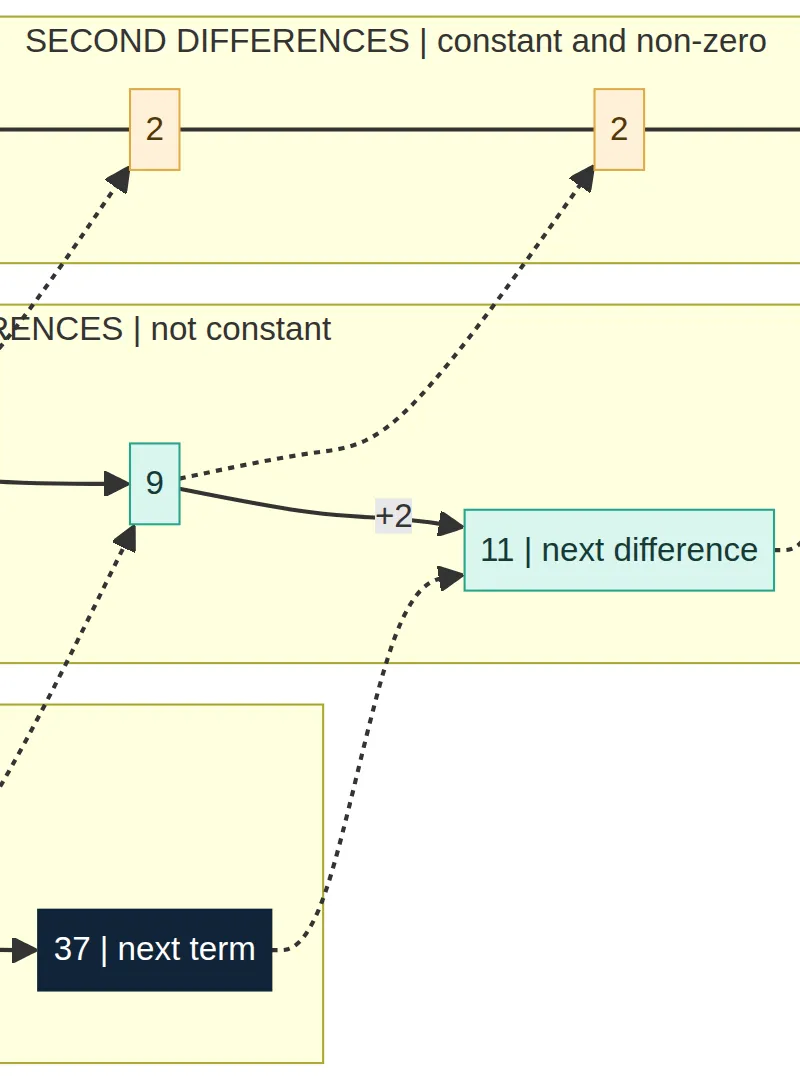
A quadratic sequence has constant, non-zero second differences. Consider 2, 5, 10, 17, 26. Its first differences are 3, 5, 7, 9. Its second differences are 2, 2, 2.
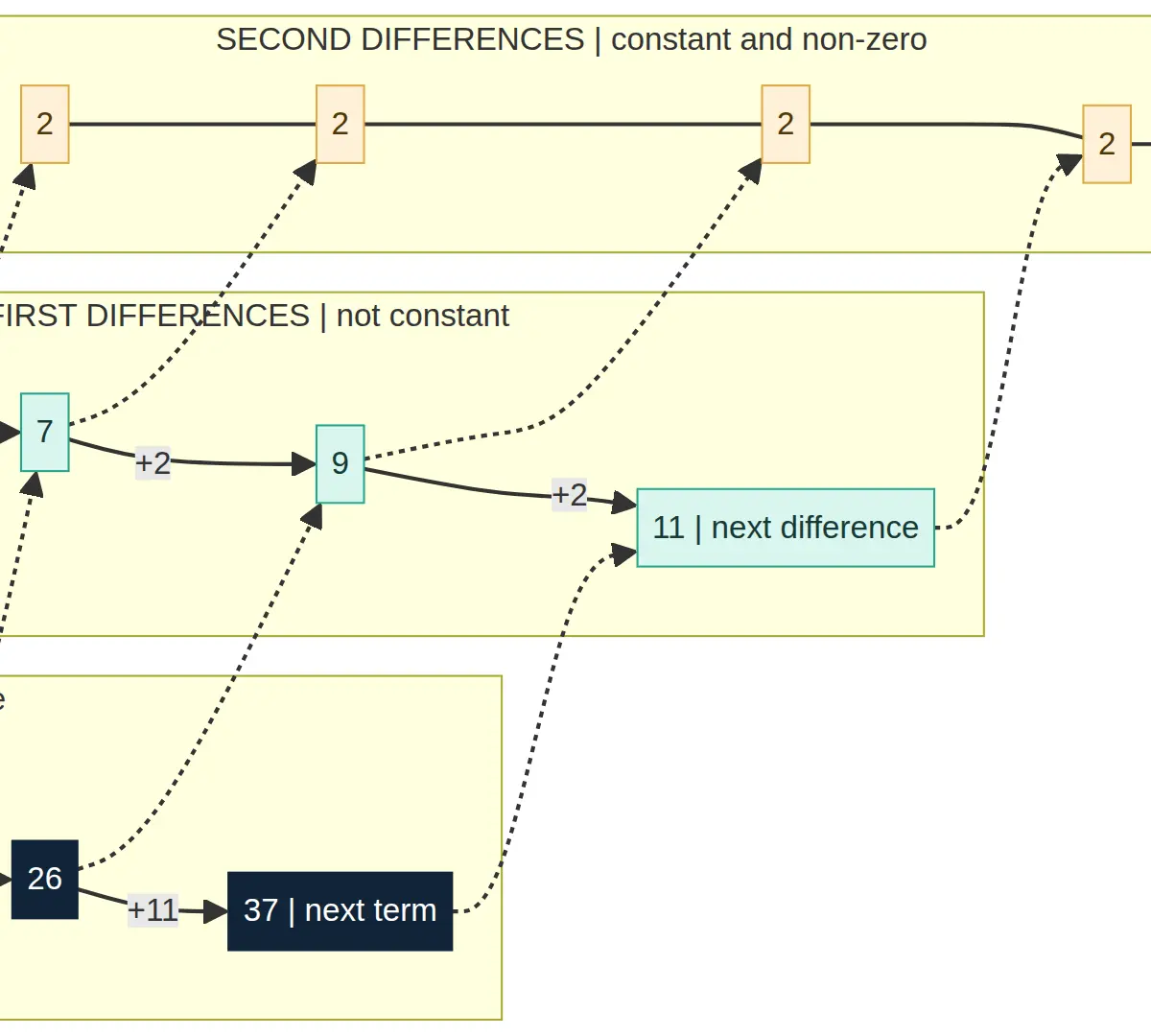
Extend the first differences before extending the terms. The next first difference is 9 + 2 = 11, so the next term is 26 + 11 = 37. Adding 9 again would give 35 and would not continue the quadratic pattern.
Growing gaps alone do not establish a quadratic pattern. Candidates should calculate both difference rows. A finite list provides evidence for the intended rule, not proof of a unique infinite continuation. Use any rule explicitly stated in the question.
Recognising and continuing quadratic sequences is Foundation content. Deriving a general quadratic nth-term expression is Higher-only.1 Triangular and square sequences are special quadratic sequences, so family names can overlap.
8. Simple geometric progressions
A geometric progression multiplies by a fixed ratio. In 3, 6, 12, 24, the ratio is 2. Check by dividing the next term by the current term, not the other way round.
In 8, 12, 18, the ratio is 12 ÷ 8 = 3/2. The next term is 18 × 3/2 = 27. A fractional ratio can increase positive terms when it is greater than 1. In 16, 8, 4, 2, the ratio is 1/2, so the next term is 1.
Foundation A24 includes simple powers r^n with integer exponents and positive rational r.1 For positive starting terms, r > 1 increases the values and 0 < r < 1 decreases them. A positive ratio preserves the sign of a non-zero first term, so do not assume every geometric sequence has positive terms.
Never divide by zero when testing ratios. A non-zero constant sequence such as 9, 9, 9 is both arithmetic, with difference 0, and geometric, with ratio 1. The all-zero sequence also has constant difference 0, but division cannot establish its ratio.
Mathematical Relationships
Must memorise: a common difference is d = u_(n+1) − u_n. A common ratio is r = u_(n+1)/u_n, provided u_n ≠ 0. Arithmetic continuation uses u_(n+1) = u_n + d; geometric continuation uses u_(n+1) = r × u_n.
Must memorise: arithmetic nth terms can be written a + (n − 1)d or dn + c, where c = a − d. The constant c is an adjustment, not automatically the first term. Square and cube rules are n² and n³. The Fibonacci-type rule is u_n = u_(n−1) + u_(n−2) for n ≥ 3, with the first two terms specified.
Must memorise: r⁰ = 1 and r^(−k) = 1/r^k for positive integer k and non-zero r. For example, 2⁰ = 1 and 2^(−1) = 1/2. These are exponent rules; they do not automatically introduce zero or negative positions into a question whose positions begin at 1.
Must memorise for Higher-tier extension only, not Foundation: a general quadratic rule is An² + Bn + C, with A ≠ 0, and its second difference is 2A. A general scaled geometric position rule is a × r^(n−1). These are included for completeness, not as required Foundation methods. Pearson teaching guidance identifies general scaled geometric expressions as extension content.3
None of these sequence formulas is Given on formula sheet in the published 2026 Foundation Exam Aid.2 Prioritise understanding and applying the numerical rules rather than memorising extension material.
Membership: justify yes or no
For u_n = 6n − 1, test 47 by solving 6n − 1 = 47. This gives n = 8, a positive integer, so 47 is a term. Testing 50 gives n = 8.5, so it is not a term. Being between the eighth term, 47, and ninth term, 53, does not create an allowed position.
Parity is a useful rejection test but not a complete membership test. Every term of 6n − 1 is odd, so an even value cannot belong. However, 49 is odd and still does not belong because its required index is not an integer. A successful explanation links the decision to the actual rule.
Graph and Data Skills
Plot a sequence as discrete pairs of position and value. For 4, 7, 10, 13, plot (1, 4), (2, 7), (3, 10), (4, 13). Label the horizontal axis “position n” and the vertical axis “term value u_n”.
Arithmetic points lie on a straight-line pattern. Quadratic points show curvature. Geometric points may rise or fall at a changing rate. Do not normally join sequence points: positions between whole-number indices are not terms. Follow the question if it explicitly describes a continuous situation. Graphs illustrate patterns, but an exact rule or calculation is stronger evidence for an exact answer.
Practical Applications
There is no required practical for this Mathematics topic. Growing arrangements, rewards and repeated changes provide useful contexts.
Suppose rewards start at 25p and increase by 15p each stage. The sequence is 25, 40, 55, 70, so the tenth reward is 25 + 9 × 15 = 160p = £1.60. Keep all amounts in the same unit before calculating. Remember £1 = 100p; 160p is not £160.
A different reward starts at £4 and doubles: £4, £8, £16, £32. Its cash increase changes, but its multiplier stays 2, so it is geometric. Ask “what stays the same?” to distinguish fixed increases from fixed multipliers.
Why does this work? Increasing the starting value of an arithmetic sequence by 3 increases every term by 3, without changing its common difference. Changing the starting pair of a Fibonacci-type sequence changes later terms. Explain these consequences rather than just listing new numbers.
Exam Method and Active Recall
Read whether the question asks for a next term, a generating rule, a later term or membership. Write the terms in order, show the relevant differences or ratios, then answer the actual command.
Pearson's official sample-assessment notation includes M for method, P for a problem-solving process, A for accuracy after a correct method or process, B for unconditional accuracy and C for communication.4 The individual mark scheme controls credit. Not every sequence question carries a method mark.
A real example of Foundation demand appears in Pearson teaching guidance: Specimen Papers Set 1, Paper 3F, question 13 asks for the first two negative terms following 32, 26, 20 and is worth 3 marks.3 Continuing by subtracting 6 gives 14, 8, 2, −4, −10. The required terms are −4 and −10; zero is not less than zero. This is a sourced example of demand, not a reproduced official mark breakdown.
Cover the guide and name all seven families. Then generate one example of each without notes. Calculate two difference rows for 2, 5, 10, 17, find the eighth term of 3, 7, 11, and work backwards in a Fibonacci-type sequence. Uncover only after committing to answers. Repeat retrieval later rather than simply rereading.
Audio Revision: 10 Minutes
The episode follows this route: 0:00 introduction; 1:00 core concepts; 6:00 exam tips; 8:00 recall quiz; 9:00 summary. Answer during the quiz pauses before listening to the explanation.
Sources
Visual Resources
2 diagrams and illustrations

Interactive Diagrams
2 interactive diagrams to visualise key concepts
Conceptual Flow Outline
Choose a test using numerical evidence. Special sequence families can overlap.
Conceptual Flow Outline
Constant, non-zero second differences allow the intended quadratic sequence to be continued.
Worked Examples
5 worked examples — open one to explore the question and available guidance.
Practice Questions
Try the question, then reveal an answer plan or example response
The sequence is 14, 19, 24, 29, ...
(a) Write down the next two terms. [1]
(b) Calculate the 20th term. [2]
Hint: Find the common difference, then count the jumps from position 1 to position 20.
The sequence is 3, 8, 15, 24, 35, ...
(a) Write down the first differences. [1]
(b) Write down the second differences. [1]
(c) Find the next term. [2]
Hint: Extend the first-difference pattern before adding to 35.
The sequence is 3, 9/2, 27/4, 81/8, ...
(a) State the common ratio. [1]
(b) Find the next term. [1]
(c) Is 8 a term? Explain your answer. [2]
Hint: Divide next by current. For membership, locate 8 between consecutive terms and consider whether the sequence is increasing.
The sequence is 16, 8, 4, 2, 1, ...
(a) State the common ratio. [1]
(b) Write down the next term. [1]
(c) Is 3 a term? Explain your answer. [2]
Hint: Each term is a fixed fraction of its predecessor. Compare 3 with two neighbouring terms.
In this Fibonacci-type sequence, each term is the sum of the previous two terms.
__, 7, 11, 18, 29, __
Find both missing terms.
Hint: Undo addition for the first gap and use the latest pair for the final gap.
The square-number sequence is 1, 4, 9, 16, 25, ...
(a) Write down the next two terms. [1]
(b) Is 49 a term? Give a reason. [1]
Hint: Use successive positive integer squares.
The cube-number sequence is 1, 8, 27, 64, ...
(a) Write down the next term. [1]
(b) Is 100 a term? Explain your answer. [2]
Hint: Compare 100 with consecutive cubes.
The triangular-number sequence is 1, 3, 6, 10, 15, ...
(a) Write down the next term. [1]
(b) Explain how the differences produce your answer. [2]
Hint: Write the gaps before extending them.
Exam technique
How to turn what you know into marks
How to approach the question
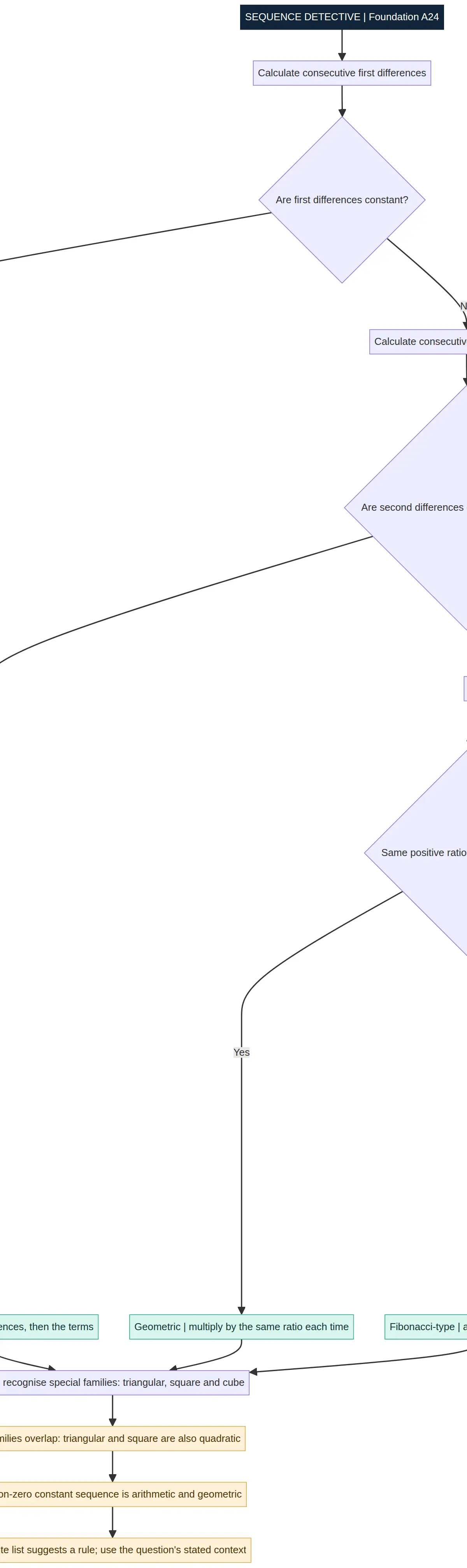
Read the command word and identify whether the task asks for continuation, a rule, a specified term or membership. Write consecutive first differences. If they vary, test second differences. Where multiplication is suggested, divide next by current and check several ratios. Test the latest-two rule for Fibonacci-type. Recognise familiar triangular, square and cube numbers. Check every supplied term and use any stated generating rule. A25 requires deducing linear nth terms at Foundation; a + (n − 1)d is one useful method rather than a compulsory format. Paper 1 is non-calculator; Papers 2 and 3 allow calculators.
How to structure your answer
For a short continuation question, give the requested terms in order. For a multi-mark calculation, show the relevant differences, ratios, substitutions or repeated operations and label the final result. For an explanation, make a claim and attach numerical evidence using 'because'. For membership, write yes or no and justify it with a valid positive integer index or, for a monotonic sequence, consecutive-term bounds. Do not assume one mark is awarded for each line: the individual scheme controls credit.
Timing
Each paper provides 90 minutes for 80 marks, a baseline of 1.125 minutes per mark. Aim for approximately 1 minute per mark during the first pass and reserve about 10 minutes for checking. Allow roughly 3–3.5 minutes for a 3-mark item and 6–7 minutes for a 6-mark item. These are planning guidelines, not official question time limits.
Common pitfalls
- Using n jumps instead of n − 1 jumps from the first term.
- Calling a sequence arithmetic merely because its first differences follow a pattern; arithmetic requires equal first differences.
- Calling a sequence quadratic because it grows quickly rather than calculating constant, non-zero second differences.
- Adding the previous first difference rather than extending the difference pattern before adding.
- Calculating a ratio as current divided by next; use next divided by current.
- Assuming a fractional ratio must decrease positive terms. The ratio 3/2 increases them.
- Adding the original first two terms repeatedly in a Fibonacci-type sequence instead of the latest pair.
- Confusing n³ with 3n, or n² with 2n.
- Using parity alone to establish membership rather than checking the actual generating rule.
- Treating n = 0, a negative n or a non-integer n as an allowed position when the question starts at position 1.
- Treating sequence families as exclusive: triangular and square sequences are also quadratic, and non-zero constant sequences are both arithmetic and geometric.
- Assuming a finite list proves a unique infinite rule.
What the command words want
- Show
- Display a convincing chain of calculations or reasoning. A supplied answer alone is not a demonstration.
- Compare
- Identify a precise similarity or difference between both sequences, such as fixed addition compared with fixed multiplication.
- Explain
- Make a claim and support it with evidence: 'quadratic because the second differences are 2, 2, 2'.
- Describe
- Say how the terms are generated, for example 'start at 7 and add 5 each time'.
- Evaluate
- In Mathematics, calculate the expression or value. Do not use a humanities-style discussion of advantages and disadvantages.
- Calculate
- Set out the operation or substitution, calculate accurately and identify the final answer. Include contextual units if appropriate.
- State/Give
- Provide the requested value, family or rule directly. Include the operation and its number when stating a term-to-term rule.
- Write down
- Give the requested answer without an unnecessary derivation, after checking the rule.
Marking language note
Pearson's official sample-assessment notation uses M for method, P for process, A for accuracy after a correct method or process, B for unconditional accuracy and C for communication. The allocations for this guide's original questions are indicative teacher-designed schemes, not official Pearson allocations.
Watch or listen (optional)
Test your understanding of Algebra - Sequences: recognise and use sequences of triangular, square and cube numbers, simple arithmetic progressions, Fibonacci type sequences, quadratic sequences, and simple geometric progressions (rⁿ where n is an integer, and r is a rational number > 0) (Foundation tier)
Active recall beats re-reading. Take an instant quiz now to test what you’ve learned and lock it into long-term memory.
7 days Premium · Then the free plan continues · No card, no charge