Pearson Edexcel · GCSE · Mathematics
Course version: 1MA1 · Version from Mar 2026
Algebra - Solving equations and inequalities: solve quadratic equations algebraically by factorising; find approximate solutions using a graph (Foundation tier)
Turn a quadratic into brackets, then turn the brackets into marks. This Foundation-tier guide explains why factorising works, how to keep every valid solution and how to read approximate roots from a graph, with examiner-style examples, visual explanations and a ten-minute tutor podcast.
- 11 min read
- 4 worked examples
- 8 practice questions
- 12 key terms
Try the lesson
The start of the Algebra - Solving equations and inequalities: solve quadratic equations algebraically by factorising; find approximate solutions using a graph (Foundation tier) lesson, made from checked teaching notes for this specification point.
Have a go first
Solve the equation x² + 2x - 15 = 0 by factorising.
There is more to this lesson
The full lesson goes on to check your understanding and help you earn the marks. Create a free account to carry on, with your progress saved.
7 days Premium · Then the free plan continues · No card, no charge
Check what you remember
Read the wording for your board, then hide it and explain Quadratic equation in your own words. Rough notes are fine. This is a self-check, with no mark or grade.
Reference: Pearson Edexcel
An equation that can be written ax² + bx + c = 0, where a, b and c are constants and a ≠ 0.
Study Notes
GCSE Pearson Edexcel Mathematics Foundation: A18 Quadratic Equations
Overview
Quadratic equations contain an x^2 term and can model a curved relationship rather than a constant rate of change. For Pearson Edexcel GCSE Mathematics qualification 1MA1, A18 at Foundation asks you to solve quadratic equations algebraically by factorising and to find approximate solutions from a graph. A11, A12, A17 and A21 connect this work to quadratic graphs, function language, linear solving and forming equations from situations. The secure Foundation target is the monic form x^2+bx+c=0: find two numbers that add to b and multiply to c, then use the zero-product rule. 1 2
You will also need to recognise a root on a graph, distinguish an exact algebraic answer from a graph estimate, and decide whether an answer makes sense in context. Rearrangement examples show why the right-hand side must be zero before using the zero-product rule. Non-monic factorisation, completing the square and the quadratic formula sit beyond this Foundation A18 guide. Apart from the explicitly cited November 2024 question, examples and allocations are original illustrations, not official mark schemes. Work neatly, substitute to check, and give every valid solution unless a context rejects one.
Key Concepts
Recognise a quadratic
A quadratic equation is commonly written in the general form ax^2+bx+c=0, where $a
e0$. Must memorise / not supplied on checked 2026 Foundation sheet: this is the general form; at Foundation A18, use the monic case a=1, x^2+bx+c=0. Pearson's 2026 Foundation aid provides geometry, trigonometry, compound-interest and probability formulae, but no quadratic factorising identities or solving formula. 3
Find the factor pair
For a monic quadratic, expand two brackets:
Must memorise / not supplied on checked 2026 Foundation sheet:
(x+p)(x+q)=x^2+(p+q)x+pq.
Must memorise / not supplied on checked 2026 Foundation sheet: to factorise x^2+bx+c, choose p and q so that p+q=b and pq=c. The product tells you which signs are alike or different; the sum checks the middle term. For x^2-2x-15, -5\times3=-15 and -5+3=-2, so
(x-5)(x+3)=0.
Use the zero-product rule
Must memorise / not supplied on checked 2026 Foundation sheet: if AB=0, then A=0 or B=0. This zero-product rule works only because the product is zero. If AB=12, neither factor need be zero, so you cannot set A=0 or B=0.
Solve each bracket as a linear equation rather than relying only on a “flip the sign” mnemonic. From x-5=0, add 5, so x=5. From x+3=0, subtract 3, so x=-3. These are the solutions. A command word matters: factorise asks for (x-5)(x+3), while solve asks for x=5 and x=-3.
This exact example appeared as Question 26 on Pearson's November 2024 Foundation Paper 1F. The official scheme, available in the supplied hosted copy, awards 3 marks: M1 for a valid factorisation attempt meeting a coefficient condition, M1 for (x+3)(x-5), then A1 for 5,-3. 4 That is evidence for this question, not a universal “one mark per algebra line” rule.
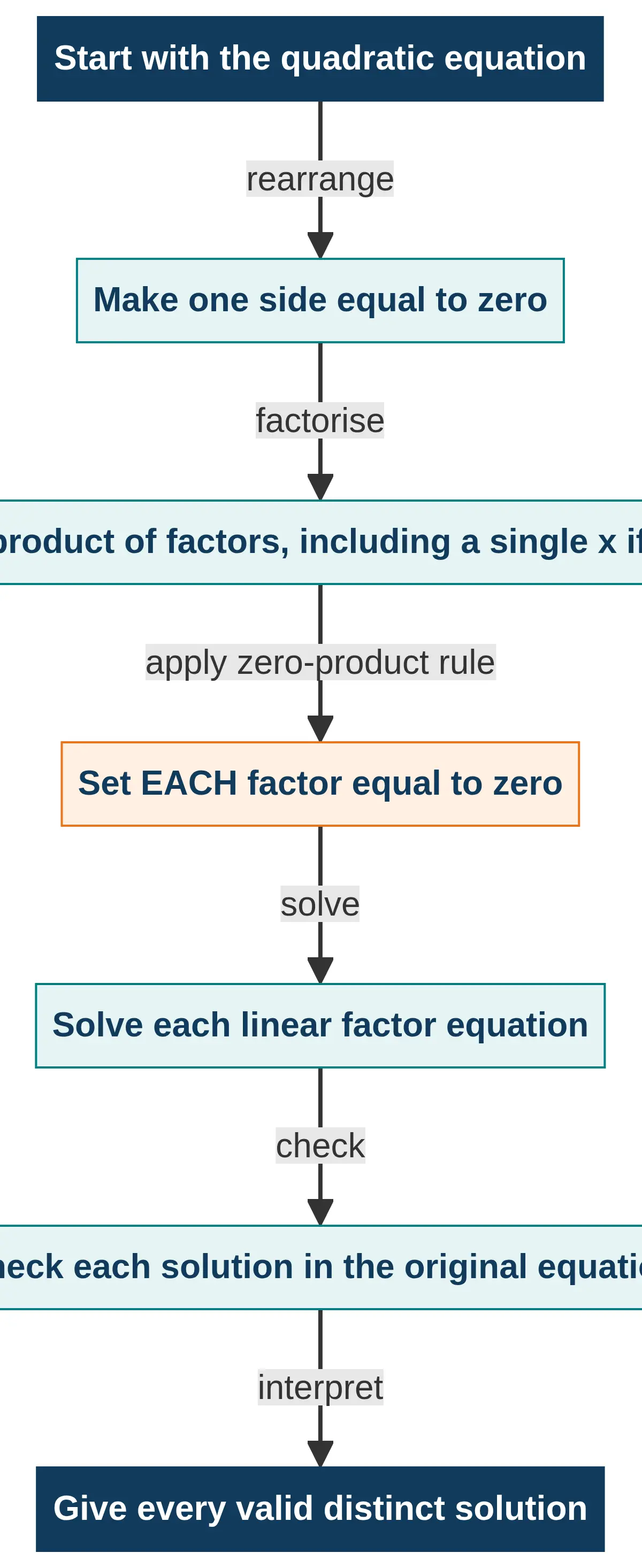
Mini worked example, ordinary factors. Solve x^2+x-6=0. The pair 3 and -2 has product -6 and sum 1.
(x+3)(x-2)=0.
Set each factor to zero: x+3=0\Rightarrow x=-3, or x-2=0\Rightarrow x=2.
Mini worked example, rearrange first. Solve x^2+x=6. Subtract 6 from both sides to make zero on one side: x^2+x-6=0. The factorising above gives x=-3 or x=2. The formal Foundation guidance limits A18 factorising to x^2+bx+c=0, so rearrangement here is useful preparation and linked algebra, not a reason to assume every rearranged quadratic is a Foundation factorising question. 2
Keep zero roots and recognise special factors
Must memorise / not supplied on checked 2026 Foundation sheet: a common factor can make a quadratic product. For x(x-4)=0, do not divide by x, because that could lose the solution x=0. Use the zero-product rule: x=0 or x-4=0, so x=4.
Must memorise / not supplied on checked 2026 Foundation sheet: the difference of two squares is x^2-d^2=(x-d)(x+d). For x^2-25=0, write (x-5)(x+5)=0; hence x=5 or x=-5.
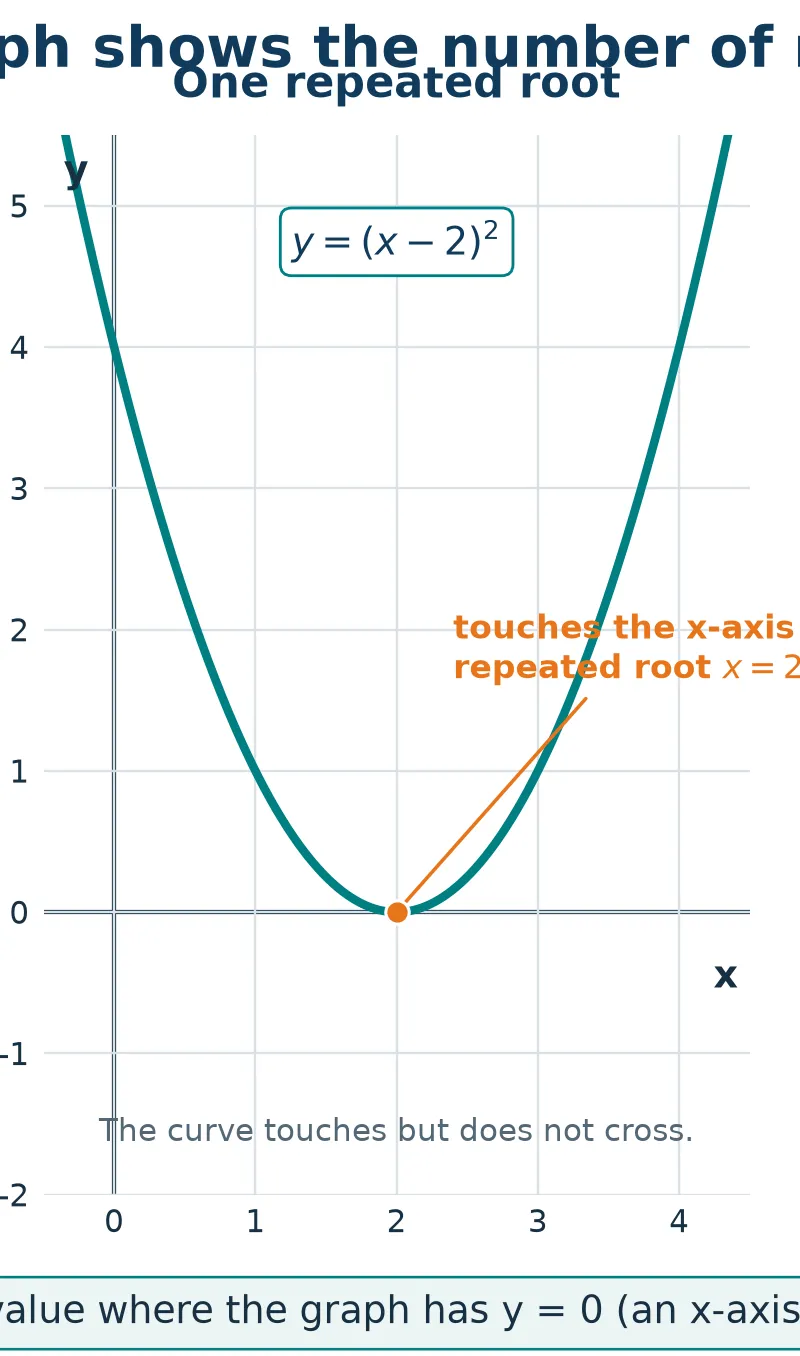
Must memorise / not supplied on checked 2026 Foundation sheet: a repeated factor (x-r)^2=0 gives one repeated root, x=r. For x^2-6x+9=0, (x-3)^2=0, so the root is x=3 twice. State it as one solution, or as a repeated root if asked.
Mathematical Relationships
A factorised equation and its graph tell the same story. Must memorise / not supplied on checked 2026 Foundation sheet: for y=f(x), a root is an x-value for which f(x)=0, so it is an x-axis intercept. Must memorise / not supplied on checked 2026 Foundation sheet: solving f(x)=k means finding where the curve y=f(x) meets the horizontal line y=k.
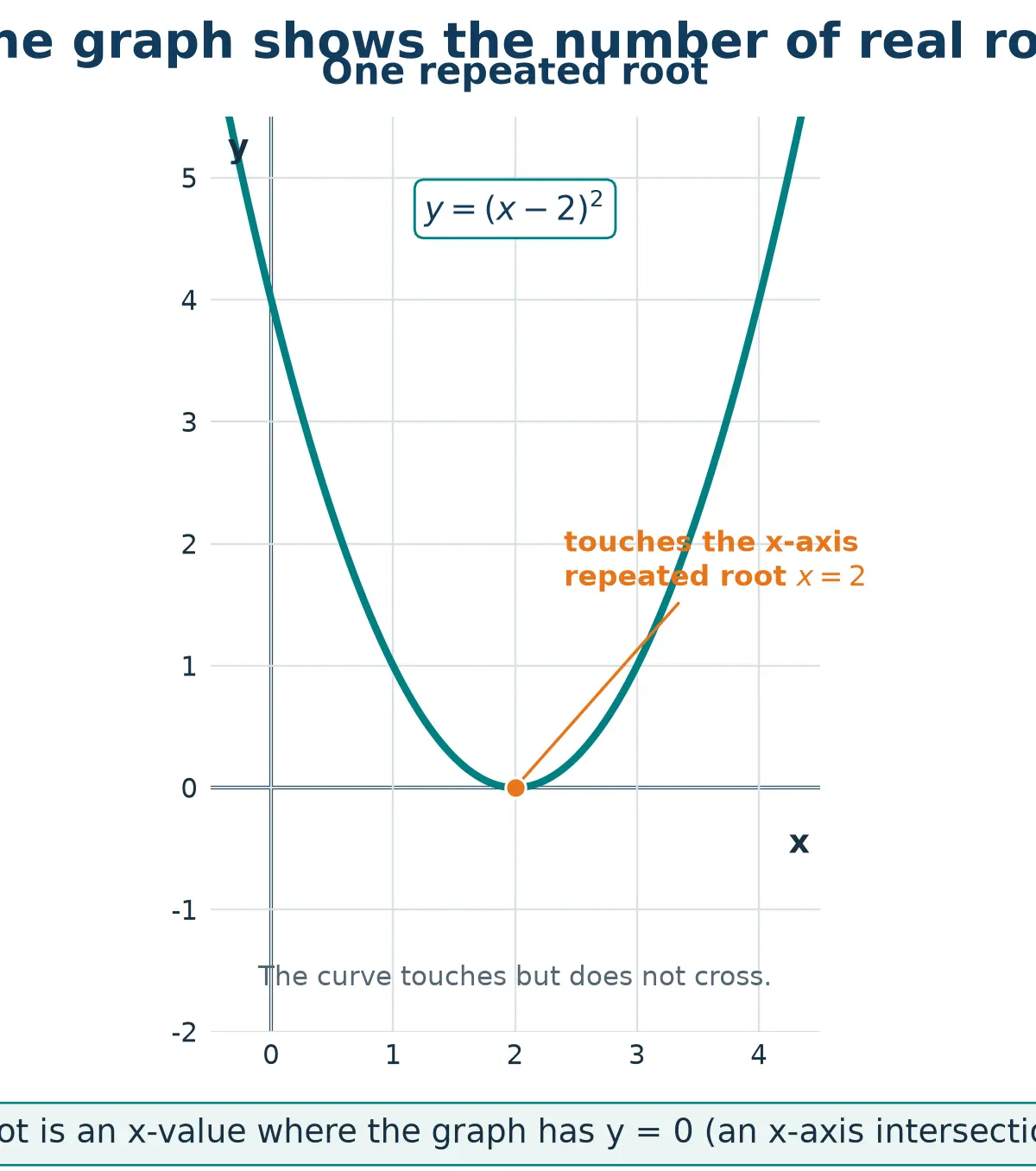
There may be two, one repeated, or no real roots. An upward-opening curve that crosses the x-axis twice has two real roots. A curve that touches the x-axis at its turning point has a repeated root, and that touching point is a root. A curve entirely above the axis has no real roots. Algebra explains x^2+1=0: for real x, x^2\geq0, therefore x^2+1\geq1, so it can never equal zero.
Failure to find an integer factor pair does not prove that there are no real roots. For example, x^2-2x-1=0 has two non-integer real roots visible on its graph. A non-negativity argument or a suitable graph can justify a no-real-roots claim at this level. Ask yourself why a curve above the x-axis could still intersect a higher horizontal line.
The practical time guide is sensible but not a board rule. Each 1MA1 paper is 90 minutes and 80 marks, so 90\div80=1.125 minutes per mark. That is roughly one minute per mark with time kept for checking, not a speed requirement. 1 Questions can be linked multi-part problems worth 4 to 6 marks. They reward connecting known algebra, graphs and geometry, rather than a mysterious extra method. If told use the graph, read the given graph; if told show your working, show the method, not just the final roots.
Foundation boundary
Non-monic quadratics that need additional factorisation, such as 2x^2+7x+3=0, are Higher-only for this guide. Completing the square as a method for solving and use of the quadratic formula are also Higher-only. Do not try to memorise a formula as a required Foundation method. Pearson's specification and teaching guidance distinguish the Foundation factorising target from these Higher methods. 1 2
Practical Applications
Area is a common route from a situation to a quadratic. Must memorise / not supplied on checked 2026 Foundation sheet: for a rectangle, A=lw. Here A is area, l is length and w is width. If adjacent lengths are x and x+2, its area is x(x+2).
Mini worked example, rectangle. A rectangle has area 48\text{ cm}^2, length x+2 cm and width x cm. Form the equation
x(x+2)=48.
Rearrange: x^2+2x-48=0. Since 8\times(-6)=-48 and 8+(-6)=2,
(x+8)(x-6)=0.
Thus x=-8 or x=6. A length cannot be negative, so reject -8. The rectangle is 6 cm by 8 cm. Check: 6\times8=48.
When units change, square the conversion factor for area. Must memorise / not supplied on checked 2026 Foundation sheet: 1\text{ m}=100\text{ cm}. Must memorise / not supplied on checked 2026 Foundation sheet: 1\text{ m}^2=10000\text{ cm}^2, because 100\text{ cm}\times100\text{ cm}=10000\text{ cm}^2. Units help decide whether a numerical solution is physically possible.
There is no required practical experiment for this mathematics topic. A graph exercise is mathematical practice, not a science-style required practical. Use pencil, graph paper and a ruler for axes and reading guides, and draw the quadratic itself as a smooth curve.
Graph Skills
To plot y=x^2-2x-1, calculate reliable points before drawing. At x=-1,0,1,2,3, the corresponding y values are 2,-1,-2,-1,2. Plot (-1,2), (0,-1), (1,-2), (2,-1) and (3,2). Use an even scale, label both axes and read the numbered grid carefully. A scale might make each small square represent 0.2, not 1.
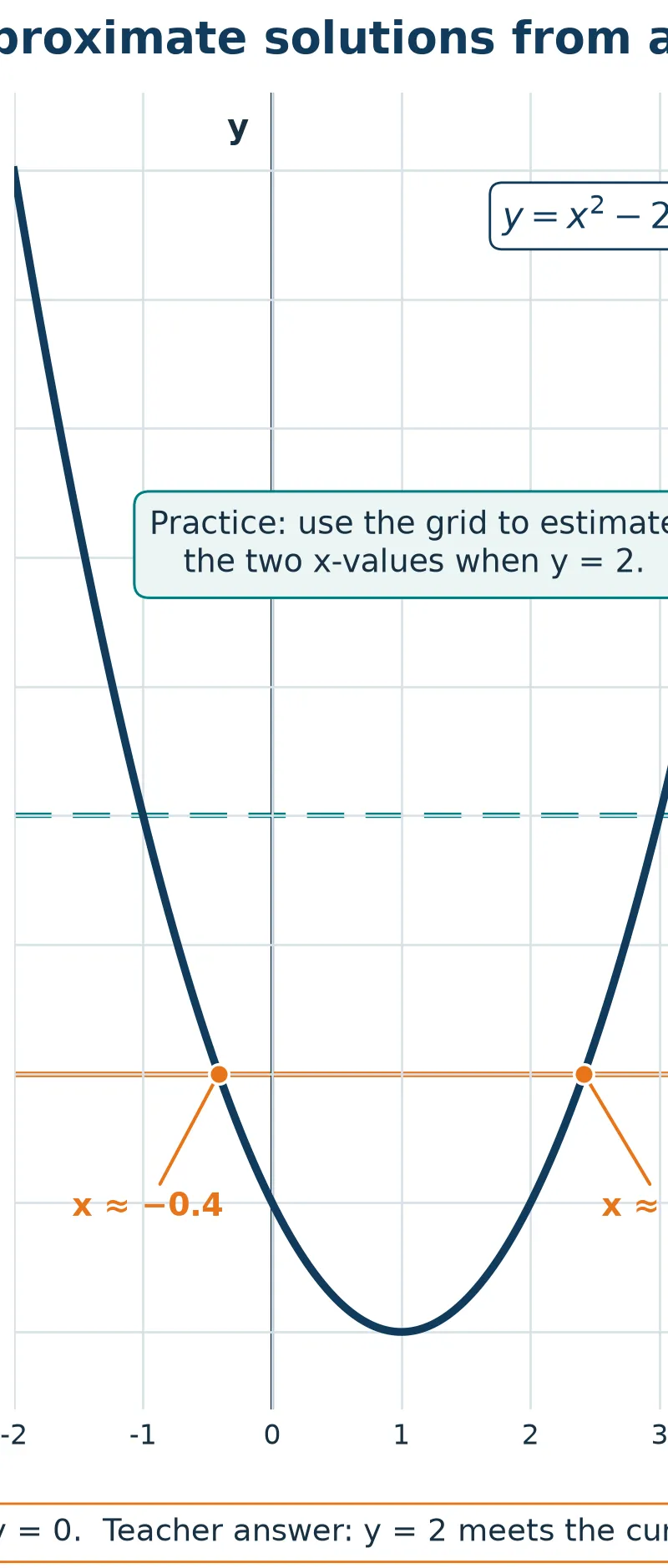
Draw one smooth U-shaped curve through the points. Do not join the points with ruler segments: a quadratic is curved between plotted values. Where this curve crosses y=0, read roots of approximately -0.4 and 2.4 to 1 decimal place. These graph answers are approximations. Algebra can sometimes give exact integer roots; a graph gives the precision supported by its scale.
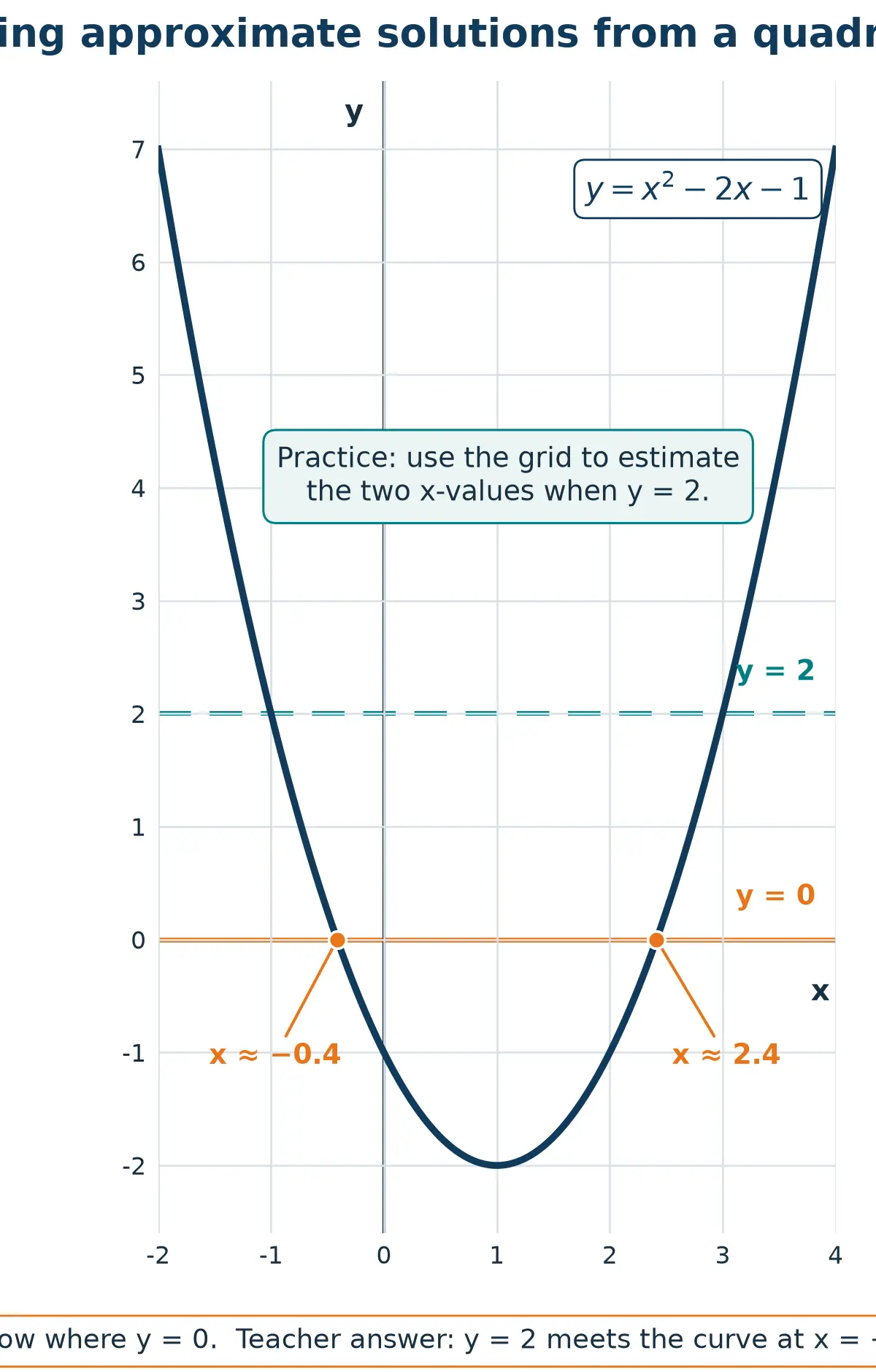
For the same function, solve f(x)=2 by drawing the horizontal line y=2. It meets the curve at x=-1 and x=3, so the solutions are -1 and 3. A quick algebra check is x^2-2x-1=2, hence x^2-2x-3=0, which factorises to (x-3)(x+1)=0. On a graph, always read the intersection x-coordinates, not their y-coordinates, unless the question asks for coordinates.
Retrieval Checkpoints
Try these without notes. They are original practice prompts, not Pearson questions or allocations.
- Factorise and solve x^2-7x+12=0.
- Explain why the zero-product rule cannot be used directly on (x-1)(x+4)=8.
- Solve x(x+5)=0 without dividing by x.
- State the number and type of real roots of x^2-6x+9=0.
- For y=f(x), what does an x-axis intercept mean?
- A positive rectangle side is x and the other is x+3. If its area is 28\text{ cm}^2, what are the side lengths?
Answers. For 1, (x-3)(x-4)=0, so x=3,4. For 2, the product is 8 rather than zero, so neither factor is forced to be zero. For 3, x=0 or x+5=0, giving 0,-5. For 4, there is one repeated real root, x=3. For 5, it is a root: an input where f(x)=0. For 6, x^2+3x-28=0=(x+7)(x-4), so x=4 after rejecting -7; the sides are 4 cm and 7 cm.
Ten-minute Podcast
Listen to a warm British female tutor and answer before she does. 00:00–01:00, introduction: what Foundation A18 covers and how to listen actively. 01:00–06:00, core concepts: rearrange, factorise, solve, check, then distinguish root types and graph intersections. 06:00–08:00, exam tips: authentic three-mark scheme, command words, timing and common errors. 08:00–09:00, recall quiz: factor-pair conditions, bracket signs, zero roots, repeated roots and the correct horizontal line. 09:00–10:00, summary: retrieve the complete method and plan a later revision attempt. The full transcript is included in the podcast_script field.
References
Download the complete resource
Visual Resources
3 diagrams and illustrations
Interactive Diagrams
2 interactive diagrams to visualise key concepts
Conceptual Flow Outline
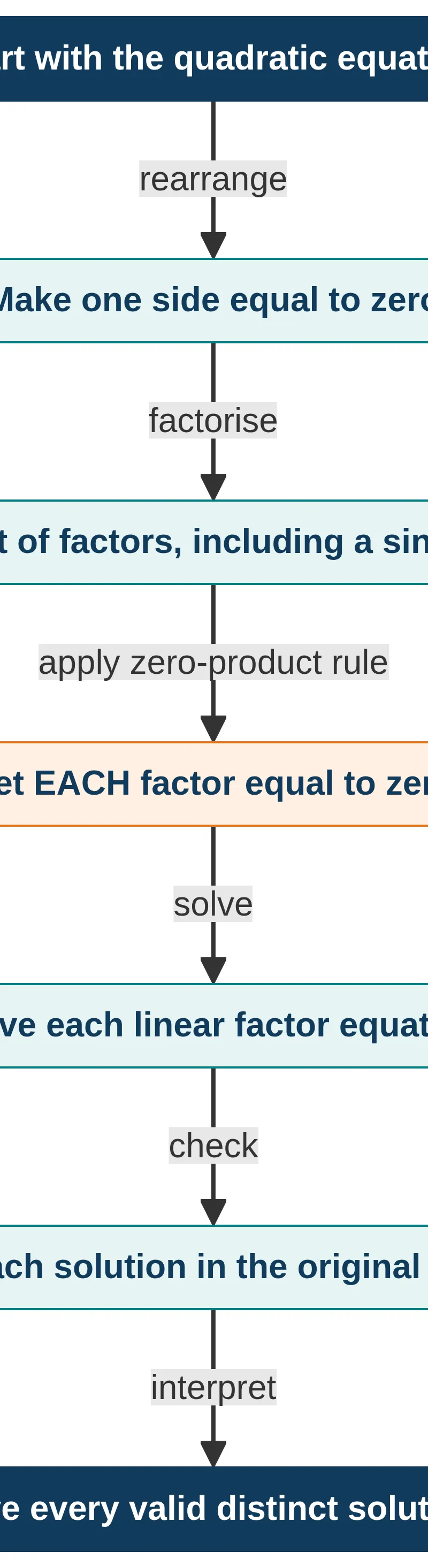
Rearrange to zero, factorise, set each factor equal to zero, solve and check every solution.
Conceptual Flow Outline
Connect two distinct roots, a repeated root and no real roots to the ways a quadratic graph meets the x-axis.
Worked Examples
4 worked examples — open one to explore the question and available guidance.
Practice Questions
Try the question, then reveal an answer plan or example response
Original practice, 3 marks: Solve x² + 7x + 12 = 0 by factorising. Show your working.
Hint: Find two positive numbers with product 12 and sum 7, then solve the bracket equations.
Original practice, 3 marks: Solve x² − 5x = 0 by factorising. Show your working.
Hint: Take out the common factor x. Treat the single x as a factor in its own right.
Original practice, 3 marks: Solve x² − 8x + 16 = 0 by factorising, and state whether the equation has two distinct roots or a repeated root.
Hint: Which equal factor numbers multiply to 16 and add to −8?
Original practice, 3 marks: Solve x² − 25 = 0 by factorising.
Hint: Use the difference-of-two-squares pattern, not two identical brackets.
Original practice, 4 marks: Solve x² + x = 20 by factorising. Show your working.
Hint: Make one side zero before choosing the factor pair.
Original practice, 4 marks: Use graph_estimation.png. (a) Estimate the solutions of x² − 2x − 1 = 2. [2 marks] (b) State the number of real solutions of x² − 2x − 1 = −3 and explain your answer from the graph. [2 marks]
Hint: For part (a), use the dashed y = 2 line. For part (b), compare the line y = −3 with the minimum of the curve.
Original practice, 2 marks: Explain why x² + 4 = 0 has no real solution.
Hint: What is the smallest possible value of x² for a real x?
Original practice, 6 marks: A rectangle has width x cm and length (x + 5) cm. Its area is 36 cm². (a) Form an equation with one side zero. [2 marks] (b) Solve by factorising. [3 marks] (c) Give the dimensions, explaining any rejected root. [1 mark]
Hint: Form x(x + 5) = 36, then find numbers that multiply to −36 and add to 5.
Exam technique
How to turn what you know into marks
How to approach the question
Identify the command word and the requested method. For algebra, write the equation with one side zero, choose the factor pair, factorise and solve each factor equation. For a graph, first decide whether the target line is y = 0 or y = another stated value. Check the scale and all intersections. In a context, define the unknown and check which algebraic roots are admissible.
How to structure your answer
A 3-mark factorisation solution should visibly reach correct factors and all roots; the actual allocation comes from that question’s scheme. A longer question may additionally credit forming an equation, rearranging, plotting, reasoning or interpretation. Use one meaningful algebraic step per line. Finish with ‘x = … or x = …’, or with the requested contextual dimensions. All allocations for the original worked and practice questions in this guide are illustrative.
Timing
Each Pearson Edexcel 1MA1 paper is 90 minutes for 80 marks, an overall average of 1.125 minutes per mark. Aim at about 1 minute per mark to retain checking time: approximately 3–4 minutes for 3 marks, 4–5 minutes for 4 marks and 6–7 minutes for 6 marks. These are planning targets, not official question time limits.
Common pitfalls
- Using the zero-product rule before the product equals zero. Rearrange first.
- Choosing numbers with the correct product but the wrong sum. Check both conditions.
- Copying bracket signs into the roots. Solve x + p = 0 to obtain x = −p.
- Stopping after factorising when asked to solve. State the values of x.
- Dividing by x and losing the x = 0 root. Keep x as a factor.
- Giving two different values for a repeated root. A squared bracket gives one distinct solution.
- Claiming no real roots just because no integer factor pair works. A graph or a valid non-negativity argument is needed.
- Reading the y-intercept or turning point instead of the x-intercepts. For f(x) = 0, use y = 0.
- Using the x-axis for f(x) = 2. Use the horizontal line y = 2.
- Rejecting every negative algebraic root. Reject a value only when the question’s context excludes it.
What the command words want
- Solve
- Find every value of the unknown that satisfies the equation. Factors alone are not the answer.
- Compare
- Identify the particular similarities or differences asked for, such as two distinct roots versus one repeated root. This is less typical than ‘Solve’ here.
- Explain
- Give a mathematical reason linked to the claim, such as ‘because a real square is non-negative’.
- Describe
- State the requested graph feature precisely, such as ‘the curve touches the x-axis at x = 3’.
- Evaluate
- In mathematics, ‘evaluate’ usually means work out the value of an expression, not weigh up both sides of an argument. Substitute carefully if a value of x is supplied.
- Factorise
- Rewrite the expression as a product of factors. Do not add an equals-zero equation unless one is given or required.
- Show that
- Derive the given result through valid intermediate steps. Quoting the supplied answer is not proof.
- Show your working
- Display the method used, including factorisation and factor equations. A bare answer does not satisfy an explicit requirement for working.
- Calculate/Work out
- Carry out the necessary calculation, show useful working and include contextual units.
- Write down/State/Give
- Supply the requested value or statement directly, for example both estimated roots. Answer length depends on what is asked, not a fixed word count.
- Use the graph/Estimate
- Read the appropriate intersections from the supplied graph. Match the requested accuracy to its scale and use ≈ for estimates.
Watch or listen (optional)
Test your understanding of Algebra - Solving equations and inequalities: solve quadratic equations algebraically by factorising; find approximate solutions using a graph (Foundation tier)
Active recall beats re-reading. Take an instant quiz now to test what you’ve learned and lock it into long-term memory.
7 days Premium · Then the free plan continues · No card, no charge