Pearson Edexcel · GCSE · Mathematics
Course version: 1MA1 · Version from Mar 2026
Algebra - Solving equations and inequalities: solve two simultaneous equations in two variables (linear/linear) algebraically; find approximate solutions using a graph (Foundation tier)
Two equations, one shared answer: learn to find the pair that makes both conditions true, then see why it is the crossing point of two lines. Master elimination, substitution and accurate graph reading to secure method and accuracy marks in Pearson Edexcel GCSE Mathematics, including Foundation-tier A19.
- 12 min read
- 5 worked examples
- 7 practice questions
- 11 key terms
Try the lesson
The start of the Algebra - Solving equations and inequalities: solve two simultaneous equations in two variables (linear/linear) algebraically; find approximate solutions using a graph (Foundation tier) lesson, made from checked teaching notes for this specification point.
Have a go first
Solve the simultaneous equations x + y = 7 and x − y = 3.
There is more to this lesson
The full lesson goes on to check your understanding and help you earn the marks. Create a free account to carry on, with your progress saved.
7 days Premium · Then the free plan continues · No card, no charge
Check what you remember
Read the wording for your board, then hide it and explain Simultaneous equations in your own words. Rough notes are fine. This is a self-check, with no mark or grade.
Reference: Pearson Edexcel
Two or more equations whose unknowns must have values that satisfy all equations at the same time.
Study Notes

Overview
Simultaneous equations are two conditions that must hold at the same time. Your task is to find one pair of values, usually x and y, that makes both equations true. One equation such as x + y = 8 has many possible pairs; a second independent equation identifies the shared pair. This turns algebra into a useful tool for comparing prices, interpreting graphs and finding unknown quantities.
For Pearson Edexcel GCSE Mathematics, specification A19 includes solving linear/linear pairs algebraically and finding approximate solutions using a graph at Foundation tier. Higher candidates study these skills too; linear/quadratic pairs are Higher-only and outside this guide. Expect questions asking you to solve a supplied pair, draw or interpret two straight lines, or form equations from a context. 1 2
Success depends on visible reasoning, not guessing. Candidates should show how they eliminate a letter or substitute an expression, then identify both unknowns. You will connect this topic to coordinates, gradients, rearranging equations and modelling. Use the diagrams to understand the methods, then cover the worked solutions and attempt the questions yourself. Your aim is a reliable routine that survives unfamiliar numbers and negative signs.
Key Concepts
1. A solution must satisfy both equations
Consider 2x + 3y = 19 and x + y = 8. The pair x = 5, y = 3 works because 2(5) + 3(3) = 19 and 5 + 3 = 8. Although x = 6, y = 2 satisfies the second equation, it fails the first: 12 + 6 = 18, not 19. A correct answer to only one equation is not a simultaneous solution.
Each point on a straight-line graph represents a pair that satisfies its equation. At the intersection, the same coordinates belong to both lines. For two non-vertical lines, different gradients guarantee exactly one intersection. The solution is therefore a point, not a range of values. Despite the wider specification heading mentioning inequalities, this guide solves equations; shaded inequality regions are a different task.
Cover and recall: Why does checking only x + y = 8 fail to prove that a pair is correct? Answer: many pairs satisfy that equation, so the second condition must also be checked.
2. Elimination: match, eliminate, substitute, check
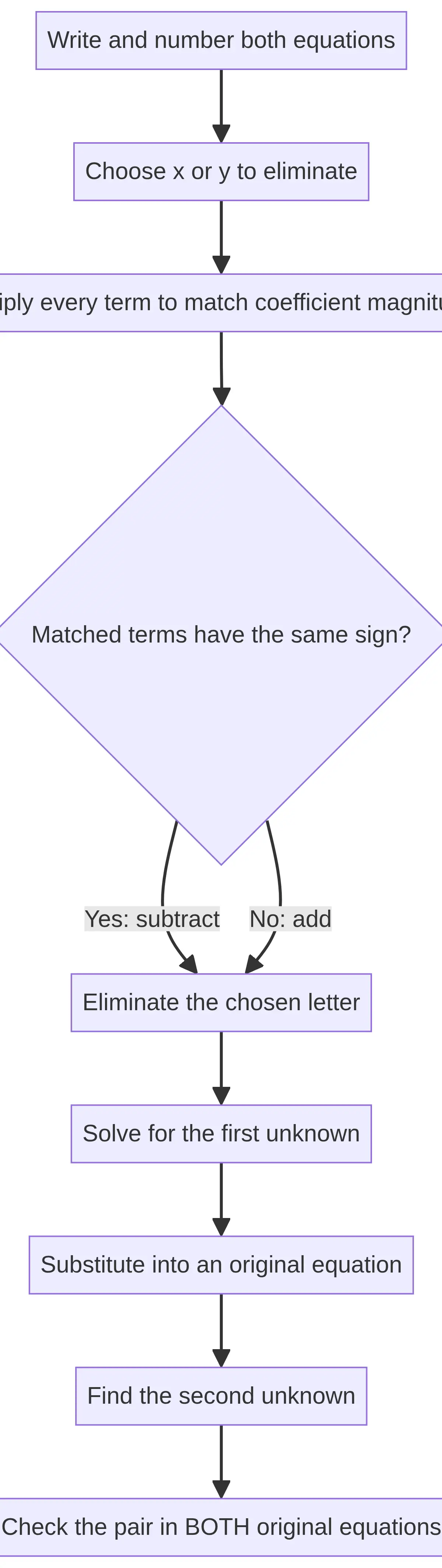
Elimination combines the equations so one letter disappears. Number the originals: (1) 2x + 3y = 19 and (2) x + y = 8. The coefficients of x are 2 and 1. Double every term of equation (2), including its right-hand side: (3) 2x + 2y = 16.
Subtract (3) from (1): (2x + 3y) − (2x + 2y) = 19 − 16. This gives y = 3. Substitute into original equation (2): x + 3 = 8, so x = 5. State both answers clearly. Check them in both originals, not just in your newly created equation.
Why does this work? Multiplying both sides of an equation by the same non-zero number preserves its solutions. If two left-hand sides equal their respective right-hand sides, subtracting those equal quantities also preserves equality. Keep an original equation alongside the new one: the eliminated equation alone does not contain all the original information.
Use MESC: Match, Eliminate, Substitute, Check. The routine is useful, but checking does not automatically earn an extra mark. Its main job is to catch an error before the accuracy mark is lost.
3. Choose addition or subtraction using the signs
Once the coefficient magnitudes match, same signs: subtract; opposite signs: add. For 3x + 2y = 16 and x − 2y = 0, add to obtain 4x = 16. Hence x = 4. Substitute into x − 2y = 0: 4 − 2y = 0, giving y = 2.
Subtracting here would produce 2y − (−2y) = 4y, so y would not disappear. When subtracting, put the whole second equation in brackets. For example, (3x + 2y) − (x − 2y) = 3x + 2y − x + 2y. The subtraction changes the sign of every term inside the second bracket, including a negative constant.
Candidates should line up the x terms, y terms and constants. Credit for a valid method can survive some arithmetic errors, depending on the actual question's scheme; untidy or missing working makes the method harder to identify. 3
4. When the coefficients do not match immediately
Choose the letter requiring the simplest multiplications. For 2x + 3y = 13 and 3x + 2y = 12, multiply the first equation by 3 and the second by 2. This gives 6x + 9y = 39 and 6x + 4y = 24. Subtract to get 5y = 15, so y = 3. Then 2x + 9 = 13, giving x = 2.
Matching x used the common multiple 6. Matching y would also work, producing coefficients of 6 for y. Prefer small multipliers to reduce arithmetic, but do not assume that multiplying both equations is automatically a different topic. This is a more demanding linear/linear application; Higher questions can use more involved algebra. 2
A negative or fractional result is not evidence of failure. Pearson's teaching guidance gives the Foundation specimen pair 4x + y = 25 and x − 3y = 16, worth 3 marks. Its solution is x = 7, y = −3. Check: 28 − 3 = 25 and 7 − 3(−3) = 16. 2
5. Substitution: replace a letter with an equal expression
If y = 2x + 1 and x + y = 10, substitute the expression 2x + 1 for y in the other equation. Then x + (2x + 1) = 10, so 3x + 1 = 10, 3x = 9 and x = 3. Return to y = 2x + 1 to get y = 7. Check 3 + 7 = 10.
Substitution works because equal expressions are interchangeable. It is often efficient when a variable is already isolated or has coefficient 1. If a replacement expression is multiplied, retain brackets: 3y becomes 3(2x + 1), not 6x + 1. Expand to obtain 6x + 3.
Substituting an equation into itself produces a statement such as 2x + 1 = 2x + 1. That is true but gives no new information. Elimination and substitution are equally valid when the instruction simply says solve algebraically; choose a clear method rather than switching repeatedly.
6. Graphical solutions: read the intersection
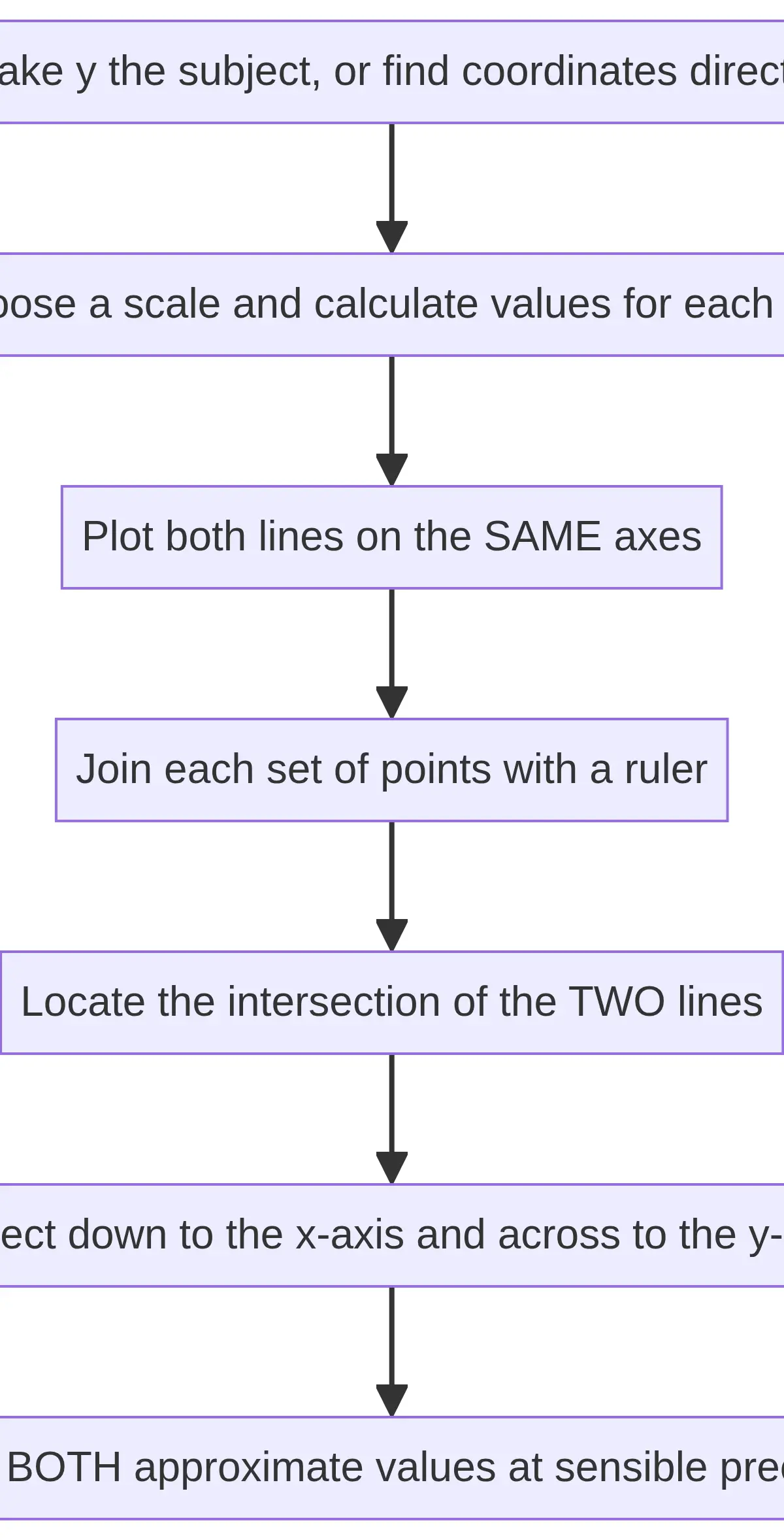
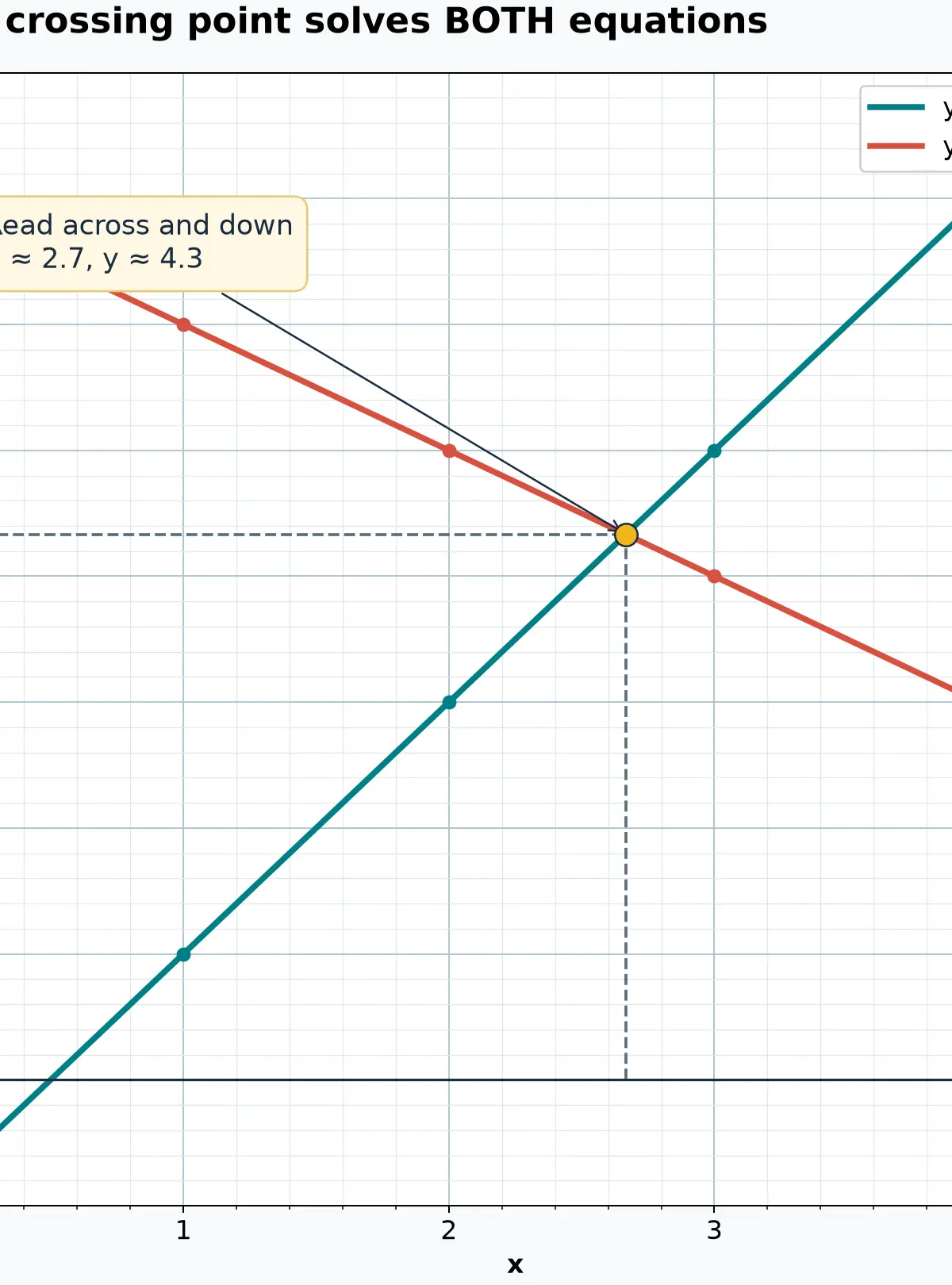
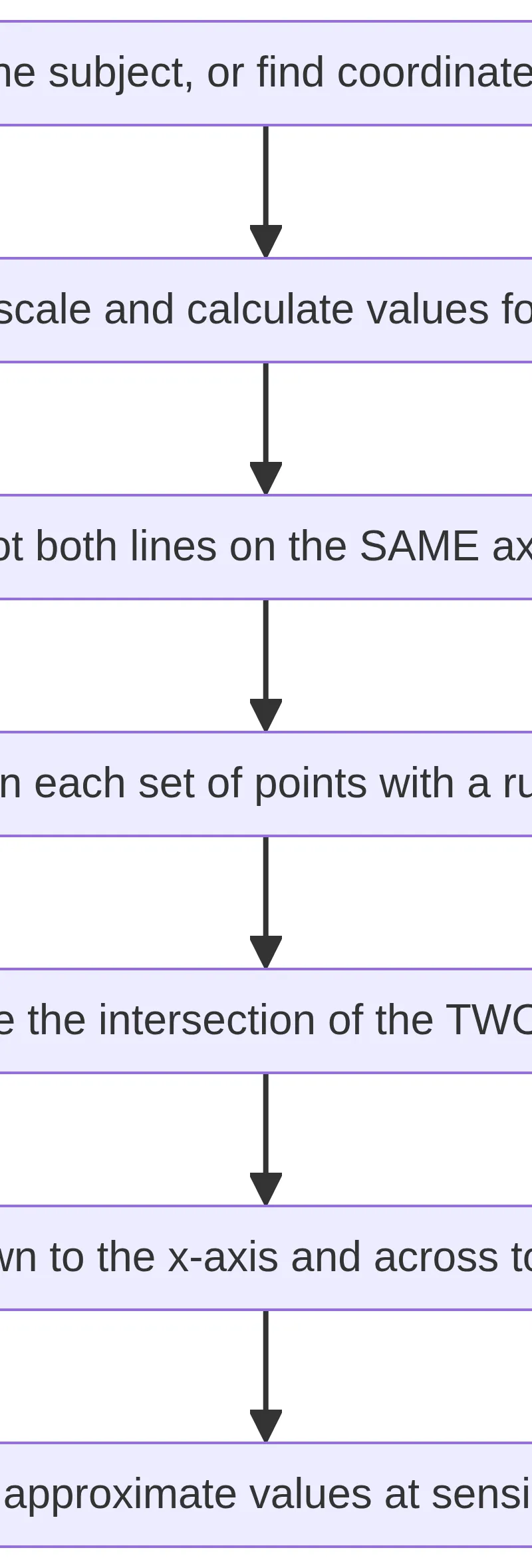
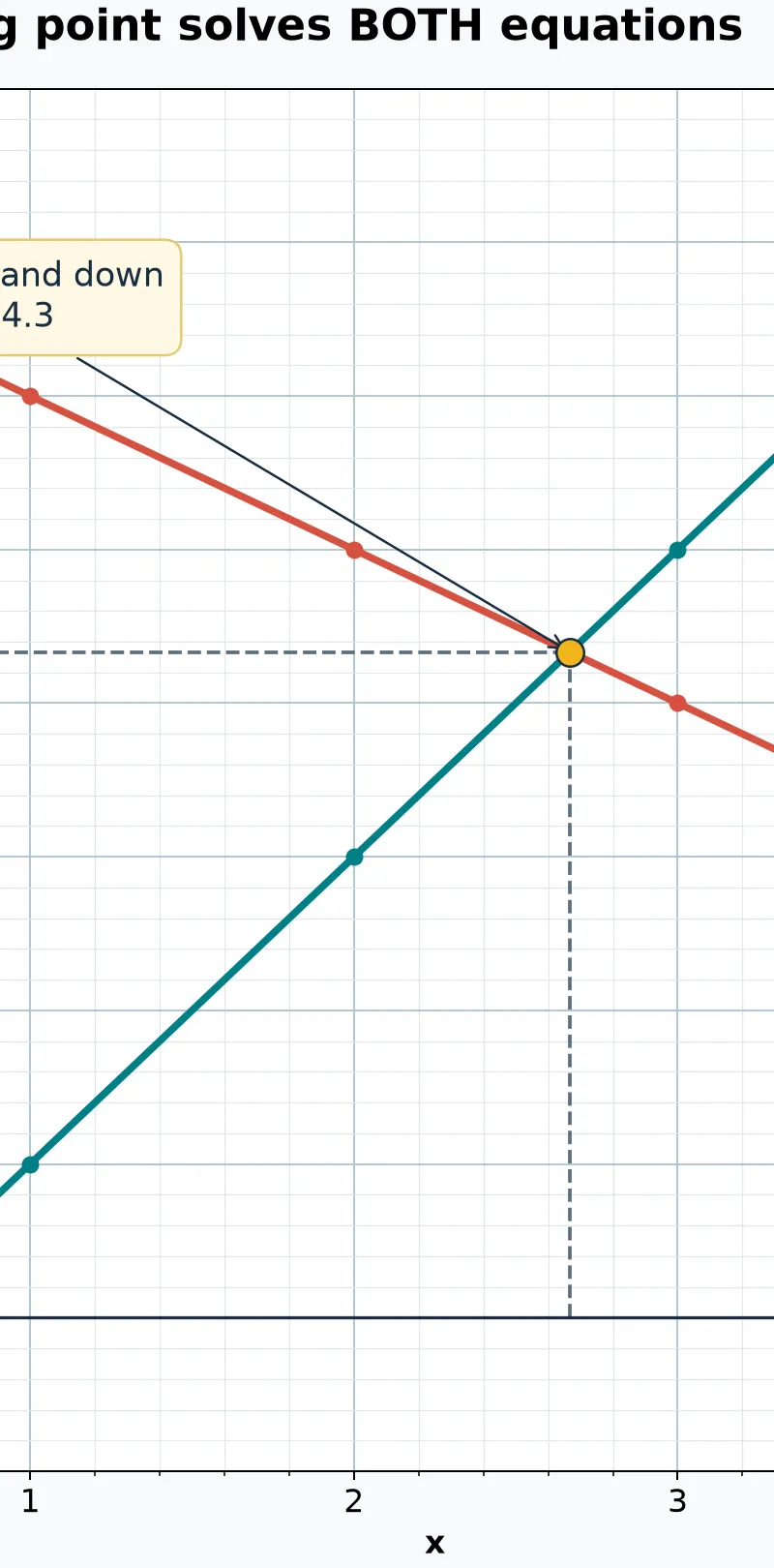
For y = 2x − 1 and y = −x + 7, calculate coordinates before drawing. Using x = 0, 2, 4, the first line gives y = −1, 3, 7 and the second gives y = 7, 5, 3. Plot both sets on the same axes. Two distinct points determine a straight line, but a third point checks your arithmetic. Join each set with a ruler and extend far enough to include the crossing.
Read vertically down from the intersection to obtain x and horizontally across to obtain y. The graph gives approximately x ≈ 2.7, y ≈ 4.3, to one decimal place. The plotted crossing is actually (8/3, 13/3); this exact comparison explains why the graphical answer is approximate, not permission to ignore a graphical instruction.
The image's small grid intervals represent 0.2 units. Half a small interval is therefore 0.1, not 0.5. Inspect each axis separately: exam grids can have different scales. A scale can differ between axes while remaining consistent along each axis. Label lines or use a key so the two equations remain identifiable.
Do not read an axis intercept unless the question asks for one. Do not swap coordinates: the order is always (x, y). If instructed to use the graph, show the required plotting or reading; a correct algebraic result cannot replace all the marks allocated to graph work. Use requested precision, or precision justified by the grid. Any accepted tolerance comes from that question's mark scheme, not a universal rule.
7. One solution, no solution or infinitely many
For non-vertical lines y = m₁x + c₁ and y = m₂x + c₂, different gradients mean one intersection. Equal gradients with different intercepts mean distinct parallel lines and no solution. Equal gradients and equal intercepts mean the same line and infinitely many solutions. A vertical line and a non-vertical line also meet once, even though a vertical line has no finite gradient.
Algebra confirms these cases. The equations x + y = 4 and 2x + 2y = 10 lead to 0 = 2 after doubling and subtracting. That contradiction means no solution. By contrast, x + y = 4 and 2x + 2y = 8 lead to 0 = 0: the second equation repeats the first, so every point on x + y = 4 is a solution.
Why question: Why is 0 = 0 not a unique numerical answer? Because no remaining condition selects one pair from all points on the line.
Mathematical Relationships
Formula-sheet status: The relationships below are labelled Must memorise, meaning understand and be able to use them. They are not supplied on Pearson's published 2026 Foundation formula sheet. There is no separate simultaneous-equation formula on that sheet. Equations printed in a question are given data, not formula-sheet support. 4
Must memorise: ax + by = c. This is a general linear equation in two variables. Here x and y are unknowns, a and b are coefficients and c is a constant, with a and b not both zero. A pair of such equations can be solved together.
Must memorise: y = mx + c. Here m is the gradient and c is the y-intercept. In this form c labels the intercept, not necessarily the same constant as in an earlier ax + by = c equation.
Must memorise: m = (y₂ − y₁)/(x₂ − x₁), provided x₂ ≠ x₁. Gradient is change in y divided by change in x. It explains why different slopes give one crossing.
Must memorise: ax + by = c gives y = (c − ax)/b when b ≠ 0. Use this rearrangement to generate plotting values. When b = 0 and a ≠ 0, the graph is vertical: x = c/a.
Must memorise: m₁x + c₁ = m₂x + c₂ at an intersection. Both lines have the same y there. You can solve this equality algebraically, then substitute for y, if the task permits an algebraic method.
Must memorise: ax + by = c implies kax + kby = kc for k ≠ 0. Scale the whole equation when matching coefficients. Addition and subtraction must also include both right-hand constants. These are equality rules, not extra formulae to hunt for on the exam aid.
Practical Applications and Units
Let a be an adult ticket price in pounds and c a child ticket price in pounds. Two adults and three children pay £34, while one adult and two children pay £20. Model this as 2a + 3c = 34 and a + 2c = 20. Double the second, then subtract the first: c = 6. Substitute to find a = 8. State adult £8; child £6, not just an unexplained ordered pair.
Two taxi tariffs, C = 3 + 2d and C = 7 + d, charge the same when d = 4 kilometres and C = £11. The intersection answers when the costs are equal; a comparison before or after that point needs an additional interpretation of the graph. This links A19 to straight-line gradients and contextual modelling in A21. 1
Pure algebra has no compulsory units. In context, keep units consistent: £1 = 100p, 1 metre = 100 centimetres and 1 hour = 60 minutes. Convert only when required. For instance, do not combine 2a in pounds with a total written as 3400 pence without converting. A time of 1.5 hours is 90 minutes, not 150. This mathematics topic has no required practical; plotting is a mathematical skill, not a laboratory practical.
Earning Marks and Revising Actively
A real allocation is November 2023 Paper 2F, question 30: M1 for elimination or a method leading to substitution; dependent M1 for substituting the found value or a correct restarted method; A1 for both correct values, x = −2 and y = 1.5. Its method instructions condone one arithmetic error. This does not guarantee an accuracy mark for a wrong pair or automatic follow-through elsewhere. 3
All newly written examples and practice schemes here are original Edexcel-style teaching material, not official Pearson questions or marking guarantees. Marks awarded in a live examination follow its published scheme. Each Edexcel paper has 80 marks in 90 minutes, averaging 67.5 seconds per mark. As a flexible guide, allow 3–4 minutes for 3 marks and 6–7 minutes for 6 marks. 1
For retrieval practice, cover the solution, choose an operation and write the first two lines from memory. Then solve a fresh pair. After checking, identify the first incorrect step rather than copying the entire answer. Revisit tomorrow and a few days later, alternating an algebra question with a graph question. Ask yourself why each operation preserves the original solution.
Ten-Minute Tutor Podcast
A warm female tutor guides you through introduction (00:00–01:00), core concepts (01:00–06:00), exam tips (06:00–08:00), recall quiz (08:00–09:00) and summary (09:00–10:00). Try responding before hearing the quiz answers, then solve a new question without the audio.
References
Visual Resources
3 diagrams and illustrations

Interactive Diagrams
2 interactive diagrams to visualise key concepts
Conceptual Flow Outline
Elimination decision process: match magnitudes, select the correct operation, find both values and check.
Conceptual Flow Outline
Graphical solution process: plot both lines accurately on common axes and read their intersection.
Worked Examples
5 worked examples — open one to explore the question and available guidance.
Practice Questions
Try the question, then reveal an answer plan or example response
Solve algebraically x + y = 9 and x − y = 3. Show your working. Original Edexcel-style question.
Hint: The y terms already have opposite signs and equal magnitudes.
Solve algebraically 3x + 2y = 18 and x + y = 7. Show your working. Original Edexcel-style question.
Hint: Double the second equation to eliminate y.
Solve 2x + y = 7 and 3x − y = 8 algebraically. Show your working. Original Edexcel-style question.
Hint: Which operation cancels +y and −y?
Solve algebraically y = 3x − 2 and x + y = 10. Show your working. Original Edexcel-style question.
Hint: Replace y in the second equation with the expression from the first.
On squared paper draw y = 2x + 1 and y = −x + 6 for 0 ≤ x ≤ 3, with axes covering 0 ≤ y ≤ 7. Use small grid intervals of 0.2 units. Use your graph to solve the simultaneous equations approximately to one decimal place. Original Edexcel-style question.
Hint: Use x = 0, 1 and 3 to plot each line. Find where the two lines cross.
Solve algebraically 2x + 3y = 13 and 3x + 2y = 12. Show your working. Original Edexcel-style stretch question.
Hint: Make both x coefficients 6 by multiplying the first equation by 3 and the second by 2.
Two pens and three notebooks cost £12. One pen and two notebooks cost £7. Form simultaneous equations and calculate the cost of a pen and a notebook. Show your working. Original Edexcel-style question.
Hint: Let p and n be the individual prices in pounds. Double the second equation.
Exam technique
How to turn what you know into marks
How to approach the question
Identify the command word and any required method. For algebra, line up and number the equations, choose a letter, match coefficient magnitudes, add or subtract appropriately, solve and back-substitute. If a variable is already isolated, substitution may be quicker. For a graphical instruction, plot or inspect both lines on the same axes and read their intersection. For a context, define both unknowns and units before forming equations.
How to structure your answer
For a typical 3-mark supplied pair, a visible elimination/substitution step, back-substitution and both labelled values are a useful model. For 4 marks, show any scaling explicitly and retain the intermediate equation; graph questions may allocate marks separately to the lines and coordinates. For 5–6-mark contextual tasks, include defined variables, both equations, the algebra and an interpreted answer. These are illustrative structures, not universal Pearson allocations. Published November 2023 2F Q30 specifically uses M1, dependent M1, A1 for both values.
Timing
Each Edexcel 1MA1 paper is 90 minutes for 80 marks: 67.5 seconds per mark on average. Use roughly 3–4 minutes for 3 marks, 4–5 minutes for 4 marks and 6–7 minutes for 6 marks as flexible planning, not board-imposed question timings.
Common pitfalls
- Subtracting matched opposite-sign terms: add them instead, because 3y + (−3y) = 0.
- Multiplying only part of an equation: multiply every term on both sides.
- Forgetting the right-hand constants when adding or subtracting: line constants up with the algebra.
- Losing a minus sign on subtraction: bracket the whole equation being subtracted.
- Stopping after one unknown: substitute and report both x and y.
- Checking only a derived equation: verify both original equations independently.
- Swapping graph coordinates or reading an axis intercept: use the crossing of the two lines and label x and y.
- Inventing precision: use the requested rounding and actual grid scale.
- Assuming a wrong first value guarantees credit for the second: method and follow-through depend on the specific scheme.
- Mixing pounds and pence in a model: choose one unit and convert all amounts consistently.
What the command words want
- Solve
- Find all values satisfying the equations. For a usual unique linear pair, report both unknowns.
- Compare
- Compare the requested features, such as gradients or costs. Answer the actual comparison; a generic similarities-and-differences essay is not required.
- Explain
- Give a mathematical reason linked to the claim: for example, different gradients mean the two non-vertical lines meet once.
- Describe
- Describe the mathematical feature requested, such as the lines being parallel. This is less central here than solve or use the graph.
- Evaluate
- In mathematics, evaluate usually means work out the value of an expression. It does not normally mean discuss both sides of an argument.
- Calculate
- Show the relevant calculation and identify both unknowns when needed; include units in a contextual answer.
- Show that
- Present a valid chain of reasoning reaching the supplied result; repeating the stated answer is not proof.
- State/Give
- Give the requested value or pair clearly. If reading coordinates, preserve (x, y) order. Do not write an unnecessary essay.
- Use the graph
- Obtain the answer from the graph, showing required plotting or reading. Read both coordinates of the intersection.
- Solve algebraically
- Use elimination or substitution with clear working; a graph alone does not meet the instruction.
Watch or listen (optional)
Test your understanding of Algebra - Solving equations and inequalities: solve two simultaneous equations in two variables (linear/linear) algebraically; find approximate solutions using a graph (Foundation tier)
Active recall beats re-reading. Take an instant quiz now to test what you’ve learned and lock it into long-term memory.
7 days Premium · Then the free plan continues · No card, no charge