Pearson Edexcel · GCSE · Mathematics
Course version: 1MA1 · Version from Mar 2026
Algebra - Solving equations and inequalities: solve two simultaneous equations in two variables (linear/linear or linear/quadratic) algebraically; find approximate solutions using a graph (Higher tier)
Two equations, one shared set of answers: learn to eliminate or substitute, then keep every x matched with its y. This Higher-tier guide turns linear/quadratic algebra and graph intersections into a repeatable, mark-focused process, with worked solutions, visual explanations and a ten-minute revision podcast.
- 12 min read
- 6 worked examples
- 6 practice questions
- 11 key terms
Try the lesson
The start of the Algebra - Solving equations and inequalities: solve two simultaneous equations in two variables (linear/linear or linear/quadratic) algebraically; find approximate solutions using a graph (Higher tier) lesson, made from checked teaching notes for this specification point.
Have a go first
Solve the simultaneous equations y = x + 1 and x² + y² = 25.
There is more to this lesson
The full lesson goes on to check your understanding and help you earn the marks. Create a free account to carry on, with your progress saved.
7 days Premium · Then the free plan continues · No card, no charge
Check what you remember
Read the wording for your board, then hide it and explain Simultaneous equations in your own words. Rough notes are fine. This is a self-check, with no mark or grade.
Reference: Pearson Edexcel
Two or more equations that must hold for the same values of the variables.
Study Notes
Overview
Simultaneous equations ask you to find values of two unknowns that satisfy two conditions at the same time. Think of each equation as a rule: a successful answer must obey both rules, not just one. In a graph, the solution is an intersection because that point belongs to both graphs. In algebra, you reduce the two equations to one unknown, solve it, then recover the matching value of the other unknown.
For Pearson Edexcel GCSE Mathematics, specification 1MA1, A19, candidates must solve simultaneous equations algebraically and find approximate solutions graphically. Linear/linear work is assessed at both tiers; linear/quadratic work is Higher-only. This guide develops both so you can choose a method rather than apply a memorised routine blindly. 1
Questions may say “solve algebraically”, ask you to draw or use graphs, or hide the equations inside a geometry or modelling problem. The supporting skills are rearranging formulae, expanding brackets, factorising, using the quadratic formula and reading coordinates. Clear working makes your method visible. A complete answer usually means an ordered pair, or two ordered pairs, with each x securely matched to its y.
Key Concepts
1. What counts as a simultaneous solution?
The pair (3, 1) solves 2x + y = 7 and x − y = 2 because 2(3) + 1 = 7 and 3 − 1 = 2. Checking only one equation is insufficient: infinitely many points satisfy either straight-line equation individually. Solving simultaneously finds the shared point or points.
An ordered pair is written (x, y), in that order. If x = 3 and y = 1, the point is (3, 1), not (1, 3). In pure algebra, coordinates do not need units. In a word problem, attach the units and interpret the answer using the original definitions of the variables.
Cover and recall: What two substitutions would prove that (3, 1) is a solution? Write both checks before looking back.
2. Two linear equations: eliminate one variable
A linear equation has variables to the first power, such as 2x + y = 7. Elimination combines equations so one variable cancels. Add 2x + y = 7 and x − y = 2 to obtain 3x = 9. Hence x = 3. Substitute into x − y = 2 to obtain y = 1.
Why is this valid? The left and right sides of each equation are equal. Adding equal quantities preserves equality. Multiplying every term by the same non-zero number also preserves its solutions.
If the coefficients do not already match, create matching coefficients. For 3x + 2y = 12 and 2x − 3y = −5, multiply the first equation by 3 and the second by 2. This gives 9x + 6y = 36 and 4x − 6y = −10. Adding gives 13x = 26, so x = 2 and y = 3. Multiply every term, including the constant. Opposite coefficients cancel by addition; equal coefficients cancel by subtraction. Substitution is also valid for linear pairs.
3. Linear/quadratic pairs: substitution is the reliable route
A quadratic equation includes a squared variable, such as y = x² − 3 or x² + y² = 10. Substitution uses the linear equation to replace one variable throughout the quadratic equation. Choose the variable already isolated, or rearrange the linear equation to minimise fractions.
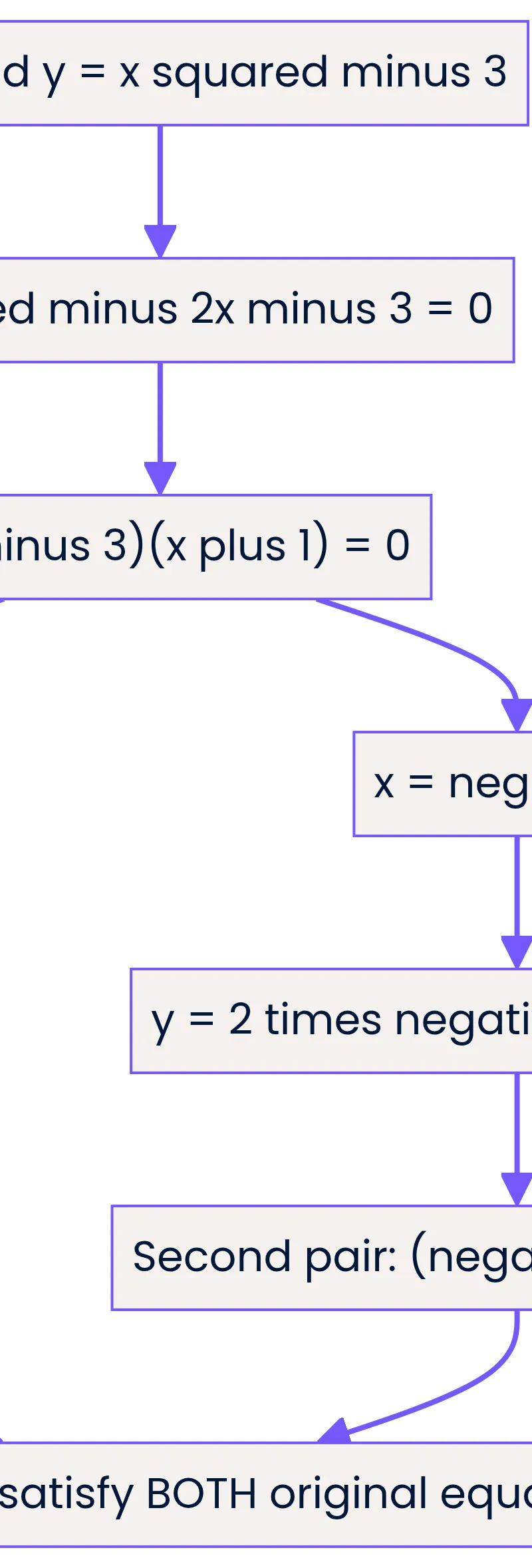
For y = 2x and y = x² − 3, replace y in the quadratic with 2x: 2x = x² − 3. This leaves only x. Rearrange to x² − 2x − 3 = 0, factorise to (x − 3)(x + 1) = 0, then obtain x = 3 or x = −1.
Important correction: elimination is not universally impossible when one equation is quadratic. If both equations give y, subtracting eliminates y and is equivalent to equating the two expressions. However, ordinary linear elimination does not generally remove squared terms in relations such as x² + y² = 10. Substitution is the dependable GCSE method, not a rule that forbids other correct algebra.
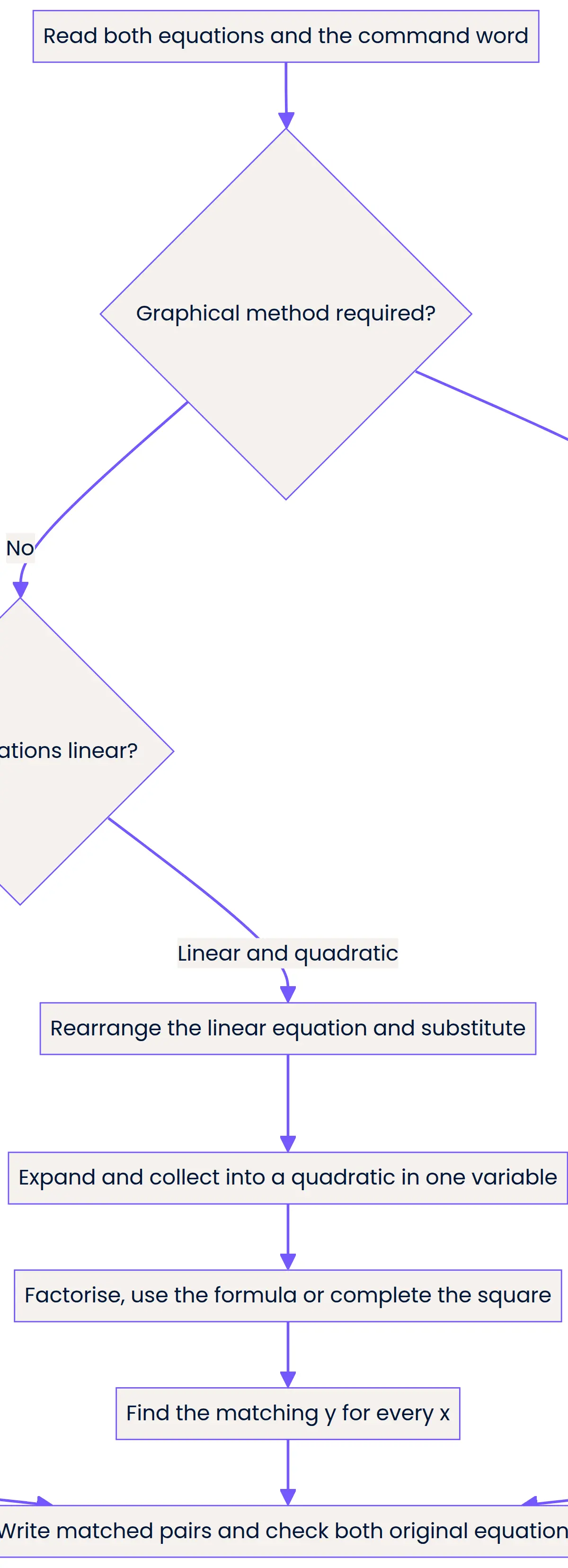
Why does this work? At a solution, the linear expression and the replaced variable have exactly the same value. Replacing equals with equals therefore preserves every simultaneous solution.
4. Substitute the whole expression, then expand carefully
Suppose x + y = 4 and x² + y² = 10. Rearrange to y = 4 − x. Since y² means y multiplied by itself, substitute (4 − x)², not 4 − x². Now x² + (4 − x)² = 10.
Expand (4 − x)(4 − x) to obtain 16 − 8x + x². The middle term comes from two cross-products: −4x and −4x. Collecting terms gives 2x² − 8x + 6 = 0. Divide every term by 2 to simplify before factorising.
Similarly, (x + 4)² = x² + 8x + 16, not x² + 16. Candidates commonly lose accuracy by omitting the middle term. Write a squared bracket as two identical brackets if you are uncertain. A negative number squared is positive when the whole negative number is squared: (−3)² = 9, whereas −3² means −9 under the usual order of operations.
5. Solve the resulting quadratic without losing roots
First arrange the equation in the form ax² + bx + c = 0. Factorising works when suitable factors are easy to find. From (x − 3)(x + 1) = 0, at least one factor must be zero, giving two branches: x − 3 = 0 or x + 1 = 0.
If factorising is awkward, use the quadratic formula, which appears on Pearson's Higher-tier formula sheet. Identify a, b and c with their signs. In x² − x − 3 = 0, a = 1, b = −1 and c = −3. The formula gives x = (1 ± √13)/2. Use both signs. Completing the square is another valid Higher-tier method. 1 2
Do not divide an equation by x, x − 1 or another variable expression without checking whether that expression could be zero. Doing so can remove a valid root. Dividing every term by a known non-zero constant, such as 2, is safe. Keep exact fractions or surds unless the question requests rounding. On calculator papers, retain unrounded roots while finding y.
6. Match every x to its own y
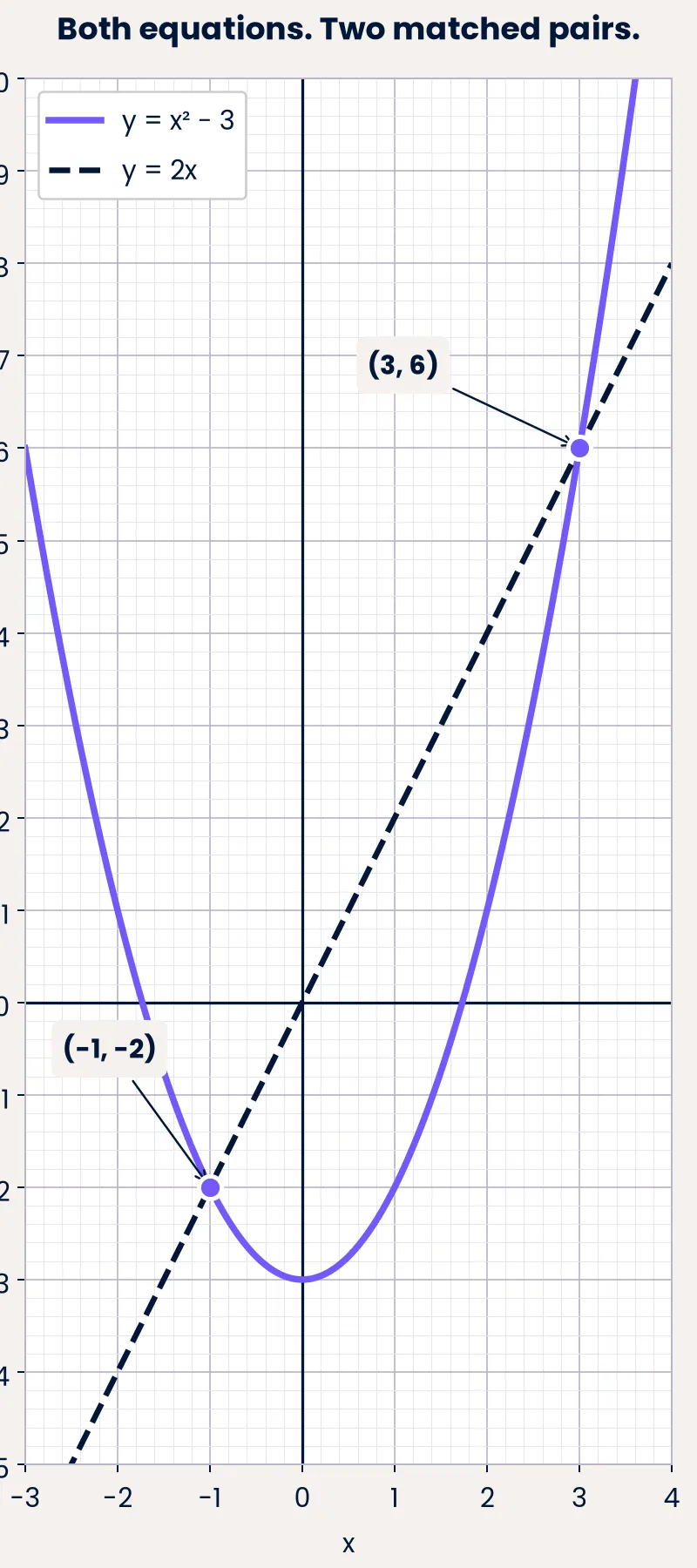
For y = 2x, the roots x = 3 and x = −1 give y = 6 and y = −2 respectively. Therefore the answers are (3, 6) and (−1, −2). Four disconnected numbers are a poor finish because their pairing can be ambiguous.
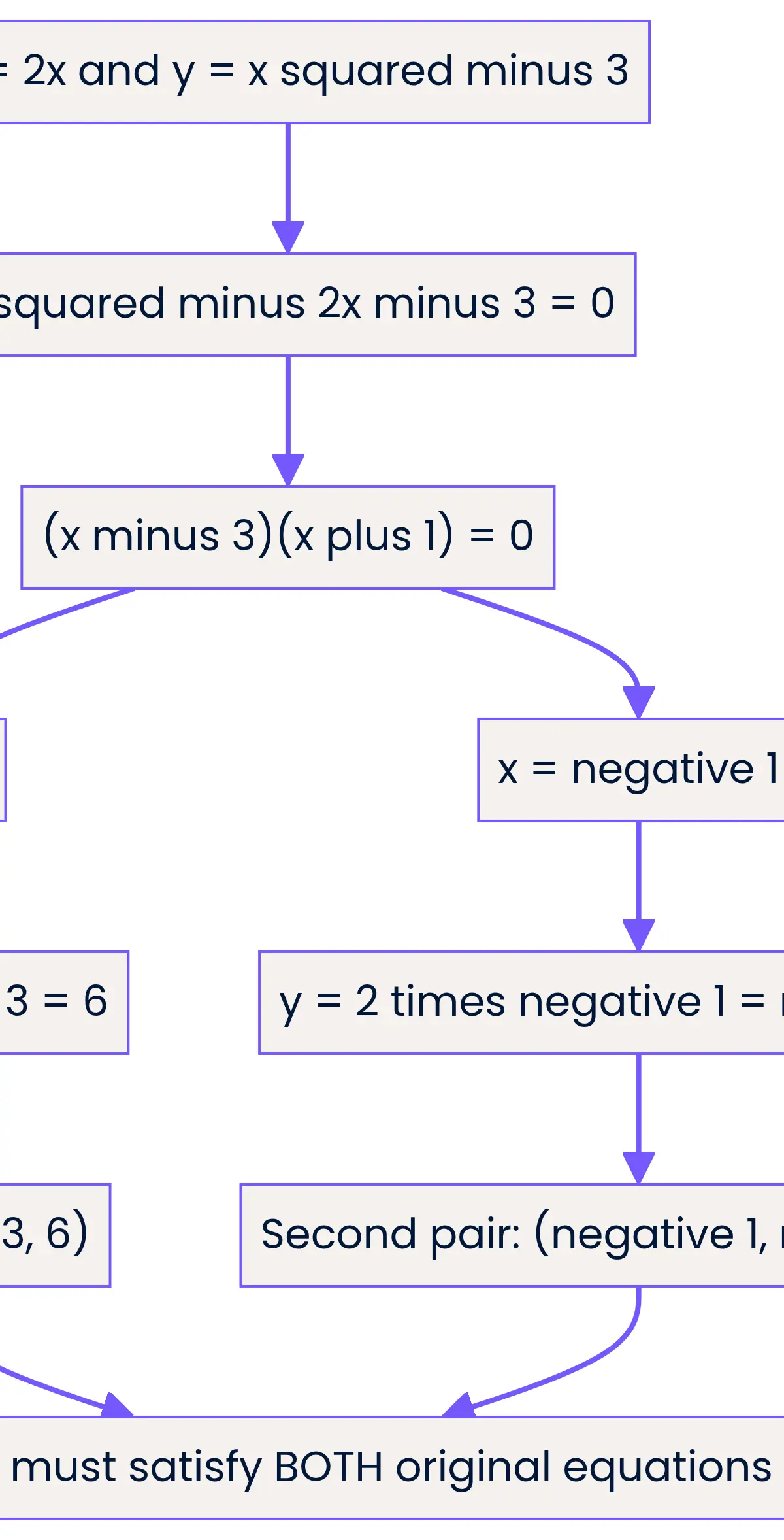
Write each branch on a separate line: “When x = 3, y = 6”; “when x = −1, y = −2”. Then check both equations for each pair if time permits. For (−1, −2), −2 = 2(−1) and −2 = (−1)² − 3. This checks the signs as well as the arithmetic.
Pearson's June 2022 Higher Paper 3, question 22, awarded three method marks followed by one accuracy mark for each correct solution pair. That published five-mark allocation demonstrates why finding x alone is not a complete response. It is not a universal allocation for every question. All original questions in this guide have illustrative, not official Pearson, mark schemes. 3
7. Graphical solutions: intersections, not intercepts
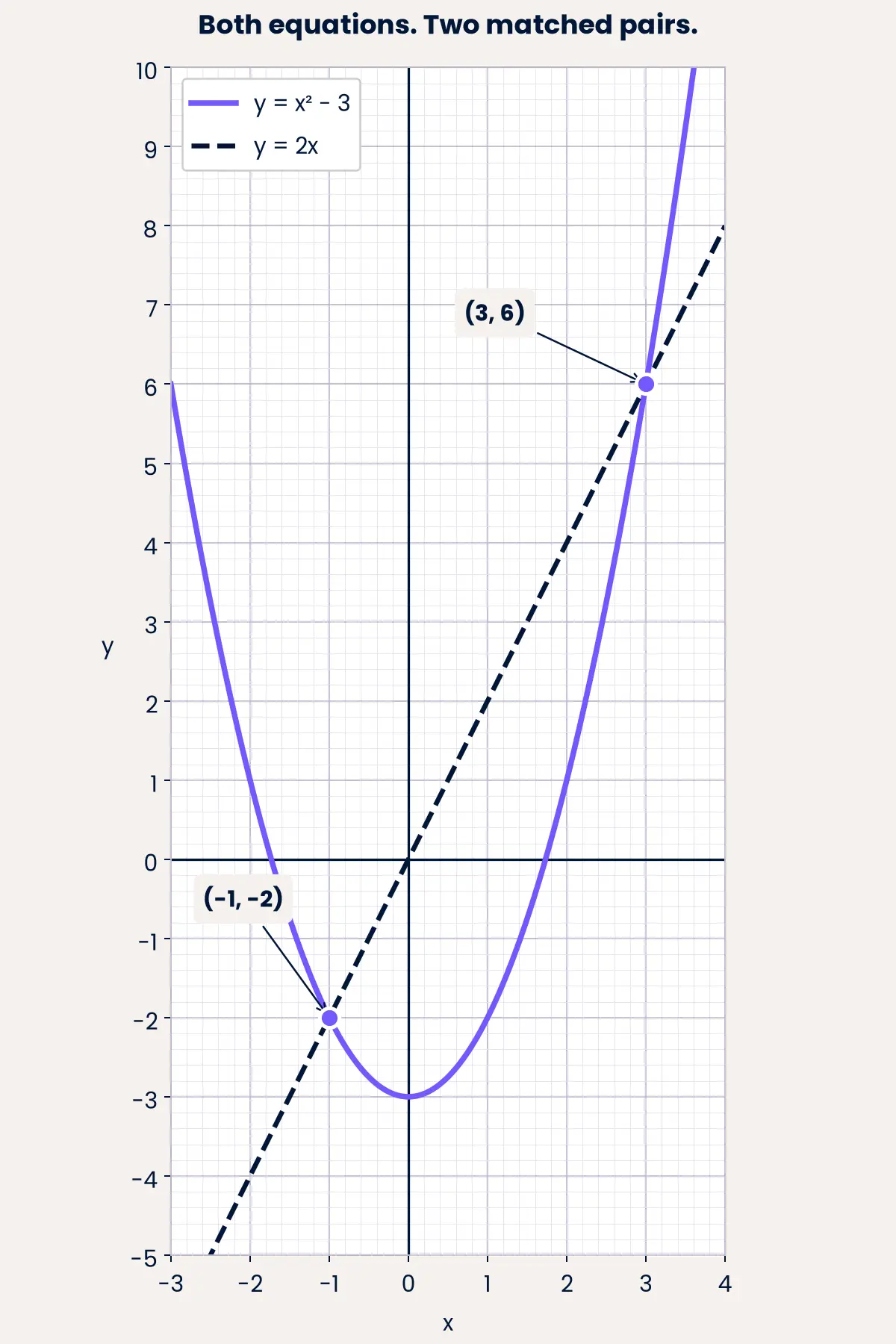
The purple parabola y = x² − 3 and dashed line y = 2x intersect at (−1, −2) and (3, 6). These are the same solutions obtained algebraically. An x-intercept of the parabola solves y = 0; it does not solve the simultaneous pair unless the other equation is also satisfied there.
When drawing graphs, check both axis scales first. Use a ruler for the line. Two accurate points define a straight line, but a third helps catch a plotting error. For the quadratic, calculate enough points to show its shape and turning region, plot them, then draw a smooth curve rather than straight segments. Negative x values must be substituted using brackets.
Read x and y from each intersection using light horizontal and vertical guide lines. Use the accuracy specified in the question. Otherwise report only the precision supported by the grid: a nearest-tenth estimate is often sensible on the practice grid here, but it is not a universal requirement. Do not invent extra decimal places. The exact acceptance interval is determined by the particular mark scheme.
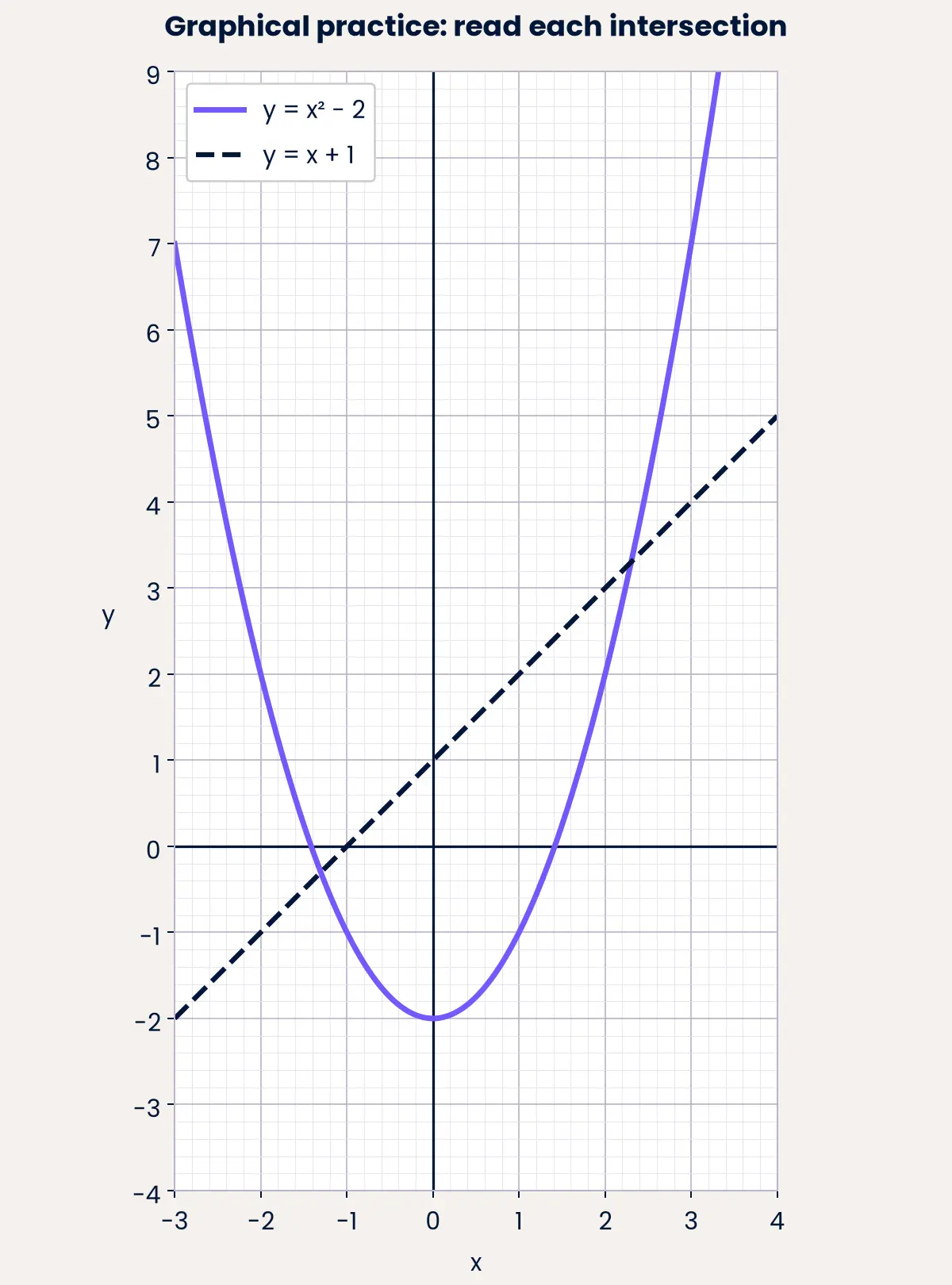
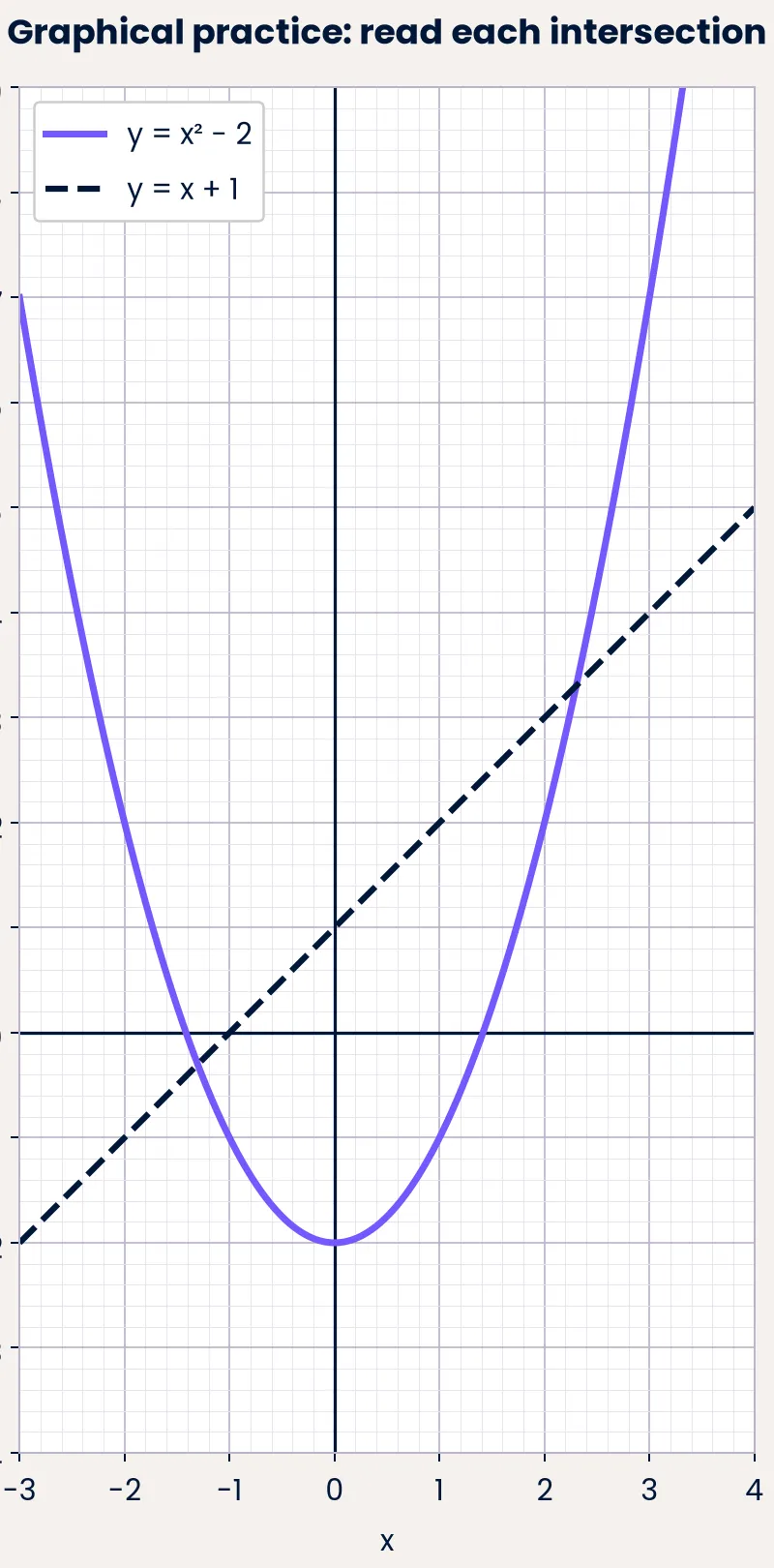
Try before checking: Use this graph to estimate the simultaneous solutions of y = x² − 2 and y = x + 1. Expect two coordinate pairs, approximately (−1.3, −0.3) and (2.3, 3.3). The worked example explains the reading method. A correct algebraic result does not replace a required graphical method.
8. Two, one or no real solutions
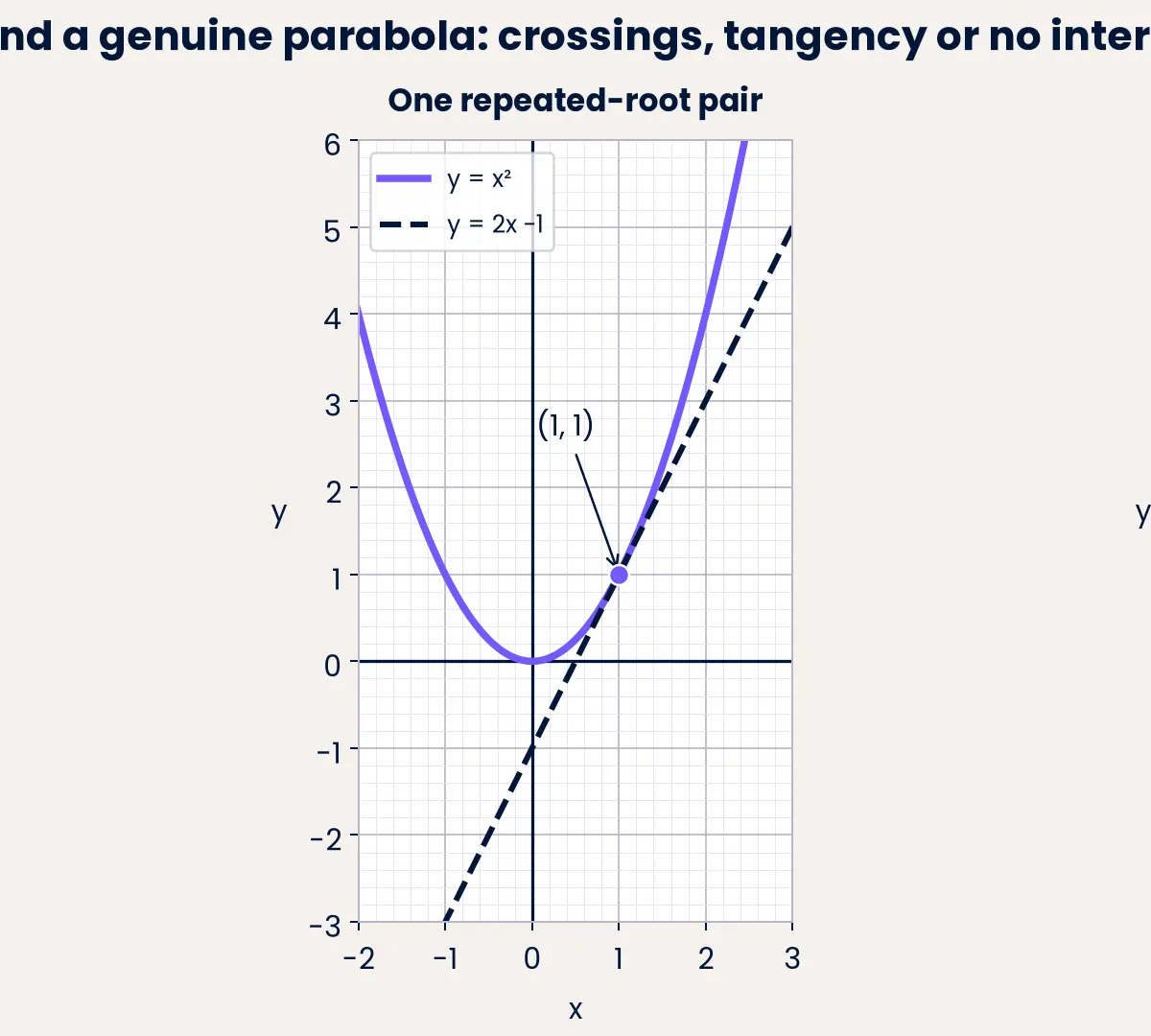
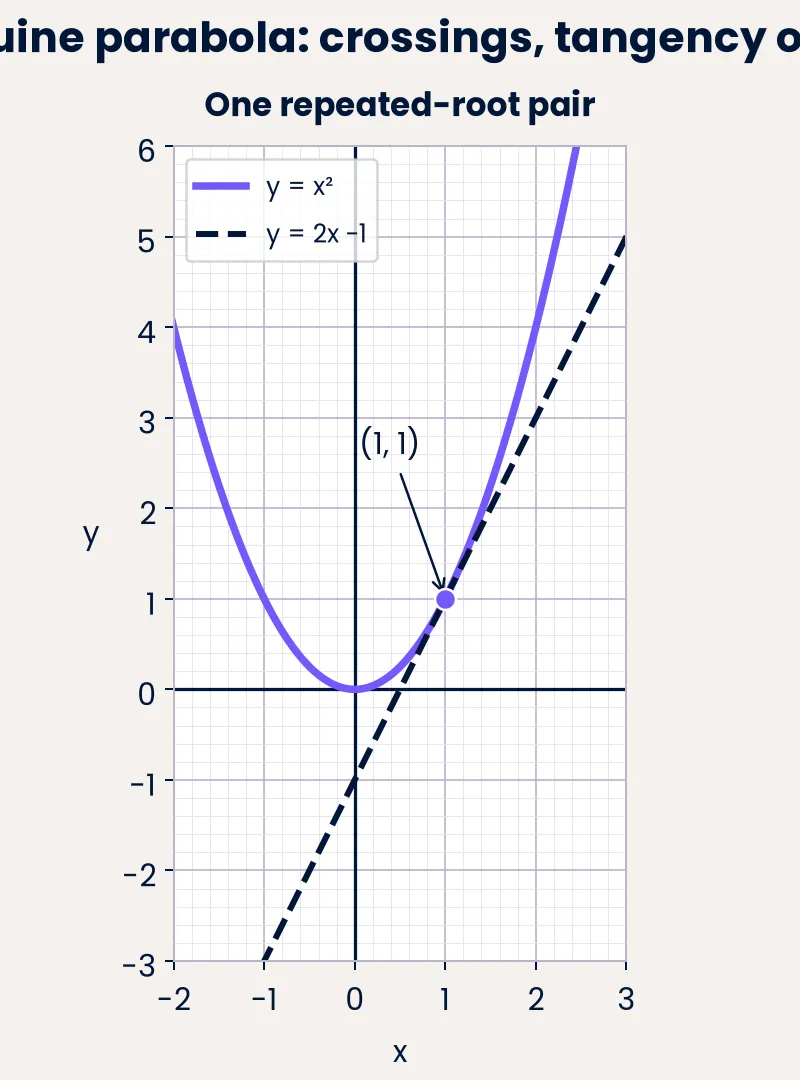
For a non-vertical straight line and a genuine parabola y = ax² + bx + c, with a ≠ 0, substitution produces a quadratic. Two distinct real roots mean two intersections. A repeated root means one intersection where the line is tangent. No real roots mean the graphs do not meet.
For y = x² and y = 2x − 1, equating gives x² − 2x + 1 = 0, or (x − 1)² = 0. There is one distinct pair, (1, 1), not two different points. For y = x² and y = −1, x² = −1 has no real solution because a real square cannot be negative.
The discriminant D = b² − 4ac explains these cases: D > 0 gives two real roots, D = 0 a repeated root, and D < 0 no real roots. This is useful enrichment derived from the quadratic formula. Do not assume formal discriminant terminology is required by every GCSE question. One visible intersection on a restricted grid does not prove tangency: a second might lie outside the window.
Mathematical/Scientific Relationships
The following are the relevant relationships for this topic, not a list of every formula on the GCSE course.
Given on formula sheet: x = [−b ± √(b² − 4ac)]/(2a), for ax² + bx + c = 0 and a ≠ 0. Here a, b and c are coefficients including their signs; x is the unknown. Apply the square root to the entire discriminant and divide the entire numerator by 2a. Pearson's 2026 Higher-tier aid supplies this formula; practise with the aid for your examination series. Pearson confirms continued formula-sheet provision for the current specification. 2 4
Must memorise: (u + v)² = u² + 2uv + v² and (u − v)² = u² − 2uv + v². These identities explain squared-bracket substitution. Also know u² − v² = (u − v)(u + v) when difference-of-squares factorisation appears.
Must memorise: PQ = 0 implies P = 0 or Q = 0. This is the zero-product rule. A quadratic must be set equal to zero before applying it to its factors.
Must memorise: y = mx + c describes a straight line: m is its gradient and c its y-intercept. At an intersection of y = f(x) and y = g(x), f(x) = g(x); substitute the resulting x into either expression to find y.
Must memorise: (x − h)² = k gives x = h ± √k for k ≥ 0. This is the square-root step after completing the square. The two signs still matter.
Must memorise if using this optional enrichment: D = b² − 4ac and its root-count interpretation. The expression appears inside the supplied quadratic formula, but the separate interpretation is not supplied on the formula sheet.
For the circle extension, x² + y² = r² describes a circle centred at the origin, where r is the radius. Must memorise as the coordinate-circle relationship. Its underlying Pythagorean relationship a² + b² = c² is Given on formula sheet. Do not confuse the coefficient c in a quadratic with a side labelled c in Pythagoras' theorem. 1 2
Practical Applications
Two pricing conditions can determine two unknown ticket prices. A rectangle with a known perimeter and area gives a linear equation from its perimeter and a quadratic relationship from its area. For side lengths x and y, 2x + 2y = P and xy = A; substitute y = P/2 − x to obtain one quadratic. Reject negative lengths only because the context demands positive measurements, not because negative roots are inherently wrong.
Circle-and-line intersections connect simultaneous equations to coordinate geometry and Pythagoras. Graphs can also show where two models predict the same value. State what each coordinate means in context.
There is no required practical for this mathematics topic. No special unit conversion is built into A19. In contextual questions, make units consistent before forming equations: use either pounds or pence throughout, and one length unit throughout. Area conversions are squared: 1 m² = 10,000 cm², not 100 cm².
Listen, Retrieve and Revisit
The ten-minute female-narrated episode follows this sequence: introduction 0:00–1:00; core concepts 1:00–6:00; exam tips 6:00–8:00; recall quiz 8:00–9:00; summary 9:00–10:00. Listen with a pen and attempt each prompt before hearing the answer. Afterwards, cover the method and solve a fresh problem. Revisit tomorrow and again several days later, mixing algebraic and graphical tasks so you must select the approach yourself.
References
Visual Resources
5 diagrams and illustrations
Interactive Diagrams
2 interactive diagrams to visualise key concepts
Worked Examples
6 worked examples — open one to explore the question and available guidance.
Practice Questions
Try the question, then reveal an answer plan or example response
Original exam-style question: Solve algebraically 3x + 2y = 12 and 2x − 3y = −5. Show your working.
Hint: Create +6y and −6y by multiplying the equations by 3 and 2.
Original Higher exam-style question: Solve algebraically y = x + 2 and y = x². Give both pairs.
Hint: Equate x² and x + 2, then factorise.
Original Higher exam-style question: Solve algebraically x + y = 5 and x² + y² = 13.
Hint: Use y = 5 − x and retain brackets around the whole expression.
Original Higher exam-style question: Solve y = x² and y = 2x − 1 algebraically. Explain why the line is tangent to the parabola.
Hint: Look for a squared factor in x² − 2x + 1.
Original exam-style question: Use {{asset:graphical_practice.png}} to estimate the simultaneous solutions of y = x² − 2 and y = x + 1, to the nearest 0.1.
Hint: Read x and y at both places where the dashed line meets the curve.
Original Higher exam-style question: Explain why y = x² and y = −1 have no simultaneous real solution. Do not use complex numbers.
Hint: Can the square of a real number be negative?
Exam technique
How to turn what you know into marks
How to approach the question
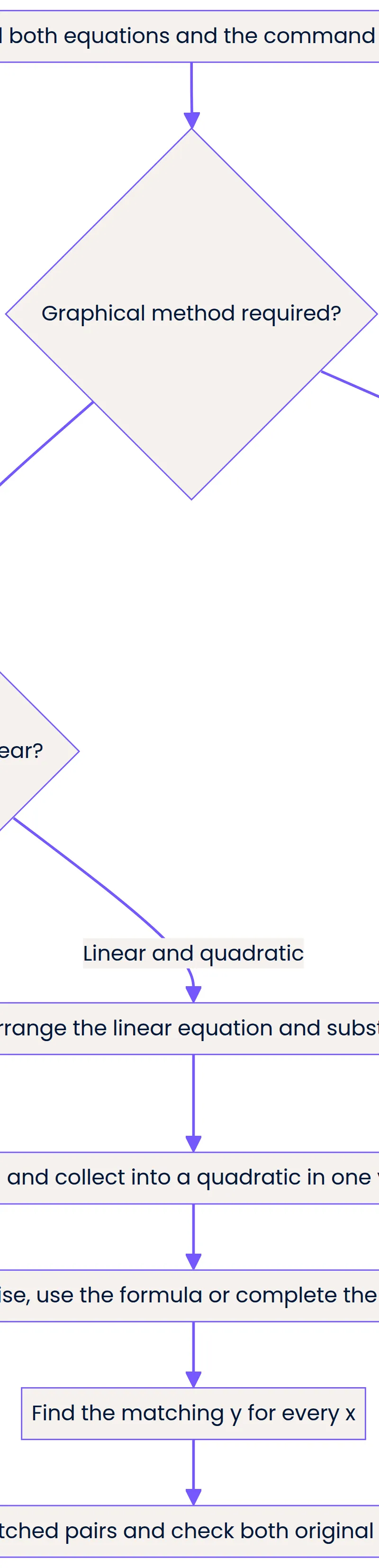
Underline the required method and accuracy. Classify the pair as linear/linear or linear/quadratic. For algebra, eliminate or substitute to get one unknown, show expansions, solve every branch, recover the second variable and pair the results. For graphs, use the axis scales and read every intersection. Interpret or reject solutions only when the context requires it.
How to structure your answer
Write one justified transformation per line. In a short linear question, show elimination, the first variable and back-substitution. In a longer quadratic question, show substitution, expansion, a quadratic equal to zero, its solution method and separate lines for each pair. M1 is a method mark and A1 an accuracy mark; their exact allocation is question-specific. Original schemes here are illustrative. Paper 1 is non-calculator; Papers 2 and 3 allow calculators, but an algebraic command still requires algebra.
Timing
Each 1MA1 paper is 90 minutes for 80 marks, giving 1.125 minutes per mark overall. Use about 1.1 minutes per mark as a planning guide: 3 marks about 3–4 minutes; 4 marks about 4–5; 5 marks about 5–6; 6 marks about 6–7. This is guidance, not an official per-question time limit.
Common pitfalls
- Omitting 2uv in a squared bracket: write the bracket twice before expanding.
- Multiplying only some terms of an equation: multiply the constant as well.
- Losing a root by dividing by a variable expression: test its zero case first.
- Stopping at x values: calculate a matching y for every root.
- Swapping y values between roots: write separate branches or ordered pairs.
- Using only the plus branch of the quadratic formula: use both ± cases.
- Rounding x before finding y: keep the exact value or calculator memory.
- Reading intercepts instead of intersections: a simultaneous solution belongs to both graphs.
- Calling one visible intersection a tangent without checking the graph window: another intersection may be off-grid.
What the command words want
- Solve
- Find all values satisfying the equations. For two variables, give complete paired values.
- Compare
- Identify relevant mathematical similarities and differences, such as exact algebraic answers versus approximate graph readings.
- Explain
- Give a reason: for example, the intersection satisfies both equations because it lies on both graphs.
- Describe
- Describe the mathematical feature asked for, such as the number or location of intersections.
- Evaluate
- In mathematics this often means find the value of an expression, not discuss advantages and disadvantages. If evaluating a method or statement, use the wording to determine the required judgement.
- Calculate
- Show the calculation and use the requested accuracy; add units only where the variables represent measured quantities.
- Draw/Plot
- Use the specified range and scale; plot accurately, draw straight lines with a ruler and quadratic curves smoothly.
- Show that
- Give a complete algebraic chain to the supplied result; do not assume the result is true at the start.
- State/Give
- Provide the requested values, coordinates or fact clearly. Complete pairs matter more than a fixed word count.
- Solve algebraically
- Show elimination or substitution and the quadratic solution method when needed. Graph readings or calculator-solver output alone are insufficient evidence of algebra.
- Estimate/Use the graph
- Show or identify the intersections and read approximate coordinates to the grid-supported or stated accuracy.
Watch or listen (optional)
Test your understanding of Algebra - Solving equations and inequalities: solve two simultaneous equations in two variables (linear/linear or linear/quadratic) algebraically; find approximate solutions using a graph (Higher tier)
Active recall beats re-reading. Take an instant quiz now to test what you’ve learned and lock it into long-term memory.
7 days Premium · Then the free plan continues · No card, no charge