Pearson Edexcel · GCSE · Mathematics
Course version: 1MA1 · Version from Mar 2026
Geometry and measures - Mensuration and calculation: know the exact values of sin θ and cos θ for θ = 0°, 30°, 45°, 60° and 90°; know the exact value of tan θ for θ = 0°, 30°, 45° and 60°
Two triangles unlock the exact sine, cosine and tangent values that Edexcel GCSE candidates must recall without a calculator. Learn how to rebuild the table, use it in exact calculations, and avoid the swaps and premature rounding that cost marks. Foundation recall is clearly separated from Higher surd algebra and extensions.
- 12 min read
- 4 worked examples
- 7 practice questions
- 10 key terms
Try the lesson
The start of the Geometry and measures - Mensuration and calculation: know the exact values of sin θ and cos θ for θ = 0°, 30°, 45°, 60° and 90°; know the exact value of tan θ for θ = 0°, 30°, 45° and 60° lesson, made from checked teaching notes for this specification point.
Have a go first
Write down the exact value of sin 30°.
There is more to this lesson
The full lesson goes on to check your understanding and help you earn the marks. Create a free account to carry on, with your progress saved.
7 days Premium · Then the free plan continues · No card, no charge
Check what you remember
Read the wording for your board, then hide it and explain Exact value in your own words. Rough notes are fine. This is a self-check, with no mark or grade.
Reference: Pearson Edexcel
A value expressed without rounding, such as 1/2 or √3/2.
Study Notes

Overview
Exact trigonometric values turn familiar right-triangle ratios into answers that retain their full mathematical meaning. For Pearson Edexcel GCSE Mathematics 1MA1 G21, both Foundation and Higher students need to recall and use the standard sine, cosine and tangent values without a calculator. 1 The skill is more than reciting a table: you must select the appropriate ratio, preserve an exact form, and recognise when a triangle diagram is valid. This guide builds the values from two memorable special triangles so that recall can be rebuilt under pressure. It then develops Higher-only surd simplification and rationalisation, and positions non-right-angled trigonometry and graphs as useful extensions rather than as extra G21 recall requirements. Examiner-style success comes from setting out the ratio before substituting, labelling units only where they belong, and giving precisely the form requested. All questions and mark allocations here are original Edexcel-style practice, not official Pearson questions or mark schemes. Typical questions ask candidates to give a value, work out a length, evaluate an expression, or show how a special triangle produces a stated ratio.
Listen and retrieve
The ten-minute podcast explains the values, models an exact calculation and includes a recall quiz. Answer each question before checking the tutor’s response.
Key Concepts
1. Ratios depend on the chosen angle
For an acute angle θ in a right-angled triangle, SOHCAHTOA defines three ratios: sin θ = opposite/hypotenuse, cos θ = adjacent/hypotenuse, and tan θ = opposite/adjacent.
The hypotenuse is always opposite the right angle. The opposite side is across from the chosen acute angle. The adjacent side touches that angle but is not the hypotenuse. Do not identify these sides simply from whether they appear horizontal or vertical: a rotated diagram changes neither the geometry nor the ratios.
These ratios are unitless because each divides one length by another length expressed in the same units. Their values remain unchanged when a triangle is enlarged: corresponding lengths acquire the same scale factor, which cancels in the division. This similarity is why a small reference triangle supplies values for every similar triangle.
Example: if opposite = 3 cm and hypotenuse = 6 cm, sin θ = 3/6 = 1/2. Enlarging both lengths by 4 gives 12/24 = 1/2 again. The angle and ratio remain unchanged.
Cover and recall: which side label never changes when you switch between the two acute angles? The hypotenuse. Opposite and adjacent exchange roles.
2. Derive the 30° and 60° values
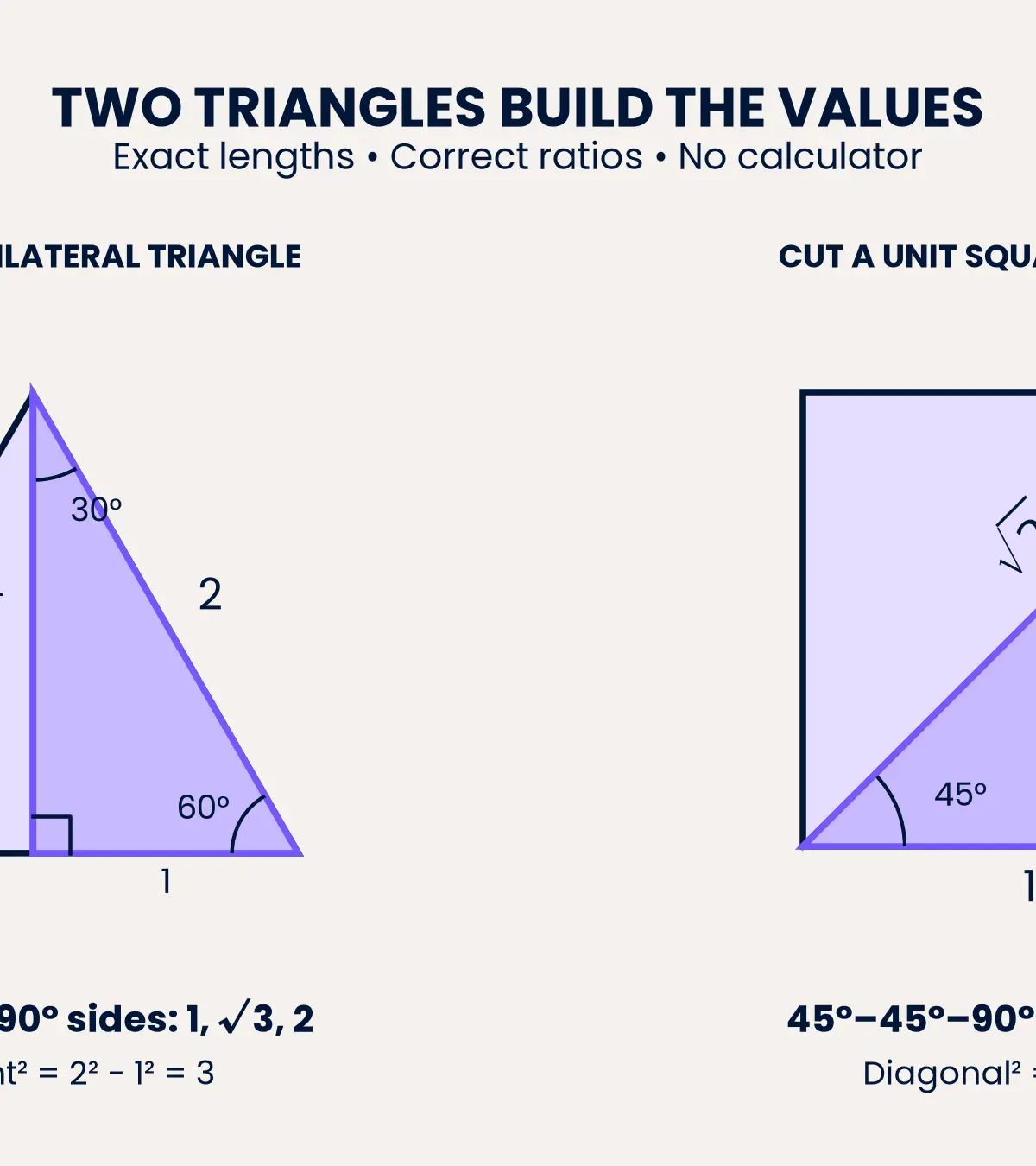
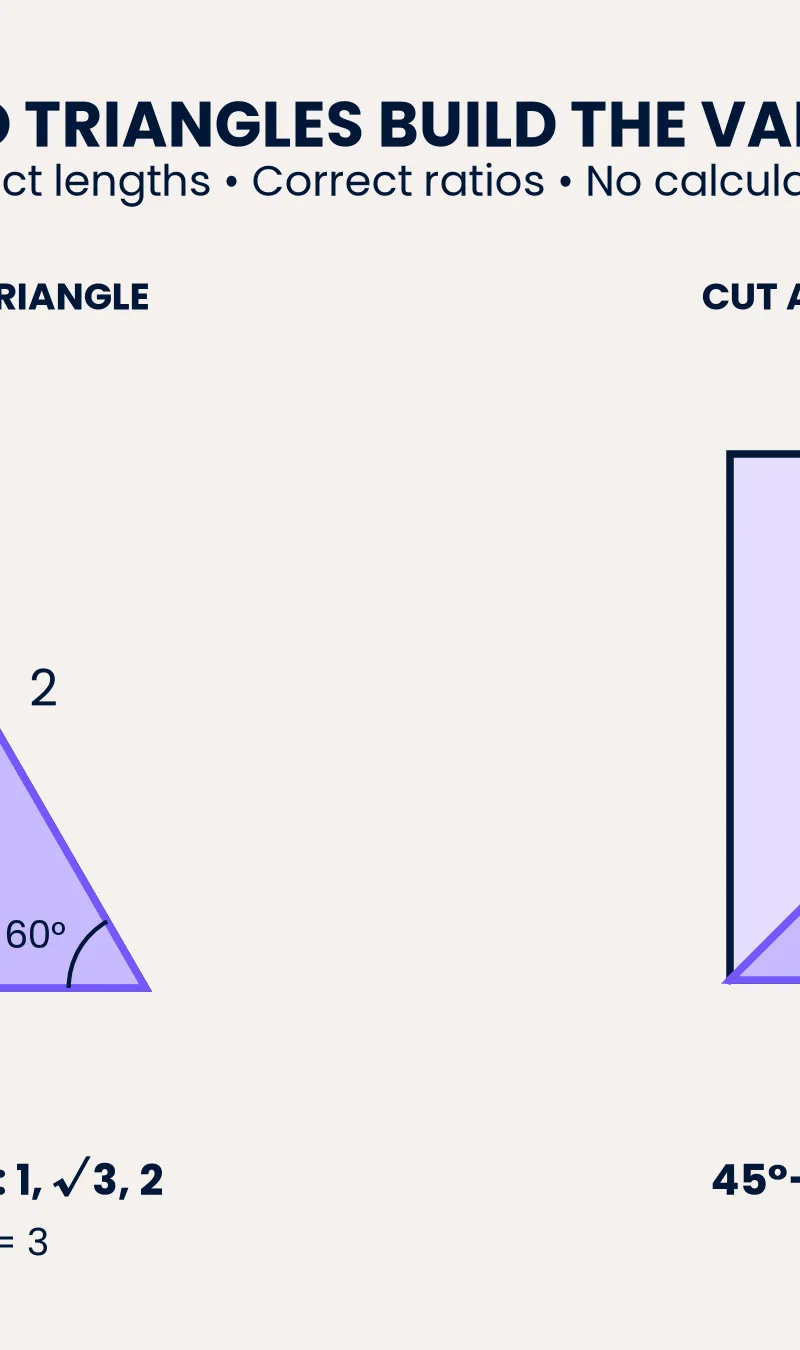
Start with an equilateral triangle whose sides are all 2 units long. Every angle is 60°. Draw a perpendicular from its top vertex to the midpoint of the base. Symmetry halves the base into lengths of 1 and bisects the top angle into two 30° angles.
Each half is a 30°–60°–90° triangle with hypotenuse 2 and short leg 1. If the remaining leg is h, Pythagoras gives h² + 1² = 2², so h² = 3 and h = √3. Choose the positive root because h is a length.
Relative to the 30° angle, opposite = 1, adjacent = √3 and hypotenuse = 2. Therefore sin 30° = 1/2, cos 30° = √3/2 and tan 30° = 1/√3.
Relative to the 60° angle, opposite and adjacent exchange roles. Therefore sin 60° = √3/2, cos 60° = 1/2 and tan 60° = √3.
Higher algebra, N8: rationalising 1/√3 gives √3/3. Multiply numerator and denominator by √3: (1 × √3)/(√3 × √3) = √3/3. Both expressions are exact; the rationalised expression is the conventional simplest form.
Why does this work? The altitude creates congruent right triangles. It does not merely make a convenient sketch: symmetry justifies the side of length 1 and the angle of 30°.
3. Derive the 45° values
Draw a square of side 1 and divide it along a diagonal. Each resulting triangle has perpendicular legs 1 and 1. Pythagoras gives diagonal² = 1² + 1² = 2, so the diagonal is √2.
The two acute angles are equal and sum to 90°, so each is 45°. Opposite and adjacent are equal, giving sin 45° = cos 45° = 1/√2 = √2/2. Tangent is 1/1 = 1.
Candidates should not write sin 45° = 1/2 because 45° is half of 90°. Sine is not proportional to angle. Its meaning is a side ratio, not an instruction to halve the angle numerically.
Example: a 45° right triangle with adjacent leg 5 cm also has opposite leg 5 cm. Its hypotenuse is 5√2 cm. The same ratios hold because the reference triangle has simply been enlarged.
4. Understand 0°, 90° and undefined tangent
An ordinary, non-degenerate right triangle cannot have an acute angle of 0° or 90°. For these endpoints, an optional unit-circle explanation is clearer than pretending such a triangle exists.
Imagine a radius of length 1 turning anticlockwise from the positive horizontal axis. The point on the circle has coordinates (cos θ, sin θ). At 0°, the point is (1, 0), giving cos 0° = 1 and sin 0° = 0. At 90°, it is (0, 1), giving cos 90° = 0 and sin 90° = 1.
Where cosine is non-zero, tan θ = sin θ/cos θ. Consequently tan 0° = 0/1 = 0. At 90°, the expression would require 1/0. Division by zero is undefined, so tan 90° is undefined, not zero and not infinity.
G21 requires tangent recall at 0°, 30°, 45° and 60°. The explanation of tan 90° helps candidates understand why it is excluded from that list. 1
5. Rebuild the complete table
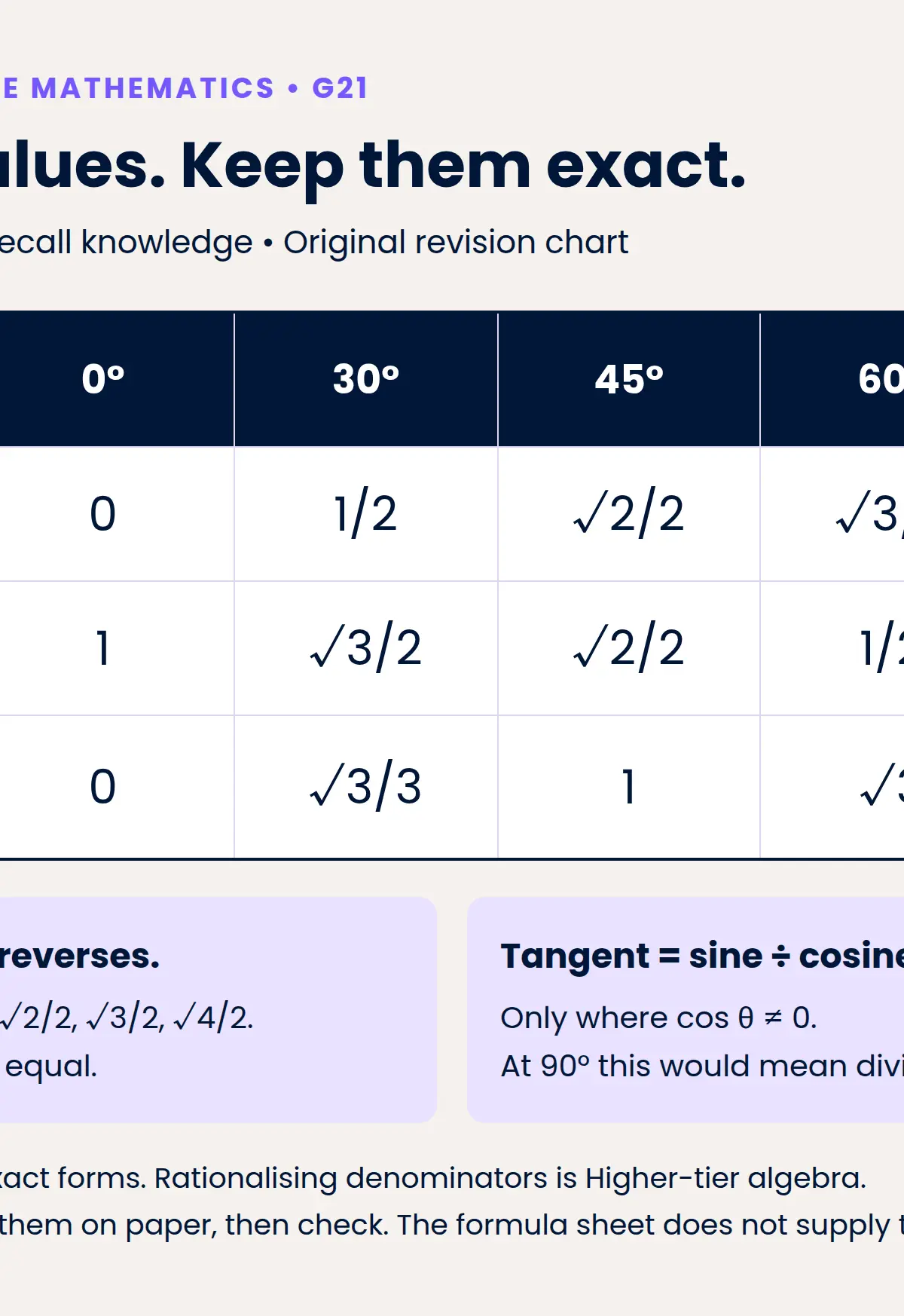
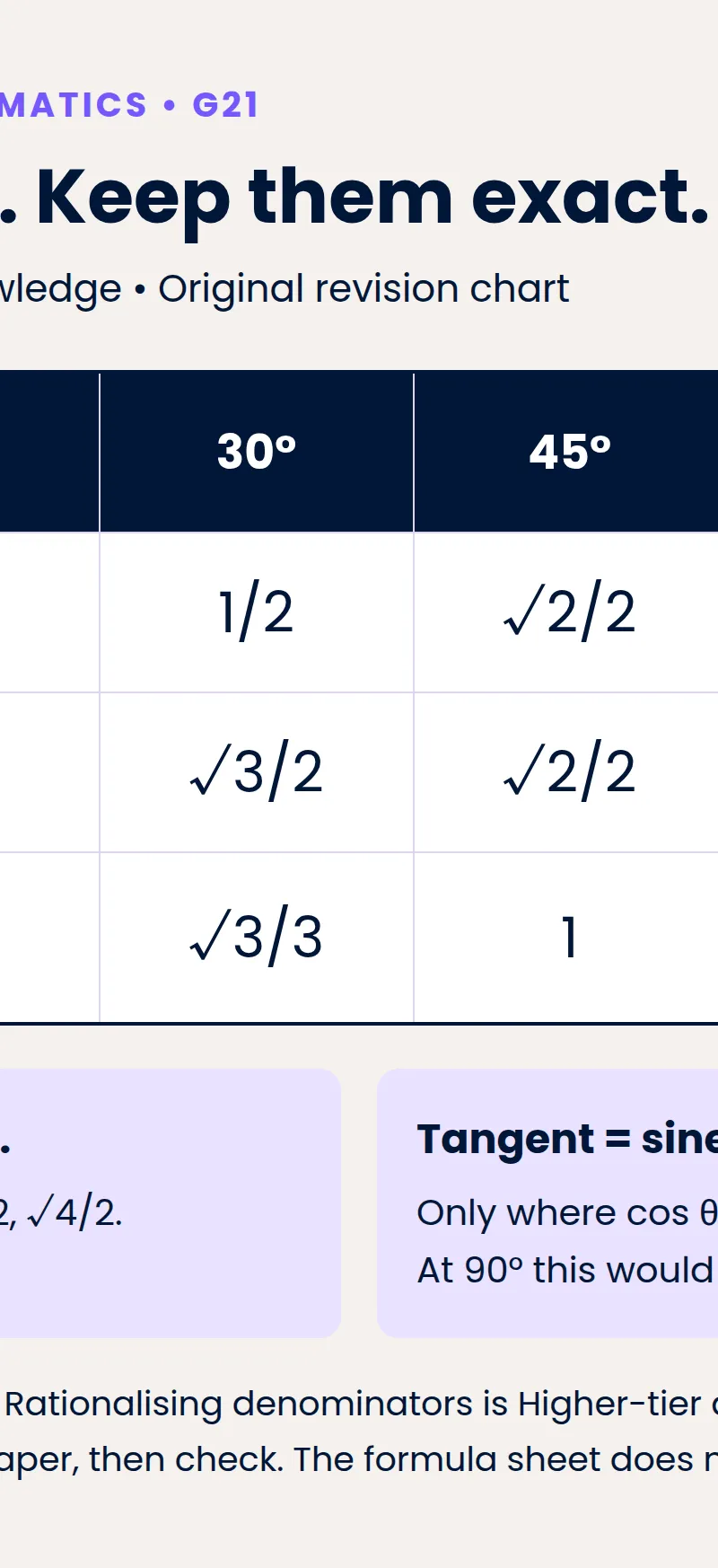
| Angle θ | sin θ | cos θ | tan θ |
|---|---|---|---|
| 0° | 0 | 1 | 0 |
| 30° | 1/2 | √3/2 | √3/3 |
| 45° | √2/2 | √2/2 | 1 |
| 60° | √3/2 | 1/2 | √3 |
| 90° | 1 | 0 | Undefined |
For the labelled angle sequence 0°, 30°, 45°, 60°, 90°, sine follows the square-root ladder √0/2, √1/2, √2/2, √3/2, √4/2. Simplify its first, second and final entries. Cosine reads the same ladder backwards.
The angle gaps are not equal: they are 30°, 15°, 15° and 30°. The ladder is therefore a memory device, not a plotting scale or a rule for other angles. Rebuild tangent by dividing the sine entry by the cosine entry, provided the cosine entry is non-zero.
Cover and recall: hide the table and write sin 30°, cos 30° and tan 30°. Commit an answer before checking. Repeat tomorrow, then after three days and a week, adjusting the intervals if recall is difficult.
6. Keep answers exact and simplify appropriately
An exact answer has not been rounded. A fraction, integer or surd may preserve its full value. A terminating decimal can also be exact: 0.5 equals 1/2 exactly. However, 0.866 is only an approximation to √3/2 and is unsuitable when that exact value is requested.
The wording determines the required finish. “Give an exact value” prohibits replacing an irrational value with a rounded decimal. “Give your answer in its simplest form” also requires appropriate simplification. Higher candidates should extract square factors and rationalise surd denominators where required.
Higher example: √12 = √(4 × 3) = 2√3. Also, (6√3)² = 36 × 3 = 108, not 36√3. Squaring applies to both the coefficient and the root.
Keep brackets when substituting fractional exact values into longer expressions. For example, 12(√3/2) = 6√3. Do not multiply only part of an expression accidentally. A clearly written substitution allows the examiner to identify a valid method even if a later arithmetic slip occurs.
7. Select, substitute, rearrange, check
First identify the marked angle and right angle. Next label the relevant sides and select the ratio connecting the known and required lengths. Write the equation before inserting the exact value.
If sin 30° = x/10, then 1/2 = x/10 and x = 5. If sin 30° = 5/x instead, then 1/2 = 5/x and x = 10. The unknown’s position matters; a memorised instruction to “multiply by sine” does not work in every question.
For an acute angle, sine and cosine are positive and less than 1. Therefore a calculated leg should be shorter than the hypotenuse. At 45°, tangent is 1 because the legs match. At 60°, tangent exceeds 1 because the opposite leg is longer than the adjacent leg. These checks detect errors but do not replace working.
Mathematical/Scientific Relationships
Formula status
The following labels refer to Pearson’s published 2026 formula sheets. The right-triangle ratios are supplied, but the exact-value table is not. 2 3
| Formula or relationship | Status | Meaning and use |
|---|---|---|
| a² + b² = c² | Given on formula sheet, both tiers | c is the hypotenuse; a and b are perpendicular legs. |
| sin θ = O/H | Given on formula sheet, both tiers | O is opposite and H is hypotenuse relative to the chosen angle. |
| cos θ = A/H | Given on formula sheet, both tiers | A is adjacent, excluding the hypotenuse. |
| tan θ = O/A | Given on formula sheet, both tiers | Connects the two perpendicular legs. |
| Exact-value table | Must memorise | Recall the specified angles without a calculator. |
| tan θ = sin θ/cos θ | Must memorise or understand | Valid when cos θ ≠ 0; explains undefined tangent. |
| sin θ = cos(90° − θ) | Must memorise or understand | Complementary acute angles exchange opposite and adjacent. |
| Triangle area = 1/2 bh | Must memorise | h must be perpendicular to base b. |
| Triangle area = 1/2 ab sin C | Given on formula sheet, Higher | C is the included angle between sides a and b. |
| a/sin A = b/sin B = c/sin C | Given on formula sheet, Higher | Sine rule; lowercase sides lie opposite matching uppercase angles. |
| a² = b² + c² − 2bc cos A | Given on formula sheet, Higher | Cosine rule for non-right-angled triangles. |
| √(uv) = √u × √v, for u,v ≥ 0 | Must memorise or understand, Higher algebra | Extract square factors when simplifying surds. |
| q/√n = q√n/n, for n > 0 | Must memorise or understand, Higher algebra | Rationalise a simple surd denominator. |
| L′ = kL; P′ = kP; area′ = k² × area | Must memorise or understand | Enlargement scales lengths and perimeter by k, but area by k². |
The tangent identity follows by dividing O/H by A/H: the hypotenuse factors cancel, leaving O/A. The complementary-angle identity follows by switching the reference angle in the same right triangle.
Higher extension: the sine rule, cosine rule and non-right-angled area formula can combine exact values with longer calculations. They are related specification content, not additional Foundation requirements for this topic.
Graph skills: Higher extension
Selected exact values provide useful anchors for sine and cosine graphs. Use actual angle coordinates: 0°, 30°, 45°, 60° and 90° must not be placed at equal horizontal intervals. Sine rises smoothly from 0 to 1 across this interval; cosine falls smoothly from 1 to 0. Straight-line joins alone do not represent the true curves.
Tangent passes through (0°, 0) and (45°, 1), then grows without bound as 90° is approached from the left. Its graph has a vertical asymptote at θ = 90°. Do not plot a point there or label tan 90° as infinity. This graph explanation is a Higher extension, not an instruction to draw a graph in every G21 question.
Exact values also support inverse reasoning. If sin θ = √3/2 and θ is acute, the table identifies θ = 60°. The acute-angle condition matters: broader trigonometric equations can have further solutions outside the right-triangle setting.
Practical Applications
There is no required practical for GCSE Mathematics exact trigonometry. Drawing and labelling the special triangles is an optional learning activity, not a mandated assessed practical.
Exact ratios can model a ramp, roof pitch, line of sight or diagonal brace. A 12 m slope at 60° has vertical rise 12 sin 60° = 6√3 m and horizontal distance 12 cos 60° = 6 m. Decide whether the question asks for a vertical, horizontal or sloping distance before choosing the ratio.
Keep measurements in consistent units. Since 1 m = 100 cm, 1 m² = 10,000 cm², not 100 cm². Square-unit conversions use the square of the length factor. Trigonometric ratios themselves have no unit; calculated lengths require cm or m, and areas require cm² or m².
A scale drawing can help identify the relevant side, but do not measure an exam diagram unless instructed. Diagrams may not be drawn to scale. Use the stated lengths, angles and mathematical relationships to earn calculation marks.
What if the model doubles in size? Its angles and trigonometric ratios stay unchanged, its lengths and perimeter double, and its area becomes four times as large. Explain this through similarity rather than memorising unrelated facts.
References
Visual Resources
2 diagrams and illustrations
Interactive Diagrams
2 interactive diagrams to visualise key concepts
Conceptual Flow Outline
Choose the ratio from the two relevant sides, then substitute exactly.
Conceptual Flow Outline
Rebuild an exact value from a special triangle; rationalising is a Higher algebra step.
Worked Examples
4 worked examples — open one to explore the question and available guidance.
Practice Questions
Try the question, then reveal an answer plan or example response
Foundation and Higher. Evaluate sin 30° + cos 60°. Give an exact value.
Hint: Use the two exact halves before adding.
Higher. A right-angled triangle has an acute angle of 45° and adjacent side 8 cm. Work out its exact hypotenuse in its simplest form.
Hint: Use cos 45° = adjacent/hypotenuse. The unknown is in the denominator.
Higher synoptic practice. Simplify √48, giving your answer in its simplest form.
Hint: Extract the square factor 16.
Higher synoptic practice. Rationalise 5/√2, giving your answer in its simplest form.
Hint: Multiply numerator and denominator by √2.
Foundation and Higher. A ladder 10 m long rests against a vertical wall and makes an angle of 30° with level ground. Work out its exact vertical height and horizontal distance from the wall.
Hint: The ladder is the hypotenuse. Height is opposite the ground angle.
Foundation and Higher. Show that tan 60° = √3 using tan θ = sin θ/cos θ.
Hint: Substitute both exact values, then divide by 1/2.
Higher extension. A non-right-angled triangle has two sides of 8 cm and 10 cm with included angle 30°. Work out its exact area.
Hint: Use the area formula involving two sides and their included angle.
Exam technique
How to turn what you know into marks
How to approach the question
Identify the marked acute angle and right angle. Label opposite, adjacent and hypotenuse. Choose the ratio connecting the known and required sides, write its equation, substitute the exact value and rearrange. Check the required answer form and units.
How to structure your answer
For recall, give the requested exact value directly. For calculations, show ratio, exact substitution, rearrangement and final answer. For a derivation, show the triangle construction, Pythagoras where needed and the resulting ratio. Mark allocations in this guide are indicative, original guidance rather than official Pearson mark schemes.
Timing
Each Edexcel paper has 80 marks in 90 minutes, an average of 1.125 minutes per mark. For practical pacing, allow about 3–4 minutes for 3 marks, 4–5 minutes for 4 marks and 6–7 minutes for 6 marks, while preserving a checking margin. These are revision targets, not compulsory question limits.
Common pitfalls
- Swapping sin 30° and cos 30°: the short side is opposite 30°, so sine is 1/2.
- Writing sin 45° = 1/2: sine is not proportional to angle.
- Giving 0.866 instead of √3/2 when an exact answer is requested.
- Claiming all decimals are inexact: 0.5 is exactly 1/2, but a rounded irrational decimal is not exact.
- Writing tan 90° = 0 or infinity: division by zero is undefined.
- Treating the hypotenuse as the adjacent side: the adjacent label excludes the hypotenuse.
- Multiplying by a ratio when the unknown is in the denominator: show the equation before rearranging.
- Using a length-conversion factor for area: 1 m² = 10,000 cm².
What the command words want
- Compare
- State the requested mathematical similarity or difference, for example sin 30° < cos 30°.
- Explain
- Give a mathematical reason, using because to connect it to the conclusion.
- Describe
- Identify the requested mathematical feature precisely, such as equal legs in the 45° triangle.
- Evaluate
- Find the numerical value of the expression. In mathematics this does not mean weighing arguments.
- Work out
- Choose and apply a method, showing enough working for the examiner to identify the calculation.
- Calculate
- Show the relevant ratio or formula, exact substitution, rearrangement and final measurement with units.
- Show that
- Present a connected chain from the supplied facts to the stated result. Merely copying the target answer is insufficient.
- State/Give
- Write the requested exact value or brief mathematical fact. A one-mark recall item does not need unnecessary explanation.
- Give your answer in its simplest form
- Simplify fractions and square factors; at Higher level, rationalise a surd denominator where appropriate.
Watch or listen (optional)
Test your understanding of Geometry and measures - Mensuration and calculation: know the exact values of sin θ and cos θ for θ = 0°, 30°, 45°, 60° and 90°; know the exact value of tan θ for θ = 0°, 30°, 45° and 60°
Active recall beats re-reading. Take an instant quiz now to test what you’ve learned and lock it into long-term memory.
7 days Premium · Then the free plan continues · No card, no charge