Pearson Edexcel · GCSE · Mathematics
Course version: 1MA1 · Version from Mar 2026
Geometry and measures - Properties and constructions: apply and prove the standard circle theorems concerning angles, radii, tangents and chords, and use them to prove related results (Higher tier only)
A single radius or chord can unlock a whole circle-theorem question. Learn to calculate angles and lengths, give the precise reasons examiners expect, and build Higher-tier proofs rather than guess from a diagram.
- 12 min read
- 5 worked examples
- 7 practice questions
- 13 key terms
Try the lesson
The start of the Geometry and measures - Properties and constructions: apply and prove the standard circle theorems concerning angles, radii, tangents and chords, and use them to prove related results (Higher tier only) lesson, made from checked teaching notes for this specification point.
Have a go first
A tangent touches a circle with centre O at point T. A point A lies on the tangent such that AT = 20 cm and the radius OT = 15 cm. What is the length of AO?
There is more to this lesson
The full lesson goes on to check your understanding and help you earn the marks. Create a free account to carry on, with your progress saved.
7 days Premium · Then the free plan continues · No card, no charge
Check what you remember
Read the wording for your board, then hide it and explain Radius in your own words. Rough notes are fine. This is a self-check, with no mark or grade.
Reference: Pearson Edexcel
A line segment from the centre of a circle to a point on its circumference. All radii of the same circle have equal length.
Study Notes

Overview
Circle-theorem questions become manageable when you stop guessing from the picture and start identifying relationships. A radius, chord or tangent can unlock an angle, a length or an entire proof. For Pearson Edexcel GCSE Mathematics 1MA1, G10, applying and proving these theorems, including related results, is Higher-tier only. Basic circle vocabulary and ordinary angle facts also support Foundation work, but this guide develops the Higher requirement. 1
Candidates may be asked to calculate an angle and give reasons, combine circle geometry with algebra or Pythagoras, or prove a statement without numerical measurements. The topic connects closely to isosceles triangles, congruence, parallel-line angles and trigonometry. A diagram is a source of given information, not a scale drawing to measure unless instructed.
Your goal is to write a justified chain: identify the relevant points, state the relationship, substitute values, and conclude. This earns credit more reliably than an unexplained number. Read one theorem, cover it, and explain it aloud before attempting a question. The original examples and practice mark allocations below are Pearson-style teaching material, not official examination questions or official Pearson mark schemes.
Key Concepts
1. Read the geometry before calculating
In ∠ABC, B is the vertex. Trace BA and BC with your pencil. The centre is O; OA and OB are radii only when A and B lie on the circle. A diameter is a chord passing through O. A tangent touches at one point, and its perpendicular-radius property applies at that contact point, not at an arbitrary point on the line.
Mark equal radii immediately. Two equal radii create an isosceles triangle, so its base angles are equal. For example, if ∠AOB = 100°, then ∠OAB = ∠OBA = (180° − 100°)/2 = 40°. The reason is equal radii and base angles of an isosceles triangle, not angles in the same segment. Cover and recall: why is an unmarked chord not necessarily a diameter?
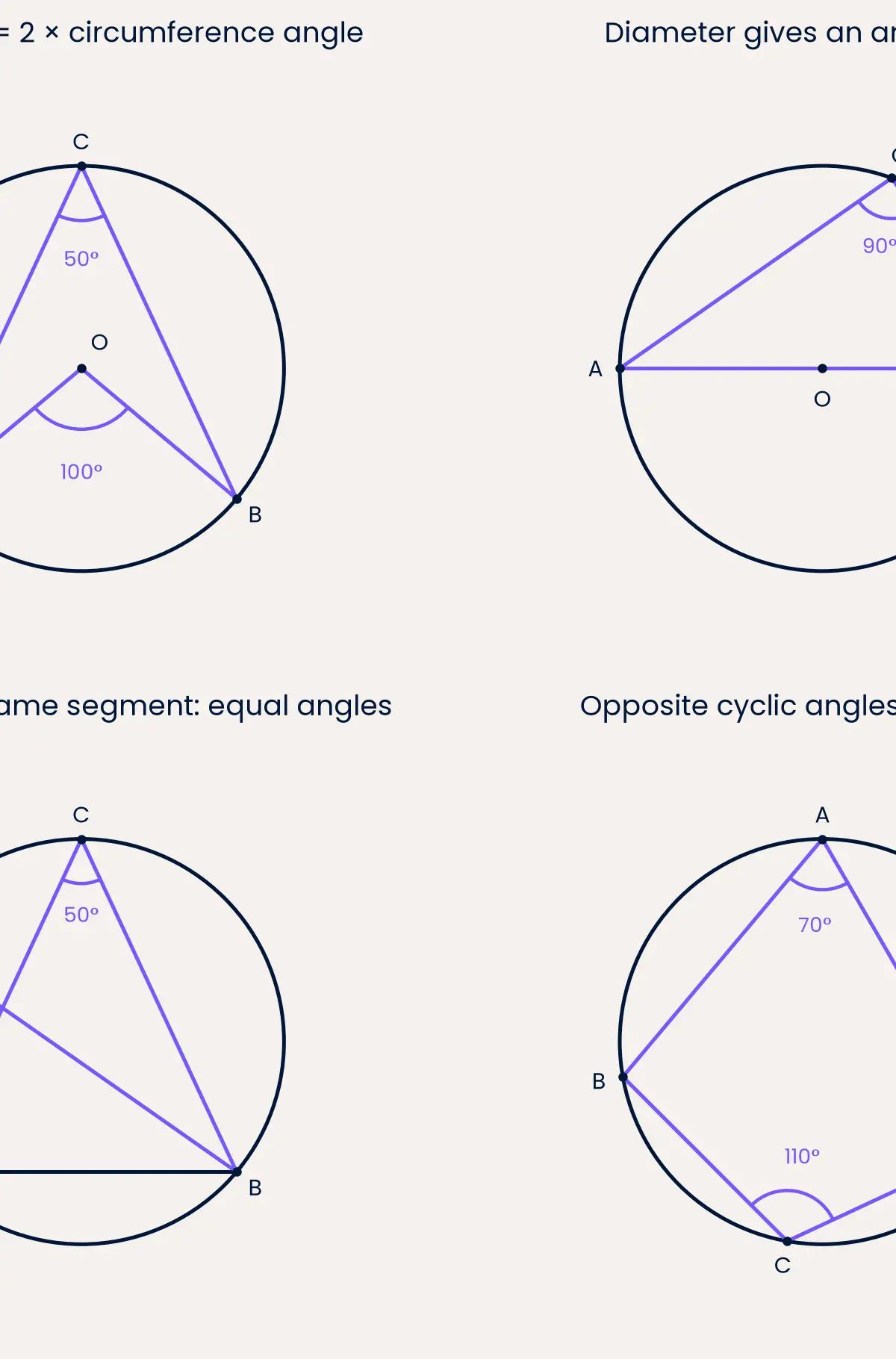
2. Angle at the centre: double the circumference angle
The angle at the centre is twice the angle at the circumference subtended by the same arc. With C on the major arc AB, the minor central angle ∠AOB equals 2∠ACB. Thus a circumference angle of 38° gives a central angle of 76°. Reverse the process by halving: a matching central angle of 124° gives 62° at the circumference.
The phrase same arc matters. If C lies on the minor arc AB, ∠ACB subtends the major arc, so the matching central angle is reflex. A circumference angle of 130° corresponds to a reflex central angle of 260°, leaving a minor central angle of 100°. State which angle you mean; do not automatically halve whichever angle at O looks smallest.
3. Proving the centre-angle theorem
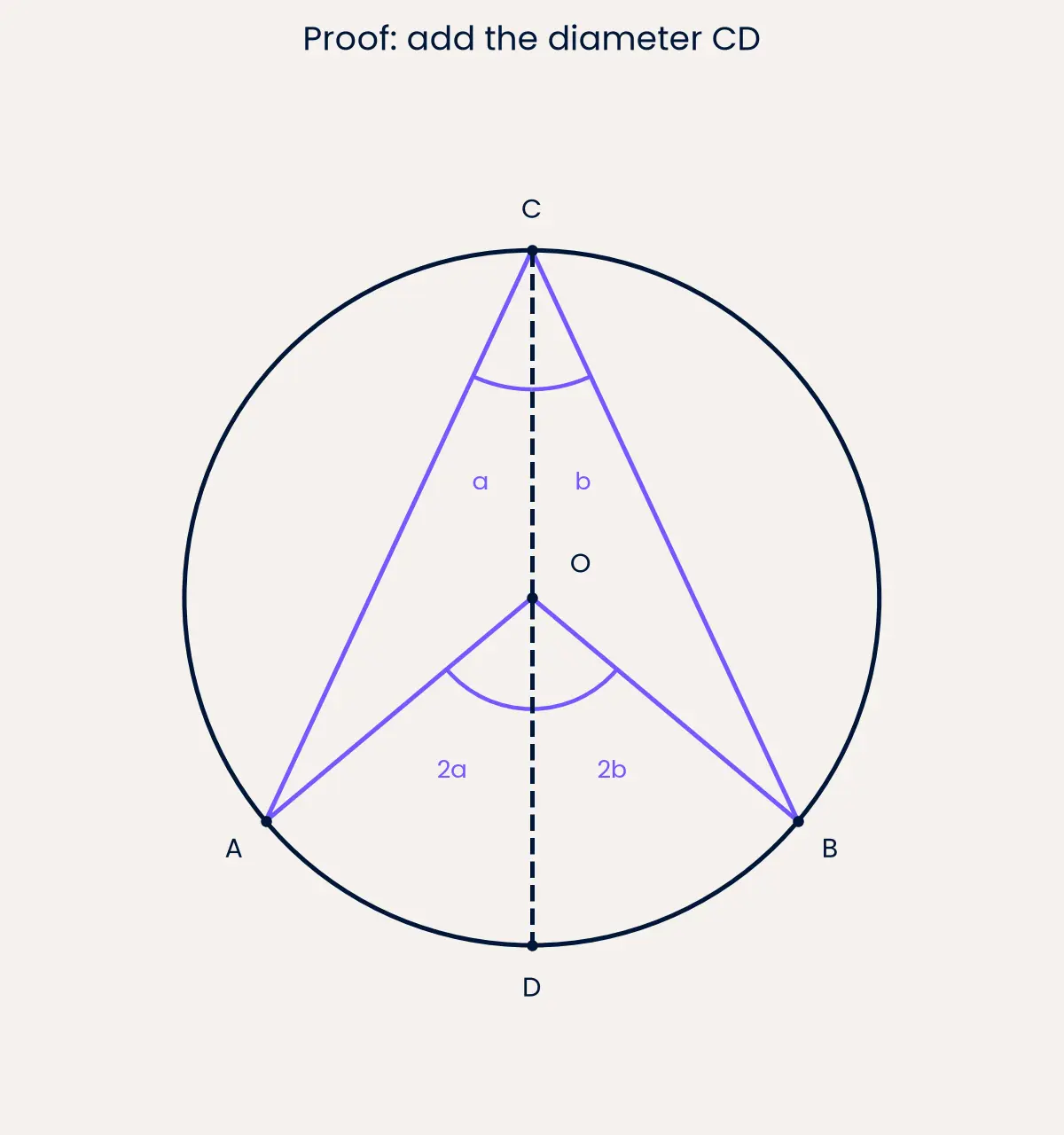
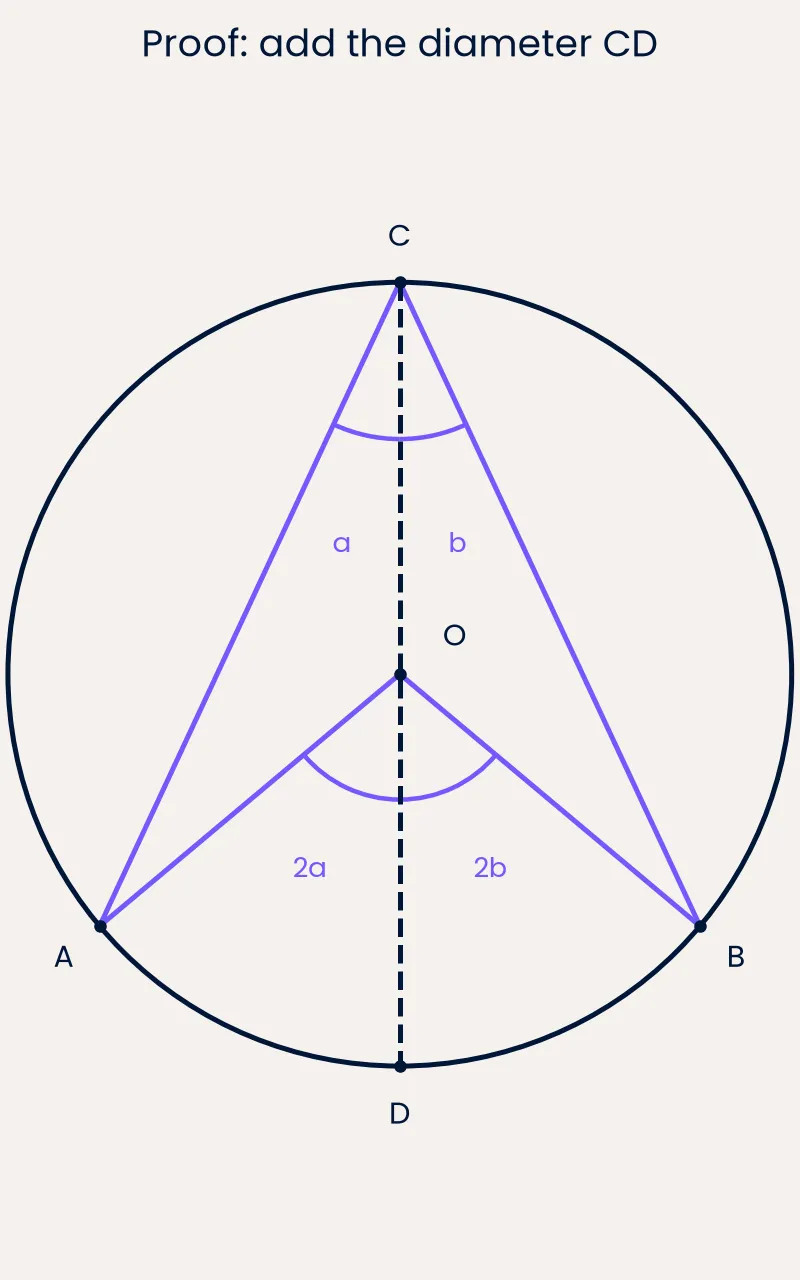
In the illustrated configuration, O is inside ∠ACB. Draw diameter CD, with C, O and D collinear. Let ∠ACO = a and ∠OCB = b. Since OA = OC, triangle AOC is isosceles and ∠CAO = a. The exterior-angle theorem gives ∠AOD = a + a = 2a. Similarly, OB = OC gives ∠DOB = 2b. Consequently ∠AOB = 2a + 2b = 2(a + b) = 2∠ACB.
This argument uses equal radii and ordinary triangle facts, not the theorem being proved. When O lies outside the circumference angle, express the angle as a difference of the two diameter-based angles and subtract the corresponding doubled central angles. If one side passes through O, only one isosceles-triangle calculation is needed. Choose the central angle standing on the same arc throughout, including a reflex angle where required. Credit in a proof requires a connected argument; an isolated numerical example is not a general proof.
4. Angle in a semicircle
An angle subtended by a diameter at the circumference is 90°. The diameter makes 180° at the centre, so the centre-angle theorem gives 180°/2 = 90°. The point forming the angle must be on the circle and different from the diameter endpoints.
If AB is a stated diameter and C lies on the circle, then ∠ACB = 90°. If ∠BAC = 31°, ∠ABC = 180° − 90° − 31° = 59°. Give both reasons: angle in a semicircle, then angles in a triangle sum to 180°. What if AB does not pass through O? The right angle is no longer guaranteed.
5. Angles in the same segment
Angles subtended by the same chord at points on the same side of that chord are equal. If C and D are on the same arc AB, ∠ACB = ∠ADB. Each is half the same matching central angle, which proves the result. A known angle of 47° therefore transfers to 47° at the other suitable circumference point.
Do not pair angles merely because their vertices lie on the circle: both must stand on the same chord. Vertices on opposite sides of the chord generally give supplementary angles instead. Examiners expect candidates to identify the equal angles unambiguously. For a related-result proof, establish two equal angles in a triangle, then conclude that their opposite sides are equal and the triangle is isosceles.
6. Opposite angles of a cyclic quadrilateral
A cyclic quadrilateral has all four vertices on one circle. Its opposite interior angles sum to 180°. If ABCD is named in order around the circle, ∠ABC + ∠ADC = 180°, and ∠BAD + ∠BCD = 180°. An angle of 108° has an opposite angle of 72°. Adjacent angles are not automatically supplementary.
For the proof, opposite circumference angles stand on the two complementary arcs between the other two vertices. Those arcs make 360° at the centre. Each circumference angle is half its matching central angle, so their sum is 180°. An exterior angle at one vertex therefore equals the opposite interior angle, because both equal 180° minus the interior angle at that vertex. For algebraic angles, translate the theorem into an equation before solving.
7. Radius and tangent
A tangent is perpendicular to the radius at the point of contact. If PA is tangent at A, ∠OAP = 90°. With OP = 10 cm and OA = 6 cm, PA² = 10² − 6² = 64, so PA = 8 cm. OP is the hypotenuse, not the radius.
To understand the theorem, drop a perpendicular OM from O to the tangent line. If M differed from A, OM would be shorter than radius OA. The line would pass inside the circle and meet it twice, contradicting tangency. Therefore M = A, so OA is perpendicular to the tangent. This explanation connects the circle property to shortest distance from a point to a line.
8. Two tangents from one external point
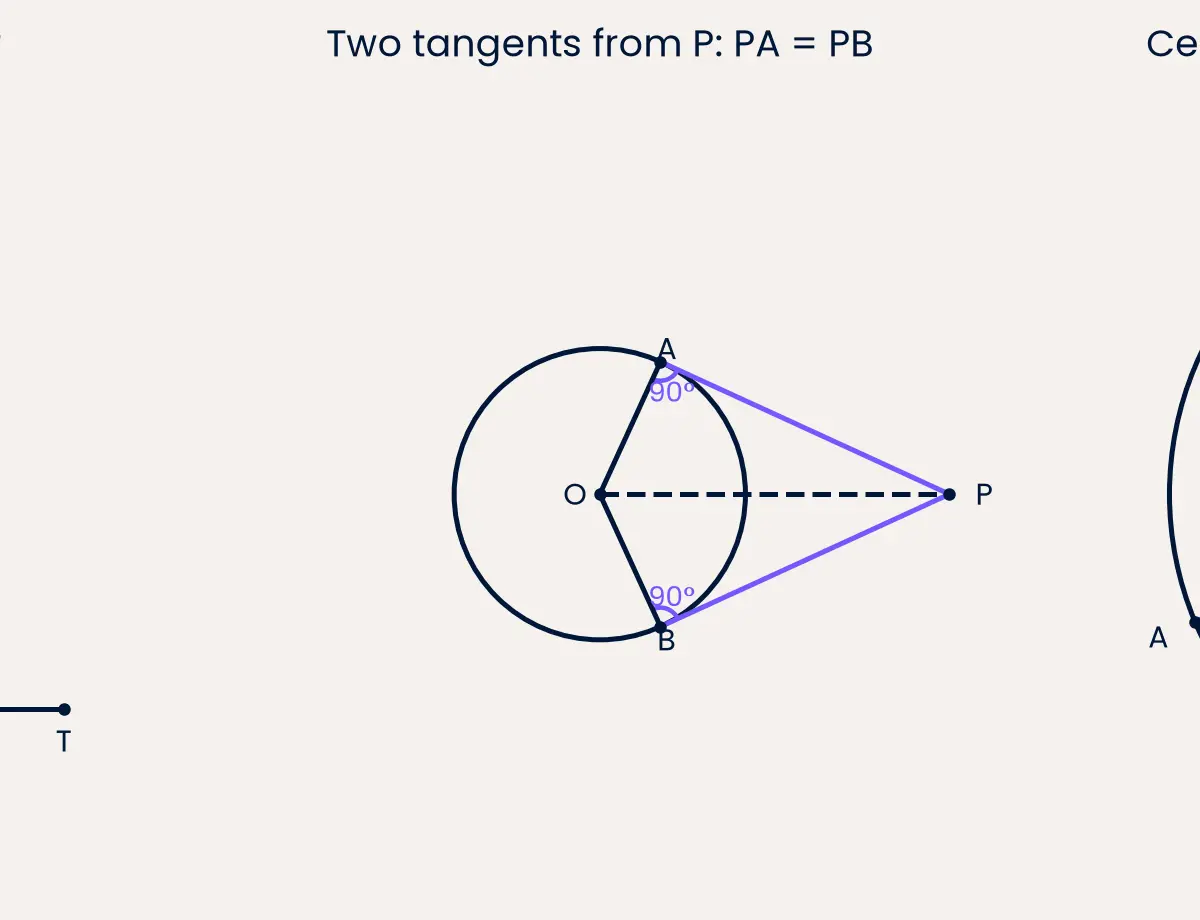
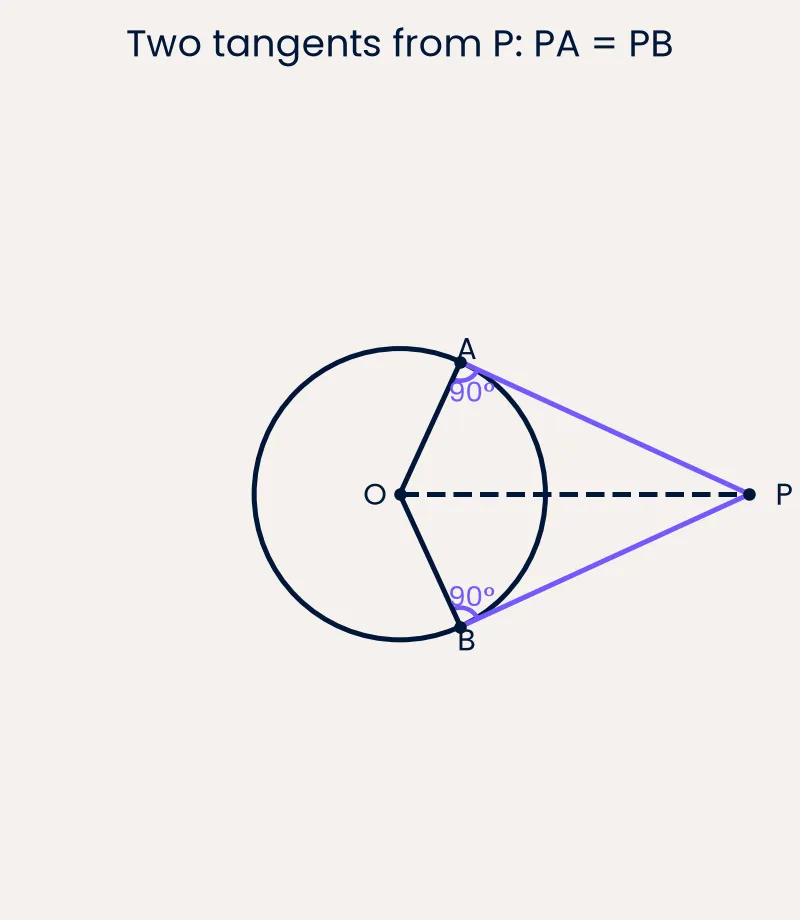
If PA and PB are tangents from the same external point P, then PA = PB. Join OA, OB and OP. Triangles OAP and OBP are right-angled, have equal hypotenuse OP and equal radii OA and OB. They are congruent by RHS, so the corresponding tangent sides are equal.
This proof also shows OP bisects ∠APB and the relevant central angle. In quadrilateral OAPB, the two contact angles are 90°, so ∠APB + ∠AOB = 180°, using the minor central angle between the contact radii. For instance, ∠APB = 64° gives ∠AOB = 116°. Equal tangent lengths do not mean tangents from different external points must be equal.
9. Alternate segment theorem
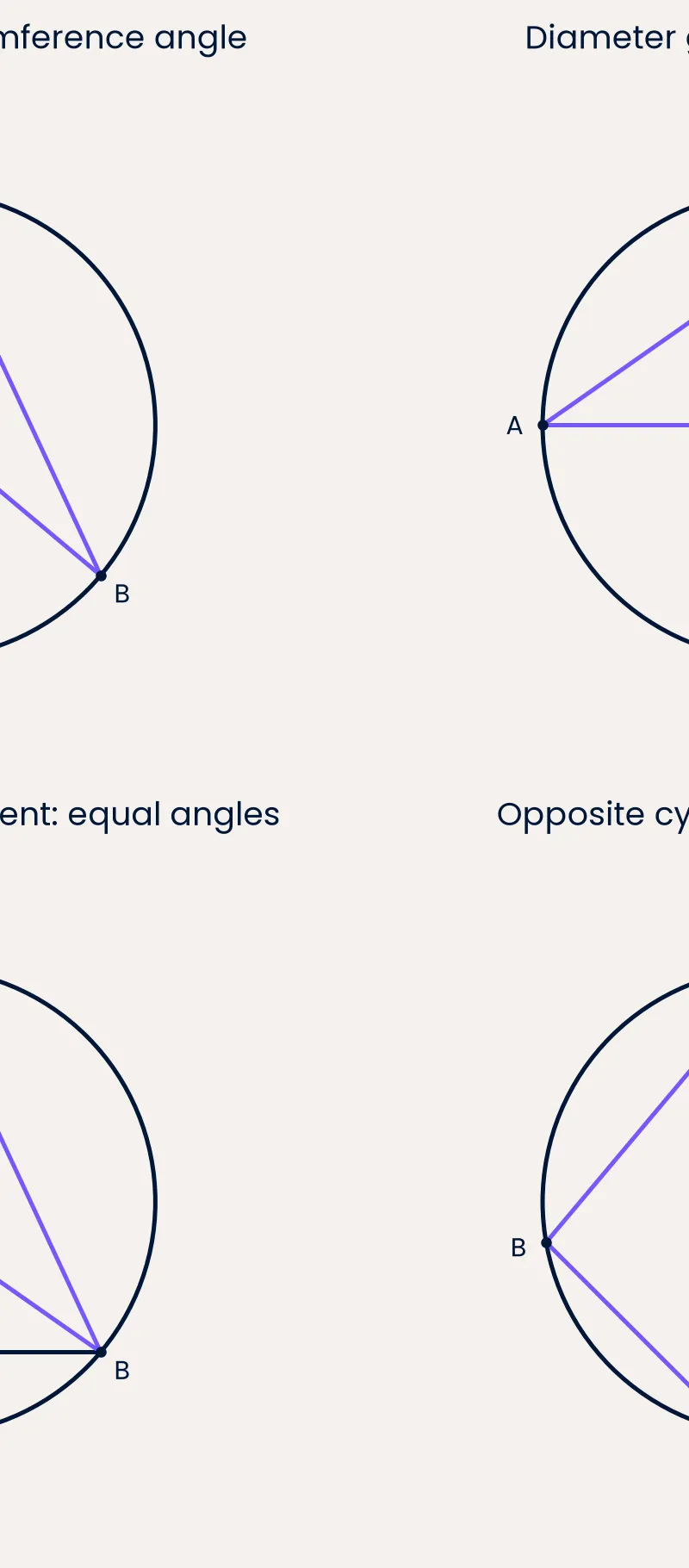
The angle between a tangent and a chord equals the angle subtended by that chord in the alternate segment. In the tangent panel, AT is the rightward tangent ray and AB is the chord: ∠TAB = ∠ACB = 55°. Trace A and B before locating the circumference vertex C. The other tangent ray gives the supplementary angle, not the same 55°.
For an acute-angle proof, let the minor central angle ∠AOB be θ. Equal radii give ∠OAB = (180° − θ)/2 = 90° − θ/2. The chosen tangent-chord angle is 90° − ∠OAB = θ/2. The circumference angle standing on that same minor arc is also θ/2, so they are equal. For the supplementary configuration, both relevant angles are 180° − θ/2. Establish which tangent ray and circumference segment are involved before applying either result.
10. Perpendicular from the centre to a chord
If OM is perpendicular to chord AB, then AM = MB. For a chord not passing through O, triangles OMA and OMB are right-angled; OA = OB and OM is common. RHS congruence gives AM = MB. For a diameter, the midpoint is O directly. The converse also holds: the line from O to the midpoint of a non-diameter chord is perpendicular to it, proved using SSS congruence and equal adjacent angles on a straight line.
The chord panel has OA = 13 cm and OM = 5 cm. Pythagoras gives AM = √(13² − 5²) = 12 cm, so AB = 24 cm. Do not report the half-chord as the full length. Longer chords lie nearer the centre for a fixed radius, since the half-chord squared equals radius squared minus perpendicular distance squared.
Equal chords in the same circle subtend equal matching central angles: their radius-radius-chord triangles are congruent by SSS. They are also equally distant from the centre, using the half-chord right triangles. Conversely, equal perpendicular distances give equal chord lengths. These results are useful for proving related geometric statements, rather than just calculating angles.
Mathematical Relationships and Formula-Sheet Status
The official 2026 Higher formula sheet supplies Pythagoras, trigonometry and circle mensuration, but does not list circle theorems. 3 Labels below distinguish supplied equations from relationships candidates must recall or reconstruct.
Must memorise: θcentre = 2θcircumference for the same arc; θsemicircle = 90°; θsame segment 1 = θsame segment 2; opposite cyclic angles total 180°; radius-tangent angle = 90°; PA = PB for two tangents from P; tangent-chord angle equals its alternate-segment angle; AM = MB when OM is a centre perpendicular. Here θ denotes an angle.
Must memorise: triangle angles total 180°, straight-line angles total 180°, angles around a point total 360°, and equal isosceles base angles. For a radius-radius triangle, each base angle is (180° − θcentre)/2, derived from these facts. ∠APB = 180° − ∠AOB for the two-tangent configuration is likewise derived, not separately supplied.
Given on formula sheet: a² + b² = c², where c is the hypotenuse of a right-angled triangle. Must memorise the geometric relationship, then derive: AB = 2√(r² − d²), where r is radius and d is perpendicular centre-to-chord distance; t = √(s² − r²), where t is tangent length and s is external-point-to-centre distance. Neither derived expression is printed; rote memorisation is unnecessary if you reconstruct its right triangle.
Given on formula sheet: sin θ = opposite/hypotenuse, cos θ = adjacent/hypotenuse, tan θ = opposite/adjacent; sine rule a/sin A = b/sin B = c/sin C; cosine rule a² = b² + c² − 2bc cos A; triangle area = ½ab sin C. Establish the correct triangle before using them. In non-right triangles, side a is opposite angle A, and likewise for b and B.
Given on formula sheet: circumference C = 2πr = πD and circle area A = πr², where D is diameter. Must memorise the sector fraction: arc length = θ/360 × 2πr and sector area = θ/360 × πr² when θ is in degrees. These are synoptic extensions, not substitutes for G10 angle reasons.
Practical Applications, Units and Diagram Skills
Wheel geometry and circular structures make radii memorable; a taut line touching a circular pulley illustrates tangency, although real equipment can deform. Surveying and design can combine a known radius with a measured chord. These contexts may introduce a problem, but marks are awarded for the mathematical model and reasoning.
There is no science-style required practical for this topic. Compass-and-straightedge construction is related geometry, not a substitute for proving a theorem. A protractor measurement illustrates a result but does not establish a general proof.
Use consistent units before squaring: 1 cm = 10 mm and 1 m = 100 cm. A 50 mm perpendicular distance is 5 cm, not 0.5 cm. Length answers use cm, area answers use cm², and angles use degrees. Set a calculator to degree mode for linked trigonometry and avoid premature rounding.
No graph plotting is required for G10 itself. Read labels, contact points and angle arcs carefully; diagram size and orientation are not evidence. In coordinate extensions, calculate a midpoint or gradient and justify a perpendicular using the relevant coordinate facts. Finish each solution by checking that its answer fits the theorem conditions, not merely that it looks plausible.
Listen, Retrieve and Revisit
Listen to the ten-minute episode, then attempt the recall prompts without replaying it. Revisit missed questions tomorrow and a few days later. Explain why your selected theorem applies, and test whether changing a diagram's orientation changes your reasoning.
References
Visual Resources
3 diagrams and illustrations
Interactive Diagrams
2 interactive diagrams to visualise key concepts
Conceptual Flow Outline
A question-selection flowchart. Check the conditions before applying a theorem.
Conceptual Flow Outline
A proof-dependency map showing how radii, triangle facts and congruence support the circle theorems.
Worked Examples
5 worked examples — open one to explore the question and available guidance.
Practice Questions
Try the question, then reveal an answer plan or example response
A and B lie on a circle with centre O. C lies on the major arc AB and ∠ACB = 34°. Calculate the minor ∠AOB and give a reason.
Hint: Identify the centre angle and the matching arc. Foundation denotes an easier task within Higher-only G10, not Foundation-tier assessment.
ABCD is a cyclic quadrilateral, named in order around the circle. ∠ABC = 112°. Calculate ∠ADC and explain your answer.
Hint: B and D are opposite vertices, not adjacent vertices.
In cyclic quadrilateral ABCD, named in order, ∠BAD = (3x + 8)° and ∠BCD = (5x − 4)°. Calculate x and both angles. Give the geometric reason for your equation.
Hint: Form one equation by adding the opposite interior angles.
A circle has radius 17 cm. The perpendicular distance from its centre to chord AB is 80 mm. Calculate AB in centimetres. Show your working.
Hint: Convert the distance first. Pythagoras gives half the chord.
PA and PB are tangents to a circle with centre O at A and B. ∠APB = 64°. C lies on the major arc AB. Calculate the minor ∠AOB and ∠ACB. Give reasons.
Hint: First use quadrilateral OAPB, then the matching centre/circumference theorem.
PA and PB are tangents from the same external point P to a circle with centre O. Prove that PA = PB. Do not assume equal tangent lengths.
Hint: Join OA, OB and OP. Use RHS congruence.
A, B, C and D are distinct points on a circle, in that order. Diagonals AC and BD intersect at X inside the circle. Prove that triangles ABX and DCX are similar.
Hint: Use the chords AD and BC, then compare the angles at X.
Exam technique
How to turn what you know into marks
How to approach the question
Read the command word and target angle. Mark only stated or established facts. Trace the chord endpoints, identify the correct arc or alternate segment, and add useful radii. Choose a theorem, write its labelled equation and reason, then combine with triangle facts, algebra, congruence or Pythagoras. If stuck, leave a valid intermediate step and return later.
How to structure your answer
For a short angle question, give the angle, equation and exact reason requested. For 3–4 marks, show each essential intermediate angle or length and why it follows. For 5–6-mark proofs, introduce any construction and variables, justify equal lengths or angles, identify a valid congruence or angle argument, and finish with the exact conclusion. Marks are not universally allocated one per written line. Official Summer 2023 1H question 21 used M1 + M1 + A1 + C1, with its relevant-reason communication mark dependent on a method mark and linked to the method. The worked and practice schemes here are original teaching allocations.
Timing
Each Pearson Edexcel paper has 90 minutes for 80 marks: 90/80 = 1.125 minutes per mark, or 67.5 seconds. Aim for about 3 minutes 23 seconds on 3 marks, 4 minutes 30 seconds on 4 marks, and 6 minutes 45 seconds on 6 marks. This is a planning average, not an official per-question limit.
Common pitfalls
- Writing circle theorem alone: name the relationship, such as opposite angles of a cyclic quadrilateral sum to 180°.
- Assuming a diameter: require the chord to pass through the stated centre, or establish it.
- Choosing the wrong central angle: use the same arc, including the reflex angle where appropriate.
- Choosing adjacent cyclic angles or the wrong segment: trace the correct vertices and chord.
- Using the supplementary tangent-chord angle: identify the tangent ray and alternate segment explicitly.
- Reporting a half-chord as a full chord: label AM and AB separately.
- Mixing mm and cm before squaring: convert all lengths to the same unit first.
- Assuming the target result in a proof: start from givens and previously established facts.
- Expecting the formula sheet to provide circle theorems: the 2026 Higher sheet supplies equations, not these theorem statements.
What the command words want
- Prove
- Give a general, logically connected argument using established facts. Measurements or one numerical case do not prove a general statement.
- Compare
- Describe a mathematically justified equality or difference. Do not import an essay-style similarities-and-differences template into an angle calculation.
- Explain
- Link a labelled result to its reason, for example ∠OAP = 90° because the radius is perpendicular to the tangent at A.
- Describe
- Use accurate geometric vocabulary to describe the relationship. This is less typical than calculate or prove in G10.
- Evaluate
- In Mathematics, evaluate an expression means work out its value. It does not mean discuss both sides of an argument.
- Calculate
- State the relationship, substitute the given values, show arithmetic and include degrees or length units as appropriate.
- Show that
- Derive the stated result from the givens. Treat the printed answer as a target, not a premise.
- State/Give
- Provide the requested fact or value briefly. If a reason is requested, give the complete specific theorem, not a vague label.
- Give reasons
- Attach each requested geometric reason to the relevant angle or equation. Write enough of the theorem to identify it unambiguously.
Watch or listen (optional)
Test your understanding of Geometry and measures - Properties and constructions: apply and prove the standard circle theorems concerning angles, radii, tangents and chords, and use them to prove related results (Higher tier only)
Active recall beats re-reading. Take an instant quiz now to test what you’ve learned and lock it into long-term memory.
7 days Premium · Then the free plan continues · No card, no charge