Pearson Edexcel · GCSE · Mathematics
Course version: 1MA1 · Version from Mar 2026
Geometry and measures - Properties and constructions: derive and apply the properties and definitions of: special types of quadrilaterals, including square, rectangle, parallelogram, trapezium, kite and rhombus; and triangles and other plane figures using appropriate language
Become a shape detective: use parallel sides, equal lengths and diagonal properties to unlock missing angles and convincing proofs. This Pearson Edexcel GCSE guide shows how precise definitions, clear working and named reasons turn geometry knowledge into exam marks.
- 13 min read
- 4 worked examples
- 6 practice questions
- 16 key terms
Try the lesson
The start of the Geometry and measures - Properties and constructions: derive and apply the properties and definitions of: special types of quadrilaterals, including square, rectangle, parallelogram, trapezium, kite and rhombus; and triangles and other plane figures using appropriate language lesson, made from checked teaching notes for this specification point.
Have a go first
Which quadrilateral has exactly one pair of parallel sides?
There is more to this lesson
The full lesson goes on to check your understanding and help you earn the marks. Create a free account to carry on, with your progress saved.
7 days Premium · Then the free plan continues · No card, no charge
Check what you remember
Read the wording for your board, then hide it and explain Quadrilateral in your own words. Rough notes are fine. This is a self-check, with no mark or grade.
Reference: Pearson Edexcel
A polygon with four sides.
Study Notes

Overview
A diagram is a collection of clues, not a photograph to measure. This topic teaches you to identify triangles and special quadrilaterals from precise definitions, then use their properties to calculate missing angles and lengths. You will also explain why those properties follow from parallel lines, equal sides and congruent triangles. That combination turns a familiar-looking shape into a reliable mathematical argument.
For Pearson Edexcel GCSE Mathematics, the main reference is 1MA1, G4. Geometrical language comes from G1, angle reasoning from G3, and congruence and simple proofs from G5 and G6. The core content is assessed at both Foundation and Higher tiers. A difficult-looking proof is not automatically Higher-only. 1
Questions may ask candidates to name a shape, work out an angle, give a reason, show that two lengths are equal, or combine shape properties with algebra and Pythagoras. Marks are awarded for the required mathematical evidence, not the neatness of the sketch. Read the command word, mark the stated facts, and explain each deduction. Your aim is to move from definition → property → calculation or proof, using a named reason whenever one is requested.
Key Concepts
1. Read the mathematical language
A vertex is a corner. Adjacent sides meet at a vertex; opposite sides do not. Parallel lines have the same direction and never meet. Perpendicular lines meet at 90°. A diagonal joins two non-adjacent vertices, while a bisector divides an angle or line segment into two equal parts.
Equal-length ticks and parallel-line arrows communicate different facts. A right-angle square establishes perpendicularity. Matching angle arcs establish equal angles. Only use a property that is stated, marked or logically established. If ABCD names a quadrilateral, the vertices are normally listed in order around its boundary. In angle ABC, B is the vertex.
Cover and recall: explain the difference between equal, parallel and perpendicular without using a diagram. Why would two equal sides not necessarily be parallel?
2. Parallelograms: begin with parallel sides
A parallelogram has two pairs of parallel opposite sides. Its opposite sides are equal, opposite angles are equal, adjacent interior angles total 180°, and its diagonals bisect each other. None of these facts requires four right angles or four equal sides.
Example: if angle A in parallelogram ABCD is 68°, then C = 68° because opposite angles are equal. B = D = 180° − 68° = 112° because adjacent angles are supplementary. State the particular property used, rather than writing only “parallelogram”.
To derive equal opposite sides, draw diagonal AC. Alternate angles give angle BAC = DCA and BCA = DAC. AC is common to both triangles. Therefore triangles ABC and CDA are congruent by ASA, so AB = CD and BC = AD. This establishes the result from parallelism instead of assuming it.
3. Rectangles, rhombi and squares: related, not interchangeable
A rectangle is a parallelogram with four right angles. Opposite sides are equal, and diagonals are equal and bisect each other. The diagonals are not generally perpendicular, and they do not generally bisect the corner angles.
A rhombus is a parallelogram with four equal sides. Opposite angles are equal and adjacent angles total 180°. Its diagonals bisect each other, meet at 90°, and bisect the angles at their endpoints. They are not generally equal. A tilted rhombus has exactly the same properties as an upright one.
A square has four equal sides and four right angles. It is simultaneously a rectangle, a rhombus and a parallelogram. Its diagonals are equal, perpendicular, mutually bisecting, and angle-bisecting. Each diagonal divides a corner into two 45° angles.
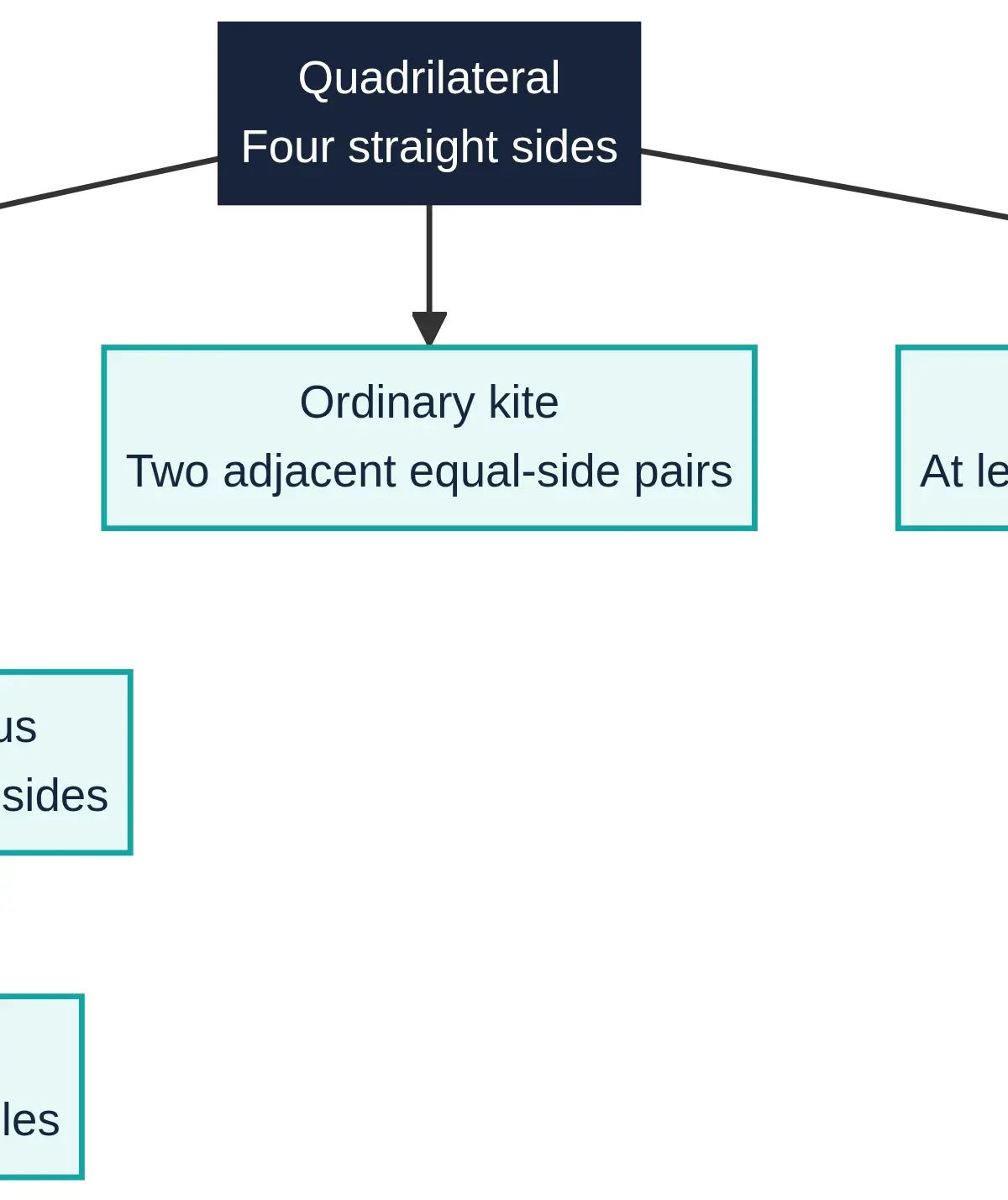
The hierarchy shows selected specialisations, not every possible inclusion. Rectangles and non-square rhombi each have two lines of reflection symmetry; a square has four. Their rotational symmetry orders are 2, 2 and 4 respectively. An ordinary slanted parallelogram has rotational symmetry of order 2 but no reflection symmetry.
Why do a rectangle's diagonals have equal lengths? Triangles ABC and DCB have AB = DC, BC common, and included right angles ABC and DCB. SAS congruence gives AC = DB. Why are a rhombus's diagonals perpendicular? If they meet at O, bisection gives AO = OC; AB = CB and BO is common. SSS makes triangles AOB and COB congruent. Their equal angles at O lie on a straight line, so each is 90°.
4. Kites and trapezia: avoid invented properties
A kite has two pairs of adjacent equal sides. For an ordinary convex kite ABCD with AB = AD and CB = CD, AC is its symmetry diagonal. AC perpendicularly bisects BD and bisects the angles at A and C. Angles B and D are equal. BD does not generally bisect AC. An ordinary non-rhombus kite has one line of symmetry and rotational symmetry of order 1.
This guide allows a rhombus as a special kite because four equal sides satisfy the adjacent-pair definition. When a question describes an ordinary kite, do not transfer the rhombus's stronger properties to it.
A trapezium has at least one pair of parallel opposite sides under the inclusive convention supplied for this guide. Some school resources use exactly one pair. Follow any explicit definition in the question; the inspected G4 wording names trapezia without choosing between these conventions. Under the inclusive convention, parallelograms also qualify. Neither convention makes all trapezia symmetrical.
If AB is parallel to CD, angles A and D total 180°, as do B and C. An isosceles trapezium with exactly one parallel pair additionally has equal non-parallel sides, equal angles on each base, equal diagonals and one symmetry line. These extras cannot be assumed for a general trapezium.
5. Triangles: classify sides and angles separately
An equilateral triangle has three equal sides and three equal angles of 60°. An isosceles triangle has at least two equal sides; the angles opposite the equal sides are equal. An ordinary scalene triangle has no equal sides and consequently no equal angles.
An acute-angled triangle has three angles below 90°. A right-angled triangle has one 90° angle. An obtuse-angled triangle has one angle above 90°. These labels describe angles, so a triangle can be both right-angled and isosceles. It cannot contain two obtuse angles because its total is only 180°.
Example: AB = AC and angle BAC = 40°. Angles ABC and BCA are equal, so each is (180° − 40°)/2 = 70°. The equality is justified by the side information, not by apparent symmetry. Conversely, two equal angles in a triangle establish equal opposite sides. This is useful in “show that the triangle is isosceles” questions. Pearson's teaching guidance includes a 4-mark Foundation sample requiring such a demonstration with reasons at each stage. 2
6. Polygons: total angles versus individual angles
A polygon is a closed plane figure bounded by straight sides. A regular polygon has all sides equal and all interior angles equal. Equal sides alone are insufficient: a non-square rhombus is not regular.
A convex n-sided polygon can be divided into n − 2 triangles by diagonals from one vertex. Hence its interior sum is (n − 2) × 180°. The formula also holds for simple concave polygons using a suitable triangulation, but not for arbitrary self-crossing outlines. A pentagon totals 540° and a hexagon 720°, whether regular or irregular.
For a convex polygon, one consistently chosen exterior turning angle at each vertex totals 360°. In a regular polygon, each exterior angle is 360°/n and each interior angle is 180° − 360°/n. A regular hexagon therefore has exterior angles of 60° and interior angles of 120°. An irregular hexagon still has interior sum 720°, but its six angles need not each be 120°.
What if someone claims a regular polygon has exterior angle 50°? The calculation n = 360/50 = 7.2 gives a non-integer, so no such polygon exists. The number of sides must be a whole number of at least 3.
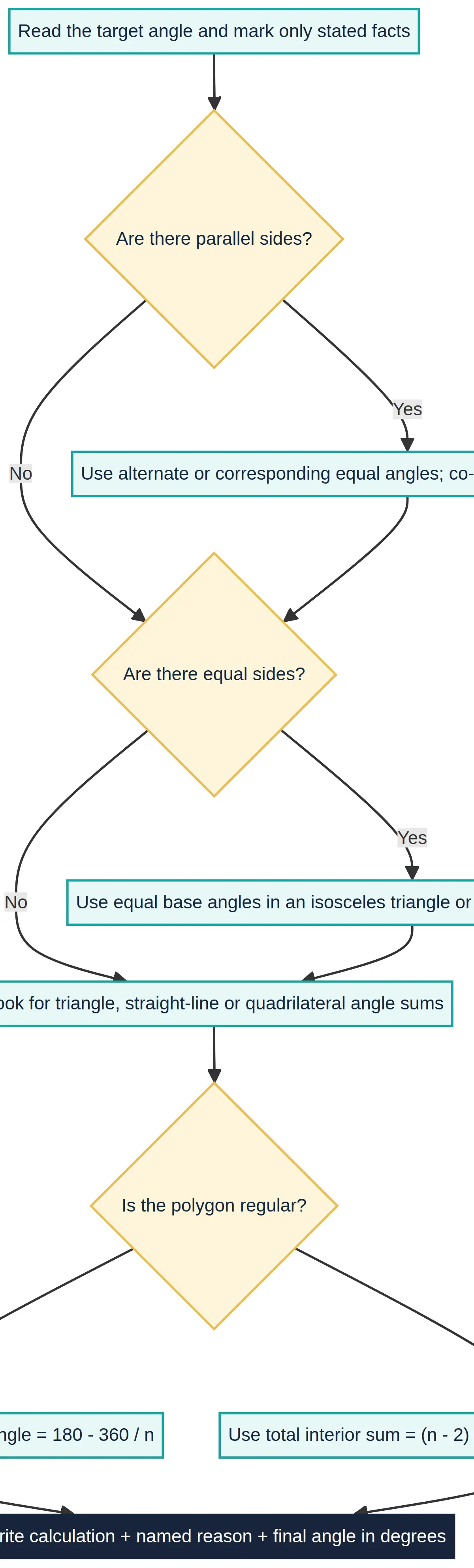
7. Combine properties with algebra, lengths and composite figures
When angles are algebraic, write the geometric relationship before solving. Adjacent parallelogram angles labelled (2x + 10)° and (3x − 20)° give 2x + 10 + 3x − 20 = 180, so x = 38. The angles are 86° and 94°, providing a check.
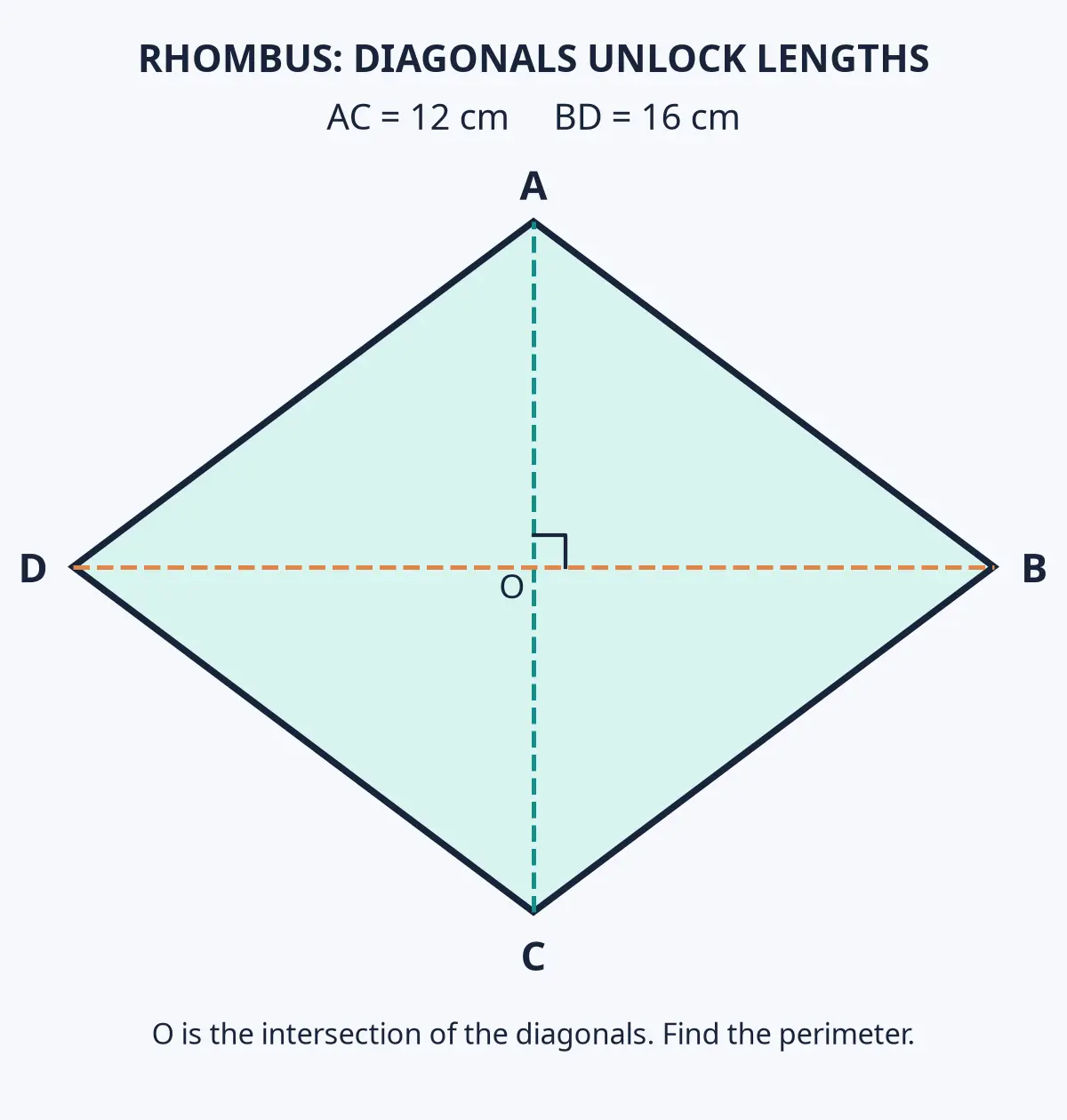
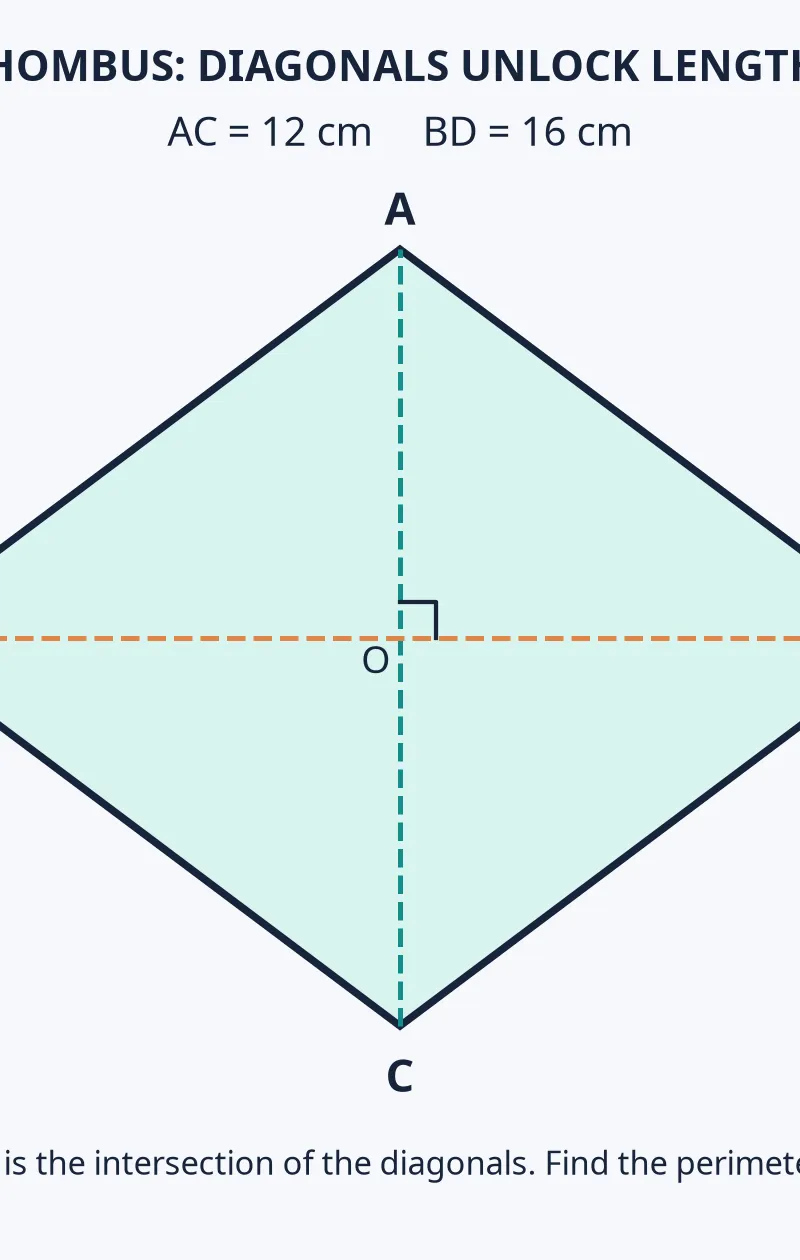
Rhombus diagonals create right-angled triangles. For diagonals of 12 cm and 16 cm, their halves are 6 cm and 8 cm. A side has length √(6² + 8²) = 10 cm, so the perimeter is 40 cm. Do not use the full diagonals as the shorter sides.
In composite diagrams, identify each component separately. An attached triangle does not make the whole outline a regular polygon. Work out useful component angles, then use a straight-line or full-turn relationship at the shared vertex. Label precisely which angle your number describes.
Mathematical Relationships
The following provision labels refer to the 2026 Pearson formula sheets, which were checked for both tiers. The polygon-angle formulae and shape definitions are not provided. 3 4
Must memorise: angles on a straight line = 180°; angles around a point = 360°; triangle interior sum = 180°; quadrilateral interior sum = 360°. Vertically opposite angles are equal. With parallel lines, alternate and corresponding angles are equal, while co-interior angles total 180°.
Must memorise: S = (n − 2)180°, where S is the total interior angle sum and n is the number of sides of a simple polygon. For a regular convex polygon, e = 360°/n, i = 180° − e = (n − 2)180°/n, and n = 360°/e. Here e and i are one exterior and one interior angle. Do not use the individual-angle formulae without regularity.
Must memorise: an isosceles triangle's base angle b = (180° − v)/2, when v is the angle between its equal sides. General perimeter P is the sum of boundary side lengths. Rectangle P = 2(l + w); square or rhombus P = 4s, where l, w and s are lengths.
Must memorise: rectangle area A = lw; square A = s²; parallelogram A = bh; triangle A = bh/2. Here b is the chosen base and h its perpendicular height. For a convex kite or rhombus with perpendicular diagonals d₁ and d₂, A = d₁d₂/2, obtained by adding the areas of its right-angled component triangles.
Given on formula sheet: trapezium A = (a + b)h/2, with parallel-side lengths a and b and their perpendicular separation h. Given on formula sheet: Pythagoras a² + b² = c² for a right-angled triangle, where c is the hypotenuse. Shape properties must establish the right angle before you apply it. No Higher-only formula is required for this guide. 3 4
Practical Applications and Diagram Skills
Window frames make rectangles memorable: equal diagonals help check that a frame is square-cornered, but appearance alone is not proof. Rhombus and kite designs reveal how perpendicular diagonals support area and length calculations. Regular hexagonal tiling works because three 120° angles make 360° around a point.
There is no required practical for this mathematics topic. Ruler-and-compass constructions belong to linked content G2 rather than a science-style practical assessment. On coordinate grids, plot ordered pairs accurately, join vertices in boundary order and distinguish horizontal, vertical and slanted sides. A sketch supports reasoning but cannot replace it. There is no statistical graph-plotting requirement here.
Convert lengths before combining them: 1 cm = 10 mm and 1 m = 100 cm. For area, square the scale factor: 1 cm² = 100 mm² and 1 m² = 10,000 cm². Perimeter answers use length units; areas use squared units; angles use degrees.
Listen, Then Retrieve
The ten-minute episode contains introduction (0:00–1:00), core concepts (1:00–6:00), exam tips (6:00–8:00), recall quiz (8:00–9:00), and summary (9:00–10:00). After listening, cover the guide and draw the six named quadrilaterals from memory. Add their diagonal properties, then solve one angle problem with reasons and one short proof. Check only after attempting; repeat tomorrow and later in the week.
Source and Marking Notes
All worked examples and practice questions below are original Edexcel-style teaching questions. Their exact allocations are illustrative, not official Pearson mark schemes. Pearson uses M for method, P for process, A for accuracy, C for communication and B for independent accuracy; individual question guidance determines the award. 5
Visual Resources
3 diagrams and illustrations
Interactive Diagrams
2 interactive diagrams to visualise key concepts
Conceptual Flow Outline
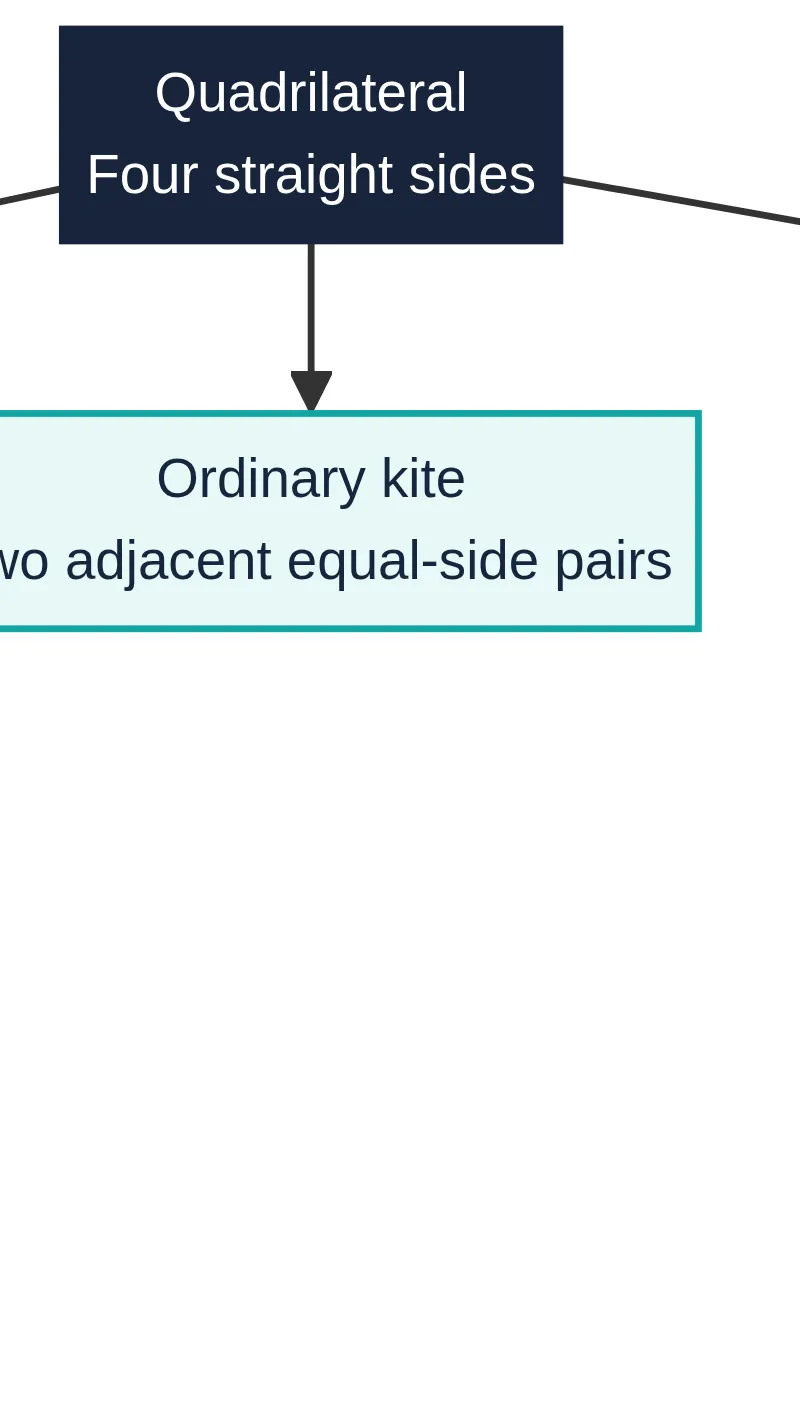
Selected quadrilateral specialisations. A square is both a rectangle and a rhombus. Inclusive kite and trapezium definitions allow further overlaps not drawn.
Conceptual Flow Outline
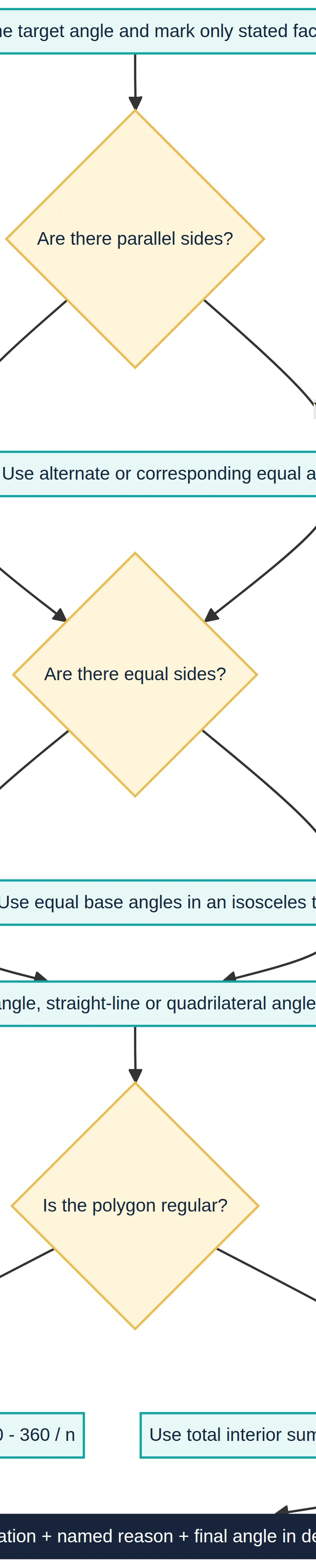
Choose angle relationships from the given properties, then state a calculation and named reason. Polygon rules refer to simple polygons and ordinary convex exterior angles.
Worked Examples
4 worked examples — open one to explore the question and available guidance.
Practice Questions
Try the question, then reveal an answer plan or example response
State the most specific name of a quadrilateral with four equal sides and four right angles. Give a reason for your choice.
Hint: You need a name that includes both side and angle conditions.
AB = AC in triangle ABC and angle BAC = 52°. Calculate angles ABC and BCA. Give a reason for their equality.
Hint: Identify the angles opposite AB and AC, then use the triangle angle sum.
ABCD is an ordinary convex kite with AB = AD and CB = CD. Angle A = 84° and angle C = 36°. Calculate angles B and D. Show your working.
Hint: The equal opposite angles lie between the unequal side lengths.
Each interior angle of a regular polygon is 165°. Work out its number of sides. Then decide whether a regular polygon can have exterior angle 50°, explaining your answer.
Hint: Find the first polygon's exterior angle. A side count must be a whole number.
ABCD is a trapezium, with vertices in boundary order and AB parallel to CD. Angle A = 72° and angle B = 104°. Calculate angles D and C, giving a reason for each.
Hint: Each non-parallel side crosses the two parallel lines.
ABCD is a rectangle, with vertices in boundary order. Prove that its diagonals AC and BD are equal using triangles ABC and DCB.
Hint: Compare two sides and their included angle, then identify the corresponding diagonals.
Exam technique
How to turn what you know into marks
How to approach the question
Read the command word and target first. Mark only given parallel lines, equal sides and right angles. Name the relevant shape or theorem, write the relationship, then calculate or prove. In composite shapes, identify the component triangle or polygon before using a formula. Finish with the exact requested quantity and suitable units.
How to structure your answer
For 1 mark, give a precise name or fact. For 2–3 marks, make the useful relationship and calculation clear and give a named reason if asked. For 4–6 marks, show the full chain of deductions and a concluding answer. In a proof, state paired equalities, justify them, name the congruence criterion and draw the requested conclusion. Exact mark splits depend on the question; the examples here use illustrative schemes.
Timing
Each paper lasts 90 minutes for 80 marks: a whole-paper average of 1.125 minutes, or 67.5 seconds, per mark. Plan roughly 3–4 minutes for 3 marks, 4–5 for 4 marks and 6–7 for 6 marks. Adjust for difficulty and leave checking time; these are revision targets, not official per-question deadlines.
Common pitfalls
- Rectangle diagonals are equal and bisect each other, but are not generally perpendicular; the square is the exception.
- Rhombus diagonals are perpendicular and mutually bisecting, but are not generally equal; the square is the exception.
- An ordinary kite has only one diagonal bisected by the other, not mutual bisection. Identify the symmetry diagonal.
- Do not divide a polygon's total angle sum equally unless equal angles or regularity are established.
- Use the exterior angle, not the interior angle, in n = 360/e.
- Adjacent parallelogram angles total 180°; opposite angles are equal.
- Do not measure an unscaled diagram or assume equality because of its orientation.
- Do not use the property being proved as a starting fact. Begin from the given definition.
- Trapezium conventions vary. Follow an explicit question definition and do not assume isosceles-trapezium properties.
- Convert lengths before using them together, and square conversion factors for area.
What the command words want
- Compare
- State the relevant common properties and differences, for example rectangle diagonals are equal whereas rhombus diagonals are perpendicular.
- Describe
- Specify the requested properties using terms such as adjacent, opposite, equal, parallel, perpendicular and bisect.
- Evaluate
- In mathematics this commonly means find the value of an expression, not write a balanced essay. For a claim, use a proof or counterexample as the wording requires.
- Show that/Prove
- Provide a logical argument from stated facts to the result. A numerical example, measurement or restatement of the conclusion is not proof.
- Calculate/Work out
- Use the relevant relationship and obtain the requested value. Show working whenever asked; include degrees, length units or squared area units as appropriate.
- Explain/Give a reason
- Name the property and connect it to the deduction: 'B = 112° because adjacent angles in a parallelogram sum to 180°.'
- State/Give/Write down
- Give a concise shape name, property or value. If asked for the most specific name, four equal sides and four right angles means square.
Watch or listen (optional)
Test your understanding of Geometry and measures - Properties and constructions: derive and apply the properties and definitions of: special types of quadrilaterals, including square, rectangle, parallelogram, trapezium, kite and rhombus; and triangles and other plane figures using appropriate language
Active recall beats re-reading. Take an instant quiz now to test what you’ve learned and lock it into long-term memory.
7 days Premium · Then the free plan continues · No card, no charge