Pearson Edexcel · GCSE · Mathematics
Course version: 1MA1 · Version from Mar 2026
Geometry and measures - Properties and constructions: describe the changes and invariance achieved by combinations of rotations, reflections and translations (Higher tier only)
Two reflections can secretly become a slide or a turn. Learn to track successive images, describe the equivalent transformation completely, and distinguish unchanged lengths and angles from points that genuinely stay fixed, so your Higher-tier answers secure the available marks.
- 14 min read
- 4 worked examples
- 6 practice questions
- 12 key terms
Try the lesson
The start of the Geometry and measures - Properties and constructions: describe the changes and invariance achieved by combinations of rotations, reflections and translations (Higher tier only) lesson, made from checked teaching notes for this specification point.
Have a go first
A shape is reflected in the x-axis and then reflected in the y-axis. Describe fully the single transformation that has the same effect as these two reflections combined.
There is more to this lesson
The full lesson goes on to check your understanding and help you earn the marks. Create a free account to carry on, with your progress saved.
7 days Premium · Then the free plan continues · No card, no charge
Check what you remember
Read the wording for your board, then hide it and explain Combined transformation in your own words. Rough notes are fine. This is a self-check, with no mark or grade.
Reference: Pearson Edexcel
An ordered sequence of transformations, each acting on the image produced by the preceding transformation.
Study Notes
Overview
Two moves can hide one simple answer. In this Higher-tier topic, you follow a shape through rotations, reflections and translations, then identify the single transformation that takes the original directly to the final image. You also explain what changes and what remains invariant. Pearson Edexcel GCSE Mathematics specification 1MA1, G8 covers these combinations; individual transformations from G7 are the prerequisite. 1
The central skill is keeping track of corresponding vertices. An intermediate image is not a new starting question: it is the input for the second transformation. Accurate coordinates, a clear diagram and a complete description can secure marks even when a picture initially looks complicated.
Typical questions ask candidates to draw two successive images, describe an equivalent transformation fully, identify invariant points, or explain why the final shape is congruent to the original. This connects coordinate geometry, vectors, angle facts and ruler-and-compass constructions. Start by mastering the three basic moves, then learn the two-reflection rules. Finally, use unchanged lengths and angles as a check on every answer, without confusing these preserved properties with points that stay fixed.
Key Concepts
1. Follow the order: original → intermediate → final
A combined transformationis a sequence in which each move acts on the result of the preceding move. Write the journey as (A\to B\to C). If the question asks for the overall transformation, compare A with C, not B with C. Label images immediately so an examiner can identify your intended working.
For example, translate (P(2,1)) by (\begin{pmatrix}1\0\end{pmatrix}), then rotate 180° about the origin. The translation gives ((3,1)); the rotation gives ((-3,-1)). Reversing the order gives ((-2,-1)), then ((-1,-1)). Different final coordinates demonstrate thatorder generally matters.
Do not claim it always matters: two translations can be reversed without changing their combined effect. To test an unfamiliar pair, follow one labelled point through both orders. This can disprove equivalence, although one matching point alone does not prove two transformations are identical.
Cover and recall: what image receives the second transformation? Answer before rereading: the intermediate image.
2. Describe each basic move completely
A translationmoves every point by the same vector. In (\begin{pmatrix}a\b\end{pmatrix}), a is horizontal displacement and b is vertical displacement. Positive a means right; positive b means up. Give the vector, not merely a distance.
A reflection maps a point to the opposite side of a mirror line at the same perpendicular distance. The mirror bisects the segment joining the point and its image, at right angles. Describe it using the mirror-line equation, such as (x=3), (y=-2) or (y=x).
A rotation moves every point through the same angle around a centre. Give the angle, clockwise or anticlockwise direction, and centre coordinates. For 180°, either direction produces the same result. A rotation centre is not necessarily the origin and need not lie inside the shape.
Examiner checkpoint: “rotation 90° clockwise about ((1,2))” is complete. “Turn it clockwise” is not. For a reflection, “in the vertical line” is incomplete unless that particular line is unambiguously specified.
3. Two reflections in parallel mirrors give a translation
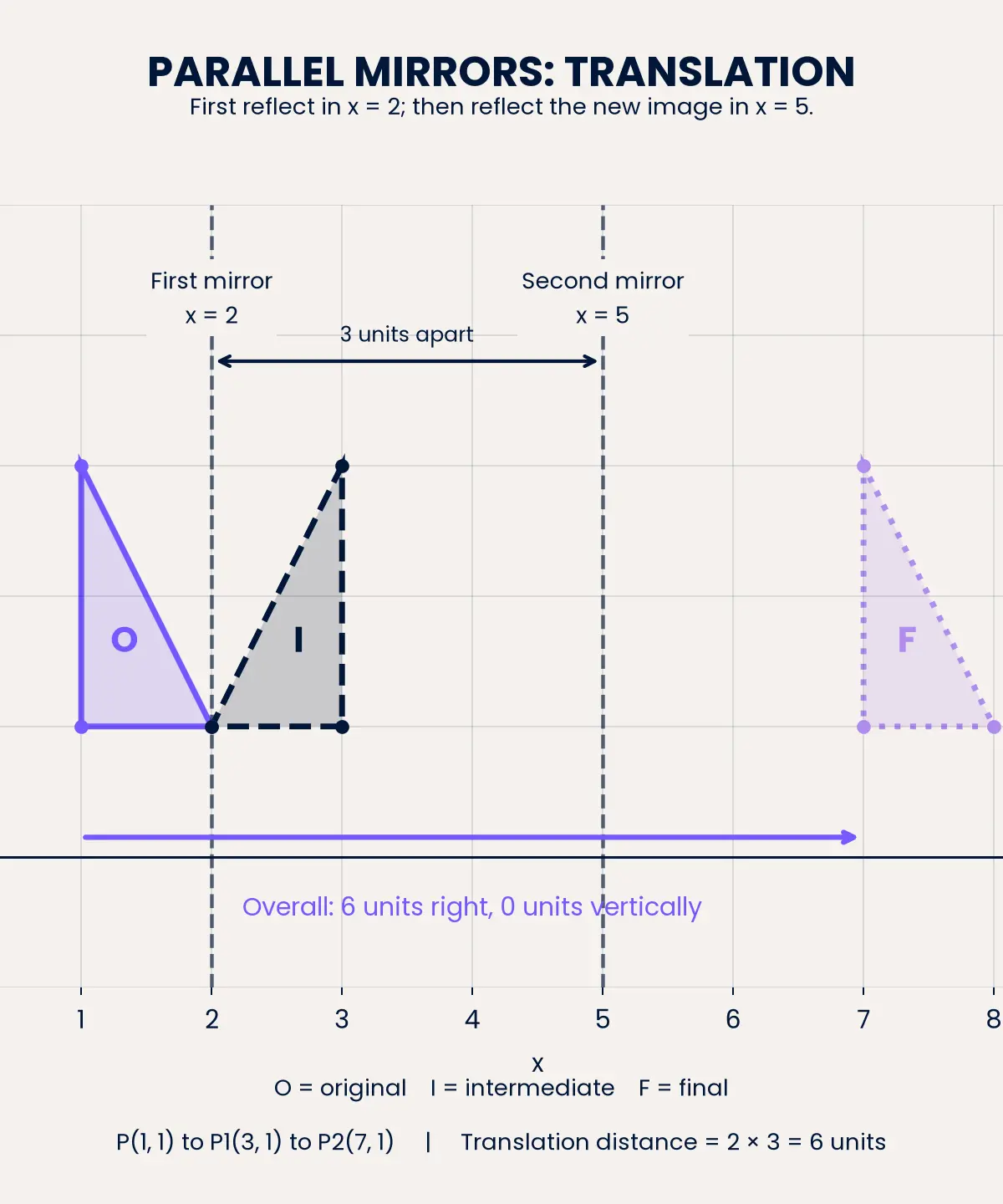
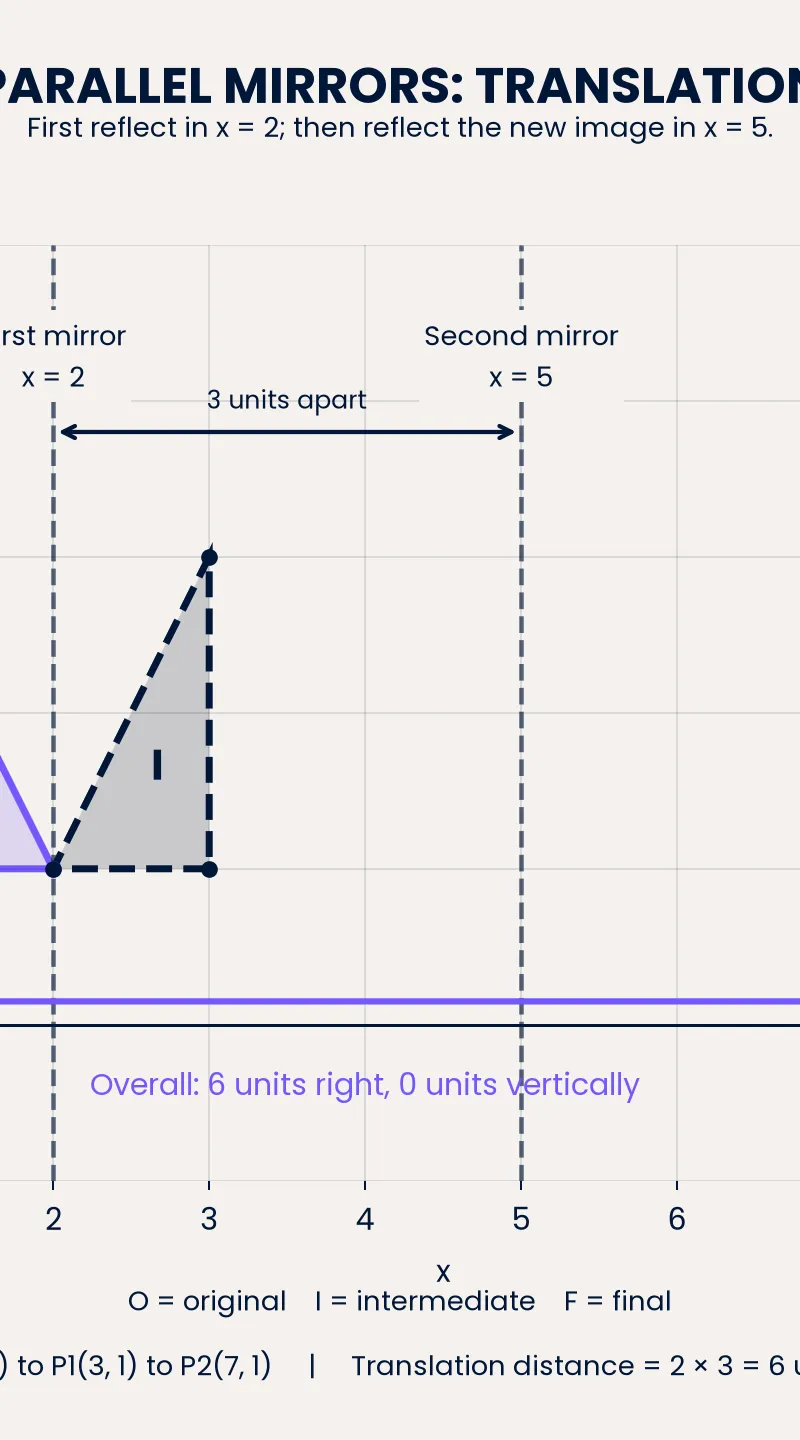
Reflect first in (x=2), then in (x=5). The mirrors are 3 units apart. Every point moves 6 units right overall, so the equivalent transformation is a translation by (\begin{pmatrix}6\0\end{pmatrix}).
Why does the distance double? A point with horizontal coordinate x becomes (4-x) after the first reflection. The second gives (10-(4-x)=x+6). The original x appears unchanged apart from adding 6, and y never changes. This proves the rule for every point, not just one vertex.
For distinct parallel mirrors separated by perpendicular distance d, the translation has magnitude 2d, perpendicular to the mirrors and directed from the first mirror towards the second. Horizontal mirrors produce vertical translations. Oblique parallel mirrors produce an oblique translation, not necessarily a purely horizontal or vertical one.
Reversing the mirrors reverses the translation vector. Reflecting twice in the same line instead gives identity: every point returns to its original position. Distinguish this exceptional case from two distinct parallel mirrors.
What if? Moving the second mirror 1 unit farther away increases the translation distance by 2 units. Explain why before checking the algebra.
4. Two reflections in intersecting mirrors give a rotation
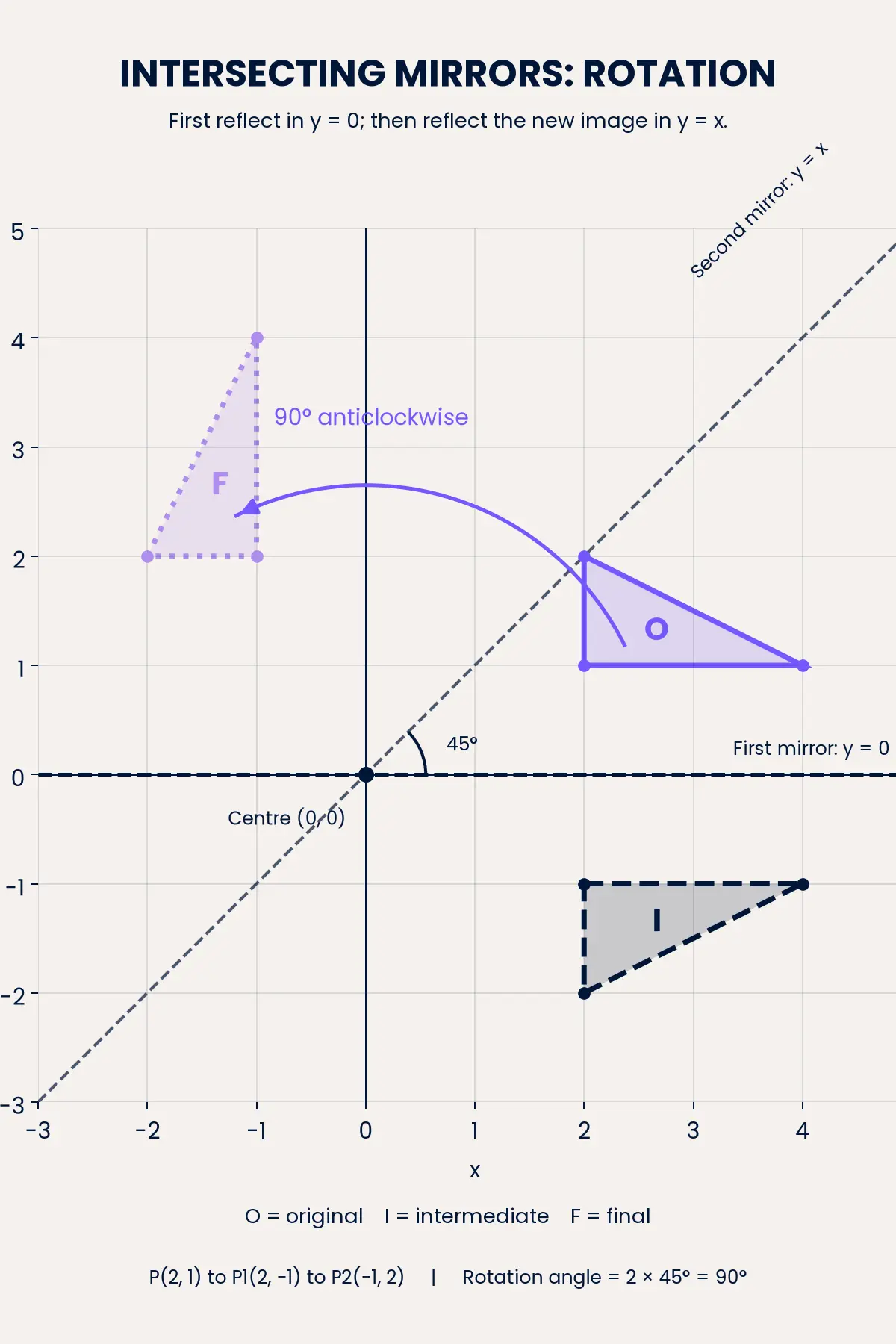
The equivalent rotation is centred at the intersection of the mirror lines. Its angle is twice the directed angle from the first mirror to the second, interpreted modulo 360°. For ordinary GCSE diagrams, double the marked angle and verify the direction by following a vertex.
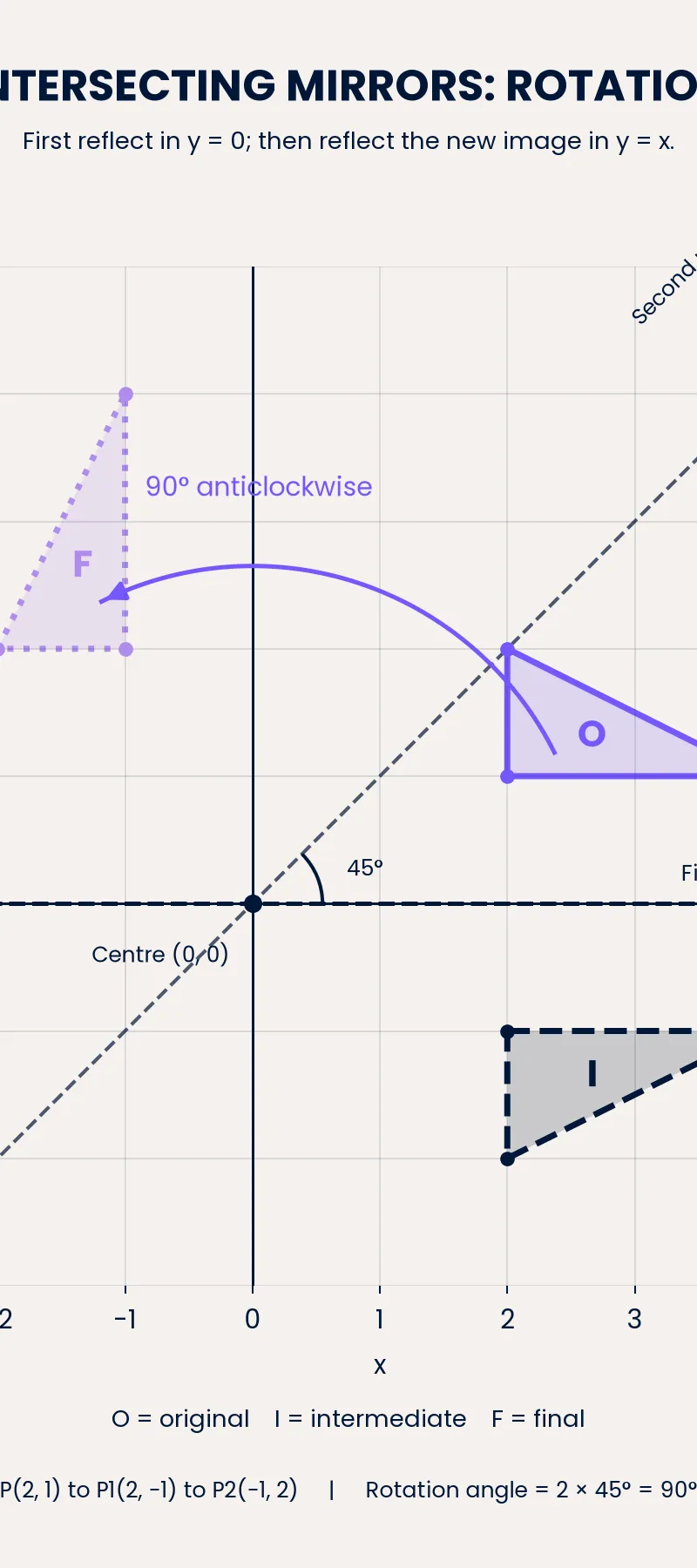
Reflecting in (y=0), then (y=x), takes ((2,1)) to ((2,-1)), then ((-1,2)). The mirrors meet at 45°, so the overall result is 90° anticlockwise about ((0,0)). Reverse the order and obtain 90° clockwise instead.
Why is the intersection the centre? It lies on both mirrors, so neither reflection moves it. Other points maintain their distance from that intersection but change their angular position. Two perpendicular mirrors give a 180° rotation because (2\times90°=180°).
Credit given for: a complete rotation description supported by the construction or coordinates. “Rotation 90°” omits direction and centre. The angle between mirrors is not the final rotation angle.
5. Combine translations and rotations carefully
Two translations combine by adding their vectors component by component. For example, (\begin{pmatrix}3\-2\end{pmatrix}+\begin{pmatrix}-1\5\end{pmatrix}=\begin{pmatrix}2\3\end{pmatrix}). Negative components are signed movements, not positive distances to be added indiscriminately.
Rotations about the same centre combine by adding signed angles. Taking anticlockwise as positive, 90° anticlockwise followed by 180° gives 270° anticlockwise, equivalently 90° clockwise, about that same centre. A total of 360°, or a multiple of 360°, gives identity.
Do not add angles about different centres and simply retain one centre. Two 180° rotations about different centres can give a translation. Mixed combinations can also have an equivalent rotation centre different from any centre explicitly given in the question. Draw intermediate images or use coordinate rules to find it.
Scope warning: not every combination reduces to one ordinary translation, rotation or reflection. A reflection followed by a non-zero translation parallel to its mirror is a glide reflection. That term is extension context here, not a required extra formula. Never force an unsupported basic-transformation answer.
6. Invariant properties are not invariant points
Rotations, reflections and translations are isometries: they preserve the distance between any two corresponding points. Each also preserves angles. Their combinations therefore preserve side lengths, angle sizes, area and perimeter. The final shape is congruent, not merely similar, to the original.
An invariant point is a particular point whose final coordinates equal its original coordinates. Under a reflection, every point on the mirror line is invariant. A non-zero translation has no invariant points. A non-identity rotation has exactly one invariant point in the plane: its centre. Identity fixes every point.
If asked for invariant points of a particular shape, include only fixed points belonging to that shape. A rotation centre outside a triangle is fixed in the plane, but is not a point of that triangle.
A point can move after stage one and return after stage two. For example, opposite translations combine to identity although neither translation individually fixes any point. Judge invariance for the transformation or combination named in the question.
A square may occupy the same region after a quarter-turn while its vertices exchange positions. That is rotational symmetry, not proof that those vertices are invariant. Always track the same labelled point.
7. Orientation is a useful check, not a complete answer
A reflection reverses handedness, meaning the clockwise or anticlockwise order of corresponding labelled vertices. A translation and rotation preserve it. Two reflections restore handedness, although the final shape may face a different direction because it has rotated.
Do not confuse “faces the same way” with “has the same handedness”. A turned triangle preserves handedness but points differently. An even number of reflections preserves handedness; an odd number reverses it. This narrows possibilities but does not determine a vector, mirror line or rotation centre.
Mathematical Relationships
The following topic-specific rules are Must memorise, or be able to reconstruct quickly. They are not printed on Pearson's 2026 Higher formula sheet. 3 Coordinate rules support a geometric method; a drawing method is also valid.
Translation: ((x,y)\mapsto(x+a,y+b)). Combine vectors by (\mathbf{v}_{\text{overall}}=\mathbf{v}_1+\mathbf{v}_2). The inverse translation has vector (-\mathbf{v}).
Reflections:in (x=a), ((x,y)\mapsto(2a-x,y)); in (y=b), ((x,y)\mapsto(x,2b-y)); in (y=x), ((x,y)\mapsto(y,x)); in (y=-x), ((x,y)\mapsto(-y,-x)). Here a and b specify the mirror's position. The axis reflections are the cases (a=0) and (b=0).
Rotations about ((h,k)): set (u=x-h), (v=y-k). A 90° anticlockwise rotation gives ((h-v,k+u)); 90° clockwise gives ((h+v,k-u)); 180° gives ((2h-x,2k-y)). A 270° anticlockwise rotation is 90° clockwise, and vice versa. Translate to the centre, rotate the relative coordinates, then translate back.
Double reflections: parallel-mirror translation magnitude (t=2d); intersecting-mirror rotation angle (\phi=2\theta), with direction determined by order. In (x=a) then (x=b), the vector is (\begin{pmatrix}2(b-a)\0\end{pmatrix}). In (y=a) then (y=b), it is (\begin{pmatrix}0\2(b-a)\end{pmatrix}).
Same-centre rotations: (\phi=\alpha+\beta\pmod{360°}), using signed angles. Optional derived shortcut:two half-turns about centres C then D give vector (2(\mathbf{D}-\mathbf{C})).
Finding a centre: the midpoint of ((x_1,y_1)) and ((x_2,y_2)) is (\left(\frac{x_1+x_2}{2},\frac{y_1+y_2}{2}\right)), Must memorise. For a 180° rotation, each corresponding pair has this same midpoint. For other non-identity rotations, intersect the perpendicular bisectors of two corresponding-point segments.
Checking a length: (L=\sqrt{(\Delta x)^2+(\Delta y)^2}), Must memorise as a coordinate application. The underlying (a^2+b^2=c^2) is Given on formula sheet. 3 Unchanged coordinate differences in magnitude can therefore verify an unchanged side length.
Coordinate-Grid and Construction Skills
Read coordinates as horizontal first, vertical second. Check the scale on each axis: one square does not always mean one unit. Use equally scaled axes when constructing a rotation by physical turning. Plot all vertices, join with straight lines, and retain a visible intermediate image.
For a reflection, measure perpendicular to the mirror, particularly for diagonal mirrors. For a rotation, tracing paper can help: mark the centre and original vertices, hold the centre fixed, turn through the stated angle, then copy the image. Check two corresponding vertices rather than trusting visual resemblance.
If locating a rotation centre, construct two perpendicular bisectors accurately. If the image is identical point-for-point because the transformation is identity, these constructions do not determine a unique rotation centre.
Practical Applications and Units
Computer graphics move an object using successive coordinate operations. Repeating a tile pattern uses translations; mirror designs and turning motifs use reflections and rotations. These examples are memorable because they preserve the object's dimensions, just as the GCSE moves do.
There is no required practical for this mathematics topic. Squared paper, a ruler, pencil and optional tracing paper are learning aids, not a science-practical requirement.
Use coordinate units unless a length unit is specified. A quarter-turn is 90°, a half-turn 180° and a full turn 360°. The distance between parallel mirrors must be perpendicular. When lengths are in mixed units, convert before doubling: 3 cm is 30 mm, so mirrors 3 cm apart produce a 6 cm or 60 mm translation. Do not confuse displacement components with the diagonal distance travelled.
Exam Checkpoint and Active Revision
In June 2024 Paper 1H question 11, the published three-mark scheme allocated M1 for specified drawing work or a valid rotation of the candidate's intermediate image, then A2 for the complete equivalent rotation. A1 was available for two of the three aspects, subject to the stated conditions. Extra transformations or ambiguity could prevent the accuracy marks. 2 This demonstrates the importance of completeness, not a universal one-mark-per-detail rule.
All worked examples and practice questions below are original Edexcel-style questions with explicitly allocated teaching marks. They are not reproduced Pearson questions or official mark schemes. G8 does not have a fixed four-mark allocation on every paper.
After studying, cover the diagrams and reconstruct both double-reflection rules. Solve one practice question before viewing its model answer. Repeat tomorrow, then again a few days later, mixing translations, reflections and rotations so you must choose a method rather than repeat one mechanically.
Ten-Minute Tutor Podcast
Listen with squared paper. The episode contains an introduction (00:00–01:00), core concepts (01:00–06:00), exam tips and common mistakes (06:00–08:00), a quick-fire recall quiz (08:00–09:00), and a summary (09:00–10:00). Try answering aloud before each quiz answer.
References
Visual Resources
2 diagrams and illustrations
Interactive Diagrams
2 interactive diagrams to visualise key concepts
Conceptual Flow Outline
Follow the order and use the intermediate image as the input to the second transformation.
Conceptual Flow Outline
Choose the correct two-reflection rule, including the same-line identity exception.
Worked Examples
4 worked examples — open one to explore the question and available guidance.
Practice Questions
Try the question, then reveal an answer plan or example response
Two translations have vectors (3, −2) then (−5, 6). (a) Give the combined column vector. (b) Work out the final image of P(1, −1). (c) State whether the overall transformation has an invariant point in the plane.
Hint: Add each pair of corresponding vector components, then apply the result to P.
Triangle A has vertices (0, 1), (1, 1), (0, 3). Reflect A in y = 1 to give B, then B in y = 4 to give C. Draw B and C on the same unit grid (2 marks), and describe fully the single transformation from A to C (2 marks).
Hint: Both mirror lines are horizontal; compare the vertical coordinates after both reflections.
A shape is reflected in the x-axis, then the y-axis. Describe fully the single equivalent transformation (2 marks), and give its invariant point in the plane (1 mark).
Hint: Follow (2, −3) through both reflections and identify where the mirrors meet.
Triangle T has vertices A(2, 0), B(4, 0), C(2, 3). T is reflected in x = 2. (a) Give all invariant vertices (1 mark). (b) Describe all invariant points belonging to the triangle, including its boundary, and explain why they are fixed (1 mark). (c) State what happens to the perimeter (1 mark).
Hint: Distinguish the named vertices from every point of the triangle lying on the mirror.
Translate every point by the vector (2, 0), then reflect the result in x = 0. (a) Work out the final image of P(1, 2) (2 marks). (b) Describe fully the single equivalent transformation (2 marks). (c) Describe all invariant points in the plane (1 mark).
Hint: Use a general point (x, y) to find the final coordinate rule, then compare with reflection in x = a.
Rotate P(0, 3) through 180° about C(1, 2), then rotate its image through 180° about D(4, −1). Work out both images (2 marks), describe fully the single transformation applying to all points (1 mark), and explain whether it has invariant points (1 mark).
Hint: Apply the half-turn rule twice to a general point if needed. The centres are different.
Exam technique
How to turn what you know into marks
How to approach the question
Read and underline the order and every parameter. Label original A, intermediate B and final C. Transform all vertices of A to make B, then all vertices of B to make C. Compare corresponding vertices of A and C. Identify a candidate equivalent transformation and test it on a second vertex. Finally check unchanged lengths and angles, then assess invariant points separately.
How to structure your answer
For drawing parts, leave clear, accurate labelled images joined with a ruler. For describe fully, write one complete transformation: translation plus column vector; reflection plus mirror equation; rotation plus angle, direction and centre. For explain, give a mathematical claim followed by its reason. Exact allocations depend on the question: the guide uses original teaching schemes, while June 2024 Paper 1H question 11 is a published 3-mark example with M1 plus A2, with conditional partial credit.
Timing
Each 1MA1 Higher paper has 80 marks in 90 minutes. A flexible pacing guide is 1.125 minutes per mark: about 3 minutes 23 seconds for 3 marks, 4 minutes 30 seconds for 4 marks, 5 minutes 38 seconds for 5 marks, or 6 minutes 45 seconds for 6 marks. These are planning targets, not official per-question time limits.
Common pitfalls
- Applying the second move to the original: use the intermediate image instead.
- Giving two moves when a single transformation is requested: compare original and final and name only the equivalent move.
- Using d or θ instead of 2d or 2θ for double reflections: double the separation or angle.
- Omitting a rotation centre or direction: use ADC; either direction is equivalent for 180°.
- Assuming same handedness means same facing direction: rotations preserve handedness while turning the shape.
- Saying nothing is invariant under reflection: every point on the mirror is fixed.
- Calling all points invariant because the shapes are congruent: compare a labelled point with its own final coordinates.
- Adding rotation angles about different centres: construct or calculate the overall mapping instead.
- Inventing centimetres on an unlabelled grid: use coordinate units.
What the command words want
- Draw
- Plot all required vertices accurately on the supplied axes, join with a ruler, and label the requested images. Written coordinates alone are not a substitute for a requested drawing.
- Compare
- Identify the specific preserved properties and changed positions or handedness. Do not infer that unchanged area means unchanged coordinates.
- Explain
- Give the mathematical reason linking your statement to the transformation, for example: congruent because every length and angle is preserved.
- Describe
- For describe fully a transformation, name the single type and every defining parameter. Do not narrate the original two-stage journey instead.
- Evaluate
- This is not a characteristic command for describing transformations. If asked to evaluate an expression, calculate its value; do not write a general both-sides essay.
- Show/Prove
- Give a construction or a general-point argument establishing the result for the whole shape or plane. One sample point alone does not prove a general equivalence.
- State/Give
- Provide the precise requested fact, coordinate or vector. Brevity does not justify omitting required information: a vector needs both components.
- Calculate/Work out
- Show coordinate rules, signed-vector addition or doubled mirror separation/angle as appropriate. Give degrees for angles and only use length units when supplied.
Watch or listen (optional)
Test your understanding of Geometry and measures - Properties and constructions: describe the changes and invariance achieved by combinations of rotations, reflections and translations (Higher tier only)
Active recall beats re-reading. Take an instant quiz now to test what you’ve learned and lock it into long-term memory.
7 days Premium · Then the free plan continues · No card, no charge