Pearson Edexcel · GCSE · Mathematics
Course version: 1MA1 · Version from Mar 2026
Number - Fractions, decimals and percentages: identify and work with fractions in ratio problems
A ratio such as 3:5 can mean 3/8 of the whole or 3/5 of another share: the comparison decides the denominator. Master that distinction, then use one equal part to solve known-total, known-share and difference problems while showing the working that can earn exam marks.
- 13 min read
- 4 worked examples
- 7 practice questions
- 10 key terms
Try the lesson
The start of the Number - Fractions, decimals and percentages: identify and work with fractions in ratio problems lesson, made from checked teaching notes for this specification point.
Have a go first
A bag contains red and blue counters in the ratio 2 : 3. What fraction of the counters are red?
There is more to this lesson
The full lesson goes on to check your understanding and help you earn the marks. Create a free account to carry on, with your progress saved.
7 days Premium · Then the free plan continues · No card, no charge
Check what you remember
Read the wording for your board, then hide it and explain Ratio in your own words. Rough notes are fine. This is a self-check, with no mark or grade.
Reference: Pearson Edexcel
A comparison of quantities expressed using their relative amounts in a stated order, such as A:B = 3:5.
Study Notes

Overview
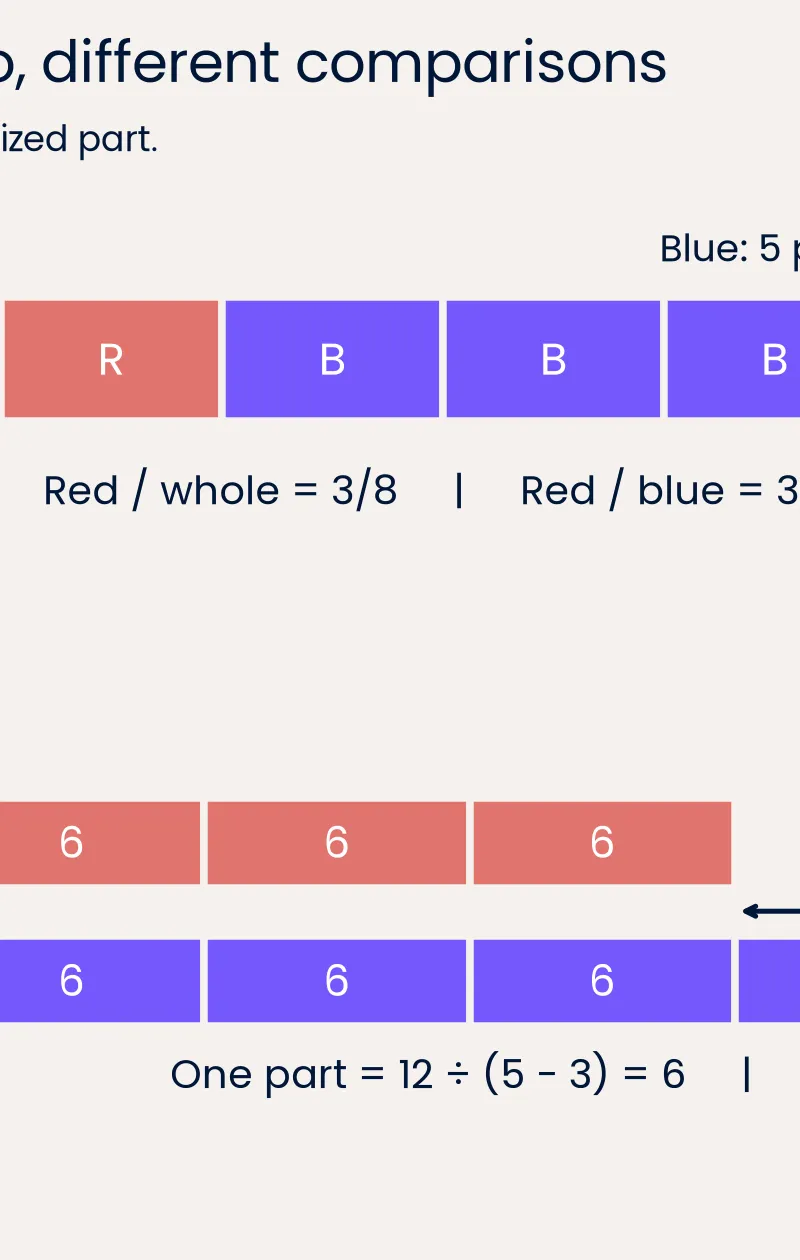
A ratio describes relative amounts, not automatically fractions of a whole. If red counters to blue counters are in the ratio 3:5, red represents three equal parts and blue represents five equal parts. The whole therefore contains eight parts. Red is 3/8 of all the counters, but 3/5 of the number of blue counters. Knowing which comparison a question asks for is the central skill in this topic.
Pearson Edexcel assesses this under N11: identify and work with fractions in ratio problems, with close links to R3, R4, R5, R6 and R8. The ideas apply at both Foundation and Higher tier. Candidates may identify a fraction, share a total, reconstruct a missing total from one share, or use the difference between shares. More demanding questions combine these operations with percentages, units or another ratio. 1 2
The reliable approach is to label the quantities, identify what the given number represents, find the value of one part, and build the required amount. This links fractions to proportional reasoning, probability and algebra. Clear working makes the method visible to the examiner and helps preserve available method or process marks if an arithmetic slip occurs. 3
Key Concepts
1. Ratio parts are equal units
In red:blue = 3:5, a part is an equal-sized unit. It might represent one counter, five counters or twenty counters. The ratio does not specify which until an actual amount is given. Writing red = 3k and blue = 5k captures this: k is the value of one part.
For example, 15 red counters and 25 blue counters fit the ratio because both quantities are five times their ratio parts. So do 6 red and 10 blue. Adding the same number to both quantities usually changes the ratio; multiplying both by the same positive number preserves it.
Order matters. Red:blue = 3:5 becomes blue:red = 5:3. Write the names above your ratio before calculating, especially when the question asks for the second quantity first.
Cover and recall: If apples:pears = 4:7, which fruit has more pieces? What does one part mean? Reveal: pears; one equal-sized unit shared by both quantities.
2. Part to whole is not part to part
For red:blue = 3:5, add the parts when comparing either colour with the whole: 3 + 5 = 8. The fraction red is 3/8; the fraction blue is 5/8. These fractions add to 1 because the two colours account for everything.
When comparing red with blue alone, do not add the parts. The number of red counters is 3/5 of the number of blue counters. Conversely, blue is 5/3 of red. A part-to-part fraction can exceed 1 because one share can be larger than another. A fraction of a non-negative whole cannot exceed 1.
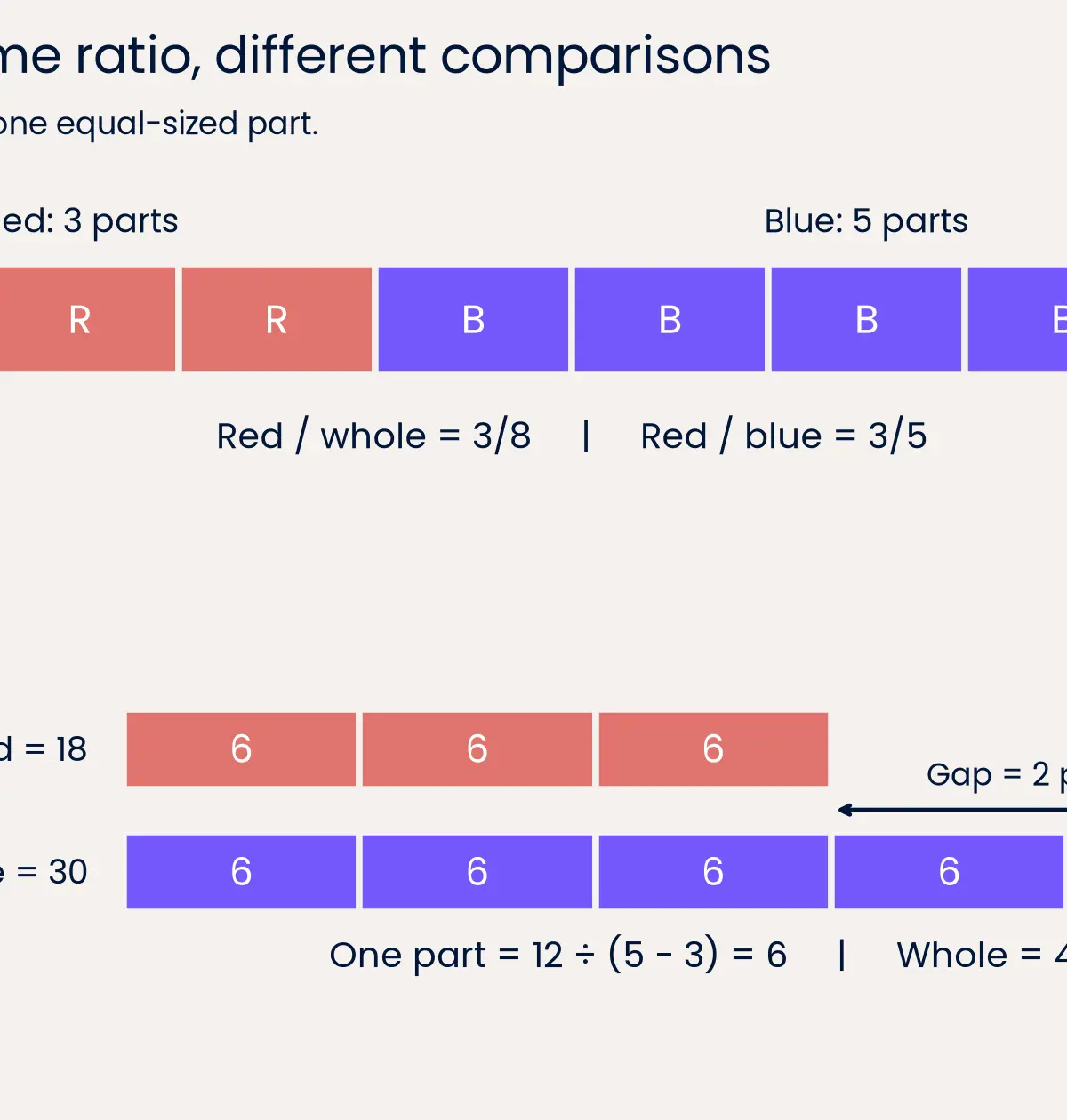
The diagram's upper bar contains eight equal sections. The lower bars line up the two shares, so their two-part difference is visible. Colours help, but the labels and equal sections carry the mathematical meaning.
Why does this work? Fractions compare a selected amount with a reference amount. In 'fraction of all counters', the reference is eight parts. In 'fraction of blue counters', it is five parts. The numerator remains three; the denominator changes because the comparison changes.
3. Sharing a known total
Suppose forty counters are divided red:blue = 3:5. Eight parts represent forty counters, so one part is 40 ÷ 8 = 5. Red is 3 × 5 = 15 and blue is 5 × 5 = 25.
The fraction method gives exactly the same answers: red = (3/8) × 40 = 15 and blue = (5/8) × 40 = 25. The methods are equivalent because dividing by eight finds one part, then multiplying by three selects three parts.
Write at least one complete calculation rather than an unexplained pair of numbers. In a multi-step problem, candidates should identify the relevant total first. If there are other categories outside the named ratio, subtract them before sharing the remaining amount.
Check: 15 + 25 = 40 and 15:25 simplifies to 3:5. A sum check alone is insufficient: 20 and 20 also add to forty, but give the wrong ratio. A check is useful, not automatically a separate awarded mark.
4. Working backwards from one share
If red:blue = 3:5 and there are twenty-five blue counters, the twenty-five represents five parts, not eight. One part is 25 ÷ 5 = 5. Red is 3 × 5 = 15, and the total is 8 × 5 = 40.
The common error is 25 ÷ 8, treating a known share as the whole. Avoid it by writing 'blue: 5 parts = 25' before dividing. You can also use red = (3/5) × blue, provided you recognise that 3/5 compares red with blue rather than with the total.
What if? If blue doubled while the ratio remained unchanged, red and the total would also double. If blue doubled but red stayed fixed, the ratio would change.
5. Working backwards from a difference
If red:blue = 3:5 and blue exceeds red by twelve counters, the difference represents 5 − 3 = 2 parts. One part is 12 ÷ 2 = 6. Red is 18, blue is 30, and the total is 48.
Do not share twelve in the ratio 3:5. Twelve is the gap between the shares, not the combined amount. Use the sentence 'gap in quantities matches gap in parts' to select the correct divisor.
With three shares, use only the two shares mentioned to interpret a difference. For A:B:C = 2:3:7 and C exceeds A by thirty, the gap is 7 − 2 = 5 parts. One part is 6, so B is 18 and the total is 72. The middle share does not contribute to the C-minus-A difference.
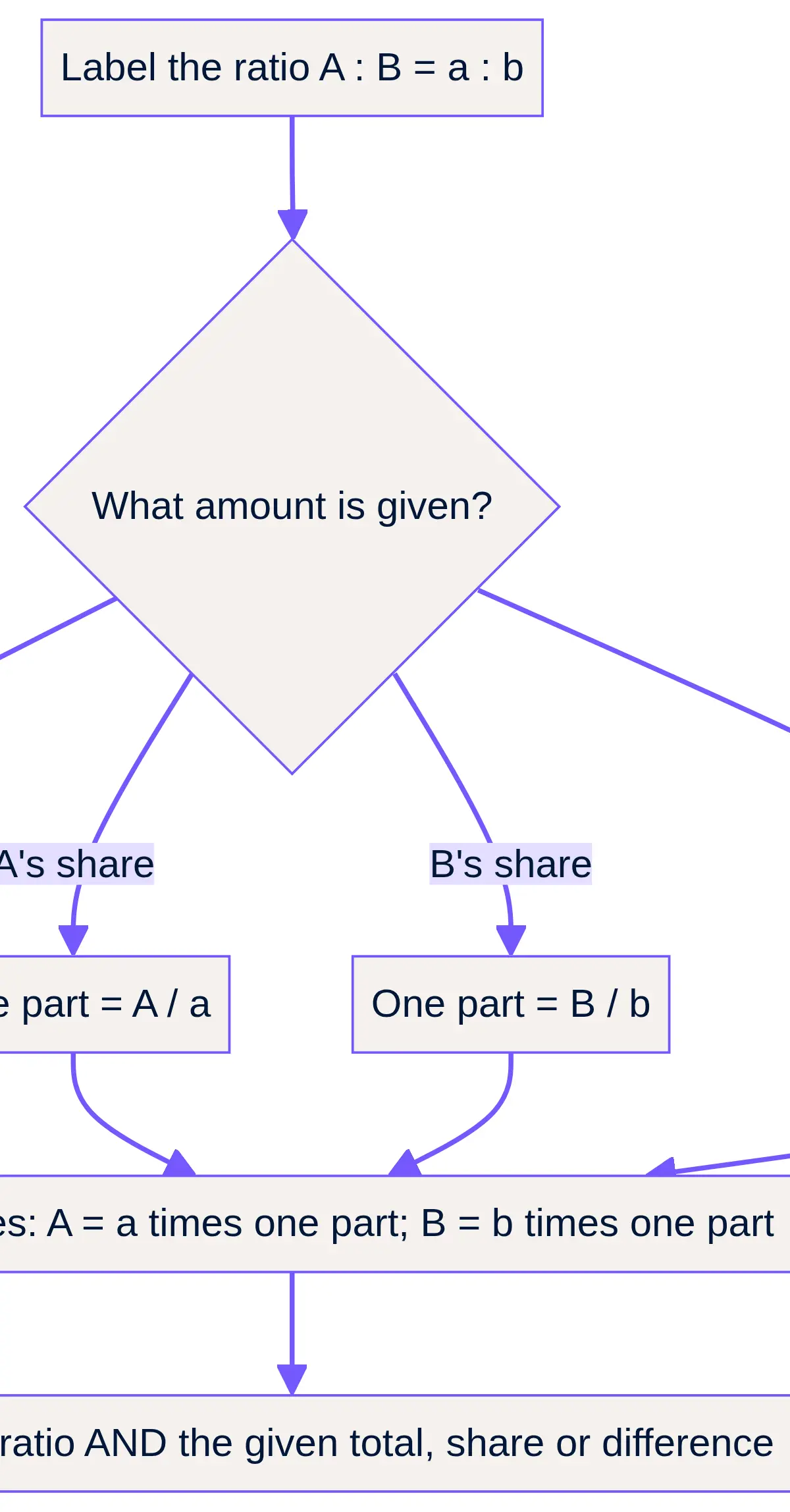
Cover and recall: For 4:9 and a difference of £35, find one part without looking back. Reveal: £35 ÷ (9 − 4) = £7.
6. Converting a fraction of a whole into a ratio
If 2/7 of a group are left-handed and everyone else is right-handed, seven parts describe the whole. Two belong to the first category and 7 − 2 = 5 to the second. Therefore left-handed:right-handed = 2:5, not 2:7.
In general, if a fraction p/q belongs to A and the rest to B, A:B = p:(q − p). This requires two categories that are mutually exclusive and together exhaust the whole. If some people are in neither category, or a third category exists, the remainder is not automatically B.
A decimal or percentage can be converted first. If 35% prefer tea and the rest prefer coffee, tea:coffee = 35:65 = 7:13. As a fraction, 35% = 7/20, leaving 13/20. Both routes give the same ratio.
7. Ratios whose entries are fractions
The ratio 1/2:3/4 is not yet in simplest whole-number form. Multiply both entries by four, the lowest common multiple of the denominators: (1/2) × 4:(3/4) × 4 = 2:3.
This multiplication preserves the relationship because every entry receives the same scale factor. It does not mean that 1/2 and 3/4 are individually the fractions of the final mixture. After simplification, the first share is 2/5 of the whole and the second is 3/5.
For 2/3:5/6, multiply both entries by six to obtain 4:5. If a total is ninety, there are nine parts, one part is ten, and the shares are forty and fifty. An unsimplified equivalent ratio can still give a valid method, but simplest whole numbers reduce arithmetic errors and satisfy instructions to simplify.
8. Fractions, decimals and percentages
Once the fraction of the whole is correct, convert normally. For a 3:5 ratio, the first share is 3/8 = 0.375 = 37.5% of the whole. The second is 5/8 = 0.625 = 62.5%. These percentages add to 100%.
The first share is also 3/5 = 60% of the second share. This is not a contradiction: the reference amount differs. Always finish the sentence 'percentage of ...' before dividing.
For three categories in the ratio 2:3:5, the denominator for fractions of the whole is ten. Their fractions are 2/10, 3/10 and 5/10. Simplify individual fractions where appropriate, but preserve the labelled ratio order.
Mathematical Relationships
All relationships below: Must memorise. Here this means know or reconstruct the method. These elementary ratio relationships are not listed on Pearson's published formula aid; the existence of a formula sheet does not remove the need to understand them. Pearson has confirmed formula-aid support for 2025, 2026 and 2027. 4 5
For A:B = a:b, let T be their combined total, k the value of one part, and D the positive difference. Assume positive ratio entries.
Fraction of whole: A/T = a/(a + b), and B/T = b/(a + b). Use these only when T includes exactly A and B.
Part-to-part comparison: A/B = a/b, so A = (a/b)B. Reversing the comparison gives B/A = b/a.
Known total: k = T/(a + b); A = ak and B = bk.
Known share: k = A/a or k = B/b. Divide by the parts belonging to the given share.
Known difference: k = D/|b − a|; T = (a + b)k. The vertical lines mean absolute value. This method requires unequal ratio entries. For 4:4 the difference must be zero, and a zero difference does not determine the total.
Known fraction of whole: A/T = p/q implies A:B = p:(q − p), where B is all the remainder and 0 < p < q.
Three or more shares: total parts = a + b + c + ...; each share = T × (its parts)/(total parts). A difference between two shares uses the difference between their two part counts.
Equivalent ratios: a:b = ca:cb for any positive c. For fraction entries, multiply every entry by a common denominator, then divide every integer entry by their highest common factor.
Conversions: decimal = numerator ÷ denominator; percentage = fraction × 100%; percentage as a fraction = percentage number/100. None of these requires a special ratio formula from the sheet.
Exam Technique and Marks
Each 1MA1 paper has 80 marks in 90 minutes. Paper 1 is non-calculator; Papers 2 and 3 permit a calculator. A practical target is about one minute per mark, leaving checking time, not a Pearson requirement for every question. Aim for roughly three minutes on a three-mark item and six minutes on a six-mark item. 1
Read the command word and underline whether the given amount is the total, a share or a difference. Label a bar or write equal-part statements. Show the decisive division, then the multiplication, and state the requested quantity with units. Keep exact fractions until the final requested conversion or rounding.
Pearson mark schemes use M for method, P for process, A for dependent accuracy and B for an accuracy mark that does not require method. C identifies communication marks when used. Exact allocations depend on the individual question. Correct intermediate fractions, divisions or processes may earn credit where the relevant scheme allows, but there is no universal 'one mark for adding the parts' rule. 3
For a one-mark 'Write down' fraction item, a correct simplified fraction is normally enough. For 'Work out', show the calculation. For 'Explain', use a mathematical reason: '3/5 compares red with blue; red is 3/8 of the whole because there are eight equal parts.' Do not substitute a general opinion for numerical evidence.
Official benchmark: Pearson's teaching guidance includes a one-mark item with black:green = 2:5 asking for the fraction black, and a three-mark item with Frank:Mary:Seth = 4:5:7 where Seth has eighteen more sweets than Frank and candidates find the total. Their answers are 2/7 and 96 respectively. The longer examples in this guide are original exam-style composites, not quotations from an official paper, and their allocations are illustrative. 2
Practical Applications and Connected Skills
For a drink with concentrate:water = 1:4, concentrate is 1/5 of the final drink. A 750 ml mixture needs 150 ml concentrate and 600 ml water. The ratio 1:4 describes ingredients, not concentrate to finished drink. If 200 ml of concentrate is available, water needed is 800 ml and the total drink is 1 litre.
Use consistent units before forming a ratio: 0.6 litres:150 ml becomes 600 ml:150 ml = 4:1. Useful conversions are 1 litre = 1000 ml, 1 kg = 1000 g, 1 m = 100 cm and £1 = 100p. Ratios of like quantities have no units after simplification, but calculated amounts must retain the relevant units.
Probability is a natural link. If equally likely counters are in the ratio 3:5, the probability of drawing a red counter is 3/8, because probability compares favourable outcomes with all outcomes. This assumes random selection with every counter equally likely.
For a graph extension, let x be the number of blue counters and y the number of red counters. The relationship is y = (3/5)x, a straight line through the origin. Points include (0,0), (5,3) and (10,6). Put blue on the horizontal axis and red on the vertical axis; read the gradient as red divided by blue, not red divided by total. Physical counter amounts must be whole numbers consistent with the ratio. This connection is not automatically Higher-only. 2
There is no required practical for this mathematics topic. All core content here is suitable for both tiers; 'challenging' labels identify difficulty, not Higher-only specification content.
Podcast and Active Revision
The ten-minute episode runs from introduction to core ideas, exam technique, a retrieval quiz and a final recap. Listen with a pencil. When a question appears, pause and attempt it before listening to the answer. Then solve one known-total, one known-share and one difference problem without the guide. Revisit the recall questions tomorrow and later in the week; checking an answer after retrieval is more useful than copying it while visible.
References
Visual Resources
2 diagrams and illustrations
Interactive Diagrams
2 interactive diagrams to visualise key concepts
Conceptual Flow Outline
The same 3:5 ratio gives 3/8 for red as a fraction of the whole and 3/5 for red as a fraction of blue.
Worked Examples
4 worked examples — open one to explore the question and available guidance.
Practice Questions
Try the question, then reveal an answer plan or example response
Original exam-style practice. Yellow counters to purple counters are in the ratio 2:7. Write down the fraction of all the counters that are yellow. [1 mark]
Hint: Your denominator must count every part in the whole.
Original exam-style practice. In a rescue centre, 3/8 of the animals are cats and all the others are dogs. (a) Write the ratio cats:dogs in simplest form. (b) Write down the fraction that are dogs. [2 marks]
Hint: Eight parts form the whole. How many remain after the three cat parts?
Original exam-style practice. A box contains 72 red and blue counters altogether. Red:blue = 5:7. Work out the number of red counters and the number of blue counters. [3 marks]
Hint: Use the combined total to find one of the twelve parts.
Original exam-style practice. Flour:sugar = 4:3 in a recipe. The recipe uses 180 g of sugar. Work out the mass of flour and the combined mass of flour and sugar. [3 marks]
Hint: The known sugar belongs to three parts, not seven.
Original exam-style practice. Mia and Noah share money in the ratio 3:8. Noah receives £45 more than Mia. Work out the total amount shared. [3 marks]
Hint: Find the gap in parts first, then count all the parts.
Original exam-style practice. Red paint:blue paint = 2/3:5/6. There are 540 ml of paint altogether. (a) Write the ratio in simplest whole-number form. (b) Work out the volume of each colour. [4 marks]
Hint: Multiply both entries by six before sharing the total.
Original exam-style practice. A club has 100 members. Of these, 20 are adults. All the remaining members are either juniors or seniors. Juniors:seniors = 3:5. (a) Work out the number of juniors and seniors. (b) Work out the percentage of all club members who are juniors. (c) Explain why juniors are not 3/8 of all club members. [5 marks]
Hint: First identify the total that the ratio actually divides. For the percentage, return to all 100 members.
Exam technique
How to turn what you know into marks
How to approach the question
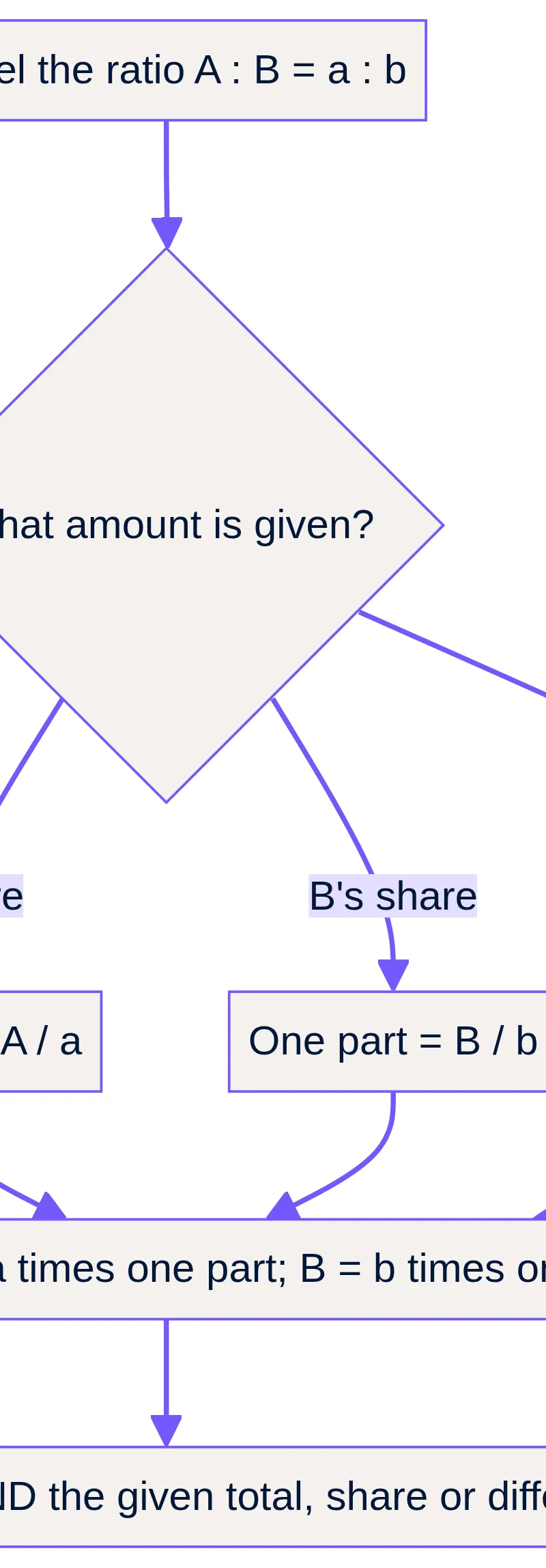
Read the names in order and label the ratio. Identify whether the given number is a combined total, one share or a difference. Select the matching part count, find one part, build the requested amounts and check against the original condition. For a fraction, first decide what the reference amount is.
How to structure your answer
For a 1-mark write-down item, give the requested fraction or simplified ratio. For 2-3 marks, show a clear decisive division or equivalent fraction calculation, then the labelled answer. For 4-6 marks, separate the stages, retain intermediate quantities, show any change to the shares, and finish every subpart. Original allocations in this guide are illustrative, not official Pearson schemes; marks are not awarded merely for writing a fixed number of lines.
Timing
Each Pearson Edexcel 1MA1 paper has 80 marks in 90 minutes. Use about 1 minute per mark as a personal working target, leaving checking time: about 3 minutes for 3 marks and 6 minutes for 6 marks. This is revision advice, not an official time allocation per question.
Common pitfalls
- 3:5 does not make the first share 3/5 of the whole. Use 3/(3 + 5) = 3/8.
- Do not divide a difference by the sum of the ratio entries. Divide by their difference.
- Do not divide a known share by total parts. Divide by that share's own part count.
- Keep names and ratio entries aligned; reversing the requested order requires reversing the entries.
- Clear fractional denominators by multiplying every entry by the same common denominator.
- Convert like quantities to the same unit before simplifying the ratio.
- A correct sum does not prove the ratio is correct. Check both, and also the supplied difference when relevant.
- If an ingredient or share is changed, recompute the total and ratio rather than reusing an old fraction.
What the command words want
- Compare
- Use the same reference amount or convert both quantities to a common unit, then state the relevant numerical similarity or difference.
- Explain
- Give a mathematical reason supported by the comparison: for example, 3/8 because the whole has 8 equal parts, not 3/5 because that compares the two shares.
- Describe
- State the mathematical relationship precisely, such as the first share is three fifths of the second. This is less typical here than work out or write down.
- Evaluate
- If used for a numerical expression, calculate its value. GCSE maths does not generally use this as an instruction to write an essay considering both sides.
- Show that
- Demonstrate the stated result through valid working. Do not start by assuming the target is true.
- State/Give
- Provide the requested mathematical value, fraction or ratio concisely. Include units if the value measures an amount.
- Write down
- For a direct 1-mark fraction or ratio item, the correct value is sufficient unless further instructions require working.
- Work out/Calculate
- Show the relevant part-count calculation, the division to find one part and the multiplication to find the requested amount. Label the answer and include units.
- Give your ratio in its simplest form
- Use equivalent whole-number entries with no common factor greater than 1, unless a different requested form is specified.
Watch or listen (optional)
Test your understanding of Number - Fractions, decimals and percentages: identify and work with fractions in ratio problems
Active recall beats re-reading. Take an instant quiz now to test what you’ve learned and lock it into long-term memory.
7 days Premium · Then the free plan continues · No card, no charge