Pearson Edexcel · GCSE · Mathematics
Course version: 1MA1 · Version from Mar 2026
Number - Fractions, decimals and percentages: work interchangeably with terminating decimals and their corresponding fractions (such as 3.5 and 7/2 or 0.375 or 3/8); change recurring decimals into their corresponding fractions and vice versa (Higher tier)
Turn an endless decimal into an exact fraction by making its repeating tail disappear. This Higher-tier guide builds from 0.375 = 3/8 to delayed repeats and examiner-quality proofs, with worked solutions, a ten-minute tutor podcast and questions that test what you can recall.
- 11 min read
- 5 worked examples
- 6 practice questions
- 11 key terms
Try the lesson
The start of the Number - Fractions, decimals and percentages: work interchangeably with terminating decimals and their corresponding fractions (such as 3.5 and 7/2 or 0.375 or 3/8); change recurring decimals into their corresponding fractions and vice versa (Higher tier) lesson, made from checked teaching notes for this specification point.
Have a go first
Write the recurring decimal 0.4̇ (where only the digit 4 recurs) as a fraction in its simplest form.
There is more to this lesson
The full lesson goes on to check your understanding and help you earn the marks. Create a free account to carry on, with your progress saved.
7 days Premium · Then the free plan continues · No card, no charge
Check what you remember
Read the wording for your board, then hide it and explain Terminating decimal in your own words. Rough notes are fine. This is a self-check, with no mark or grade.
Reference: Pearson Edexcel
A decimal representation that ends after finitely many decimal places, equivalently with all later digits zero.
Study Notes
Overview
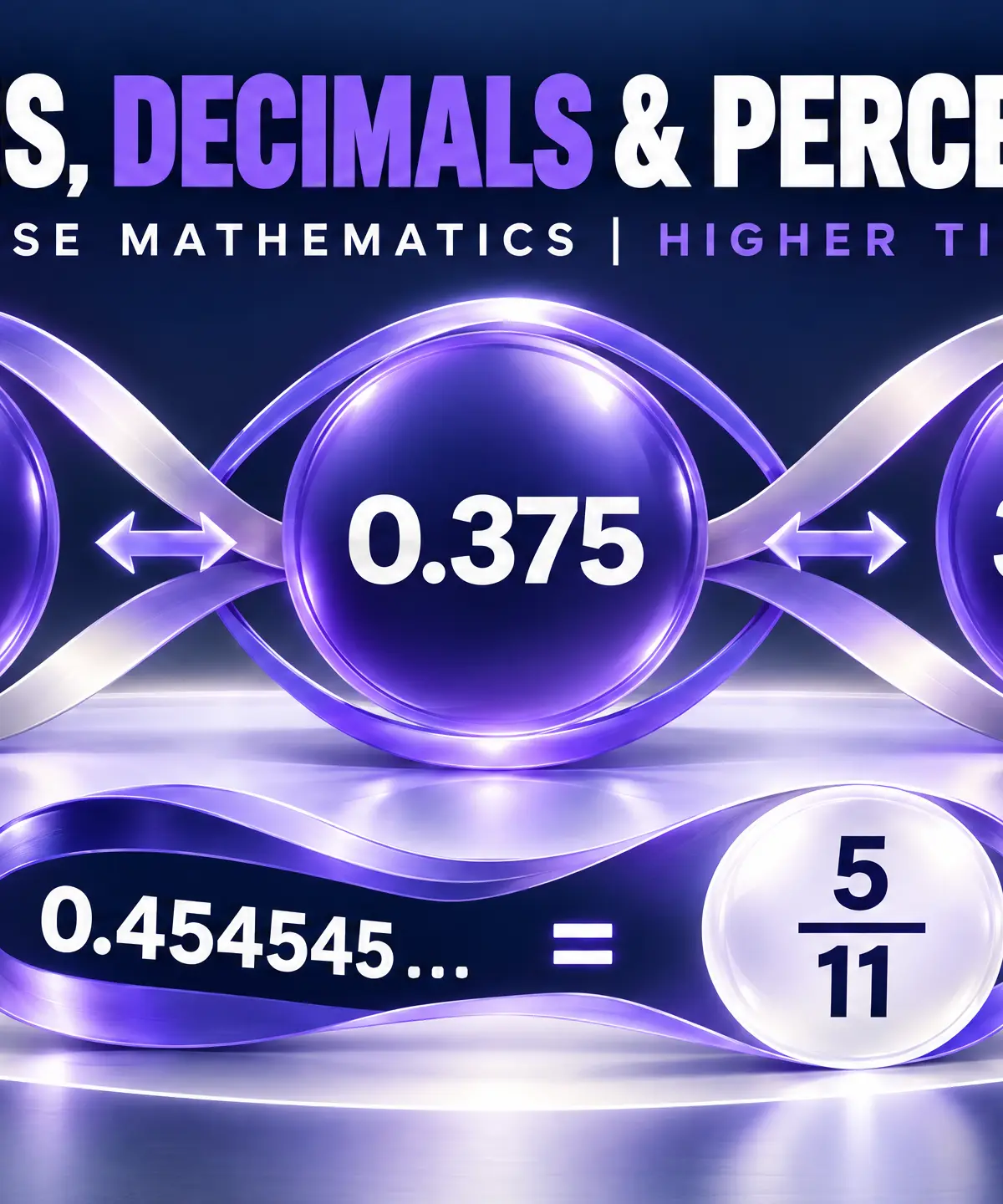
A fraction, a decimal and a percentage can describe exactly the same quantity. For example, 3/8 = 0.375 = 37.5%. Choosing the most useful form makes calculations quicker and prevents unnecessary rounding. In Pearson Edexcel GCSE Mathematics, specification 1MA1, N10, candidates must work interchangeably with terminating decimals and fractions. Converting recurring decimals into fractions and vice versa is Higher-only; terminating conversions are shared Foundation and Higher content. 1
The central Higher-tier idea is surprisingly simple: an infinite repeating decimal can be represented by an exact fraction. You do not finish writing the decimal. Instead, you multiply it by suitable powers of ten so that two repeating tails match, then subtract. The infinite parts cancel, leaving an ordinary equation.
This topic connects place value with algebraic elimination, fraction arithmetic, probability, ratio and percentages. Typical questions ask candidates to write a decimal as a fraction in simplest form, express a fraction as a recurring decimal, or show that an equality is true. A correct calculator display is not a substitute for a proof. The strongest answers expose the matching tails, show the subtraction and finish with the required exact fraction.
Key Concepts
1. Equivalent forms and place value
A fraction represents division: a/b means a divided by b, with b not equal to zero. A decimal records the same value using tenths, hundredths, thousandths and so on. A percentage means a quantity per hundred. Changing representation does not change the quantity itself.
To convert a terminating decimal, count its decimal places. Write the decimal as an integer divided by the corresponding power of ten, then cancel common factors. For 0.375, three decimal places mean thousandths:
0.375 = 375/1000 = 3/8.
Both numerator and denominator have been divided by 125. Dividing both by the same non-zero number preserves the fraction's value. Credit is given for a correct conversion; when simplest form is requested, the final fraction must have no common factor greater than one.
Example: 3.5 = 35/10 = 7/2. Do not discard the whole-number part. An improper fraction is perfectly valid unless a mixed number is specifically requested. A trailing zero adds no value: 0.50 = 50/100 = 1/2, just as 0.5 = 5/10 = 1/2.
Cover and recall: Why is 0.075 written initially as 75/1000 rather than 75/100? Explain using place value before calculating.
2. Fractions, decimals and percentages
To convert a fraction to a decimal, divide the numerator by the denominator. Sometimes an equivalent denominator of 10, 100 or 1000 is quicker: 7/20 = 35/100 = 0.35. For 3/8, multiplication by 125 gives 375/1000, so the decimal is 0.375.
To express a decimal as a percentage, multiply its numerical value by 100 and write %. Thus 0.375 = 37.5%. To convert back, divide the percentage number by 100: 37.5% = 37.5/100 = 0.375. The percent sign matters: 37.5 and 37.5% are different quantities.
A proportion greater than one gives a percentage greater than 100%. For example, 3.5 = 350%. This is not automatically an error. The context tells you whether such a value is sensible.
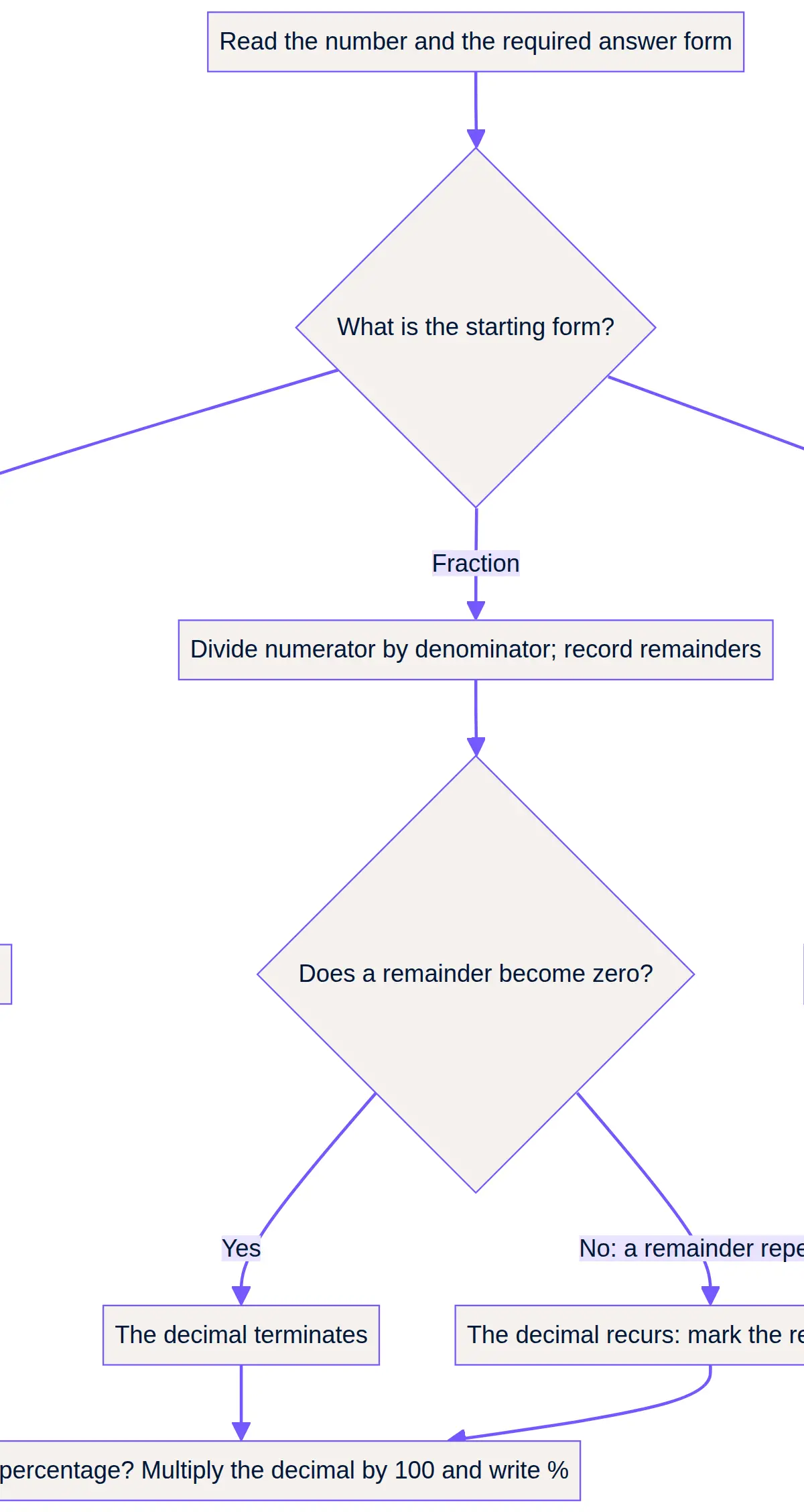
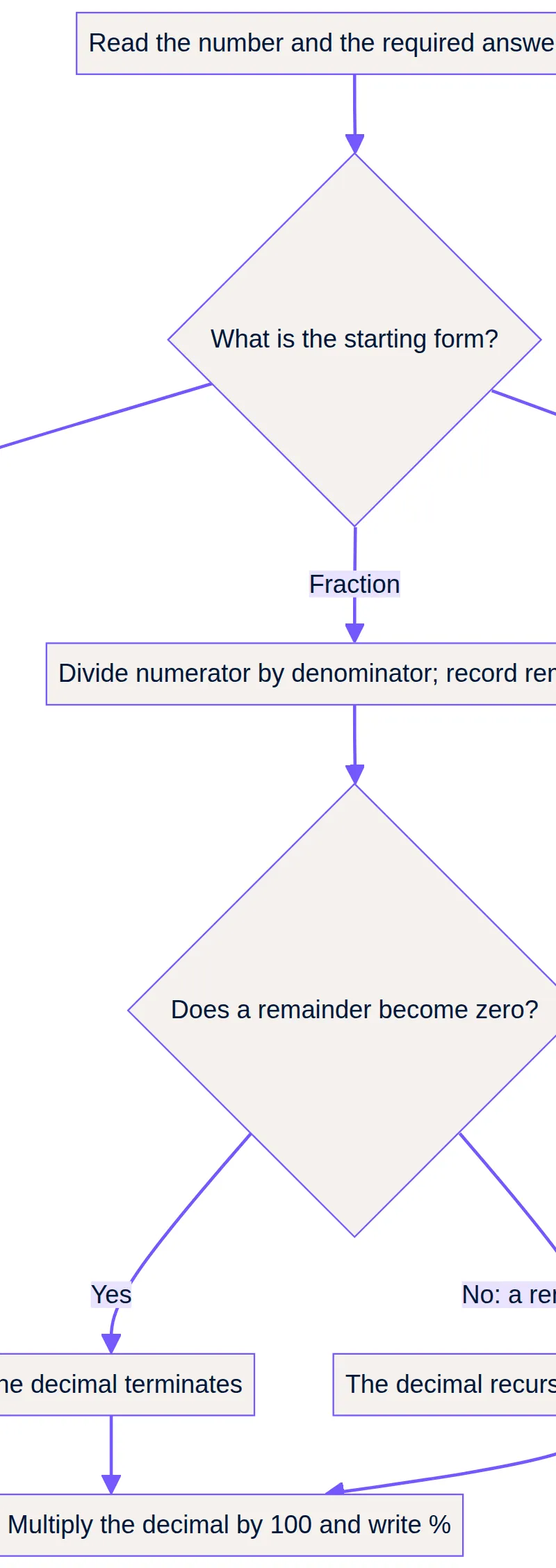
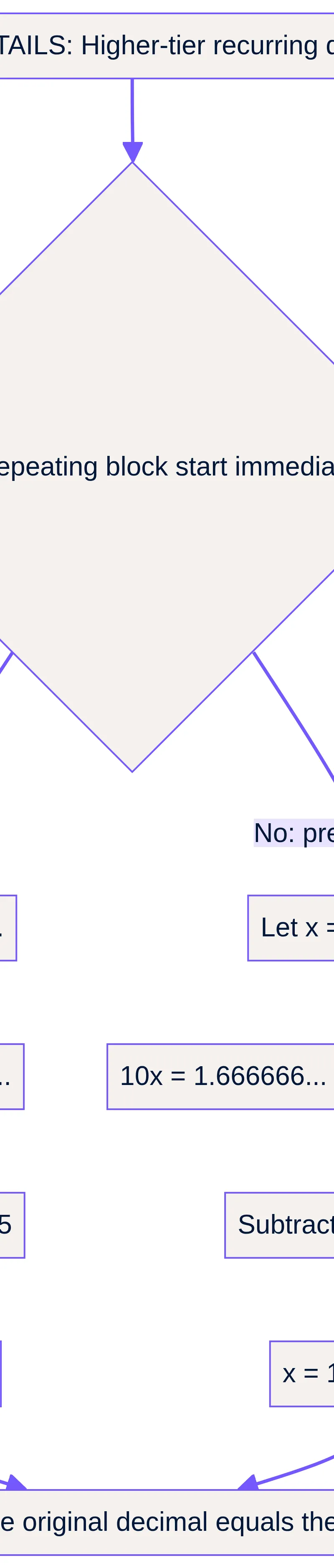
Use the diagram actively: cover the final boxes, identify the starting form, and predict the next calculation. Do not use recurring-decimal algebra for a decimal that already terminates.
3. Reading recurring notation accurately: Higher-only
A recurring decimal has a digit or block that repeats indefinitely. Here, 0.(45) means 0.454545..., with the bracketed block repeated forever. This bracket notation is a plain-text aid; exam papers normally use dots above digits or a bar over the repeating block.
For a one-digit repeat, a dot above that digit means it repeats. For a longer block, dots above its first and last digits identify the whole block, including any intervening digits. For example, dots above 1 and 3 in 0.123 can indicate 0.(123), not a repeat of only 1 and 3.
Read 0.1(6) as 0.166666..., where the initial 1 does not repeat. Read 0.(16) as 0.161616..., where both digits repeat. These are different numbers and require different setups. Write enough digits and an ellipsis to make the pattern unambiguous.
An exact equality needs exact recurring notation. The terminating number 0.45 is not 0.(45). It is only an approximation to it. Examiners cannot credit a finite decimal as a proof of an infinite recurring value.
4. Immediate repetition: match, subtract, simplify
Let x = 0.454545... . The repeating block has two digits. Multiply by 100, shifting one complete block:
100x = 45.454545...
x = 0.454545...
Subtract the second equation from the first. The decimal tails are identical, so they cancel exactly:
100x - x = 45.454545... - 0.454545...
99x = 45.
Therefore x = 45/99 = 5/11. Since x was the original recurring decimal, 0.(45) = 5/11. A show-that answer should explicitly reach the specified result, not stop at 99x = 45.
Why does this work? Both equations represent the same quantity multiplied by known amounts. Subtracting equal quantities on both sides preserves equality. You are not truncating the infinite decimal; you are subtracting two exact values with identical tails.
For one repeating digit, multiply by 10. For two, multiply by 100. For three, multiply by 1000. Use the shortest repeating block when possible. For x = 0.(7), 10x - x gives 9x = 7, so x = 7/9.
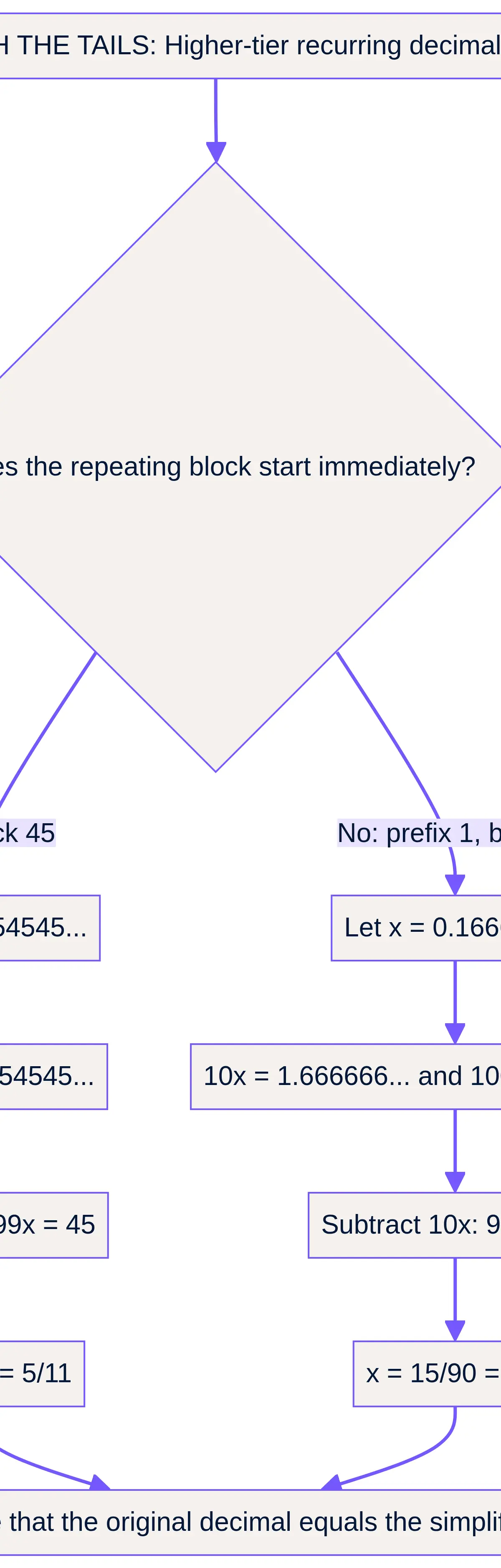
What if? If you multiplied 0.(45) by 10, the new tail would be 545454..., not 454545... . The tails would not cancel directly. The correct multiplier shifts a whole block.
5. Delayed repetition: move past the prefix first
For x = 0.166666..., there is one non-repeating digit before the repeating 6. Multiplying x directly by 10 does not create a tail identical to x's tail. Instead, form two shifted equations:
10x = 1.666666...
100x = 16.666666...
Subtract 10x from 100x: 90x = 15, so x = 15/90 = 1/6. The key is matching tails, not automatically subtracting x.
For x = 0.1272727..., the non-repeating prefix is 1 and the repeating block is 27. First use 10x = 1.272727... . Then shift a further two places to obtain 1000x = 127.272727... . Subtracting gives 990x = 126, hence x = 126/990 = 7/55.
Non-repeating zeros still occupy decimal places. For x = 0.004444..., two digits precede the repeat, so use 100x and 1000x: 900x = 4 and x = 1/225. Count positions, not just non-zero digits.
Numbers above one use the same method. For x = 2.416666..., 100x = 241.666666... and 1000x = 2416.666666... . Their difference gives 900x = 2175, hence x = 29/12. Keep the whole-number part throughout.
6. Fractions to recurring decimals: follow the remainders
Divide 3 by 11. The integer part is 0. For the first decimal digit, 30 divided by 11 gives 2, remainder 8. For the next, 80 divided by 11 gives 7, remainder 3. The starting remainder 3 has returned, so the same steps repeat forever:
3/11 = 0.272727... = 0.(27).
A remainder of zero means the division terminates. A repeated remainder means the subsequent digits repeat, because the same remainder must produce the same next digit and next remainder. This supplies a reason for the recurring notation, not just a guess from a few calculator digits.
After reducing a fraction to simplest form, its decimal terminates exactly when its positive denominator has only prime factors 2 and/or 5, including denominator 1. Those factors divide a suitable power of ten. A denominator with any other prime factor produces a recurring decimal. Thus 7/20 terminates, whereas 3/11 recurs. Simplify first: 3/6 = 1/2 terminates despite the original denominator containing 3.
7. Showing that: mathematical evidence earns the marks
Pearson's June 2024 Higher Paper 1, Question 18, asks candidates to show that 0.(15) + 0.2(27) can be written as m/66, where m is an integer. It is worth 3 marks. The notation here expands the paper's dots for readability. 2
One official route adds the decimals to obtain 0.3787878... . Letting this equal x, use 1000x = 378.787878... and 10x = 3.787878... . Subtract to get 990x = 375, so x = 375/990 = 25/66 and m = 25.
The published scheme gives M1 for adding the recurring decimals, M1 for two correct recurring values whose subtraction terminates, and C1 for correct working leading to 25/66. An alternative route converts the two decimals separately before adding the fractions. 3 Candidates should not assume a universal mark for every line: allocations depend on the specific question. Original questions below have suggested teaching schemes, clearly distinguished from this official example.
Mathematical Relationships
Must memorise: terminating conversion. d = N/10^k, where d is the decimal, k is its number of decimal places, and N is the integer obtained by multiplying d by 10^k. Simplify afterwards.
Must memorise: equivalent fractions. a/b = (a ÷ h)/(b ÷ h), where h is a non-zero common divisor and b is not zero. The highest common factor gives simplest form in one step.
Must memorise: division. a/b = a ÷ b. A repeated remainder identifies the recurring cycle.
Must memorise: percentages. If d is the decimal proportion and P the percentage number, P = 100d and d = P/100; therefore a/b = (100a/b)%. Percentage of a quantity Q is (P/100) × Q.
Must memorise: immediate repeat. For x = 0.(B) with an r-digit block representing integer B, (10^r - 1)x = B. Thus x = B/(10^r - 1). Count leading zeros in the block: 0.(003) = 3/999 = 1/333.
Must memorise: delayed repeat. With k non-repeating decimal digits followed by an r-digit block, subtract 10^k x from 10^(k+r) x. Their coefficient difference is 10^k(10^r - 1). For values below one, an equivalent shortcut is x = (A - C)/[10^k(10^r - 1)], where A is the integer formed by prefix plus one complete block and C is the prefix integer. Showing the actual subtraction is safer in proof questions.
Must memorise: termination test. In simplest form, a/b terminates if the positive denominator b = 2^u × 5^v, where u and v are non-negative integers. These conversion rules are not supplied as topic-specific formulas on the formula sheet; learn the methods rather than relying on a sheet.
Practical Applications and Exam Use
A probability of 3/8 is exactly 0.375 or 37.5%; no unit is needed. In a ratio 3:5, the first share is 3/8 of the total, not 3/5. A 12.5% discount has reduction fraction 1/8 and remaining-price multiplier 0.875. Convert into whichever form makes the required calculation clearest.
Unit conversions are separate from number-form conversions. For example, 0.375 kg = 375 g, whereas 0.375 m = 37.5 cm. Remember 1 kg = 1000 g, 1 m = 100 cm and £1 = 100p. Also 0.5 hours = 30 minutes, not 50 minutes. A percentage is not a measurement unit.
No required practical or graph-plotting technique belongs to N10. If a probability scale or number line is supplied, compare values in a common form and retain exact fractions until the end.
Listen, Retrieve and Check
Podcast chapters: 00:00 introduction; 01:00 core concepts; 06:00 exam tips; 08:00 quick-fire quiz; 09:00 summary. Listen with paper ready, then close the guide and reproduce the 5/11 proof. Revisit a delayed-repeat question tomorrow and again later in the week. Judge success by what you can recall without looking, not by how familiar the page feels.
References
Worked Examples
5 worked examples — open one to explore the question and available guidance.
Practice Questions
Try the question, then reveal an answer plan or example response
Original Edexcel-style question, 3 marks. (a) Express 2.75 as a fraction in simplest form. (2) (b) Write 2.75 as a percentage. (1)
Hint: Two decimal places mean hundredths. Keep the whole-number part.
Original Edexcel-style Higher question, 3 marks. Express 0.(72), meaning 0.727272... , as a fraction in simplest form.
Hint: The repeating block has two digits.
Original Edexcel-style Higher question, 3 marks. Express 3/11 as a recurring decimal. Show division steps that establish the repeating block.
Hint: Record the remainder after each decimal digit.
Original Edexcel-style Higher question, 4 marks. (a) Express 0.2(3), meaning 0.233333... , as a fraction in simplest form. (3) (b) State which is larger, 0.2(3) or 0.23. (1)
Hint: The 2 is a prefix; form 10x and 100x.
Original Edexcel-style Higher question, 5 marks. (a) Express 0.00(4), meaning 0.004444... , as a fraction in simplest form. (3) (b) Hence work out 225 × 0.00(4). (1) (c) Explain why the decimal is recurring rather than terminating using the simplified denominator. (1)
Hint: The two zeros are non-repeating decimal positions, so shift past them first.
Original Edexcel-style Higher question, 6 marks. (a) Express 0.(18) as a fraction in simplest form. (3) (b) Hence work out 0.(18) + 3/22 as a fraction in simplest form. (2) (c) Explain whether the sum has a terminating or recurring decimal. (1)
Hint: First convert the recurring decimal; then use denominator 22 for the sum.
Exam technique
How to turn what you know into marks
How to approach the question
Read the command word and required answer form. Identify whether the decimal terminates or recurs. For a recurring decimal, write the repeating block and any non-repeating prefix before choosing powers of ten. For a fraction, divide or find an equivalent power-of-ten denominator. Keep values exact; check size and simplify at the end. Use calculator checking only when allowed, and never as a substitute for proof.
How to structure your answer
For a typical 3-mark recurring proof, show a definition and shifted equation(s), the subtraction, and the completed exact fraction. A 4–6-mark item may include a conversion followed by percentage, arithmetic or reasoning parts: answer each part explicitly and reuse earlier results when told hence. The marks are question-specific, not one mark per line. Suggested M/A/B/C labels on original items are teaching allocations; only the June 2024 example reproduces an official Pearson allocation.
Timing
Each Pearson Edexcel GCSE Mathematics paper has 80 marks in 90 minutes, giving an average 1.125 minutes per mark, about 1 minute 8 seconds. Use roughly 3–3.5 minutes for 3 marks, 4–4.5 for 4, 5–6 for 5 and 6–7 for 6, as flexible targets rather than official per-question limits. Paper 1 is non-calculator; Papers 2 and 3 allow calculators. [1]
Common pitfalls
- Using 10 for a two-digit block: use 100 so a complete block moves and the recurring tails match.
- Treating 0.1(6) as 0.(16): read the dots or bar and separate prefix from block.
- Subtracting x automatically after a delayed repeat: subtract the two shifted equations with identical tails.
- Writing 100x - x = 100x: collect like terms correctly to obtain 99x.
- Writing only a finite number of digits without recurring notation: include dots, a bar or a clear ellipsis with the repeating pattern.
- Leaving 45/99 when simplest form is requested: cancel to 5/11.
- Rounding to 0.45 or 16.7% in an exact proof: retain exact fractions or recurring notation.
- Assuming every decimal is recurring: use place value for 0.375 rather than recurring-decimal algebra.
- Testing denominator factors before simplifying: 3/6 terminates because it simplifies to 1/2.
- Using a calculator display as a show-that proof: write the algebraic justification and required conclusion.
What the command words want
- Hence
- Use the result just established to answer the next part, rather than beginning an unrelated method.
- Compare
- Use a common denominator or a sufficiently reliable common decimal form; state the inequality or which is greater. Do not assume a larger denominator means a larger fraction.
- Explain
- Give a mathematical reason using because: the same remainder produces the same next digit, or the matched tails cancel.
- Describe
- Describe the repeating block or pattern precisely, for example the block 27 repeats after the initial digit 1. This is less common here than conversion commands.
- Evaluate
- In mathematics, evaluate usually means find the value of the numerical expression. It does not normally mean discuss both sides of an argument.
- Show that/Prove
- Build a logical calculation from the given decimal to the required fraction. Do not assume the target is already true; finish with a clear equality or conclusion.
- Calculate/Work out
- Show enough working to expose the method; use exact forms until rounding is explicitly requested. Include measurement units only when the context supplies a measurement.
- Express as a fraction
- Produce an exact fraction and simplify when requested. For recurring values, show the matching-tail subtraction.
- State/Give/Write down
- Give the requested exact number or notation directly. Do not add irrelevant explanation to a one-mark fact.
Watch or listen (optional)
Test your understanding of Number - Fractions, decimals and percentages: work interchangeably with terminating decimals and their corresponding fractions (such as 3.5 and 7/2 or 0.375 or 3/8); change recurring decimals into their corresponding fractions and vice versa (Higher tier)
Active recall beats re-reading. Take an instant quiz now to test what you’ve learned and lock it into long-term memory.
7 days Premium · Then the free plan continues · No card, no charge