Pearson Edexcel · GCSE · Mathematics
Course version: 1MA1 · Version from Mar 2026
Number - Measures and accuracy: apply and interpret limits of accuracy (Foundation tier)
Limits of accuracy reveal the possible true values hidden behind a rounded measurement. Learn to find the half-unit interval, include the lower endpoint, exclude the upper endpoint, and explain what those limits mean in context. The Foundation core is clearly distinguished from the requested box-fitting enrichment.
- 11 min read
- 4 worked examples
- 5 practice questions
- 8 key terms
Try the lesson
The start of the Number - Measures and accuracy: apply and interpret limits of accuracy (Foundation tier) lesson, made from checked teaching notes for this specification point.
Have a go first
A length is measured as 8 cm to the nearest centimetre. What is the lower limit of accuracy for this measurement?
There is more to this lesson
The full lesson goes on to check your understanding and help you earn the marks. Create a free account to carry on, with your progress saved.
7 days Premium · Then the free plan continues · No card, no charge
Check what you remember
Read the wording for your board, then hide it and explain True value in your own words. Rough notes are fine. This is a self-check, with no mark or grade.
Reference: Pearson Edexcel
The actual value of a quantity before the stated rounding or truncation.
Study Notes

Overview
A measurement written after rounding is a useful estimate, not a promise that the object has exactly that size. This topic teaches you to turn a rounded value into the range of true values that could have produced it, then choose the end of the range that matters in a real situation. That could be checking whether a shelf is long enough, whether a quantity is safely below a limit, or whether a stated length could be bigger than it looks. It is a Number topic because careful use of decimals, inequalities and units protects the accuracy of every later calculation. In Foundation questions, candidates commonly state a simple error interval, read it from a number line, or explain a decision in context. N15 supports the rounding and inequality notation; N16 asks you to apply and interpret limits of accuracy. Read the degree of accuracy first, show the interval, and finish with a sentence that answers the actual question. The examples here are original illustrative questions, not Pearson questions or official mark allocations. 1 2
Key Concepts
Concept 1: A rounded value hides a range
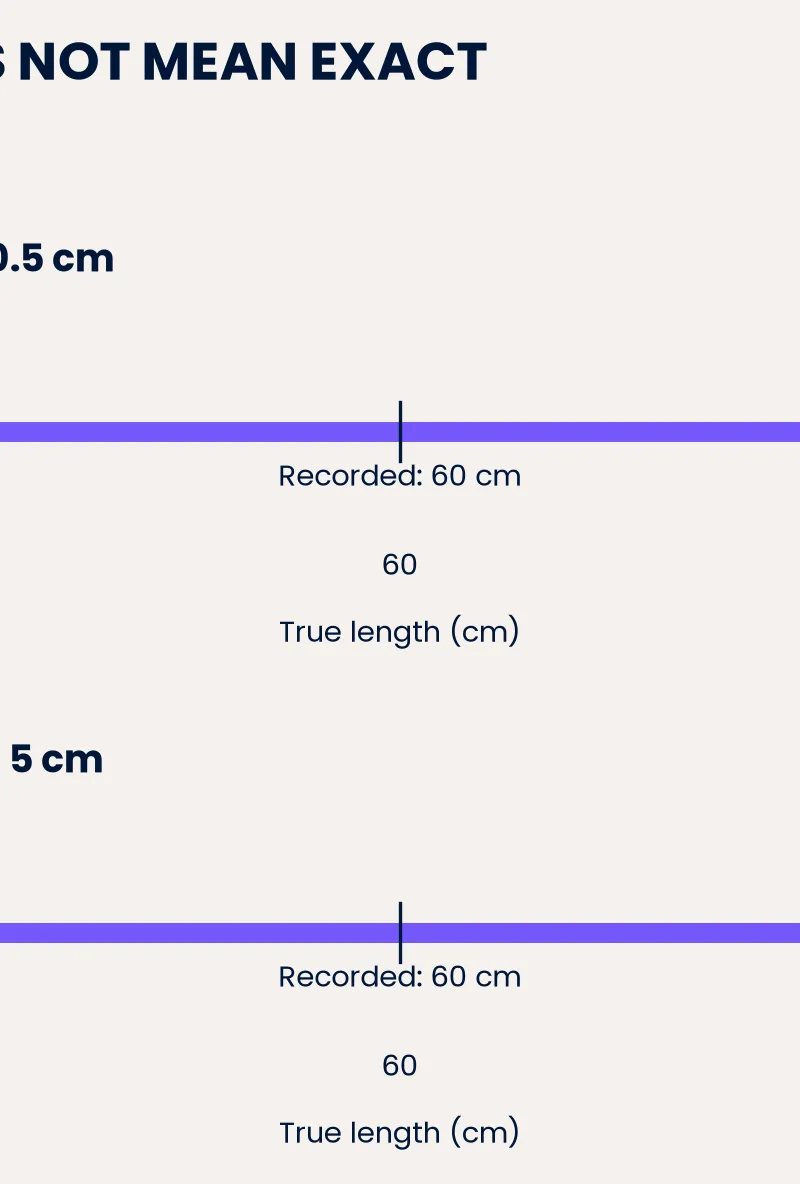
If a shelf is recorded as 60 cm to the nearest cm, it might be 60 cm exactly, but it might also be 59.6 cm or 60.49 cm. All of these round to 60 cm. The rounding unit is 1 cm, so half a unit is 0.5 cm. The true length, (l), is therefore:
[59.5 \le l < 60.5\text{ cm}]
The lower limit is 59.5 cm because it rounds up to 60 cm. The upper limit is 60.5 cm, but it is excluded: 60.5 cm rounds to 61 cm, not 60 cm. This is why the final inequality is <, not ≤. There is no actual largest possible real measurement. Values can get arbitrarily close to 60.5 cm from below, such as 60.499 cm, but cannot equal it.
Why it works: rounding uses a halfway point. Values below the next halfway point remain nearer the stated rounded value; reaching that halfway point sends the value to the next rounded result. Treat the interval as a fence with a solid left gate and an open right gate.
Cover and recall: hide the interval. What is the half-unit? Which endpoint is included? Why is 60.5 cm excluded? Say the answers before looking again.
Concept 2: Find the half-unit and show it on a number line
First identify what the value was rounded to. For 60 cm to the nearest cm, the unit is 1 cm and the half-unit is 0.5 cm. For 340 cm to the nearest 10 cm, the unit is 10 cm and the half-unit is 5 cm, so (335 \le x < 345) cm. For 2.7 kg to the nearest 0.1 kg, the unit is 0.1 kg and the half-unit is 0.05 kg, so (2.65 \le m < 2.75) kg.
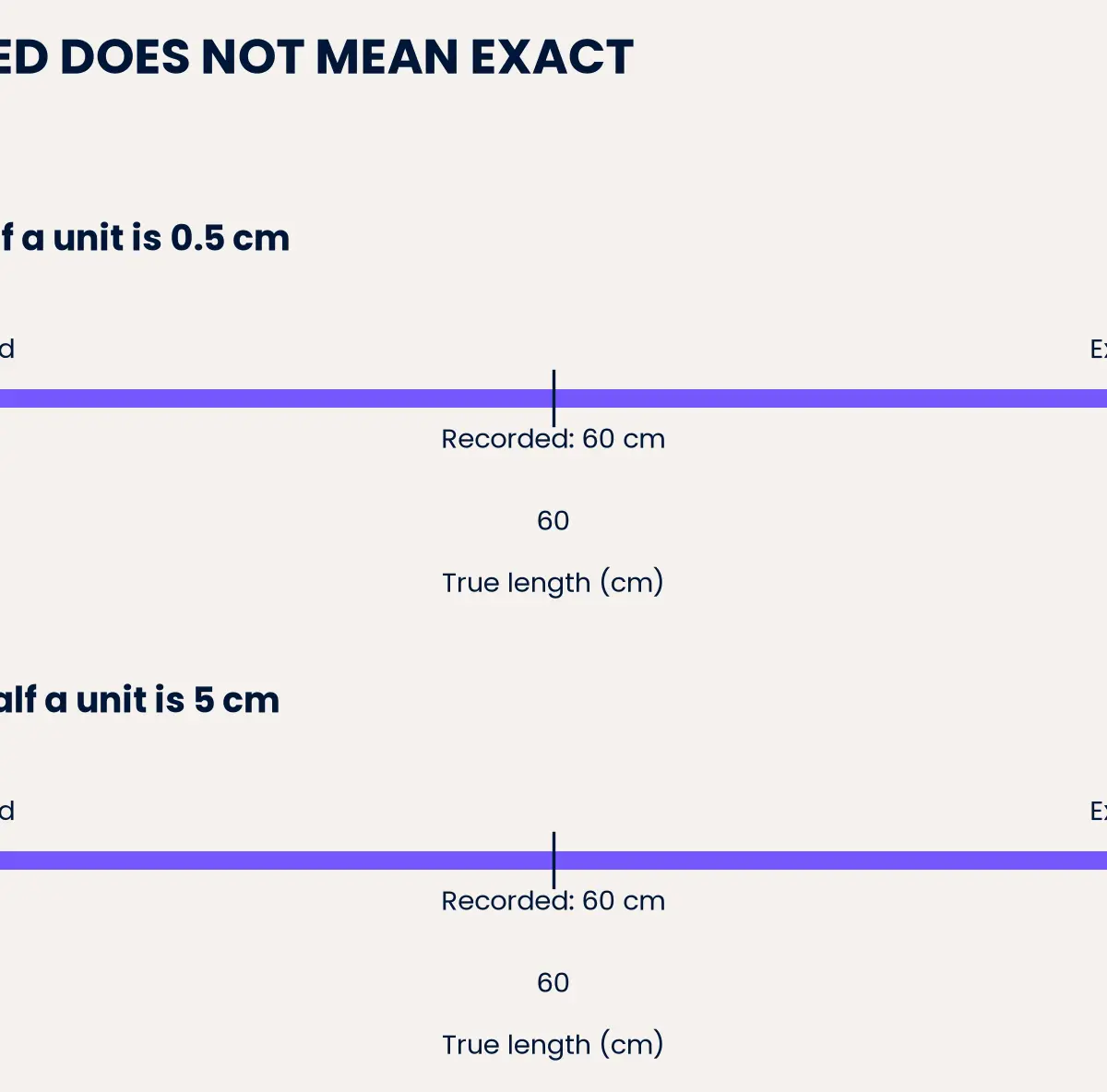
Number-line guidance: place the rounded value in the middle. Mark one half-unit either side. Put a filled circle at the lower limit because it is included, and an open circle at the upper limit because it is excluded. Shade or draw the segment between them. Label the units. Do not draw 59 cm and 61 cm for a value rounded to the nearest cm: that wrongly uses a whole unit each side.
This visual method is particularly useful when a question says write down the error interval or state the possible values. Translate the picture into an inequality only after checking the degree of accuracy. When reading an unfamiliar number line, check its scale rather than assuming each division represents one unit.
Concept 3: Choose the limit the context needs
An interval by itself may not answer the question. Ask, which possible value makes the situation hardest? If a box must fit on a shelf, consider a very large possible box length and a very small possible shelf length. If a minimum amount is required, consider the lower limit of the amount available. If a safety limit must not be exceeded, consider the upper limit of the measurement, remembering that the endpoint itself is not attained.
The following box-total reasoning is the requested bridge/enrichment. Foundation candidates should prioritise simple intervals and interpreting accuracy; formal compound-bound techniques are not the focus of this guide.
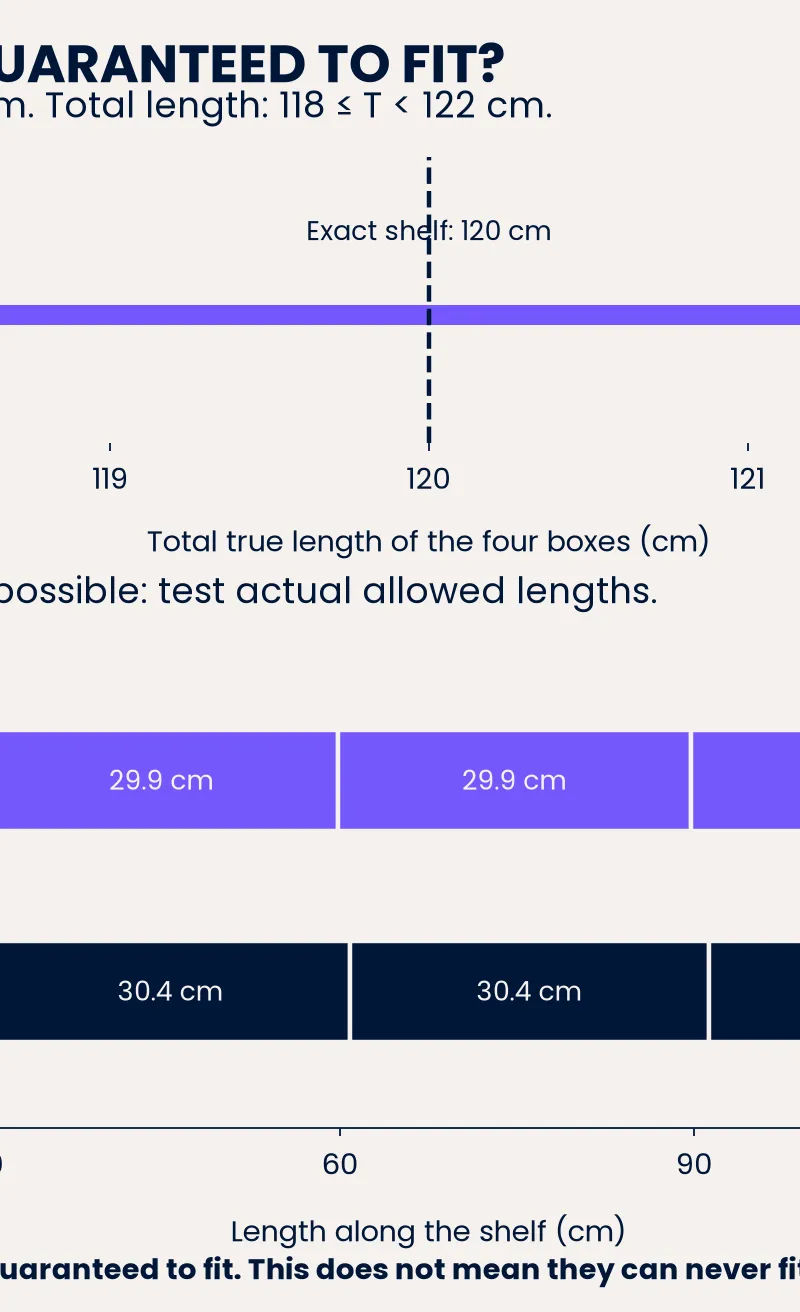
Suppose four box lengths are each given as 30 cm to the nearest cm. For one box, (29.5 \le b < 30.5) cm. Four such positive lengths have a total (118 \le T < 122) cm. The 122 cm figure is anupper limit, not an attainable maximum. Every box must be shorter than 30.5 cm, so their total must be shorter than 122 cm.
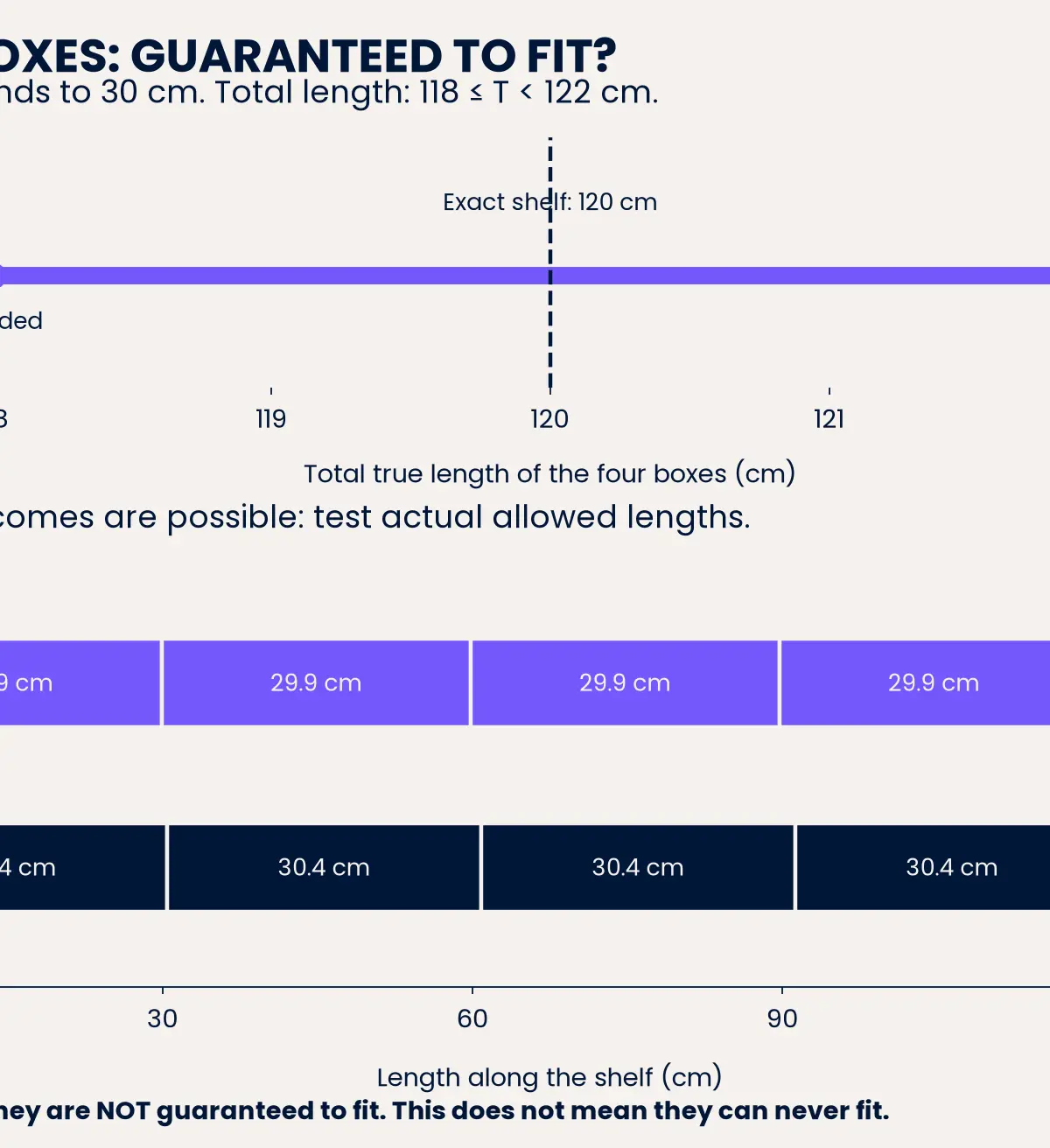
A shelf described as exactly 120 cm has no rounding interval. The boxes are not guaranteed to fit because an allowed set of boxes could be 30.4 cm each, totalling 121.6 cm. That does not mean they definitely will not fit: 29.9 cm each totals 119.6 cm, so fitting is also possible. These actual permitted measurements provide clear evidence without treating an excluded endpoint as a real measurement.
If the shelf is instead recorded as 120 cm to the nearest cm, write (119.5 \le S < 120.5) cm. For a guarantee question, test large boxes against a small shelf. For example, 121.6 cm of boxes will not fit on a permitted 119.6 cm shelf. A single valid counterexample disproves a guarantee.
Concept 4: Rounding, truncation and the supported N15 skill
N15 supplies the language behind the interval. Rounding selects the nearest stated unit. Truncationcuts digits off without rounding. For a positive value truncated to one decimal place as 4.2, the true value is (4.2 \le x < 4.3), because values from 4.20 up to 4.299... all truncate to 4.2. This is not the midpoint rule used for rounding.
Rounding also needs an appropriate degree of accuracy. An answer measured only to the nearest centimetre should not be reported as 60.000 cm. Extra decimal places suggest certainty the measurement does not have. In a multi-step question, avoid premature rounding of calculations, but state the final conclusion at a sensible accuracy and with units.
For significant figures, identify the place value of the final retained digit. For example, 340 to two significant figures is rounded to the nearest 10, so its interval is (335 \le x < 345). The number of significant figures is not itself the rounding unit.
Mathematical/Scientific Relationships
The following number relationships must be memorised. The Pearson 2026 Foundation exam aid does not supply an error-interval or limits-of-accuracy relationship. 3
Must memorise, rounding to the nearest unit (u): if a positive measurement (x) is recorded as (r), then:
[r-\frac{u}{2}\le x<r+\frac{u}{2}]
Here (r) is the rounded reading, (u) is the rounding unit, and (x) is the true value. Subtract half the rounding unit for the lower limit and add it for the upper limit.
Must memorise, positive truncation to unit (u):
[r\le x<r+u]
The displayed value is the lower limit, not the centre. This version is stated for positive quantities; do not apply it blindly to negative truncation examples.
Must memorise, repeated lengths as bridge/enrichment: for (n) positive objects each recorded as (r) to nearest (u), reason from:
[n(r-u/2)\le T<n(r+u/2)]
Here (n) is an exact count and (T) is the total true length. This is repeated addition of intervals. Formal bounds for products of two uncertain measurements, quotients and compound measures are Higher-tier extensions and are omitted.
State the units clearly. An inequality should make three ideas visible: lower limit included, actual values between the endpoints, upper limit excluded. Do not write (59.5<l<60.5), because 59.5 cm really does round to 60 cm. Do not write (59.5\le l\le60.5), because 60.5 cm does not.
Unit conversions and accuracy
Convert before comparing lengths. Must memorise: (1\text{ m}=100\text{ cm}), (1\text{ cm}=10\text{ mm}), and (1\text{ kg}=1000\text{ g}). A half-unit must be in the same unit as the reading.
For example, 1.20 m to the nearest 0.01 m gives (1.195\le L<1.205) m. In centimetres this becomes (119.5\le L<120.5) cm. Convert the whole interval, not merely one endpoint. The half-unit 0.005 m becomes 0.5 cm, not 0.005 cm.
Practical Applications
Measurements are rounded because rulers, scales and manufacturing machines have limited resolution. A carpenter allows a margin so parts fit; a delivery company checks whether a plausible package will fit; a laboratory reports a balance reading to its resolution rather than inventing digits. In each case the question decides the direction of the check.
For a rule such as “must be under 5 kg”, a displayed value of 5.0 kg to the nearest 0.1 kg represents (4.95\le m<5.05) kg. It does not guarantee compliance: a permitted true mass could exceed 5 kg. A useful conclusion identifies an allowed counterexample rather than simply repeating the rounded reading.
Required practicals
None apply to this GCSE Mathematics topic. The practical skill is clear mathematical communication: state the interval, identify the relevant extreme, calculate with consistent units, and interpret it in words.
Exam Focus, Method and Common Mistakes
Use the HALF routine: Highlight accuracy, Amount halved, Limits written, Finish in context. Circle the accuracy phrase, identify the rounding step, halve that step, and write the interval before attempting the contextual decision. For positive truncation, replace the midpoint approach with the full-step interval above the displayed value.
A frequent error is treating 120 cm as exact when the question says “correct to the nearest cm”. Another is calling 122 cm the largest total of four rounded 30 cm boxes. It is only the excluded upper limit. A third error is saying the boxes “will not fit”. The evidence proves only that fitting is not guaranteed; a fitting case and a non-fitting case can both exist.
Pearson mark schemes use M for method, P for process, A for accuracy following a method or process, B for unconditional accuracy, and C for communication. The allocation depends on the individual question. 2 Candidates should show a short logical chain, but should not assume that every numerical question has the same marking pattern. The questions and exact mark allocations in this guide are original illustrative material.
Tier Boundary and Formula-Sheet Check
For the Foundation core, confidently use simple error intervals, inequality notation and contextual interpretation. The formal phrase upper and lower bounds is explicitly added in Higher N16. 1 The box-total examples are included as requested bridge/enrichment, not as a promise that such a formal compound-bound question is routine Foundation assessment.
The 2026 Foundation exam aid provides no bounds or error-interval formula to copy. Learn the half-unit rule and the open upper endpoint rather than expecting the formula sheet to supply them. 3
Ten-minute Tutor Podcast
Listen once, then answer the recall questions without looking at the text. The episode begins with an introduction at 00:00, core concepts at 01:00, exam tips at 06:00, a quick-fire quiz at 08:00 and a summary at 09:00.
References
Visual Resources
2 diagrams and illustrations
Interactive Diagrams
2 interactive diagrams to visualise key concepts
Conceptual Flow Outline
Turn a positive rounded measurement into its simple error interval.
Conceptual Flow Outline
Choose the relevant limits and answer the contextual question precisely.
Worked Examples
4 worked examples — open one to explore the question and available guidance.
Practice Questions
Try the question, then reveal an answer plan or example response
Original self-assessment question: A pencil is 84 mm correct to the nearest millimetre. Write down the error interval for its length p. [3 illustrative marks]
Hint: Nearest millimetre means the rounding unit is 1 mm.
Original self-assessment question: A parcel has mass 570 g correct to the nearest 10 g. State the lower and upper limits, then write down the error interval for its true mass m. [3 illustrative marks]
Hint: The stated rounding unit is 10 g, not 1 g.
Original self-assessment question: A ribbon is 2.6 m correct to the nearest 0.1 m. Write its error interval in centimetres. [4 illustrative marks]
Hint: Find the interval in metres, then convert both endpoints using 1 m = 100 cm.
Original bridge/enrichment question: Five rods are each 30 cm correct to the nearest centimetre. A rail is exactly 150 cm long. Explain whether the rods are guaranteed to fit end to end. [5 illustrative marks]
Hint: A single permitted counterexample is enough to disprove a guarantee.
Original bridge/enrichment question: Four boxes are 30 cm correct to the nearest centimetre and a shelf is 120 cm correct to the nearest centimetre. Decide whether fitting is guaranteed. Use a permitted set of measurements to justify your answer. [6 illustrative marks]
Hint: Make the boxes large and the shelf small. Choose actual values inside both intervals rather than excluded endpoints.
Exam technique
How to turn what you know into marks
How to approach the question
Underline the accuracy phrase and the decision word. Identify the rounding unit, halve it and write the interval. For a context, choose the extreme that makes the claim hardest to satisfy, keep units consistent and distinguish ‘guaranteed’, ‘possible’ and ‘not guaranteed’.
How to structure your answer
For a short interval question, give the requested endpoints or complete inequality with units. Where calculations or explanations are requested, show the rounding unit, half-unit and endpoint arithmetic. For contextual enrichment questions, write the relevant intervals, choose appropriate extremes or a permitted numerical counterexample, calculate, compare and conclude. Exact allocations in this guide are illustrative; individual Pearson mark schemes determine official credit.
Timing
Pearson papers last 90 minutes and have 80 marks, averaging 67.5 seconds per mark. A practical revision target is about 1 minute per mark, leaving roughly 10 minutes for checking. Suggested practice timings: 3 marks about 3 minutes; 4 marks about 4 minutes; 5 marks about 5 minutes; 6 marks about 6 minutes. These are revision targets, not board-imposed question time limits.
Common pitfalls
- Using a whole unit either side. Halve the stated rounding unit, not the rounded number.
- Using ±0.5 for every question. Nearest 10 uses ±5; nearest 0.1 uses ±0.05.
- Writing ≤ at the upper endpoint. Test it: 60.5 rounds to 61, so it must be excluded from the interval for 60.
- Calling an excluded upper limit an actual maximum. There is no largest real value below that boundary.
- Treating a rounded shelf as exact, or inventing an interval for a shelf explicitly described as exact.
- Saying ‘will not fit’ when the evidence only shows ‘not guaranteed to fit’.
- Comparing metres and centimetres without converting the whole interval.
- Applying the midpoint rounding rule to positive truncation. Truncation uses the displayed value as the lower endpoint.
What the command words want
- Compare
- Use compatible units and state which value is longer, smaller or sufficient.
- Explain
- Link numerical evidence to the conclusion using ‘because’. Explain why a guarantee holds or fails.
- Describe
- Say what the interval means, including whether its endpoints are included.
- Evaluate
- Make a justified judgement using the required extreme case or a valid counterexample.
- Calculate
- Show the relevant arithmetic and conversions. Keep the accuracy of intermediate values and label the result.
- State/Give
- Give the requested limit or interval directly, with units. If asked for the upper limit, give the endpoint rather than an arbitrary nearby permitted value.
- Write down
- Present the requested result concisely. For an error interval, include both endpoints and the correct inequality signs.
- Decide whether
- Give a clear decision supported by relevant calculations. Match the certainty of the conclusion to the evidence.
Watch or listen (optional)
Test your understanding of Number - Measures and accuracy: apply and interpret limits of accuracy (Foundation tier)
Active recall beats re-reading. Take an instant quiz now to test what you’ve learned and lock it into long-term memory.
7 days Premium · Then the free plan continues · No card, no charge