Pearson Edexcel · GCSE · Mathematics
Course version: 1MA1 · Version from Mar 2026
Number - Structure and calculation: calculate exactly with fractions and multiples of π (Foundation tier)
Exact answers protect accuracy: fractions preserve part-whole values and π preserves the true circle value. Master common denominators, reciprocals and radius-based formulas so that you can secure Foundation marks without turning an exact instruction into a rounded decimal.
- 12 min read
- 4 worked examples
- 6 practice questions
- 14 key terms
Try the lesson
The start of the Number - Structure and calculation: calculate exactly with fractions and multiples of π (Foundation tier) lesson, made from checked teaching notes for this specification point.
Have a go first
Work out 3/4 + 1/8. Give your answer as a fraction in its simplest form.
There is more to this lesson
The full lesson goes on to check your understanding and help you earn the marks. Create a free account to carry on, with your progress saved.
7 days Premium · Then the free plan continues · No card, no charge
Check what you remember
Read the wording for your board, then hide it and explain exact value in your own words. Rough notes are fine. This is a self-check, with no mark or grade.
Reference: Pearson Edexcel
A value stated without rounding. It may be a fraction, a multiple of π, or a terminating decimal such as 0.75.
Study Notes

Overview
Number N8 is about preserving mathematical information instead of rounding it away. In Foundation GCSE Maths, you calculate exactly with fractions and multiples of (\pi): add, subtract, multiply or divide fractions accurately, then retain (\pi$) in circle answers when the question requires an exact value. This matters because a rounded calculator decimal can lose accuracy before the final answer. It also links number skills with geometry: the same radius may lead to a circumference, an area, or part of an area. N8 is Foundation content in Pearson Edexcel GCSE Mathematics 1MA1; the linked Higher-only addition is surds, which are not required here. 1$
$Expect short calculations, multi-step fraction questions, and diagram-based circle questions. Read whether the question says calculate, give your answer as a fraction, or in terms of (\pi). The three Foundation papers are 80 marks in 90 minutes: 1F is non-calculator and 2F and 3F are calculator, but any topic can appear on any paper. 1 The aim is not to memorise disconnected tricks. It is to choose a correct process, show secure working and present the exact form requested.$
Key concepts
1. Exact means do not round
$An exact value has not been rounded. Fractions such as (19/12) and multiples such as (36\pi) are exact. A terminating decimal can also be exact: (0.75=3/4). Therefore, decimals are not automatically forbidden. The instruction decides the form: for “give as a fraction”, give a fraction; for “in terms of (\pi)”, keep (\pi). (\pi\approx3.14), but (\pi$
e3.14). Replacing it with 3.14 creates an approximation.
Exam check: Circle answers need both the exact expression and the correct unit. Length uses, for example, cm; area uses (\text{cm}^2). An answer such as (36\pi\text{ cm}) has the correct area coefficient but the wrong kind of unit.
2. Add and subtract only like-sized parts
The denominator names the size of each part. You can add thirds to thirds, but not thirds directly to quarters. Make equivalent fractions with a common denominator, then add or subtract the numerators and retain that denominator. A common multiple works; the lowest common multiple is often quickest.
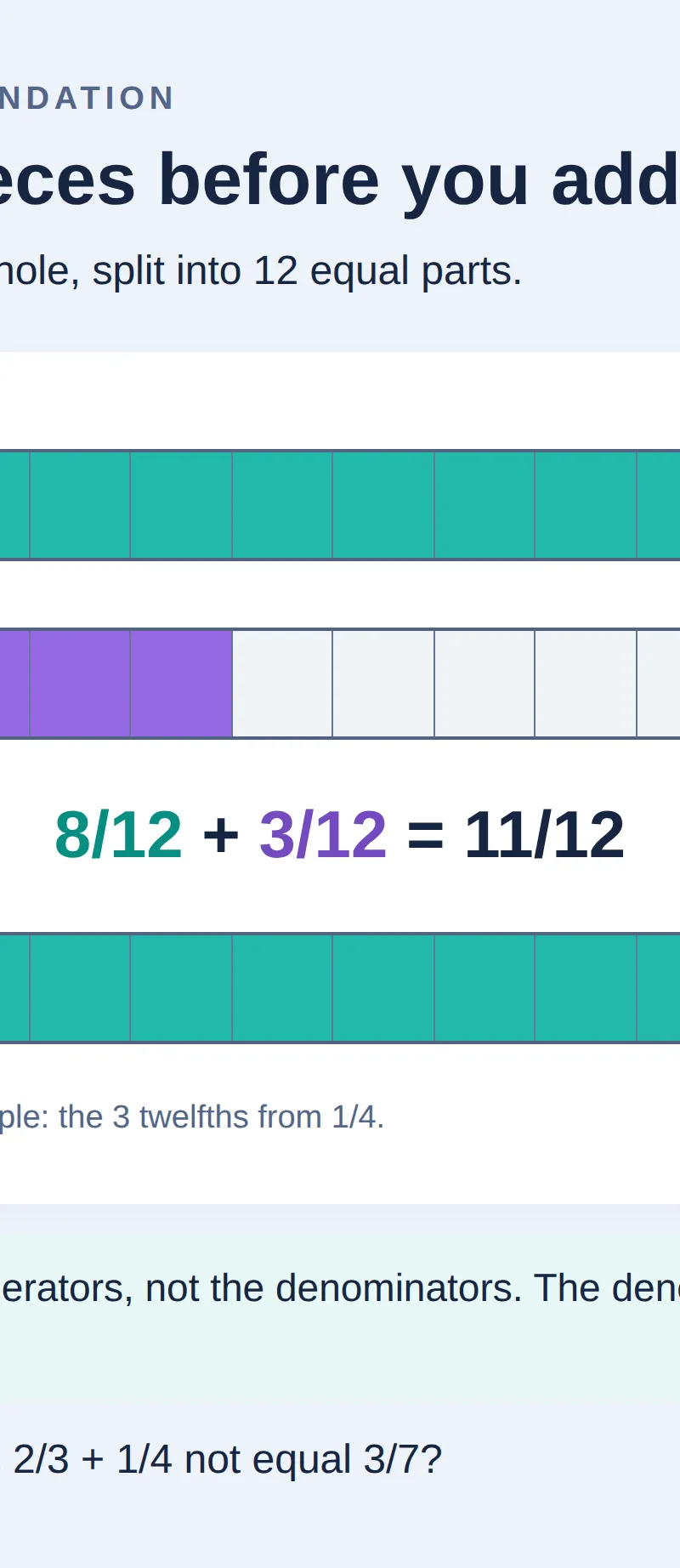
(\frac14+\frac23=\frac3{12}+\frac8{12}=\frac{11}{12}$). The denominator does not become (4+3). After calculating, simplify if numerator and denominator share a factor. Simplest form is a safe final default, although a question-specific official scheme may accept an equivalent fraction unless it says otherwise. 4$
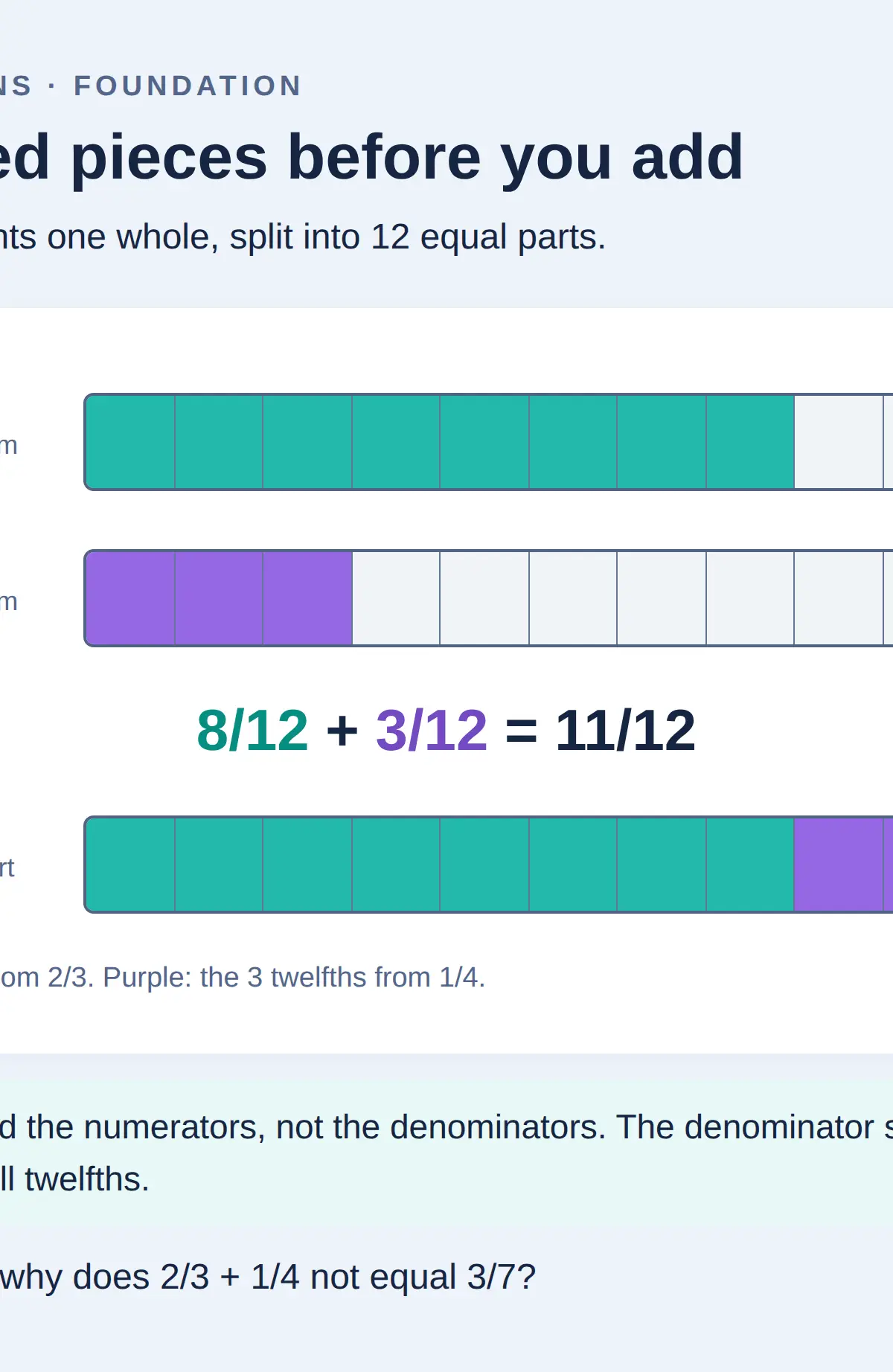
Cover and recall: Explain why the denominator stays 12. Your explanation should refer to the size of the pieces, not merely repeat a rule.
3. Multiply, divide and handle mixed numbers
For multiplication, multiply numerator by numerator and denominator by denominator. Cancel a common factor first when it makes the arithmetic clearer, or simplify at the end.
A product such as two fifths of three quarters is a fraction of a fraction: dividing the whole into fifths and quarters produces twentieths. Dividing by a fraction reverses multiplication by that fraction, which is why its reciprocal is used. For example, (\frac27\times\frac72=1), so multiplication by (7/2) undoes multiplication by (2/7).
For division, multiply by the reciprocal of the second fraction: keep, change division to multiplication, flip the divisor. Do not flip the first fraction.
Examples: (\frac25\times\frac34=\frac6{20}=\frac3{10}). For division, (\frac35\div\frac27=\frac35\times\frac72=\frac{21}{10}). A result greater than 1 is sensible because several portions of size (2/7) fit into (3/5).
Convert a mixed number before multiplication or division: (2\frac13=\frac{2\times3+1}{3}=\frac73$). With signed fractions, use the usual sign rules: one negative factor gives a negative product; two negatives give a positive product. Follow operation priority in a longer calculation. These fraction-operation and reciprocal skills connect to N2 and N3. 1$
4. Circles: retain the (\pi)
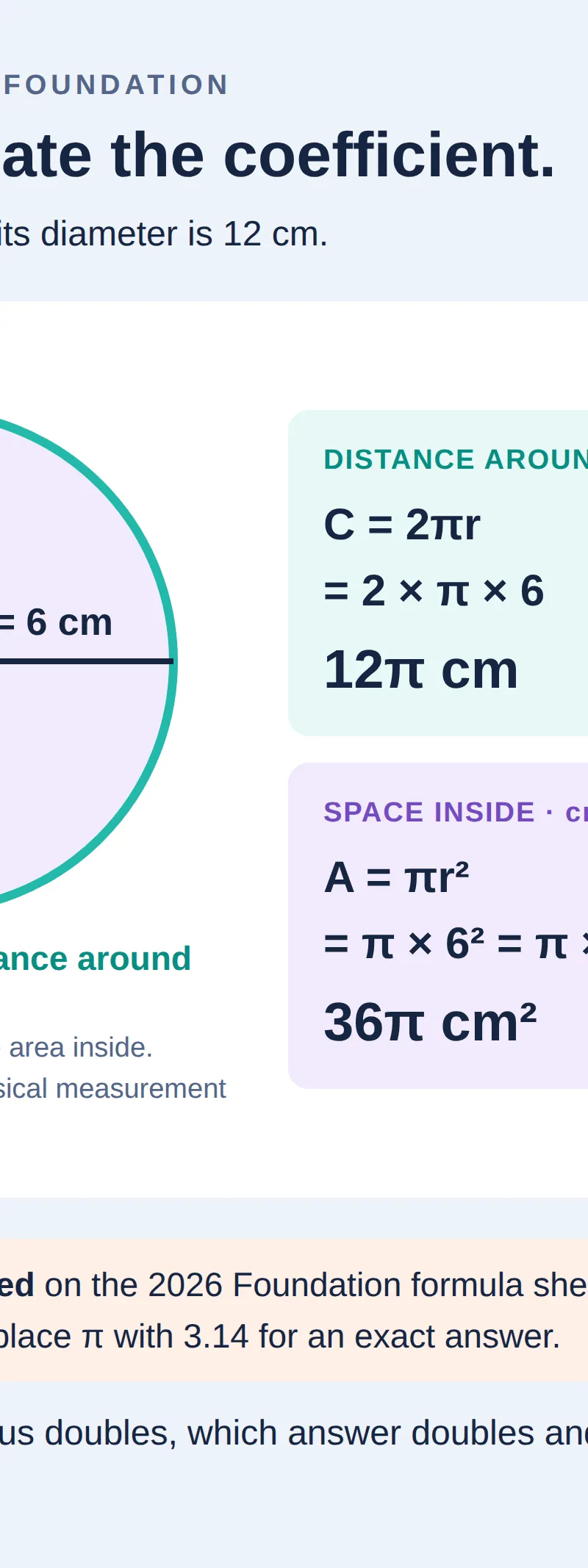
A radius runs from the centre to the circumference; a diameter passes through the centre and is twice the radius. Start by identifying which one a diagram gives. Then substitute the radius into the appropriate circle formula. With (r=6), circumference is (2\pi\times6=12\pi) cm and area is (\pi\times6^2=36\pi$) cm². The square belongs to the radius only: area is not ((\pi r)^2).$
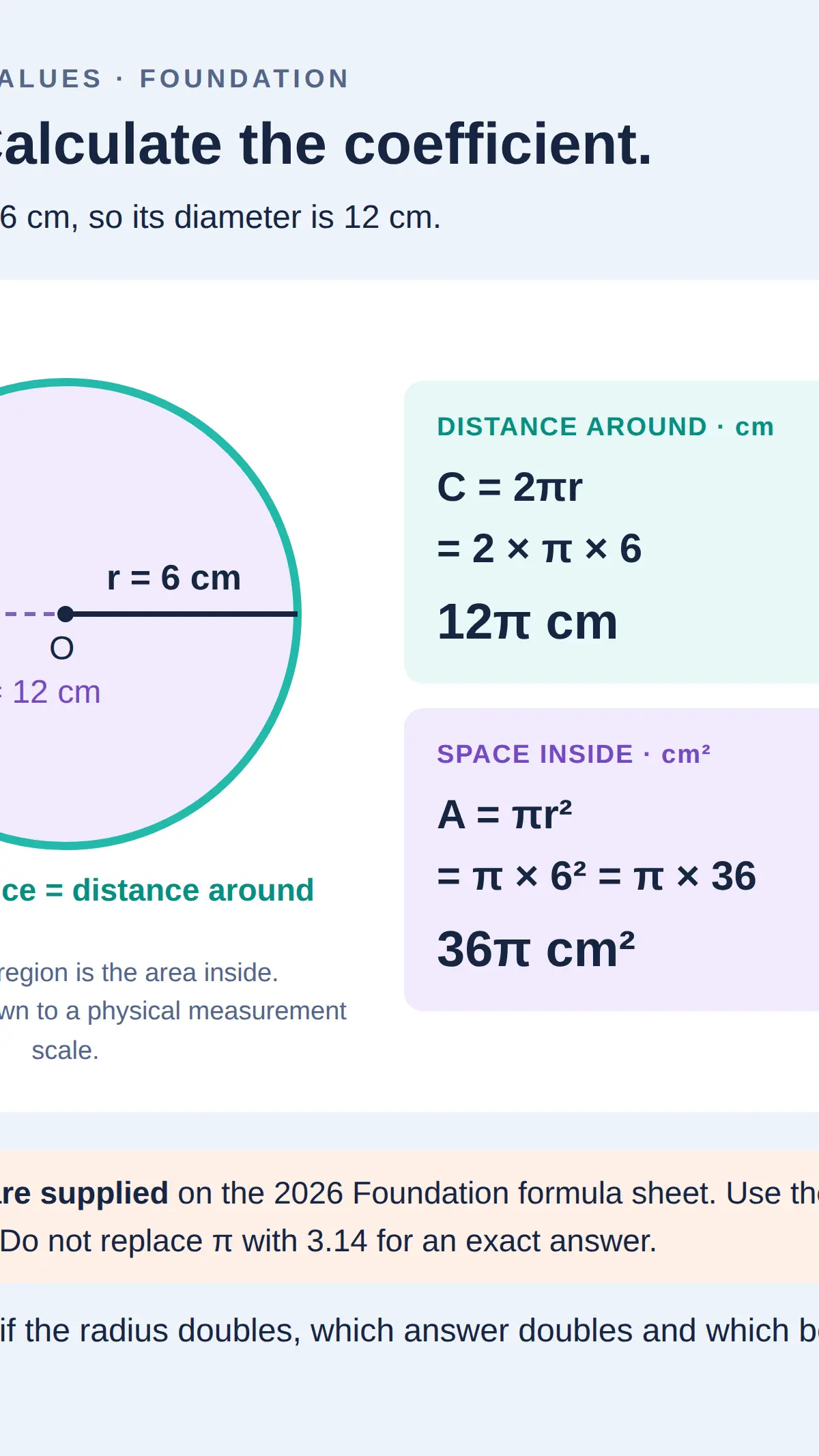
The 2026 Foundation formula sheet supplies (C=2\pi r=\pi d) and (A=\pi r$^2). Pearson has confirmed that formula sheets continue for the lifetime of the current specification. 2 3 A calculator can check the integer coefficient, but do not replace (\pi) with its decimal display when an exact answer is required.$
5. Semicircles, fractions of circles and units
For a semicircle, half the circle area is (\frac12\pi r^2). Its curved arc is half the circumference, (\pi r). A perimeter includes every outside edge, so a semicircle perimeter is (\pi r+2r): arc plus diameter. Sketch a line around the boundary before calculating; this prevents candidates giving only the arc.
For a fraction (f) of a complete circle, multiply the full area by (f). Use (\frac34\pi r^2) for three quarters, not (\frac34\pi r). Convert linear units before calculating when possible. For areas, conversion factors are squared: (1\text{ cm}=10\text{ mm}), yet (1\text{ cm}^2=100\text{ mm}^2); (1\text{ m}=100\text{ cm}), yet (1\text{ m}^2=10{,}000\text{ cm}^2). The square describes area, not a decorative label.
6. Check the operation, then check the form
Before you calculate, identify whether the question needs addition, multiplication or division. This prevents a familiar fraction symbol from triggering the wrong routine. In addition and subtraction, a common denominator changes the name of the parts but not their total value. In multiplication, cancelling is valid between factors in the numerator and denominator of the product, never across an addition sign. In division, the divisor must be non-zero and it is the divisor that is inverted.
After calculating, perform a sense check. For example, (\frac34+\frac56) must be greater than 1, so (\frac{19}{12}) is plausible, whereas (\frac8{10}) is not. A circle of radius 6 has area (36\pi), not (6\pi), because the formula needs the squared radius. If an area has been converted from cm² to mm², its numerical coefficient should become one hundred times larger, not ten times larger.
For example, (\frac34+\frac16\times\frac25) is (\frac34+\frac1{15}=\frac{49}{60}), because multiplication comes before addition. Keep each intermediate fraction exact.
Finally, match the requested presentation. Preserve (\pi) where required, use a fraction if asked, and follow any mixed-number instruction. Equivalent fraction forms can be mathematically equal, but a clearly simplified fraction avoids unnecessary doubt. Converting to a rounded decimal part-way through can make a later exact answer impossible to recover.
Mathematical relationships and formula-sheet status
The labels below distinguish supplied formulas from relationships candidates must know or derive. Must memorise means the relationship is not explicitly supplied on the current Foundation formula sheet. For semicircles, understanding how to derive the relationship is better than learning it without a reason.
| Relationship | Status | Use and meaning |
|---|---|---|
| (\frac ab=\frac{ka}{kb}), (k | ||
| e0) | Must memorise | Equivalent fractions: multiply numerator and denominator by the same non-zero number. |
| (\frac ab=\frac{a\div g}{b\div g}), where (g) divides both (a) and (b) | Must memorise | Simplify by dividing both numbers by a shared factor. |
| (\frac ab\pm\frac cd=\frac{ad\pm bc}{bd}) | Must memorise | Add or subtract using a common denominator. Denominators cannot be zero. |
| (\frac ab\times\frac cd=\frac{ac}{bd}) | Must memorise | Multiply fractions, then simplify. |
| (\frac ab\div\frac cd=\frac ab\times\frac dc) | Must memorise | Divide using the reciprocal. Both fractions must have valid denominators and the divisor cannot be zero. |
| (q\frac ab=\frac{qb+a}{b}) | Must memorise | Convert a positive mixed number to an improper fraction. |
| (r=\frac d2), (d=2r) | Must memorise | Relate radius (r) and diameter (d). |
| (C=2\pi r=\pi d) | Given on formula sheet | Circumference (C), the distance around a circle. |
| (A=\pi r^2) | Given on formula sheet | Area (A) of a complete circle. |
| Fraction (f) of circle area (=f\pi r^2) | Must memorise | Multiply the complete area by the stated fraction. |
| Semicircle area (=\frac12\pi r^2) | Must memorise | Half of a circle’s area. |
| Semicircle arc (=\pi r); perimeter (=\pi r+2r) | Must memorise | Halve the circumference, then add the diameter for perimeter. |
| (1\text{ cm}=10\text{ mm}); (1\text{ m}=100\text{ cm}) | Must memorise | Linear conversions. |
| (1\text{ cm}^2=100\text{ mm}^2); (1\text{ m}^2=10{,}000\text{ cm}^2) | Must memorise | Area conversions: square the linear scale factor. |
Practical applications and diagram reading
There is no required practical or graph-drawing skill for this topic. Diagrams can still be assessed: read the labelled radius, diameter, shaded fraction, straight edge and units before selecting a formula. Do not estimate a radius from a picture labelled “not accurately drawn”.
Exact circle calculations model a circular garden border, a wheel rim or a semicircular window. A border requires a length calculation; a surface to paint requires an area calculation. A rounded measurement is sensible only when the question asks for an approximation or a practical level of precision.
Study routine: retrieve, explain, revisit
Use cover and recall rather than rereading: cover the formula list, write the division rule and semicircle perimeter from memory, then check. Revisit a small set after another topic and again the next day, mixing fractions with circles. Explain one error aloud: “I need a common denominator because the pieces must be the same size.” This builds a reasoned method, not a copied layout.
Listen and recall
Use the companion 10-minute podcast in five chapters: Intro 0–1, Core 1–6, Tips 6–8, Quiz 8–9, and Summary 9–10. Pause at the quiz, cover the screen and answer before listening to the explanation. These are podcast chapter times, not fixed exam-topic timings.
Examiner-focused technique
A practical pace is roughly one minute per mark while leaving time to check. More precisely, 90 minutes for 80 marks is 1.125 minutes, or 67.5 seconds, per mark. 1 This is whole-paper guidance, not a fixed N8 allocation. Write the formula or common-denominator step, substitute, simplify and attach units. A correct answer can receive full marks when working was not specifically required, but showing clear working is safer if an arithmetic slip occurs. 4
Question-specific mark schemes control the credit. In Pearson notation, M means method, P process, A accuracy, B unconditional accuracy and C communication. Their availability depends on the question. 4 Do not assume every written line earns a mark. Candidates earn credit for valid work meeting the actual requirement. All questions created for this guide are original Edexcel-style practice with illustrative teaching allocations, not official Pearson questions or published mark schemes.
Final 15-second check: Is the answer exact? Is the fraction simplified where appropriate? Did you square the radius for area? Did you include the diameter in a semicircle perimeter? Are the units correct?
Download the complete resource: edexcel_foundation_exact_fractions_and_pi.json.
References
Visual Resources
2 diagrams and illustrations
Interactive Diagrams
2 interactive diagrams to visualise key concepts
Conceptual Flow Outline
A decision route for exact fraction calculations. Identify the operation before choosing the method.
Conceptual Flow Outline
How a labelled diameter or radius leads to exact circle and semicircle measurements.
Worked Examples
4 worked examples — open one to explore the question and available guidance.
Practice Questions
Try the question, then reveal an answer plan or example response
Original Edexcel-style practice, illustrative teaching allocation: 3 marks. Calculate 7/12 − 1/4. Give your answer as a fraction in its simplest form.
Hint: Rewrite one quarter as twelfths, then simplify the result.
Original Edexcel-style practice, illustrative teaching allocation: 3 marks. Calculate 3/10 × 5/9. Give your answer in its simplest form.
Hint: Multiply top by top and bottom by bottom, or cancel common factors first.
Original Edexcel-style practice, illustrative teaching allocation: 3 marks. Calculate 4/7 ÷ 2/3. Give your answer in its simplest form.
Hint: Which fraction is the divisor? Flip that one only.
Original Edexcel-style practice, illustrative teaching allocation: 3 marks. Calculate 5/6 + 3/4. Give your answer as a mixed number in its simplest form.
Hint: Both denominators divide into 12.
Original Edexcel-style practice, illustrative teaching allocation: 4 marks. A circle has diameter 14 cm. Calculate its circumference and area, giving both answers in terms of π.
Hint: You can use C = πd, but area needs the radius.
Original Edexcel-style practice, illustrative teaching allocation: 4 marks. A shaded region is 3/4 of a circle of radius 8 cm. Calculate its area exactly in mm².
Hint: Find the full circle area, take three quarters, then use 1 cm² = 100 mm².
Exam technique
How to turn what you know into marks
How to approach the question
Underline the form requested. For fractions, identify the operation, convert mixed numbers where needed, show the common-denominator or reciprocal step, calculate and simplify. For circles, identify radius or diameter, select the formula, retain π and check units and boundary edges.
How to structure your answer
For 2–3 marks, give a clear method and final exact answer. For 4–6 marks, label the relevant stages: conversion or formula, substitution, exact calculation, simplification and units. These are teaching structures, not a promise that every line earns a separate mark. If working is explicitly requested, it must be shown.
Timing
Use roughly 1 minute per mark as a practical working target, leaving checking time. Across a 90-minute, 80-mark paper the average is 1.125 minutes, or 67.5 seconds, per mark. N8 itself has no fixed official mark allocation.
Common pitfalls
- Adding or subtracting denominators. Rewrite both fractions with a common denominator first.
- Failing to invert the divisor, or inverting the first fraction. Say ‘keep, change, flip the divisor’ before calculating.
- Using 3.14 or a rounded calculator decimal when an exact answer is requested. Retain π or the exact fraction.
- Assuming every decimal is approximate. A terminating decimal such as 0.75 can be exact, but it still does not satisfy an instruction to give a fraction.
- Using a diameter as the radius for area. Halve the diameter before substituting into πr².
- Omitting the straight diameter from a semicircle perimeter. Trace every boundary edge.
- Converting cm² to mm² with 10 rather than 100. Square the linear conversion factor.
What the command words want
- Explain
- Give a mathematical reason, such as common denominators creating equal-sized parts or perimeter including every boundary edge.
- Work out
- Use the appropriate numerical operations. Show the main steps, especially when working is explicitly requested.
- Calculate
- Carry out the required calculation and give the requested exact form with appropriate units.
- Show that
- Provide the calculations that establish the stated result. Merely copying the printed answer is not a demonstration.
- State/Give
- Supply the requested value or formula directly, checking the specified form and unit.
- Give your answer as a fraction
- Use a fraction rather than a decimal. If simplest form is requested, cancel all common factors.
- Give your answer in terms of π
- Retain π in the final expression. Do not replace it with 3.14 or a decimal calculator display.
- Give your answer as a mixed number
- Convert an improper fraction to a whole number and a proper fractional part, then simplify that part.
Watch or listen (optional)
Test your understanding of Number - Structure and calculation: calculate exactly with fractions and multiples of π (Foundation tier)
Active recall beats re-reading. Take an instant quiz now to test what you’ve learned and lock it into long-term memory.
7 days Premium · Then the free plan continues · No card, no charge