Pearson Edexcel · GCSE · Mathematics
Course version: 1MA1 · Version from Mar 2026
Number - Structure and calculation: calculate with roots, and with integer and fractional indices (Higher tier)
Turn intimidating powers into three manageable instructions: root, power and reciprocal. This Higher-tier guide shows how to calculate exact values, simplify to one base and make your working earn credit in Pearson Edexcel GCSE Mathematics.
- 12 min read
- 4 worked examples
- 8 practice questions
- 10 key terms
Try the lesson
The start of the Number - Structure and calculation: calculate with roots, and with integer and fractional indices (Higher tier) lesson, made from checked teaching notes for this specification point.
Have a go first
Work out the value of 27 to the power of one third.
There is more to this lesson
The full lesson goes on to check your understanding and help you earn the marks. Create a free account to carry on, with your progress saved.
7 days Premium · Then the free plan continues · No card, no charge
Check what you remember
Read the wording for your board, then hide it and explain Base in your own words. Rough notes are fine. This is a self-check, with no mark or grade.
Reference: Pearson Edexcel
The number or algebraic expression raised to a power. In $a^n$, the base is a.
Study Notes
Overview
Fractional indices are a compact way of writing roots and powers together. The expression 27^{2/3} does not mean multiply 27 by two-thirds: it means take the cube root of 27, then square the result. A negative index adds one more instruction: take the reciprocal. Once candidates separate these instructions, calculations that look difficult become short, reliable sequences.
This guide covers Pearson Edexcel GCSE Mathematics 1MA1, specification N7. Roots and integer indices underpin both tiers; calculating with fractional indices is Higher-only. Exact surd calculations connect to Higher content in N8. These skills also support algebraic simplification, standard form, rearranging formulae and problems involving area or volume. 1
Typical questions ask candidates to work out an exact value, express an answer as a single power, explain a mistake or show why a relationship holds. A correct answer must match the requested form: 2^3 is a single power, whereas 8 is its numerical value. The examples below make the reasoning visible so that credit can be given for a correct method, even when an arithmetic slip affects the final answer. Practise without a calculator first, then check your understanding rather than merely checking a decimal.
Key Concepts
1. Integer indices describe repeated multiplication
In a^n, a is the base and n is the index, also called the exponent. For a positive integer n, the index counts how many copies of the base are multiplied. Thus 3^4=3\times3\times3\times3=81, not 3\times4.
The multiplication law follows by counting factors: a^3\times a^2 contains five copies of a, so it equals a^5. Division cancels matching factors, giving a^5\div a^2=a^3 for $a
e0. A power of a power multiplies indices:(a^3)^2=a^6$, because there are two groups of three factors.
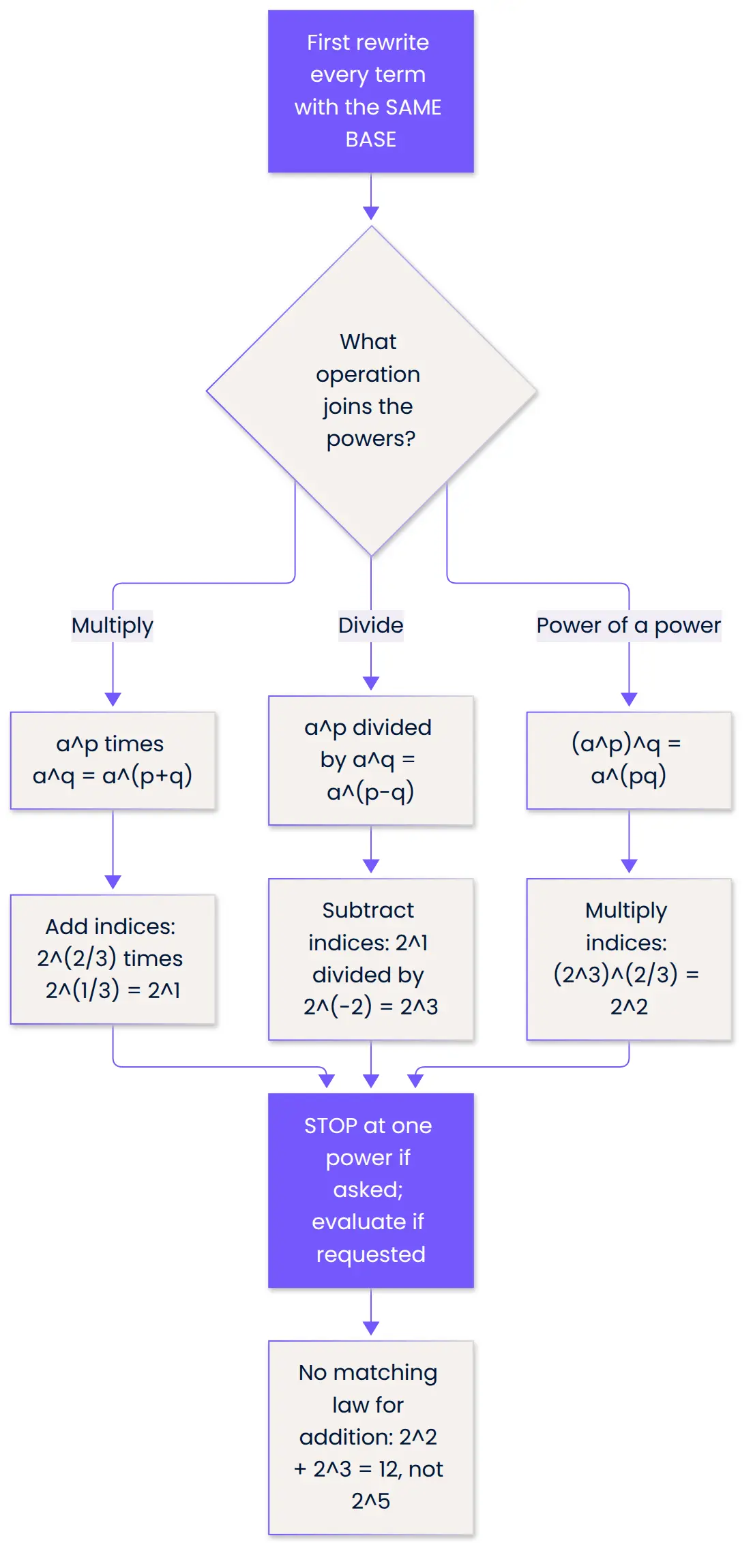
Examiner focus: first identify the operation between the powers. Multiplication means add indices; division means subtract; a power applied to a power means multiply. These laws do not apply to addition: 2^2+2^3=4+8=12, not 2^5.
Cover and recall: simplify 7^3\times7^2 and (7^3)^2. Explain why the answers have different indices.
2. Zero and negative indices extend the same laws
For a non-zero base, dividing a power by itself gives 1. The division law also gives a^k\div a^k=a^{k-k}=a^0. Therefore a^0=1. It is not 0, and this rule does not define 0^0 in GCSE calculations.
Continue the pattern 2^3=8, 2^2=4, 2^1=2, 2^0=1. Each step divides by 2, so 2^{-1}=1/2 and 2^{-2}=1/4. In general, a^{-n}=1/a^n for $a
e0$.
A negative index changes the position of a factor, not its sign. Consequently 5^{-2}=1/25, whereas -5^2=-25 and (-5)^2=25. Brackets determine whether a negative sign belongs to the base.
Why does this work? Multiplying a^n by a^{-n} gives a^0=1. The two values must therefore be reciprocals. For a positive base, every defined power remains positive.
3. Why a half index represents a square root
Let x\ge0 and put y=x^{1/2}. The multiplication law gives y\times y=x^{1/2+1/2}=x. Therefore y^2=x. The notation x^{1/2} denotes the non-negative, or principal, square root, so x^{1/2}=\sqrt{x}.
There is an important distinction: \sqrt{25}=5, but solving t^2=25 gives t=5 or t=-5. The radical symbol selects the principal root; the equation asks for every value whose square is 25. A complete explanation needs this sign convention, not just the observation that a value squares to x.
Similarly, a^{1/3}=\sqrt$3{a}for positivea. The cube root of 64 is 4 because4^3=64. Odd roots of negative numbers can be real, such as\sqrt3{-8}=-2, whereas\sqrt{-8}$ has no real value. Use positive bases for the general fractional-index laws in this guide; do not extend them blindly to negative bases.
4. Fractional indices: denominator root, numerator power
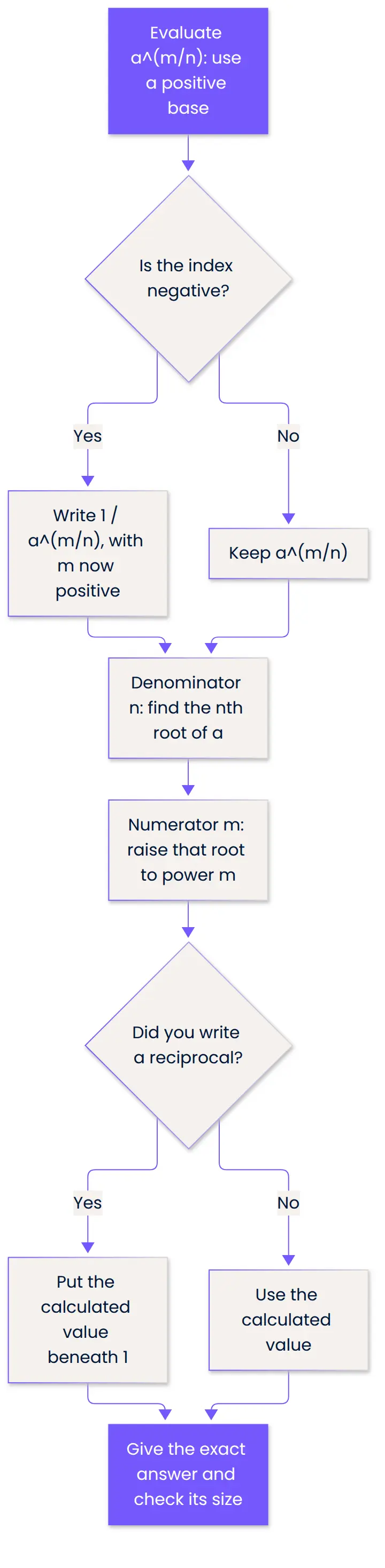
For a>0, a^{m/n}=(\sqrt[n]{a})^m, where m is an integer and n is a positive integer. The denominator n tells you which root to take; the numerator m tells you which power to apply.
Example: 27^{2/3}=(\sqrt$3{27})^2=3^2=9. Reading the fraction upside down would produce(\sqrt{27})^3$, which is a different expression. The fraction is an instruction about operations, not an amount by which the base is multiplied.
It is usually easier to find the root first. Squaring 27 first gives 729, whose cube root is still 9, but recognising the cube root of 27 keeps the numbers small. The two orders are mathematically equivalent for positive bases: root first is an efficiency choice, not the only valid method.
Another example: 32^{2/5}=(\sqrt[5]{32})^2=2^2=4. Recognising 32=2^5 also gives (2^5)^{2/5}=2^2. Reduce an exponent such as 2/4 to 1/2 when this makes the required root clearer.
Cover and recall: what does each part of 81^{3/4} instruct you to do? Find its exact value before checking the answer.
5. Negative fractional indices combine three instructions
For a>0 and positive integers m,n, write a^{-m/n}=1/a^{m/n}. Then calculate the root and power in the denominator.
Example: 16^{-3/2}=1/16^{3/2}=1/(\sqrt{16})^3=1/4^3=1/64. The denominator 2 means square root. The numerator 3 means cube. The negative sign means reciprocal. None of these instructions says make the answer negative.
Writing the reciprocal first is a useful way to avoid losing the minus sign. Alternatively, calculate 16^{3/2}=64 first, then take its reciprocal. Credit should be given for an equivalent correct route under the relevant mark scheme. Avoid taking a reciprocal twice.
A useful size check depends on the base. If a>1, then a^{-r}<1 for r>0. If 0<a<1, a negative power gives a value greater than 1: (1/4)^{-1/2}=1/(1/2)=2. Therefore “negative index means a small answer” is not a universal rule.
6. Fractions and decimals can be bases
If the base is a fraction, apply the root to its numerator and denominator. For example, (4/9)^{-1/2}=1/\sqrt{4/9}=1/(2/3)=3/2. The reciprocal of a fraction swaps its numerator and denominator; it does not change its sign.
For a less familiar calculation, (81/16)^{-3/4}=1/(3/2)^3=1/(27/8)=8/27. Here the fourth roots of 81 and 16 are 3 and 2. Showing the intermediate fraction makes the method easy to follow.
A terminating decimal may be easier as a fraction: 0.25^{-1/2}=(1/4)^{-1/2}=2. Candidates who multiply 0.25 by -1/2 have confused an index with a multiplier. Translate the notation before calculating.
7. Simplifying to a single power requires a common base
The laws combine indices only when the bases match. Rewrite 8=2^3 and 4=2^2 before simplifying 8^{2/3}\times4^{-1/2}:
(2^3)^{2/3}\times(2^2)^{-1/2}=2^2\times2^{-1}=2^1.
If the expression is then divided by 2^{-2}, subtract the denominator's index: 2^{1-(-2)}=2^3. The numerical value is 8. Subtracting a negative adds; it does not make the final index negative.
Examiner focus: if the command is “write as a single power of 2”, finish with 2^3. If it is “work out”, give 8. If both forms are requested, label both. Do not lose the requested base by ending with an equivalent but differently based power.
8. Roots and exact surd calculations
A surd is an irrational root written exactly, such as \sqrt{2}. It is not merely any expression containing a root symbol: \sqrt{16}=4 is rational. Surd manipulation is related Higher-tier N8 content. 1
For non-negative a,b, \sqrt{a}\sqrt{b}=\sqrt{ab}. Thus \sqrt8\times\sqrt2=\sqrt{16}=4. Alternatively, \sqrt8=2\sqrt2, so the product is 2(\sqrt2)^2=4.
Addition is different: \sqrt8+\sqrt2=2\sqrt2+\sqrt2=3\sqrt2, not \sqrt{10}. The product rule does not become a sum rule. When an exact answer is requested, keep a simplified fraction or surd rather than rounding to a decimal. Rationalising denominators is a separate N8 extension; it is not needed to evaluate the integer answers in the central examples here.
Mathematical Relationships
For the fractional-index relationships below assume a,b>0, p,q are rational indices, m is an integer and n is a positive integer. Ordinary integer-index laws also apply to non-zero real bases where defined. Every index or root relationship below is Must memorise, not supplied on Pearson's 2026 Higher formula sheet. 2
- Must memorise: a^p a^q=a^{p+q}. Same base, multiplication.
- Must memorise: a^p/a^q=a^{p-q}. Same base, division; the denominator must not be zero.
- Must memorise: (a^p)^q=a^{pq}. A power applied to a power.
- Must memorise: (ab)^p=a^p b^p and (a/b)^p=a^p/b^p. A power applies to every factor or to both parts of a quotient.
- Must memorise: a^0=1 and a^{-p}=1/a^p for $a
e0$. - Must memorise: a^{1/n}=\sqrt[n]{a} and a^{m/n}=(\sqrt[n]{a})^m=\sqrt[n]{a^m}.
- Must memorise: a^{-m/n}=1/(\sqrt[n]{a})^m when m>0.
- Must memorise: $\sqrt a\sqrt b=\sqrt{ab}$ for $a,b\ge0$; $\sqrt a/\sqrt b=\sqrt{a/b}$ for $a\ge0,b>0$; and $\sqrt{a^2}=|a|$ for real $a$.
The vertical bars in $|a|$ mean absolute value, the non-negative distance from zero. In particular, $\sqrt{(-3)^2}=3$, not $-3$. Zero cannot be used as a base with a negative index because that would require division by zero.
Practical Applications and Linked Skills
Area, volume and scale
For a square, Must memorise: A=s^2, so the positive side length is s=A^{1/2}. A square of area 49\text{ cm}^2 has side length 7 cm. For a cube, Must memorise: V=s^3, so s=V^{1/3}. A cube of volume 125\text{ cm}^3 has side length 5 cm. Taking a root reverses the power and changes the physical quantity back to length.
For similar solids, Must memorise: volume scale factor =k^3 and area scale factor =k^2, where k is the length scale factor. A volume scale factor of 27 gives k=27^{1/3}=3 and an area scale factor of 27^{2/3}=9. This gives fractional indices a concrete meaning.
For wider formula work, Given on formula sheet: A=\pi r^2 for a circle and V=\text{cross-sectional area}\times\text{length} for a prism. The index laws themselves are still not supplied. 2
Graphs, calculators and units
Graph plotting is not the central skill assessed here. As a useful algebra link, y=x^{1/2} is the square-root graph with real domain x\ge0: it passes through (0,0), (1,1), (4,2) and (9,3). A root graph does not mean divide every coordinate by 2.
Paper 1H does not permit a calculator; Papers 2H and 3H do. 1 On calculator papers, enter the entire fractional exponent in brackets, such as 16^{(-3/2)}, using the calculator's power function. Check that its display matches the intended expression. Do not round intermediate values in an exact calculation.
There are no special unit conversions in pure index calculations. In geometry, Must memorise: 1\text{ m}=100\text{ cm}, 1\text{ m}^2=10,000\text{ cm}^2 and 1\text{ m}^3=1,000,000\text{ cm}^3. Area and volume conversion factors must be squared or cubed. This topic has no required practical.
Exam-Focused Retrieval and Audio
Try the worked examples before reading their solutions. Then attempt the practice questions under a short time limit and explain each mistake using the correct rule. Repeat missed questions the next day and again several days later. Testing yourself from memory is more useful than repeatedly recognising an answer on the page.
The ten-minute female-tutor podcast follows a one-minute introduction, five minutes of core explanations, two minutes of exam advice, a one-minute recall quiz and a one-minute summary. Pause whenever asked to calculate, say the rule aloud and write your working before revealing the answer.
Assessment Notes and Sources
The real June 2023 Paper 1H Question 14(b) is used below with its published three-mark allocation. Other worked examples and all practice questions are original Edexcel-style questions with illustrative mark schemes, not Pearson-issued assessment materials. Pearson's M, A and B abbreviations refer to method, accuracy and unconditional accuracy marks respectively. Individual mark schemes decide exactly what is credited. 3
Worked Examples
4 worked examples — open one to explore the question and available guidance.
Practice Questions
Try the question, then reveal an answer plan or example response
Work out 64^{2/3}. Show your working. [3 marks] Original practice question.
Hint: Which number has cube 64? The difficulty label means an entry-level question within this Higher-topic guide, not Foundation-tier specification content.
Calculate 125^{-2/3} exactly. Show your working. [3 marks] Original practice question.
Hint: Write a reciprocal first, then find the cube root of 125.
Simplify 5^{3/2}\times5^{1/2}\div5^{-1} to a single power of 5. Show your working. [3 marks] Original practice question.
Hint: Add the indices when multiplying, then subtract the denominator index.
Calculate (9/16)^{-3/2} exactly. Show your working. [4 marks] Original practice question.
Hint: The square root of the fraction is the square root of its numerator divided by the square root of its denominator.
Work out \sqrt{18}\times\sqrt8-\dfrac{\sqrt{50}}{\sqrt2}. Give an exact answer and show your working. [4 marks] Original practice question linked to N8.
Hint: Apply the product and quotient root rules separately, then subtract the resulting values.
Solve 16^k=1/8 by writing both sides as powers of 2. Show your working. [3 marks] Original practice question.
Hint: Write 16 as $2^4$ and $1/8$ as a negative power of 2.
Two similar cubes have volumes in the ratio 1:64. Calculate their side-length ratio and their surface-area ratio. Show your working. [4 marks] Original practice question.
Hint: Cube root the volume scale factor to get the length scale factor, then square it for area.
A candidate says 9^{-1/2}=-3 and \sqrt9=\pm3. Explain both mistakes and give the correct values. [4 marks] Original practice question.
Hint: Distinguish the reciprocal instruction from the principal-root convention.
Exam technique
How to turn what you know into marks
How to approach the question
Read the command and underline the required answer form. Inspect the sign and fraction in the index. For a numerical fractional power, write a reciprocal if needed, find the root and apply the power. For algebraic simplification, rewrite terms with one common base before combining indices. Check brackets, exactness and the answer's likely size. Use the calculator only where permitted.
How to structure your answer
For 1 mark, a correct exact value may be sufficient unless working is explicitly required. For 2-3 marks, show the defining transformation and the calculation before the final answer. For 4-6 marks, separate base rewriting, index operations, arithmetic and the requested final form. For Show that or Explain, include the relevant law and a logical reason. Actual marks depend on the individual scheme; number of written lines does not determine marks.
Timing
Each Edexcel Higher paper has 80 marks in 90 minutes: 1.125 minutes per mark, or 67.5 seconds, as a whole-paper planning average. Aim for roughly 3-4 minutes for 3 marks, 4-5 minutes for 4 marks, 5-6 minutes for 5 marks and 6-7 minutes for 6 marks. Straightforward one-step calculations may take less. These are revision targets, not Pearson timing rules.
Common pitfalls
- Multiplying base by index: $25^{1/2}$ is $\sqrt{25}=5$, not 12.5.
- Reversing numerator and denominator: $8^{2/3}$ is cube root then square, not square root then cube.
- Treating a negative index as a negative answer: $9^{-1/2}=1/3$, not -3.
- Using addition laws that do not exist: $2^2+2^3=12$, not $2^5$.
- Combining different bases before rewriting them: put 8 and 4 into powers of 2 first.
- Subtracting a negative incorrectly: $1-(-2)=3$, not -1.
- Giving an approximation when exactness is requested: retain $1/64$ or a simplified surd.
- Giving $\pm5$ for $\sqrt{25}$: the radical denotes the principal root; an equation may have two solutions.
- Assuming all negative powers are less than 1: $(1/4)^{-1/2}=2$.
- Omitting working when required. In June 2022 Paper 1H Question 18, the published scheme explicitly awards 0 for a correct answer without supportive working; this is a specific instruction, not a rule for every question.
What the command words want
- Compare
- Compare the mathematical quantities or methods requested, for example their sizes or intermediate numbers. Justify with calculations or a rule where needed.
- Explain
- Give a mathematical reason linked to the claim, for example because a negative index denotes a reciprocal. Identifying a mistake without correcting or explaining it may be incomplete.
- Describe
- If asked to describe a method, state its operations in the correct order using terms such as root, power and reciprocal. This is less common than Work out or Simplify in this topic.
- Evaluate
- In mathematics, calculate the numerical value of the expression. It does NOT mean consider both sides or make an essay-style judgement.
- Simplify
- Produce the simplest form that meets the instruction. If asked for one power of 2, finish with that base and one index.
- Show that
- Write a logical calculation or proof leading to the supplied result. Merely copying the result is not a demonstration.
- State/Give
- Provide the requested value or fact concisely and exactly. These commands do not guarantee a particular mark allocation.
- Calculate/Work out
- Find the numerical value. Show working where required and use an exact fraction or surd when requested. Include units only if the quantity has units.
- Write as a single power
- Choose the stated base, rewrite other bases in terms of it, combine indices and stop at one power unless a numerical value is also requested.
Watch or listen (optional)
Test your understanding of Number - Structure and calculation: calculate with roots, and with integer and fractional indices (Higher tier)
Active recall beats re-reading. Take an instant quiz now to test what you’ve learned and lock it into long-term memory.
7 days Premium · Then the free plan continues · No card, no charge