Pearson Edexcel · GCSE · Mathematics
Course version: 1MA1 · Version from Mar 2026
Probability: apply the property that the probabilities of an exhaustive set of outcomes sum to one; apply the property that the probabilities of an exhaustive set of mutually exclusive events sum to one
One missing probability can unlock a whole exam question: account for every possible outcome once, and the total is 1. Learn to find the remainder, interpret ‘not’, and solve algebraic probability tables while avoiding the overlap trap. This guide includes worked solutions, retrieval practice and a ten-minute female-narrated podcast.
- 11 min read
- 3 worked examples
- 7 practice questions
- 9 key terms
Try the lesson
The start of the Probability: apply the property that the probabilities of an exhaustive set of outcomes sum to one; apply the property that the probabilities of an exhaustive set of mutually exclusive events sum to one lesson, made from checked teaching notes for this specification point.
Have a go first
A bag contains only red, blue and green counters. The probability of choosing a red counter is 0.3 and the probability of choosing a blue counter is 0.5. Work out the probability of choosing a green counter.
There is more to this lesson
The full lesson goes on to check your understanding and help you earn the marks. Create a free account to carry on, with your progress saved.
7 days Premium · Then the free plan continues · No card, no charge
Check what you remember
Read the wording for your board, then hide it and explain Probability in your own words. Rough notes are fine. This is a self-check, with no mark or grade.
Reference: Pearson Edexcel
A numerical measure of likelihood from 0, impossible, to 1, certain.
Study Notes
Overview
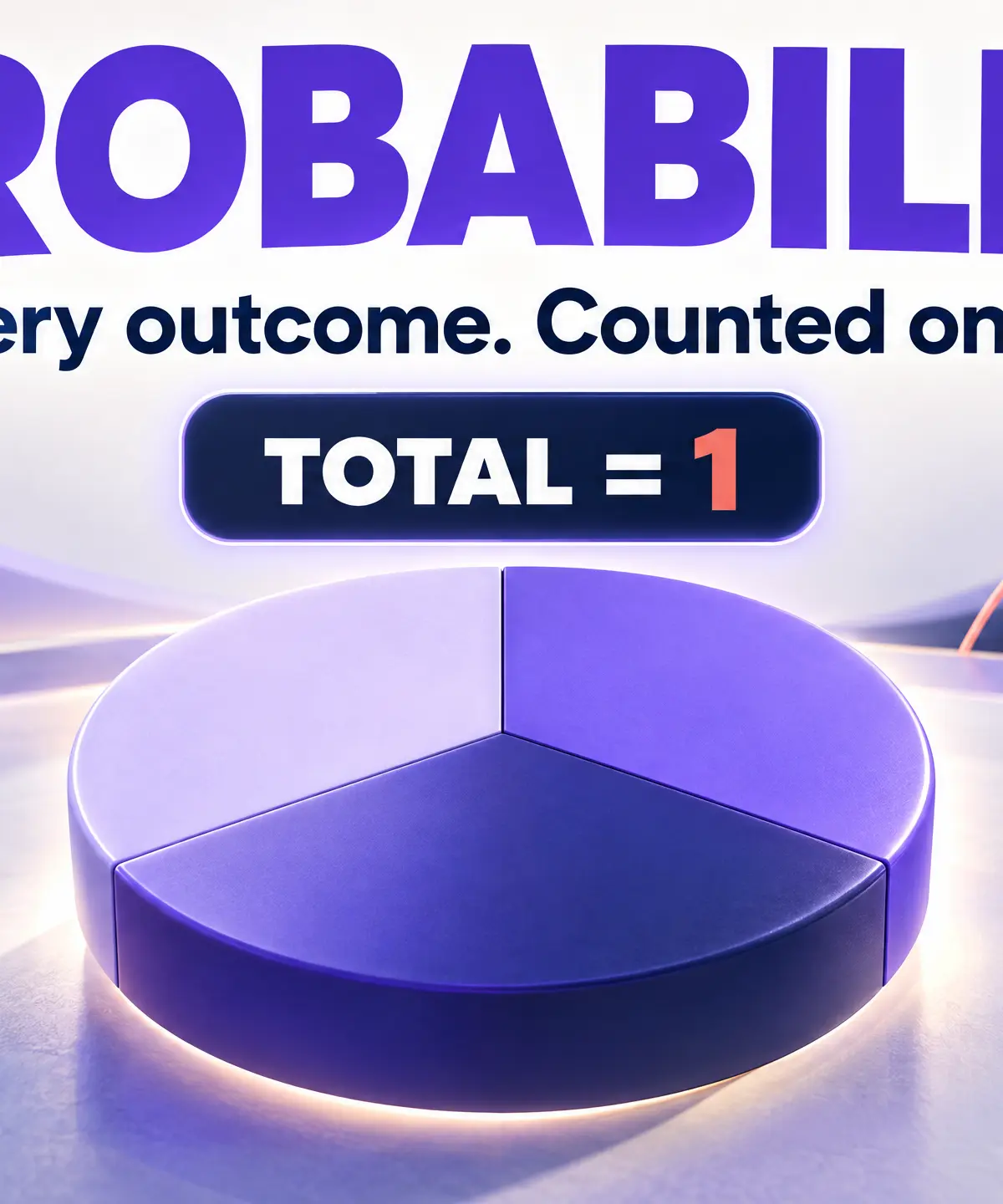
Probability is a number that describes how likely an outcome is: it runs from 0 for impossible to 1 for certain. In Pearson Edexcel GCSE Mathematics 1MA1 P4, you use the fact that the probabilities of all separate, exhaustive elementary outcomes add to 1. That one fact lets you find a missing decimal, fraction or algebraic expression, and it also supports complements such as ‘not red’. P4 is assessed at both Foundation and Higher; linear algebraic missing-probability tables are core for both tiers, so a challenging question is not automatically Higher-only 1 2.
The key is to name precisely what is being added. Individual elementary outcomes in a sample space cannot happen together, so their probabilities can be added. Larger events can overlap, however, and then adding them double-counts shared outcomes. This guide develops the method, explains why it works, and gives original, examiner-style practice rather than Pearson questions. Pearson qualification papers 1, 2 and 3 are each 90 minutes and 80 marks: Paper 1 is non-calculator, while Papers 2 and 3 allow a calculator 1.
Key Concepts
1. Exhaustive outcomes: nothing is missing
An outcome is one possible individual result, such as rolling a 4. A sample space contains every possible outcome under the conditions of the experiment. For a standard six-sided die, the sample space is {1, 2, 3, 4, 5, 6}.
A collection is exhaustive when it covers every possibility. If a bag contains only red, blue and green counters, those three colours are exhaustive. If yellow counters are also present, a list containing only red, blue and green is not exhaustive.
This distinction matters before any calculation. Subtracting the listed probabilities from 1 finds the probability of everything omitted together. It identifies one particular missing colour only when that colour is the only remaining possibility.
Cover and recall: A bag contains red, blue, green and yellow counters. You know the probabilities of red and blue. What does the remainder represent? It represents green or yellow together, not green alone.
2. Mutually exclusive events: no double-counting
Events are mutually exclusive when they cannot occur together on one trial. Taking one red counter and taking one blue counter are mutually exclusive. Taking a red counter and taking a large counter need not be: a counter could be both red and large.
If the categories are both exhaustive and mutually exclusive, exactly one category occurs. Their probabilities therefore add to 1. Remember the complete condition: every possibility, counted once.
Mutually exclusive events do not need to be exhaustive for their probabilities to be added. Exhaustiveness is the extra condition that makes the complete sum equal to 1.
Do not confuse mutually exclusive with independent. Independent means one event occurring does not change the probability of another. Mutually exclusive means they cannot happen together. Two events with positive probabilities that are mutually exclusive are not independent: once one occurs, the other becomes impossible.
3. Missing probabilities: find the remainder
For separate, exhaustive categories, add the known probabilities and subtract their total from 1.
Example: A bag contains only red, blue and green counters. P(red) = 0.20 and P(blue) = 0.45.
Known total = 0.20 + 0.45 = 0.65.
P(green) = 1 − 0.65 = 0.35.
Check: 0.20 + 0.45 + 0.35 = 1.
The subtraction works because green occupies all the probability left after the known colours. Candidates should display the calculation rather than write an unexplained answer. Under a question’s particular mark scheme, correct working may earn method credit even if subsequent arithmetic is incorrect; there is no universal mark awarded simply for writing a sum 4.
For fractions, make the whole compatible with the denominator. If known probabilities are 2/7 and 3/7, the missing probability is 7/7 − 5/7 = 2/7. With percentages, subtract from 100%, not from 1.
4. Equal missing entries: share the remainder
Two blanks do not automatically have equal probabilities. Equality must be stated or established from the information.
Pearson teaching guidance includes an authentic specimen question with red 0.24, yellow 0.32, and equal probabilities for blue and green. The known total is 0.56, leaving 0.44. Blue and green share this equally, so each probability is 0.22. That specimen question was worth 2 marks in total 2. Its official scheme governs the precise credit for a candidate’s response.
A common error is giving each missing colour the whole remainder. That allocates the same probability twice. If three equal entries were missing, the remainder would instead be divided by 3.
Why does this work? The remainder belongs to the missing entries collectively. Only the stated relationship tells you how to distribute it.
5. Complements: the probability of ‘not’
The complement of event A, written A′ or ‘not A’, contains every outcome in the sample space outside A. Either A happens or it does not. These two events are mutually exclusive and exhaustive, so P(A′) = 1 − P(A).
In the three-colour bag, P(red) = 0.20. Therefore P(not red) = 0.80. Not red includes blue and green: 0.45 + 0.35 = 0.80. It does not mean blue alone.
The complement rule is often quicker than adding several other categories. If P(rain) = 0.35, then P(not rain) = 0.65, provided the event refers to the same defined period and conditions.
Cover and recall: Explain why an event and its complement always total 1. Your answer should mention complete coverage and no overlap.
6. Algebraic probability tables
When entries contain a letter, form an equation by setting the total equal to 1. Collect like terms, solve, and substitute the value back into every expression.
For probabilities x, 2x, 0.15 and 0.25:
x + 2x + 0.15 + 0.25 = 1.
3x + 0.40 = 1, so 3x = 0.60 and x = 0.20.
The completed probabilities are 0.20, 0.40, 0.15 and 0.25. They total 1 and all lie within the allowed range.
Do not stop at x if the question asks for an actual probability. An entry such as 2x must be evaluated. A question asking for ‘not B’ then requires the complement of P(B), not the complement of x.
Linear algebraic missing-probability tables belong to both tiers 2. Higher-only extension: conditional probability, P9, is a related but distinct topic and is not required for the P4 practice here 1.
7. Overlap and invalid distributions
On a fair die, ‘even’ is {2, 4, 6} and ‘above 3’ is {4, 5, 6}. They overlap at 4 and 6. Their union contains {2, 4, 5, 6}, so its probability is 4/6 = 2/3, not 1.
An exhaustive collection of overlapping events need not have probabilities that sum to 1. Exhaustiveness alone is insufficient for the simple addition rule.
A total of 1 is also insufficient to prove a table is valid. The entries 0.9, −0.1 and 0.2 total 1, but −0.1 cannot be a probability. Check both the total and every individual value.
Mathematical Relationships
Here P(A) means the probability of event A, A′ means its complement, and ‘A or B’ includes either event or both.
| Relationship | Formula-sheet status | When to use it |
|---|---|---|
| 0 ≤ P(A) ≤ 1 | Must memorise | Check that each probability is valid. |
| P(A₁) + P(A₂) + … + P(Aₙ) = 1 | Must memorise | The categories are exhaustive and mutually exclusive. |
| Missing probability = 1 − known total | Must memorise | Exactly one probability remains unknown. |
| P(A′) = 1 − P(A) | Must memorise | Find the probability that A does not happen. |
| P(A or B) = P(A) + P(B) | Must memorise | A and B are mutually exclusive. |
| Each equal missing entry = (1 − s)/k | Must memorise | k equal entries share the remainder; s is the known total. |
| P(A) = favourable outcomes / total outcomes | Must memorise | Elementary outcomes are equally likely. |
| P(A or B) = P(A) + P(B) − P(A and B) | Given on formula sheet | Confirmed on Pearson’s 2026 Foundation exam aid; removes double-counted overlap 3. |
The general addition formula is printed on the 2026 Foundation sheet. The exhaustive-total and complement rules are not separately printed there. Learn these rules rather than assuming that every probability relationship will be supplied. Formula-sheet statements here are specific to the checked 2026 sheet, not promises about later examination series 3.
Must memorise conversions: decimal p corresponds to 100p%; q% corresponds to q/100. Thus 0.35 = 35% = 7/20, not 0.35%. Separate exhaustive percentages total 100%. Probabilities have no physical units, so do not append cm, kg or seconds.
Practical Applications and Data Skills
Probability tables model spinner colours, game prizes or categories such as pass, rework and reject. First check whether every item receives exactly one category. If an item can be both ‘needs rework’ and ‘rejected’, the categories overlap and cannot be treated as separate parts of a total without adjustment.
Read probability scales from 0 to 1 unless percentages are explicitly used. For probability bar charts, match each bar to its category and read its height against the vertical scale. Separate exhaustive categories have probabilities totalling 1. Distinguish probability heights from frequency counts, which total the number of observations rather than 1.
There is no required practical for this GCSE Mathematics topic 1. Optional repeated counter draws or spinner trials illustrate relative frequency. Experimental proportions need not match theoretical probabilities exactly, especially with few trials. Use observed data when asked to estimate; use the stated model for theoretical calculations.
Exam Technique
Underline the requested event and read every named outcome. ‘Only’ can establish complete coverage; ‘equal’ tells you to share a remainder; ‘not’ signals a complement. Check overlap before adding events.
Pearson’s papers each allow 90 minutes for 80 marks, giving an overall planning average of 67.5 seconds per mark 1. This is not a rigid deadline for each question. Complete direct one-mark parts briskly and preserve time for linked algebra and checking.
For a one-mark ‘give’ part, state the requested value. For a two-mark calculation, show the subtraction and final answer. For longer questions, display the total equation, solution, substitution and requested probability. These are working strategies, not universal official allocations.
Pearson marking guidance generally accepts probability answers as fractions, decimals or percentages 4. Match any explicitly requested form and preserve exact fractions where useful. Odds notation such as 2:3 is not a probability answer. Avoid rounding partway through an algebraic calculation.
Cover and Recall: Audio Revision
Listen to the ten-minute episode: introduction 0:00–1:00, core concepts 1:00–6:00, exam tips 6:00–8:00, recall quiz 8:00–9:00, and recap 9:00–10:00. Pause when prompted and calculate before hearing the answer.
After listening, close the guide and recreate the red, blue and green example. Explain why the colours total 1, then calculate not red in two ways. Tomorrow, solve an algebraic table without looking. Return to it a few days later: retrieval practice is more demanding, and more useful, than simply recognising a familiar worked solution.
References
The worked examples and practice questions are original teaching questions with indicative schemes, not official Pearson questions.
Visual Resources
2 diagrams and illustrations
Interactive Diagrams
2 interactive diagrams to visualise key concepts
Conceptual Flow Outline
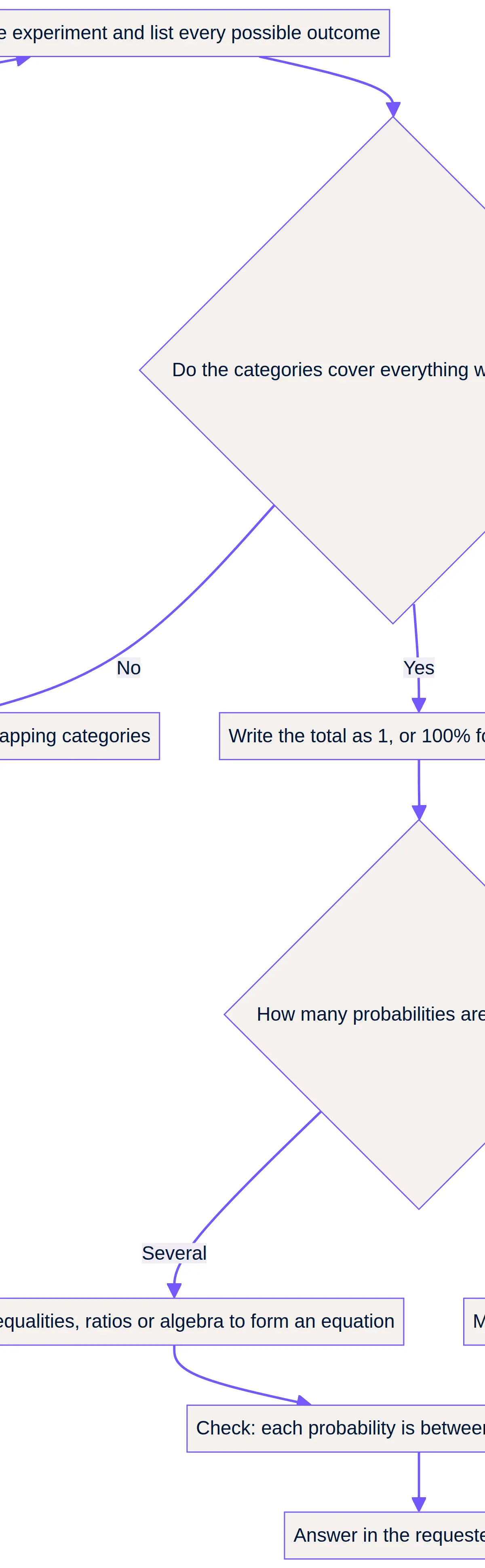
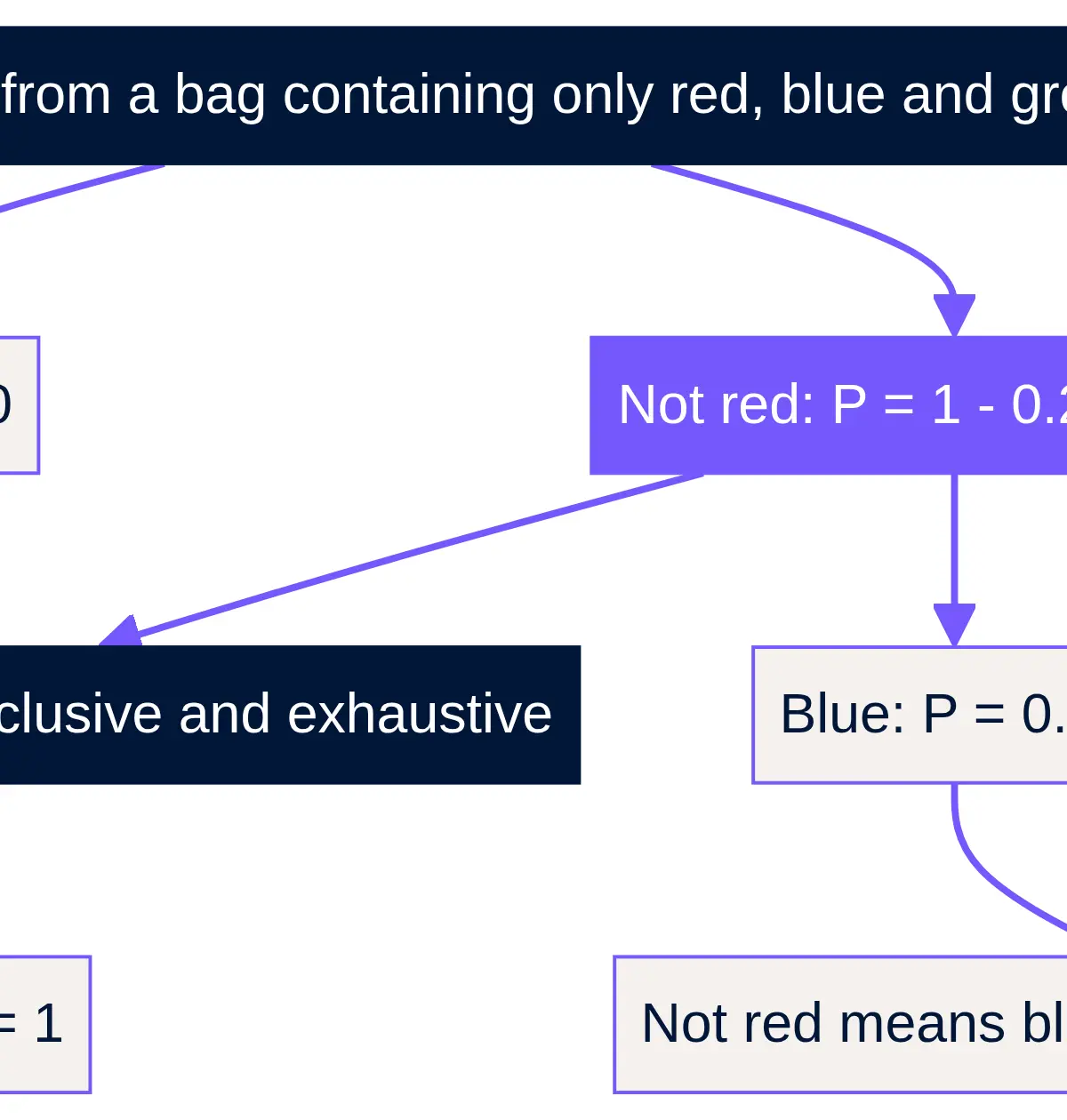
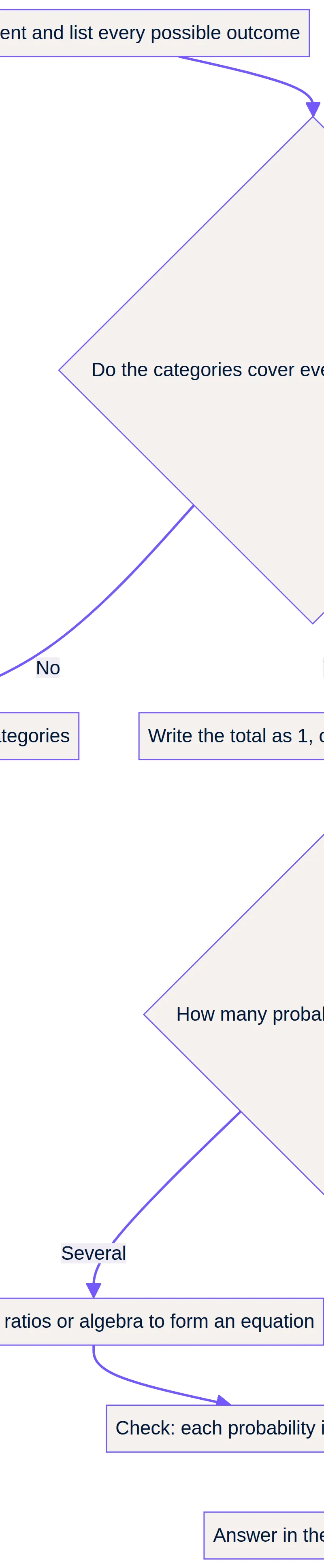
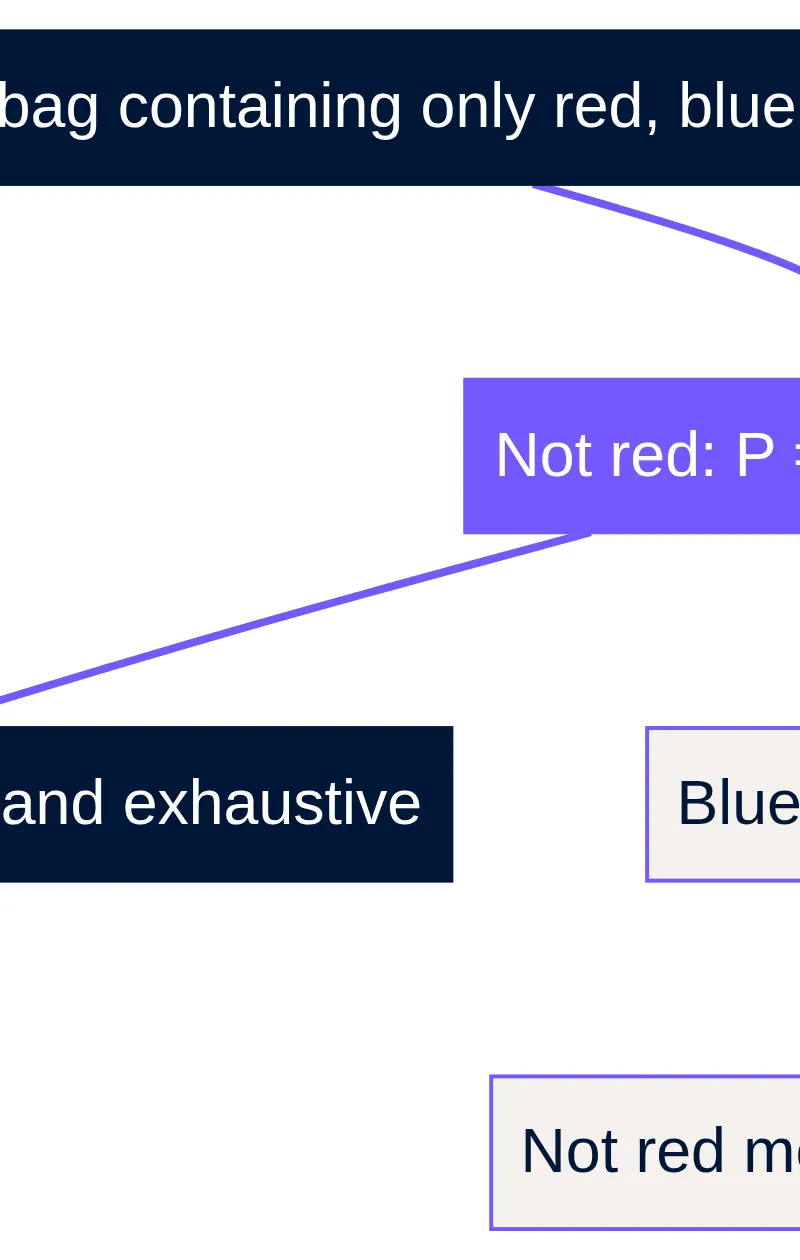
Check complete coverage and absence of overlap before finding a missing probability.
Conceptual Flow Outline
Not red contains blue and green; an event and its complete complement total 1.
Worked Examples
3 worked examples — open one to explore the question and available guidance.
Practice Questions
Try the question, then reveal an answer plan or example response
Original practice, 2 marks: A spinner has only outcomes A, B and C. P(A) = 0.28 and P(B) = 0.41. Work out P(C).
Hint: The three separate outcomes fill the whole probability of 1.
Original practice, 3 marks: A fair six-sided die is rolled. E is ‘even’ and F is ‘above 3’. Work out P(E or F).
Hint: List the outcomes and count shared outcomes only once.
Original practice, 3 marks: One card is chosen from three mutually exclusive types: plain red with probability 0.30, plain blue with probability 0.30, and green-striped with probability 0.40. These are the only types. R is ‘plain red or green-striped’; S is ‘plain blue or green-striped’. Are R and S exhaustive? Are they mutually exclusive? Explain why P(R) + P(S) is not 1.
Hint: Identify the card type shared by both events.
Original practice, 4 marks: Four exhaustive, mutually exclusive outcomes have probabilities 1/5, 3/10, y and y. Work out y and the probability of not the first outcome.
Hint: Find the remainder, share it equally, then calculate the requested complement.
Original practice, 5 marks: An exhaustive, mutually exclusive table gives P(A) = x, P(B) = 2x, P(C) = 0.20 and P(D) = 0.10. Work out x and P(not B).
Hint: Solve the total-1 equation, then substitute into B before taking its complement.
Original practice, 3 marks: A student proposes probabilities x, 0.8 − x and 0.2 for three exhaustive, mutually exclusive outcomes, then sets x = 0.9. The entries total 1. Is this a valid probability distribution? Explain.
Hint: Check every individual entry as well as the total.
Original practice, 4 marks: A prize is small, medium, large or a jackpot. These outcomes are mutually exclusive and exhaustive. P(small) = 18% and P(medium) = 42%. Large and jackpot are equally likely. (a) Work out P(jackpot) [3 marks]. (b) Work out P(not jackpot) [1 mark]. Give both answers as percentages.
Hint: Use a whole of 100%, then share the remainder equally.
Exam technique
How to turn what you know into marks
How to approach the question
Read the requested event. Check complete coverage and overlap. Choose the remainder, complement or overlap-aware addition rule. For algebra, form the total-1 equation, solve and substitute before answering.
How to structure your answer
For a 1-mark part, give the requested value. For a 2-mark missing-probability calculation, show the subtraction and answer. For longer questions, label the equation, algebra, substitution and final probability. Show enough working to establish the method; actual allocations depend on the question’s scheme.
Timing
Each paper has 80 marks in 90 minutes: an overall planning average of 67.5 seconds per mark. Roughly 3–4 minutes for 3 marks and 6–7 minutes for 6 marks are useful guides, not fixed requirements.
Common pitfalls
- Adding overlapping events without removing their shared outcomes.
- Treating not red as blue when other non-red colours are possible.
- Assuming a table is exhaustive despite another outcome named in the question.
- Giving each equal missing entry the entire remainder.
- Complementing x instead of the event probability expressed using x.
- Accepting a negative entry because the complete table totals 1.
- Mixing decimal and percentage scales: use 1 for decimals or fractions, and 100% for percentages.
- Assuming equivalent probability forms lose marks when no particular form is requested.
- Confusing mutually exclusive events with independent events.
What the command words want
- Compare
- Refer to both events or values and identify the precise similarity or difference.
- Explain
- Give a mathematical reason. Use because to connect the conclusion to coverage, overlap or a probability rule.
- Complete
- Fill every requested entry, then check that the finished probability distribution is valid.
- Describe
- Identify the relevant features accurately, such as complete coverage or shared outcomes.
- Evaluate
- Where this wording appears, test totals, individual values and assumptions before reaching a justified conclusion.
- Work out
- Choose an appropriate method, show the calculation and answer the actual event requested.
- Calculate
- Show the calculation or equation and give a clear final probability. Probabilities have no physical units.
- Show that
- Start from the supplied information and display steps leading to the stated result; do not assume the result.
- State/Give
- Provide the requested value or fact directly, using any specified answer form.
Watch or listen (optional)
Test your understanding of Probability: apply the property that the probabilities of an exhaustive set of outcomes sum to one; apply the property that the probabilities of an exhaustive set of mutually exclusive events sum to one
Active recall beats re-reading. Take an instant quiz now to test what you’ve learned and lock it into long-term memory.
7 days Premium · Then the free plan continues · No card, no charge