Pearson Edexcel · GCSE · Mathematics
Course version: 1MA1 · Version from Mar 2026
Probability: calculate and interpret conditional probabilities through representation using expected frequencies with two-way tables, tree diagrams and Venn diagrams (Higher tier only)
One phrase unlocks conditional probability: given that changes the group. Learn to choose the correct denominator in tables, Venn diagrams and trees, then reverse probabilities confidently using worked examples and a 10-minute tutor podcast.
- 13 min read
- 4 worked examples
- 5 practice questions
- 11 key terms
Try the lesson
The start of the Probability: calculate and interpret conditional probabilities through representation using expected frequencies with two-way tables, tree diagrams and Venn diagrams (Higher tier only) lesson, made from checked teaching notes for this specification point.
Have a go first
A two-way table shows that 60 students study French, of whom 24 also study German. A student is chosen at random from those who study French. Work out the probability that this student also studies German.
There is more to this lesson
The full lesson goes on to check your understanding and help you earn the marks. Create a free account to carry on, with your progress saved.
7 days Premium · Then the free plan continues · No card, no charge
Check what you remember
Read the wording for your board, then hide it and explain Conditional probability in your own words. Rough notes are fine. This is a self-check, with no mark or grade.
Reference: Pearson Edexcel
The probability of an event within the sample space restricted by a given positive-probability event: P(A | B)=P(A ∩ B)/P(B).
Study Notes

Overview
Conditional probability asks how likely an event is within a group already identified by another event. If a question says that a chosen student is late, candidates must select only from the late students. The original whole-school total is no longer the denominator. This is the central idea behind Pearson Edexcel GCSE Mathematics Higher-tier specification P9, covering expected frequencies, two-way tables, tree diagrams and Venn diagrams. 1
The topic connects fraction arithmetic with set notation, statistical modelling and independent or dependent events. A table shows counts, a Venn diagram shows overlapping groups, and a tree shows successive choices. All three can represent the same underlying probabilities. Learning to move between them makes unfamiliar exam questions more manageable.
Typical tasks ask candidates to complete a representation, work out a probability given a condition, or reverse a conditional probability using several tree paths. Some also require an explanation or an algebraic unknown. Success depends on identifying the eligible group before calculating, keeping accurate working and interpreting the answer in context. In this guide, original questions have explicit suggested mark allocations; these are teaching schemes, not predictions of an official paper's marking.
Key Concepts
1. The condition creates a new sample space
Write P(A | B) as 'the probability of A given B'. Event B defines the outcomes still eligible for selection. The numerator counts eligible outcomes that also satisfy A. Thus, conditional probability is a fraction of a restricted group, not automatically a fraction of everybody.
For a count-based representation in which each individual is equally likely to be selected, use number satisfying both A and B ÷ number satisfying B. The denominator must be positive. If nobody satisfies B, the usual conditional-probability fraction is undefined because it requires division by zero.
Example: Of 40 club members, 16 are juniors and 6 juniors wear glasses. Given that a randomly chosen member is a junior, the probability they wear glasses is 6/16 = 3/8. The answer 6/40 describes being both junior and wearing glasses without the condition. It answers a different question.
Cover and recall: Which words determine the denominator? Answer before looking: the words following 'given that', or the event after the vertical bar.
2. Expected frequency builds a useful model
Expected frequency is number of trials × probability. It predicts the average count over repeated comparable experiments, not a guaranteed result in one experiment. An expected frequency can be non-integer: 25 trials with probability 0.3 have expected frequency 7.5. Actual observed counts are integers, but theoretical expectations need not be.
To construct an expected-frequency table, first split the overall total into the initial groups. Next apply each group's conditional probability to that group's total. Finally fill complementary cells by subtraction and check the totals. Multiplying every probability by the grand total is wrong when a probability applies only to a subgroup.
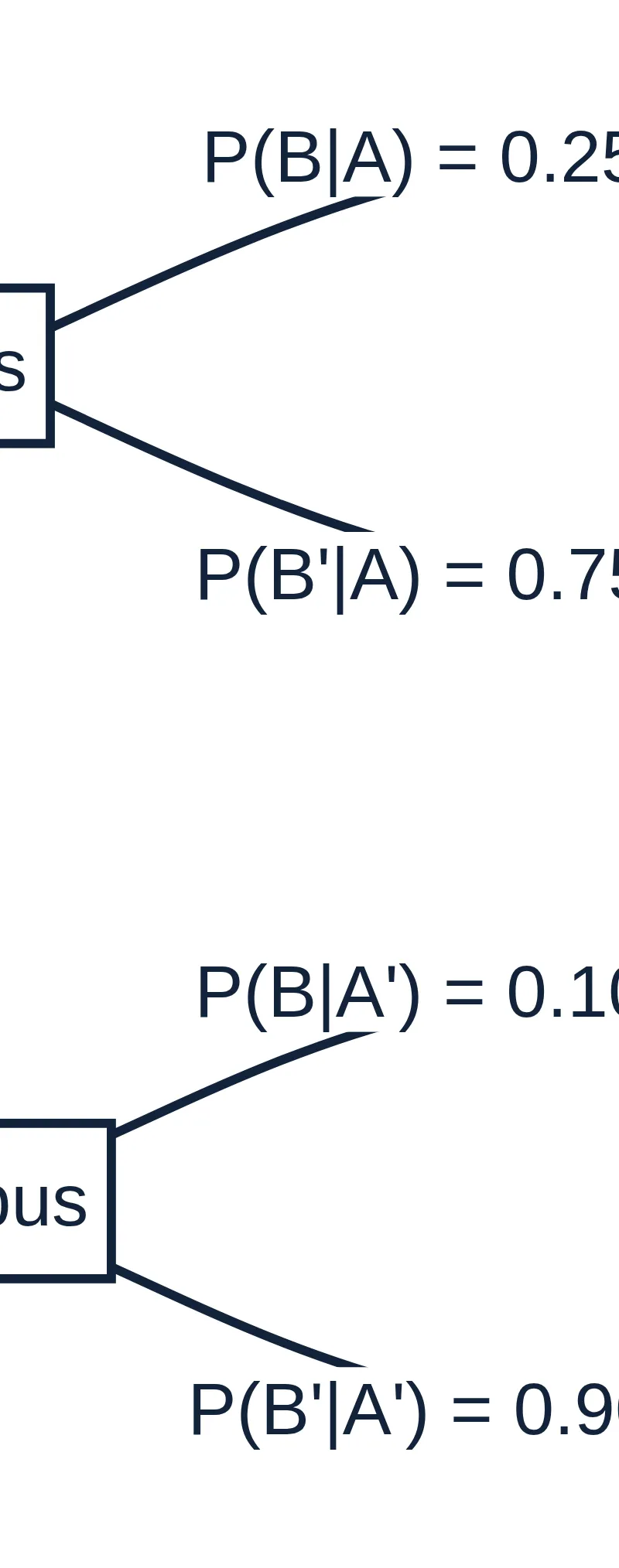
Consider a model of 200 school journeys. Let A mean bus and B mean late. Suppose P(A)=0.6, P(B | A)=0.25 and P(B | A')=0.10. The bus group has expected frequency 200 × 0.6 = 120. Its late count is 120 × 0.25 = 30. The not-bus group has 80 journeys, of which 80 × 0.10 = 8 are expected to be late.
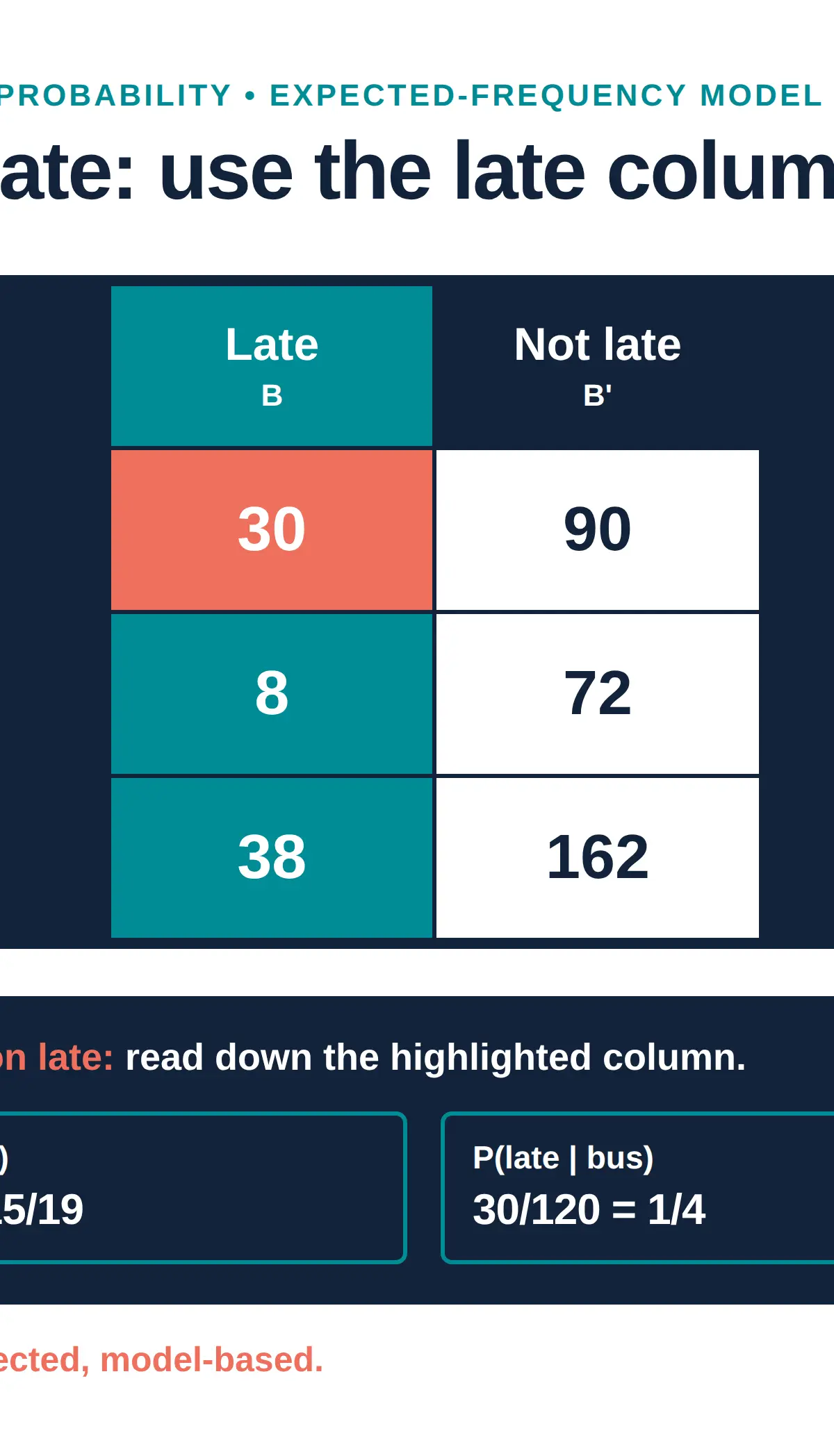
These are expected model counts, not a claim about observed school attendance. Using a convenient notional population makes the probabilities easier to see. The population size cancels when a conditional ratio is formed.
3. Two-way tables: the condition selects a row or column
The completed bus table is:
| Journey | Late B | Not late B' | Total |
|---|---|---|---|
| Bus A | 30 | 90 | 120 |
| Not bus A' | 8 | 72 | 80 |
| Total | 38 | 162 | 200 |
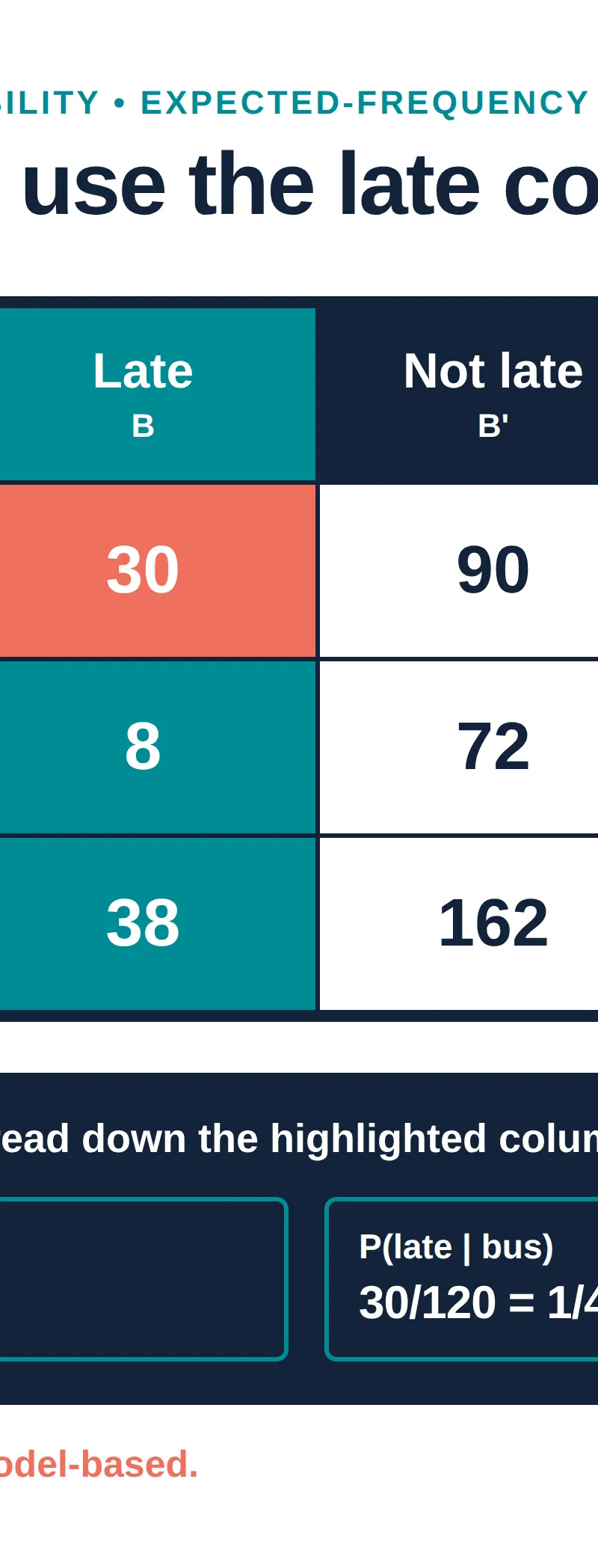
Given late, use the late column: P(A | B)=30/38=15/19. Given bus, use the bus row: P(B | A)=30/120=1/4. The overlap count, 30, is unchanged. The denominator changes because the eligible group changes.
Without a condition, P(A ∩ B)=30/200=0.15. This is the joint probability of bus and late. Do not confuse a joint probability with either conditional probability. Explain the difference in words before reaching for a calculator.
Why does this work? Both conditional ratios compare the same intersection with different totals. Unless those totals happen to match, the answers need not be equal. Probability notation does not allow candidates to swap the events around freely.
4. Venn diagrams: count the whole conditioned region
In a Venn diagram, A ∩ B means the overlap, A ∪ B means A or B or both, and A' means not A. GCSE mathematical 'or' is inclusive unless the question explicitly says 'but not both'.
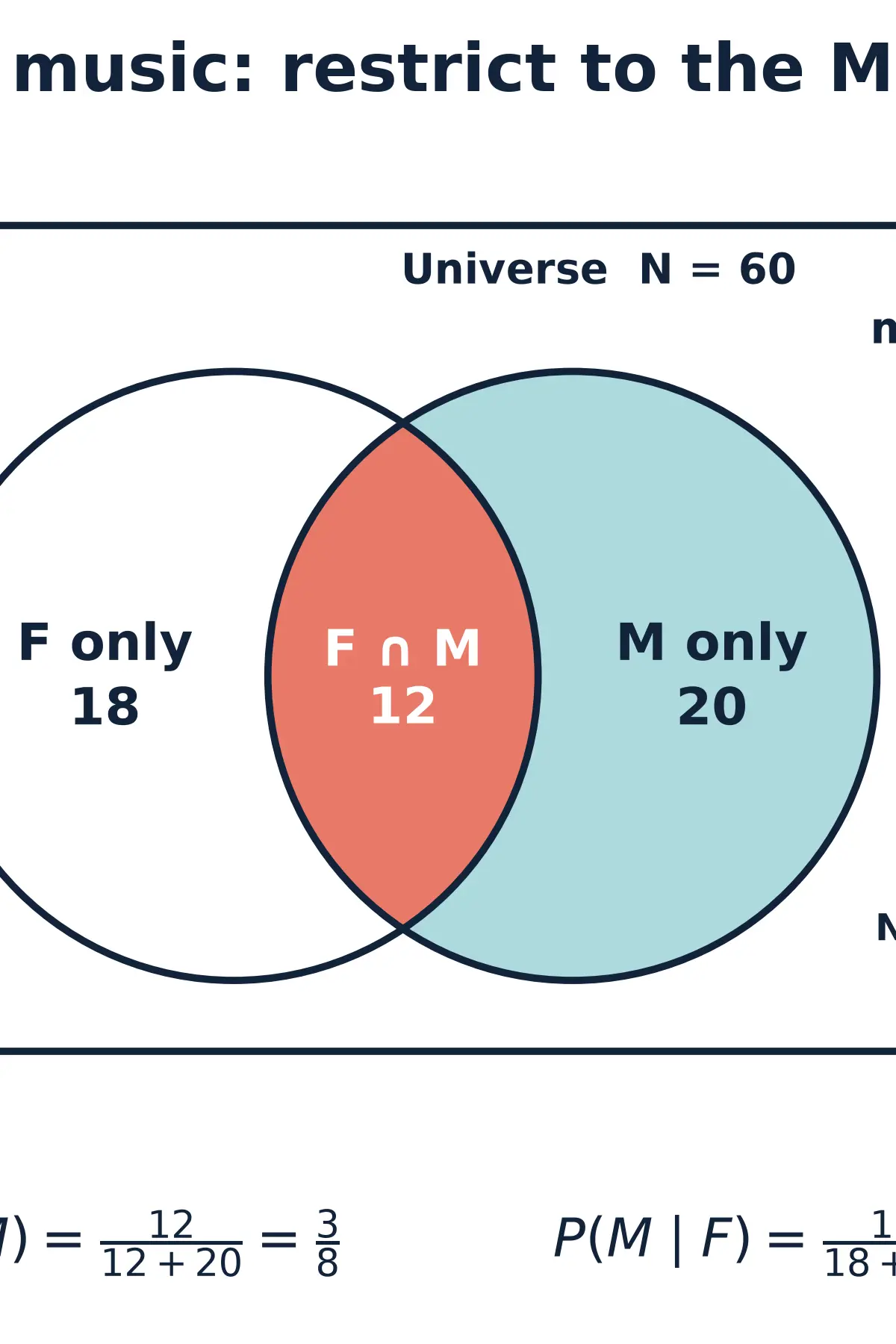
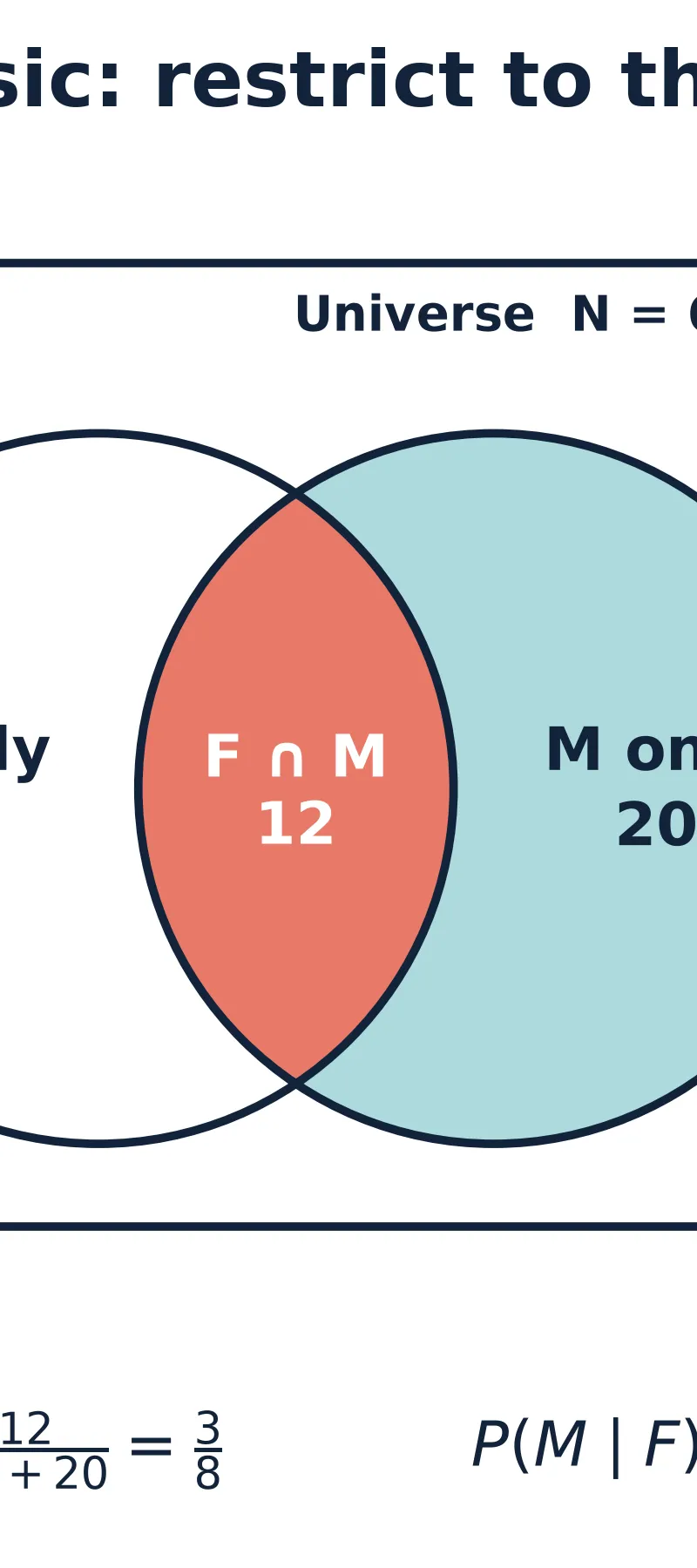
For the 60-student diagram, football only is 18, both football and music is 12, music only is 20, and neither is 10. Given music, the denominator is the whole music circle, 12+20=32. Therefore P(F | M)=12/32=3/8. Given football, use 18+12=30, so P(M | F)=12/30=2/5.
If the condition is 'does at least one activity', the denominator is the union: 18+12+20=50. The probability of both activities within that group is 12/50=6/25. If the condition is 'does not play football', the eligible group includes music only and neither: 20+10=30.
When a question gives whole-circle totals, write the overlap first and subtract it to obtain the 'only' regions. A circle's total is not its exclusive region. For three-set Venn diagrams, sum every disjoint region satisfying the condition, including relevant triple intersections, without double-counting.
5. Trees: branch probabilities are already conditional
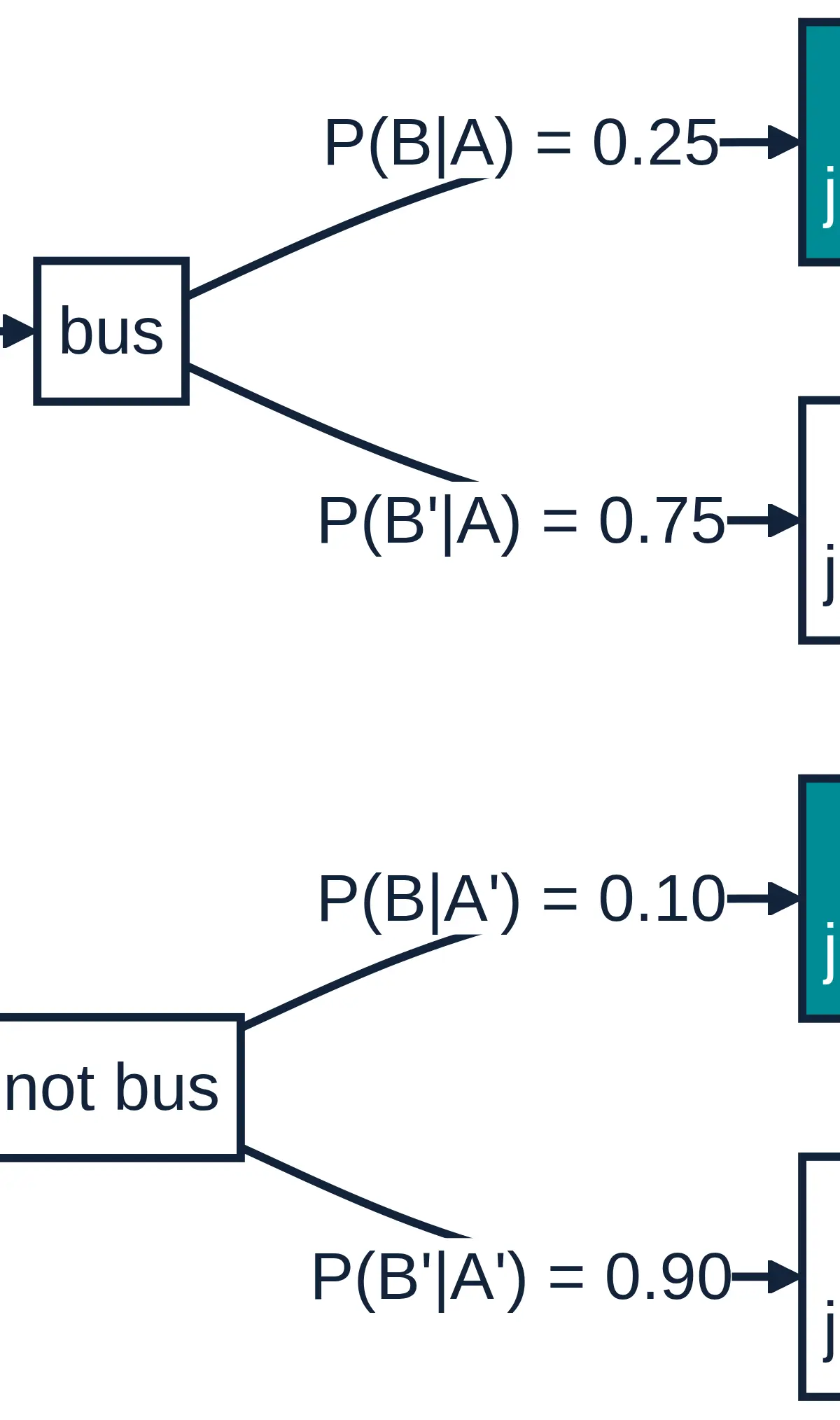
The first stage in our tree splits into bus, 0.6, and not bus, 0.4. The late branch after bus has probability 0.25. It represents P(B | A), because the bus branch has already selected the group. The late branch after not bus represents P(B | A')=0.10.
Multiply along a path to find a joint probability: P(A ∩ B)=0.6 × 0.25=0.15. The other late path has probability 0.4 × 0.10=0.04. Those paths are mutually exclusive: a journey cannot be both bus and not bus. Add them to find P(B)=0.15+0.04=0.19.
Every complete set of outgoing branches from one node must sum to 1. All terminal path probabilities should also sum to 1. These checks catch missing complements or incorrect branch labels, but they do not replace showing the required method.
6. Reverse conditional probabilities: multiply, add, divide
Reading the late branch after bus gives late given bus. Finding bus given late requires combining all the late outcomes first. Use P(A | B)=P(A ∩ B)/P(B)=0.15/0.19=15/19. The second branch 0.25 is not this reversed answer.
A useful method is MAD: Multiply, Add, Divide. Multiply for the required joint path. Add all mutually exclusive paths reaching the given event. Divide the required joint probability by that total. This 'inverse' calculation is a rearrangement of the conditional multiplication relationship, not a new rule to invent.
What if? If the probability of late after not bus increased while the bus group stayed unchanged, the denominator would increase but the bus-and-late numerator would not. Consequently, bus given late would decrease. This interpretation checks whether the arithmetic matches the model.
7. Independence and sampling without replacement
Independence means knowing one event has happened does not change the probability of the other. For positive-probability conditions, P(B | A)=P(B) for independent events. Our bus and late events are not independent: 0.25 ≠ 0.19. Independence is different from mutual exclusivity. Mutually exclusive positive-probability events cannot both happen and are not independent.
Without replacement, a first selection changes what remains. For 5 red and 3 blue counters, after a red counter is removed there are 4 red and 3 blue among 7 counters. After a blue is removed there are 5 red and 2 blue among 7. Use the appropriate updated second-stage fractions. A reversed condition such as 'first red given second blue' still requires the full conditional calculation.
Related combined-event work lies within P8; calculating and interpreting the conditional probabilities here is Higher-only P9. Expected frequencies and reading simpler tables are supporting skills, not all uniquely Higher-tier content. 1
Mathematical/Scientific Relationships
The 2026 Pearson Higher formula sheet supplies P(A or B)=P(A)+P(B)−P(A and B) and P(A and B)=P(A given B)P(B). The standalone conditional quotient is not printed, but follows by rearrangement. The expected-frequency rule is not supplied. 2
| Relationship | Formula | Formula-sheet status |
|---|---|---|
| Expected frequency | E = n × p | Must memorise |
| Relative frequency | observed frequency ÷ number of trials | Must memorise |
| Conditional probability | `P(A | B)=P(A ∩ B)/P(B), P(B)>0` |
| Conditional count ratio | n(A ∩ B)/n(B), n(B)>0 | Must memorise as the count interpretation |
| Conditional multiplication | `P(A ∩ B)=P(A | B)P(B)` |
| Forward tree multiplication | `P(A ∩ B)=P(A)P(B | A)` |
| Total probability for two exhaustive groups | `P(B)=P(A)P(B | A)+P(A')P(B |
| Complement | P(A')=1−P(A) | Must memorise |
| Union | P(A ∪ B)=P(A)+P(B)−P(A ∩ B) | Given on formula sheet |
| Independent events | P(A ∩ B)=P(A)P(B) | Must memorise, with the independence condition |
| Independence check | `P(A | B)=P(A)forP(B)>0` |
| Mutually exclusive alternatives | P(X ∪ Y)=P(X)+P(Y) when P(X ∩ Y)=0 | Given on formula sheet, as the union-rule special case |
Here E is an expected count, n is the trial total and p is a probability. n(A) denotes the number in set A, not the probability of A. Probabilities are dimensionless. Convert 25% to 0.25 before multiplication; convert a probability to a percentage by multiplying by 100. Do not attach centimetres, seconds or 'people' to a probability answer. Expected frequencies can be described as expected people or trials. Later examination series should use their own current insert rather than assume the 2026 layout is unchanged.
Practical Applications
Expected frequencies make quality-control and screening models easier to understand. Suppose 10 of 1,000 items are faulty, and an imperfect check flags 9 faulty items and 99 non-faulty items. Among flagged items, the faulty proportion is 9/(9+99)=1/12. A check catching most faulty items does not imply most flagged items are faulty. The denominator must include all flagged items.
There is no required practical for this GCSE Mathematics topic. An optional counter experiment can compare observed relative frequencies with model predictions. Differences in a small sample do not automatically invalidate the probability model; random variation is expected.
For data skills, read table headings, totals and mutually exclusive Venn regions carefully. Trees are structured diagrams, not coordinate graphs: branch length does not encode probability. Venn-circle area is not a substitute for the printed counts. No special coordinate plotting or physical-unit conversion is required here.
Examiner Focus and Active Revision
An authentic released example is June 2025, 1MA1/3H, Question 18(b): hot chocolate given coffee. Its answer is 47/67, with M1 for identifying a valid numerator or denominator under that question's marking instructions and A1 for the correct probability. The examiner report identifies using 100 instead of the restricted coffee total 67 as a common error. This exact two-mark allocation belongs to that item; the original 3–6-mark exercises below use explicitly suggested teaching schemes. 3 4 5
Each Pearson paper lasts 90 minutes and carries 80 marks, giving a whole-paper average of 1.125 minutes per mark. Aim for about 3–4 minutes on 3 marks and 6–7 minutes on 6 marks, then return to unfinished work. Paper 1 is non-calculator; Papers 2 and 3 permit calculators. There is no fixed mark allocation or guaranteed position for this topic. 1
For active revision, cover a solution and reconstruct the eligible group before any arithmetic. Draw the bus table from memory, then build its tree without looking. Explain why both produce the same answer. Revisit a fresh question tomorrow and again after a week. Change the condition in an answered question and predict whether its denominator, numerator or both will change.
Listen and Recall
The 10-minute female-voiced tutor episode follows: introduction 0:00–1:00; core concepts 1:00–6:00; exam tips 6:00–8:00; recall quiz 8:00–9:00; summary 9:00–10:00. Try answering the quiz before the tutor reveals each answer. The full transcript is supplied in podcast_script.
References
Visual Resources
3 diagrams and illustrations
Interactive Diagrams
2 interactive diagrams to visualise key concepts
Conceptual Flow Outline
The two late paths have joint probabilities 0.15 and 0.04. Add them to obtain P(late)=0.19, then divide 0.15 by 0.19 for bus given late.
Conceptual Flow Outline
The same restricted-sample-space method applies to tables, Venn diagrams and reverse tree questions.
Worked Examples
4 worked examples — open one to explore the question and available guidance.
Practice Questions
Try the question, then reveal an answer plan or example response
Original practice question. A model assigns probability 0.35 to an outcome. Work out its expected frequency in 320 trials.
Hint: Convert the probability into a predicted count by multiplying by the number of trials.
Original practice question. A two-way table has cells: A and B = 16; A and not B = 24; not A and B = 9; neither = 51. A person is selected at random. Work out P(A | B) and P(B | A), then explain why the answers differ.
Hint: Find the B total and the A total separately.
Original practice question. A Venn diagram for 80 people has A only = 24, both A and B = 16, B only = 20 and neither = 20. Work out (a) P(A | B') and (b) P(A ∪ B).
Hint: Not B includes A only and neither. The union excludes neither.
Original practice question. Factory A makes 70% of a company's products; factory B makes the rest. A product from A has probability 0.02 of being faulty; a product from B has probability 0.05 of being faulty. Given that a randomly chosen product is faulty, work out the probability that it came from A.
Hint: Find the two faulty path products before forming the conditional fraction.
Original practice question. P(A)=x, P(B | A)=0.8 and P(B | A')=0.2. It is known that P(A | B)=0.6. Work out x, giving an exact fraction.
Hint: Write the joint numerator as 0.8x and the full B denominator as 0.8x+0.2(1−x).
Exam technique
How to turn what you know into marks
How to approach the question
Underline the condition and rewrite it as a named eligible group. Decide whether the representation uses observed counts, expected model counts or probabilities. Identify the intersection numerator. In a reverse tree question, calculate every path ending in the given event before dividing. Check complements, totals and the context.
How to structure your answer
For a short conditional question, show the conditioned total and the numerator-over-total fraction. For a multi-step expected-frequency question, show subgroup totals before applying conditional probabilities. For a reverse-tree question, write joint products, their denominator total, the conditional division and the final answer on separate lines. Our original exercises have suggested schemes; official M, A and B marks depend on the published item-specific instructions. Keep exact fractions unless a specified rounding instruction requires otherwise.
Timing
Pearson GCSE Mathematics papers are each 90 minutes for 80 marks: a whole-paper average of 1.125 minutes per mark. A useful target is 3–4 minutes for 3 marks, 4–5 for 4, 5–6 for 5 and 6–7 for 6. This is a pacing guide, not a board-prescribed time limit per question.
Common pitfalls
- Using the grand total: replace it with the total satisfying the condition.
- Reversing P(A | B) and P(B | A): read the event after the bar first.
- Stopping at a joint path product: divide by the total probability of the given event.
- Adding conditional branch probabilities directly: weight each branch by its first-stage probability before summing paths.
- Double-counting a Venn intersection: sum disjoint regions once each.
- Treating without-replacement draws as independent: update both the relevant numerator and the remaining total.
- Rounding intermediate decimals: retain exact fractions or calculator values until the final line.
- Calling an expected count a guaranteed observed count: interpret it as an average prediction under the model.
What the command words want
- Compare
- Compute the relevant probabilities on a common basis and state the comparison. Equal intersection numerators do not imply equal conditional probabilities.
- Explain
- Give a mathematical reason tied to the condition, for example: only music students are eligible, so the denominator is 32. Use because when it clarifies the reasoning.
- Describe
- Describe the specified mathematical pattern or feature accurately. Do not replace a calculation with general prose.
- Evaluate
- For a mathematical expression, work out its numerical value. If evaluating a claim or model, test it with calculations and state a justified conclusion; a generic both-sides essay is not the default mathematics response.
- Work out
- Show a clear calculation and final answer. Name intermediate path probabilities or totals when needed for a conditional result.
- Calculate
- Show the formula or ratio, substitute the relevant values and evaluate. Probabilities have no physical units; expected frequencies are expected counts.
- Show that
- Demonstrate the stated result from the given information with a complete chain of working. Do not simply copy the answer supplied in the question.
- State/Give
- Supply the requested mathematical result. A probability may be a fraction, decimal or percentage; follow any requested form. A sentence or explanation is needed only if requested.
Watch or listen (optional)
Test your understanding of Probability: calculate and interpret conditional probabilities through representation using expected frequencies with two-way tables, tree diagrams and Venn diagrams (Higher tier only)
Active recall beats re-reading. Take an instant quiz now to test what you’ve learned and lock it into long-term memory.
7 days Premium · Then the free plan continues · No card, no charge