Pearson Edexcel · GCSE · Mathematics
Course version: 1MA1 · Version from Mar 2026
Ratio, proportion and rates of change: change freely between related standard units (e.g. time, length, area, volume/capacity, mass) and compound units (e.g. speed, rates of pay, prices, density, pressure) in numerical and algebraic contexts
The same journey can be described as 15 m/s or 54 km/h, and knowing why can protect several exam marks. Master standard units, squared and cubed factors, and compound rates so that speed, shopping, wages, density and pressure questions become a sequence of reliable decisions rather than guesses.
- 12 min read
- 5 worked examples
- 8 practice questions
- 10 key terms
Try the lesson
The start of the Ratio, proportion and rates of change: change freely between related standard units (e.g. time, length, area, volume/capacity, mass) and compound units (e.g. speed, rates of pay, prices, density, pressure) in numerical and algebraic contexts lesson, made from checked teaching notes for this specification point.
Have a go first
Convert 2.4 kilograms into grams.
There is more to this lesson
The full lesson goes on to check your understanding and help you earn the marks. Create a free account to carry on, with your progress saved.
7 days Premium · Then the free plan continues · No card, no charge
Check what you remember
Read the wording for your board, then hide it and explain Standard unit in your own words. Rough notes are fine. This is a self-check, with no mark or grade.
Reference: Pearson Edexcel
A recognised unit used to measure a quantity, such as metre for length, kilogram for mass or second for time.
Study Notes
Overview
A unit conversion describes the same quantity using a different measuring unit. A runner travelling at 15 m/s is also travelling at 54 km/h: the runner has not accelerated, but the numerical description has changed. Learning to control these changes protects marks in questions about journeys, shopping, wages, containers, density and pressure.
For Pearson Edexcel GCSE Mathematics 1MA1, R1, candidates must change between related standard and compound units in numerical and algebraic contexts. This connects directly to R11 compound measures, ratio, direct proportion, formula rearrangement and geometry. R1 applies to both Foundation and Higher; using a letter does not automatically make a conversion Higher-only. 1
Typical questions ask candidates to change, work out, calculate, show that or justify a comparison. Some test one conversion; others hide it inside a longer calculation. Credit may be given for a correct method even if later arithmetic is wrong, according to the individual mark scheme. 3
Your routine is Predict, Convert, Check. Predict whether a standalone numerical value should increase or decrease, write the conversion equation, calculate, then check that the answer and its unit describe the original quantity. Use the worked examples before attempting the practice questions without looking.
Key Concepts
1. Standard units: change the description, not the quantity
Start with an equality such as 1 m = 100 cm. Because each metre contains 100 centimetres, multiply a measurement in metres by 100 to express it in centimetres. Reverse the process by dividing by 100. For example, 2.4 m = 240 cm, while 750 cm = 7.5 m.
For a fixed positive length, mass or volume, moving to a smaller unit makes the numerical value larger. This is a checking rule, not a replacement for the calculation. It does not transfer blindly to compound units because their denominators matter.
Must memorise: 1 km = 1000 m; 1 m = 100 cm = 1000 mm; 1 cm = 10 mm; 1 tonne = 1000 kg; 1 kg = 1000 g; 1 g = 1000 mg; £1 = 100 pence. Write tonne rather than the ambiguous word ton. When a question needs a metric-to-imperial conversion, Pearson guidance says the necessary conversion is supplied. 2
Cover and recall: convert 0.08 kg to grams. Predict first, then calculate. The answer is 80 g, not 0.00008 g.
2. Area: square the length conversion factor
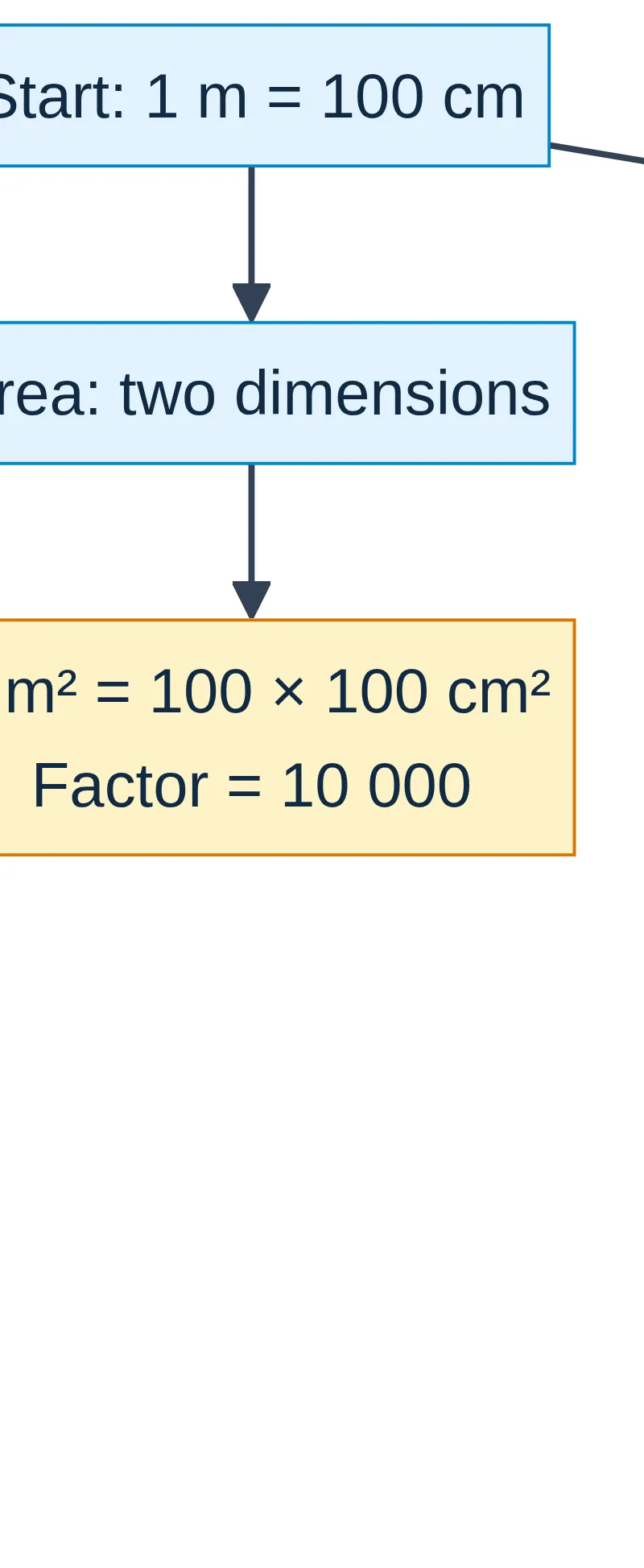
A square measuring 1 m by 1 m measures 100 cm by 100 cm. Its area is therefore 100 × 100 = 10 000 cm². The number 100 appears twice because area has two dimensions. Thus 1 m² = 10 000 cm², not 100 cm².
If a length conversion multiplies by k, the corresponding area conversion multiplies by k². For cm to mm, k = 10, so 1 cm² = 100 mm². For m to mm, k = 1000, so 1 m² = 1 000 000 mm².
Example: 1.2 m² = 1.2 × 10 000 = 12 000 cm². In reverse, 450 cm² = 450 ÷ 10 000 = 0.045 m². Convert the complete area once; do not square the measurement 1.2. It is the conversion factor that is squared.
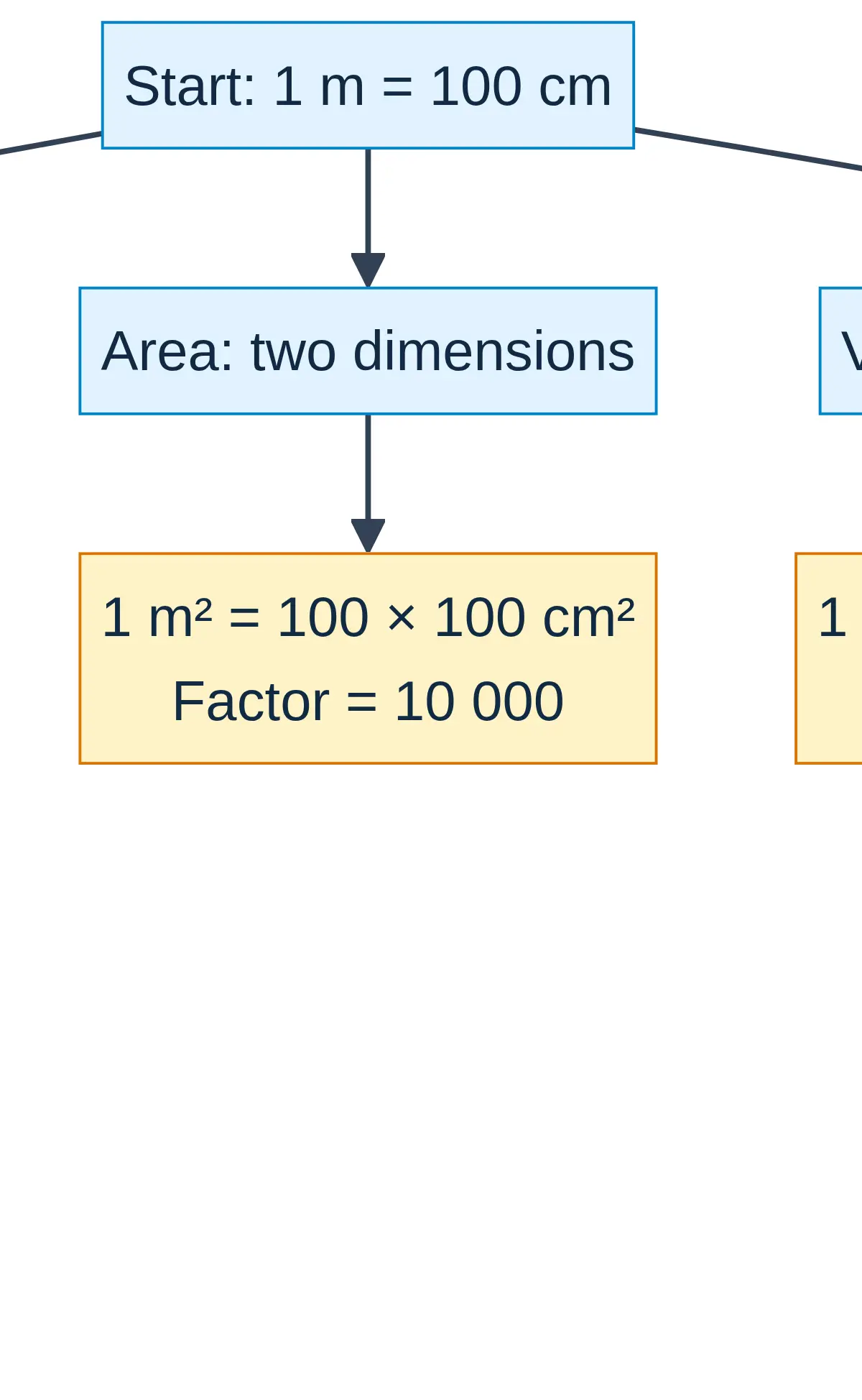
Why does this work? Both side measurements change their numerical description, so their product contains two conversion factors. This is the same multiplication structure encountered in similar-shape area problems.
3. Volume and capacity: cube the factor, then choose the right bridge
A cube with 1 m edges has 100 cm edges. Its volume is 100 × 100 × 100 = 1 000 000 cm³. Volume has three dimensions, so its factor is k³. Hence 1 m³ = 1 000 000 cm³; 1 cm³ = 1000 mm³; 1 m³ = 1 000 000 000 mm³.
Capacity measures how much a container can hold. The exact bridges are 1 cm³ = 1 ml, 1000 cm³ = 1 litre, 1 litre = 1000 ml and 1 m³ = 1000 litres. Notice that cubic metres to cubic centimetres uses a million, but cubic metres to litres uses a thousand.
Example: 0.002 m³ = 2000 cm³ = 2000 ml = 2 litres. The intermediate units explain why the two conversion factors differ. Do not assume every conversion involving a cube symbol uses the same multiplier.
If calculating a container's volume from mixed dimensions, first put every length into the same unit. A tank measuring 0.5 m × 20 cm × 30 cm becomes 50 cm × 20 cm × 30 cm, giving 30 000 cm³ = 30 litres. Multiplying 0.5 × 20 × 30 without conversion mixes incompatible units.
4. Time: decimal hours are not clock notation
Must memorise: 1 minute = 60 seconds; 1 hour = 60 minutes = 3600 seconds; 1 day = 24 hours. Time is not a base-ten conversion chain.
To change minutes to hours, divide by 60. Therefore 1 hour 45 minutes = 1 + 45/60 = 1.75 hours, not 1.45 hours. In the reverse direction, 2.4 hours = 2 hours + 0.4 × 60 minutes = 2 hours 24 minutes.
Example: travelling 105 km in 1 hour 45 minutes gives average speed 105 ÷ 1.75 = 60 km/h. The denominator is the total time in hours. Using 1.45 would produce a plausible-looking but incorrect rate.
What if? A journey includes a stop. For average speed over the whole journey, include the stop in total time unless the question specifically asks about moving time.
5. Compound units: the word per means divide
Speed, pay, unit price, density and pressure are ratios. Read their units as operations: km/h means kilometres divided by hours; g/cm³ means grams divided by cubic centimetres. If both units change, both parts of the ratio must be treated consistently.
A reliable method is to take a sample amount over a sample denominator, convert each, then divide. If the numerator's numerical conversion factor is a and the denominator's is b, the rate's numerical factor is a/b. This explains why converting a denominator can reverse your first instinct.
For £12/hour to pence/minute, the numerator becomes 1200 pence and the denominator becomes 60 minutes. Therefore 1200 ÷ 60 = 20 pence/minute. The amount earned in one hour remains £12.
For unit prices, use the same mass or capacity unit before comparing. A 400 g packet costing £2.40 has unit price 240 ÷ 400 = 0.6 pence/g, equivalent to £6/kg. A smaller packet is not necessarily better value just because its total price is lower.
6. Speed: understand the 3.6, including with algebra
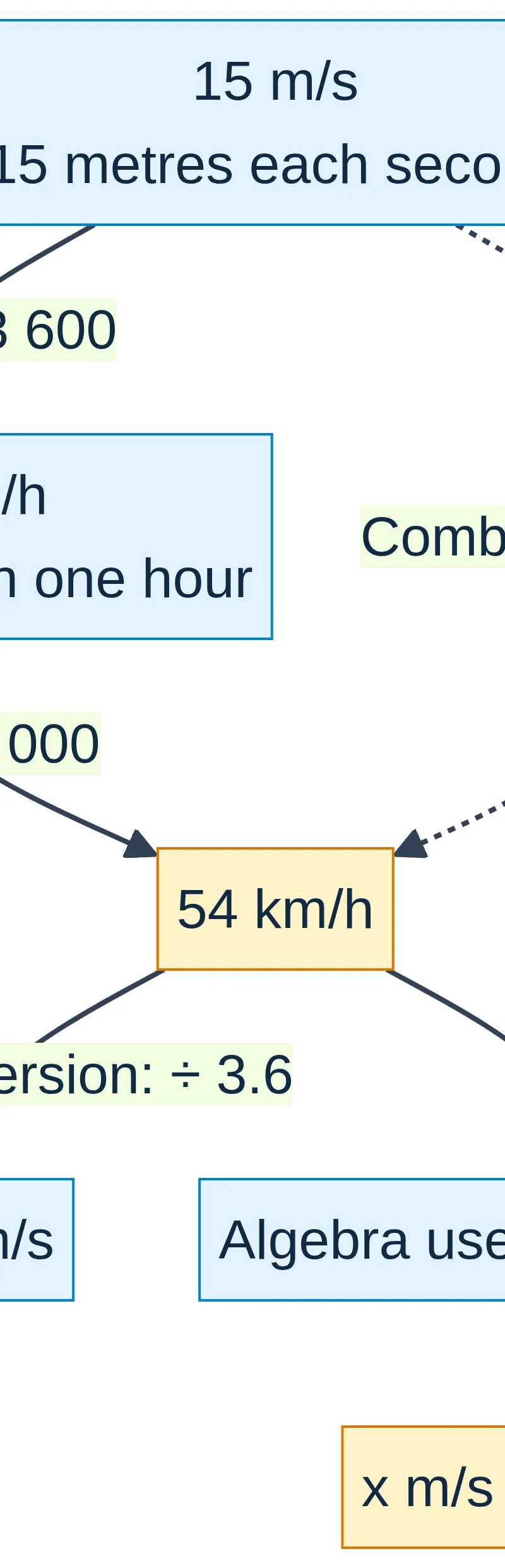
In one hour there are 3600 seconds. At 15 m/s, the distance covered in that hour is 15 × 3600 = 54 000 m. Divide by 1000 to express that distance in kilometres: 54 km/h. The combined multiplier is 3600/1000 = 3.6.
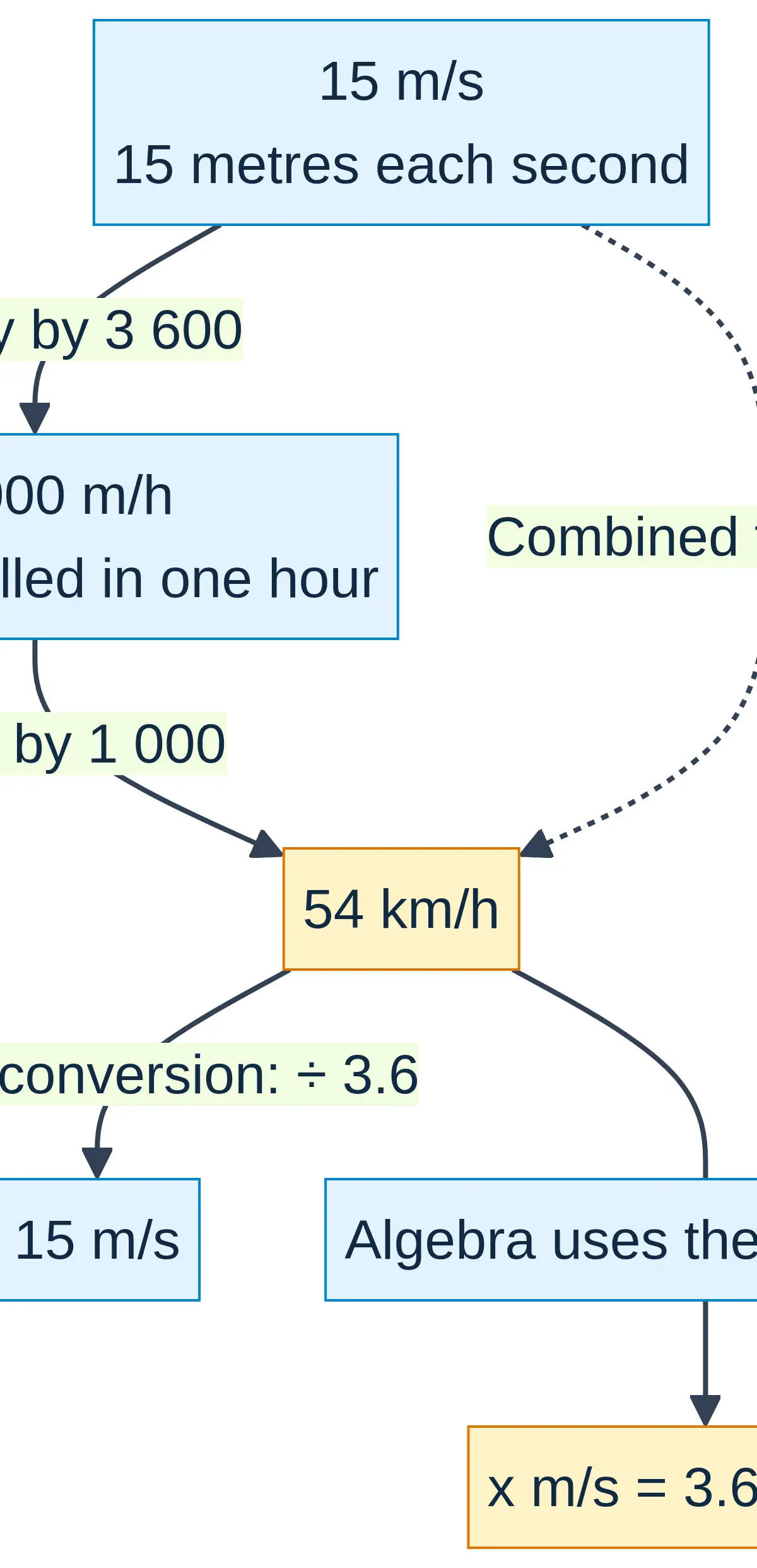
Therefore m/s to km/h means multiply by 3.6; km/h to m/s means divide by 3.6. Pearson's teaching guidance includes changing 72 km/h into m/s as a 3-mark sample question. 2 The calculation is 72 × 1000 ÷ 3600 = 20 m/s.
Letters obey the same rules: x m/s = 3.6x km/h, and y km/h = y/3.6 m/s. Keep the variable; do not invent a numerical value for it. This is a direct-proportion relationship, with zero speed corresponding to zero in either unit.
7. Density and pressure: watch the powered denominator
Density = mass ÷ volume. For 2.7 g/cm³, one cubic metre contains 1 000 000 cm³, so its mass is 2.7 × 1 000 000 g = 2700 kg. Thus 1 g/cm³ = 1000 kg/m³. Reverse this by dividing by 1000. Converting only grams to kilograms misses the much larger change in the volume unit.
Algebra example: an object has mass x kg and volume 0.002 m³. In g and cm³, these are 1000x g and 2000 cm³. Its density is 1000x/2000 = 0.5x g/cm³, an algebraic context explicitly illustrated in Pearson guidance. 2
Pressure = force ÷ area. Its units can be N/cm² or N/m². Because 1 m² contains 10 000 cm², 1 N/cm² = 10 000 N/m². A force of 240 N on 80 cm² gives 3 N/cm² = 30 000 N/m². Alternatively, convert 80 cm² to 0.008 m² and calculate 240 ÷ 0.008. These routes must agree. One pascal, Pa, is 1 N/m²; 1 kPa = 1000 Pa.
Mathematical/Scientific Relationships
Formula status below is checked against Pearson's 2026 Foundation and Higher formula sheets. Speed, density, pressure and conversion factors are not printed there. Learn them rather than assuming the insert supplies everything. Check the insert for your actual examination series. 4 5 6
Must memorise: new standalone value = old value × conversion factor; area factor = k²; volume factor = k³; new rate = old rate × a/b. Here k converts a length, while a and b convert the numerator and denominator respectively. Reverse a conversion by using the reciprocal factor.
Must memorise: v = d/t, d = vt, t = d/v, where v is speed, d distance and t time. For a journey, average speed = total distance/total time, not usually the mean of segment speeds.
Must memorise: ρ = m/V, m = ρV, V = m/ρ, where ρ is density, m mass and V volume. Also p = F/A, F = pA, A = F/p, where p is pressure, F force and A contact area.
Must memorise: pay rate = total pay/time; total pay = rate × time; time = total pay/rate. Unit price = cost/quantity; cost = unit price × quantity; quantity = cost/unit price. The chosen units must match throughout.
Must memorise: rectangle area A = lw; cuboid volume V = lwh; rate as a straight-line gradient = change in vertical quantity/change in horizontal quantity. Here l, w and h are compatible lengths. Given on formula sheet: volume of a prism = cross-sectional area × length. The cuboid formula is a rectangular-prism application, but is not separately printed. 4 5
Graph/Data Skills
For a conversion graph, label both axes with quantities and units, choose readable equal scales and plot accurately. A metres-to-centimetres graph obeys c = 100m and passes through the origin. A m/s-to-km/h graph obeys y = 3.6x. Its gradient is 3.6 only when the vertical axis is km/h and the horizontal axis is m/s; reversing the axes gives 1/3.6.
On a distance–time graph, gradient means speed. Calculate change in distance divided by change in time, and read the axis units before converting. A rise of 0.6 km over 2 minutes gives 0.3 km/min = 18 km/h. A horizontal segment means stationary. Measuring acceleration from a tangent to a curved speed–time graph is a Higher-only linked extension, not a requirement for the basic R1 conversions here. 1
Practical Applications and Retrieval
Use conversions to check recipe quantities, compare supermarket prices, calculate wages, estimate a water tank's capacity and interpret material density. GCSE Mathematics has no required practical for this topic. A measuring-cylinder demonstration can help learning, but is not an assessed required practical.
For practice, set aside about one minute per mark, then check the answer independently. Pearson papers allow 90 minutes for 80 marks, an overall average of 1.125 minutes per mark; pacing near one minute leaves checking time. 1 Our original questions use illustrative teaching mark schemes, not official Pearson allocations. Official method and accuracy conventions inform the commentary. A unit may already be printed beside the answer line, and a separate unit mark is not universal. 3
Listen once, then answer the audio quiz aloud before hearing each solution.
Podcast chapters: 00:00 introduction; 01:00 core concepts; 06:00 exam tips; 08:00 quick-fire recall; 09:00 summary; 10:00 end. After listening, cover the guide and reconstruct the area, volume and speed factors. Repeat tomorrow and again a few days later, checking your answers only after a genuine attempt.
References
Worked Examples
5 worked examples — open one to explore the question and available guidance.
Practice Questions
Try the question, then reveal an answer plan or example response
Work out (a) 2.4 kg in grams and (b) 0.6 m in millimetres. Explain why each numerical answer is larger than the original number. Original question, 3 marks.
Hint: Write 1 kg = 1000 g and 1 m = 1000 mm before calculating.
Change 4.8 m² into cm². Explain why the factor is 10 000 rather than 100. Original question, 3 marks.
Hint: Picture a one-metre square and express both sides in centimetres.
A car travels 84 km in 1 hour 45 minutes. Calculate its average speed in km/h and then in m/s, giving the latter to 3 significant figures. Original question, 4 marks.
Hint: Convert the complete journey time to hours; then use the inverse of 3.6.
Packet A contains 750 g and costs £3.60. Packet B contains 1.2 kg and costs £5.52. Work out both prices in £/kg and explain which packet offers better value. State the difference in £/kg. Original question, 5 marks.
Hint: Convert 750 g to kilograms before dividing cost by mass.
A worker earns £13.20 per hour at a constant rate. (a) Change this to pence per minute. (2 marks.) (b) Calculate the pay for 2 hours 25 minutes. (2 marks.) Original question.
Hint: Convert both pounds to pence and hours to minutes for part (a).
A block exerts a force of 240 N on an area of 80 cm². Calculate the pressure in N/cm² and in N/m². Original question, 4 marks.
Hint: First calculate force/area. Then use the squared area conversion in the denominator.
A liquid has mass 1.8 kg and occupies 1500 cm³. Calculate its density in g/cm³ and in kg/m³. Original question, 4 marks.
Hint: Convert the mass for the first density and the volume for the second.
A cyclist travels at x m/s. (a) Write the speed in km/h. (1 mark.) (b) A second cyclist travels at (x + 2) m/s. Write this speed in km/h as an expanded expression. (1 mark.) (c) The second cyclist travels at 43.2 km/h. Work out x. (2 marks.) Original question.
Hint: Apply the speed factor to the entire bracket, then form an equation.
Exam technique
How to turn what you know into marks
How to approach the question
Underline the starting unit, requested unit and command word. Identify length, area, volume or a compound rate. Write the relevant equalities. Make every quantity compatible before calculating, keep full accuracy until the end, then test your answer by reversing the conversion or checking a sample quantity.
How to structure your answer
For 1 mark, provide the requested value or expression. For 2–3 marks, show the factor and calculation. For 4–6 marks, use a clear chain with named intermediate values, compatible units and a final result answering every part. Official schemes distinguish M method, P process, A accuracy, B independent accuracy and C communication marks; not every question uses all types. Our practice allocations are illustrative. Include units unless preprinted; a separate unit mark is not universal.
Timing
Each 1MA1 paper has 80 marks and lasts 90 minutes: 1.125 minutes per mark overall. Aim at about 1 minute per mark for these questions, approximately 3 minutes for 3 marks, 4 for 4 and 6 for 6, leaving checking time. This is a revision pacing guide, not an official question time limit.
Common pitfalls
- Using ×100 for m² to cm²: use ×100² = ×10 000.
- Using ×1000 for m³ to cm³: use ×100³ = ×1 000 000; ×1000 applies to m³ to litres.
- Writing 1 h 45 min as 1.45 h: write 1 + 45/60 = 1.75 h.
- Converting only one part of a compound unit: convert a sample numerator and denominator, then divide.
- Using the smaller-unit direction rule for all rates: denominator changes can reverse the effect.
- Comparing packet costs rather than unit prices: make both quantities the same unit first.
- Rounding midway through a rate calculation: retain the calculator value until the final answer.
- Averaging two speeds without considering journey distances or times: use total distance/total time.
What the command words want
- Compare
- Use matching units and state the relevant comparison, supported by calculated rates. A list of unrelated similarities and differences is not required for a unit-price comparison.
- Explain
- Support the statement with a mathematical reason, for example 'because both side lengths are multiplied by 100, the area factor is 100²'.
- Describe
- Describe the mathematical feature or relationship precisely, for example 'a straight line through the origin'. This is less typical than 'work out' for R1.
- Evaluate
- In Mathematics, evaluate normally means find the value of an expression. It does not mean debate both sides as it might in an essay subject.
- Calculate
- Use the correct relationship, show compatible conversions and give the requested answer with units and rounding.
- Show that
- Start with the given information and show a complete logical route to the stated result; do not merely copy it.
- State/Give
- Provide the requested value, unit or expression concisely. If working is requested, include it even when the command starts with 'Give'.
- Work out/Change
- Carry out the calculation or conversion and show the numerical route when the question has several marks.
Watch or listen (optional)
Test your understanding of Ratio, proportion and rates of change: change freely between related standard units (e.g. time, length, area, volume/capacity, mass) and compound units (e.g. speed, rates of pay, prices, density, pressure) in numerical and algebraic contexts
Active recall beats re-reading. Take an instant quiz now to test what you’ve learned and lock it into long-term memory.
7 days Premium · Then the free plan continues · No card, no charge