Pearson Edexcel · GCSE · Mathematics
Course version: 1MA1 · Version from Mar 2026
Ratio, proportion and rates of change: define percentage as ‘number of parts per hundred’; interpret percentages and percentage changes as a fraction or a decimal, and interpret these multiplicatively; express one quantity as a percentage of another; compare two quantities using percentages; work with percentages greater than 100%; solve problems involving percentage change, including percentage increase/decrease and original value problems, and simple interest including in financial mathematics
A sale price, a pay rise and a savings balance all become easier once you identify the original 100%. Master percentage multipliers, reverse percentages and simple interest, then practise showing the methods and comparisons that earn GCSE Mathematics marks.
- 13 min read
- 4 worked examples
- 7 practice questions
- 12 key terms
Try the lesson
The start of the Ratio, proportion and rates of change: define percentage as ‘number of parts per hundred’; interpret percentages and percentage changes as a fraction or a decimal, and interpret these multiplicatively; express one quantity as a percentage of another; compare two quantities using percentages; work with percentages greater than 100%; solve problems involving percentage change, including percentage increase/decrease and original value problems, and simple interest including in financial mathematics lesson, made from checked teaching notes for this specification point.
Have a go first
Write 45% as a decimal. Select the correct answer.
There is more to this lesson
The full lesson goes on to check your understanding and help you earn the marks. Create a free account to carry on, with your progress saved.
7 days Premium · Then the free plan continues · No card, no charge
Check what you remember
Read the wording for your board, then hide it and explain Percentage in your own words. Rough notes are fine. This is a self-check, with no mark or grade.
Reference: Pearson Edexcel
A number of parts per hundred; p% is equivalent to p/100.
Study Notes

Overview
Percentages let you compare quantities fairly, calculate discounts and pay rises, and decide what a savings account really earns. A percentage describes a number of parts per hundred, but its most useful examination role is as a multiplier. Once you identify which quantity represents 100%, a long-looking money problem often becomes one short calculation.
This guide covers Pearson Edexcel GCSE Mathematics 1MA1, R9, within ratio, proportion and rates of change. All the core skills here are assessed at both Foundation and Higher tier, including reverse percentages and simple interest. They connect to fractions, decimals, ratio, algebra and interpreting real-life data. None of the core sections is Higher-only. 1
Candidates may be asked to work out a percentage, compare two changes, calculate a new price, recover an original value, or distinguish interest earned from the final balance. Questions may require a written reason as well as arithmetic. The worked examples and practice questions below are original Edexcel-style teaching questions with indicative mark schemes, not official Pearson examination items. Use them actively: cover the solutions, attempt the calculation, then check both your answer and your choice of baseline.
Key Concepts
1. Percentage means parts per hundred
The symbol % means 'per hundred'. Therefore 23% = 23/100 = 0.23. A hundred-square helps: shading 23 equal squares represents 23% of the whole. The whole does not have to contain exactly 100 objects; percentages rescale any total into hundredths.
To change a percentage into a decimal, divide the percentage number by 100. To change a decimal into a percentage, multiply by 100 and include %. Thus 0.4 = 40%, while 0.04 = 4%. To convert a fraction, divide its numerator by its denominator: 3/8 = 0.375 = 37.5%. Simplify percentage fractions when appropriate: 35% = 35/100 = 7/20.
Percentages can exceed 100%. For example, 130% = 1.3 means one whole plus three tenths of another. However, a probability cannot exceed 100%, and a category cannot exceed 100% of a whole of which it is genuinely a part.
Cover and recall: convert 7%, 0.7 and 7/20 into decimals or percentages without checking the preceding paragraph. Explain why 7% and 0.7 are not equal.
2. Finding a percentage of an amount
In this context, 'of' means multiply. To find p% of x, calculate x × p/100. For example, 15% of £80 is £80 × 0.15 = £12.00. This gives the percentage amount, not a new price after an increase.
On the non-calculator paper, build awkward percentages from easy ones. Ten per cent of 80 is 8; five per cent is half of that, 4; therefore fifteen per cent is 12. Fifty per cent is half, twenty-five per cent is a quarter, and one per cent is one hundredth. These methods also provide quick estimates on calculator papers.
For percentages over 100%, apply the same rule: 234% of 150 = 2.34 × 150 = 351. Pearson's official sample materials include this as Paper 3F Question 9, worth 2 marks, demonstrating that percentages above 100% are Foundation content. 2
Examiner focus: candidates should make the intended multiplication clear. A plausible estimate protects against a misplaced decimal point: 234% of 150 must exceed 300 because it is more than twice 150.
3. Expressing one quantity as a percentage of another
Use the order stated in the question: required quantity ÷ comparison quantity × 100%. If 18 of 40 candidates cycle to school, the percentage is 18/40 × 100% = 45%. The denominator is the whole group.
Order matters. Expressing 60 as a percentage of 40 gives 150%; expressing 40 as a percentage of 60 gives approximately 66.7%. These are different questions, not contradictory answers. Ask, 'What is being treated as 100%?'
Quantities must have matching units before division. Express 45 minutes as a percentage of 2 hours by converting 2 hours to 120 minutes: 45/120 × 100% = 37.5%. Dividing 45 by 2 mixes minutes and hours and cannot produce the intended comparison.
Why does this work? Dividing finds the proportion of the reference quantity. Multiplying by 100 expresses that proportion as parts per hundred.
4. Increasing and decreasing with a multiplier
An increase of 15% leaves 100% + 15% = 115% of the original, so the multiplier is 1.15. A decrease of 15% leaves 85%, so the multiplier is 0.85. Hence £80 increased by 15% becomes £80 × 1.15 = £92.00; decreased by 15%, it becomes £80 × 0.85 = £68.00.
Be precise about 'of' and 'increase by'. 130% of £80 is £104.00, but increase £80 by 130% means 230% of £80, which is £184.00. A 100% increase doubles the original; 200% of the original also doubles it. A 200% increase triples it.
For ordinary positive prices, an increase multiplier exceeds 1 and a decrease multiplier lies between 0 and 1. An answer that breaks this size check needs attention. A 100% decrease gives zero; the original cannot then be recovered from zero alone.
Examiner focus: credit may be given for a correct method or process even if arithmetic goes wrong, subject to the question's specific mark scheme. Write the multiplier and the calculation rather than only a calculator display. 3
5. Percentage change and fair comparisons
First find the actual change. Then divide by the original value and multiply by 100%. A price rising from £40 to £50 increases by £10, so the percentage increase is 10/40 × 100% = 25%. The denominator is not £50.
For a decrease, use original minus new to obtain the positive size of the decrease. A fall from £50 to £40 is 10/50 × 100% = 20%. Therefore reversing a journey changes the percentage, because it changes the starting baseline.
Compare changes using each quantity's own original value. Shop A's sales rise from 80 to 100, a 25% increase. Shop B's sales rise from 200 to 240, a 20% increase. Shop B adds more sales, but Shop A has the larger percentage increase. A full comparison names the winner and quotes the calculated percentages.
A change from 40% to 50% is 10 percentage points, but the relative percentage increase is 10/40 × 100% = 25%. Percentage points are subtraction between percentages; relative percentage change still requires the original denominator.
6. Original values: reverse percentages
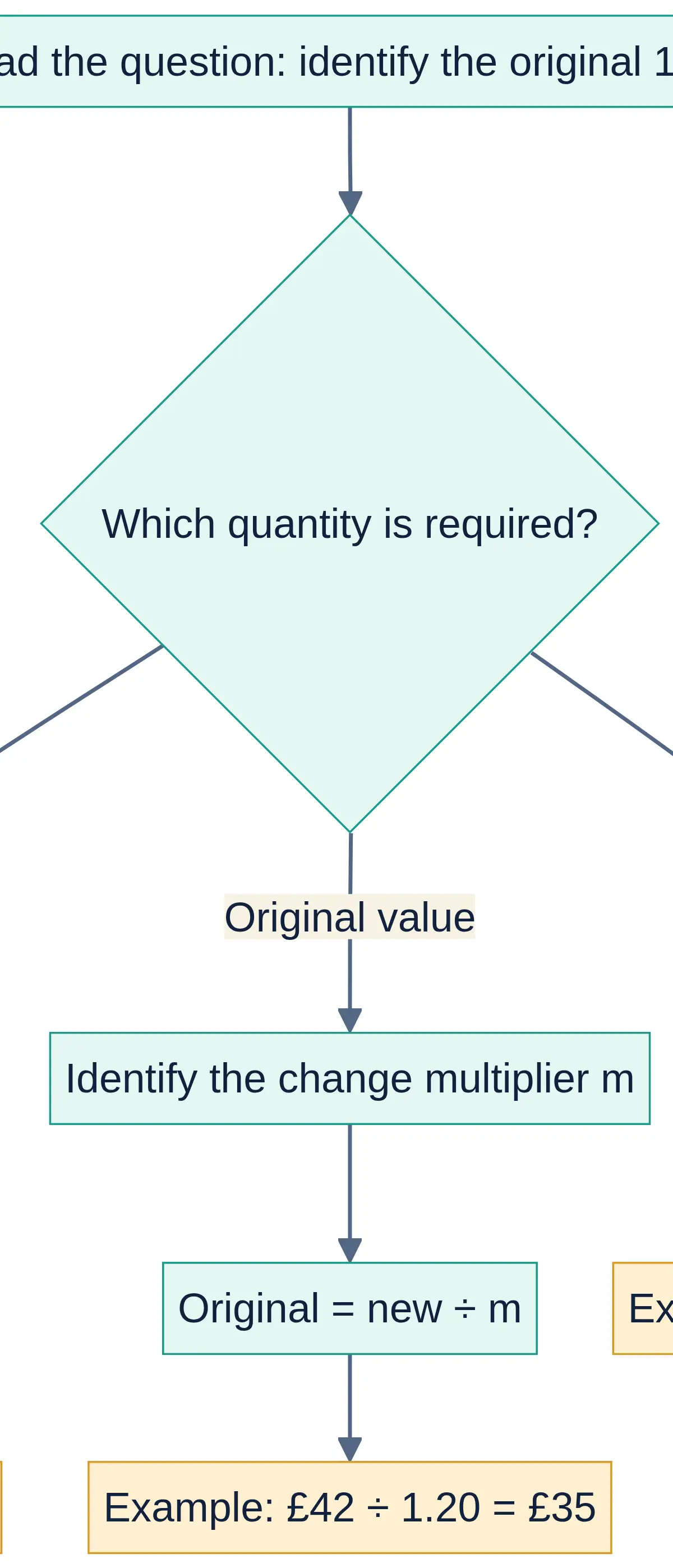
A final value after a change does not usually represent 100%. If a price is £42 after a 20% increase, £42 represents 120% of the original. Write original × 1.20 = 42, then undo multiplication with division: original = 42/1.20 = £35.00.
After a 20% discount, a £56 sale price represents 80% of the original. Therefore original = 56/0.80 = £70.00. Check forward: £70 × 0.80 = £56. A discounted original must exceed the sale price; an original before a rise must be less than the final price.
Do not subtract 20% from £42 to reverse a 20% increase. That subtracts 20% of the wrong baseline and gives £33.60. The equation explains the safe rule: forward, multiply; backward, divide.
Also distinguish the final price from the amount of the change. If a coat's price is reduced by £15, and this reduction is 20%, then £15 represents 20%, not 80%. Its original price is 15/0.20 = £75.00. Highlight whether the given amount is the saving or the sale price.
7. Successive percentage changes
Each change applies to the amount available at that stage unless the question states otherwise. A £100 item increased by 10% becomes £110; a subsequent 10% decrease gives £110 × 0.90 = £99.00. Combined multiplier: 1.10 × 0.90 = 0.99. Overall, this is a 1% decrease, not no change.
Two discounts of 20% and 10% give 0.80 × 0.90 = 0.72, equivalent to a 28% discount, not 30%. Multiply the multipliers; do not add the percentages. Successive numerical calculations are useful on both tiers. 4
The order of two fixed multipliers does not affect the final product if neither stage involves rounding or an extra fixed charge. However, individual changes and intermediate values can differ. Keep unrounded intermediate values unless the question explicitly requires rounding at each transaction.
What if? How much must £99 increase to return to £100? The required rise is 1/99 × 100%, approximately 1.01%, not exactly 1%.
8. Simple interest: the same interest each year
Simple interest is calculated on the original principal throughout. If £500 earns 4% simple interest per year, annual interest is £500 × 0.04 = £20.00. In three years it earns £60.00, and the final balance is £560.00.
The word 'simple' matters. Compound interest is calculated on a changing balance, so later interest includes interest on earlier interest. Do not use a compound-interest formula for a simple-interest question. Conversely, a description saying interest is paid on each year's updated balance indicates compounding.
Match time to the rate. For an annual rate, 18 months is 1.5 years, provided the question applies simple interest proportionally over that period. With £600 at 5% per annum for 18 months, interest is 600 × 0.05 × 1.5 = £45.00, so the total is £645.00.
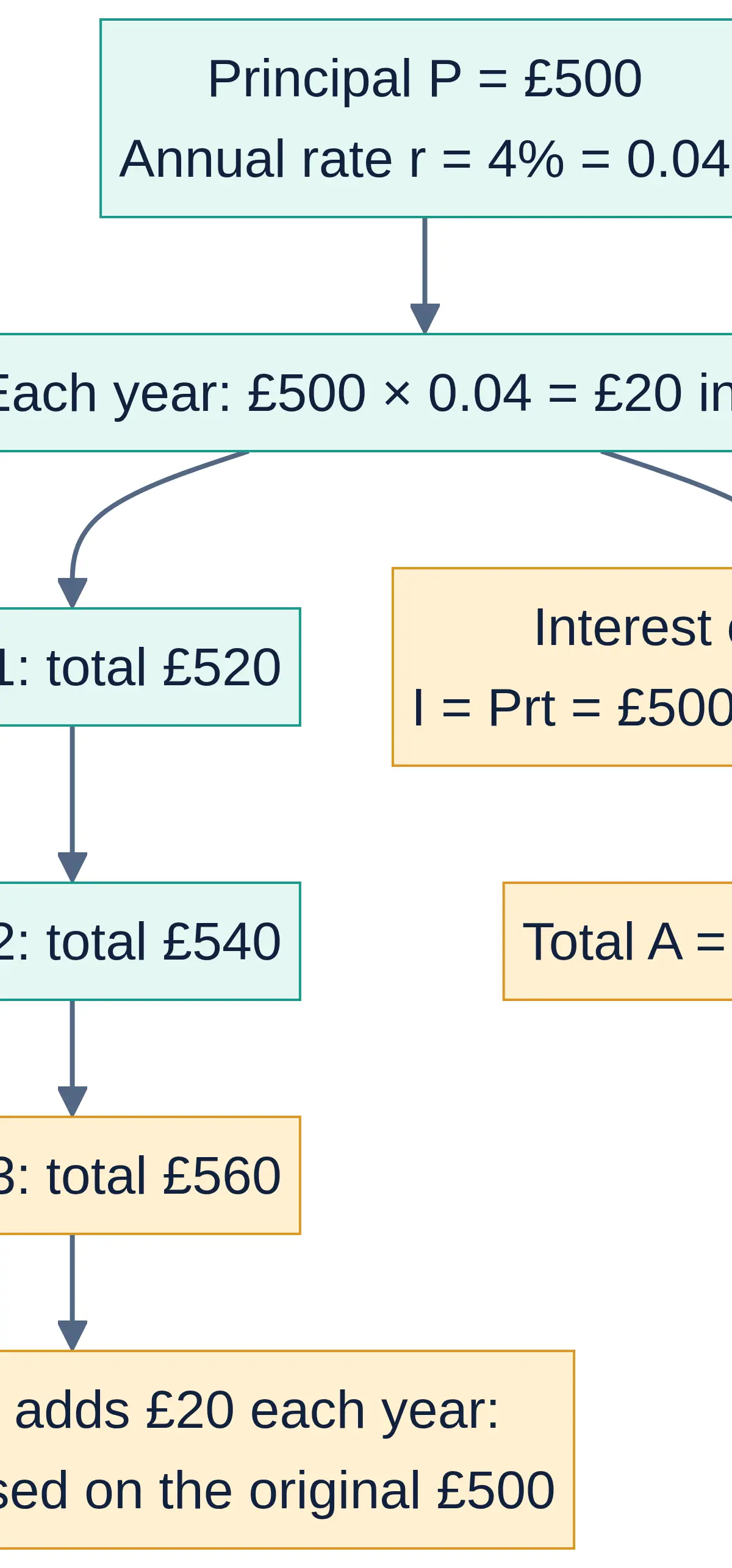
Examiner focus: answer the quantity requested. 'Interest earned' asks for £60, while 'total amount' asks for £560. Labels are useful even where a currency unit is already printed on the answer line.
Mathematical Relationships
Here p is a percentage number, such as 15, while r is a decimal rate, such as 0.15. O is the original amount, N the new amount, m the multiplier, P the principal, I the interest, A the final balance and t the number of years for an annual rate.
Must memorise: p% = p/100; percentage of x = x × p/100; a as a percentage of b = (a/b) × 100%. The reference b must be non-zero.
Must memorise: increase multiplier m = 1 + p/100; decrease multiplier m = 1 - p/100; N = Om; O = N/m, provided m is non-zero. Percentage increase = ((N - O)/O) × 100%; percentage decrease = ((O - N)/O) × 100%, for the usual positive original quantities.
Must memorise: combined multiplier = m1 × m2 × ...; overall percentage change = (combined multiplier - 1) × 100%, with a negative result indicating decrease. Percentage-point change = new percentage number - original percentage number.
Must memorise: simple interest I = Prt; total A = P + I = P(1 + rt). If using the percentage number p rather than decimal r, use I = Ppt/100. Annual interest = Pr. Rearrangements include P = I/(rt), r = I/(Pt), and t = I/(Pr), when their denominators are non-zero.
Given on formula sheet, related-topic comparison only: compound-interest total A = P(1 + p/100)^n, where p is the percentage rate per compounding period and n is the number of periods. Pearson's 2026 Foundation and Higher aids include this compound-interest formula, but not the percentage or simple-interest relationships above. This does not make compound interest the correct method for simple interest. Check the aid for your examination series. 5 6
Graph and Data Skills
Simple-interest balances follow A = P + Prt. Plot time in years horizontally and balance in pounds vertically. For £500 at 4%, points are (0, 500), (1, 520), (2, 540), (3, 560). They lie on a straight line with vertical intercept £500 and gradient £20 per year. An interest-only graph instead starts at zero.
Choose an even scale, label axes with units and read coordinates carefully. To recover the annual percentage rate from the balance gradient, calculate gradient/principal × 100%. For example, £20/£500 × 100% = 4%. A simple-interest graph does not generally pass through the origin; the interest-only graph does.
Practical Applications and Unit Checks
Discounts, profit, pay rises, tax calculations and savings all use percentage baselines. In a simplified exam scenario, a price including 20% VAT is 1.20 times the pre-tax price, so £96 including VAT corresponds to £80 before VAT. Profit percentage normally uses cost price as the baseline when the question asks for profit as a percentage of cost; follow any different wording explicitly.
Remember £1 = 100p, 1 hour = 60 minutes, and 1 year = 12 months. Convert £2.40 to 240p before comparing with 180p. Express final money to the nearest penny unless instructed otherwise, and follow requested decimal places or significant figures for percentages. There is no required practical for this mathematics topic.
Ten-Minute Tutor Podcast
Listen once, then replay the quiz without looking at the answers. Pause whenever you need more thinking time. Structure: 00:00 introduction; 01:00 core concepts; 06:00 exam tips; 08:00 recall quiz; 09:00 summary.
Revision That Earns Marks
Read one concept, cover it, and write its rule from memory. Then attempt a question before revealing the model answer. After checking, explain the error in one sentence and try a fresh example. Revisit the retrieval cues tomorrow and again several days later; recognise a method from the question wording, not from the position of a familiar example.
Use written explanations to connect ideas: reverse percentages are algebraic inverse operations, comparisons require consistent baselines, and simple interest gives a constant yearly increase. Candidates earn communication credit where the question requires a justified statement, not by adding unrelated mathematical vocabulary. 3
References
Visual Resources
2 diagrams and illustrations
Interactive Diagrams
2 interactive diagrams to visualise key concepts
Worked Examples
4 worked examples — open one to explore the question and available guidance.
Practice Questions
Try the question, then reveal an answer plan or example response
Original Edexcel-style teaching question. (a) Write 35% as a fraction in its simplest form. (b) Write 0.4 as a percentage. (c) Write 125% as a decimal.
Hint: Per cent means per hundred. Use multiplication by 100 when converting a decimal to a percentage.
Original Edexcel-style teaching question. A box contains 80 counters, of which 28 are blue. Work out the percentage that are blue and the percentage that are not blue.
Hint: Use all 80 counters as 100%, then use the complement.
Original Edexcel-style teaching question. A bag costs £48 after a 25% reduction. Work out its price before the reduction. Show your working.
Hint: The sale price represents 75% of the original.
Original Edexcel-style teaching question. £800 is invested at 3.5% simple interest per year for 4 years. Work out the total interest and the final balance.
Hint: Find one year's interest on £800, then multiply it by 4.
Original Edexcel-style teaching question. A £120 item increases in price by 20%, then the new price is reduced by 25%. Work out the final price and the overall percentage decrease from the original price.
Hint: Multiply 1.20 and 0.75. Compare the combined multiplier with 1.
Original Edexcel-style teaching question. Team A's membership rises from 240 to 300. Team B's rises from 450 to 540. Compare the percentage increases and determine which team has the greater percentage increase. Show your working.
Hint: Find each increase and divide by that team's own starting membership.
Original Edexcel-style teaching question. Work out (a) 150% of £60 and (b) the amount after £60 is increased by 150%. Explain why the two answers differ.
Hint: For part (b), retain the original 100% before adding the increase.
Exam technique
How to turn what you know into marks
How to approach the question
Read the command word and identify what the answer must represent. Underline the original 100%, the rate, the time and any instruction about rounding. Decide whether the given money is a final price or merely the amount of a change. Choose part/whole × 100%, a forward multiplier, a reverse division or simple interest. Convert units, estimate the answer's size, calculate, then check against the wording. All custom question marks here are indicative teaching allocations, not official Pearson awards.
How to structure your answer
For a 1–2 mark calculation, write the relevant expression and answer; where working is explicitly required, it must be shown. For 3–4 marks, show the multiplier or baseline, the calculation and a labelled conclusion. For 5–6 marks, separate the stages, retain intermediate precision and finish with the requested comparison or judgement. Pearson mark schemes distinguish M method, P process, A accuracy, B unconditional accuracy and C communication marks; there is no universal rule assigning one mark to every written line. Follow-through is only available where the specific scheme permits it.
Timing
Each Edexcel GCSE Mathematics paper lasts 90 minutes and contains 80 marks. This is 1.125 minutes, or 67.5 seconds, per mark including checking. A practical working target is about 1 minute per mark: approximately 3 minutes for 3 marks, 4 for 4 marks and 6 for 6 marks, leaving some time to check. Timing is guidance, not a Pearson rule. Paper 1 is non-calculator; Papers 2 and 3 permit a calculator.
Common pitfalls
- Writing 0.4 as 4%: multiply a decimal by 100, so 0.4 = 40%.
- Using 0.15 for a 15% increase: 0.15 finds the increase only; 1.15 finds the new total.
- Reversing a rise by subtracting the same percentage from the final value: divide by the original change multiplier instead.
- Dividing by the new value when finding percentage change: use the original value as the denominator.
- Adding successive percentage changes: multiply their multipliers and use the current amount at each stage.
- Confusing a 10-percentage-point rise with a 10% relative rise: a change from 40% to 50% is 10 points but a 25% relative increase.
- Using the compound-interest formula for simple interest because it appears on the formula sheet: simple interest uses only the original principal.
- Using months with an annual rate: convert months to years by dividing by 12.
- Giving the interest when asked for the total: add the original principal to the interest.
- Rounding every intermediate stage: keep full precision unless the question requires transaction-by-transaction rounding.
What the command words want
- Compare
- Calculate comparable measures using the correct baselines, then name which is larger or smaller and support the conclusion with values. Do not give a generic list of similarities and differences.
- Explain
- Give a specific mathematical reason. Example: '£56 is 80% of the original, so divide by 0.80.' A vague statement such as 'because it is a percentage' earns no useful justification.
- Describe
- Identify the mathematical pattern or change precisely, such as 'the balance increases by £20 each year'. Description alone does not replace a requested calculation.
- Evaluate
- In mathematics, evaluate normally means find the numerical value of an expression. If a financial decision is requested, calculate the options and give a justified choice; do not write a generic discussion of both sides.
- Work out
- Show a suitable mathematical calculation. On Paper 1, build percentages from 10%, 5%, 1%, one half or one quarter when useful.
- Calculate
- Write the correct expression, evaluate it and give the requested unit and rounding. Work out has the same practical approach for these questions.
- Determine
- Establish the required conclusion from calculations. For a shop comparison, give both prices and the cheaper shop, with the difference if requested.
- Show that
- Supply a complete logical calculation reaching the stated result. Copying the result is not evidence; do not start by assuming it is true.
- State/Give
- Provide exactly the requested value or statement. Include a percentage symbol or unit where appropriate; do not bury a short answer in an unrelated explanation.
Watch or listen (optional)
Test your understanding of Ratio, proportion and rates of change: define percentage as ‘number of parts per hundred’; interpret percentages and percentage changes as a fraction or a decimal, and interpret these multiplicatively; express one quantity as a percentage of another; compare two quantities using percentages; work with percentages greater than 100%; solve problems involving percentage change, including percentage increase/decrease and original value problems, and simple interest including in financial mathematics
Active recall beats re-reading. Take an instant quiz now to test what you’ve learned and lock it into long-term memory.
7 days Premium · Then the free plan continues · No card, no charge