Pearson Edexcel · GCSE · Mathematics
Course version: 1MA1 · Version from Mar 2026
Ratio, proportion and rates of change: divide a given quantity into two parts in a given part:part or part:whole ratio; express the division of a quantity into two parts as a ratio; apply ratio to real contexts and problems (such as those involving conversion, comparison, scaling, mixing, concentrations)
Sharing money, scaling recipes and mixing drinks all become easier when you identify what one equal ratio part represents. Master the wording traps and show a clear method to protect your marks on both Foundation and Higher papers. [Download the complete JSON guide](/home/ubuntu/study_guide_ratio/ratio_study_guide.json)
- 11 min read
- 5 worked examples
- 7 practice questions
- 11 key terms
Try the lesson
The start of the Ratio, proportion and rates of change: divide a given quantity into two parts in a given part:part or part:whole ratio; express the division of a quantity into two parts as a ratio; apply ratio to real contexts and problems (such as those involving conversion, comparison, scaling, mixing, concentrations) lesson, made from checked teaching notes for this specification point.
Have a go first
A 36 cm ribbon is cut into two pieces in the ratio 1:2. What is the length of the shorter piece?
There is more to this lesson
The full lesson goes on to check your understanding and help you earn the marks. Create a free account to carry on, with your progress saved.
7 days Premium · Then the free plan continues · No card, no charge
Check what you remember
Read the wording for your board, then hide it and explain Ratio in your own words. Rough notes are fine. This is a self-check, with no mark or grade.
Reference: Pearson Edexcel
A multiplicative comparison of quantities in a specified order, written using a colon, such as a:b.
Study Notes
Overview
Ratio questions test whether candidates can interpret a relationship, select the correct calculation and communicate an answer in context. A ratio compares quantities using equal-sized parts: in Ava:Milla = 3:2, Ava receives three parts for every two received by Milla. Those parts might represent money, lengths, ingredient masses or liquid volumes. The central skill is identifying what the information describes: the whole quantity, one share or the difference between shares.
This guide covers Pearson Edexcel GCSE Mathematics 1MA1, R5, supported by R1, R2, R3, R4, R6, R7 and R8. R5 is assessed at both Foundation and Higher tiers; none of the methods taught here is Higher-only. More demanding questions combine several familiar steps rather than requiring a separate ratio rule. Ratio links naturally to fractions, percentages, direct proportion, linear graphs and unit pricing. Typical questions ask candidates to work out two shares, give a ratio in its simplest form, scale a recipe or justify a value comparison. Clear working makes the method visible and can secure credit even when a later calculation goes wrong, subject to the question's mark scheme. 1
Marking note: the new worked examples and practice questions use original Pearson-style questions with indicative teaching allocations, not official Pearson mark schemes. Exact published examples are identified separately.
Key Concepts
1. Ratio notation, labels and equal parts
The order of a ratio matters. Red:blue = 2:5 means red has two equal parts and blue has five. It does not mean there are exactly two red objects and five blue objects: 20:50 and 140:350 express the same relationship. Multiplying or dividing both entries by the same positive number preserves the comparison because the common scale cancels.
To simplify 36:24, divide both entries by their highest common factor, 12, giving 3:2. For 1.5:2.5, first multiply both entries by 10, then simplify 15:25 to 3:5. Fractional entries can be cleared by multiplying both by a common denominator: 1/2:3/4 becomes 2:3 after multiplying by 4. Do not subtract the same number from both entries.
Exam focus: candidates should keep the requested order throughout. The official November 2023 Paper 2F, Question 10, awards M1 for a suitable ratio such as 24:40 and A1 for the required 3:5. Its particular scheme even allows a reversed 5:3 for the method mark, but not for the final accuracy mark. This is evidence for that question, not a universal rule. 3
2. Share a total in a part:part ratio
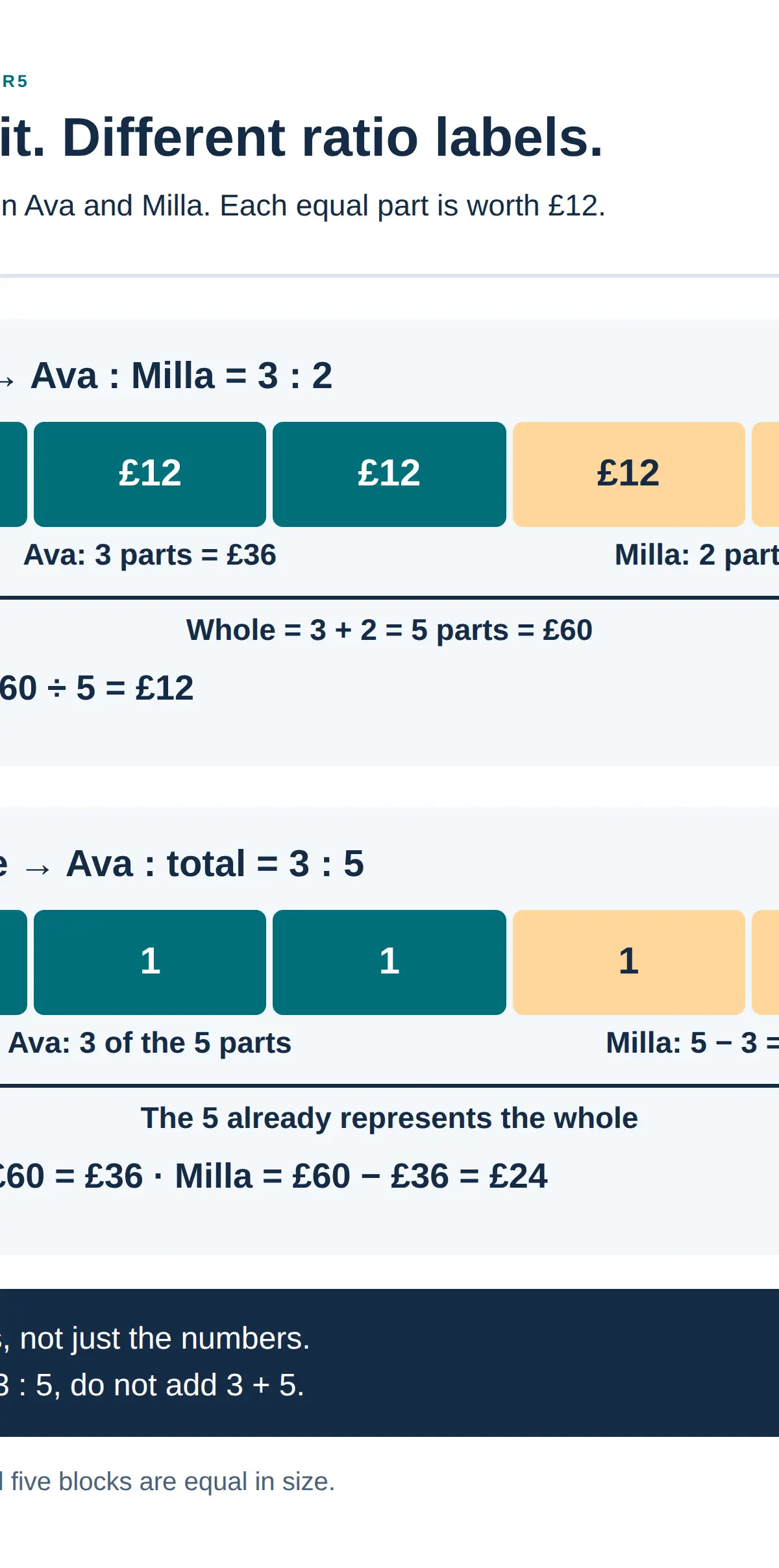
Suppose £60 is shared in the ratio 3:2. The total has 3 + 2 = 5 equal parts. One part is £60 ÷ 5 = £12. The shares are 3 × £12 = £36 and 2 × £12 = £24. Adding the shares verifies the total; simplifying 36:24 verifies the ratio. Both checks are needed because an equal split of £30 and £30 would pass the total check but fail the ratio check.
The method works because every part has the same value. Add, divide, multiply, check describes the sequence, but only when the information gives a total in a part:part ratio. An equivalent method is to calculate 3/5 of £60 and 2/5 of £60 directly. Credit is given for a valid method, not for using one preferred layout.
3. Distinguish part:whole from part:part
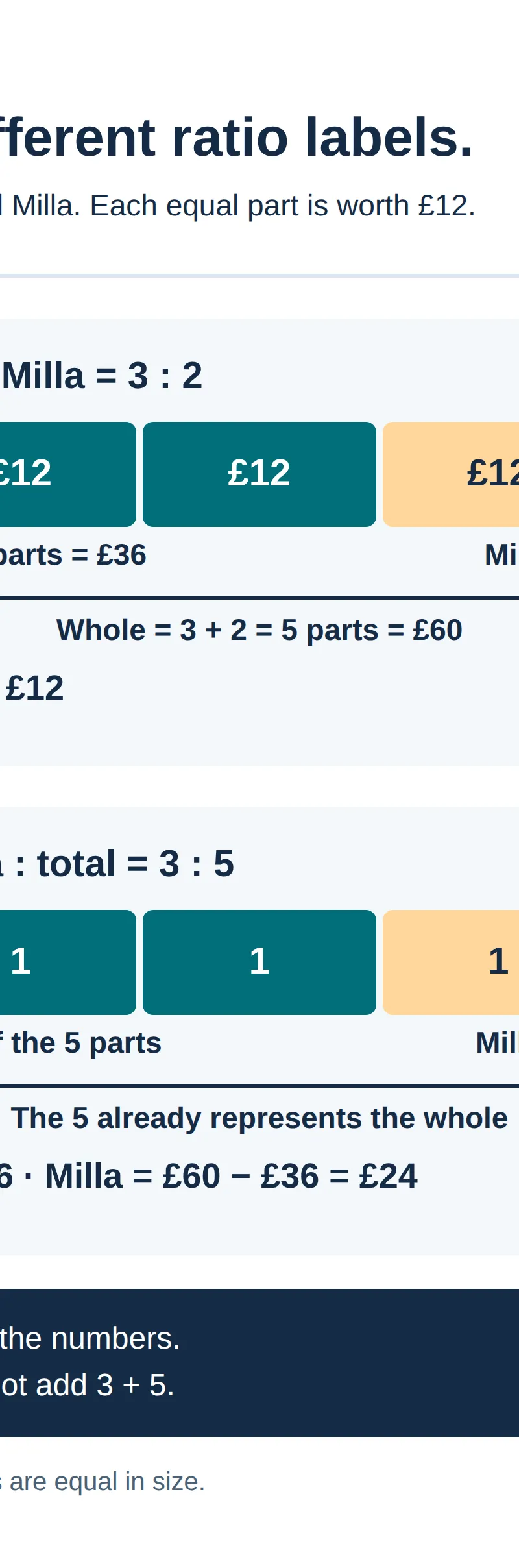
If Ava:total = 3:5, the 5 already represents the whole. Ava receives 3/5 of the total; Milla receives the remaining 2/5. For £60, the amounts are again £36 and £24. Adding 3 + 5 would count Ava's share twice: once separately and once inside the total.
A:whole = a:w converts to A:B = a:(w − a), provided A and B are the only components. Thus red:total = 2:7 becomes red:blue = 2:5. Conversely, red:blue = 2:5 gives red:total = 2:7. A bare '3:5' is not automatically part:whole. Identify the named quantities before calculating.
Cover and recall: why do 3:2 and 3:5 sometimes describe the same split? Answer using the labels 'other share' and 'total', not just the numbers.
4. When one share is given
For red:blue = 2:5, suppose blue measures 350 ml. The five blue parts correspond to 350 ml, so one part is 350 ÷ 5 = 70 ml. Red is 2 × 70 = 140 ml, and the whole mixture is 490 ml. Dividing 350 by 7 would incorrectly treat blue as the whole.
Before using any number, write what it represents. A compact annotation such as '5 parts = 350 ml' prevents a costly interpretation error. If the smaller share is given instead, divide by its corresponding ratio entry. You can then recover the other share and, if asked, the total.
5. When the difference is given
Two amounts in the ratio 7:4 differ by £18. Their difference represents 7 − 4 = 3 parts. One part is £18 ÷ 3 = £6, giving £42 and £24. The total is £66, but £18 was never the total: it was the gap between the amounts.
A published Pearson example uses Frank:Mary:Seth = 4:5:7, with Seth receiving 18 more sweets than Frank. The gap is 3 parts, so one part is 6 sweets. The total is (4 + 5 + 7) × 6 = 96 sweets. Pearson assigns this question 3 marks in its sample materials and includes it on both Paper 2F and Paper 2H. Three-part sharing is an extension of the same equal-parts method. 2
6. Form a ratio from quantities and convert units
Write the quantities in the requested order, convert to matching units where necessary, then simplify. For 1.5 kg of flour and 600 g of sugar, convert 1.5 kg to 1500 g. Flour:sugar = 1500:600 = 5:2. A final unitless ratio is suitable because it compares like quantities in the same units.
Recall 1 kg = 1000 g, 1 litre = 1000 ml, 1 m = 100 cm, 1 km = 1000 m, and £1 = 100p. Time is different: 1 hour = 60 minutes. For scale lengths, match centimetres with centimetres before interpreting the scale. A ratio can also express a rate between different kinds of quantity, such as pounds per kilogram; retain those units rather than treating the rate as a dimensionless sharing ratio.
7. Scale recipes, maps and conversions
Flour:sugar = 5:2 by mass. If flour is 250 g, one part is 50 g and sugar is 100 g. To double the recipe, double every ingredient. Adding 50 g to each would not preserve the ratio because the percentage changes would differ.
For a scale of 1:50 000, 3 cm on a map represents 150 000 cm, which is 1500 m or 1.5 km. The scale multiplier applies to lengths in matching units. This guide does not treat a length ratio as an area or volume ratio: those require further similarity reasoning.
For a stated exchange rate of £1 = €1.20, £75 converts to €90 by multiplying by 1.20. Converting €90 back to pounds requires division by 1.20. These are illustrative rates, not live exchange quotations. A sensible check is whether reversing the conversion returns the starting amount.
8. Mixing, dilution and concentration
Squash:water = 1:4 means five parts of finished drink. Squash is 1/5 = 20% of the total, while water is 4/5 = 80%. Squash/water = 1/4 = 25% compares squash with water alone, so it answers a different question.
To make 1 litre of this drink, use 1000 ÷ 5 = 200 ml per part: 200 ml squash and 800 ml water. Here the ratio is by volume, and the question assumes volumes add. If a mixture ratio is by mass, use masses instead. When a problem defines concentration as ingredient amount divided by total mixture, keep both quantities compatible before calculating the percentage.
Adding water changes the ratio because only one component increases. Starting with 300 ml squash and 1200 ml water, adding 300 ml water gives 300:1500 = 1:5. The squash amount stays fixed; the whole increases. To reach a target ratio, calculate the target water amount first, then subtract the existing water. Do not subtract ratio entries and call the result millilitres.
9. Compare value fairly
A 250 g pack costs £1.25 and a 400 g pack costs £1.80. The first costs £1.25 ÷ 0.25 = £5 per kg. The second costs £1.80 ÷ 0.4 = £4.50 per kg, so the second is better value. The lower pack price does not identify the lower unit price.
Candidates should show comparable figures and state the conclusion explicitly. Price per kilogram is convenient, but price per gram or cost for another shared reference amount is also valid. Round only after retaining enough precision to compare accurately. Pearson's R5 teaching examples include best-value questions requiring candidates to show how they obtained their answer. 2
Mathematical Relationships
All rules below are Must memorise: they are not supplied as ratio methods on the reviewed 2026 Pearson Foundation formula sheet. A formula sheet does not remove the need to interpret ratio wording. 4
For a part:part ratio A:B = a:b, let T be the total, u the value of one equal part, and D the positive difference between the amounts.
- Must memorise: u = T/(a + b); A = au = aT/(a + b); B = bu = bT/(a + b).
- Must memorise: if A is given, u = A/a, B = bA/a and T = A(a + b)/a; exchange A,a with B,b when B is given.
- Must memorise: u = D/|a − b| and T = D(a + b)/|a − b| for unequal entries. The vertical bars mean take the positive difference; equal entries cannot describe a non-zero difference.
- Must memorise: for A:whole = a:w, A = aT/w and B = (w − a)T/w, with 0 ≤ a ≤ w and w > 0.
- Must memorise: A:B = a:b implies A/B = a/b and B = (b/a)A for a > 0. Equivalent ratios satisfy a:b = ka:kb for k > 0.
- Must memorise: a:b simplifies to (a/h):(b/h), where h is the highest common factor of positive integer entries.
- Must memorise: ingredient fraction = ingredient amount/total mixture; percentage = fraction × 100.
- Must memorise: scale factor k = new amount/original amount; each new quantity = k × its original quantity. Real length = map length × scale denominator for a 1:n scale.
- Must memorise: converted amount = original amount × the stated conversion factor; reverse conversion divides by that factor.
- Must memorise: unit price = cost/quantity; required cost = unit price × required quantity, assuming a constant price per unit.
- Must memorise: for fixed squash S and target squash:water = a:b, target water W = (b/a)S; water to add = target water − current water.
Graph and Data Skills
For red:blue = 2:5, let x be red volume and y blue volume in the same units. Then y = (5/2)x = 2.5x. Plot red on the horizontal axis and blue on the vertical axis, label both units, and use consistent scales. Points (0,0), (2,5) and (4,10) lie on a straight line through the origin. Its gradient, change in y divided by change in x, is 2.5: blue per unit of red.
If the total is fixed instead, y = T − x. That is not the same relationship. Read axis labels before interpreting a gradient, and distinguish exact values from estimates read from a graph. A graph can show proportional quantities, but the axis labels decide which ratio the gradient represents. 1
Practical Applications and Active Revision
There is no required practical for this GCSE Mathematics topic. Measuring a recipe can illustrate ratio, but it is not an assessed science practical. The exam assesses interpreting information, calculations and mathematical reasoning.
Listen to the podcast, then answer its recall questions without looking at the guide. Replay only after attempting them. For written practice, cover the solutions, complete a question, check your method and correct the precise misconception. Revisit errors tomorrow and again after several days rather than immediately copying the answer repeatedly.
References
Visual Resources
2 diagrams and illustrations
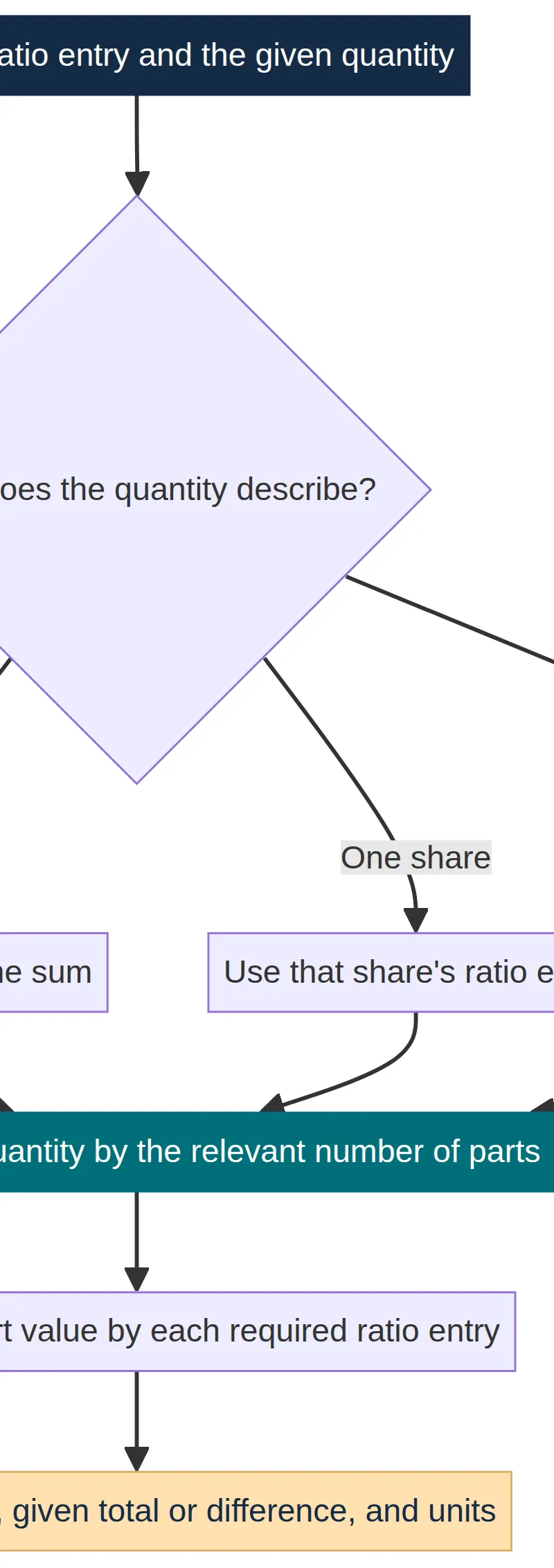
Interactive Diagrams
2 interactive diagrams to visualise key concepts
Conceptual Flow Outline
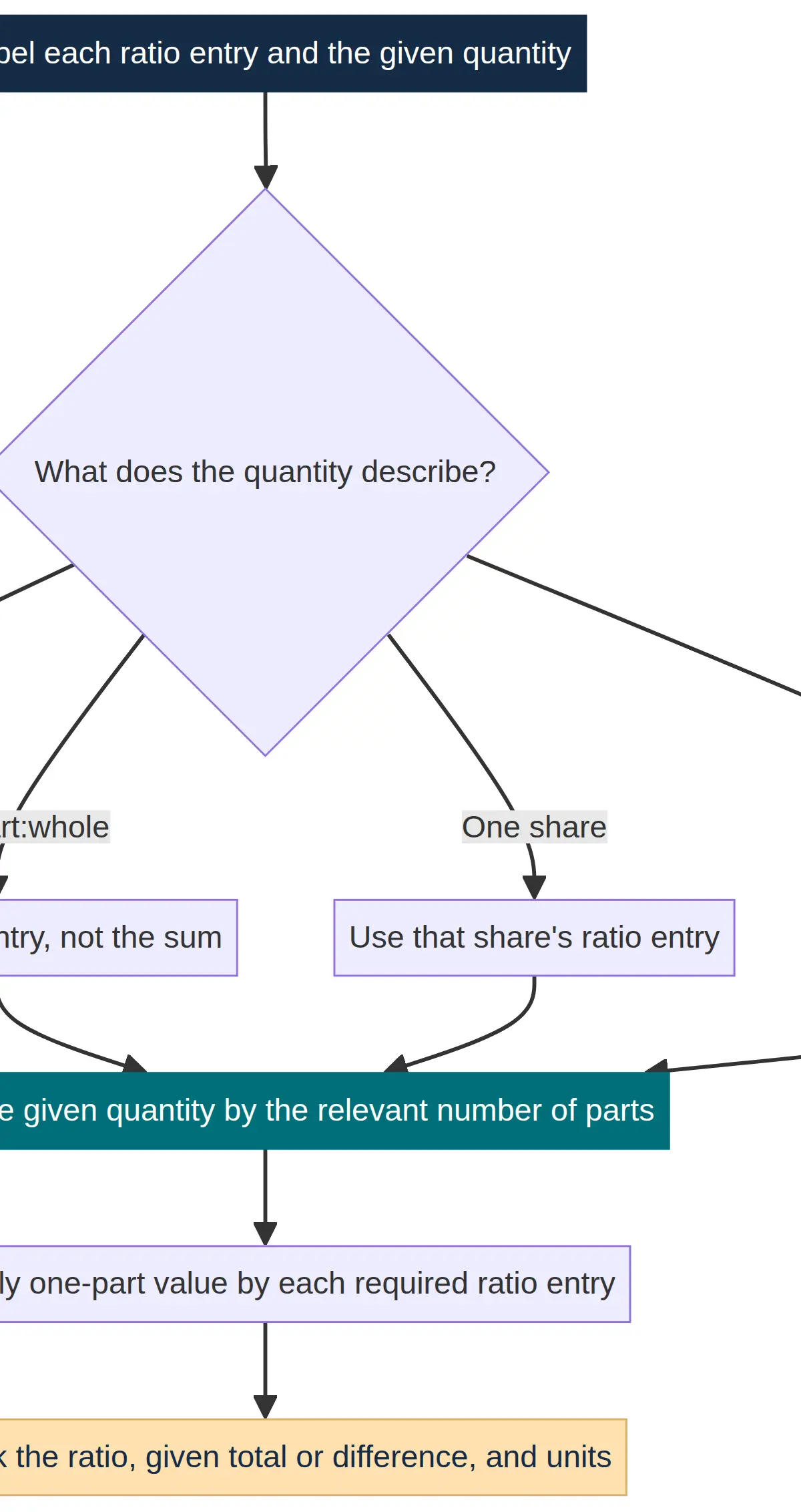
Choose the correct number of parts from the meaning of the given quantity. The rendered image is ratio_method_flowchart.png.
Conceptual Flow Outline
Squash:water = 1:4 gives one fifth of the whole drink, not one quarter. The denominator changes with the comparison.
Worked Examples
5 worked examples — open one to explore the question and available guidance.
Practice Questions
Try the question, then reveal an answer plan or example response
Work out the two shares when £72 is divided in the ratio first:second = 5:3. Show your working. Original Pearson-style practice; indicative 3-mark scheme.
Hint: Identify how many equal parts make the whole.
A bag contains only red and blue counters. Red:all = 2:7, and there are 84 counters altogether. Work out both counts and give red:blue in its simplest form. Original Pearson-style practice; indicative 3-mark scheme.
Hint: The seven already represents the total number of parts.
Blue paint:red paint = 4:3. There are 280 ml of red paint. Work out the blue volume and the total mixture volume. Show your working. Original Pearson-style practice; indicative 3-mark scheme.
Hint: Write which number of parts corresponds to 280 ml. Keep intermediate values exact.
A recipe uses 1.2 kg of flour and 300 g of sugar. Give flour:sugar in its simplest form, then work out both ingredient masses for 750 g of mixture in that ratio. Show your working. Original Pearson-style practice; indicative 4-mark scheme.
Hint: Convert kilograms to grams before simplifying.
Pack A contains 250 g and costs £1.25. Pack B contains 400 g and costs £1.80. Calculate each price per kilogram and explain which is better value. Show your working. Original Pearson-style practice; indicative 4-mark scheme.
Hint: Compare the cost for the same mass.
A 900 ml drink has juice:water = 2:7 by volume. Water is added until juice:water = 1:5. Work out the water added, then the percentage of the final drink that is juice, to 1 decimal place. Assume volumes add. Show your working. Original Pearson-style practice; indicative 5-mark scheme.
Hint: The juice volume remains fixed when water is added.
Red volume:blue volume = 2:5. Let x be red volume and y be blue volume, both in ml. Write y in terms of x, give two non-zero coordinate pairs, and explain why the graph passes through the origin. Original Pearson-style practice; indicative 3-mark scheme.
Hint: The vertical quantity is blue: use blue per unit of red.
Exam technique
How to turn what you know into marks
How to approach the question
Underline the named quantities and command word. Label whether the given amount is a total, one share or a difference; identify part:part versus part:whole. Convert units when comparing like quantities. Write a one-part calculation or equivalent fraction relationship, calculate the required result and check against the original information.
How to structure your answer
For 3 marks, show the interpretation, the useful calculation and the labelled answer. For 4–6 marks, keep connected stages on separate lines and show any new total, unchanged ingredient or conversion explicitly. There is no universal one-line-one-mark rule. M means method, P process, A accuracy, C communication and B unconditional accuracy; the specific official scheme controls credit. The guide’s new questions use indicative schemes. A correct unsupported answer may earn full marks where working is not required, but questions explicitly requiring working must show it.
Timing
Each 1MA1 paper is 90 minutes for 80 marks: 1.125 minutes, or 67.5 seconds, per mark across the whole paper. A practical target is about 1 minute per mark with time reserved for checking: roughly 3–4 minutes for 3 marks and 6–7 minutes for 6 marks. These are pacing guides, not board-mandated times.
Common pitfalls
- Adding entries in a part:whole ratio: identify the entry labelled total instead.
- Using total parts when one share is given: divide by the entry belonging to that share.
- Using the sum when a difference is given: subtract the smaller entry from the larger.
- Reversing requested order: keep quantity labels beside both entries.
- Simplifying unlike units: convert kilograms to grams or litres to millilitres first.
- Treating ingredient:ingredient as ingredient:whole: include both ingredients in the whole.
- Giving final water instead of water added: subtract the initial water amount.
- Rounding a repeating one-part value too early: retain exact fractions or calculator precision.
- Assuming the cheapest pack is best value: compare price per common unit.
What the command words want
- Compare
- Use comparable quantities such as £/kg and state which is larger or smaller. Both similarities and differences are not automatically required.
- Explain
- Give the mathematical reason, for example: five is the whole because the ratio is share:total. A bare yes or no is insufficient.
- Describe
- For a mathematical relationship, state its relevant features using precise terms, such as a straight line through the origin.
- Evaluate
- In mathematics, this usually means find the numerical value of an expression, not write a balanced essay.
- Show that
- Produce a calculation or argument leading to the stated result; do not assume the result as your starting point.
- State/Give
- Supply the requested value, ratio or units directly. If simplest form is required, remove common factors and preserve order.
- Write down
- Give the requested mathematical fact or expression; do not replace a ratio with a sentence when ratio notation is required.
- Work out/Calculate
- Select a valid method, show useful numerical working and give the requested labelled answer with units where appropriate.
- Give your answer in its simplest form
- Use common factors to reduce the ratio, preserving the quantities’ order and avoiding unnecessary rounding.
Watch or listen (optional)
Test your understanding of Ratio, proportion and rates of change: divide a given quantity into two parts in a given part:part or part:whole ratio; express the division of a quantity into two parts as a ratio; apply ratio to real contexts and problems (such as those involving conversion, comparison, scaling, mixing, concentrations)
Active recall beats re-reading. Take an instant quiz now to test what you’ve learned and lock it into long-term memory.
7 days Premium · Then the free plan continues · No card, no charge