Pearson Edexcel · GCSE · Mathematics
Course version: 1MA1 · Version from Mar 2026
Ratio, proportion and rates of change: express a multiplicative relationship between two quantities as a ratio or a fraction
Eight red counters and twenty blue counters can reveal a ratio, two reciprocal fractions and a multiplier. Learn to choose the comparison the question actually asks for, then show the clear working that earns credit in Pearson Edexcel GCSE Mathematics.
- 10 min read
- 4 worked examples
- 6 practice questions
- 9 key terms
Try the lesson
The start of the Ratio, proportion and rates of change: express a multiplicative relationship between two quantities as a ratio or a fraction lesson, made from checked teaching notes for this specification point.
Have a go first
A bag contains 6 red counters and 10 blue counters. Write the number of red counters to the number of blue counters as a ratio in its simplest form.
There is more to this lesson
The full lesson goes on to check your understanding and help you earn the marks. Create a free account to carry on, with your progress saved.
7 days Premium · Then the free plan continues · No card, no charge
Check what you remember
Read the wording for your board, then hide it and explain ratio in your own words. Rough notes are fine. This is a self-check, with no mark or grade.
Reference: Pearson Edexcel
An ordered comparison of quantities by division, written with a colon, for example 2:5.
Study Notes

Overview
R6 is about describing a multiplicative comparison accurately. You may compare two or more quantities as a ratio, turn a ratio into a fraction, find a multiplier, or represent a constant multiplicative relationship with an equation. The order of a ratio is meaningful: red:blue is not the same as blue:red. Before comparing, put quantities into the same unit, then simplify only when every part is divided by the same positive factor. A part:part ratio compares categories; a part:whole fraction compares a category with the total. Fractions can be greater than 1 when the numerator is the larger quantity, so 5/2 is perfectly valid and means two-and-a-half times as much.
This is core content at both Foundation and Higher; no R6 core is Higher-only. Expect concise calculations, interpretation of wording, and links to direct proportion and graphs. Pearson’s specification places R6 alongside fraction and ratio ideas for both tiers 1. The skill is not simply cancelling numbers: it is choosing the correct comparison, keeping units consistent and communicating the direction of the comparison clearly.
Key Concepts
Ratio order carries the meaning
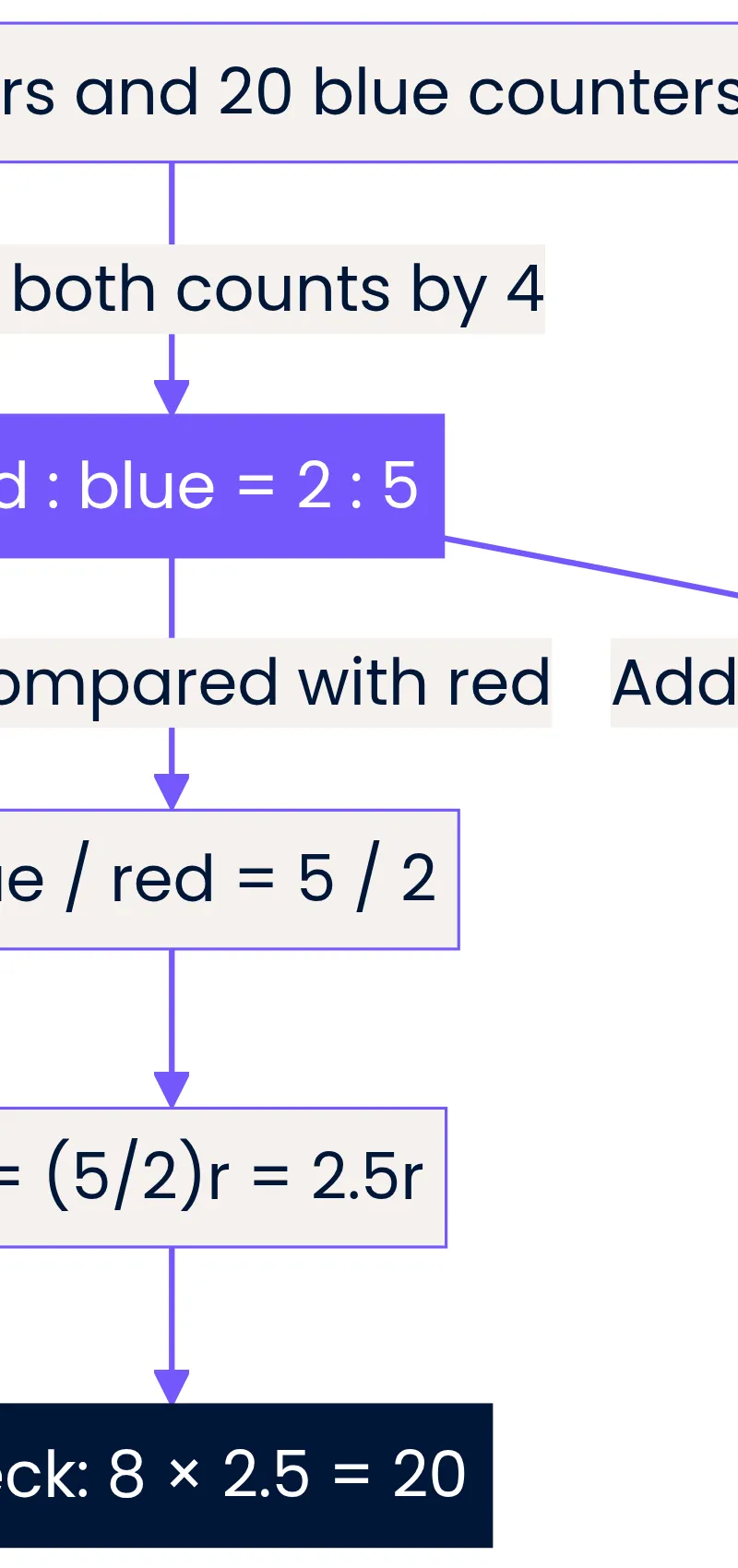
A ratio writes quantities in the stated order. If there are 8 red counters and 20 blue counters, then red:blue is 8:20, which simplifies to 2:5. Blue:red is 20:8, which simplifies to 5:2. Reversing the words reverses the ratio. Read the question once before calculating and write a small label above each number.
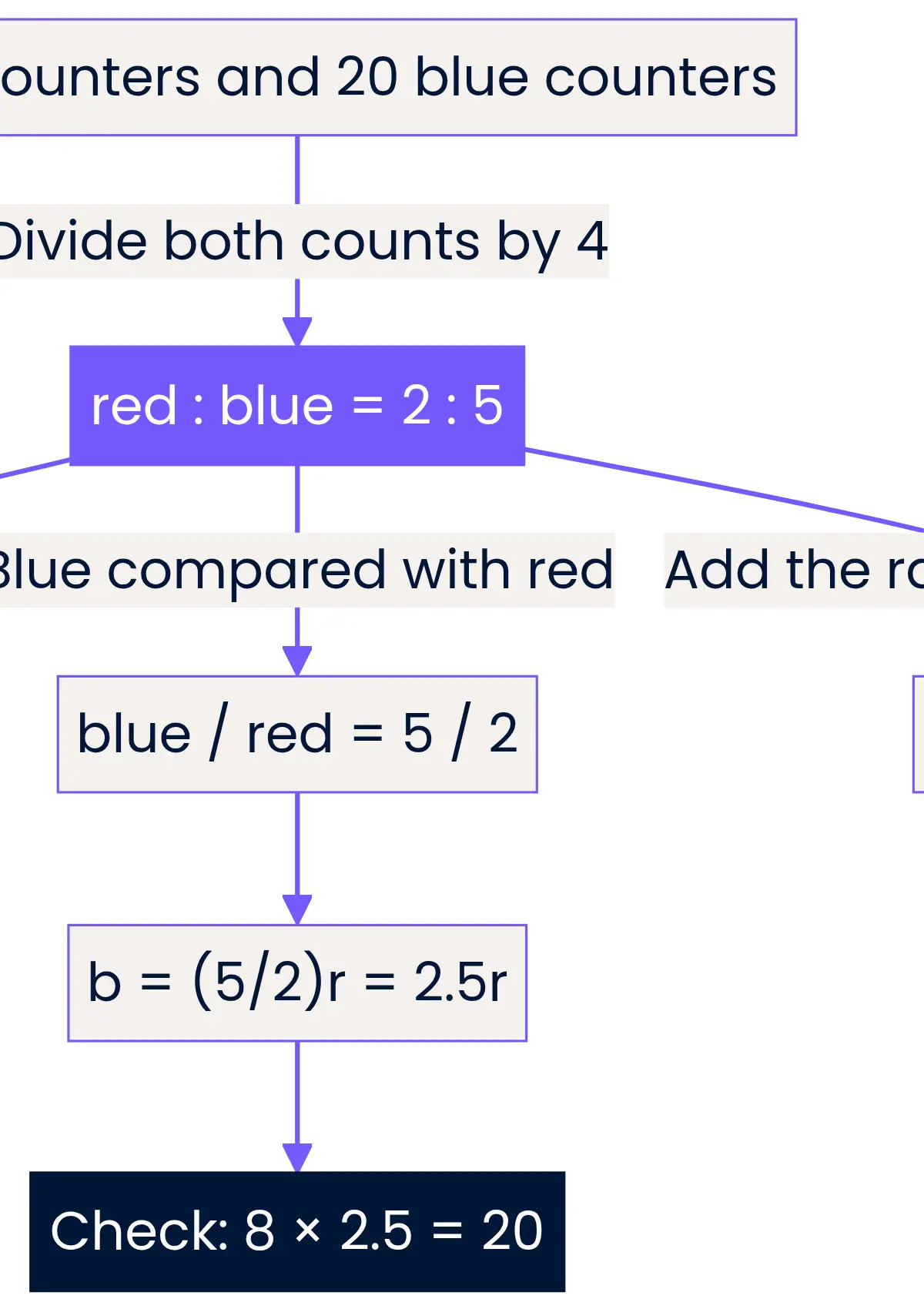
The teaching guidance gives the language “twice as many blue as red” as blue:red = 2:1 3. This is multiplicative language. It does not mean blue has 2 more counters than red. “Three times as many” means multiply by 3; “three more” means add 3. For example, if A has three times as many stickers as B, A = 3B. If A has three more stickers than B, A = B + 3.
Part:part and part:whole are different comparisons
For a red:blue ratio of 2:5, red is 2/5 of the number of blue counters. This is a part:part fraction because blue is the reference group. There are 7 equal ratio parts altogether, so red is 2/7 of the whole and blue is 5/7 of the whole. Do not automatically put the first ratio number over the total: first decide whether the question says “of blue” or “of all the counters”.
Cover and recall: Hide this paragraph. For red:blue = 2:5, state red/blue, red/total and blue/red. Check: 2/5, 2/7 and 5/2.
A fraction above 1 is often the right answer in a comparison. In 2:5 red:blue, blue is 5/2 of red. That is 2.5, so blue is two-and-a-half times the number of red counters. The reciprocal changes the comparison direction: if red/blue = 2/5, then blue/red = 5/2. It is not a new fact; it is the same relationship viewed from the other direction.
Simplifying integer, decimal and fractional ratios
Simplify a ratio by dividing every term by the same common factor. 18:30 becomes 3:5 after division by 6. A three-part ratio must divide every one of its parts: 12:18:30 becomes 2:3:5 after division by 6. Never subtract a common amount.
For rational ratios, first remove decimals or fractions without changing the relationship. For example, 1.5:2.25 can be multiplied throughout by 100 to give 150:225, then divided by 75 to give 2:3. For 3/4:5/6, multiply both terms by 12, the lowest common multiple of 4 and 6, to get 9:10. You have scaled every part equally, so the ratio is unchanged.
Why does this work? Multiplying both ratio terms by 12 preserves their quotient: (12A)/(12B) = A/B. Adding 12 generally does not preserve that quotient. Explain this aloud using 2:5 and 14:17.
Units must match before you form a ratio
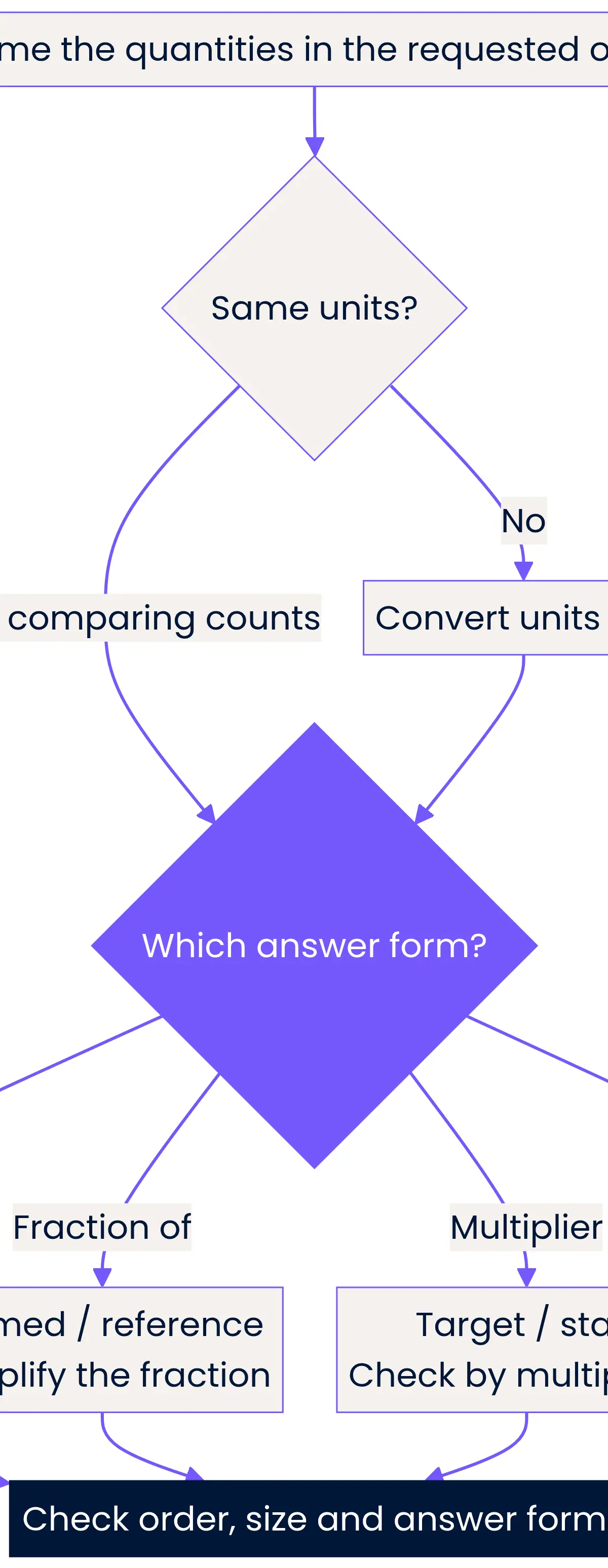
A ratio such as 2 m:75 cm is not simplified by treating it as 2:75. Convert first: 2 m = 200 cm, so 200:75 = 8:3. Common labelled conversions are: 1 m = 100 cm; 1 km = 1000 m; 1 kg = 1000 g; 1 litre = 1000 ml; 1 hour = 60 minutes; 1 minute = 60 seconds; and £1 = 100 p. Write the converted unit beside the number so that a unit error is visible and avoid mixing kilograms with grams or pounds with pence.
Cover and recall: Convert 0.6 kg:150 g without looking back. The result is 600:150 = 4:1. Area and volume conversions need squared or cubed factors, but they are not required in the examples here.
Multipliers and direct proportion
The phrase “A is k times B” means A/B = k, or A = kB. The multiplier from B to A is target divided by start, A ÷ B. If you travel from red to blue in the 2:5 comparison, multiply by 5/2. From blue to red, multiply by 2/5. A multiplier less than 1 reduces; a multiplier greater than 1 increases.
Direct proportion is a relationship in which the multiplier y/x is constant. It is written y = kx. Its graph is a straight line through the origin. The origin matters: a line that is straight but misses (0, 0) is not y = kx. One matching data pair, for example x = 4 and y = 18, gives a possible k of 18/4, but one pair alone does not establish a universal direct-proportion relationship. The rule must be stated, justified by the context, or supported by sufficient data.
What if? If both quantities double, their ratio is unchanged. If only the blue quantity doubles, red:blue changes from 2:5 to 2:10 = 1:5. Retrieve the new red/blue and red/total fractions: 1/5 and 1/6.
Exam focus and tier context
All three 1MA1 papers are 90 minutes and 80 marks, so the planning average is 1.125 minutes, or 67.5 seconds, per mark. Paper 1 is non-calculator; Papers 2 and 3 are calculator papers 1. That average guides pacing rather than forcing a rushed answer. The official 2026 exam aid does not supply ratio rules, so ratio-to-fraction and multiplier facts must be memorised [4].
A genuine source example is Summer 2024 Paper 2H Question 4, which used a red:blue probability ratio of 5:4. Its published mark scheme awards P1, P1, P1, A1 for a correct result of 70 2. It is useful practice in chained ratio and probability, but it is not an R6-only question. Treat it as evidence of how ratio can appear in a wider problem, not as a prediction.
Podcast listening section
The ten-minute episode follows this structure: introduction 0:00–1:00; core concepts 1:00–6:00; exam tips and common mistakes 6:00–8:00; quick-fire recall 8:00–9:00; summary and sign-off 9:00–10:00. Listen after completing the examples. During the quiz, answer aloud before the tutor gives the answer. Then rework one example without looking.
Mathematical/Scientific Relationships
Must memorise: equal scaling. a:b = (ta):(tb) for a positive scale factor t. To simplify integer terms, divide each by their highest common factor.
Must memorise: multiplier calculation. k = target/start, with a non-zero starting quantity, and target = k × start.
Must memorise: ordered ratio. If quantities are A and B, then the ratio A:B means “A compared with B”, in that order.
Must memorise: ratio as a fraction. A:B = a:b gives A/B = a/b. Reversing the comparison gives B/A = b/a.
Must memorise: part of the whole. For A:B = a:b, total parts = a + b, so A as a fraction of the whole is a/(a + b), and B as a fraction of the whole is b/(a + b).
Must memorise: multiplicative wording. “A is k times B” means A = kB and A/B = k.
Must memorise: reciprocal direction. If A/B = k, then B/A = 1/k, provided A and B are non-zero.
Must memorise: direct proportion. y is directly proportional to x means y = kx, where k = y/x for x not equal to 0.
Must memorise: graph test. The graph of y = kx is a straight line through the origin, with gradient k.
These formulae are compact statements of a comparison, not replacements for reading the wording. In a physical context, check that the units make sense before calculating k. A speed-like rate, for example, has units, whereas a pure ratio of like quantities is unitless.
Practical Applications
Ratios organise recipes, paint mixtures, map scales, currency comparisons, concentrations, sharing and probability. If a paint mix is yellow:white = 3:2, 3/5 of the mixed paint is yellow but yellow is 3/2 of the white paint. Both statements are true and answer different questions. In a recipe, scaling a 3:2 mix to 12:8 preserves the colour because each quantity has been multiplied by 4.
For money, convert pounds and pence before comparing: £2.40:60 p becomes 240 p:60 p = 4:1. For time, 1.5 hours:45 minutes becomes 90 minutes:45 minutes = 2:1. In data and science-style contexts, decide whether a question seeks a fraction of a total, a concentration comparison, or a multiplier. A bare numerical answer can lose its meaning if it does not identify the reference quantity.
For a stated rule y = 3x, label x on the horizontal axis and y on the vertical axis. Use consistent intervals on each axis, plot (0,0), (2,6) and (4,12), then draw the straight line. Read a multiplier from y/x at a non-zero plotted point.
On graphs, direct proportion models unit pricing and constant-speed distance in suitable conditions. If y = 2.4x, every increase of 1 in x increases y by 2.4. Check the origin and a second point where possible. Real data may be rounded or affected by measurement, so a near-straight graph is not automatically proof of exact direct proportion.
There is no required practical for this GCSE Mathematics topic. An optional counter-sorting activity can help visualise the comparison, but apparatus or practical-method recall is not assessed here.
All original questions and suggested mark allocations in this guide are not official Pearson questions or mark schemes. They are deliberately Edexcel-style practice. A senior examiner would expect a clear method where the question requires it, especially when units or a fraction-of-whole interpretation is involved.
References
[4]: https://qualifications.pearson.com/content/dam/pdf/GCSE/mathematics/2015/exam-materials/2026-exam-aid-foundation.pdf "GCSE Mathematics 2026 Exam Aid Foundation".
Worked Examples
4 worked examples — open one to explore the question and available guidance.
Practice Questions
Try the question, then reveal an answer plan or example response
Original Edexcel-style practice, 2 marks. A box contains 12 green beads and 18 yellow beads. Express green:yellow in its simplest form.
Hint: Put green first, then divide both terms by their highest common factor.
Original Edexcel-style practice, 3 marks. The ratio cats:dogs is 3:7. Find the fraction of all the animals that are cats and the fraction that are dogs.
Hint: The denominator for a fraction of all animals is the total number of ratio parts.
Original Edexcel-style practice, 4 marks. Express 2.4 m:90 cm in its simplest form. State the multiplier from the smaller quantity to the larger quantity.
Hint: Use one length unit before simplifying, then calculate target divided by start.
Original Edexcel-style practice, 3 marks. Simplify the rational ratio 3/4:5/6. Hence express the first quantity as a fraction of the second quantity.
Hint: Multiply both terms by the lowest common multiple of 4 and 6.
Original Edexcel-style practice, 5 marks. A machine’s output y is directly proportional to its input x. When x = 12, y = 30. Find the equation connecting y and x. Find y when x = 17. Explain one graph feature that supports the model and one reason why one data pair alone would not establish it.
Hint: Find k first. A direct-proportion graph has two essential properties, but one must be explained cautiously here.
Original Edexcel-style practice, 6 marks. A red:blue paint mix is 5:4. The amount of blue paint is 360 ml. Work out the amount of red paint, the total amount of paint, red as a fraction of the total, and blue as a fraction of red. Explain why the last fraction is less than 1.
Hint: Four ratio parts correspond to 360 ml. Keep part:whole and part:part denominators separate.
Exam technique
How to turn what you know into marks
How to approach the question
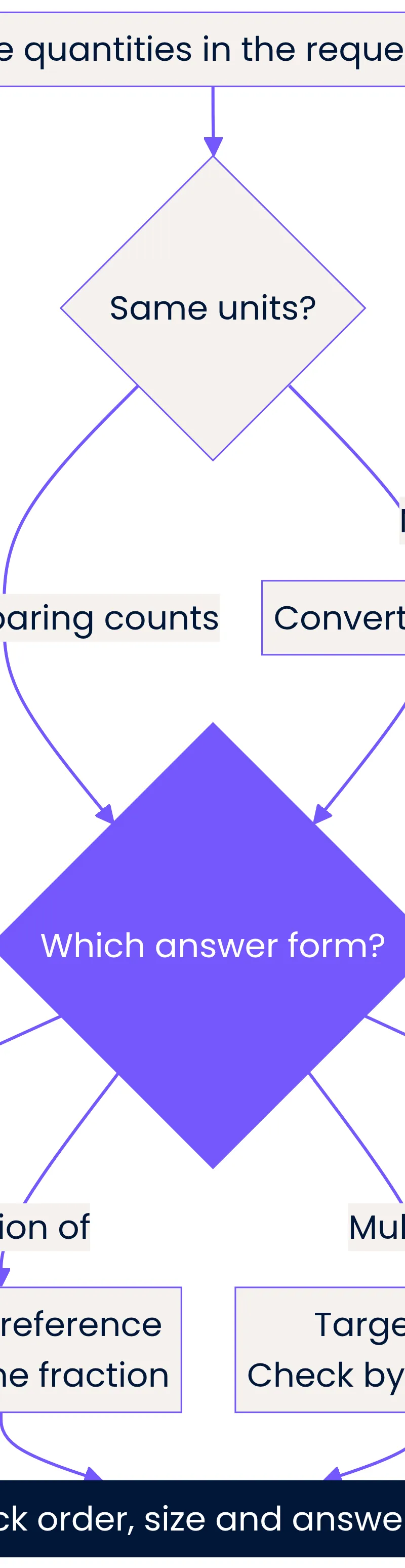
Underline the comparison words: 'of', 'to', 'times as many', 'total' and 'directly proportional'. Label the quantities in the requested order. Convert units before writing a ratio. Decide whether the denominator is a reference group or the whole. Check magnitude: a larger numerator over a smaller denominator should give a fraction above 1.
How to structure your answer
Write one connected line of working: converted quantities, ordered ratio or fraction, simplification, then a labelled conclusion. For a direct-proportion question, show k = y/x before y = kx. A method line can earn credit even if final arithmetic later slips, but no follow-through credit is guaranteed. In a 1-mark write-down item, a correct concise answer is normally sufficient. For a 2-mark calculation, show the method and final answer. For a 3–6 mark linked item, show the conversion or ratio set-up, each requested comparison, and the labelled final result. Marks reflect mathematical evidence, not one mark per line.
Timing
Across three 90-minute, 80-mark papers, use 1.125 minutes, or 67.5 seconds, per mark as a pacing average. Paper 1 is non-calculator; Papers 2 and 3 are calculator [1]. Leave a difficult calculation and return rather than sacrificing several accessible marks. Suggested working windows: about 3 min 23 s for 3 marks, 4 min 30 s for 4 marks, 5 min 38 s for 5 marks and 6 min 45 s for 6 marks. These are pacing estimates, not official question limits.
Common pitfalls
- Writing 5:2 when the question asks red:blue = 2:5.
- Using 2/7 for 'red as a fraction of blue' rather than 2/5.
- Treating 5/2 as impossible because it is greater than 1.
- Simplifying 12:18 by subtracting 6, or dividing only one term.
- Mixing 2 m and 75 cm without conversion.
- Interpreting 'three times as many' as 'three more'.
- Calling any straight line a direct-proportion graph when it does not pass through the origin.
What the command words want
- hence
- Carry forward the established result, usually as a ratio, fraction or multiplier.
- compare
- Make the order explicit and use a ratio, fraction or multiplier rather than an unsupported descriptive phrase.
- explain
- Use a precise comparison: identify the reference, total or reciprocal, then state why it follows.
- express
- State the relationship in the requested form and order, such as 3:5, 3/8 or y = 4.5x.
- simplify
- Use a common factor applied to every ratio term; show it when numbers are not obvious.
- work out
- Show conversion, method and final value with units where relevant.
- show that
- Present enough exact working to reach the given target; do not work backwards from the claimed answer alone.
- write down
- Give the requested value only, but retain labels if they prevent a direction error.
Watch or listen (optional)
Test your understanding of Ratio, proportion and rates of change: express a multiplicative relationship between two quantities as a ratio or a fraction
Active recall beats re-reading. Take an instant quiz now to test what you’ve learned and lock it into long-term memory.
7 days Premium · Then the free plan continues · No card, no charge