Pearson Edexcel · GCSE · Mathematics
Course version: 1MA1 · Version from Mar 2026
Ratio, proportion and rates of change: relate ratios to fractions and to linear functions
A ratio, a fraction and a straight-line graph can tell the same mathematical story. Learn to choose the correct denominator, find the conversion multiplier and interpret a gradient so that familiar ideas keep earning marks when the question changes its wording.
- 13 min read
- 4 worked examples
- 7 practice questions
- 10 key terms
Try the lesson
The start of the Ratio, proportion and rates of change: relate ratios to fractions and to linear functions lesson, made from checked teaching notes for this specification point.
Have a go first
A bag contains only red counters and blue counters in the ratio red : blue = 3 : 5. What fraction of the counters in the bag are red?
There is more to this lesson
The full lesson goes on to check your understanding and help you earn the marks. Create a free account to carry on, with your progress saved.
7 days Premium · Then the free plan continues · No card, no charge
Check what you remember
Read the wording for your board, then hide it and explain Ratio in your own words. Rough notes are fine. This is a self-check, with no mark or grade.
Reference: Pearson Edexcel
An ordered comparison of quantities showing their relative sizes; multiplying all parts by the same non-zero factor gives an equivalent ratio.
Study Notes

Overview
A ratio question and a graph question can describe exactly the same relationship. If concentrate and water are mixed in the ratio 2 : 5, two measures of concentrate match five measures of water. That information lets you compare ingredients using fractions, calculate missing amounts and write a straight-line equation. The challenge is choosing the right comparison, not memorising disconnected tricks.
Pearson Edexcel GCSE Mathematics specification 1MA1, R8 requires candidates to relate ratios to fractions and to linear functions. This content applies to both Foundation and Higher. Typical questions ask candidates to write an equation, calculate a conversion, find a gradient or explain whether a relationship is directly proportional. Fraction arithmetic, algebra, percentages and compound measures can appear in the same problem. 1
This guide develops one reliable approach: identify what each quantity means, decide the direction of comparison, then connect the ratio to the multiplier and graph. Practise with the model answers covered before checking your working. The worked examples and practice questions are original Edexcel-style questions with indicative mark schemes, not reproduced Pearson questions or guaranteed official allocations. Every calculation should answer the actual question, with suitable units and visible reasoning.
Key Concepts
1. A ratio describes matching quantities
Write x : y = a : b only after deciding what x and y represent. The letters a and b describe ratio parts, not necessarily the actual amounts. For concentrate x and water y in the ratio 2 : 5, matching amounts include (2, 5), (4, 10) and (6, 15). Multiplying both parts by the same factor preserves the ratio.
Why does this work? If x = 2t and y = 5t, dividing gives x/y = 2t/(5t) = 2/5 for any positive scale factor t. The actual batch changes; the comparison does not. A fixed difference is different: 2 : 5 and 4 : 7 both differ by 3, but are not equivalent ratios.
Exam application: candidates should reduce 12 : 30 to 2 : 5 by dividing both numbers by 6. Credit is given for an equivalent ratio in the form requested. If the question says simplest form, finish the simplification.
Cover and recall: produce two new matching pairs for 2 : 5 without looking. Check each using y/x = 2.5.
2. Part-to-part and part-to-whole fractions
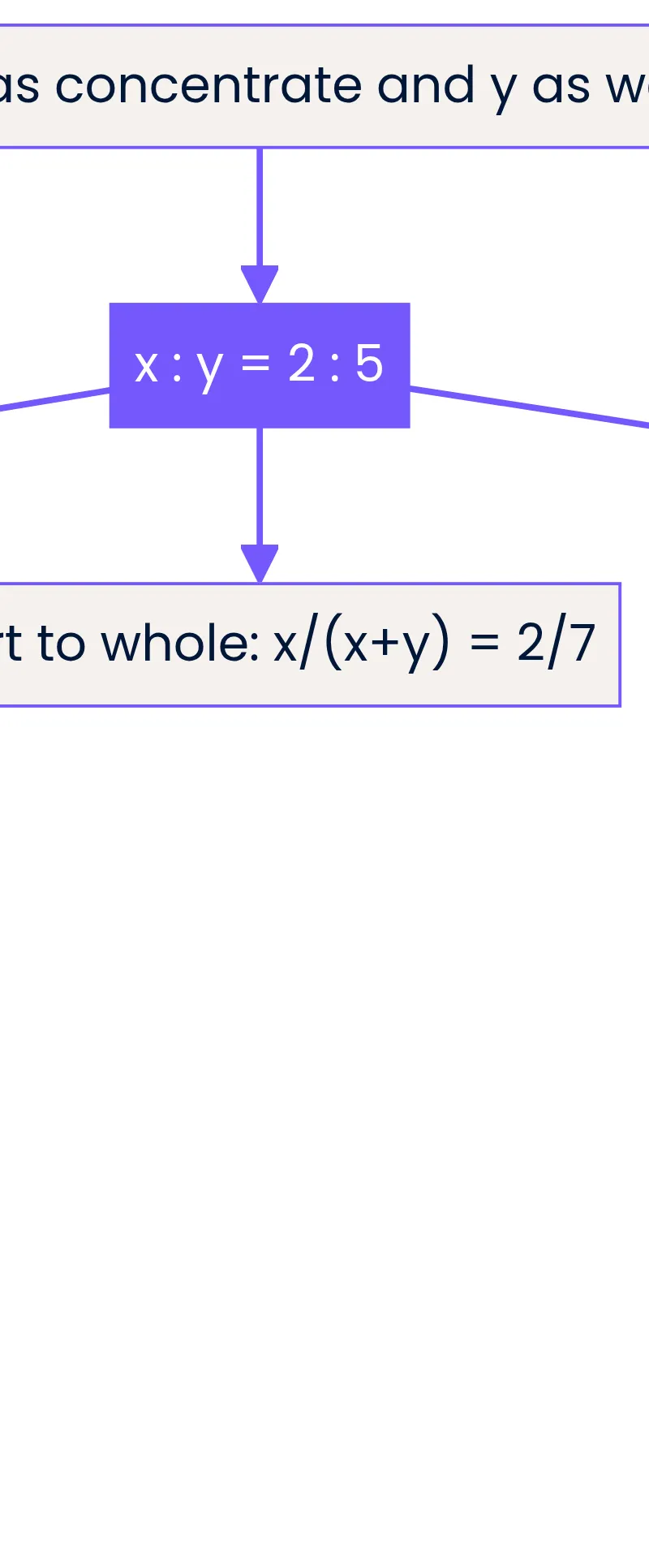
For x : y = 2 : 5, x/y = 2/5 compares concentrate with water. The total is x + y, represented by 7 parts, so x/(x + y) = 2/7 compares concentrate with the whole mixture. Similarly, y/(x + y) = 5/7. These statements do not contradict one another: their denominators describe different quantities.
Read the wording literally. ‘Concentrate as a fraction of water’ requires 2/5. ‘The fraction of the drink that is concentrate’ requires 2/7. A fraction of another quantity can exceed 1: water as a fraction of concentrate is 5/2. Do not replace a correct improper fraction just because you expect fractions to be less than 1.
Why question: why do 2/7 and 5/7 add to 1, but 2/5 and 5/2 do not? The first pair partitions one shared whole. The second pair makes comparisons with different denominators.
3. The multiplier depends on direction
Suppose x : y = 2 : 5 and you want y from x. The input is x; the output is y. Calculate k = output/input = 5/2 = 2.5. Therefore y = 2.5x. For x = 12, y = 2.5 × 12 = 30.
The fraction x/y = 2/5 is correct, but it is not the multiplier from x to y. It is the reverse multiplier. Recovering x from y gives x = (2/5)y, or x = y/2.5. An examiner can only interpret a multiplier reliably if your variable labels and equation agree.
Direction check: substitute a known matching pair. With x = 2, the equation y = 2.5x gives y = 5. The incorrect equation y = 0.4x gives 0.8, so it fails immediately. If the axis labels are reversed, the correct gradient becomes 0.4. ‘Second divided by first’ works only when the stated ratio is input : output.
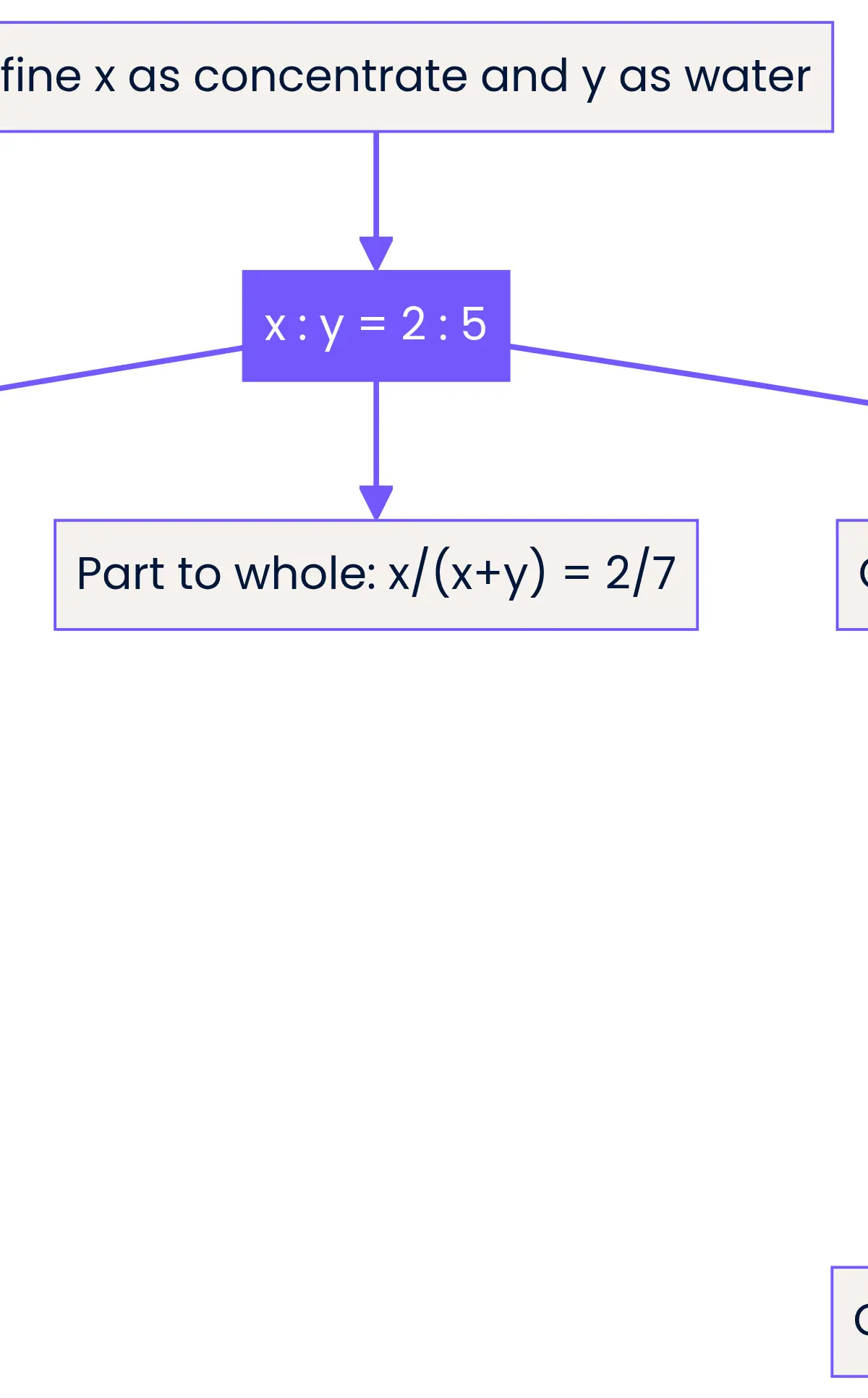
4. A part-to-whole ratio needs careful interpretation
If concentrate : total drink = 2 : 7, the water has 7 − 2 = 5 parts. Concentrate : water is therefore 2 : 5. If x represents concentrate and y represents water, y = (5/2)x. If instead T represents total drink, T = (7/2)x. Both equations are valid, but they connect different variables.
For a total of 350 ml, concentrate is (2/7) × 350 = 100 ml and water is (5/7) × 350 = 250 ml. Check 100 + 250 = 350 and 100 : 250 = 2 : 5. Candidates should not calculate water as seven times concentrate simply because ‘7’ appears in the ratio.
What if? If a question asks for the total rather than the other ingredient, do not automatically subtract ratio parts. Identify the requested output first.
5. Direct proportion gives a straight line through the origin
The equation y = kx means y is directly proportional to x. A fixed multiplier connects the quantities. Doubling x doubles y; multiplying x by any factor multiplies y by the same factor. Where the ratio y/x is defined, it remains constant.
Plot (0, 0), (2, 5) and (4, 10) for y = 2.5x. They lie on a straight line through the origin. The origin is included by the equation, even though the numerical ratio 0 : 0 does not define a multiplier. Zero concentrate corresponds to zero water in this model.
Both features matter: straight line and origin. A curve may pass through (0, 0) without showing direct proportion. A straight line y = 2.5x + 4 has a non-zero intercept, so it is not direct proportion. Its multiplier y/x changes with x, even though its gradient stays 2.5.
6. Gradient is a rate, not just a number
For points (x₁, y₁) and (x₂, y₂), gradient is (y₂ − y₁)/(x₂ − x₁). Use the matching changes between the same two points. On y = 2.5x, the change from (2, 5) to (4, 10) gives (10 − 5)/(4 − 2) = 5/2 = 2.5.
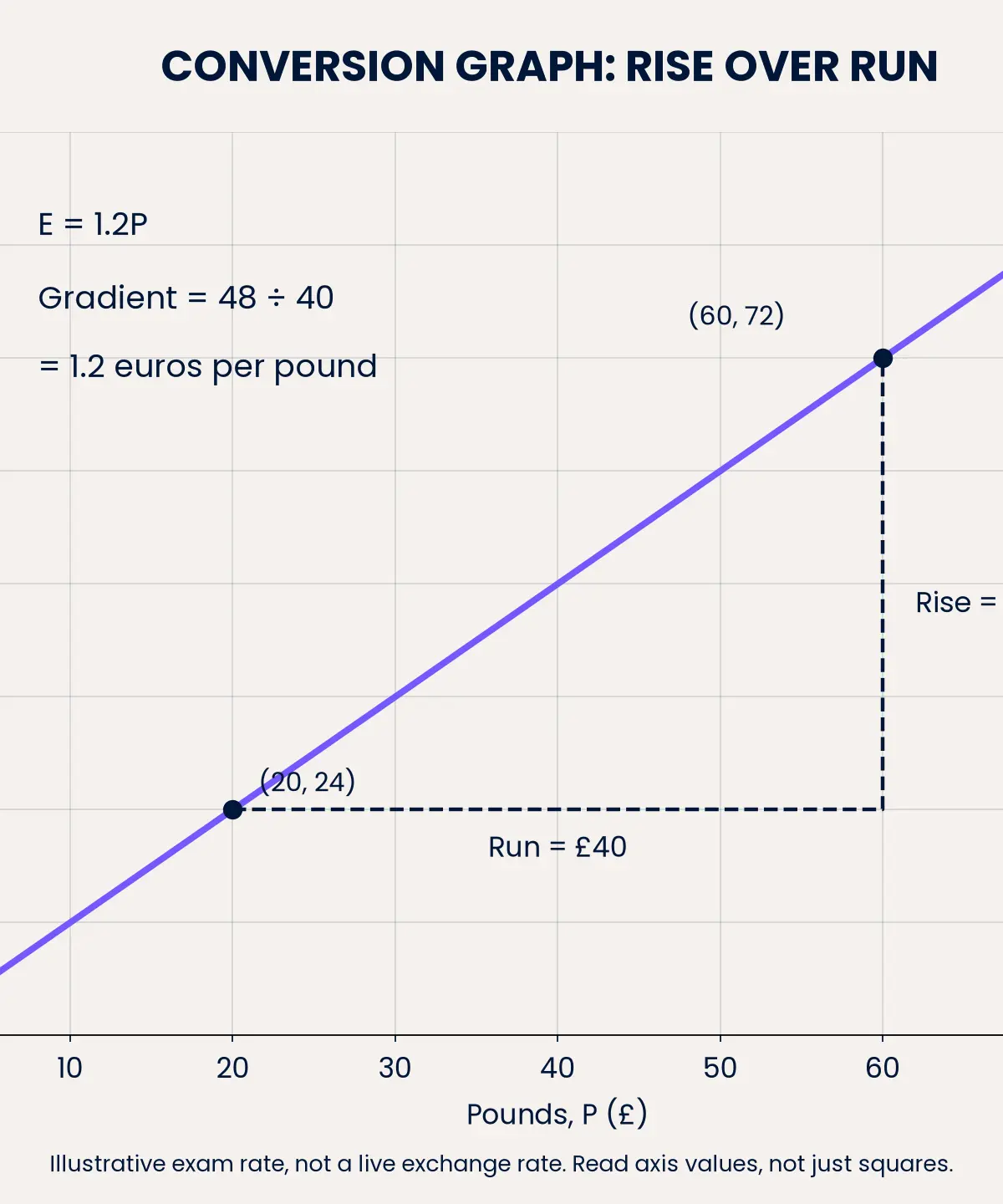
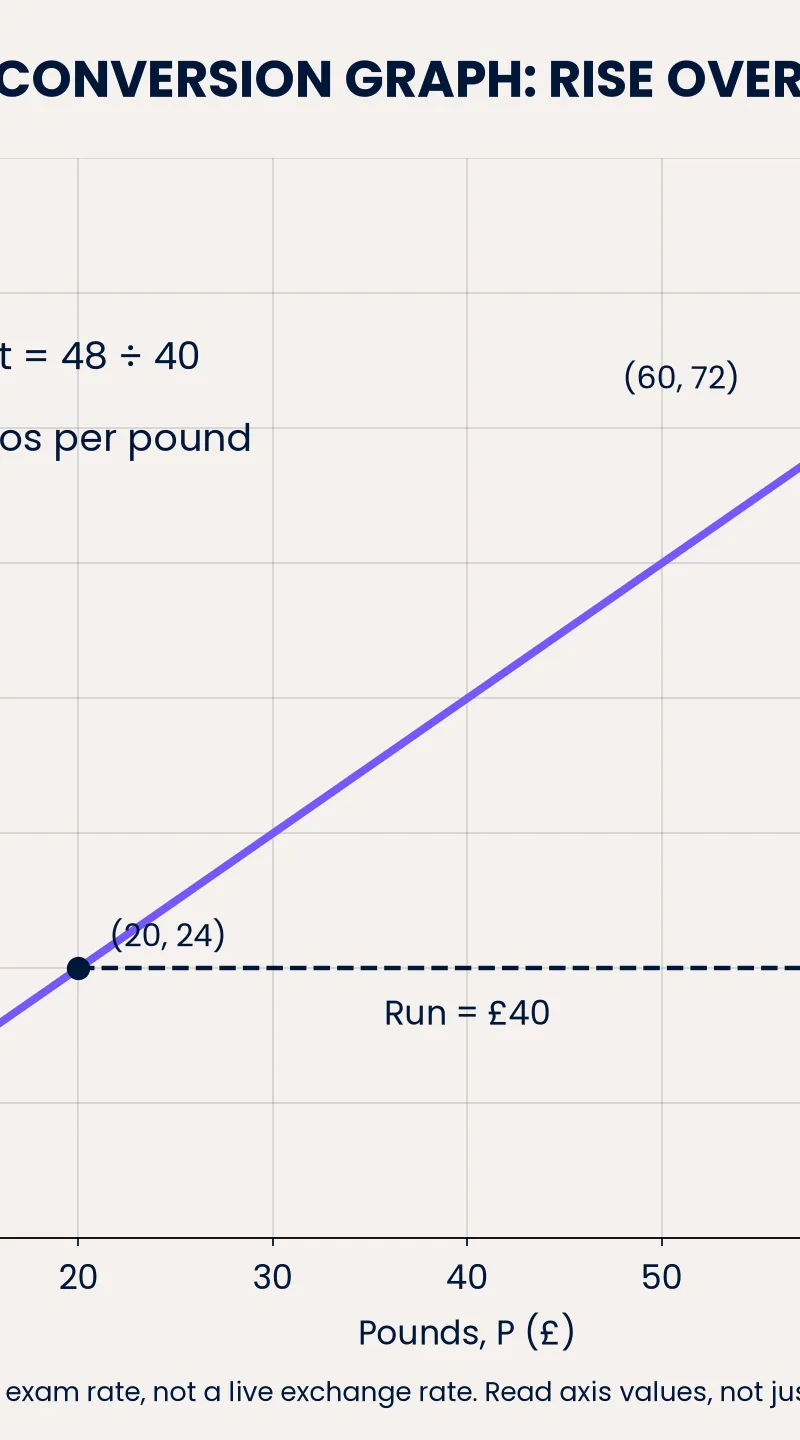
On a conversion graph with pounds P horizontally and euros E vertically, the gradient has units euros per pound. If (20, 24) and (60, 72) lie on the line, the gradient is (72 − 24)/(60 − 20) = 48/40 = 1.2 euros per pound. The equation is E = 1.2P. This is an illustrative examination rate, not a current exchange rate.
Convert £35 using E = 1.2 × 35 = €42. Reverse the conversion using P = E/1.2, so €90 gives £75. Marks awarded for interpretation depend on connecting the number to the quantities: ‘1.2 euros for each pound’ is clearer than ‘it goes up by 1.2’.
Mathematical Relationships
Formula-sheet status: none of the relationships below appears on Pearson’s inspected 2026 Foundation or Higher formula sheet. Each is labelled Must memorise, meaning candidates must know or be able to derive it, unless a particular question supplies it. Check the sheet for your examination series. 2 3
Ratio representation: x = at and y = bt. Must memorise. Here a : b is the ratio x : y and t is one ratio part. Use it to scale both quantities consistently.
Part-to-part fraction: x/y = a/b. Must memorise. It compares the first quantity with the second. Reversing the comparison gives y/x = b/a. Denominators must be non-zero.
Part-to-whole fractions: x/(x + y) = a/(a + b) and y/(x + y) = b/(a + b). Must memorise. Use these only when the total contains these two parts.
Sharing a total T: x = aT/(a + b), y = bT/(a + b), and t = T/(a + b). Must memorise. These convert ratio parts into actual amounts.
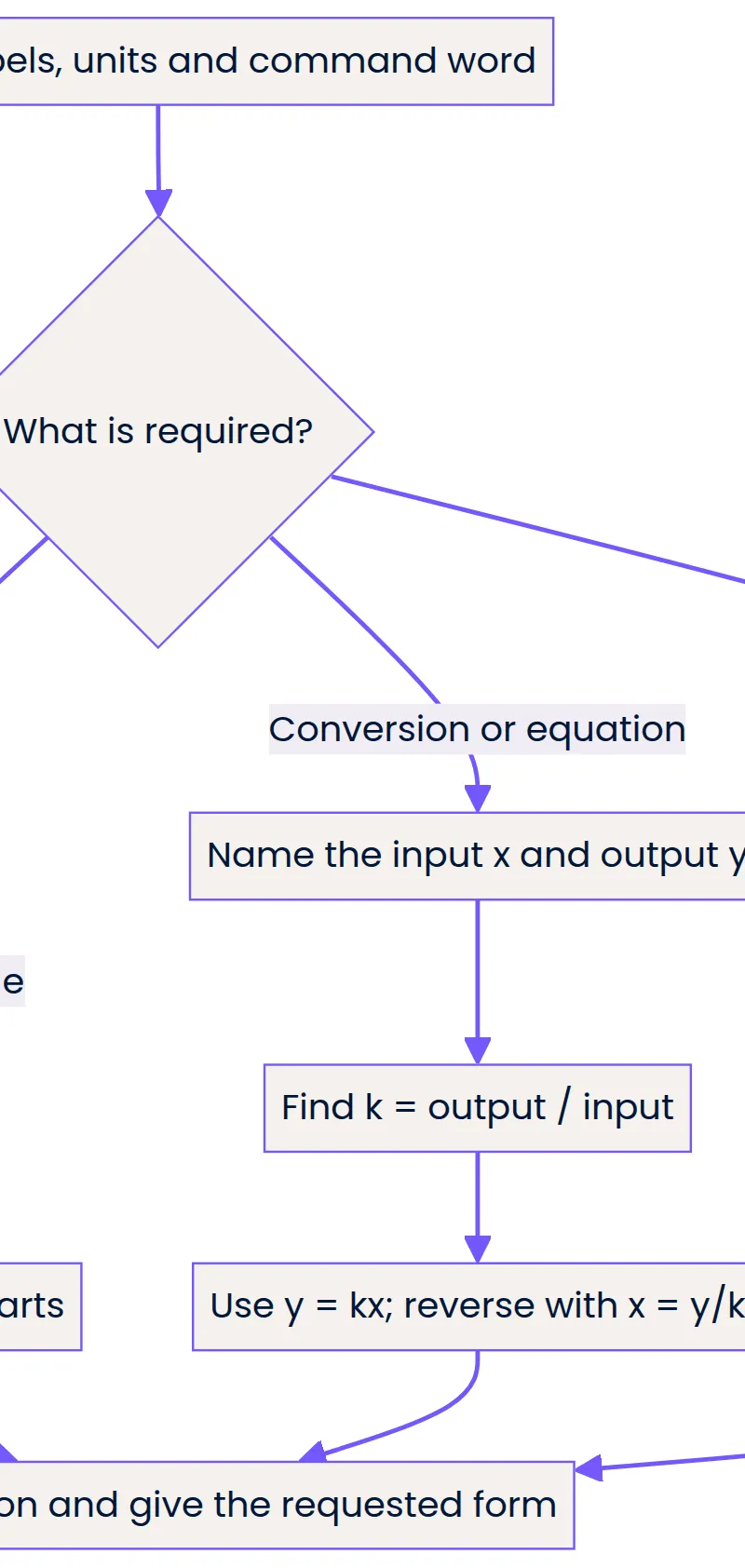
Direct-proportion multiplier and equation: k = y/x = b/a; y = kx. Must memorise. Here k converts input x into output y. Find k using a known non-zero input.
Reverse conversion: x = y/k. Must memorise. It reverses multiplication by k; k must be non-zero.
Gradient: m = Δy/Δx = (y₂ − y₁)/(x₂ − x₁). Must memorise. Δ means ‘change in’. The horizontal change must be non-zero. For y = kx, m = k.
General straight line: y = mx + c. Must memorise. The gradient is m and the vertical intercept is c. Direct proportion is the special case c = 0.
Part-to-whole conversion: if x : T = a : c and y = T − x, then x : y = a : (c − a). Must memorise. For a genuine two-part positive total, c > a. The letter c here labels ratio parts, not a graph intercept.
Graph and Data Skills
Plot accurately
Name the horizontal and vertical quantities, including units. Choose regular scales covering the required range. Calculate at least three suitable points, such as (0, 0), (2, 5) and (4, 10), then use a ruler for the straight line. Extend it only over the range appropriate to the context. Positive ingredient amounts usually mean using the first quadrant, not negative volumes.
Read and calculate accurately
For a gradient, select two well-separated readable points on the line, preferably at grid intersections. Draw a right-angled gradient triangle. Read the changes from the axis values, not the number of squares: ten horizontal units per square and twelve vertical units per square do not cancel. Keep subtraction in the same order for both coordinates.
To read an output, travel vertically from the horizontal input to the line, then horizontally to the output axis. Reverse that route when the output is known. If a graph provides only an approximate reading, say approximately and round only as directed. A line need not pass through every grid intersection.
Cover and recall: hide the conversion diagram. Recreate its gradient calculation, equation and reverse-conversion rule. Then explain why the gradient units are euros per pound rather than pounds per euro.
Practical Applications and Unit Conversions
Recipes, prices and conversions
A fixed recipe scales directly: doubling every ingredient preserves flavour proportions. A constant price per kilogram gives cost = price per kilogram × mass, provided there is no fixed charge or discount rule. A currency conversion without fees gives a similar linear model. In each case, the gradient is the output per unit input.
A fixed fee changes the model. If a provider deducts €3, the amount received is E = 1.2P − 3 over the relevant transaction range. It is linear but not directly proportional. The algebraic intercept describes the model; a negative amount at P = 0 need not represent an actual permitted transaction.
Keep units consistent
For two amounts of the same kind, convert into matching units before simplifying their ratio. £1 = 100p, 1 m = 100 cm, 1 km = 1000 m, 1 litre = 1000 ml, and 1 hour = 60 minutes. Thus £3 : 60p becomes 300p : 60p = 5 : 1, not 1 : 20. A distance of 40 km in 30 minutes gives 40/0.5 = 80 km per hour, not 40/0.30.
Different quantities can legitimately have different units, as euros and pounds do on a conversion graph. Keep each axis consistent with itself. Changing euros to cents changes the numerical gradient from 1.2 to 120 cents per pound without changing the underlying conversion.
Required practicals: none applies to this GCSE Mathematics topic. Plotting and interpreting graphs are examinable mathematical skills, not a prescribed science practical.
Exam-Focused Revision Routine
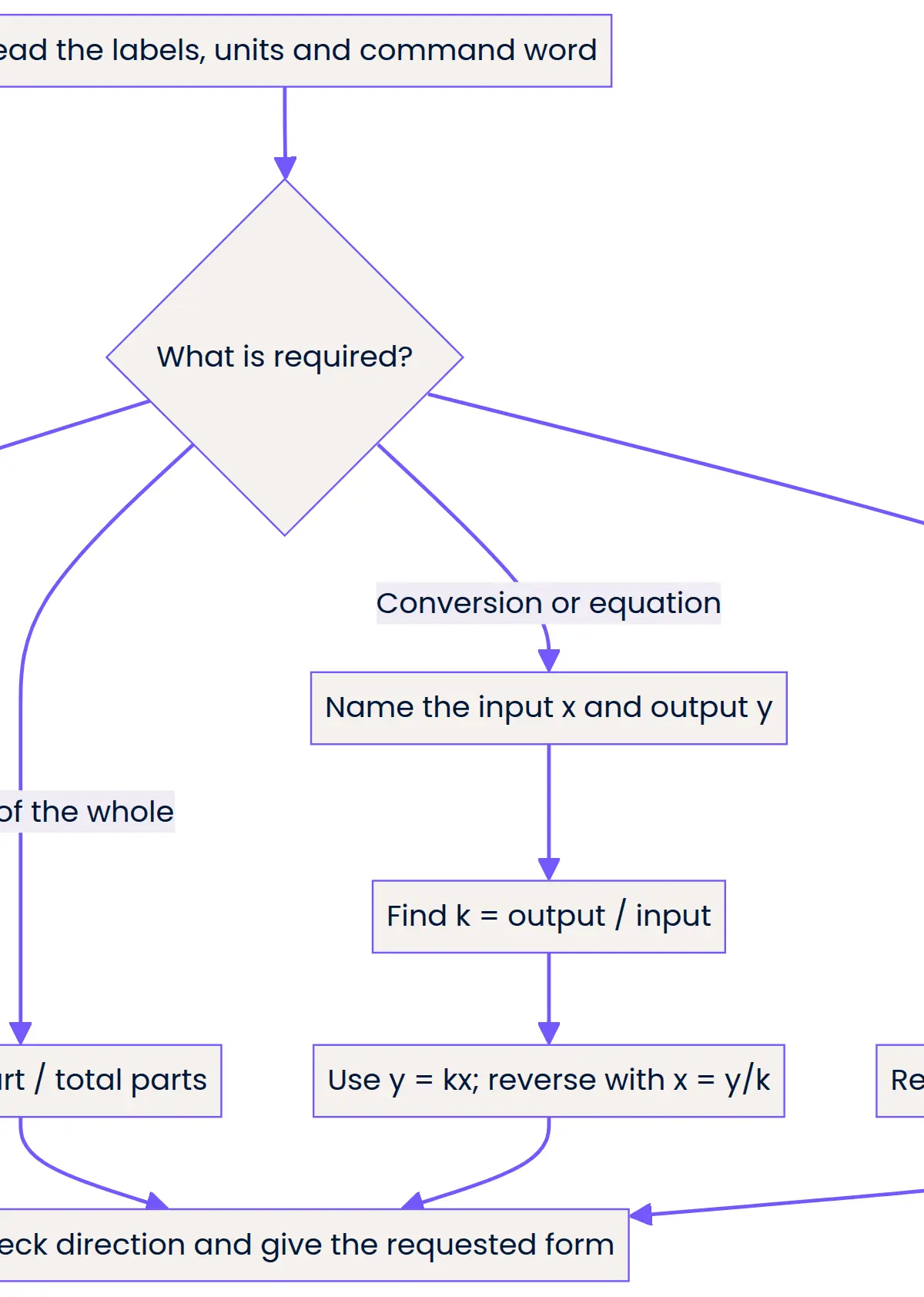
Before calculating, identify the command word and circle the requested comparison. Name the variables, find the correct denominator or multiplier, show a usable calculation, then check a matching pair and units. For ‘explain’, add a mathematical reason. For ‘show that’, demonstrate the route to the stated result rather than merely copying it.
Pearson papers allow 90 minutes for 80 marks, an average of 67.5 seconds per mark. A 3-mark question corresponds to about 3 minutes 23 seconds; a 4-mark question to 4 minutes 30 seconds; a 6-mark question to 6 minutes 45 seconds. These are planning averages, not official question-by-question limits. Leave time to revisit difficult questions. 1
Pearson uses M for method, P for problem-solving process, A for accuracy, B for unconditional accuracy and C for communication in its marking guidance. Actual credit and any follow-through depend on the individual scheme. Show working to make your method available for credit; do not assume every line earns a separate mark. 4
Test yourself with the answers hidden, mark your attempt, and redo the exact step you missed. Return tomorrow and later in the week, mixing a fraction question with an equation and a graph question. Aim to recognise the relationship when the wording changes. All content in this guide is suitable for both tiers; no Higher-only extension is required here. 1
Ten-Minute Tutor Podcast
Listen after your first independent attempt. The episode includes an introduction, core explanations, exam tips, a quick-fire recall quiz and a summary. Pause before each quiz answer and say your reasoning aloud. The full transcript is supplied in podcast_script.
Sources and Download
Visual Resources
3 diagrams and illustrations
Interactive Diagrams
2 interactive diagrams to visualise key concepts
Worked Examples
4 worked examples — open one to explore the question and available guidance.
Practice Questions
Try the question, then reveal an answer plan or example response
Two positive quantities satisfy x : y = 4 : 7. (a) Write down x/y. (1) (b) Write down x/(x+y). (1) (c) Write down y in terms of x. (1)
Hint: Choose the denominator separately for each part.
Blue beads : red beads = 5 : 3. There are 40 blue beads. Work out the number of red beads. (2)
Hint: Forty corresponds to the five blue parts, not to the total of eight parts.
An illustrative conversion line through the origin has pounds P horizontally and euros E vertically. It passes through (10, 8) and (30, 24). (a) Calculate its gradient. (2) (b) Write down its equation. (1) (c) Work out the pounds corresponding to €44. (2)
Hint: Use the vertical change over the horizontal change, then reverse the conversion for part (c).
A mixture contains only apple juice x and water y. Apple juice : total mixture = 3 : 10. Both amounts are in ml. (a) Write down apple juice : water. (1) (b) Find an equation for y in terms of x. (2) (c) Calculate y when x = 45 ml. (1)
Hint: Water is the whole minus the apple-juice part.
Two amounts are £4 and 80p. (a) Express the first amount : second amount as a ratio in simplest form. (2) (b) Write down the fraction of their combined value represented by the first amount. (1)
Hint: Convert both amounts to pounds or both to pence before comparing.
For positive x, consider A: y = 6x; B: y = 6x + 5; C: y = x². State which relationship shows direct proportion and explain why the other two do not. (4)
Hint: Direct proportion needs a constant y/x and a straight graph through the origin.
Two positive quantities satisfy x : y = 5 : 2. (a) Write down y in terms of x. (1) (b) Write down x in terms of y for a graph with y horizontal and x vertical. (1) (c) For the original axes with x horizontal, calculate the gradient using (10, 4) and (25, 10). (2)
Hint: Changing which quantity is vertical reverses the multiplier.
Exam technique
How to turn what you know into marks
How to approach the question
Identify the requested quantity, command word and units. Define the ratio order and variables. Decide whether the denominator is another part or the whole, or whether a forward or reverse multiplier is needed. For graphs, read axis values and use matching coordinate changes. Calculate, then check a known pair and the answer's units.
How to structure your answer
For a 1-mark write-down item, give the precise fraction, ratio or equation requested. For a typical 2-mark calculation, show the method and its answer. For 3–6-mark multi-part questions, separate parts, show the conversion or gradient method, calculate in context and give any requested explanation. These patterns are guidance: actual marks depend on the specific scheme. M denotes method, P problem-solving process, A accuracy, B unconditional accuracy and C communication.
Timing
Each 1MA1 paper is 90 minutes for 80 marks: an average of 67.5 seconds per mark. Planning guides: 3 marks about 3 min 23 sec; 4 marks 4 min 30 sec; 5 marks about 5 min 38 sec; 6 marks 6 min 45 sec. These are averages, not official limits for individual questions.
Common pitfalls
- Using 2/7 for a part-to-part comparison. Read 'of water' versus 'of the whole drink'.
- Writing y = (2/5)x when x : y = 2 : 5. Check that x = 2 produces y = 5.
- Inverting gradient. Use change in vertical quantity divided by change in horizontal quantity.
- Counting squares despite unequal axis scales. Read the numerical changes on each axis.
- Assuming every straight line is direct proportion. Check that its intercept is zero.
- Converting back by multiplying again. Reverse the forward operation by dividing by the non-zero multiplier.
- Mixing pounds and pence in a same-kind ratio. Convert to matching units before simplifying.
- Rounding a graph reading silently or too early. Use readable points and round only as directed.
What the command words want
- Find
- Obtain the requested quantity using the given information. For a gradient, show matching coordinate differences.
- Compare
- Compare like with like. Name which rate is greater and support the comparison with values and consistent units.
- Explain
- Give a mathematical reason, such as 'the line has a non-zero intercept, so it does not pass through the origin'.
- Describe
- Identify the relevant mathematical feature in context, such as a constant rate or a straight line through the origin.
- Evaluate
- In mathematics, evaluate normally means calculate the value of an expression. It does not normally mean discuss both sides of an argument.
- Show that
- Demonstrate the calculation or reasoning leading to the supplied result. Copying the stated answer is not a demonstration.
- Work out/Calculate
- Use a suitable calculation and show enough working to reveal the method. Give units and the requested accuracy where relevant.
- State/Give/Write down
- Provide the requested value, ratio, fraction or full equation. Do not give only a multiplier when an equation is required.
Watch or listen (optional)
Test your understanding of Ratio, proportion and rates of change: relate ratios to fractions and to linear functions
Active recall beats re-reading. Take an instant quiz now to test what you’ve learned and lock it into long-term memory.
7 days Premium · Then the free plan continues · No card, no charge