Pearson Edexcel · GCSE · Mathematics
Course version: 1MA1 · Version from Mar 2026
Ratio, proportion and rates of change: solve problems involving direct and inverse proportion, including graphical and algebraic representations
A fixed multiplier makes quantities grow together; a fixed product makes one shrink as the other grows. Learn to recognise each relationship, find its constant and move confidently between calculations, equations and graphs, including clearly labelled Higher-tier equation-construction exercises.
- 14 min read
- 4 worked examples
- 7 practice questions
- 10 key terms
Try the lesson
The start of the Ratio, proportion and rates of change: solve problems involving direct and inverse proportion, including graphical and algebraic representations lesson, made from checked teaching notes for this specification point.
Have a go first
y is directly proportional to x. When x = 5, y = 30. Find the value of y when x = 8.
There is more to this lesson
The full lesson goes on to check your understanding and help you earn the marks. Create a free account to carry on, with your progress saved.
7 days Premium · Then the free plan continues · No card, no charge
Check what you remember
Read the wording for your board, then hide it and explain Direct proportion in your own words. Rough notes are fine. This is a self-check, with no mark or grade.
Reference: Pearson Edexcel
A relationship in which one quantity is a constant multiple of another: y = kx. For non-zero x, y/x is constant.
Study Notes

Overview
Why does buying twice as many pens usually cost twice as much, while using twice as many equally productive workers can halve the time for a fixed job? The first relationship is direct proportion; the second is inverse proportion. Your task is to identify what stays constant, represent the relationship correctly and use it to calculate an unknown value.
This topic combines ratio, multiplication, division, algebra and graphs. Pearson Edexcel questions may ask candidates to calculate a cost, complete a table, find a constant of proportionality, write a formula or explain whether a graph represents proportion. Stronger questions connect proportional relationships to powers, roots or compound measures.
The most reliable approach is to start with the relationship rather than guess an operation. Find the constant from a matching pair of values, write the complete rule, then substitute the requested value. A sensible final answer must have appropriate units and rounding. Showing this chain makes your method visible, which matters when a numerical slip prevents a correct answer. This guide develops the numerical core first, then labels the Higher-only extensions, with worked examples, graph interpretation and active-recall checks.
Assessment context: Each of the three 1MA1 papers lasts 90 minutes and carries 80 marks. Paper 1 is non-calculator; Papers 2 and 3 allow calculators. Start with about one minute per mark, then use the remaining time to check. This is a working strategy, not an official per-question time limit. 5
Key Concepts
1. Direct proportion: a fixed multiplier
Two quantities are directly proportional when one is a constant multiple of the other. Write y ∝ x, read as “y is directly proportional to x”. Replacing the proportionality symbol with an equation gives y = kx, where k is the constant of proportionality.
For non-zero x, the quotient y/x stays constant. If x doubles, y doubles; if x is multiplied by 3, y is multiplied by 3. This is multiplicative change, not adding the same number to both quantities. Where zero is meaningful, x = 0 gives y = 0.
Example: Five identical pens cost £3.50 with no fixed charge or discount. The cost per pen is 3.50 ÷ 5 = £0.70. With C in pounds and n the number of pens, C = 0.70n. Twelve pens cost 0.70 × 12 = £8.40. The constant is £0.70 per pen, not the final cost requested.
Why does this work? Every pen contributes the same cost, so scaling the quantity scales the total. If a delivery charge is added, the relationship changes. C = 0.70n + 2 is a straight-line relationship but is not direct proportion, because its graph does not pass through the origin.
Cover and recall: What two tests distinguish direct proportion from an arbitrary increasing relationship? Recall a constant quotient and a straight-line graph through the origin.
2. Inverse proportion: a fixed product
Two quantities are inversely proportional when their product stays constant. Write y ∝ 1/x, giving y = k/x or equivalently xy = k. For positive quantities, doubling x halves y; multiplying x by 3 divides y by 3.
Example: Four equally productive workers take six hours to complete a fixed job. The work is 4 × 6 = 24 worker-hours. If n is the number of workers and t is the time in hours, nt = 24, so t = 24/n. Eight workers take 24 ÷ 8 = 3 hours.
This model assumes each worker works at the same constant rate, the job does not change, and extra workers do not interfere with one another. In an examination, use the assumptions stated or implied in the question. If asked to assess a model, explain which assumption might fail in practice.
A decrease alone does not establish inverse proportion. For y = 10 − x, y decreases as x increases, but xy is not constant. When x changes from 2 to 4, y changes from 8 to 6, not from 8 to 4. Candidates should justify inverse proportion using a fixed product, not merely “one goes up and the other goes down”.
Cover and recall: Why is k = xy here, rather than y/x? Multiply both sides of y = k/x by x.
3. The constant method: rule, constant, substitute, check
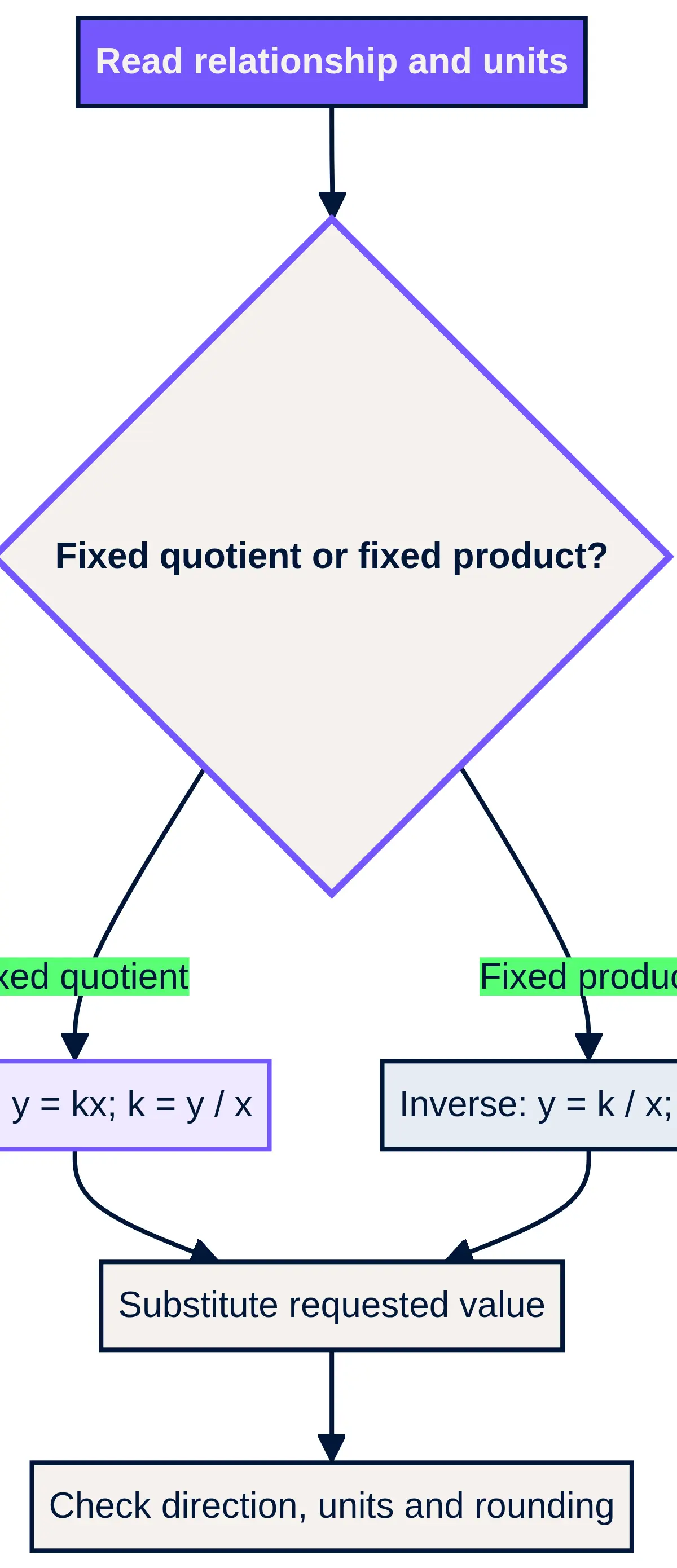
Use the same four-step routine for either relationship. First write the correct general equation. Next substitute a matching pair of known values to calculate k. Then write the numerical equation and use the value requested. Finally check the direction, units and rounding.
For direct proportion, y = 18 when x = 6 gives 18 = 6k, so k = 3 and y = 3x. At x = 11, y = 33. For inverse proportion, the same pair gives k = 6 × 18 = 108 and y = 108/x. At x = 12, y = 9. The same starting pair therefore produces different answers when the relationship changes.
An equivalent scaling method is valid when the relationship is established. In direct proportion, moving from x = 6 to x = 12 doubles y. In inverse proportion, the same change halves y. Do not introduce k if a simple unitary method is clearer, but an explicit equation is particularly helpful in algebraic questions.
For credit, working must demonstrate a relevant method. A correct answer can sometimes earn full marks without intermediate lines, depending on the question and its scheme, but “show that” questions require sufficient working. Never assume every line automatically earns a mark.
4. Tables: test the invariant
For direct proportion, compare y/x for each non-zero x. The pairs (2, 7), (4, 14) and (10, 35) all give k = 3.5. For inverse proportion, compare xy. The pairs (2, 18), (3, 12) and (6, 6) all give k = 36.
A single pair of positive values cannot distinguish the two models: both a direct and an inverse formula can be made to pass through it. The wording, graph or additional values are needed. If experimental measurements are rounded, quotients or products may be only approximately constant; do not claim exact proportion from visibly inconsistent data.
What if? A table doubles x but y also doubles only once. Is that enough to prove a universal direct relationship? No. Test the stated model or all available pairs; one observed change is not proof for every input.
5. Graphs: shape is evidence, but not the whole test
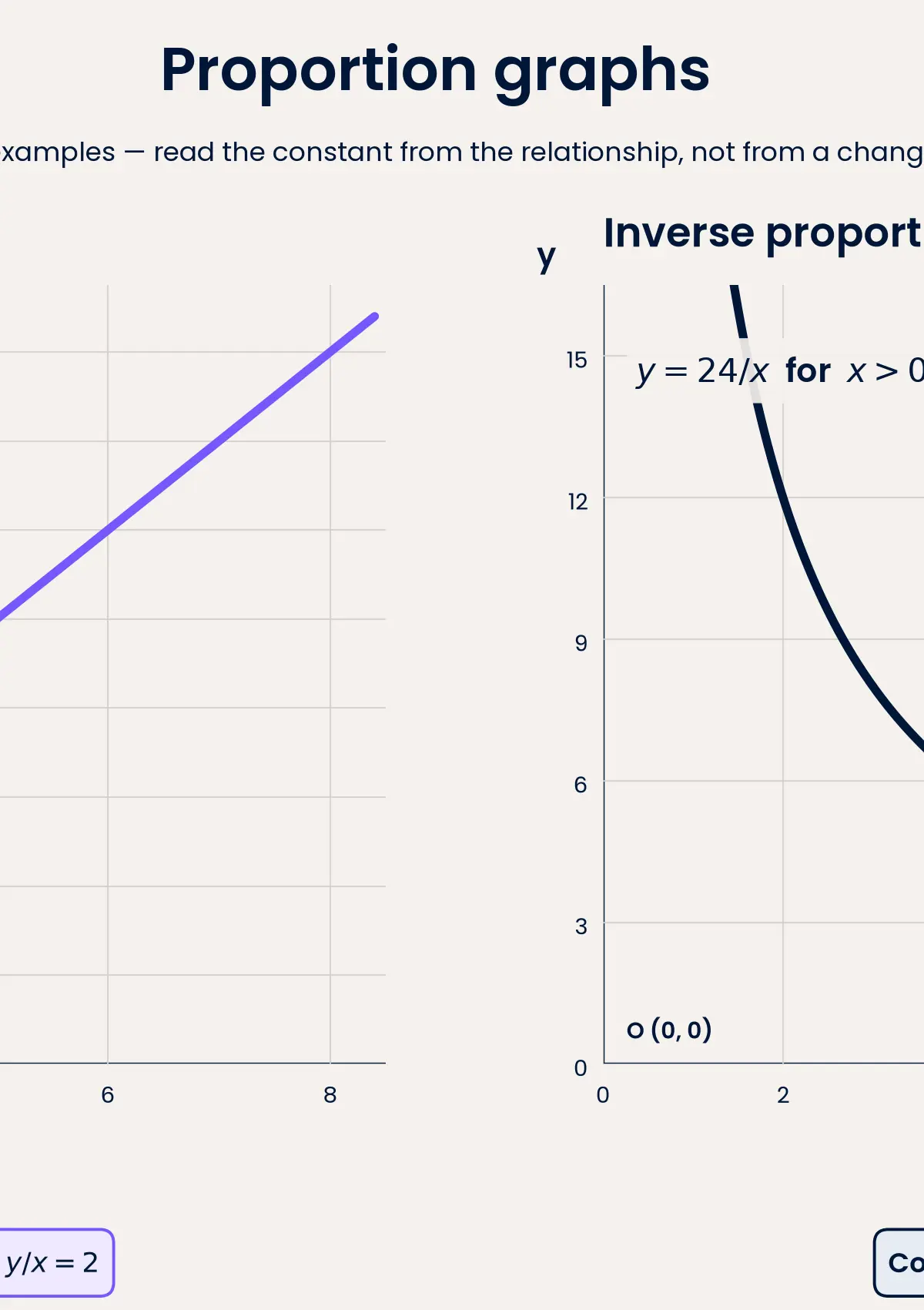
The graph of y = kx is a straight line through (0, 0). Its gradient is k: gradient = change in y ÷ change in x. For y = 2x, points include (0, 0), (2, 4) and (4, 8). A ruler gives the straight line. A non-zero intercept rules out direct proportion to x, even when the line rises steadily.
For y = k/x with k positive and x positive, the graph is a smooth decreasing reciprocal curve. For y = 24/x, points include (2, 12), (4, 6), (6, 4) and (8, 3). The curve becomes flatter but does not touch either axis. There is no value at x = 0 because division by zero is undefined. Its gradient changes, so k is not its gradient.
When plotting, label both axes and units, choose consistent scales and plot coordinates accurately. Join inverse-proportion points with a smooth curve, not a sequence of ruler-drawn segments. To read y at a given x, move vertically from x to the graph, then horizontally to the y-axis. Give a sensible approximate value rather than more decimal places than the scale supports.
If a direct graph is established, one non-zero point gives k = y/x. If an inverse graph is established, one point gives k = xy. A falling curve by itself is insufficient evidence: many other decreasing curves exist. Negative k and negative x produce other orientations or branches, so “inverse means falling” is specifically a positive-domain description.
6. Tier pathway and Higher-only extensions
Foundation and Higher: R10 covers solving direct and inverse proportion problems, including graphical and algebraic representations. R13 includes interpreting equations and understanding that inverse proportion to x means direct proportion to 1/x. R14 covers interpreting direct and inverse graphs and the gradient of a straight line. 1
Higher-only: R13 reserves constructing proportional equations for Higher tier. The power and root exercises below are labelled Higher practice because they ask candidates to build the model from proportionality wording. Do not interpret this as a claim that all powers, roots or given equations are Higher-only: Foundation also uses basic integer powers and roots, and interprets supplied proportional equations. Fractional powers have their own Higher-only restriction in N7. 1
If y is directly proportional to x², write y = kx², not y = kx. When y = 45 at x = 3, k = 45/9 = 5, so at x = 4, y = 5 × 16 = 80. Doubling x multiplies y by 4, because (2x)² = 4x².
If y is inversely proportional to x², write y = k/x². When y = 12 at x = 2, k = 12 × 4 = 48. At x = 4, y = 48/16 = 3. Doubling x quarters y, not halves it.
For y ∝ √x, use y = k√x. If y = 15 at x = 9, k = 15/3 = 5. If y = 20, then √x = 4 and x = 16. Undo a square root by squaring only after isolating it. Use the positive value when the context requires a positive length or time.
Mathematical Relationships
Formula status and symbols
The following proportionality rules are Must memorise: they are not supplied on Pearson's published 2026 GCSE Mathematics examination aids. A question may nevertheless state the proportional relationship or provide an equation. Formula-sheet provision is confirmed for 2027 6, but the formula-status labels here are checked against the actual 2026 sheets; check the published sheet for your own exam series. 2 3
Core rules, Must memorise: y ∝ x ⇔ y = kx; k = y/x for x ≠ 0; y₁/x₁ = y₂/x₂ for non-zero inputs. For inverse proportion, y ∝ 1/x ⇔ y = k/x ⇔ xy = k; x₁y₁ = x₂y₂. Here x is the input, y is the linked output, and k is the constant for the stated model and units. For a direct line, gradient = Δy/Δx = k. Keep x ≠ 0 in inverse equations.
Rules for Higher construction practice, Must memorise: y ∝ x² gives y = kx² and k = y/x²; y ∝ x³ gives y = kx³ and k = y/x³; y ∝ √x gives y = k√x and k = y/√x. Inverse versions are y = k/x², k/x³ or k/√x, with k found by multiplying y by the relevant power or root. More generally, y ∝ xⁿ gives y = kxⁿ, while y ∝ 1/xⁿ gives y = k/xⁿ. Respect the real-number domain and the question's context.
Related compound measures, Must memorise: speed = distance/time, distance = speed × time and time = distance/speed; density = mass/volume; pressure = force/area. These are not printed on the 2026 aid. They reveal proportional relationships only when the other relevant quantity is fixed. For example, fixed-distance travel gives inverse proportion between time and speed, while fixed-time travel gives direct proportion between distance and speed. 2
Units and precision
A constant's numerical value depends on units. £0.70 per pen is 70 pence per pen. For worker-hours, convert 90 minutes to 1.5 hours, not 0.90 hours. Use 60 minutes = 1 hour, 100 pence = £1, 1000 g = 1 kg and 100 cm = 1 m. For area and volume, 1 m² = 10,000 cm² and 1 m³ = 1,000,000 cm³: the length conversion must be squared or cubed.
Keep full calculator accuracy until the final answer. Round only as instructed, and use two decimal places for a money total such as £8.40. If the question asks for a whole number of workers sufficient to meet a deadline, round up when a fractional result cannot meet it. For time conversions, 2.4 hours means 2 hours 24 minutes, not 2 hours 40 minutes.
Practical Applications
Shopping, work and journeys
For identical products with fixed unit prices and no additional fees, cost is directly proportional to quantity. For a fixed job shared between equally productive workers, completion time is inversely proportional to worker number. For a fixed journey distance, increasing constant speed reduces time inversely. Always name the fixed condition: a journey twice as long at the same speed takes twice as long, so time and distance are directly proportional instead.
Currency conversions at a fixed exchange rate provide another direct example, but a fixed commission introduces an intercept. Scaling a recipe uses direct proportion only when every ingredient is multiplied by the same factor. Relating area to length requires a squared scale factor, a useful bridge to power relationships and Higher construction questions.
Use this guide actively
Listen to the tutor episode, then close the guide and reconstruct both models from memory. The audio includes a recall quiz; answer before hearing the explanation.
Attempt the worked examples without reading their solutions. Then try the practice questions under timed conditions, check the teaching mark schemes and redo any incorrect question later without notes. Connecting ratio to algebra or graphs earns credit when it supplies reasoning required by the question; mentioning another topic alone does not earn extra marks.
There is no required practical for this GCSE Mathematics topic. Its practical applications are modelling examples, not compulsory science experiments.
Official marking example
Pearson June 2023 Paper 1 Higher, Question 13 is worth 3 marks. With y directly proportional to x, y = 24 when x = 1.5, candidates work out y at x = 5. The calculation is k = 24/1.5 = 16, then y = 16 × 5 = 80. The official scheme awards M1 for setting up the relationship or starting direct-proportion work, M1 for using it with the new value, and A1 cao for 80, meaning correct answer only. Equivalent valid methods are credited. This is a real marking example, unlike the original teaching schemes elsewhere in this guide. 4
Sources and mark-scheme note
This is an independently written study guide, not an official Pearson publication. Worked examples and practice questions are original Edexcel-style items. Their stated mark allocations and breakdowns are teaching schemes, not reproduced official mark schemes. Actual awards depend on the scheme for the examination question.
Visual Resources
2 diagrams and illustrations
Interactive Diagrams
2 interactive diagrams to visualise key concepts
Conceptual Flow Outline
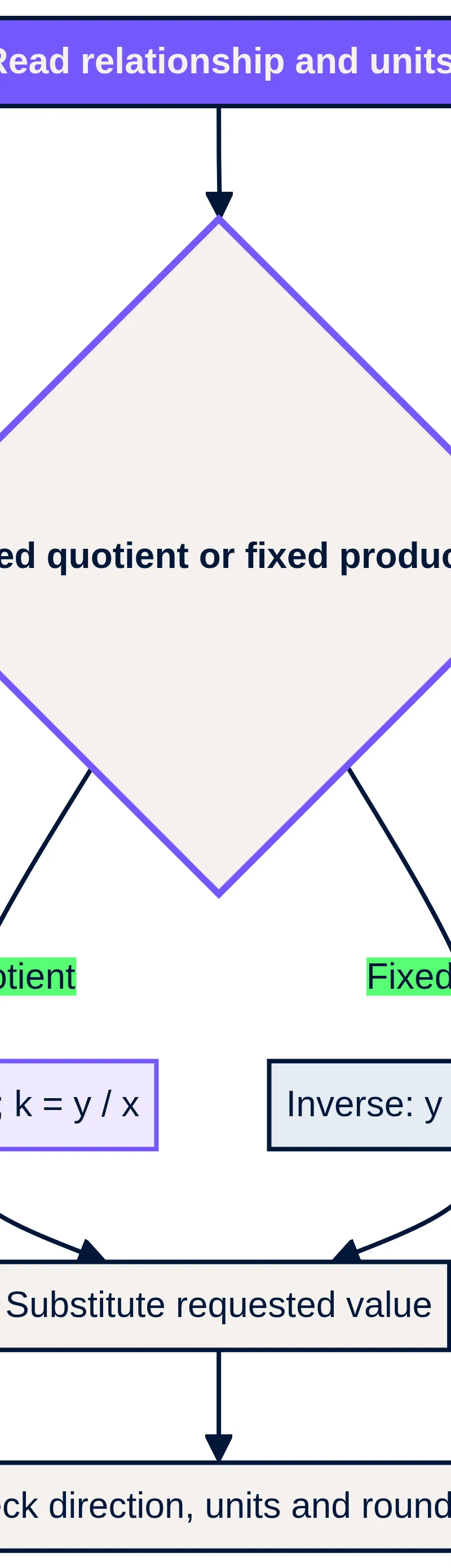
Find the invariant, choose the correct model and complete the constant method. The rendered version is proportion_method.png.
Conceptual Flow Outline
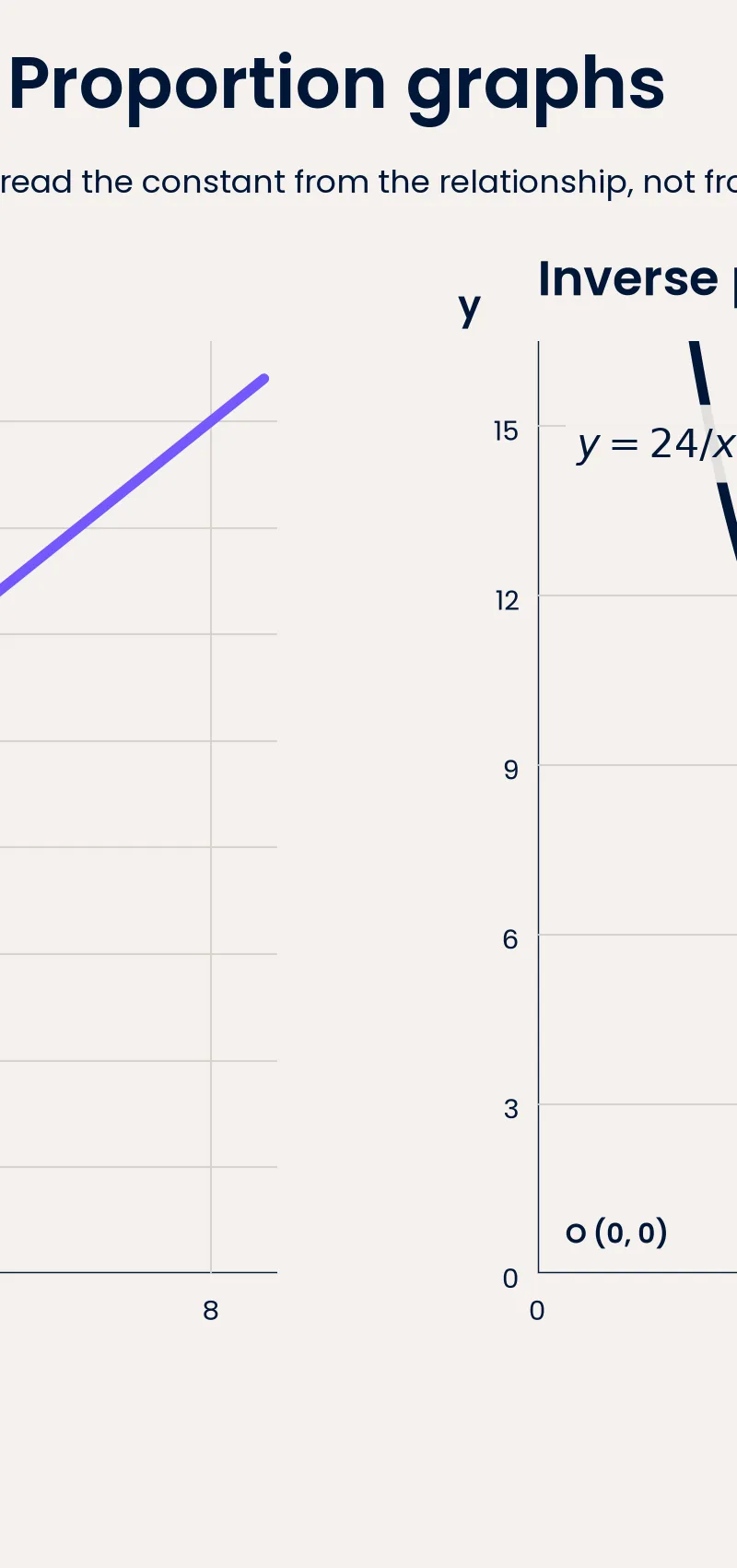
Graph recognition requires mathematical evidence. A non-zero intercept rules out direct proportion, and a falling curve alone does not prove inverse proportion.
Worked Examples
4 worked examples — open one to explore the question and available guidance.
Practice Questions
Try the question, then reveal an answer plan or example response
Foundation numerical core, original Edexcel-style item. Seven identical notebooks cost £10.50. Cost is directly proportional to quantity. Work out the cost of 16 notebooks. (3 marks)
Hint: Find the cost of one notebook before scaling to 16.
Foundation numerical core, original Edexcel-style item. Six identical pumps empty a fixed tank in 15 minutes. Each works at the same constant rate with no interference. Work out how long 10 pumps take. (3 marks)
Hint: Keep pump number × time constant.
Standard core, original Edexcel-style item. A table contains the pairs (x, y) = (2, 18), (3, 12), (6, 6). It is stated that the values follow either a direct or an inverse proportional model. State which model applies, justify your answer numerically, and work out y when x = 9. (4 marks)
Hint: Compare the products as well as the quotients.
Higher equation construction from a direct graph, original Edexcel-style item. A straight-line graph through the origin contains the point (5, 12). Find the direct-proportion equation and work out y when x = 7. (3 marks)
Hint: For a direct line, the quotient at a non-zero point is the gradient and k.
Standard core application, original Edexcel-style item. A car travels a fixed distance of 180 km at a constant speed. Work out the journey time at 75 km/h in hours and minutes. Explain why time is inversely proportional to speed for this journey. (4 marks)
Hint: Use time = distance/speed, then multiply the fractional hour by 60.
Higher-only equation-construction exercise, original Edexcel-style item. y is directly proportional to x². When x = 4, y = 48. Find the positive value of x when y = 75. (4 marks)
Hint: Find k using x², then rearrange for x² before taking the square root.
Higher-only equation-construction exercise, original Edexcel-style item. y is inversely proportional to √x. When x = 9, y = 8. (a) Find a formula for y in terms of x. (2 marks) (b) Work out x when y = 3. (2 marks) (c) Explain what happens to y when positive x is multiplied by 4. (1 mark)
Hint: The constant is y√x, not yx. Isolate √x before squaring.
Exam technique
How to turn what you know into marks
How to approach the question
Underline the quantities, their units, the exact proportional relationship and the requested result. Identify the invariant: quotient for direct, product for inverse. For a named square, cube or root, transform the input first. Find k from one matching pair, write the completed rule and calculate the unknown. If the relationship is not stated, use the context, additional pairs or established graph rather than guessing from one point.
How to structure your answer
Use a short chain: general relationship → substitution of known values → k → numerical equation → requested value → units and rounding. For the original 3-mark teaching questions, two relevant method stages and a correct answer are commonly used here. In 4-6 mark multi-part questions, label each part and show rearrangements or reasoning explicitly. Official Pearson marks are question-specific. M denotes method, A accuracy and B an independent mark; some official schemes also use P for a process mark. A correct unit is not automatically a separate mark, and each written line is not automatically worth one mark. For a real example of M1 + M1 + A1, see the June 2023 Paper 1 Higher Q13 discussion in the content.
Timing
Pearson Edexcel 1MA1 has three 90-minute, 80-mark papers: Paper 1 is non-calculator; Papers 2 and 3 permit calculators. This averages 1.125 minutes per mark. Aim for about 1 minute per mark initially, so roughly 3 minutes for 3 marks and 6 minutes for 6 marks, leaving checking time. This is a revision strategy, not an official question-by-question time limit.
Common pitfalls
- Choosing direct proportion for a fixed-job problem. Test whether the worker-time product is fixed before multiplying time by the new worker ratio.
- Finding direct k as x/y. Rearrange y = kx to k = y/x and substitute matching values in that order.
- Stopping at k. Read the final instruction again and substitute the requested input or rearrange for the requested variable.
- Calling any decreasing graph inverse proportion. Establish xy = k; decreasing alone is insufficient.
- Calling every straight line direct proportion. Check that the line passes through the origin.
- Treating k as the inverse curve's gradient. The curve's gradient changes; k is its constant product.
- Ignoring a square or root in an equation-construction question. Write the complete symbolic model before substituting.
- Mixing hours with minutes or pounds with pence. Convert consistently before finding k, then round only the final answer.
- Rounding a required number of workers down. If a whole number must meet a deadline, round up when necessary and verify the resulting time.
What the command words want
- Find
- Supply the specified object: a numerical value, formula or coordinate. For 'find a formula', include the variables and the numerical constant.
- Sketch
- Show the correct shape and key features without claiming precision that was not requested. For direct proportion include the origin; for an inverse positive-domain curve avoid touching either axis.
- Compare
- Address both relationships using the same property: direct has a constant quotient and doubles with x; inverse has a constant product and halves when positive x doubles.
- Explain
- Give a mathematical reason. Link the conclusion to a constant quotient, constant product, zero intercept or stated fixed condition using 'because'.
- Describe
- Identify the mathematical feature precisely, for example a straight line through the origin or a smooth positive-domain decreasing reciprocal curve.
- Evaluate
- In mathematics, evaluating an expression means calculate its numerical value, not discuss both sides. If asked to evaluate or assess a model, use the question's evidence and assumptions to reach a justified judgement.
- Work out
- Calculate the requested quantity using a valid method. Do not finish with only the constant unless that is what is asked for.
- Calculate
- Use the correct model, substitute accurately and provide the requested result with relevant units and rounding. Show working to make the method visible.
- Show that
- Give sufficient correct working to reach the stated result. Copying the supplied result or reasoning backwards without justification does not establish it.
- State/Give
- Write the requested relationship, value or brief fact directly. If an explanation is also requested, a bare label is insufficient.
Watch or listen (optional)
Test your understanding of Ratio, proportion and rates of change: solve problems involving direct and inverse proportion, including graphical and algebraic representations
Active recall beats re-reading. Take an instant quiz now to test what you’ve learned and lock it into long-term memory.
7 days Premium · Then the free plan continues · No card, no charge